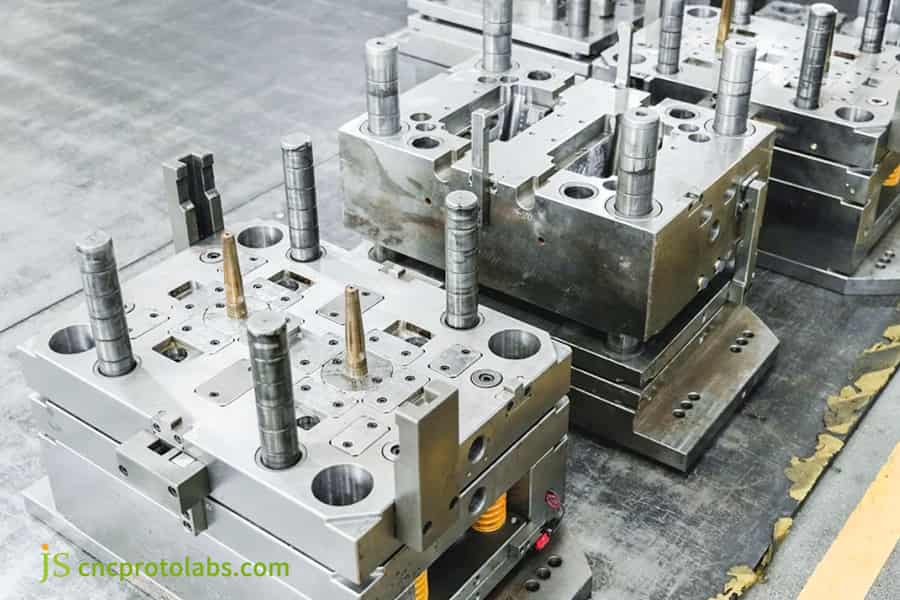
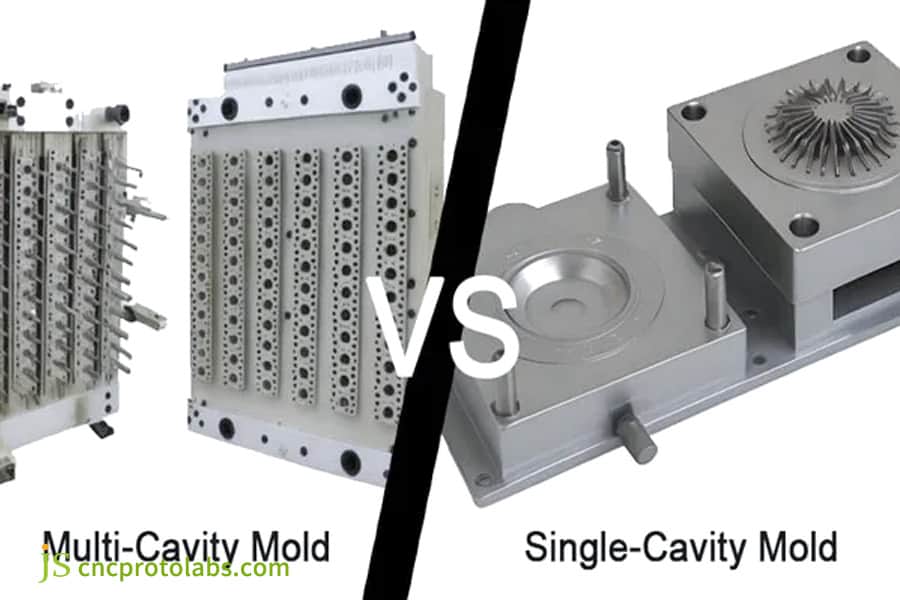
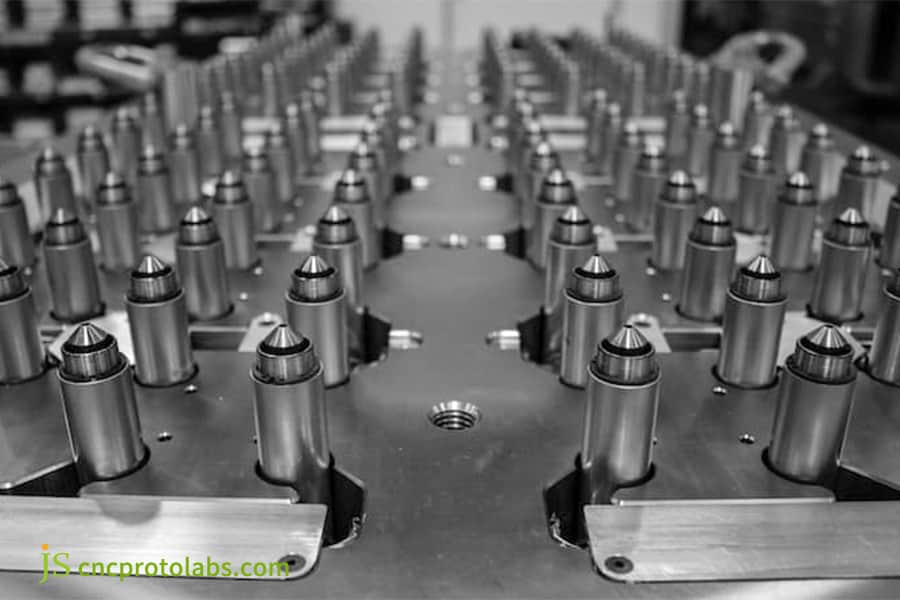
高粘度のポリマーが高圧でランナーに射出された後、壁面の高いせん断速度によりせん断減粘効果と熱成層が引き起こされます。マルチキャビティ金型の専門メーカーは、キャビティ充填の差異を防ぐために、設計の初期段階でせん断熱補正を組み込みます。 業界標準のコールド スラグ ウェルの設計は次のとおりです。コールド スラグ ウェルの直径はメイン ランナーの端の直径の 1.2 x D、深さは 1.5 x D です。
For large volume projects with more than 16 cavities, needle valve hot runners should be the first choice.
High-viscosity engineering plastics need temperature control zones that are independent of each other.
For parts which are visible, gate structures that are needle valve must be used to completely ensure there is no gate residue.
Materials that are reinforced with glass fiber require hot nozzles that are coated with a wear-resistant material.
Needle valve hot runners can significantly reduce material costs for high-volume projects. You can submit your production volume and material information to obtain a customized hot runner solution quote and accurately calculate material savings during mass production.
Figure 4: Operator adjusting a hot runner needle valve system in a custom injection mold.
What Draft Angle Constraints Preclude Surface Scuffing According to a Comprehensive Mold Tooling Design Guide?
Multi-cavity molds contain a large number of ejector pins. If the angles of draft and texture are different, the use of the ejector pins will result in the scratching of the product surface. In line with professional mold tooling design guide, it is considered a good practice to quantitatively relate the draft angle and the texture depth of a molded product.
Quantified Guidelines for Textured Surface Draft Angles
Based on the main mold tooling design guidelines, there is a very precise mapping between the different textured surfaces and the draft angles. For very smooth, polished surfaces, a minimum draft angle of 0.5 to 1 would be adequate. Textured surfaces classified by the VDI 3400 standard require an extra draft angle between 1 and 1.5 for each 0.025 mm increment in texture depth.
The regulation of ejection synchronization in Multi-Cavity
Plastic injection mold service of excellent quality doesn't just keep an eye on the synchronization of ejection but also measures it very strictly. Very high-standard physical factories resort to precision guide ejector plates with graphite guide bushings and also put in forced return mechanisms in large size multi-cavity mold bases to ensure the ejection of hundreds of ejector pins in 16/32 cavities is absolutely synchronous within 0.01 mm increments. This way, void deformation of the plastic part caused by non-synchronous ejection is prevented.
The conditions below are the necessary fundamental ones for demolding design when the change of single to multi cavity tooling is made:
Draft angles for smooth surfaces should be at least 0.5°, whereas the angles for textured surfaces should be stacked in accordance to their depth.
To have the stress in the product uniform, ejector pins should be well-spaced.
A multi-cavity mold should be provided with a forced return mechanism that would allow the synchronous ejection.
Points where there is a change of direction should be rounded to prevent stress concentration.
How Did JS Precision Resolve Filling Imbalances for a Civil Robotics Connector Using a Specialized Multi Cavity Mold?
Client Challenges
The project team from a civilian robot R&D company asked us for help with a core part of their product - a 30% glass fiber reinforced nylon (PA66+30% GF) precision connector with a design flow length-to-wall thickness ratio of about 145:1, which is the engineering limit for this material. The 8-cavity hot runner mold which had been supplied previously by a typical multi-cavity mold manufacturer was found during trial molding to be seriously defective: the central cavities (1-4) were completely filled, while the peripheral cavities (5-8) often experienced short shots.
Aside from that, uneven glass fiber orientation caused the dimensions and positional tolerances to go beyond 0.15 mm, which forced a complete shutdown of the mass production line.
JS Precision Solution
Thanks to being a custom injection mold builder focusing on high precision injection molding, JS Precision engineering staff re-engineered the design and effectuated a systematic optimization through four steps:
Fluid Dynamics Reconstruction Analysis: The original design was uploaded into Moldflow for non-Newtonian fluid 3D filling simulation. It was discovered that the initial runner was omitting shear rate compensation, and so there was a pressure loss of up to 18 MPa in the edge cavities.
Hot Runner Temperature Control Reconstruction: Refashioning the manifold and assigning independent single-point temperature control to the peripheral cavity nozzles were the two changes that were made. Increasing the peripheral nozzle temperature by 5℃ allowed melting the glass fiber over long paths to lower the viscosity of the melt.
Core Venting Correction: By end one of high-speed CNC machining, a 0.015 mm deep and 5 mm wide vacuum venting groove was made in the end-filling area so that air resistance was eliminated.
Pressure Holding Switching Optimization: The V-P switching point was locked at the moment of 98.2% filling using a cavity pressure sensor, coupled with an 85 MPa stepped pressure holding process.
Learning through Failure
When the tenacity was turned to run a full-on test with the first two rounds of samples, the team was aiming at upscaling the total injection pressure to fill the edge cavities, which resulted in severe flash and ejection whitening in the center cavity. Doing this proved that a filling problem of a multi-cavity fiberglass material cannot be solved simply by adjusting process parameters. It is mandatory to optimize the runner structure and temperature control compensation.
The End of the Line
Because of the final changes, the 8-cavity mold was run continuously at high speed for 72 hours. The variation coefficient on filling weight per cavity declined from 8.4% to 0.85%, and the product's dimensional and positional tolerances were kept within 0.025 mm, so fully manifesting the technical capability of a professional precision mold tooling company. Also, the cycle time has been shortened from 38 seconds to 24 seconds, and the scrap rate has fallen from 18.5% to zero.
"With the help of detailed simulation data and accurate temperature control optimization, the JS Precision team managed to rescue our mass production project which was on the verge of scrapping within 7 days, " said the client's Supply Chain R&D and Procurement Director. Seriously, they are the kind of manufacturing gurus who also are engaged in the frontline operation.
Complex multi-cavity filling problems require targeted structural optimization solutions. You can upload your problem mold drawings and defect descriptions to receive one-on-one engineering diagnosis and customized improvement solutions from senior engineers.
Why Choose JS Precision as Your Long Term Strategic Multi Cavity Tooling Partner for Full Scale Production?
Most importantly, precision mold tooling selection is not about who replies first but who can maintain strict quality control over the production of millions of units at high speed for a very long time without shutdowns. JS Precision offers comprehensive engineering support, from single-cavity prototyping to multi-cavity mass production of hundred thousands of units.
Factory Equipment and Engineering Team Professionalism
We operate a well-equipped, physical facility in Humen Town, Dongguan City China which is ISO 9001:2015 certified. As an established multi cavity mold manufacturer we have professional equipment like Makino high-speed CNC machines and Sodick mirror EDM machines, besides that, our core engineering team consists of 12 senior injection mold designers each of them having an average of over 15 years of experience in the industry.
Strict Quality Inspection Standards Throughout the Process
All multi-cavity molds delivered by our factory strictly comply with high volume mold tooling service mass production standards, accompanied by traceable standardized quality inspection documents. This comprehensively guarantees mass production stability.
Core quality inspection items include:
Providing a complete Moldflow analysis report to verify the filling balance of multiple cavities and completely eliminate cavity pressure deviation issues.
Issuing an original manufacturer's heat treatment traceability report to stably control the hardness of the mold steel within HRC 48-52, ensuring wear resistance for long-term mass production.
Complete 24-hour full-load mold test, and use CMM full cavity dimension inspection report to ensure that the product first pass rate exceeds 99.5%.
Finding the right expert is half the battle won in mass production. Stop aimless comparisons now! Click the "Get a Customized Multi-Cavity Mold Quote Now" link below, submit your 3D CAD model and production requirements, and embark on a new journey of efficient mass production with JS Precision!
FAQs
Q1: When converting a single-cavity prototype mold into a multi-cavity mass production mold, what three main technical factors account for the biggest percentage of project failures?
Why is the omission of the non-uniform shear heat inside the runner and the nonlinear surge of clamping force.Most mold makers use no micron-level viscosity compensation resulting in flash, short shot and mold bulging issues.Fluid balance analysis should be prepared in the first step of mould design following professional standards.
Q2: How does JS Precision use technology to ensure the overall dimension of each cavity (a 16-cavity or 32-cavity high-volume multi-cavity mold) is identical in the high speed injection molding process?
JS Precision evolved three major control beams: Machinery with a positioning accuracy of 0.002 mm. Hot runner system set for balancing with a pressure variation coefficient locked below 2%. Complete dimensional inspection before delivery on all cavities by CMM.
Q3: What is the reduction rate of unit production cost for project with high volume if multi-cavity mold been used instead of single-cavity?
Although there is a higher investment cost for multi-cavity molds than for single- cavity molds, the degree of savings on unit costs is tremendous.16 (or less) cavity mold can reduce variable cost of the unit by more than 80% based on these calculation.Heating system together with hot runner system will lessen the lead time and decrease scrap rate below 2%. Investment cost will recover at the minimum number of production output at 50,000 units.
Q4:How hard vacuum quenching normally use in heat treatment of multi-cavity mould core steel? And why the hardness index is very important?
For Class 101 multi-cavities molds, life more than 1 000 000 cycles, to JS Precision also use the HRC 48-52 vacuum quenching standard and choose S136 material or H13 steel.The product will be flash out and tolerance failure when hardness is not enough.
Q5: Before the formal delivery of a multi-cavity mold, which technical document and inspection records on the quality usually need to be provided?
Professional suppliers should offer 3D drawings of the full size mold, steels certificates and heat treatment reports, Moldflow filling analysis data, T1 Trial molding process charts, and full cavities inspection report from CMM testing for multi-cavity molds.
Q6: In general, what causes the hot runner system to be more expensive when a multi-cavity mold is designed to replace a single-cavity mold? Which factors affect hot runner pricing?
Factors that affecthot runner's pricing vary from needle valve controlling is more costly than open nozzle control, more cavities, the more expensive. European&American brand is 2~3 times more expensive than Chinese & American.Specl material Wear-resistant material need to coated, cost is about 25%. You may upload the drawings to get a quotation.
Q7: How do I know that my product is right to be coined in a multi-cavity injection mold project (32 cavity or 64 cavity)?
There must be three essential conditions to produce multi-cavity molds: a steady year future total output of more than 1,000,000 units, a compact shape of a product, so that it can work with unifying qualities of conventional injection moulding machines, and a completed product design, otherwise huge later costing risks in both mold change and shut-downs.
Q8: What detail should be considered during daily continuous mass production maintenance of multi-cavity molds such that local internal stress fatigue damage not occurring?
Three significant maintenance concern for a multi-cavity mold on mass production: Every 50,000 cycles, clean venting-channel from venting deposits. Use 200C-resistance grease, Lubricate the slide and guide-powers, by cooling it below 40℃, without residuals-stresses should be put into the mouth of the material, so would not be into the thermal cracks.
概要
The seamless transition of single-cavity prototype confirmation to multi-cavity high-performance and large-volume manufacturing is not a matter of just copying the same drawing dimension layouts, it is an arms race between the engineering revolutions of high-shear flow field geometry balancing, micron-order precision geometric tolerances copying, thermodynamically conformal cooling control, and highly rigidized mechanical fatigue resistance calculation.
Technical comparison of eight largest global suppliers of injection molds shows that, only by closely penetrating core technical aspects such as fully balanced runner parameters, vacuum high-hardness heat treatment, micron-class positioning accuracy of solid-machine, can the problems of multi-cavity size difference flash short shot be eliminated completely during continuous high-speed production, so that a single product's overall procurement cost and quality risk is brought into the range of optimum value. Stop multi-sparks negotiation and today's multi-steps construction for totally inaccurate multi-cavity shot, now directly step into strategic cooperation with our centralized solution of PID precision manufacturing center.
JS Precision has 20 senior engineering experts at your service for 2026 multi-cavity mold step-by-step DFM analysis. Would you like to increase the existing single cavity prototype to a highly productive, fully automated production line with 16, 32 or 64 cavities? Or do you have crisis issues like uneven runner balance, distortion of final product, etc. with other supplier's multi-cavities? Please send us your 3D CAD drawing and tell us what delivery you expecting. We will send you an all-in-one solution for multi-cavities mold quotation within 24 hours, including runner practicality investment, calculation of closing force and full production cost estimation, etc.
Disclaimer
The contents of this page are for informational purposes only. For JS Precision Services, there are no representations or warranties, express or implied, as to the accuracy, completeness, or validity of the information. It is the buyer's responsibility to identify specific technical requirements and request a formal parts quotation. Please contact us for more information.
JS Precision Team
ustom manufacturing solutions. With over 15 years of experience serving more than 1,000 customers, we specialize in high-precision CNC machining, sheet metal fabrication, 3D printing, injection molding, and metal stamping. Having successfully delivered over 300,000 precision parts, we maintain a 99.2% on-time delivery rate across all custom projects.
Our facility is equipped with over 100 state-of-the-art 5-axis machining centers and is ISO 9001:2015 certified. We deliver fast, efficient, and high-quality manufacturing solutions to B2B clients across 150 countries. Whether you require low-volume prototyping or large-scale customization, we support your project with lead times as short as 24 hours. Choose JS Precision for unparalleled efficiency, quality, and professionalism.
 日本語
日本語