English



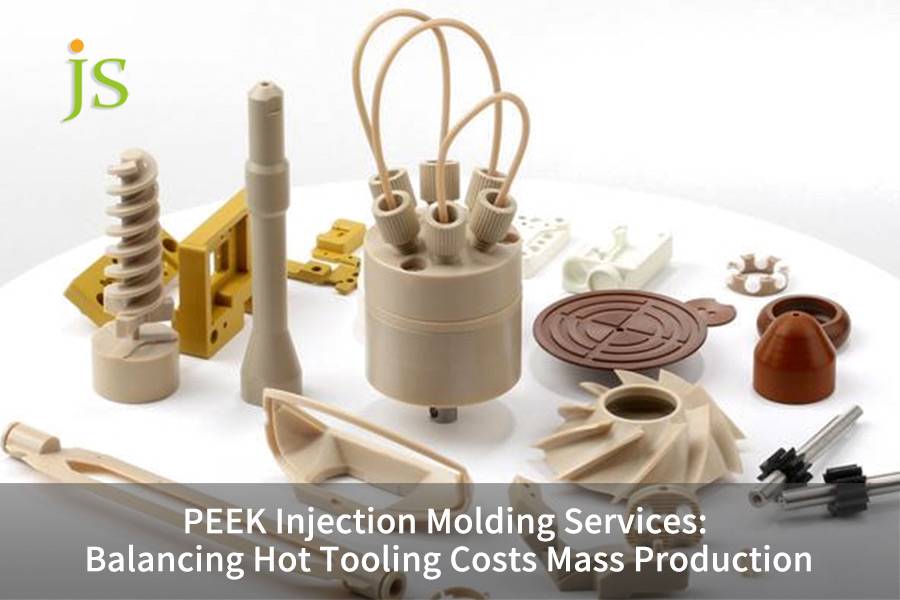

PEEK injection molding service enables manufacturing high performance industrial, medical device, and precision semiconductor components through the use of one of the most important processes. The use of ordinary plastics is characterized by lack of temperature resistance and mechanical strength under extreme conditions, while PEEK injection molding can provide a solution to these pain points.
Since PEEK material's melting temperature is > 343℃, the first investment of matching hot molds and the high barriers to PEEK tooling cost optimization make it hard for most purchasing managers and design engineers to balance fixed asset investment and unit cost. This article assumes readers have the basic injection molding knowledge so it does not discuss it but instead break downs the logic behind cost control in mass production. It combines engineering parameters, steel selection, and JS Precision's quantitative production data to provide an effective guide to cutting expenses while maintaining dimensional tolerances of 0.02mm.
This article will cover the following key points:
1. The cost structure differences and pricing models between PEEK hot tooling and conventional molds.
2. The engineering path to achieve low-cost PEEK mass production through runner design and multi-cavity molds.
3. JS Precision's mold life extension and wear-resistant heat treatment solutions for high-performance PEEK parts.
4. Practical case studies on avoiding overheating degradation and localized stress warping of PEEK materials through customized DFM (Design for Manufacturability).
PEEK Injection Molding Service Cost and Production Parameter Framework
|
Core Evaluation Dimension
|
Hardcore Technical Parameters & Decision Metrics
|
Cost & Efficiency Optimization Strategy
|
|
Mold Heating & Temperature Control Requirement
|
Maintain mold surface temperature at 160°C-200°C with oil temperature controller or embedded heating rods.
|
Select H13 or S136 mold steel with overall quenching (hardness 50-54 HRC) to prevent long-term high temperature thermal fatigue.
|
|
High Mold Cost Amortization
|
Conventional single-cavity PEEK mold costs 35%-50% more than standard plastic molds.
|
Leverage mass production PEEK molding to amortize fixed asset costs via multi-cavity runners for orders over 5000 pieces.
|
|
Shrinkage & Tolerance Control
|
Pure PEEK shrinkage: 1.0%-1.5%. 30% GF reinforced grade: 0.2%-0.5%.
|
Design asymmetric compensation during DFM phase, control runner shear heat to deliver consistent ±0.02mm precision parts.
|
Key Takeaways
- Hot mold investment is a hard barrier: Generally, un-hardened cold molds can't be used for making PEEK parts, the molds must not only support PEEK processing temperatures but also be able to withstand long-term operating environments of over 160℃.
- Quantity determines the cost curve: When the number of parts is below 3,000, the PEEK tooling cost optimization for individual piece allocation will increase the unit price, very high volume PEEK molding service of more than 10,000 parts are the economic turning point.
- High material utilization equals cost savings: The best method for lowering the final price per unit is to use submerged gates or a precise hot runner system to minimize sprue waste.
Why Trust JS Precision’s PEEK Injection Molding Service? Experience In Balancing Heated Mold Costs
JS Precision has been heavily invested in the specialty engineering plastics injection molding industry for many years, with comprehensive hot mold chain R&D and production capabilities. We not only help our clients with overall cost control but also ensure the performance of parts through our expertise.
We provide services to various high-end manufacturing sectors including medical, automotive, and semiconductor. Because of this far we have completed more than 200 PEEK injection molding mass production projects. We standardize all procedural controls.
Using as an example a semiconductor PEEK insulating base project, we have found that an unsuitable thermal mold design may cause yield losses exceeding 30%, whereas with early thermodynamic optimization the yields can be maintained at a level higher than 99%.
With over 10 years of hands-on experience in specialty plastic injection molding, the tech team at JS Precision is capable of giving technical support right from the characteristics of material crystallization and mold structure to the mass production processes. Besides, process control is aligned with IATF 16949, the automotive industry standard, and core parameters are completely traceable.
A mature compliance system and first-hand project experience are the core guarantees for the stable implementation of PEEK projects. You can submit preliminary design requirements to receive a free feasibility assessment of JS Precision's PEEK injection molding service, identifying project risks and optimization directions in advance.
Why High Temperature PEEK Molding Requires Hot Tooling Engineering?
High temperature PEEK molding is a challenge that needs a very precise temperature control of the mold as well as a heat-resistant mold structure. Normal molds fail to create a stable temperature environment that is necessary for the material crystallization, which is the direct cause of poor part performance.
Strict Requirements of Crystallization Kinetics on Mold Temperature:
PEEK has a melting temperature of 343℃ and a glass transition temperature (Tg) of 140℃. For high temperature PEEK molding, if the mold temperature is kept below 140℃, the material will freeze very rapidly and form a brittle shell with low crystallinity, so the mechanical strength of the part will fall drastically even above 30%. This is one of the critical parameters that precision injection molding must be controlled tightly.
Really, future use will cause post-shrinkage and warping of the material. The mold surface temperature should be constantly maintained in the range of 160℃ to 200℃ for the uniform crystallization of the material and mechanical properties standards to be met.
In fact, it is quite similar to the kiln constant temperature necessity when high-precision ceramic blanks are being baked. Lack of temperature results in incomplete powder densification inside the green body and ultimately the overall compact strength of the sintered part is reduced.
Major Design Programming of Hot Mold Core Structure:
- The thick high-temperature resistant insulation plate helps to block the transmission of the heat to the moving and stationary mold plates of the injection molding process thereby reducing the heat loss and temperature fluctuations. This principle makes a significant impact on the production stability of the custom injection molding over time.
- To keep the production process stable and safe, fluororubber heat-resistant sealing rings are used to prevent leakage of high-temperature oil.
- With the two PT100 thermocouples built-in, it becomes possible to do a closed-loop constant temperature control within ±2℃, which is in line with the material crystallization requirements of PEEK injection molding service.
How Can Mass Production PEEK Molding Optimize Your Amortization Curve?
One significant advantage of mass production PEEK molding is that it can take advantage of the economies of scale which help to recover the high initial investment in hot mold fixed assets. This comes with the benefit that the unit manufacturing cost can gradually come very close to the theoretical lower limit of the material's price.
Unit Cost Amortization Mathematical Model
A standard simple calculation formula is often used to arrive at the unit cost in a business-to-business manufacturing setting:
Piece Cost = (Tooling Cost Volume) + Material Cost + Processing Cost
When it is about the mass production PEEK molding, the mold cost is considered a fixed investment. As the production volume grows, the mold cost per unit falls continuously. When a batch size is more than 10,000 units, the contribution of mold cost to the unit price is so low that the cost structure only consists of material and processing costs. This is the main logic behind cost optimization of medical injection molding mass production projects.
Simply, a higher production quantity implies that the fixed mold cost per unit is lower which is the overall result of higher cost-effectiveness.
Comparison of ROI between Single-Cavity and Multi-Cavity Molds
1. A single-cavity mold has the advantage of a lower investment cost at the start. But, it only makes one product per cycle, so the production efficiency is low and the labor and energy costs become high. That is why they are suitable only for sample and small-batch trial production.
2. It is estimated that the initial cost of a four-cavity mold is about 1.8 times that of a single-cavity mold. But, it makes 4 products per cycle, so it raises the production efficiency level by more than 3 times and thereby greatly decreases the unit energy consumption and labor costs.
3. A four-cavity mold has a drastically better overall return on investment than that of the single-cavity mold when the batch size is more than 5000 pieces. This makes it the best option for low cost PEEK mass production. The same decision-making consequence also applies to the industrial injection molding large-scale production scenarios.
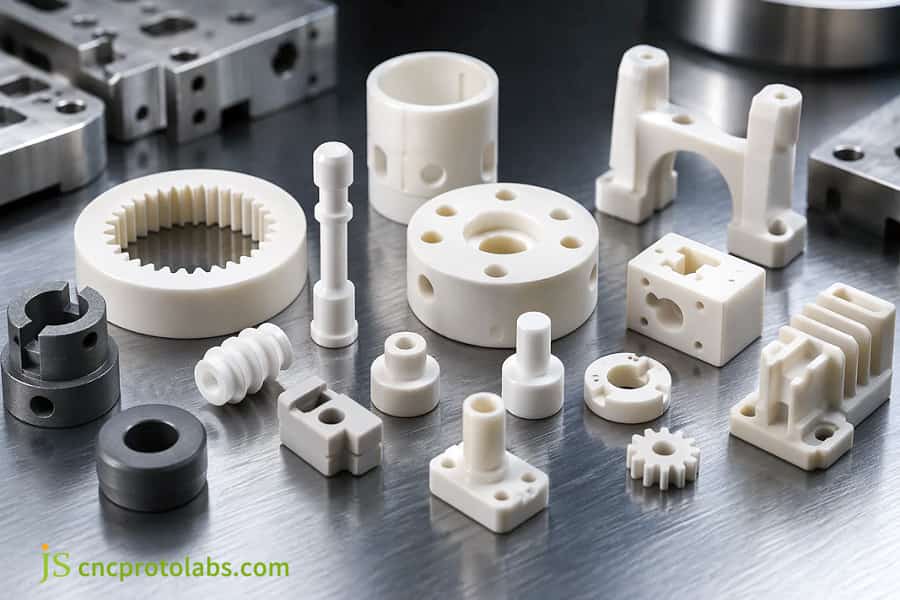
Figure 1: White PEEK injection-molded components, including gears, displayed on a metallic surface.
Which Mold Steel Specs Guarantee Long Life In High Volume Peek Molding Service?
High volume PEEK molding relies on steel with excellent red hardness and wear resistance for molding. Steel choice not only affects the work life of a mold but is also the key for stable long-term mass production.
PEEK Injection Molding Mold Wear Mechanism
The viscosity of PEEK melt is very high and because of this injection pressure is usually 150-200 MPa. Most of the modified materials are strengthened by 30% carbon fiber or glass fiber. During high volume PEEK molding service, normal aluminum molds or P20 mild steel molds will be corroded by the molten metal in just a few hundred injection cycles, which will cause gate deformation, flash, and other problems that are not capable of supporting long-term mass production. This is a typical problem in the plastic injection molding industry when highly abrasive materials are being processed.
Comparison of Mainstream Mold Steel Performance
|
Steel Grade
|
Hardness After Quenching (HRC)
|
Thermal Expansion Coefficient at 200°C (10⁻⁶/°C)
|
Expected Service Life
|
Core Application Scenario
|
|
H13
|
50-54
|
12.8
|
100,000-150,000 shots
|
General PEEK structural component mass production.
|
|
S136
|
50-52
|
11.2
|
120,000-180,000 shots
|
High gloss, corrosion resistant PEEK components.
|
|
NAK80
|
40-45
|
12.5
|
60,000-100,000 shots
|
Small to medium batch, low wear PEEK parts.
|
|
P20
|
28-32
|
13.5
|
Less than 10,000 shots
|
Prototype testing only, not suitable for mass production.
|
Mold Life Extension Processes
- A vacuum heat treatment process is used to harden the steel to a level of 50-54 HRC, which will enhance the stability of its structure and resistance to deformation even at high temperatures, and also help in maintaining the stability of the mass production of PEEK injection molding for a long time.
- Titanium nitride coating on mold cavity surface lowers the surface friction coefficient and that means reduces the wear caused by glass fiber erosion. This method will highly increase the lifetime of the highly engineered injection molding molds.
- Scheduled mold cleaning and dimensional rechecking of molds are a must. Renovation of the smallest wear, in time, is the best way to keep the damage from developing and finally destroying the accuracy of the parts.
Selecting the right mold steel can directly extend mold life by more than 30%. You can download the PEEK mold selection white paper compiled by JS Precision to fully understand the applicable scenarios and cost differences of different steels.
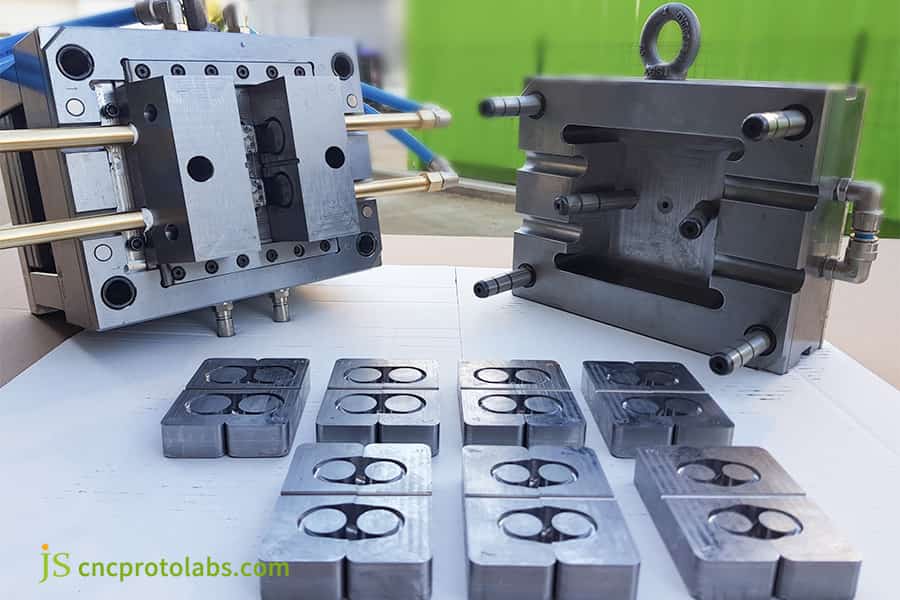
Figure 2: Heavy-duty steel molds with multiple cavities displayed with machined inserts on a factory floor.
How To Practical Minimize Raw Material Scrap With PEEK Hot Tooling Service Optimization?
In PEEK hot tooling service optimization, the gate and runner design directly determines material utilization. Since PEEK raw materials are expensive, reducing scrap directly lowers overall production costs.
Material Utilization Comparison of Different Gating Schemes
|
Gate Type
|
Runner Scrap to Part Weight Ratio
|
Automation Level
|
Suitable Batch Size
|
Post-processing Requirement
|
|
Standard Sprue Gate
|
30%-50%
|
Low
|
Small batch prototype.
|
Manual gate trimming required.
|
|
Submarine Gate
|
10%-15%
|
Medium to High
|
Small to medium batch production.
|
Automatic shearing, no manual processing.
|
|
Valve Gate Hot Runner
|
≤5%
|
High
|
Very large batch production.
|
Virtually no runner, no post-processing.
|
|
Pin Point Gate
|
20%-25%
|
Medium
|
Small to medium thin wall parts.
|
Manual gate mark finishing required.
|
Optimizing Gating Size Based on Mold Flow Analysis
At the heart of gating size optimization lies the method of enhancing the use of materials in PEEK hot tooling service. The gate size needs to be perfectly aligned with the flow behavior of PEEK melt: a gate that is too small leads to the overheating degradation by shear, because of this causing the appearance of silver streaks or black spots on the surface of the part, a gate that is too big leads the part to have a longer solidification time, so increasing the post-processing cutting time.
JS Precision has been utilizing SolidWorks Plastics mold flow analysis to measure gate dimensions accurately up to 50%-60% of the part wall thickness, to equally favor the molding quality and material usage. This is one of the main techniques to minimize the wastage of materials in high precision injection molding.
Main Concepts of the Gate Design:
1. Heavily lean on using submerged automatic shear gates, thereby doing away with manual gate removal, which leads to fewer post-processing steps and labor costs, as well as enhancing the overall productivity of PEEK injection molding service.
2. When the production is for ultra-large batches of over 10,000 parts, implement needle valve hot runners that help lower the sprue material ratio to less than 5%, because of this maximizing the utilization of the material. This design solution is the norm for attaining high material utilization in specialty injection molding.
3. Keep the runner shear rate at a level that does not cause degradation of the material due to overheating since that normally results in lowering the mechanical properties.
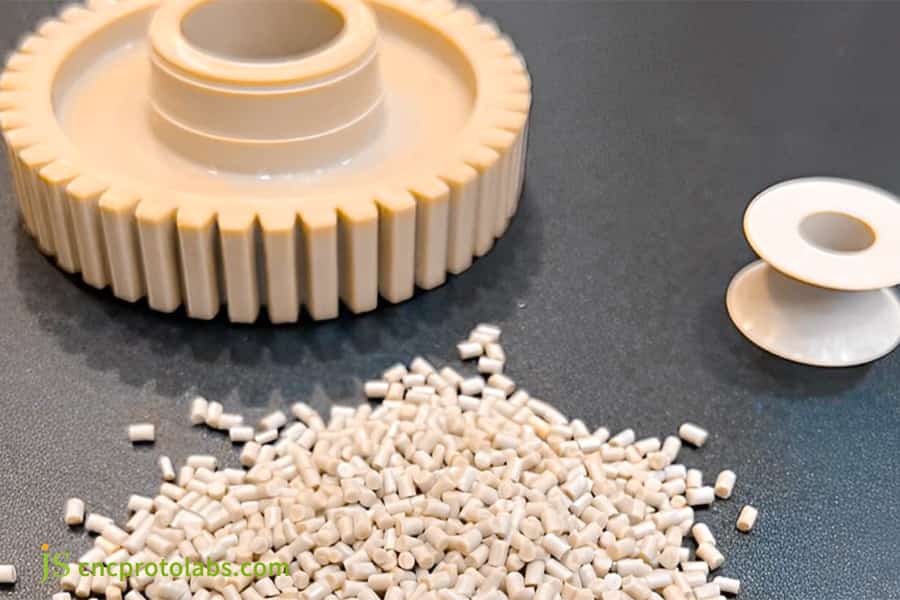
Figure 3: PEEK polymer pellets with a finished gear, ready for the injection molding process.
How To Manage Tight Dimensional Tolerances In High Temperature PEEK Molding Operations?
Anisotropic shrinkage of the material is one of the reasons for dimensional deviations and part warpage of material during high temperature PEEK molding. Only systematic process control can help in producing parts at high-precision level.
Asymmetric Shrinkage Compensation Solution
During PEEK high-temperature molding, these two directions of shrinkage, lateral and longitudinal, of PEEK material, show quite a difference. Pure PEEK shrinks by 1.0%-1.5%, while adding 30% glass fiber reduces it to 0.2%-0.5%. Uneven shrinkage leads to localized stress buildup and warpage deformation.
JS Precision's exclusive test results indicate that, at 180℃ oil heating condition, regulating the cooling rate at 5℃/min-10℃/min, range enables the uniform growth of spherulites inside the material, because of this completely eliminating residual stress. This temperature control method is the centerpiece of engineered injection molding at a very high level of accuracy.
In brief, even cooling lets the structure inside the material shrink uniformly, which leads to stability in dimensions.
Precision Inspection and Closed-Loop Process Control
- In the DFM stage, asymmetrical adhesive application compensation is designed for different areas of the part to proactively offset dimensional deviations caused by material shrinkage.
- By adopting a multi-stage holding pressure switching process, holding pressure is controlled at 60%-80% of the injection pressure, which fills the melt uniformly and compresses it progressively.
- Final products are checked for geometric tolerance using a Zeiss coordinate measuring machine. Only those parts that meet the dimensional stability criterion of 0.02 mm are considered as high-precision output from PEEK injection molding. Thorough inspection through the entire process is the basis of stable high-precision part output in custom plastic injection molding.
Precision tolerance control requires the dual support of process and inspection. You can contact our technical team for one-on-one tolerance solution consultation and customized control processes based on part requirements.
How JS Precision Executed Low Cost PEEK Mass Production For An Industrial Components Supplier?
To make low cost PEEK mass production, a multi-disciplinary strategy should be implemented that involves structural optimization, thermal mold upgrades, alongside process modifications among other things. JS Precision previously worked on a PEEK valve body project for a global civilian analytical instrument manufacturer that they optimized for cost and yield improvements.
Customer Challenges
The original valve body design of the customer featured non-uniform wall thickness ranging from a thickest part of 4.5mm to the thinnest of barely 1.2mm. At trial molding stage with the existing supplier, surface shrinkage, internal porosity and thread stress cracking were commonly noticed on the parts.
These issues contributed to a 22% skip-thread rate in the first batch of finished products. At the same time, the high amortization cost of an existing single-cavity mold was being seen as a major barrier in scaling up for the annual order of 15,000 units of low cost PEEK mass production which is a typical cost pitfall of medical grade injection molding projects.
JS Precision Solutions
1. Structural DFM Optimization: We suggested that the customer eliminate the thick-walled hollowing in certain areas by introducing a reinforced structure to provide a uniform wall thickness transition that will help in shrinkage reduction and stress concentration will also be minimized at the source.
2.Hot Mold System Upgrade: After thorough consideration and comparison, we chose not to stick to the usual electric heating rods, but rather replaced them with a dual-circuit, high-boiling-point oil temperature controller to provide the mold with constant temperature heating at 185℃ and the material would crystallize in a uniform way.
3. Injection Molding Process Debugging: To compact the melt in layers, eliminate internal porosity defects, and meet the stable requirements of mass production PEEK molding, we implemented a three-stage stepped pressure holding method with pressures of 160MPa, 120MPa, and 80MPa, respectively.
Lessons Learned from Failures
During the first appearance of injection molding, the runner venting groove depth was originally 0.015mm. Because venting was insufficient, localized gas-burned black spots appeared at the front of the PEEK melt. After adding 0.008mm precision venting grooves to the ejector pins and parting line edges, we successfully resolved the venting obstruction issue. This type of detail optimization is key to improving yield in industrial grade injection molding.
Final Results
JS Precision's approach to solve the problem was to change the single-cavity mold into a four-cavity cold runner system with submarine gates, which led to a reduction of 42% in per part cost amortization as the initial fixed cost was divided among four parts instead of one. The first order of 15,000 units was delivered smoothly, and the overall yield rate increased to 99.4%.
The client's VP of Purchasing said, "JS Precision showed we handled specialist engineering plastics processing very skillfully, which eventually helped us in saving tens of thousands of dollars from the costs of material wastes."
Mature optimization solutions can simultaneously reduce costs and improve efficiency. You can send 3D drawings of your parts and your batch requirements to receive a customized low-cost PEEK mass production solution and detailed quotation from JS Precision.
What Machine Specifications Are Mandatory For Handling Modified PEEK Injection Molding Service?
PEEK injection molding service entail specific equipment requirements for injection molding machinery. Conventional machinery is incapable of enduring the high melt temperature and extremely abrasive nature of PEEK. Because of this, its forceful use would not only cause damage to the machinery but also lead to the production of defective parts.
Core Screw and Barrel Configuration Requirements
The hardware makeup of the screw and barrel is the major factor that determines the successful operation of PEEK injection molding service over a long period. The glass fiber and carbon fiber in modified PEEK create very strong frictional shear forces and at the same time, can cause ordinary steel to corrode at high temperatures. For this reason, the screw and barrel have to be made of hard alloy or bimetallic coatings to be able to resist long-term wear and corrosion. Having a dedicated hardware setup is a must if precision plastic injection molding of modified materials is to be achieved.
Temperature Control and Screw Parameter Standards
- The machine must be fitted with a five-zone temperature-controlled electric heating coil capable of consistently heating a barrel to a working temperature of 380℃-420℃, which is fully sufficient to continually meet the melting production demands of high volume PEEK molding service.
- The screw length-to-diameter ratio should be limited to between 18:1 and 22:1, while the compression ratio is to be 2.0:1 to 2.5:1. These parameter settings correspond to low-shear plasticization and help the polymer to avoid degradation due to long-chain breakage. This parameter setting is ideal for the injection molding process of most specialty engineering plastics.
- To prevent the material from cooling and solidifying too early at the nozzle, which can cause the flow path to get clogged and thereby hinder the production process, the injection molding machine nozzle is furnished with a separate heating and temperature control unit.
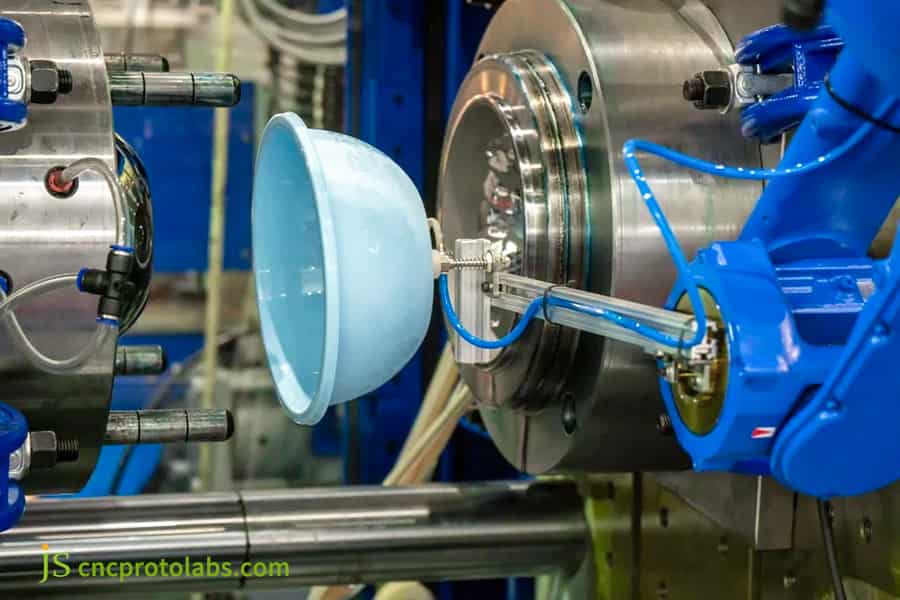
Figure 4: Large industrial injection molding machine with a robotic arm holding a blue plastic basin.
How Can Design For Manufacturability (DFM) Support Your PEEK Tooling Cost Optimization?
At the heart of the PEEK tooling cost optimization is the idea of not creating overly complicated structures during the product design phase. An early touch in DFM optimization will not only help in reducing the time of mold processing but also in the reduction of hidden production costs.
Drawbacks of Unsuited Design
If the structural design is inappropriate, then the effort and cost of PEEK tooling cost optimization will be Quite a bit higher. Due to PEEK extremely hard and rigid nature, the structural elements such as the deep cavities with micro-under-cuts and very narrow dead angles will require high-temperature sliders or hydraulic core-pulling mechanisms.
Mold processing costs will not only be increased but, hot mold also risks such as seal failure and thermal expansion jamming. Besides that, cost of maintenance and mold repair go even higher which means that such design errors should Sure be avoided in all injection molding projects.
Essential Rules for DFM Optimization
1. Try to give priority to external draft angles without compromising the assembly functionality. The draft angle for the internal holes should not be less than 1.5°, and for the external surfaces no less than 1°, both making the demolding structure easier.
2. Instead of having scattered mold inserts, merge them to have less insert joint gaps and because of this the risk of thermal expansion misalignment also goes down. As a result, the time spent on mold processing and assembly is reduced, the durability of the PEEK hot tooling service is enhanced and all these directly lead to the reduction of complex injection molding cost.
3. Make part wall thickness uniform to be able to avoid defects in molding and keep the costs of re-moldings due to repeated mold repairs at a minimum which result from very high differences in wall thicknesses.
Early DFM intervention can reduce overall mold costs by 25%. You can submit preliminary design drawings to receive free cost accounting and optimization suggestions, allowing you to plan your project cost control path in advance.
Why Partner With JS Precision For Your Precision PEEK Injection Molding Service Needs?
One of the main services of JS Precision is the PEEK injection molding service. The company has accumulated a lot of experience in engineering plastic injection molding of high-difficulty and precision machining. Equipped with an ISO 9001:2015 certified quality management system and fully closed-loop high-temperature hot mold manufacturing capabilities, we offer a one-stop, low-risk supply chain assurance from design improvement to the mass production of tens of thousands of parts to our customers.
End-to-End Production and Testing Capabilities
JS Precision has its independent high temperature oil temperature injection molding production floor, a highly skilled team of specialist plastic mold makers, and top-notch testing laboratories including Zeiss CMM. This guarantees the uniformity and mechanical performance of each batch of PEEK injection molding products. From raw material warehousing to finished product delivery, the entire process is controllable. This end-to-end management is the main guarantee for the consistent quality of high-end PEEK injection molding projects.
Transparent and Compliant Service Guarantee
The company strictly sticks to customers' intellectual property protection agreements allowing transparency tiered pricing based on material and labor costs, and also no hidden costs. This enables the clients to clearly comprehend the cost structure of the project and then confidently continue with the PEEK injection molding projects. Transparency in service is among the key standards of the professionals in the injection molding suppliers' industry.
FAQs
Q1: What is the minimum order quantity (MOQ) for JS Precision PEEK injection molding service?
As the barrel and hot mold need to be heated over 180℃, and there is always some material loss during the operation, JS Precision strongly suggests a minimum order of 500 pieces for standard PEEK part production. Or, the minimum spend should be $1500 for a single custom production project.
Q2: How much does a typical PEEK hot tooling service mold cost compared to traditional injection molds?
If you want to make molds for PEEK only, you will need very high-quality, heat-resistant steel, as well as heating systems embedded, and finishing to the mirror level for a long time. This can make the manufacturing cost about 35% to 50% more than the normal cold-work plastic molds.
Q3: Can regular injection molding machines safely process high-temperature PEEK molding materials?
PEEK cannot be safely processed with a regular injection molding machine. Standard heating coils are usually not able to constantly reach the maximum operating temperature of 380℃-420℃ and normal screws are very likely to get broken at the very high viscosity level, so they must be modified for high temperature and low shear application.
Q4: How do you protect my company's intellectual property and design details during inquiry?
JS Precision regards customer IP as a core asset and can sign a two-way confidentiality agreement before and after submitting drawings. Strict data isolation is implemented internally, and drawings are only open to specific project engineers and accounting centers.
Q5: What is the general lead time for a standard PEEK mass production project from tooling to delivery?
Typically, for such a project, it takes 3-5 working days to perform the mold flow analysis and to get the design for manufacturing details confirmed, 20-25 working days to produce the high-temperature hot mold, and 5-7 working days to carry out the mass production and delivery after T1 sample confirmation.
Q6: Can we mix regrind or recycled scrap into our high-volume PEEK molding service orders?
Even though pure PEEK is thermally stable, JS Precision suggests that you use 100% pure virgin material, mostly when dealing with core components of precision machinery or semiconductors. The addition of recycled material will be the cause of the secondary thermal degradation of the modified fibers, bringing about a decrease in the tensile strength of the parts.
Q7: How can I quickly estimate my single component price for PEEK injection molding?
The cost per unit is a combination of material weight, cycle processing cost, and amortization cost of the single-component mold. You just send the production quantity and 3D files to JS Precision, and a complete transparent and detailed formal quotation will be provided to you within 24 hours.
Q8: Why is post-molding annealing sometimes necessary for high-temperature PEEK components?
When making big solid or complicated parts out of PEEK on a very large scale, annealing with a program is going to be needed for eliminating the differences in the cooling rates of the surface and the interior. Heating in an oven at 200℃, holding at that temperature, followed by a slow cooling releases internal stress and fixes the highest crystallinity.
Summary
The main thing in PEEK injection molding procurement is picking a manufacturer who knows how to handle such materials well (crystallization), who can design hot molds, and optimize DFM. If one just uses non-hardening cold molds or usual equipment that cannot get to the crystallization temperature of 160℃-200℃, one will face issues such as warping, shrinkage, and the waste of output that might be over 20%. JS Precision hardening hot molds professionals and the multi-cavity runner design allow the realization of rapid cost-effectiveness even when orders reach approximately 5000 pieces or more, That's why ensuring 0.02mm tolerances and at the same time achieving low-cost mass production.
Are you ready to obtain cost effective PEEK molding solutions for your industrial or precision manufacturing projects? You may drop your STEP or IGS format 3D drawings in our official inquiry mail or fill out a customized inquiry form. Within 24 hours the JS Precision engineering team will send you a formal quotation, including runner utilization calculations, cycle time estimates, and multi-tiered batch unit prices with a free DFM feasibility assessment report to give your project a fast start.

Disclaimer
The contents of this page are for informational purposes only.JS Precision Services,there are no representations or warranties, express or implied, as to the accuracy, completeness or validity of the information. It should not be inferred that a third-party supplier or manufacturer will provide performance parameters, geometric tolerances, specific design characteristics, material quality and type or workmanship through the JS Precision Network. It's the buyer's responsibility Require parts quotation Identify specific requirements for these sections.Please contact us for more information.
JS Precision Team
JS Precision is an industry-leading company, focus on custom manufacturing solutions. We have over 20 years of experience with over 5,000 customers, and we focus on high precisionCNC machining,Sheet metal manufacturing,3D printing,Injection molding,Metal stamping,and other one-stop manufacturing services.
Our factory is equipped with over 100 state-of-the-art 5-axis machining centers, ISO 9001:2015 certified. We provide fast, efficient and high-quality manufacturing solutions to customers in more than 150 countries around the world. Whether it is small volume production or large-scale customization, we can meet your needs with the fastest delivery within 24 hours. Choose JS Precision this means selection efficiency, quality and professionalism.
To learn more, visit our website:www.cncprotolabs.com
Resource