English



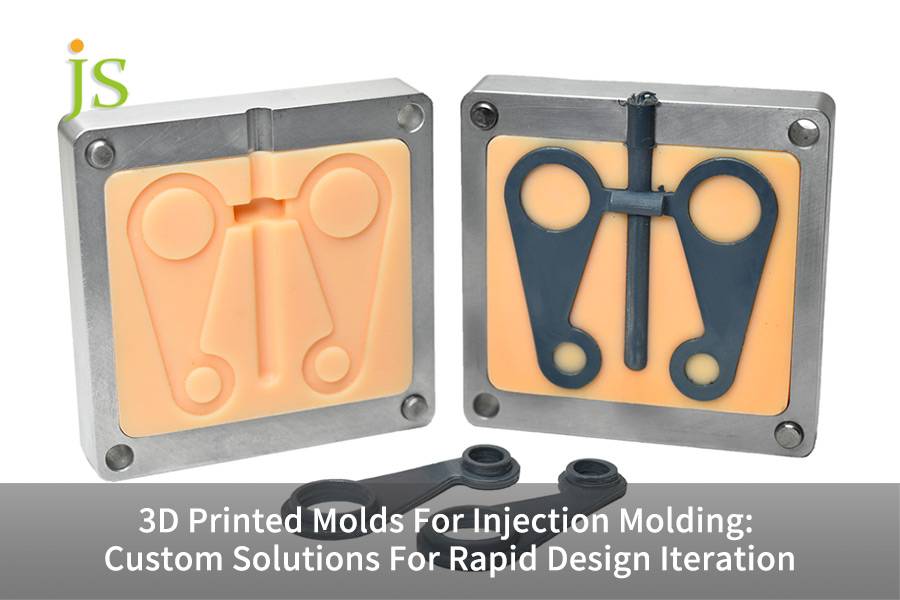

3D printed molds for injection molding offer a way for hardware startups and product engineers to escape the limitations imposed by traditional injection molds.
Many product teams have gone through this scenario:
After three rounds of product design, they spent $6,000 on modifying a traditional steel mold, and delivery was delayed by four weeks. Design iterations, which should be rapid trial and error, are dramatically slowed down with traditional injection mold tooling.
They can be made in 24-72 hours, design changes only need digital file modifications and re-molding, and there's no need to have CNC programming and other processes.
The aim of this article is, by using real data and cost models, to explain when 3D printed injection molds should be used, when traditional steel molds are still needed and, through China injection molding services, how the iteration cycle can be reduced from 3 months to 10 days.
Core Answer Summary
| Project | Core Content |
| Technical Solution | 3D Printed Injection Molds (Resin/Metal), 24-72 Hour Delivery |
| Pain Points Solved | Expensive mold modification ($500-$2000/time), long cycle (4-6 weeks) |
| Key Data | Mold lifespan 10-5000 cycles, unit cost $0.8-$3, 10 iterations reduced from 3 months to 10 days |
| Applicable Scenarios | Design verification, small batch (≤2000 pieces), ≥3 iterations |
| Service Model | Mold printing + injection molding prototyping full process, starting from $80-$200, no MOQ |
| Action Path | Upload 3D drawing → 2-3 day sample production → Iteration as needed → Steel mold opening after confirmation |
Key Takeaways:
- If the number of iterations for a design is less than 20 or the number of pieces in the batch is under 2,000 3D printed injection molds can lower upfront costs by 60% - 80%.
- If you want to use resin molds for functional verification only, then metal 3D molds will be better for your small batch production runs.
- Cooling time can be decreased by 40% - 60% by using conformal cooling channels.
- The mold investment has been changed from being an upfront capital expenditure to becoming an on demand cost consumption.
Why Choose 3D Printed Molds For Injection Molding? Real-World Insights From JS Precision
For hardware entrepreneurs and product development engineers, the choice of injection mold tooling directly determines the project's progress and cost. Due to the high cost and long cycle of traditional steel molds, these are often the reasons that block the progress of projects.
The 3D printed molds for injection molding by JS Precision are the breakthrough solution for these clients. Drawing on the experience of more than 5 years in the industry and more than 300 successful projects (including medical, consumer electronics, etc.), our data and experience enable clients to address their main problems.
JS Precision processes are 100% aligned with ISO/ASTM 52900:2021 standards to deliver consistent and controllable quality for each mold so that customers have absolutely no doubts about the quality of the product or defects.
For instance, a client in the consumer electronics industry needed four design iterations of the new product enclosure. Modifications to the traditional steel mold would cost a total of $8,000 and take almost two months.
With JS Precision's 3D printed molds for injection molding however each iteration was about $80-100, and the overall time reduced to 12 days, resulting in direct upfront cost savings of 70%.
By choosing JS Precision, you can have the pleasure of a fully closed loop service without any hassle.
Through our state-of-the-art 3D printing and injection molding workshops, we offer an integrated service platform that includes everything from mold design and 3D printing to injection molding prototyping without any interruption.
You will no longer have to move from one service provider to another, which on one hand reduces your communication costs.
On the other hand guarantees the mold and injection molding process perfectly match each other, thus no trial molding failures occur and product validation is done faster at a lower cost, ultimately giving you a strong position in the market.
Want to overcome the limitations of traditional steel molds? Contact JS Precision engineers for a free consultation on 3D printed molds for injection molding, download the white paper, and quickly grasp the core technical points.
What Are 3D Printed Molds For Injection Molding And How Do They Disrupt Traditional Mold Manufacturing?
3D printed molds for injection molding are produced directly from CAD models, hence there is no need for intermediate steps like CNC programming.
They could be shipped in as short as 24-72 hours and be stable during operation based on certain injection molding parameters, making the product iteration cycles very short.
Basically, it's as if you are "printing" a mold directly from 3D blueprints. Mold making has traditionally been a long series of design, processing, and debugging steps.
3D printing skips over all the boring steps. It's like ordering food for delivery - you get the meal immediately without having to buy groceries, cook or clean up.
Direct Manufacturing Path from Digital Model to Mold
Traditional methods of making molds are not only difficult but also error prone. 3D printing removes the need for these intermediate steps. Once the customer has submitted a 3D drawing, the CAD model can be used directly for printing, thus a mold can be produced quickly and it is ready for use.
Quantitative Relationship Between Interlayer Bond Strength and Injection Parameters
The interlayer bond strength in photosensitive resin molds is 12-18 MPa. When the injection pressure is 30 MPa and the mold temperature is 120℃, they can be stably used up to 50-200 molding cycles.
Going beyond these limits, the cracks will appear very quickly. JS Precision will provide the most appropriate process recommendations.
Practical Significance for Injection Molding Service Providers
3D printing molds could help China's injection molding services get rid of old-fashioned steel molds. Now if the customers want to change their designs, it won't be necessary to pay huge mold modification fees. All they need is to change the digital model and then re-print the mold.
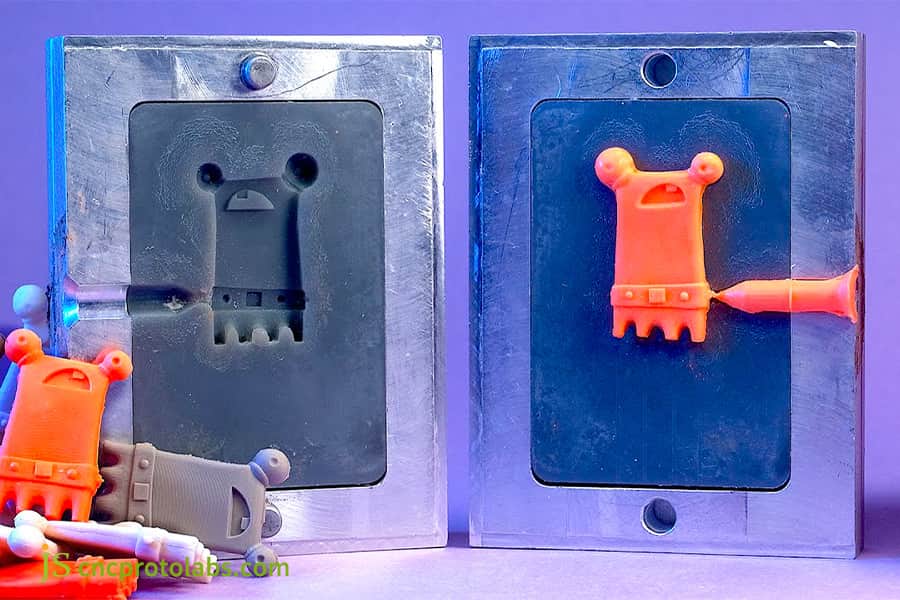
Figure 1: A close-up view of a 3D printed injection mold within a metal frame, showing an empty cavity on the left and the same cavity filled with a detailed orange plastic part on the right, with raw material pellets nearby.
Why Is It Said That 3D Printing Injection Molds Are The Optimal Solution For Rapid Design Iteration?
3D printing injection molds enable the highly effective resolution to the issue of lengthy and costly mold modifications that are inherent in the traditional mold making process.
Through multiple loops of iterations, it is possible to drastically lessen the total cycle time, thus resulting in significant time and cost savings to the customer.
Direct Comparison of Mold Modification Costs and Time
| Comparison Items | Traditional Steel Molds | 3D Printing Injection Molds (Resin) | 3D Printing Injection Molds (Metal) | Customer Benefits: |
| Single Mold Modification Cost | $500-$2000 | $20-$100 | $80-$200 | 70%-90% cost saving per mold modification. |
| Mold Modification Time | 5-7 days | 24-72 hours | 48-96 hours | 60%-80% reduction in mold modification cycle time. |
| Total Time for 10 Iterations | 3 months | 10-15 days | 15-20 days | Over 70% reduction in iteration cycle time. |
| Total Cost for 10 Iterations | $5000-$20000 | $200-$1000 | $800-$2000 | Over 80% cost saving in total iteration cost. |
Positioning Accuracy Guarantee Solution After Multiple Mold Disassemblies
By using 6mm H7 tolerance locating pins and magnetic bases, JS Precision ensures that the positioning accuracy remains stable at 0.03mm even after 100 times of disassembly and assembly, thereby aligning perfectly with the product precision requirements of the customer.
Practical Solution for Non Stop Iteration
In order to prevent the loss of downtime during iterations, JS Precision is capable of supplying customers with two identical molds: one for actual injection molding and the other as a spare for modification. Replacement is possible within 4 hours of design changes, ensuring continuous production.
How To Complete The Complete Process From Resin Printing To Plastic Parts Using a 3D Print Injection Mold?
The 3D print injection mold process is extremely productive. Customers just have to send in their 3D designs, and JS Precision is capable of handling the whole operation from making the mold to delivering the injection molded finished products. They are able to provide 50 ABS samples in just 2 hours.
Material Selection: High Temperature Resin Vs. Sintered Metal
The choice of material determines the lifespan and price of the mold. JS Precision suggests the most appropriate materials according to customers' production quantities and needs. This can help them manage their expenses.
1. High Temperature Photosensitive Resin (HDT > 200):
This is the best option for trial production of up to 100 pieces. One set of the mold material will cost you between $15-50 USD. Some of the major benefits include minimal expenditures and rapid delivery, so it is perfect for the functional verification stage.
2. Sintered Metal (316L Stainless Steel):
A good choice for 100-1000 pieces. One set of the mold material will cost you between $150-500 USD. This material has a long service life, high strength, and is perfect for the small batch production stage.
Surface Roughness Issues and Low Cost Solutions
3D printed molds usually have a surface roughness Ra in the range of 5-15µm, which leads to challenges during demolding. We provide two inexpensive options that help decrease Ra down to 1-2µm and, as a result, the demolding force is reduced by 60%.
It is just like the surface of the mold cavity was initially covered with rough sandpaper, so the plastic parts would stick to it and be difficult to come off. We have polished that sandpaper to smooth glass which makes removing the parts a breeze and without any scratches.
Six Step Hands on Guide from Mold Printing to Injection Molded Product
The standardized steps for 3D print injection mold operation are printing, post processing, mold release agent application, parameter setting, pressure holding and cooling, and finished product ejection. Customers do not need to undergo any extra training.
- Manufacture the mold (including the ejector pin holes, runners, and venting channels, tolerance 0.1mm).
- Post curing (2 hours at 60) / Metal sintering (1300℃).
- Use PTFE mold release agent.
- Set up on the injection molding machine, determine injection pressure as 25MPa and speed as 15mm/s.
- Keep pressure for 5 seconds and cool for 15 seconds.
- Remove the finished product.
JS Precision provides a full process service. Customers only need to provide 3D drawings and do not need to participate in any intermediate steps to receive the finished product.
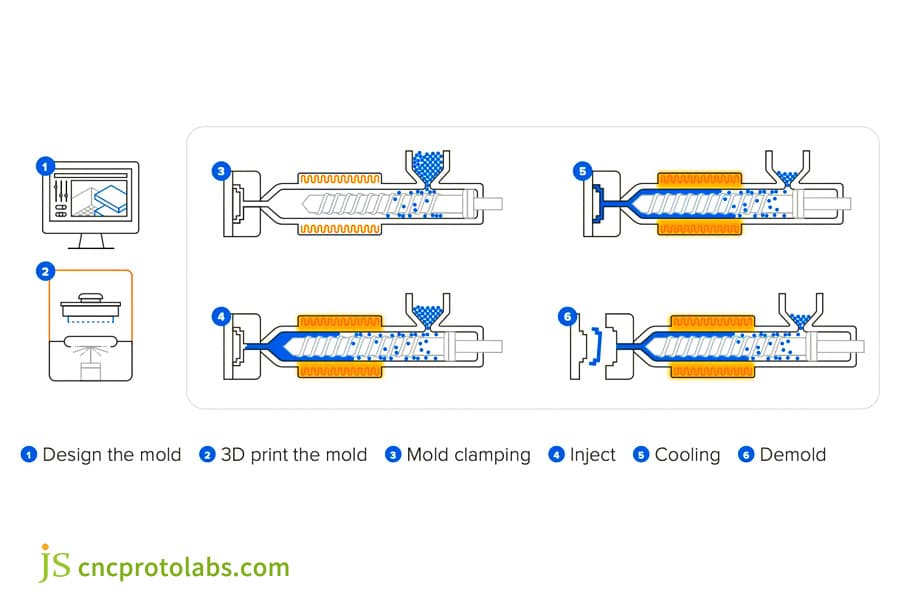
Figure 2: An infographic illustrating the six-step process for 3D printed injection molds, from digital design and 3D printing of the mold to clamping, injection, cooling, and demolding of the final plastic part.
How To Balance The Mold Life And Single Piece Cost When Injecting Molding From 3D Printed Molds?
Selecting injection molding from 3D printed molds requires balancing the mold life and cost per unit depending on the batch size. The differences between resin and metal molds are obvious, if the batch size is more than 2000, then changing to steel molds will be cheaper.
The Influence of Different Plastic Materials on Resin Mold Life
| Plastic Material | Resin Mold Life (cycles) | Recommended Injection Pressure (MPa) | Applicable Scenarios | Factors Affecting Life |
| PP/PE | 150-200 | 20-25 | General housings, accessories | Soft material, minimal wear on the mold |
| ABS/PC | 80-120 | 25-30 | Electronic housings, structural components | Moderate hardness, minimal wear |
| PA66 | 50-80 | 30-35 | Mechanical parts, gears | High hardness, some wear on the mold |
| PA66-GF30 | 10-30 | 35-40 | High strength structural components | Strong glass fiber abrasion, drastic lifespan reduction |
| TPU | 100-150 | 15-20 | Soft rubber parts, seals | Elastic material, minimal wear |
Fatigue Life and Densification Treatment of Metal 3D Printed Molds
LPBF-printed 316L molds meet the ASTM specifications. As per the F2924-14 standard, the molds without HIP treatment suffer from high porosity and are prone to cracking.
The porosity level reduces to 0.02% and the lifetime goes to 5000 cycles after HIP treatment, which aligns with the small batch production requirement of customers.
Cost Models for Three Mold Types (Including Injection Molding Fees)
If one needs to carry out validation phase iterations more than 20 times or a batch size more than 2000 pieces, it is advised that one should resort to the use of traditional steel molds.
Earlier, going for 3D printed molds could enable the customers to cut their upfront costs even by 60%-80%, thereby demonstrating the superior cost effectiveness of the solution.
Unsure how to balance mold lifespan and cost? Get a free injection molding from 3D printed molds calculation tool, input parameters to quickly obtain cost estimates.
As a Provider Of Injection Molding Services In China, How Can 3D Printing Molds Help You Quickly Commercialize?
Pairing China injection molding services with 3D printed molds can address the major challenges faced by hardware startups like tough trial and error plus slow product realization, thereby enabling customers to effectively bring their products to market.
One Stop Closed Loop Service: From Design Upgrading to Product Roll out
JS Precision provides a one stop closed loop service, from design upgrading to mold printing and other processes. This frees clients from dealing with various parties, thus saving on communication costs and enhancing the likelihood of successful trial molding.
Thanks to JS Precision's mold optimization and resin molds printing, a smart wearable startup team's sample production time was 2 days, and they delivered 1000 units in 18 days. They reduced the cycle by 60% and saved a lot of time after delivery of the product.
Manageable Expenses: Switching Large Investments to Operating Expenses
Traditional service providers require clients to pay the complete steel mold fees upfront, and design modifications make the initial investment totally useless. JS Precision turns fixed costs into variable ones, so that small lot ordering becomes economically viable.
Lowered Risks: Small Batch Trial Production to Test Market Potential
With JS Precision's "3D printed mold + small batch trial production" model, clients can test market potential before making decisions to ramp up production, thus eliminating the risk of ending up with unsold inventory.
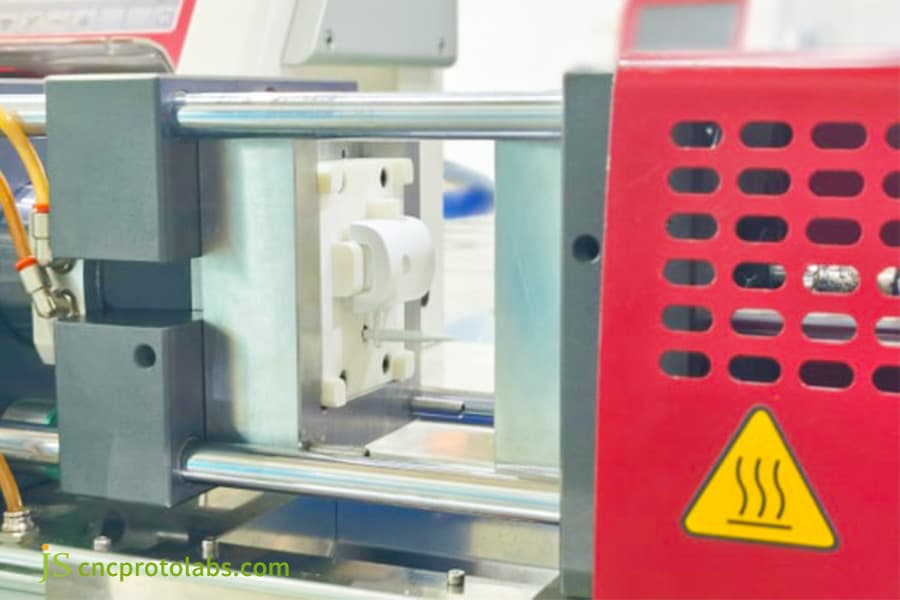
Figure 3: A red industrial injection molding machine in operation, with a white 3D printed mold visible inside the clamping unit, actively producing parts.
What Are The Unique Technical Challenges Faced By Injection Molding With 3D Printed Molds, And How Can They Be Solved At a Low Cost?
Using injection molding with 3D printed molds can give rise to technical issues, such as the deformation of molds at high temperature. JS Precision provides low cost possibilities to make sure stable production for our clients is maintained.
Challenge 1: Heat Deformation of Molds Still at a High Temperature (Most Common)
When injection molding high temperature materials, resin molds tend to get heat deformation which not only changes product dimensions but also breaks the mold and costs the customer more. This is the problem that occurs most often.
To cope with this, we choose a high temperature photosensitive resin with an HDT 200℃, increase wall thickness by 3mm, and also design simple cooling channels to keep mold temperature at 80-100℃. Heat deformation is controlled within 0.05mm, with a minor cost increase of only $5-10.
It is as if a mold is given a "high temperature resistant protective coat" and a "mini air conditioner" is installed. Even though they get heated to injection molding high temperature, they can keep their shape, like a person putting on sun protection clothes and being fannedthey won't get heatstroke and deform.
Challenge 2: Insufficient Mold Venting, Leading to Air Bubbles and Material Shortages
The small pores in the 3D printed molds can trap air causing as a result, air bubbles, and material shortages which reduce the quality and delay the delivery.
We create 0.1 to 0.2 mm venting channels at the cavity ends and corners so that the mold can be 3D printed directly. By changing the injection parameters, the defect rate can be brought down to less than 1%, no extra cost being needed.
Challenge 3: Difficult Demolding, Leading to Product Scratches and Ejector Pin Jamming
The uneven surface of 3D printed molds can be the reason of demolding difficulties and product scratches thus lowering the efficiency and leading to higher costs of rework.
By applying PTFE release agent, changing the ejector pin position and number and steam smoothing treatment, the demolding issues can be resolved easily, as a result, product get safe.
Challenge 4: Mold Dimensional Deviations, Leading to Incomplete Product Assembly
Material shrinkage and limited precision of 3D printing lead to a higher chance of mold size variations, especially for complex structures, which lower assembly pass rates and cause schedule problems.
We do a shrinkage compensation for the material prior to printing, then after printing, the first step is the accuracy check and if need be, the second step is the fine adjustment by grinding resulting in the mold to be kept within the dimensional deviation of 0.1mm.
Encountering technical challenges in injection molding with 3D printed molds? Contact engineers for one-on-one consultation to obtain low-cost solutions for free and ensure stable production.
JS Precision Case Study: Medical Connector Housing, Total Cost $2990 Vs Traditional Steel Mold $6750
The value of 3D printed injection molds can be shown quite effectively by a real life case study, which serves as the most intuitive way.
Here is a medical connector housing project that together with JS Precision illustrates how we helped our clients in cutting down costs, speeding up production, and meeting their highly demanding requirements.
Challenges Encountered
The client is after 1500 PC+ABS medical connector housings that are of high precision and they need 3-5 iterations. Steel molds that are made through the traditional method are too expensive and take a long time. Besides that, they cannot meet the time-to-market plan.
Solution
JS Precision implemented "resin validation + metal production" strategy:
- Round 1 (Checking functionalities):
Created a mold of high temperature resin (cost $45), produced 50 PC+ABS samples under an injection pressure of 28MPa. The snap fit assembly was determined to be very tight.
- Round 2 (Fixing dimensional):
Changed the snap fit offset in the CAD model by 0.15mm, remade the mold (cost $45), and made 50 parts again. Assembly testing was successful.
- Round 3 (Manufacturing small batch):
Finally, after the design was frozen, we printed 316L metal mold (cost $380 including HIP densification treatment), and injected molding 1400 parts. By utilizing conformal cooling channels (4mm diameter, 6mm from the cavity), the injection cycle time per part was reduced from 45 seconds to 22 seconds.
Final Results
The entire project cost was $2990, which means a huge 56% saving when compared with traditional steel molds. Also, 3 iterations and 1500 parts were done in just 15 days, thereby cutting down the cycle time by 80%. Besides, the metal molds will be able to last for the next follow up orders.
The product's undercut structure is realized with the PVA soluble core in one piece, therefore the mold structure is simpler, cost is lower and it is fully capable of meeting the quality requirement of medical products.
Do you have similar medical parts or small batch injection molding needs? Submit your 3D drawings, and we'll customize a dedicated injection molding with 3D printed molds to achieve cost reduction and speed.
In What Scenarios Should 3D Printing Injection Molds Be Firmly Chosen, And In What Scenarios Must Traditional Steel Molds Still Be Used?
The dispute that 3D printing injection molds are absolutely better or totally worse than traditional steel molds is a deadlock. The difference is in tailoring the solution to the project's features. At JS Precision, we guide our customers in understanding their situations and help them prevent costs and time wastes.
4 Cases in Which 3D Printing Injection Molds Should Be Your First Choice
Below are some examples in which opting for 3D printed molds was a good way to increase cost reduction and speed, thus saving clients both time and money:
- Product design concept testing with 3 iterations: minimal costs and quick cycles for mold changes, a way to sidestep the steep modification charges and long waiting times of regular steel molds that are always in demand.
- Running a limited number of products (2000 pieces): Overall cost reduction of 60%-80% compared to regular steel molds, which no longer requires an initial investment in steel molds, especially ideal for SMEs.
- Difficult product geometries (undercuts, etc.): Such complicated structures can be simply printed without the necessity of sliders, which cuts down on mold complexity and consequently cost.
- Launching a product very soon and needing fast sample/small batch production: Quick mold and sample production help cut down the cycle time by 70% vis--vis traditional methods, which facilitates capturing market share.
Three Scenarios Where Traditional Steel Molds Must Be Used
Using 3D printed molds in the following cases not only raises the costbut also causes the instability. Therefore, traditional steel molds are more suitable and can effectively help customers reduce the risk.
- Large batch production (>2000 pieces): 3D printed molds have limited lifespan, requiring frequent replacements, resulting in higher total costs and lower efficiency compared to traditional steel molds.
- Injection molding of high hardness, highly abrasive materials (e.g. PA66-GF30): 3D printed molds have extremely short lifespans, while traditional steel molds can achieve over 100,000 cycles after heat treatment.
- Very high levels of product precision (tolerance < 0.05mm): Traditional steel molds, after precision machining, are capable of delivering superior precision, thereby satisfying the highly refined measurement requirements of the customers.
Boundary Region: Transition Decision Matrix for Two Mold Types
For boundary scenarios with batch sizes of 1500-2500 pieces and an accuracy of ±0.05-±0.1mm, the decision matrix is as follows:
| Project Parameters | Recommended Mold Type | Customer Benefits | Notes |
| Batch size 1500-2000 pieces, accuracy ±0.1mm | Metal 3D printing injection molds | 30%-50% lower cost than steel molds, 60% shorter cycle time. | Choose HIP-treated metal molds to extend lifespan. |
| Batch size 2000-2500 pieces, accuracy ±0.05mm | Traditional steel molds | High initial investment, more economical for long term production, guaranteed accuracy. | Use 3D printed molds to verify the design before making steel molds. |
| Batch size 1500-2500 pieces, requiring multiple iterations | 3D printed mold + steel mold transition | Use 3D printing during the iteration phase, switch to steel molds after stabilization, reducing costs and accelerating speed. | Plan steel mold design in advance to reduce transition costs. |
Why Choose JS Precision's 3D Printing Injection Mold+Injection Molding Services?
JS Precision balances mold quality, injection precision, and cost control perfectly. Through its end-to-end service and transparent pricing system, it helps clients save their time, efforts, and money.
Advantage 1: Closed Loop Service, No Need for Multiple Intermediaries
Considering that JS Precision has its own workshop, it is able to implement a closed loop process. So, the service cycle is shortened by 30% in comparison with outsourcing providers, the success rate in trial molding is 99%, and communication costs are reduced for clients.
Advantage 2: Transparent and Controllable Costs, No Hidden Charges
JS Precision ensures that pricing is transparent without any hidden charges and also, there is no MOQ requirement. It proposes appropriate option(s) based on the client's requirements and even small orders can be that cost effective.
Advantage 3: Strong Technical Capabilities, Solving Complex Scenarios
The engineers at JS Precision are very proficient and highly capable of troubleshooting and handling various technical problems. The delivery speed is highly efficient and even after making changes to the design, it is only 24 hours before the product is ready.
Advantage 4: Flexible Response, Rapid Delivery
We operate more than one machine so the delivery speed of molds, samples, and small batch products is well surpassed the industry average. The design changes are made within 24 hours and the clients are supported in acquiring the market share.
Figure 4: Two sets of 3D printed injection molds housed in metal frames, displayed alongside the dark blue plastic components they produce, demonstrating the link between tooling and final parts.
FAQs
Q1. How many times can a 3D printed injection mold be used?
There is a great variance in the number of cycles for which resin molds can serve -- from 10 to 200, on the other hand metal 3D molds could reach even 1000 - 5000. Factors like plastic hardness, injection pressure as well as post processing influence the lifespan greatly.
Q2. What is the precision of a 3D printed mold?
Overall, resin molds have a precision level of 0.1mm, whereas metal 3D molds can have a precision of 0.05mm, while locating pin mating surfaces are 0.02mm, which is generally good enough for most product requirements.
Q3. What happens if the injection pressure exceeds 30MPa?
If the injection pressure gets higher than 30MPa then the risk of interlayer cracking in resin molds could raise up to 40%. In that case, it is advisable to go for metal 3D molds or conventional steel molds.
Q4. How much lower is the unit cost of a 3D printed mold compared to a traditional steel mold?
Simply put, the unit price of a 3D printed mold per piece is 60%-70% less than a traditional steel mold for 100 pieces, while the difference shrinks to 30%-50% for batches of 1000 pieces.
Q5. Are conformal cooling channels really effective?
In reality, conformal cooling channels have actually led to 40%-60% reductions in cooling times, which in turn have shortened the injection molding cycle and led to an improvement in the quality of product surfaces.
Q6. Which injection molding materials do you support?
We offer a diverse range of injection molding materials like ABS PC PP, PE, and PA66. Depending on the requirements, we help customers choose the most appropriate material.
Q7. How many days does it take from sending drawings to receiving samples?
It usually takes 2-3 days to produce resin mold samples after sending drawings, whereas for metal molds, it takes 5-7 days, which covers mold printing, post processing, and producing 50 injection molded samples.
Q8. Can you help us design molds?
Yes, customers should first supply a CAD model of the product to which our designers will carry out the entire mold designing work based on the product's configuration and materials.
Summary
3D printed injection molds go beyond the existing limitations of the industry. At the heart of it, it is about turning the expense of pre-installed molds into pay-as-you-go, thus enabling customers to finish product validation and small scale production rapidly and affordably.
It is the best choice for a project that hardly requires 20 iterations or a batch size of not more than 2,000 pieces, as it reduces 60%-80% of initial cost. When combined with comprehensive injection molding services, it delivers a one stop realization.
If you're facing difficulties with the costs and lead times being high due to the traditional mold modifications, then you should probably start thinking about going for 3D printed injection molds.
By submitting your 3D mold files (STL/STEP) to our engineering team, you are able to go to market quickly with your product with very low risk and cost.

Disclaimer
The contents of this page are for informational purposes only.JS Precision Services,there are no representations or warranties, express or implied, as to the accuracy, completeness or validity of the information. It should not be inferred that a third-party supplier or manufacturer will provide performance parameters, geometric tolerances, specific design characteristics, material quality and type or workmanship through the JS Precision Network. It's the buyer's responsibility Require parts quotation Identify specific requirements for these sections.Please contact us for more information.
JS Precision Team
JS Precision is an industry-leading company, focus on custom manufacturing solutions. We have over 20 years of experience with over 5,000 customers, and we focus on high precisionCNC machining,Sheet metal manufacturing,3D printing,Injection molding,Metal stamping,and other one-stop manufacturing services.
Our factory is equipped with over 100 state-of-the-art 5-axis machining centers, ISO 9001:2015 certified. We provide fast, efficient and high-quality manufacturing solutions to customers in more than 150 countries around the world. Whether it is small volume production or large-scale customization, we can meet your needs with the fastest delivery within 24 hours. Choose JS Precision this means selection efficiency, quality and professionalism.
To learn more, visit our website:www.cncprotolabs.com
Resource