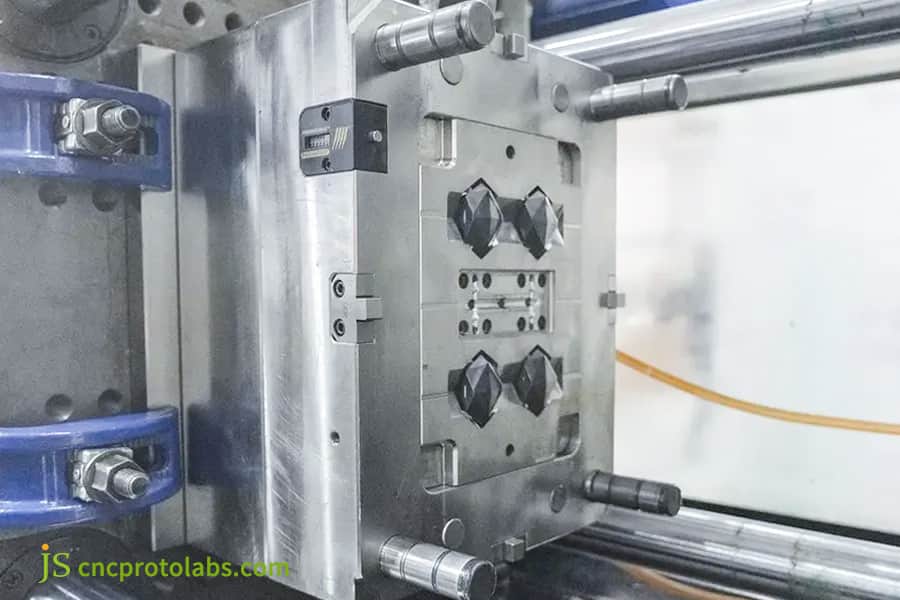
Q4: What is the perfect vent depth for ABS injection molds and why is it important?
The usual depth for ABS venting channels is 0.02-0.03mm and the width is 3-5mm. If the depth is less than 0.02mm, that will cause scorch marks, if it's more than 0.03mm, flash will be generated. Injection pressure 120MPa lowers the depth by 0.005-0.01mm.
Q5: What should be the melt and mold temperature range for ABS injection molding?
Melt temperature 216-260℃, upper limit 270℃. Mold temperature 60-80℃. Mold temperature <40℃ results in a rise of internal stress and warping, mold temperature >90℃ causes the molding cycle to be longer and also the demolding to be more difficult.
Q6: How does JS Precision maintain quality consistently in high-volume ABS injection molding production?
Three major systems are responsible for quality stability in mass production. The production process is performed with the help of cavity pressure and mold temperature real-time monitoring, dimensional control by SPC request of CPk1.33, raw material moisture content and MI index batch testing, mold cleaning and maintenance intervals. Upload your drawings for customized process solutions, precise quotations, and mass production optimization plans.
Q7: What ranges does custom ABS injection molding pricing usually fall into? What Mainly influences the cost?
Here are the top five factors playing a role in the price:
Mold charge: basic single-cavity molds can be less than $5 000 while very complex multi-cavity hot runner molds can be above $50,000.
Material cost: Pure ABS is approx. $2-4 per kg. flame retardant and/or reinforced types will be more expensive.
Single item cycle affects production capacity and unit cost.
Secondary operations such as painting or plating.
Quantity requirement: Unit prices difference between 10,000 and 100,000 quantity can be 30% - 50%.
Q8: Usually how long does it take for custom ABS injection molding job with JS Precision?
Typical production time: Mold making 4-6 weeks, test running + method development 1-2 weeks, initial full production 2-3 weeks. Fast-track jobs finish in 3-4 weeks. A Gantt chart is made available, reporting weekly on proceeding milestones.
概要
Five defects in ABS injection molding are most commonly seen -silver streaks, shrinkage marks warpage burn marks, and short shots. These can all be traced to only three main things: the moisture content of the material, the settings of the process parameters, and the condition of the mold. If drying parameters are correctly controlled so that the moisture content is reduced to less than 0.1% by weight, holding pressure can be optimized to 50MPa, mold temperature differences can be strictly managed within ±10℃, and venting grooves can be precisely machined to 0.02mm to 0.03mm, the scrap rate can be brought down from industry average of 5% to 10% to below 2%.
Upload 3D drawings (STEP/IGS/X_T format), and JS Precision will send you a free DFM assessment report (defect risk prediction and process suggestions) within 48 hours and a preliminary quote and project timeline within 72 hours. Get your next ABS injection molding project running on a zero-defect track from the design stage.
 日本語
日本語