English



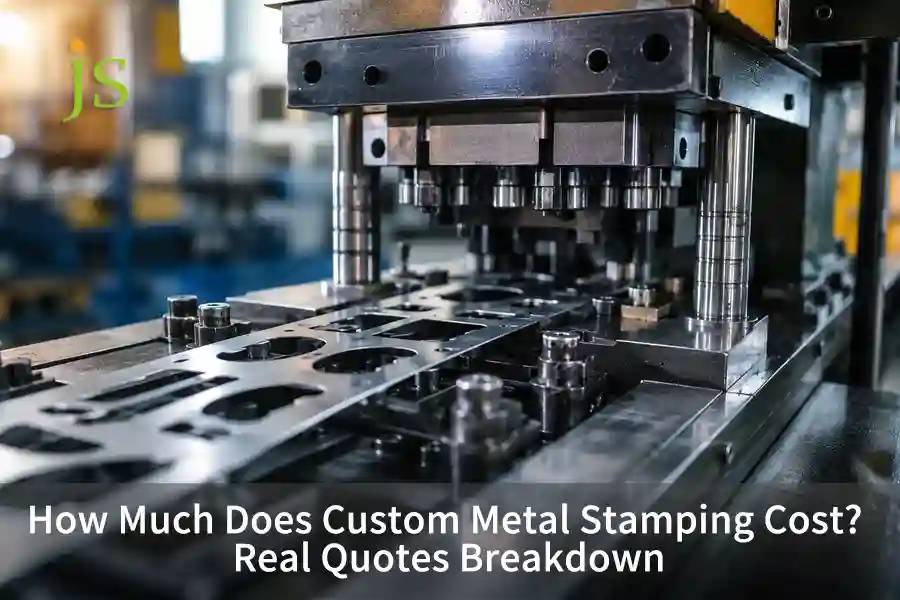

Custom metal stamping carries an upfront tooling investment of $15,000 to $65,000+ and a recurring piece price of $0.05 to $4.50. While for a volume of less than 1,000 per production run CNC machining and laser cutting offer quite a bit lower costs due to fixed die amortization, for production runs above 10,000 high speed progressive stamping reduces costs per unit to less than $1.00 and is typically better than all other processes. The ultimate project cost drivers include choice of alloy, shape, and tolerance constraints, and annual total volume. What comes next summary and method outlines actual RFQ range, tooling payback points and cost reduction levers for your budgeting.
Custom Metal Stamping Cost Framework by Volume Tier
Core Takeaway: Landed cost of metal stamping depends on the tooling amortization rate. Metal stamping batches above 10,000 are 70%–90% cheaper than CNC/laser prototyping routes.
| Volume Tier | Die / Tooling Strategy | Die Cost (USD) | Part Price (USD) | Landed Cost/pc | Best-Fit Application & Advice |
| Low (100 pcs) | Stage Die / Laser Hybrid | $1,500 – $4,500 | $1.80 – $6.50 | $16.80 – $51.50 | Functional testing, use CNC/laser if unrepeated |
| Mid (1,000 pcs) | Compound / Transfer Die | $4,000 – $12,000 | $0.45 – $2.20 | $4.45 – $14.20 | Pre-series ramp, design validation phase |
| High (10,000+ pcs) | Progressive Die | $15,000 – $65,000+ | $0.05 – $0.85 | $1.55 – $7.35 | Mass production, lowest per-part expense |
Note: 2026 industrial median benchmark data, excludes secondary surface plating and freight.
How Much Does Custom Metal Stamping Cost and What Drives It?
The estimate for custom metal stamping price includes four basic parts: tooling (always capitalized), raw coil stock, press run, and secondary operations. The percentage of raw material will be estimated at 50%-65% of recurring unit cost excluding secondary finishing (plating and anodizing can dominate on low-value parts). Total cost of the job could be logically determined based on press tonnage and secondary plating.
The Four Pillar Elements of Stamping Quotations
- Tooling and Engineering (NRE): One time cost for stamping die design, CNC machining, wire EDM cutting, polishing, and die testing.
- Raw Material Coil Stock: Net metal weight of each blank with carrier strip scrap.
- Press Operation and Machine Setup: Press capacity cost (mechanical press 45T to high-speed press 300T), labor, and feed calibration.
- Secondary Processing & Finish: Deburring, electroplating, passivation, heat treatment, and export packaging.
The Technical Unit Cost Formula
Unit Price = (Material Weight × Material Unit Price / Scrap Utilization Efficiency) + (Press Hourly Rate / Strokes Per Minute × 60) + Secondary Post-Processing
This baseline helps to isolate the cost of materials from that of tooling depreciation while analyzing line item estimates from precision metal stamping services.
Worked Calculation Example: 1.5 mm SPCC Flat Spacer
Applying this equation to a typical SPCC steel spacer:
- Material Component: The net weight of the part is 12 g. Based on 84% nesting efficiency of the strip, the gross coil consumption will be about 14.3 g per part. With SPCC material cost of $0.90/kg, the material cost comes to $0.013/pc.
- Press Work: Working on a $60/hr press bed of 80T at 200 SPM, the run time cost will be $0.005/pc.
- Additional Surface Finish: The electro blue zinc barrel plating cost will be $0.050/pc.
- The total recurring cost of the piece comes to $0.068.
With a production quantity of 50,000 pieces, the amortization for the $2,200 progressive die would be $0.044/pc, producing a landed cost of $0.11/pc. With a production quantity of 10,000 pieces, the amortization for the same tooling would be $0.22/pc, giving us the landed cost of $0.29/pc shown in the Real Quotes Breakdown by Volume Tier matrix below.
How Are Tooling and Setup Cost Calculated for Custom Dies?
Stamping tooling and setup cost is dictated by die complexity, tooling steel grade, and the number of operational stations. A single station stage die is $2,500-$6,000 and a high speed progressive die is $15,000-$65,000+. A press setup charge usually runs $150-$600 per run for die set-up and first article dimensional validation.
Tooling Architecture and Tool Steel Grades
- Single-Stage Tooling ($2,500 – $6,000): Conducts a single process per stroke (piercing or blanking). Recommended for flat blanks below 2,000 units.
- Compound Tooling ($4,000 – $12,000): Executes blanking and internal piercing in one press stroke, holding concentricity within ±0.03 mm.
- Progressive Tooling ($15,000 – $65,000+): Moves continuous coil stock through 6 to 18 sequential stations, operating at 100 to 500 strokes per minute.
Both Cr12MoV and AISI D2 tool steels deliver lives between 300,000 and 500,000 strokes. In order to achieve speeds greater than 1,000,000 strokes, it is necessary to use tungsten carbide die inserts at higher prices of 25% to 40%.
Batch Setup Fees and Machine Calibration
Every production run incurs recurring setup costs: Bolting upper and lower dies, alignment of guide pins, shut heights, first-article sample checking on CMM. Calibration of tools is always conducted within the tolerances specified by ISO 9001:2015 manufacturing quality standards.
How Does Material Cost Drive Your Final Custom Metal Stamping Price?
Raw material cost directly represents 50% to 65% of the recurring custom metal stamping price. The basic carbon steel (SPCC/A36) is the lowest-level material cost standard, while aluminum 5052 will be 2x–2.5x the cost of raw materials, and stainless steel 304 will be 3.2x–4.0x the cost of raw materials. Scrap rates during strip nesting dictate competitiveness of final production costs.
Sheet Metal Benchmarking Index for Commercial Applications
- Carbon Steel (SPCC, Cold-Rolled, A36): Standard benchmark (1.0x price index). Very ductile and easy to form, which reduces die wear.
- Aluminum Alloys (5052-H32, 6061-T6): Sits at 2.0x to 2.5x the base cost of mild steel. Has significant springback requiring special over-bending stations.
- Austenitic Stainless Steel (304, 316): Costs 3.2x to 4.0x more per kg than mild steel. High work hardening demands TiCN coated punches.
- Copper and Phosphor Bronze (C110, C5191): 4.5x -6.0x the standard steel cost. Used only for conductive contacts and shields.
DFM Strip-Nesting Optimization and Scrap Reduction
Interleaving parts on the strip and shrinking web margins from 3.0 mm to 1.5 mm boosts material efficiency from 68% to 84%, saving 15% on recurring unit material cost. This factor is essential in comparing metal stamping vs sheet metal fabrication.
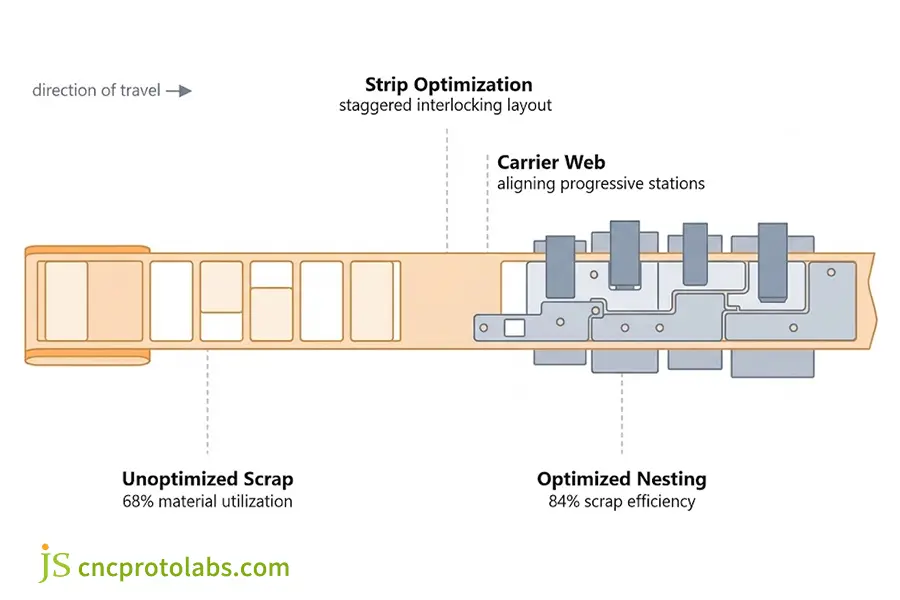
Figure 1: Strip nesting optimization: Staggered blank layout cuts material scrap and lowers custom metal stamping cost by boosting efficiency to 84%.
How Does Metal Stamping Cost Per Part Change at Volume Tiers?
A per-part cost at volume plummets as the major setup costs and the die tooling costs are allocated over increasing quantities. For a precision stainless steel bracket, the effective unit price is $22.50 at 100 parts, but drops to just $3.80 at 1,000 parts, and falls further to $0.38 at 10,000 parts. Amortization curves definitively establish where stamping achieves volume supremacy.
Real Quotes Matrix: Geometry, Tooling, and Volume Breakdowns
Custom Metal Stamping Real Quotes Breakdown by Volume Tier
Core Takeaway: Most low volume production runs up-front tooling, but part costs plummet above roughly 3,000 pieces with progressive dies being the best option above 10,000 parts.
| Part Type & Material | Batch Volume | Tooling Fee (Die) | Piece Price (Run) | Amortized Unit Cost |
| Flat Spacer (SPCC Steel, 1.5 mm) | 100 pcs | $2,200 | $0.85 | $22.85 |
| Flat Spacer (SPCC Steel, 1.5 mm) | 1,000 pcs | $2,200 | $0.22 | $2.42 |
| Flat Spacer (SPCC Steel, 1.5 mm) | 10,000 pcs | $2,200 | $0.07 | $0.29 |
| Formed Bracket (Al 5052, 1.2 mm, simple bend) | 100 pcs | $8,500 | $3.20 | $88.20 |
| Formed Bracket (Al 5052, 1.2 mm, simple bend) | 1,000 pcs | $8,500 | $1.45 | $9.95 |
| Formed Bracket (Al 5052, 1.2 mm, simple bend) | 10,000 pcs | $8,500 | $0.48 | $1.33 |
| Precision Terminal (Bronze, 0.4 mm) | 100 pcs | $18,000 | $4.50 | $184.50 |
| Precision Terminal (Bronze, 0.4 mm) | 1,000 pcs | $18,000 | $0.80 | $18.80 |
| Precision Terminal (Bronze, 0.4 mm) | 10,000 pcs | $18,000 | $0.09 | $1.89 |
Note: Straight-line tooling amortization based on 2026 contract manufacturer benchmarks, excludes plating and freight.
Stamping vs Alternate Processes: Economic Break-Even
Comparing unit prices against alternate manufacturing routes requires balance: explore our CNC machining vs progressive stamping cost comparison for process constraints. Capital investment for production less than 1000pcs is eliminated when using CNC machining or laser cutting. Consider volume cost breakdown in low volume vs high volume stamping economics.
When Stamping Is NOT the Cheapest Route
Stamping is only economical once it crosses the tooling break-even point. When the production volume is lower than 1,000 parts, using CNC machining or laser cutting and bending avoids paying the upfront costs of a die ($2,500-$65,000) and is generally less expensive. Using a single-stage or laser-hybrid tool can be a practical intermediate step before investing in a dedicated progressive die.
- Avoid Progressive Tooling If: Your yearly part needs are not known, changes in the design are not yet finalized, or your batch quantity is under 3,000 parts. Request quotes for CNC milling or sheet metal laser cutting.
- Commit to Stamping If: You are sure you have consistent yearly requirements over 10,000 parts, need exact dimension repeatability between batches, or need continuous coil-fed progressive stamping.
Next Procurement Steps: More than 10,000 pieces, progressive stamping lowers the cost of components by more than 70% relative to other non-tooling processes. Planning an upcoming serial run? Upload Your Drawing for a direct DFM review and tooling quote within 24 hours.
How Do Hidden Costs and Secondary Finishes Increase Metal Stamping Quotes?
Hidden costs in metal stamping occur due to secondary finishes, dimension inspections, special export packing requirements, and overseas shipping. Additional costs due to secondary finishing operations such as electro-galvanization ($0.05 to $0.15/pc), deburring, and PPAP Level 3 documents ($300-$1,000) could cause the quote price to be raised by 20%-45%.
Secondary Processes and Surface Finishing
- Deburring: Cost of the vibratory tumbling method or thermal deburring to remove shear burrs (5%-10% sheet thickness) is $0.02-$0.08 per piece.
- Zinc Plating: Blue/Yellow Chromate Passivation Coating cost is $0.04-$0.12 per piece.
- Electroless Nickel: Corrosion and wear resistant electroless nickel plating cost is $0.15-$0.45 per part.
- Type II Anodizing (Aluminum): It costs $0.20-$0.65 per part.
- Powder Coating: Cost of electrostatic powder coating is $0.35-$1.20 per piece.
Quality Verification and Export Logistics
All standard orders come with Certificates of Conformance (CoC). Automotive and medical projects requiring FAI, Gage R&R, and PPAP Level 3 documentation will incur a one-time quality engineering package ranging from $400 to $1,200. Protective packaging (VCI anti-corrosion bags desiccants fumigated pallets) will cost $0.02-$0.06 per part. Ocean freight and customs brokerage will cost $0.05$-0.25 per part according to component density. See all specifications in our guide on metal surface finishing options and costs.
What Is JS Precision's Workflow for Custom Metal Stamping Cost Quotes?
The way adopted by JS Precision consists of a four-stage stamping process: CAD DFM engineering review within 24 hours, rapid precision die fabrication in 15 to 25 days, FAI with complete CMM reports, and multi-tonnage production runs. This transparent process guarantees continuous tool maintenance and zero unexpected NRE engineering surcharges throughout the manufacturing lifecycle.
We have over 100 precision machine tools within our factory, all based at our Dongguan facility for presses of 45T to 300T capacity.
The Four-Step Engineering Pipeline
- Step 1: DFM Feasibility Audit (in 24 hours): Tool engineers review 3D step files & 2D drawings, design bend radius, verify hole clearances, finalize strip layout, and deliver a line-item quote.
- Step 2: Die Construction and T1 Sampling (15 to 25 business days): Tool blocks undergo CNC milling and Sodick wire EDM down to ±0.005 mm clearance before striking initial T1 samples.
- Step 3: First Article Inspection and Quality Sign-Off: Inspection is performed on samples using automated CMM machines, optical projectors and MTRs.
- Step 4: Serial Stamping and Lifetime Die Maintenance: Automated stamping begins. JS Precision maintains, sharpens, and services tooling at zero extra charge throughout serial manufacturing.
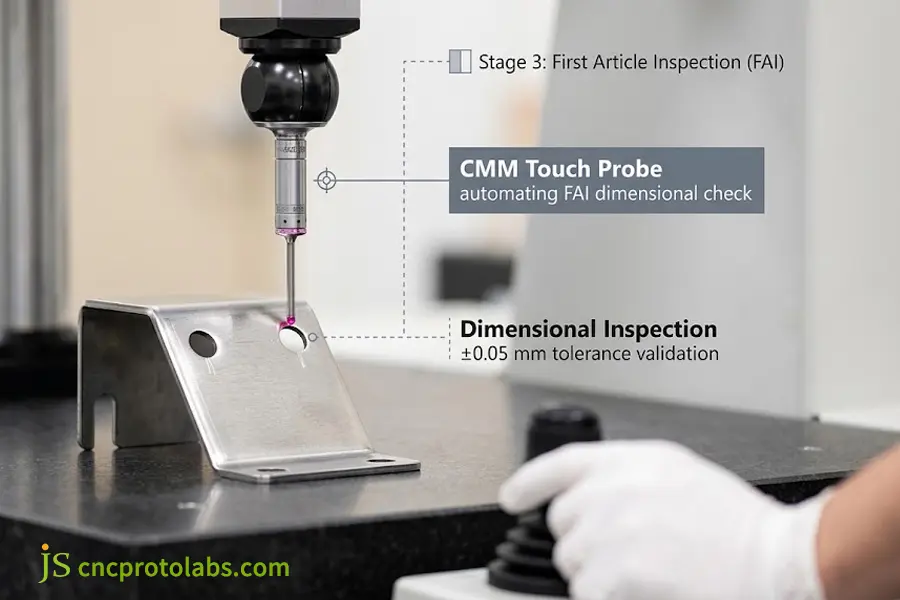
Figure 2: Automated CMM probe verifying stamped hole dimensions and tolerances within ±0.05 mm during first article inspection.
Procurement Safeguards: Low-MOQ and IP Security
We provide prototype manufacturing at 100 units using modular tooling, 10-day die modifications, and NDA contracts. For direct design feedback, request an engineering DFM review.
Technical Feasibility Support: Do you have a design that is ready to go into production? Talk to an Engineer directly to analyze strip layout and reduce upfront die expenditure.
How Was DFM Engineering Applied to Reduce Custom Metal Stamping Costs?
The industrial automation company was able to successfully transform their robotic mounting chassis design from multi-axis CNC milling to progressive die stamping thanks to JS Precision. DFM engineering optimization did not only solve costly tooling problems but also eliminated key bottlenecks of production throughput.
Project Overview: Transformation of Robotic Chassis to Stamping
- Customer Bottleneck: The production of an automatic robotics positioning chassis, which is made of 1.5 mm 304 stainless steel, was constrained by CNC machining with unsustainably high unit cost of $14.20 per piece and low monthly volume of 1,500 pieces.
- The Engineering Bottleneck: Stamping transformation was constrained by domestic quotes above $34,000 for progressive dies because of micro-flanges and over-tolerances of ±0.02 mm.
Engineering Solution and DFM Die Optimization
With the use of DFM techniques, tolerances for mounting holes without the need for tight tolerances were increased to ±0.08mm, the bend radius was set to 1.5 times material thickness (R2.25mm), and three brackets were joined into one bracket on 8-station progressive die.
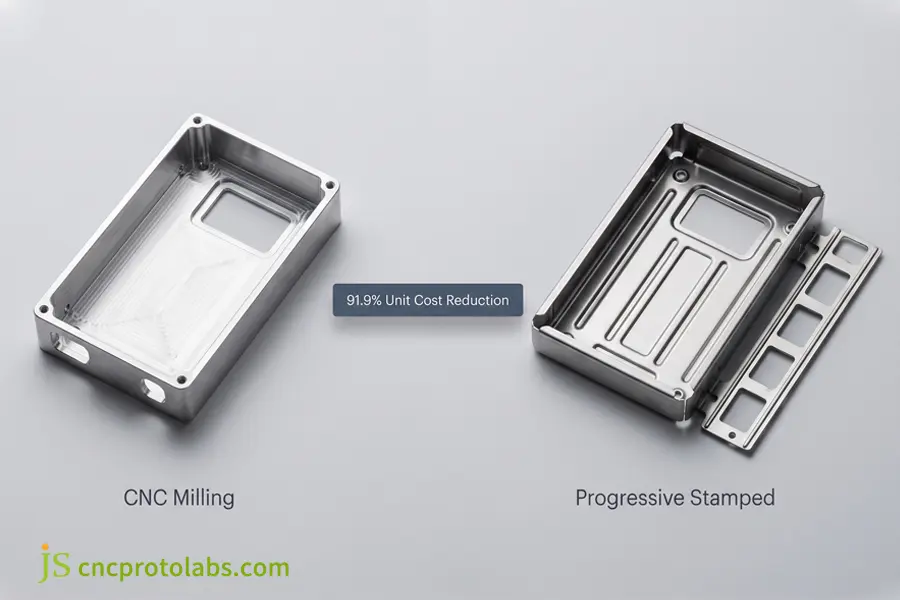
Figure 3: Converting the CNC-milled chassis to progressive stamping reduced tooling cost by 51.5% and unit part price by 91.9%.
ROI Comparison of CNC Machining and Optimized Progressive Stamping
Core Takeaway: DFM die consolidation allowed saving upfront tooling costs by 51.5%, reducing unit part cost.
| Project Metric | Original CNC Milling | JS Precision Stamping | Quantified Impact |
| Upfront Tooling (NRE) | $0 | $16,500 (vs. $34,000 bid) | 51.5% tool cost saving |
| Unit Part Price | $14.20 / pc | $1.15 / pc | 91.9% recurring reduction |
| Tooling Payback | N/A | 2,500 units | Full ROI within initial run |
| Annual Program Budget | $639,000 (at 45k pcs) | $68,250 (incl. tooling) | $570,000+ net savings |
| Monthly Capacity | 1,500 pcs (capped) | 45,000+ pcs | 30x throughput increase |
For system-level integration across hardware schedules, reference our complete sheet metal stamping guide.
FAQ
How much does custom metal stamping cost with low volume?
Production less than 1,000 units could have a tooling cost of between $2,500 and $8,000 and a cost of $1.50 to $5.50/unit. Higher die amortization due to high fixed cost could increase part costs. Single stage and laser tooling could be economical before progressive dies.
What does a metal stamping die cost and who owns it?
Die cost could be from $2,500 for blanking dies to $65,000+ for progressive dies. At JS Precision, dies belonging to customers belong to them 100%. JS Precision sharpens, services, and stores dies at no cost.
How much does metal stamping cost per part at high volumes?
For over 10,000 pieces, prices fall to $0.02 to $0.60 for regular steel, brass, or aluminum parts. Presses operating at 100 to 500 strokes per minute make direct labor costs pennies, with coil weight being the dominant cost element.
Is metal stamping cheaper than CNC machining at 1,000 units?
Flat simple products become equal in cost near 1,000 units, but complex products are more suitable for CNC machining up to 2,500 units. CNC machining is free from any tooling cost, compensating for high machine-hour costs.
What are standard production lead times, and can urgent orders be expedited?
Tooling fabrication and FAI sample submission take 15 to 25 business days. Production runs take 7 to 12 working days post-approval. Urgent orders can be expedited to 10 to 14 days for die completion.
What is JS Precision’s MOQ, and do you sign non-disclosure agreements?
JS Precision has no rigid MOQ, prototype batches start at 100 units via modular tooling. We sign bilateral NDAs before reviewing CAD files to protect client IP.
What warranty and corrective protections are provided if parts fail quality checks?
All shipments are accompanied by complete FAI reports, CMM inspection reports, and MTRs. When out of tolerance on 2D prints, parts are further analyzed by JS Precision for root-cause, tooling is recalibrated and batch remanufacture is completed within 5 days at our cost.
Summary
Calculating custom metal stamping cost requires balancing initial die fabrication expenses against volume amortization. While upfront tooling demands capital, high press speeds and optimized material strip layouts minimize recurring piece costs once production scales. Early DFM collaboration eliminates unnecessary stations and excessive tolerances before cutting tool steel.
Whether evaluating 1,000 prototype stampings or 100,000 serial components, confirm your project feasibility with an engineer-reviewed quote. Submit your 2D engineering drawings and 3D CAD models to Get a Free Quote within 24 hours, complete with an itemized tooling breakdown, scrap efficiency calculation, and volume pricing matrix.

Resource