English



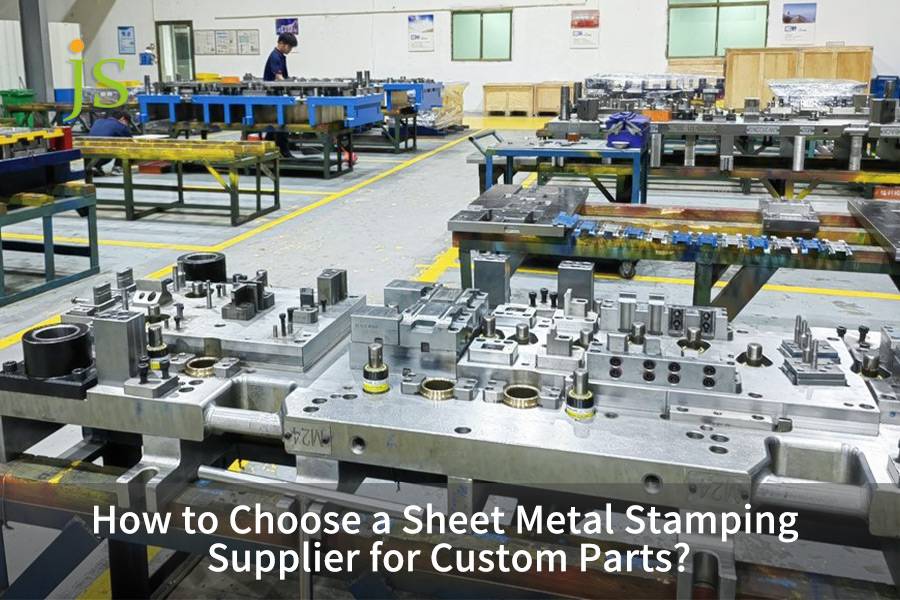

Choosing a reliable sheet metal stamping supplier requires auditing five key operational capabilities: verified press tonnage (25 to 500+ tons) matching part geometry, precision tooling tolerances (±0.002" or ±0.05 mm), ISO 9001/IATF 16949 certifications, flexible MOQ (100 to 100K pieces), and transparent lead times. Custom metal stamping is a high-speed cold-forming process converting sheet coils into complex parts using precision dies.
Summary of core answers
The bottom line for evaluating stamping suppliers is the precision and maintenance capabilities of their own mold workshop; priority should be given to source factories that provide DFM springback compensation design, promise lifetime maintenance-free molds, and support small-batch verification starting from 100 pieces.
|
Evaluation Dimension |
Threshold Standard |
Industry Excellence Benchmark (JS Precision) |
Procurement Impact |
|---|---|---|---|
|
Tolerances |
±0.005" (±0.12 mm) |
±0.0015"–±0.002" (±0.038–0.05 mm) |
Eliminates assembly interference, ensures automated assembly yield |
|
Tooling & Die |
Outsourced die, no in-house tryout press |
In-house wire EDM + precision die shop, lifetime maintenance |
Reduces trial iteration from 4 weeks to 10–14 working days |
|
MOQ Strategy |
Rigid 10,000+ pieces |
Tiered support: 100-piece soft tooling to 100K+ progressive |
Lowers NPI tooling sunk risk |
|
Quality Certifications |
Basic ISO 9001 only |
ISO 9001:2026 + Zeiss CMM + batch FAI reports |
Blocks batch cracking, burr excess, dimensional drift |
|
Lead Time & Rush |
Tooling 6–8 weeks, no rush |
Tooling 15–20 working days, rush samples 5–7 days |
Ensures new project timeline, prevents line shutdown |
Data source: JS Precision internal project benchmarks & ISO 9001:2026 (current edition; prior edition ISO 9001:2015) requirements.
How to Evaluate a Sheet Metal Stamping Supplier by Tolerance and Tooling Capabilities?
Evaluating a supplier's custom metal stamping tolerance capability starts with confirming whether the in-house tooling room can hold tolerances tighter than ±0.002" (±0.05 mm) on progressive dies. Precision die construction dictates final part dimensional repeatability, keeping springback and burr height under 10% of thickness across extended runs.
Classification and Decision-Making of Stamping Dies
The type of mold determines cost, delivery time, and quality. Mold precision is a key variable when assessing metal stamping tolerances.
- Engineering Single-Operation Mold (Soft Tooling): Suitable for 100–2,000 piece validation, mold cost starts at approximately $1,500, suitable for NPI stage.
- Progressive Die: Suitable for mass production of 10,000 or more pieces, with die cost of 5,000–25,000+, stroke speed of 60–120 strokes/minute, and low cost per piece.
- Decision threshold: Progressive die is better for batches > 5,000 pieces; laser cutting + bending is recommended for batches < 500 pieces.
Material Properties and Springback Compensation
The significant differences in yield strength among different materials directly affect mold design.
- SPCC cold-rolled sheet: yield strength 210 MPa, springback angle 1°–3°.
- 5052/6061 aluminum alloy: yield strength 130–240 MPa, springback angle 3°–6°, requires bending compensation of 2°–5°.
- SUS304 stainless steel: yield strength 520 MPa, punching gap increased to 12%–15% of material thickness, die material Cr12MoV or DC53, hardness HRC 58–62.
- C1100 copper: extremely high ductility, requires carbide punch + PVD coating, punching clearance 5%–8%.
Quality Control Hardware and Acceptance
Precision stamping relies on the accuracy of testing equipment and process control.
- Zeiss CMM: Measurement accuracy ±0.001 mm, for detecting flatness and position.
- Image measuring instrument: Quickly detects burr height and hole diameter, 3-5 times faster than CMM.
- Cpk ≥ 1.33: 99.97% of products are qualified.
ISO 2768-m: 1989 — General tolerances for linear and angular dimensions of formed sheet metal parts. Class "m" permits ±0.1 mm for dimensions up to 6 mm and ±0.3 mm for dimensions up to 30 mm. Precision stamping targeting ±0.05 mm must operate beyond this baseline.
Get a Free Quote — Receive a fully itemized DFM analysis and tooling cost breakdown within 24 hours.
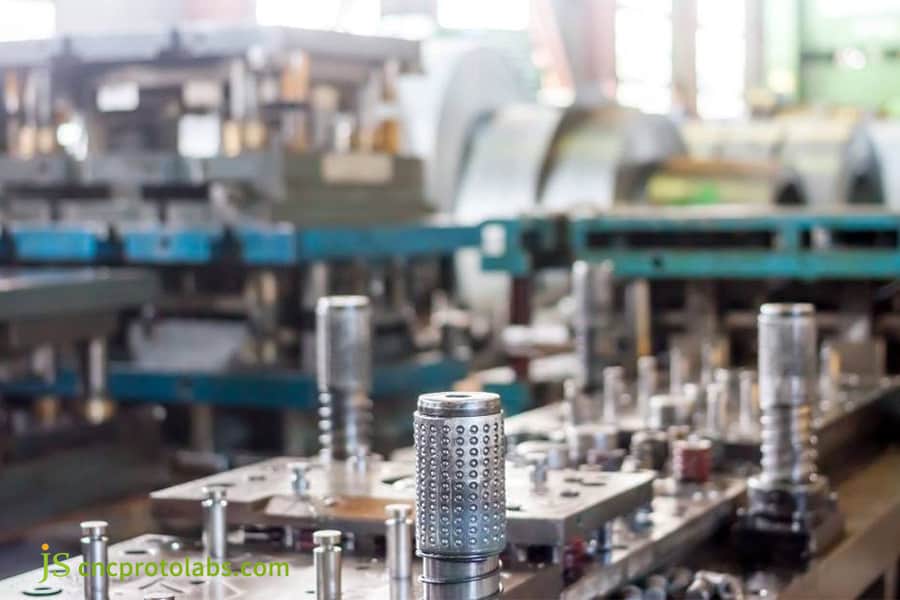
Figure 1: Close-up of progressive-die tooling components for sheet metal stamping in a factory.
How Much Does Custom Metal Stamping Cost Across Material and Volume Tiers?
A custom metal stamping quote ranges from $0.02 to $3.50 per unit depending on alloy grade, part complexity, and order volume, with upfront tooling costs between $1,500 and $25,000. Tooling absorbs most upfront capital, so per-unit price drops sharply with larger batches.
Four Elements of Quotation
Obtaining an accurate custom metal stamping quote requires confirming four cost modules. Understanding the cost differences between metal stamping and sheet metal fabrication when comparing different process routes helps in making the right choice—stamping is suitable for high-volume, low-cost production, while sheet metal fabrication is better suited for small-batch, high-complexity parts.
- Tooling/NRE: $1,500–$5,000 for a single operation, $5,000–$25,000+ for progressive dies.
- Material substrate cost: net weight + scrap rate 20%–40%, which can be reduced to 15%–25% after optimization.
- Punch press labor cost: $50–$150/hour, punching speed 60–120 strokes/minute.
- Post-surface treatment: electroplating $0.01–$0.10/piece, anodizing $0.02–$0.08/piece, passivation $0.005–$0.02/piece.
Price Range Table
To see how much custom metal stamping costs across materials and volumes, refer to the table below:
|
Material Grade |
Tolerance Class |
100–500 Pcs (Prototype) |
2,000–5,000 Pcs (Low Volume) |
20,000–100,000 Pcs (Production) |
|---|---|---|---|---|
|
SPCC Carbon Steel |
Standard ±0.005" |
$1.50–$3.50/pc + $1,500 tooling |
$0.35–$0.85/pc + $1,500 tooling |
$0.06–$0.18/pc + $1,500 tooling |
|
5052 Aluminum |
Standard ±0.005" |
$2.00–$4.50/pc + $2,000 tooling |
$0.50–$1.20/pc + $2,000 tooling |
$0.10–$0.28/pc + $2,000 tooling |
|
SUS304 Stainless |
Standard ±0.005" |
$2.80–$5.50/pc + $3,000 tooling |
$0.80–$1.80/pc + $3,000 tooling |
$0.18–$0.38/pc + $3,000 tooling |
|
SPCC Carbon Steel |
Precision ±0.0015" |
$2.50–$5.00/pc + $3,500 tooling |
$0.65–$1.50/pc + $3,500 tooling |
$0.12–$0.32/pc + $3,500 tooling |
|
C1100 Copper |
Precision ±0.0015" |
$4.00–$8.00/pc + $5,000 tooling |
$1.20–$2.80/pc + $5,000 tooling |
$0.25–$0.55/pc + $5,000 tooling |
Data sources: JS Precision internal cost database (2024–2026 project averages); ASTM A1008/A1008M-23 steel pricing benchmarks.
Optimization of strip layout
Metal stamping material costs account for 50%–70% of the unit cost; optimizing layout directly reduces the price.
- Initial layout: material utilization rate 55%–65%, waste rate 35%–45%.
- Optimized layout: Utilization rate can be increased to over 75%, and waste rate reduced to 15%–25%.
- Economic impact: For an annual output of 500,000 SPCC parts, raising material utilization from 60% to 75% yields annual savings of $12,000–$18,000.

How to Optimize Metal Stamping MOQ for Low Volume Custom Parts?
Balancing metal stamping MOQ for low-volume production involves deploying rapid prototype tooling or hybrid modular die sets to avoid high upfront costs. Using modular die holders and laser-cut die plates cuts initial tooling costs by 40% to 60%, enabling economical pilot runs of 100–1,000 pieces before committing to progressive dies.
Comparison between Soft and Hard Models
Metal stamping MOQ low volume custom parts requirements can be met with flexible molds. Many professional sheet metal stamping service providers offer such flexible mold solutions to help customers start with small batches.
|
Parameter |
Soft Tooling (Stage Tooling) |
Hard Tooling (Progressive Die) |
|---|---|---|
|
Tool life (strokes) |
1,000–5,000 |
500,000+ |
|
Tooling cost (USD) |
$1,500–$4,000 |
$5,000–$25,000+ |
|
Lead time |
10–14 working days |
15–20 working days |
|
Recommended batch size |
< 5,000 pieces |
> 20,000 pieces |
|
Per-unit cost at 1,000 pcs |
$1.50–$3.00 |
Not economical |
|
Per-unit cost at 50,000 pcs |
Not sustainable |
$0.05–$0.25 |
Data sources: ASM Handbook Volume 14B: Metalworking: Sheet Forming (2006).
Lifetime Mold Maintenance Commitment
JS Precision offers lifetime free mold protection: the initial mold belongs to the customer, and subsequent orders only incur material and labor costs; proactive maintenance every 50,000 strokes; and digitally traceable mold records.
What Determines Custom Metal Stamping Lead Time and How Are Expedited Orders Handled?
Metal stamping lead time expedited options average 3 to 6 weeks for tooling fabrication, plus 1–2 weeks for T1 samples and production. Rush orders achieve 5–7 day lead times via parallel wire EDM, pre-hardened tool steel blocks, and pre-allocated press capacity.
Standard Timeline
When a metal stamping supplier's lead time must be expedited, each stage can be compressed. Combined with a detailed quick-turn prototyping lead-time guide, you can see exactly where acceleration is possible at each stage:
- DFM review: 1–2 business days.
- Mold processing: 10–14 working days (CNC rough milling, wire EDM, heat treatment HRC 58–62, fine grinding and assembly).
- T1 trial run + FAI: 2 business days.
- Mass production: 10,000–50,000 pieces/day.
Expedited processing
- Standard molds are readily available, shortening the time by 3–5 days.
- With four wire EDM machines operating in parallel, the mold cycle time has been reduced from 14 days to 7–9 days.
- Pre-store Cr12MoV, DC53, and SKD11 billets.
- Reserve 20% of the punch press capacity each week, and put it into operation within 48 hours of receiving notification.
Which Metal Stamping Certifications and RFQ Specifications Protect Your Quality and IP?
A custom metal stamping quote must be backed by certifications such as ISO 9001:2015 for general industry, IATF 16949 for automotive, and ISO 13485 for medical-grade stampings. A comprehensive RFQ plus an NDA protects your CAD models and eliminates dimension issues.
Qualification Verification
Verify a supplier's certifications before requesting a custom metal stamping quote.
- ISO 9001:2026: Current minimum standard. Verify by logging into the CNAS/IAF website.
- IATF 16949: Essential for automotive parts, covering APQP, PPAP, FMEA, etc.
- ISO 13485: For medical stamping parts only, requiring traceability system and cleanroom.
RFQ File Package Specification
- 3D model (STEP/IGES) + 2D engineering drawings (annotated with Datums, GD&T).
- Material standards (ASTM/EN/JIS grades, thickness tolerances).
- Surface treatment (electroplated layer thickness, salt spray test duration ASTM B117 72h).
- Packaging form (bulk/carrier/pallet).
IP Protection
Reputable suppliers sign bilingual NDAs; CAD models are stored on independent servers; photography is prohibited in the workshop; mold drawings are encrypted; mold ownership belongs to the customer, and each mold is for dedicated use only.
How Are Critical Tolerances Achieved in Custom EV Stamped Components?
Achieving metal stamping tolerances requires compensating springback via predictive die geometry and precision inserts. For copper terminals, using micro-adjusted carbide punches and optical inspection holds planarity within ±0.025 mm and cuts defects below 0.2% over 250,000 cycles.
Background and Challenges
- Industry: Energy storage systems for new energy vehicles.
- Components: C1100 copper battery electrode busbar terminals, plate thickness 0.8 mm.
- Key requirement: Flatness of conductive surface ≤ 0.04 mm.
- Previous issues: Outsourced supplier scrap rate 18.5%, flatness deviation 0.06–0.12 mm, severe mold wear.
Solutions and Results
Strict metal stamping tolerances have driven four innovations. This case is also included in our sheet metal manufacturing guide as a prime example of challenging tolerance control:
- Die material upgrade: Carbide punch + PVD coating, life increased from 5,000 cycles to 50,000 cycles.
- Negative angle preload mechanism: Add 3° preload to counteract springback, and control flatness within ±0.025 mm.
- Layout optimization: Material utilization rate increased from 58% to 76%.
- Online optical full inspection: 180 pieces per minute are inspected, and out-of-tolerance products are automatically rejected.
- Quantitative results: 180 strokes/minute, 250,000 continuous strokes without downtime; flatness ±0.025 mm; defect rate reduced from 18.5% to 0.2%; first mold delivered in 18 working days.
Talk to Engineer to review bend radius allowances, material strip layouts, and tool amortization strategies.
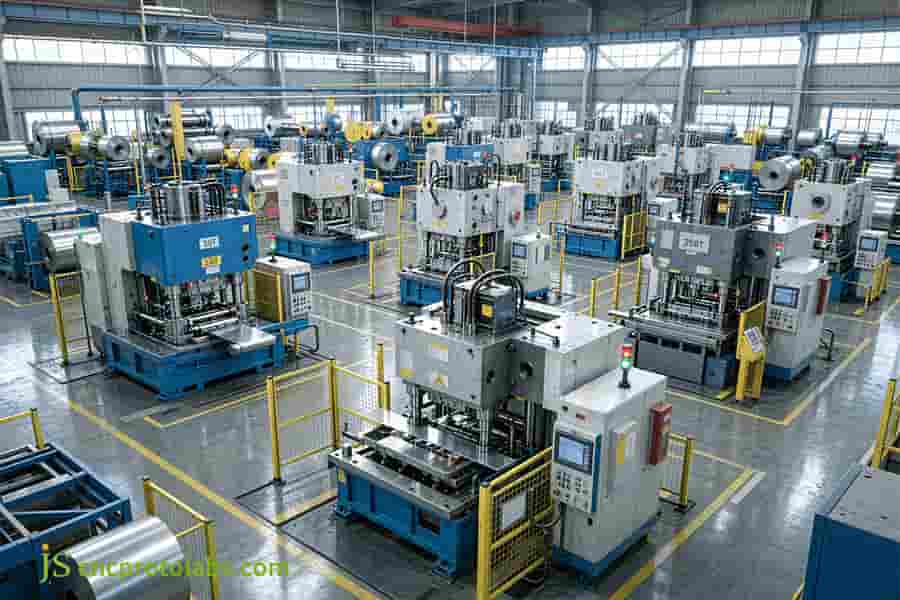
Figure 2: Row of stamping press machines with metal coils achieving critical tolerances in workshop.
FAQs
Q1: How much does custom metal stamping cost, and what factors drive the price?
The total cost of custom stamping consists of mold fees (1,500–25,000+), material costs (50%–70%), and labor costs. For high-volume production (>50,000 pieces), the cost per piece can be as low as 0.05–0.35. Tight tolerances, special alloys, and post-processing will increase the price.
Q2: Can I order custom stamped parts at low volume, and what is the typical MOQ?
Yes. Soft mold or laser blanking solutions support trial production of 100–500 pieces without incurring progressive die costs. Traditional factories typically require 10,000+ pieces, but modern factories can flexibly undertake small-batch NPI verification.
Q3: What is the standard metal stamping supplier lead time, and can it be expedited?
The standard cycle is 3–5 weeks (mold making) + 1–2 weeks (mass production). Expedited processing can reduce mold making to 10–14 working days and FAI samples to 5–7 days, relying on parallel processing and reserved capacity.
Q4: What are the typical metal stamping tolerances an overseas supplier can reliably hold?
Commercial grade ±0.005" (±0.12 mm), precision grade ±0.0015"–±0.002" (±0.038–0.05 mm). Depending on material thickness, tensile strength, and mold material, CMM testing is required to ensure Cpk ≥ 1.33.
Q5: How do raw material choices affect metal stamping material cost?
Raw materials account for 50%–70% of costs. SPCC is the most economical, followed by 5052 aluminum, while SUS304 and C1100 copper are significantly more expensive. Optimizing layout to increase utilization to over 75% can directly reduce costs.
Q6: Which metal stamping certifications should buyers verify before issuing a PO?
General-purpose parts require ISO 9001:2026; automotive parts require IATF 16949; medical parts require ISO 13485. Verify the certificate number (verifiable by CNAS/IAF) to confirm MTR, RoHS, and FAI reporting capabilities.
Q7: How do precision stamping suppliers protect proprietary CAD drawings and IP?
A bilingual NDA is signed; CAD files are stored on a separate server; photography is prohibited in the workshop; mold drawings are encrypted; molds belong to the customer, are for dedicated use only, and may not be transferred without permission.
Q8: What quality assurance protocols apply if stamped parts arrive out of specification?
The supplier will initiate 8D analysis within 24 hours. If the defect is confirmed to be due to mold or machining defects, the supplier will provide free mold repair, replacement, or a refund to ensure the buyer's production line continues uninterrupted.
Summary
The right stamping partner protects your product lifecycle, margins, and delivery reliability. A vertically integrated supplier with in-house mold machining, ISO certifications, and flexible volume ensures smooth scale-up from prototype to mass production.
- Upload Your Drawing to access real-time automated DFM feedback and manufacturability optimization.
- Get a Free Quote from JS Precision and receive an itemized, transparent pricing breakdown within 24 hours.
Disclaimer
The contents of this page are for informational purposes only. For JS Precision Services, there are no representations or warranties, express or implied, as to the accuracy, completeness, or validity of the information. It is the buyer's responsibility to identify specific technical requirements and request a formal parts quotation. Please contact us for more information.
Resource