English



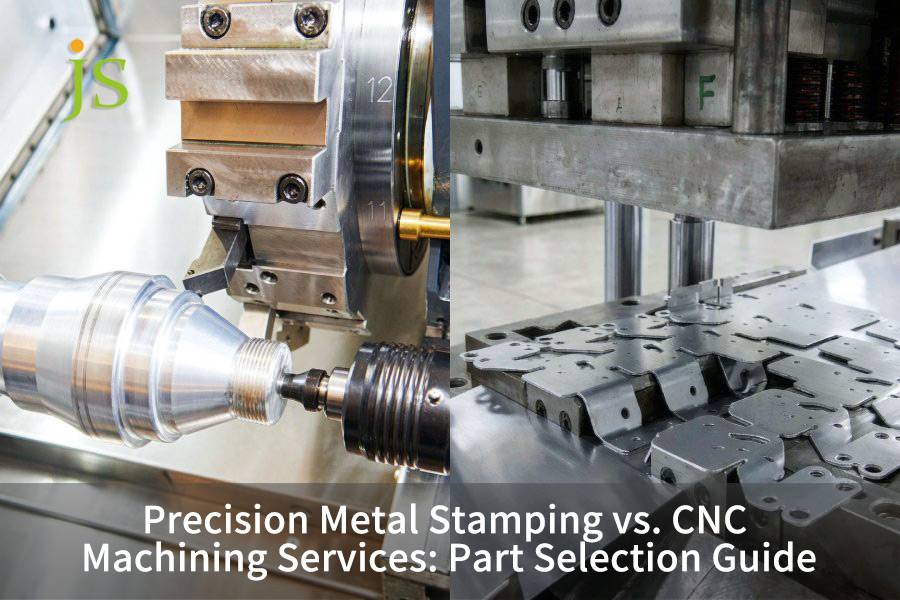

Precision metal stamping vs CNC machining is mainly influenced by production quantity, component configuration, and tolerance level requirements. Custom precision metal stamping offers very low unit price on identical thin-wall parts above 10,000, but precision CNC machining services offer a precision of ±0.005 mm on intricate 3D solid structures.
To ensure the perfect manufacturing solution, JS Precision takes into account the cost of custom tooling amortization and precision cutting workflow among other aspects.
Precision Metal Stamping vs. CNC Machining Service: Selection Matrix
|
Comparison Dimension |
Custom Precision Metal Stamping |
Precision CNC Machining Services |
|---|---|---|
|
Optimal Volume Range |
High volume production (>10,000 pcs) |
Prototype to mid volume (1–5,000 pcs) |
|
Tooling & Front Investment |
High tooling cost ($3,000–$30,000), 3–6 weeks lead time |
Zero tooling cost, programming setup only ($50–$300), first article in 24 hours |
|
Limit of Tolerance Precision |
Standard ±0.05 mm, precision progressive die ±0.02 mm |
Extreme tolerance up to ±0.005 mm (5-axis simultaneous) |
|
Geometry & Material Barrier |
Uniform wall thickness sheet parts, deep drawn parts (wall 0.1–6 mm) |
Any solid 3D complex structure, deep cavity, internal/external threads |
|
Single Piece Cycle Time |
Extremely fast (30–300 strokes per minute) |
Slower (cutting time 5–60 minutes per piece) |
Data sources: EMAG 2026 cost-benefit analysis. Metalli Industrial precision stamping guide. JS Precision 2025 internal process capability database.
Key Conclusions
- Cost Break-Even Point: If the annual demand is beyond the range of 5,000-10,000 units, the amortized cost of the stamping dies will become lower than the labor cost connected to the cumulative CNC machining time for each unit.
- Precision and Structural Thresholds: Parts with deep cavities, 3D curved surfaces, and threads require the precision of CNC machining, Then again, stamping is more often a good choice for uniform-wall-thickness sheet metal parts, as well as drawn housings.
- Cost Saving from a Hybrid Solution: In case of producing high quantity of parts with some localized tolerance requiring 0.005 mm, combining the benefits of stamping (for shape making) with CNC (finishing, precision of major details), the overall costs can be brought down by as much as 40%.
How to Calculate the Cost Break-Even Point for Precision Metal Stamping vs CNC Machining Services?
Precision metal stamping vs CNC machining cost break-even is achieved when your amortized tooling cost is less than the total of cumulative CNC cutting labor usually in the range of 5,000 to 10,000 pieces. Looking at cost stamping which gives a low unit cost, is a better option after this level.
Total Cost of Ownership (TCO) Model
TCO Formula: Total Cost = Tooling Cost + (Unit Cost × Production Volume)
Tooling Cost stands for a one-off and immovable tooling expense related mainly, but not exclusively, to molds or software setups. Unit Cost is the cost of producing one item, which usually includes cost of the material labor depreciation of plant and equipment, etc. Production Volume refers to total production quantity planned.
- Stamping View: Initial progressive die costs from 5,000 USD through 25,000 USD only, in contrast with stamping, the unit price after the production is just $0.15, per the EMAG 2026 cost-benefit assessment stamping needs high tooling investment at start but after mass production the cost of per unit falls dramatically,
- CNC View: Programming and setup charges from 100 to 300, unit machining costs (15 to 45) make total costs increase linearly at large volumes. CNC is attractive for a low-to-mid volume production scenario with the upfront capital requirement being lower.
Material Utilization and Scrap Rates
- CNC material wasted: By machining from solid blocks only very little work is done and the rate of scraps generated is about 60% - 80%.
- Stamping nesting efficiency: Making the most out of the sheet metal with stamping nesting techniques helps in material utilization exceeding 85%.
- Cost impact: At a production level of 1,000 units the stamping tooling cost vs machining show that stamping still yields lower per-unit manufacturing costs. JS Precision will accurately estimate your crossover point for every project that your client undertakes.
Engineering Assessment & DFM Entry
- DFM Review: By analyzing manufacturing data that reflects the real production floor, it might be concluded that an order of 1,000 units would make CNC the more cost-efficient solution, while production runs over 10,000 units definitely prefer high volume metal stamping.
- One-to-one Comparison: JS Precision's engineering crew delivers you a unique Total Cost of Ownership (TCO) report on your part detailing the financial comparison of precision metal stamping vs CNC machining.
IATF 16949:2016 requires: The organization shall implement a quality management system that demonstrates ability to consistently provide products that enhance customer satisfaction and meet regulatory requirements.
To comply with IATF 16949 criterion completely, JS Precision adds cost of quality tracking component to each TCO model. Tooling investment decisions consider both unit cost economics & zero defects production capabilities.
In simple terms, tooling expenses can be viewed as a membership fee, the higher the purchases, the greater the worth,however CNC is pay-per-use-flexible but expensive. Your yearly demand is basically the indicator of which one will be the cheapest of the two options, cost-wise.
To find out your cost break-even point, just send us your annual demand and material grade. Within 12 hours, you'll get your fully customized TCO comparison report, which you can download from the JS Precision platform.
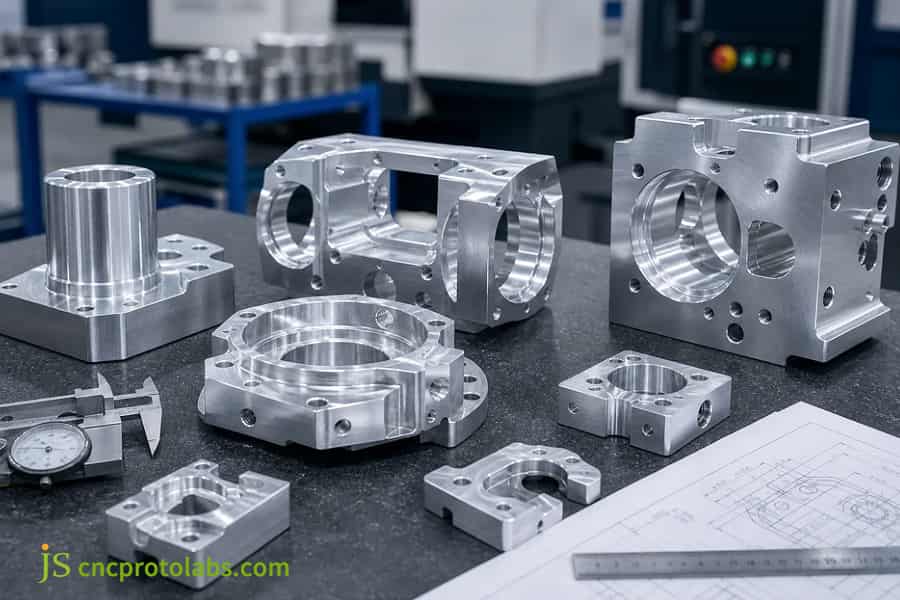
Figure 1: Precision machined parts and metal stamping components compared for cost analysis.
Is Your Part Geometry Better Suited for Custom Precision Metal Stamping or Precision CNC Machining Services?
Custom precision metal stamping is ideally suited for making sheet metal pieces of uniform wall thickness that can have cuts, bends, and deep-draw features. However, CNC machining is a requirement for solid-block parts, deep-cavity work, 3D stepped surfaces with complex geometries, and manufacturing internal threaded structures.
Sheet Metal Stamping Design Constraints
- Minimum Punching Diameter: The minimum required punching diameter is D≥1.2t (t = thickness of the material). Punching below this ratio may damage the material and tear it during blanking.
- Minimum Inner Bend Radius: The minimum inner bend radius is R≥1.0t, otherwise, micro-cracks at the edge can run along grain boundaries.
- Springback Compensation: JS Precision engineering staff compensates for the springback angle as the material yield strength by over-bending the part 2°–5° beyond.
- Deep Drawing Limits: 5052-H32 maximum deep drawing depth is 0.75 times the part diameter. If the value is exceeded, drawing should be multi-stage.
5-Axis CNC Geometric Capabilities
- Complex 3D Cavities: 5-axis simultaneous machining is a very effective method for deep pockets having depth-to-diameter ratio of 20:1 maximum.
- Precision Threading: With using 5-axis machining one can achieve precision of ±0.005 mm in pitch for M1.2 holes.
- Freeform Surfaces: Surfaces that are defined mathematically can be machined without being limited by mold geometry, i.e. Not restricted by the limits of traditional mold geometry that are based on physical shapes.
- Sharp Contrast with Sheet Metal Stamping Part Design: Stamping process doesn't allow to have overhangs, undercuts or enclosed hollow spaces.
DFM Cost-Reduction Redesign Guide
- Redesign from the machining to die stamping: JS Precision turns hollow parts, created on a machining centre, into assemblies of sheet metal and stamped stiffeners which cut the weight by 30%.
- Engineers Assessment: Our DFM engineers are using 3D CAD models to assess which features will be best converted from CNC machining to stamping while maintaining mechanical properties. For features that require CNC precision machining, precision CNC machining services are still the optimal choice.
In other words, stamping is like using a cookie cutter, the shape is limited only to what the template can do but the production is very fast and each piece does not cost very much. Whereas, CNC machining is compared to wood carving-anything can be made but it is slow going and expenses increase.
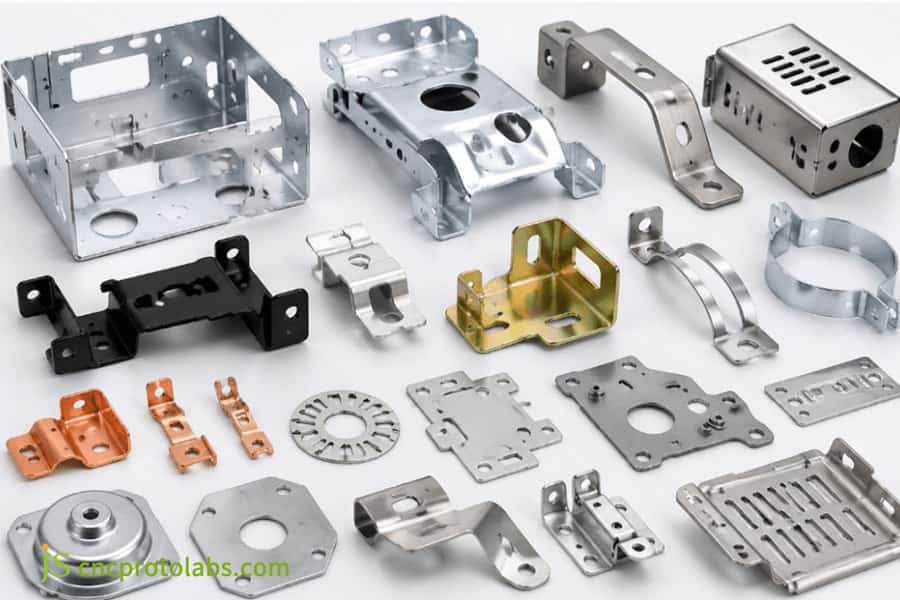
Figure 2: Assortment of stamped and CNC-machined metal parts for geometry suitability.
Can Precision Metal Stamping Service Achieve the Same Tight Tolerances as CNC Machining?
Precision metal stamping service generally maintains a ±0.05 mm tolerance whereas CNC machining can hold ±0.005 mm a great margin better. However, fine blanking utilizing progressive dies enables a ±0.015 ppm localized capability which is very close for the production of a large quantity of precision parts.
Comparison of Tolerance Mechanisms
- CNC thermal deformation: Using a 5-axis spindle runout of under 0.002 mm, and thermal compensation systems are employed to maintain dimensional stability for an entire 8-hours production cycle.
- StampingThickness variation: Gaps in sheet metal thickness, which can change by as much as ±0.01 mm, plus the effects of the material's elastic and plastic deformation, result in variation of the achieved tolerances. Stamping is different from CNC machining which has a high degree of closed-loop digital control.
- Fine Blanking Breakthrough: JS Precision's precision metal stamping service has broken through the traditional precision limits of stamping by integrating fine blanking technology with CCD optical inspection right in the progressive die.
Cpk and Process Capability Data
Based on JS Precision's internal measurements for the 316L stainless steel terminal project:
|
Process Method |
Tolerance Achieved |
Cpk Value |
Consistency across 500K cycles |
|---|---|---|---|
|
Conventional Stamping |
±0.05 mm |
1.33 |
Stable within ±0.08 mm |
|
Fine Blanking + Progressive Die |
±0.015 mm |
1.67 |
Stable within ±0.018 mm |
|
3-Axis CNC Machining |
±0.01 mm |
1.67 |
Stable within ±0.012 mm |
|
5-Axis CNC Machining |
±0.005 mm |
1.67 |
Stable within ±0.006 mm |
Data source: JS Precision JSP-FB-2025 internal process capability study, measured via ZEISS CMM.
ASTM E2282-09(2018) says: Capicity index measures like Cpk are a form of a statistical capability of the process which is indicated by the extent of the production of goods inside the tolerance zone specified.
The way JS Precision meets the automotive-part precision Cpk≥1.67 requirement, is by using fine blanking with an in-die CCD optical measurement device to ensure the dimensional consistency of metal stamping for precision parts within ± 0.015 mm during 500000 strokes.
Hybrid Process Solution
- Stamping main body: The outer profile, bending and pre-piercing by the progressive die are accomplished with 0.015mm accuracy (the same as ±0.0015mm or mm).
- CNC finishing of critical surface details: The 5-axis CNC completes a secondary precision milling of mounting surfaces, bearing holes, and threads to achieve a ±0.005mm tolerence. It`s here that precision CNC machining services make their difference.
- Outcome: Thanks to combination of technologies you get at once the economy of stamping at large volumes and the accuracy of CNC machining at the micro level.
In simple terms, conventional pressing is akin to cutting paper with scissors, swift yet edged results that are not too precise, the fine blanking + CNC blending method is as cutting paper and afterwards smoothing the sides with a hobby knife, not only a rapid process but one that also leads into high accuracy.
Send tight-tolerances drawings to JS Precision where you will be provided with: precision sampling reports, and feasibility assessments for hybrid manufacturing process(es), engineering comments within one business day.
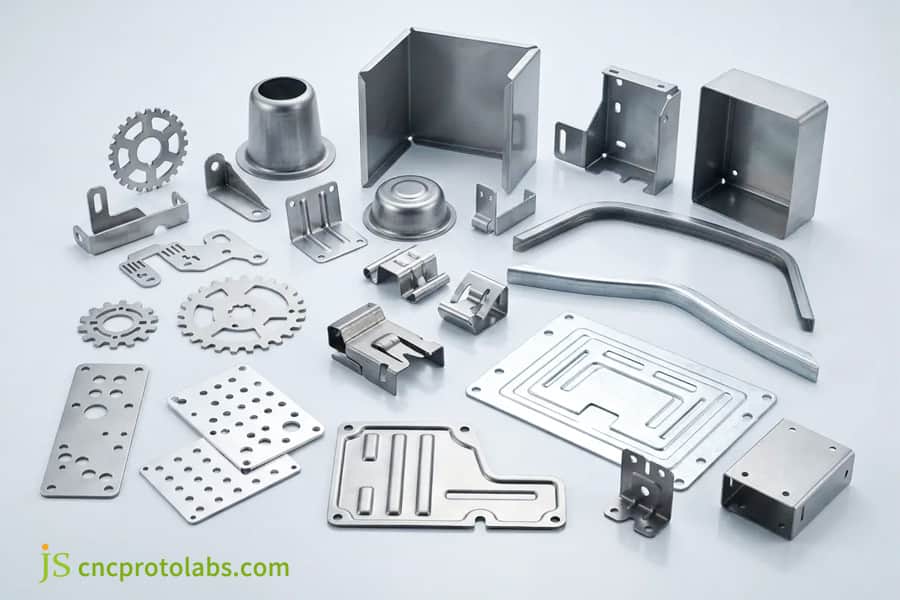
Figure 3: Precision metal stamping service components and CNC machined parts layout.
How Do Material Properties Impact Process Selection Between Custom Metal Stamping and CNC Machining?
The best way to do custom precision metal stamping is by starting out with highly ductile materials like 5052-H32 aluminum and C1100 copper, meanwhile, materials that are very hard or free-cutting like 6061-T6 aluminum and 17-4PH stainless steel are usually chosen for CNC machining.
Material Adaptability by Process
|
Material Grade & Temper |
Stamping Suitability |
CNC Suitability |
Best Process |
|---|---|---|---|
|
5052-H32 Aluminum |
Excellent (Exceptional formability, ideal for deep drawing and bending) |
Poor (Produces gummy, sticky chips; tool adhesion) |
Stamping |
|
6061-T6 Aluminum |
Poor (Low formability; cracks during bending) |
Excellent (Tensile strength 290–310 MPa; clean chips) |
CNC |
|
304 Stainless Steel |
Fair (High work-hardening rate; springback and cracking risk) |
Fair (Machinability rating ~45%; requires sharp tooling, positive feed to cut below work-hardened layer) |
Depends on volume |
|
C1100 Copper (H02) |
Excellent (Ductility 14% elongation; ideal for electrical contact stamping) |
Poor (Machinability rating 20%; built-up edge, long stringy chips) |
Stamping (high volume) |
|
17-4PH Stainless (Condition A) |
Not feasible (Hardness HRC 38–44) |
Good (Machines at same parameters as 304; age-harden after final machining) |
CNC |
Data sources: Yongxc 2025 (5052-H32 vs 6061-T6 formability). LSRPF 2026 (material utilization rates).
Pitfalls Regarding Material Temper/Condition
- Wrong Tempered Material: Stamping in 6061-T6 usually leads to cracking, which results in a 15-25% scrap. Switching to 6061-T4 or 5052-O can reduce the scrap to around 3% or so. Correct material tempered is vital for a custom metal stamping success.
- Value of Scrap Recovery: 17-4PH ($4.0/kg) and 304 stainless steel ($3.2/kg) are two types of metals whose scrap has very good recovery value, compared to it 5052-H32 ($1.2/kg) is low in this aspect which is one of the important points in the calculation of the total cost. CNC milling of these metals, results in turning of 60-80% of the raw stock into chips and scrap.
- Material Selection Discussion: JS Precision's senior material engineers look at your parts' functional requirements and suggest the best suited material grade and heat treatment condition.
Come to senior material engineers of JS Precision who can recommend the material grades and heat treatment condition suitable to your parts' requirements which will not lead to very high scrap rates from wrong material selection.
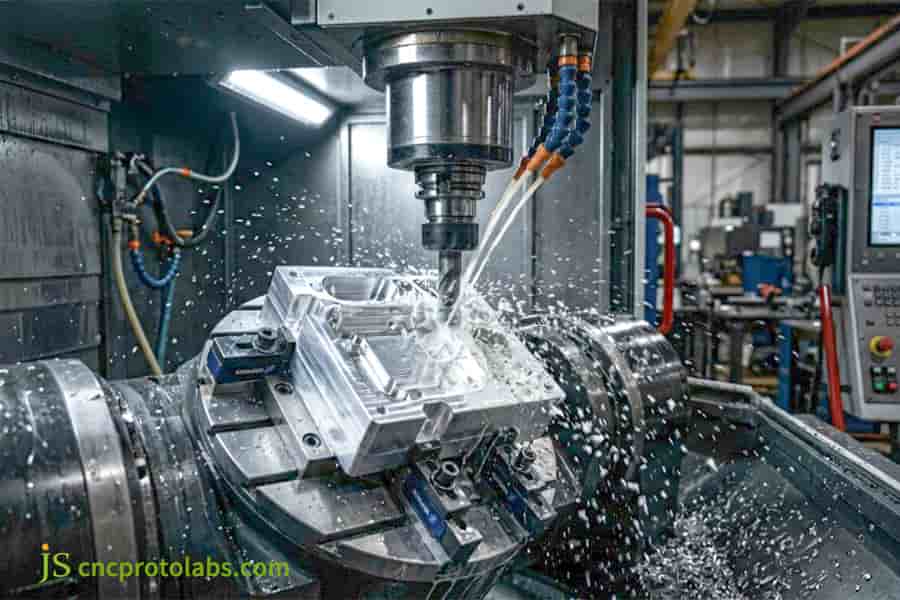
Figure 4: CNC machining center with coolant spraying on metal parts.
What Are the Production Lead Times for High Volume Metal Stamping vs Precision CNC Machining Services?
High volume metal stamping is the main method of mass production by working at speeds of 300 strokes per minute or something, while machining on the numerical control machine can provide first samples in 24, 48 hours in the prototyping stage.
Lead Time for Prototyping (1-50 Pieces)
- CNC Prototyping: CAM programming is followed by machine tooling. So, the first part is available 24, 48 hours after CAM programming.
- Stamping Prototyping: A single wire EDM die is manufactured in 5-7 days, a carbide progressive die takes 3-5 weeks for the tool to be completed (with two rounds of trials and adjustments).
- JS Precision Advantage: We have an in-house workshop that allows smooth and seamless changeover from prototyping for design validation on a computer numerically controlled machine to using progressive dies manufacturing during massive production.
Mass Production Lead Time (100,000 units)
- Standalone 3-axis CNC: if 15 minutes for 1 product is taken for manufacturing, it can be estimated that manufacturing 10,000 units will require 15,000+ minutes, i.e. 2500 hours or about 104 days.
- Automated CNC Line: 5 minutes per unit 500+ hours (about 21 days), 3 times faster than the standalone machine.
- High-speed Stamping Press (300 SPM): 0.2 seconds/stroke Total time less than 2 hours (including feed setup), over 300 times faster than 3-axis CNC.
- Progressive Die Stamping (150 SPM): 0.4 seconds/cycle Time less than 4 hours, 150 times faster. For high volume metal stamping, the speed advantage is extremely obvious.
Accelerated Time-to-Market
- Parallel Development: JS Precision uses parallel manufacturing where CNC machine prototyping starts at the same time with progressive die fabrication, making it possible to overlap 3-5 week lead times of a single process.
- Fast Production: An order of one hundred thousand parts will be entirely stamped out on a high-speed stamping press (300 SPM) in less than 6 hours, while an automated CNC line would take more than 200 hours for the same task.
Balancing fast prototyping with efficient mass production? precision CNC machining services of high precision allow rapid early-stage validation and an easy switch to stamping for mass production.
JS Precision Automotive EV Terminal Case Study: How Custom Precision Metal Stamping and CNC Machining Hybrid Process Reduced Unit Cost by 42%?
JS Precision merged stamping with CNC finishing techniques so we could cut the unit cost for the copper battery terminals (C1100, 150,000-unit annual volume) down to 42% lower.
Customer Challenge:
To meet the demand, the North American Tier-1 automotive supplier ordered C1100 copper EV battery terminals (annual demand 150,000 units). When using an all-CNC machining solution originally, the cycle time was only 18 minutes per part, and yet the material waste rate reached 72%, which caused the unit price to increase to $18.50. Not only that, the contact and threading surfaces specifications had strict geometric tolerances (±0.008 mm), stamping was not able to meet these specifications. So, a combination of custom precision metal stamping and CNC machining was needed.
JS Precision Solution
- Pre-forming: The stamping blanking, bending at 90-degree, and contacting pre-piercing with deep holes in one tool was achieved with an 11-station progressive stamping die, and the material utilization was increased from 28% to 84%.
- Finishing by CNC: The development of pneumatic positioning fixtures allowed the application of multi-axis CNC machining not only for high-quality contact surface milling (Ra 0.4 roughness) but also for the use of precision M6 threading with servo-driven tapping heads. This proved that the precision advantages of precision CNC machining services are valuable for critical features.
- Integration of processes: Stamped semi-finished parts were effortlessly moved to a CNC machine, eliminating the need for re-clamping and thereby avoiding cumulative tolerance errors.
Lessons Learned
During a first experimental run, it was found that a 0.03 mm displacement occurred in the CNC clamping reference point due to the spring-back during stamping/bending, a consequence of the very gentle nature of c1100 copper. To prevent further spring-back and deviation issues, the engineering team introduced coining at the eighth press station on the progressive die, completely eliminating residual stress and alignment errors. This problem-solving experience was afterwards incorporated into JS Precision Standard Operating Procedures (SOP) related to copper component hybrid processing.
Quantifiable Results
- Through cycle time reduction: The unit processing time was reduced from 18 minutes to 45 seconds (1s stamping + 44s CNC finishing) which means production capacity is increased by 24 times.
- Cost reduction: Cost per unit decreased from 18.50 to 10.73 that is 42% cost saving.
- Quality validation: The products cleared 1,000-hour salt spray and electrical conductivity tests, as well as achieving a Cpk of 1.67 during a 500k units production run. It's a perfect example that shows the reliability of hybrid process combining metal stamping for precision parts with CNC machining.
If you upload your complex metal part drawings to JS Precision, our DFM team can offer you a unique process optimization plan together with the latest innovations in tolerances and cost through hybrid manufacturing.
Why Partner with JS Precision for Custom Precision Metal Stamping and CNC Machining Services?
At JS Precision, you're not stuck with one option between precision metal stamping vs CNC machining, we own a tooling workshop for precision as well as advanced 5-axis CNC machining centers, meaning we provide only factual, ideal manufacturing solutions considering your project budget and production stage.
- Synergistic Dual-Process Capacity: High‑speed presses (25T‑400T, 30–300 SPM) and over 80 3‑to‑5‑axis CNC machines cover everything from prototypes to millions of parts. Services include CNC prototype validation, progressive die making, mass stamping, CNC finishing, and coating. Whether you need a direct precision metal stamping service or precision CNC machining services, we can fulfill it.
- Rigorous quality control under dual certifications: Zeiss CMM inspects 100% of critical dimensions, optical projector checks stamping features to 0.005 mm, in‑line SPC monitoring ensures Cpk ≥ 1.67.
- Clear pricing & DFM support: Free 24‑hour DFM review, TCO cost comparison (stamping vs CNC) tailored to your volume, and worldwide air/sea freight logistics for convenient delivery.
FAQs
Q1: What is the main difference between precision metal stamping vs cnc machining?
Stamping uses custom dies to rapidly form sheet metal parts, making it ideal for high-volume, low-unit-cost production. CNC machining removes material from solid blocks via cutting, it needs no tooling and offers exceptional geometric flexibility and tolerances as tight as 0.005mm.
Q2: How much does custom precision metal stamping tooling cost compared to CNC setup?
Stamping tooling costs range from $3,000 to over $30,000 with a 3-6 week lead time, whereas CNC setup fees are only $50-$300, with first-article delivery within 24 hours. JS Precision helps you to calculate an amortized tooling cost based on your annual volume.
Q3: Can JS Precision convert my CNC machined part design into a precision metal stamping part?
Yes. We utilize DFM (Design for Manufacturability) optimization to modify solid CNC parts to economical precision stamped sheet metal parts. We also make adjustments to wall thicknesses, bend radii, and load-bearing points to achieve the same level of structural strength with minimum cost reduction of up to 50%.
Q4: What production volume makes high volume metal stamping cheaper than CNC machining services?
Usually break-even cost point of the two options is somewhere between 5,000 and 10,000 units. Below 5,000 units, the lack of tooling expense in the CNC is a key thing making it the more favored choice. Above 10,000 units, the metal stamping is so much cheaper per-unit that the tooling expense becomes negligible.
Q5: How do I get an accurate quotation for precision metal stamping service from JS Precision?
Upload your design drawings on our website portal, stating which type of metal, surface finish, dimensions, and the number of units that will be produced during a year. Our engineering department will study the request and will get back to you in 12 hours with a complete cost sheet, a Total Cost of Ownership (TCO) breakdown also will be part of it.
Q6: Which process offers better material utilization: metal stamping for precision parts or CNC milling?
Nesting optimization in stamping results in 80-90% raw material utilization. As long as complex deep cavities are made in a milling machine the material recovery might go down to 20-40%. At JS Precision the cost of a scrap is included in each quotation.
Q7: What standard tolerances can JS Precision guarantee for precision cnc machining services?
Our standard CNC machining tolerances are always ±0.01mm, but if we apply a 5-axis simultaneous machining technology that can give even tighter limits of ±0.005mm. The inspection of every product using a Zeiss CMM is a requirement before the factory release.
Q8: Is it possible to combine stamping and CNC machining for a single custom precision part?
Yes. JS Precision applies a combination of technologies: progressive dies stamp the main body in large batch stamping but then the precision CNC machining can be applied to create important features.
Summary
Decision-making between stamping and CNC is a matter of thorough assessment of different factors: lot size, level of detail, degree of material waste, precision requirements. Stamping is economically feasible soon mainly when very large volumes are required. CNC Then again is very suitable to fast development and short-run production of parts even quite difficult to make. Knowing the cost-efficiency turnover point you will save money without compromising quality.
If you send your 2D/3D drawings to JS Precision, we will immediately give you free DFM analysis and cost estimate comparison between stamping and CNC manufacturing. Our highly skilled technical department will inspect drawings, advise on changes (if any), and deliver price offer that is as short as 12 hours.

Disclaimer
The contents of this page are for informational purposes only. For JS Precision Services, there are no representations or warranties, express or implied, as to the accuracy, completeness, or validity of the information. It is the buyer's responsibility to identify specific technical requirements and request a formal parts quotation. Please contact us for more information.
JS Precision Team
Custom manufacturing solutions. With over 15 years of experience serving more than 1,000 customers, we specialize in high-precision CNC machining, sheet metal fabrication, 3D printing, injection molding, and metal stamping. Having successfully delivered over 300,000 precision parts, we maintain a 99.2% on-time delivery rate across all custom projects.
Our facility is equipped with over 100 state-of-the-art 5-axis machining centers and is ISO 9001:2015 certified. We deliver fast, efficient, and high-quality manufacturing solutions to B2B clients across 150 countries. Whether you require low-volume prototyping or large-scale customization, we support your project with lead times as short as 24 hours. Choose JS Precision for unparalleled efficiency, quality, and professionalism.
To learn more or submit your RFQ, visit our website: www.cncprotolabs.com
Resource