English



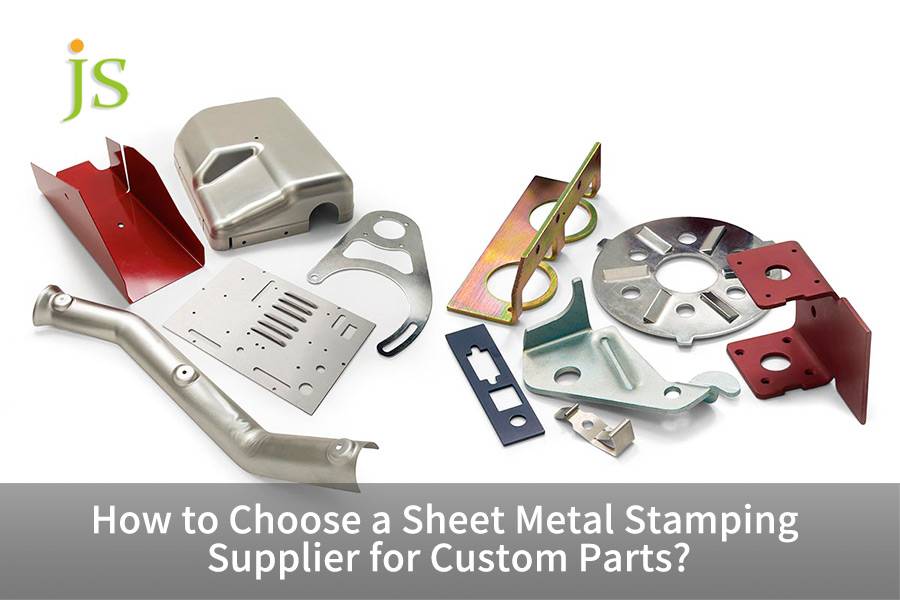

Custom metal stamping is a cold forming process that uses specialized dies to shape flat sheet metal into complex three-dimensional parts. This process applies pressure exceeding the material's yield strength using specialized dies, enabling shearing, bending, and deep drawing operations with tolerances controlled within ±0.02 mm . This method is suitable for high-volume, high-precision production in the automotive, electronics, and medical industries.
Summary of core answers
Customized metal stamping achieves micron-level tolerances by combining precision die clearances, multi-station progressive transfer, and controllable cold plastic deformation, thereby enabling ultra-high-speed mass production.
|
stamping dimensions |
Key engineering mechanisms and control parameters |
Industrial manufacturing standards and production limits |
|---|---|---|
|
tool |
Upper and lower dies fit together, single-sided cutting clearance 5%–10% t , guide post fit tolerance ≤0.003 mm, insert hardness 58–62 HRC (Rockwell C hardness). |
The polished area is controlled to be ≥50%, eliminating excessive burrs and withstanding million-level stroke loads. |
|
process |
Coil leveling → Servo feeding → Guide pin correction (positioning tolerance ±0.01 mm ) → Cutting/forming → Strip separation |
Operating at a pace of 200-800 SPM eliminates cumulative pitch errors and achieves full automation. |
|
Parts forming |
Shearing, V/U bending ( R/t≥1.0 , over-bending compensation of 1°-5° springback), multi-stage progressive deep drawing ( LDR 1.8-2.1 , where LDR = ultimate drawing ratio, the ratio of the maximum billet diameter to the cup diameter) |
Dimensional tolerances conform to DIN 6930-2 f (±0.02 mm), and material utilization rate is 75%-90%. |
Data source: DIN 6930-2:2011 , Precision stamped steel parts – Tolerances and technical delivery conditions.
What is a metal stamping die? How does it cut metal?
Metal stamping dies are precision tool steel components that cut thin metal sheets within a calibrated gap of 5%–10% of the material thickness by controlling mechanical shearing.
Compatibility of core components and molds
The core components of the die include upper and lower die bases, ball bearing guide pillars and bushings (fitting tolerance ≤0.003 mm), stripper plate, punch, and die inserts (AISI D2/DC53, hardness 58–62 HRC). The upper and lower die bases bear the pressure, and the guide pillars prevent eccentric force ; the stripper plate eliminates material accumulation during the punch retraction process ; the punch and die are made of high-hardness tool steel, ensuring a service life of millions of strokes.
Stamping machinery and clearance control
The stamping process is divided into four stages: elastic deformation, plastic shear (bright band ≥50%), crack propagation and fracture, and end burrs.
The clearance on one side is c = (5%–10%) × t; too small a clearance will cause misalignment of the upper and lower cracks and chipping of the edges; too large a clearance will cause corner collapse and rough burrs . The mold uses the upper and lower cutting edges to "press" the metal within a specific clearance, and the clearance determines the smoothness of the edges.
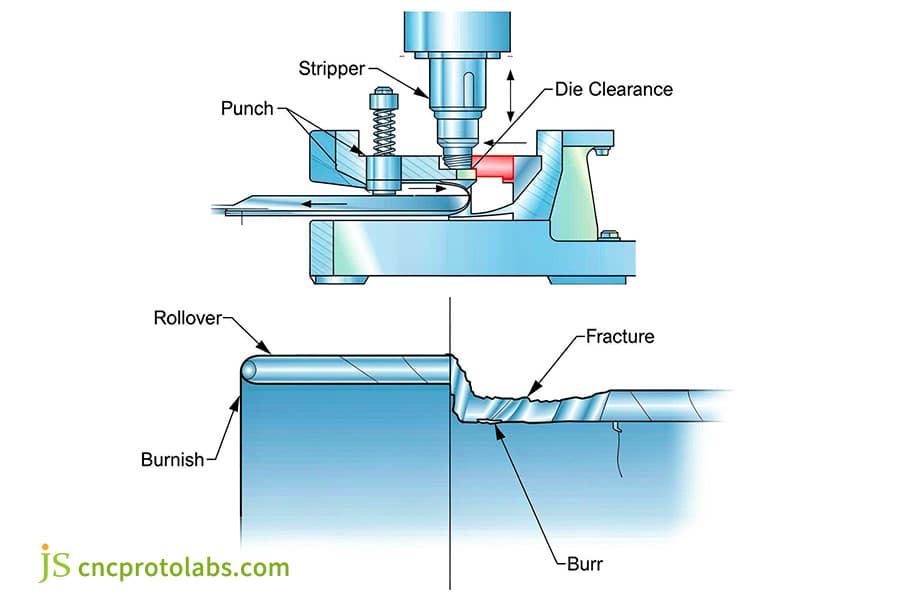
Figure 1: Schematic diagram of metal stamping die cutting thin metal sheet, showing the punch and clearance.
What are the key steps in the metal stamping process?
Metal stamping processes follow five systematic steps: automated uncoiling and leveling, servo roller feeding, progressive die stamping, online visual inspection, and secondary surface finishing. In modern progressive die systems, the coil material progressively passes through sensor-monitored guide stations that ensure positioning accuracy of ±0.01 mm. Subsequently, a high-speed mechanical press performs progressive shearing and cold deformation cycles at a rate of 200 to 800 times per minute.
Unfolding and leveling:
The coil material is leveled by a leveling machine to eliminate residual rolling stress and ensure that the flatness of the sheet is ≤0.20 mm/m before entering the die. This step is crucial for preventing cumulative feeding errors and laying the foundation for high-precision stamping ; it is especially effective in preventing feeding blockages when processing ultra-thin strips.
Servo roller feeding:
The CNC servo rollers feed material at preset intervals, achieving millisecond-level synchronization with the rotation angle of the press crankshaft, ensuring feeding accuracy within ±0.01 mm . This process is also equipped with photoelectric sensors to detect dual feeding and prevent mold damage caused by material overlap.
Pilot Badge:
Guide holes are pre-punched at the edge of the strip; tapered guide pins are finely adjusted and locked in position before the die closes, reducing the positioning tolerance to ±0.01 mm . This completely eliminates accumulated errors and ensures that the feature deviation at the final station remains within 0.02 mm.
Multi-station machining execution:
This stamping press operates at a high speed of 200 to 800 strokes per minute, sequentially performing operations such as scrap trimming, embossing, bending, and stamping . Compared with traditional mechanical stamping presses, modern servo stamping presses have improved bottom dead center repeatability by 30% and significantly enhanced stroke adjustment range, enabling them to meet different forming height requirements.
Parts cutting and inspection:
Finished parts are separated from the carrier belt and their critical dimensions are inspected by a high-speed CCD vision system to ensure a 100% quality pass rate . Defective parts are automatically ejected to a scrap bin by compressed air, thus achieving fully automated, unattended production.
|
scope |
Traditional mechanical press |
Modern servo press |
High-speed hydraulic press |
Transfer press |
|---|---|---|---|---|
|
Tonnage curve |
Fixed at a position close to the bottom dead center |
Adjustable throughout the entire trip |
Constant tonnage available |
Fixed high tonnage |
|
Lower dead point repeatability |
±0.1 mm |
±0.02 mm |
±0.05 mm |
±0.1 mm |
|
Itinerary adjustability |
No |
Yes, programmable. |
Yes, via limit switches. |
No |
|
Maximum speed |
200-400 |
200-800 |
50-150 |
15-40 |
|
Mold changeover time (minutes) |
30-60 |
10-20 |
20-40 |
60-120 |
Data source: JS Precision internal process database (2023), based on more than 150 stamping projects.
Stamping is like a miniature assembly line , where metal strips move step by step, and the stamping machine shapes them in sequence to finally obtain the finished product.
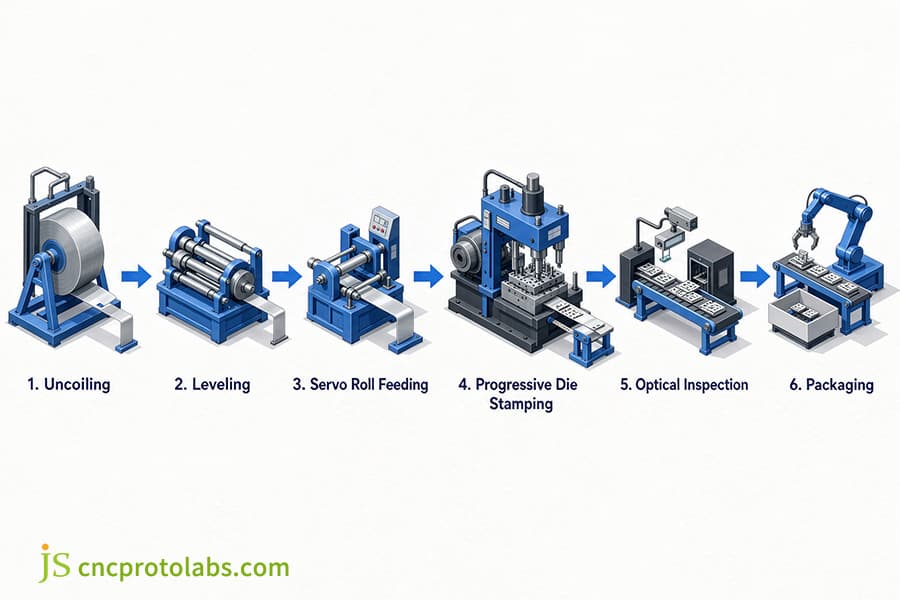
Figure 2: Flowchart showing the metal stamping process steps, from uncoiling to factory packaging.
How does part forming transform a thin metal sheet into a three-dimensional geometric shape?
Stamped parts achieve complex 3D shapes through localized stress, which exceeds the yield strength but is below the ultimate tensile strength.
Shearing
Pure shear stress dominates, with a clearance of 5%–10% t, a bright band of ≥50%, and the cutting edge requires re-grinding of 0.02–0.05 mm every 100,000–200,000 strokes.
Contour Curve
The outer side is under tension, and the inner side is under compression. The K coefficient is 0.33–0.50 (K coefficient = the ratio of the neutral axis position to the thickness of the sheet during bending), and R/t ≥ 1.0 to prevent cracking; the springback angle is 1°–5°, and over-bending compensation or indentation treatment is required.
Continuous dark drawing
LDR 1.8–2.1, pressure on the clamping ring surface 1.5–3.0 MPa, wrinkle-resistant. JS Precision uses a stepped deep drawing process for mass production of connector housings, reducing the deep drawing process of SUS304 from 4 steps to 2 steps, while achieving a material utilization rate of 85%. Clearly defining the boundary conditions between sheet metal stamping and deep drawing during the process planning stage can avoid cost waste caused by improper selection.
|
Material |
Tensile strength (MPa) |
Yield strength (MPa) |
Elongation (%) |
Recommended minimum bending radius (R/t) |
Rebound compensation (°) |
|---|---|---|---|---|---|
|
C5191 Phosphor Bronze |
390-510 |
250-350 |
15-25 |
0.8 |
2-3 |
|
5052-H32 Aluminum Alloy |
210-260 |
130-180 |
7-12 |
1.0 |
3-5 |
|
SUS304 stainless steel |
520-720 |
210-310 |
40-50 |
1.0 |
4-6 |
|
DC01 cold-rolled steel |
270-410 |
140-280 |
28-35 |
0.5 |
1-2 |
|
Brass C2600 |
300-420 |
150-250 |
35-45 |
0.6 |
1.5-2.5 |
Data source: ASTM B103/B103M-19 Phosphor Bronze Plate, Sheet, Strip and Rolled Bar Standard Specification.
The molding process causes permanent deformation of the sheet material, but does not tear it; the mold must be deliberately over-bent by a few degrees to counteract springback.
What are the advantages of progressive die application compared to other stamping methods?
Progressive die stamping integrates multiple processes into a continuous coil feeding station array, offering superior performance compared to compound dies and conveyor presses in high-speed, high-volume production . Compound dies are used for single-pass blanking and punching, producing flat parts; while progressive dies can produce complex, high-precision parts, with an annual output exceeding 100,000 pieces, covering fields such as automotive powertrain wiring harnesses, medical sensor shielding covers, and microelectronic connectors, with zero transfer deviation between stations.
- Progressive die: continuous roller feed, carrier series, 200–800 SPM, annual output ≥50,000 pieces, pitch accuracy ±0.01 mm.
- Composite mold: single-station concentric blanking and punching, coaxiality ±0.01mm , unable to perform three-dimensional bending processing.
- Conveyor mold: After blanking is completed at the first station, the part is conveyed by a robotic arm at a speed of 15–40 SPM , which is suitable for large deep-drawn parts.
Metal stamping applications include automotive powertrain wiring harnesses, medical sensor shielding, and microelectronic connectors. Examples include 1.20 mm tin-plated copper busbars (±0.03 mm) and 0.20 mm nickel-silver shielding (coplanarity ≤0.05 mm). Progressive dies offer the advantages of high speed and high consistency, making them ideal for high-volume production.
Progressive dies are like miniature automated production lines inside a mold, where rolled materials are fed in at extremely high speeds and finished parts are ejected at extremely high speeds.
If you are evaluating process routes and cost reduction plans for a specific project, you can refer to JS Precision's "Complete Guide to Precision Metal Stamping Services " to compare die life curves and overall economic cutoff points for different batches.
Frequently Asked Questions
Q1: What is the minimum bending radius required for custom metal stamping?
For low-carbon steel and semi-hard brass, a bending radius (R) ≥ 1.0 × t can prevent outer arc cracking; for hardened aluminum alloys or stainless steel, a radius ≥ 1.5-2.5 × t is required; when the bending axis is parallel to the rolling pattern, the radius must be increased by 20%-30% to prevent intergranular cracking.
Q2: How can engineers prevent burrs from forming on stamped metal parts?
The key to preventing burrs is to set the single-sided punching gap to 5% to 10% of the material thickness and keep the cutting edge sharp. If the cutting edge wears more than 0.05mm, it will lead to cracks, misalignment, and excessive burrs. In this case, the die core cutting edge must be re-grinded.
Q3: What is the difference between progressive die stamping and transfer die stamping?
Progressive dies connect parts at a speed of 200-800 times per minute via side brackets , suitable for small and medium-sized precision parts; transfer dies use robotic arms to transfer parts after punching at the first station, and are designed specifically for large deep-drawn parts.
Q4: What tool steels are typically used for metal stamping dies?
For medium-volume production, select AISI D2/DC53 cold work die steel (58-62HRC); for stamped stainless steel or producing more than 3 million stamped parts per year, insert tungsten carbide with a hardness of 88-92HRA into vulnerable parts.
Q5: How does springback affect the tolerances of stamped parts?
Springback refers to the dimensional change caused by the elastic recovery of a material after unloading. The springback angle of high-strength alloys is 2° to 8°. Engineers use simulation, calculation, and preset bending angles, bottom surface embossing, or reinforcing ribs to forcibly counteract springback.
Q6: What is the typical production volume threshold for custom stamping to be profitable?
The development cost of progressive dies ranges from $5,000 to $50,000, with economic benefits depending on production volume. Costs can be reduced if annual production reaches 10,000 to 50,000 pieces or more. For pilot production of fewer than 1,000 pieces, laser cutting and CNC bending are recommended.
Q7: What are the standard dimensional tolerances that can be achieved in custom metal stamping?
According to DIN 6930-2 f standard, the tolerance of precision progressive die is ±0.02mm, and the bending angle is ±0.5°-1.0° ; fine blanking technology can improve the smoothness of strip to over 90% , and the hole spacing tolerance is ±0.01mm.
Q8: How does sheet metal thickness affect the tonnage requirements of a stamping press?
The tonnage is directly proportional to the material thickness t, shear perimeter L, and shear strength τ (P=L×t×τ) ; the tonnage gradually increases with the increase of thickness, and a margin of 20%-30% should be reserved when selecting to prevent the machine from jamming.
Summary
Customized metal stamping processes achieve a balance between dimensional repeatability, mechanical integrity, and cost-effective mass production through synchronized die design, automated workflows, and controlled forming processes . Precise control over clearance, pitch, and springback ensures accurate tolerances.
For a deeper understanding of process selection, please refer to our "Continuous Die Stamping vs. Transfer Stamping: A Comparison Guide to DFM and Costs," which compares the die life curves, feature interference limits, and break-even points of the two mainstream mass production forming solutions.

Disclaimer
The content on this page is for informational purposes only. JS Precision Services makes no representations or warranties, express or implied, regarding the accuracy, completeness, or validity of the information. It is the buyer's responsibility to determine specific technical requirements and request a formal parts quotation . Please contact us for more information.
Resource