English



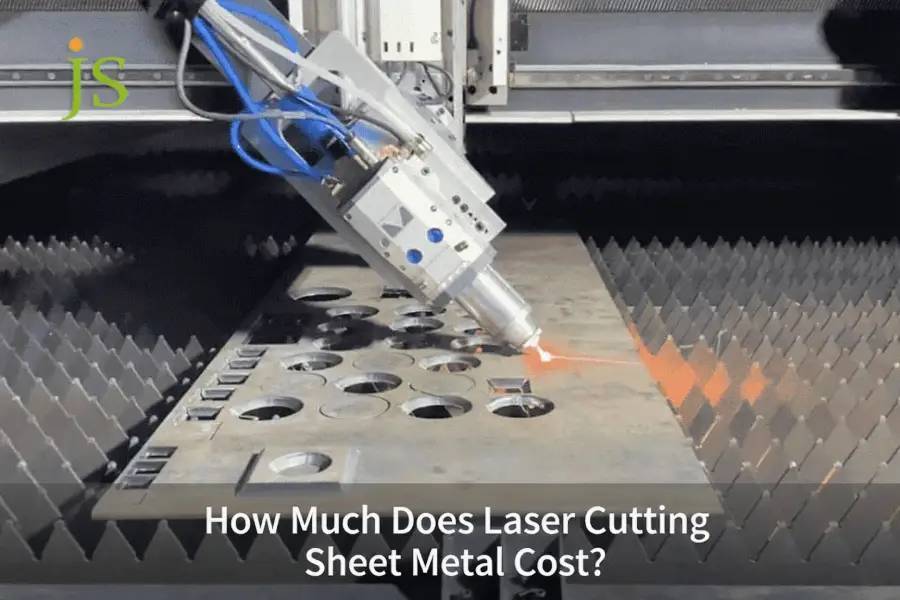

Laser cutting sheet metal cost ranges from 0.40 to 8.50 per part for standard sheet thicknesses (1 mm to 6 mm), dictated by machine hourly rates ($60–$150/hr), dynamic nesting yield, and piercing counts. Laser cutting cost is defined as the total manufacturing expense required to profile sheet metal stock into finished 2D contours using a focused thermal photon beam assisted by high-pressure gas.
Core Overview Table: Laser Cutting Cost Dimensions
|
Core Dimension |
Benchmark Range / Metric |
Key Cost Drivers |
Industry Benchmark & Standard |
|---|---|---|---|
|
Equipment Runtime Fee |
$60 – $150 / hr |
Laser power (3kW vs 12kW+), assist gas type |
12kW fiber cuts 200%–300% faster than 3kW |
|
Cost per Meter Cut |
$0.45 – $5.50 / m |
Thickness (1mm vs 12mm), assist gas (O2/N2/Air) |
Complies with ISO 9013 cut classification |
|
Piercing Penalty per Hole |
$0.03 – $0.25 / hole |
Thickness, piercing method (blast vs pulse) |
Multi-stage pulse adds 1.5–3 sec/hole for >8mm |
|
Material Nesting Yield |
68% – 92% |
Part geometry, common-line cutting |
Below 70% yield raises material cost ≥25% |
|
Volume Amortization |
65%–80% cost reduction above 500 pcs |
Programming fee ($30–$80/batch) dilution |
FMS automation cuts downtime loss by 40% |
According to ISO 9013:2017, Thermal cutting — Classification of thermal cuts — Geometrical product specification and quality tolerances defines cut surface roughness and tolerance grades for laser cutting.
According to JS Precision 2025 production data, material yield and piercing density directly determine final unit pricing.
In practical quoting, the delivered price depends on net material utilisation, pierce count per part, and assist-gas pressure — factors that go well beyond cut length alone.
What Is the True Formula Behind Laser Cutting Sheet Metal Cost?
The true formula for laser cutting sheet metal cost aggregates raw material weight including scrap margin, active laser run time, piercing penalties, auxiliary assist gas consumption, and fixed programming overhead. Custom laser cutting service providers evaluate total pricing as:
Cost = (Material Gross Weight × Raw Price) + (Run Time × Machine Rate) + (Piercing Count × Piercing Cost) + (Gas Volume × Gas Rate) + (Setup Fee ÷ Quantity)
This formula deconstructs the actual billing logic in the workshop, covering five major variables: materials, labor hours, perforation, gas, and fixed costs, providing an engineering mathematical foundation for accurate pricing.
Two relationships drive machine-time cost: feed rate falls non-linearly as sheet thickness rises, and rapid-traverse (G00) time grows with pierce count and part spacing. Both must be modelled rather than estimated when quoting run time. CAM programming and nesting setup cost $30–$80 per batch, and this non-recurring charge must be amortised across the whole order quantity. Piercing and the associated laser-on time add more than 30% to the total cutting cycle, directly increasing machine-time cost.
Per ASTM A370-22, Standard Test Methods and Definitions for Mechanical Testing of Steel Products, tensile testing defines the yield and tensile values used to verify incoming sheet. Material weight, however, is calculated from nominal thickness × density (7.85 g/cm³ for carbon steel) plus the mill thickness tolerance band — not from A370.
According to JS Precision 2025 production data, piercing penalties account for 22%–28% of total laser cutting cost for medium-complexity parts.
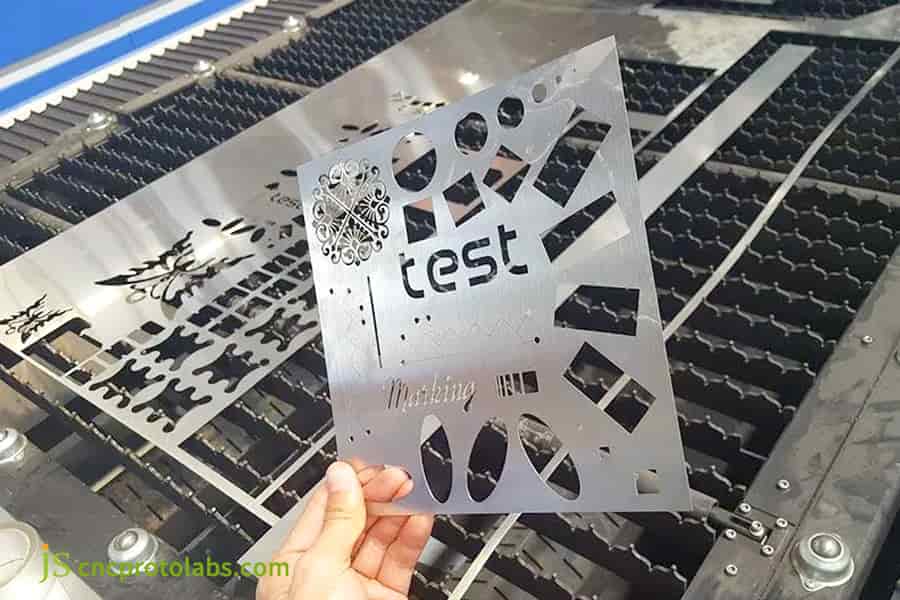
Figure 1: Hand holding a laser cut test plate with various shapes and holes over the machine bed.
How Do Material Grades and Thickness Drive Custom Laser Cutting Pricing?
Material grade and thickness dictate laser cutting price through cutting feed rates, photon absorption efficiency, and required auxiliary gas pressures. Feed rate collapses as thickness rises: 1.5 mm carbon steel cuts at 18.0 m/min on a 3 kW fiber laser, 3 mm drops to 8.5 m/min, and 6 mm 304 stainless falls to 1.6 m/min — the last requiring 25 bar nitrogen and a 12 kW source (see matrix below). Reflective alloys like brass and aluminum demand high peak-power fiber sources to eliminate back-reflection damage, adding a 15% to 35% processing surcharge.
Differences in cutting parameters under different materials and thicknesses
- Feed rate, gas pressure and power requirement differ sharply across cold-rolled steel (SPCC/CRS), 304/316 stainless, 5052 aluminium and C260 brass — at 1.5 mm, 3 mm and 6 mm (see parameter matrix below). Stainless steel at 6mm thickness is 120% more expensive per meter compared to carbon steel made to the same specification.
- Cutting 6 mm stainless requires a large-diameter nozzle and high-purity nitrogen at 20 bar or above to purge viscous high-alloy slag from the kerf. Energy and gas consumption per metre rise by roughly 180% versus the same thickness in carbon steel.
Processing Mechanism and Cost Premium of Highly Reactive Materials
- Fiber lasers operating at 1.06 μm are absorbed more efficiently by aluminium and brass, but those same alloys reflect much of the incident energy at the cut front. Cutting them therefore requires back-reflection protection for the optics and 15%–35% more peak power than mild steel — which is why reflective alloys carry a processing surcharge.
- Reflectivity forces a large reduction in feed rate on materials such as C260 brass, so sustained throughput requires high peak-power fiber sources.
Typical Material & Thickness Cutting Parameters and Cost Matrix
|
Material & Thickness |
Assist Gas (bar) |
Cutting Speed (m/min) |
Cost per Meter ($/m) |
Power Requirement (kW) |
|---|---|---|---|---|
|
Carbon Steel 1.5mm |
N2 (15) |
18.0 |
0.65 |
3 |
|
Carbon Steel 3mm |
N2 (18) |
8.5 |
1.20 |
6 |
|
Carbon Steel 6mm |
O2 (1.5) |
3.2 |
2.10 |
6 |
|
Stainless 304 1.5mm |
N2 (20) |
12.0 |
1.10 |
3 |
|
Stainless 304 3mm |
N2 (22) |
5.5 |
2.40 |
6 |
|
Stainless 304 6mm |
N2 (25) |
1.6 |
4.60 |
12 |
|
Aluminum 5052 3mm |
N2 (18) |
6.0 |
2.80 |
6 |
|
Brass C260 3mm |
N2 (20) |
4.5 |
3.80 |
12 |
Cutting 6 mm 304 costs 120% more per metre than 6 mm carbon steel ($4.60/m vs $2.10/m) because the viscous slag demands far more laser energy and high-pressure nitrogen to eject.
Per ISO 9013:2017, Thermal cutting — Classification of thermal cuts — Geometrical product specification and quality tolerances, a thermal cut is graded on perpendicularity or angularity tolerance and on surface roughness. This is the tolerance language your drawing should reference when specifying laser-cut edges.
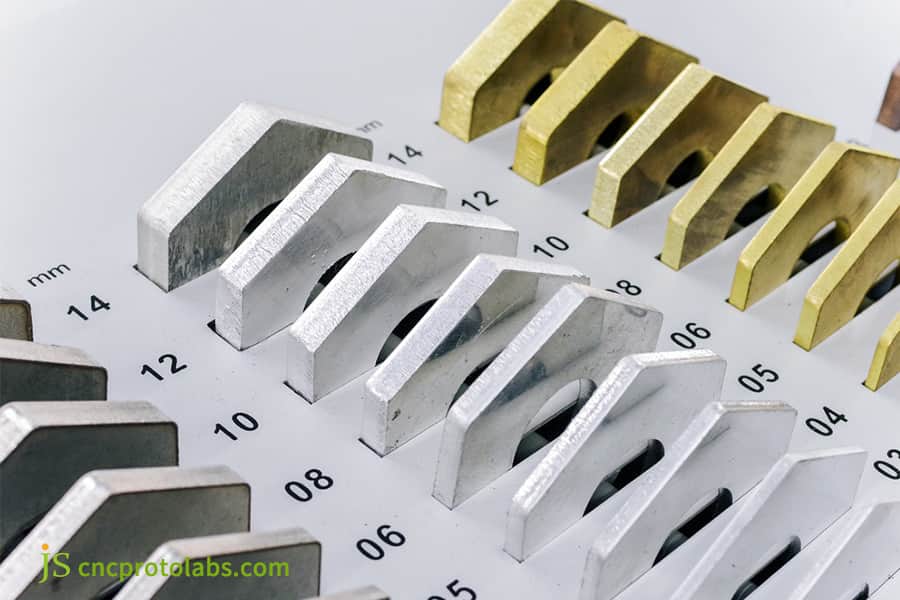
Figure 2: Laser cut parts of varying thicknesses with markings for custom cutting pricing.
How Does Assist Gas Selection Dictate Fabricating Costs in Laser Cutting?
Assist gas choice directly creates cost divergence in laser cutting for metal fabrication, swinging hourly operating costs by 8 to 25 per cutting head. Oxygen supports exothermic reactions for thick mild steel at low pressures (0.5–2 bar), minimizing gas cost but leaving a hard oxide skin requiring removal. Nitrogen prevents oxidation for clean weld-ready edges on aluminum and stainless steel cutting but requires high pressures (15–25 bar) and high purities (99.999%), substantially inflating gas expenses per meter.
Cost comparison between oxygen and nitrogen cutting
- Oxygen is the cheapest assist gas and, at 0.5–2 bar, drives an exothermic reaction that adds heat to the cut — the standard choice for thick carbon steel. The trade-off is a hard oxide scale on the cut face that must be removed by pickling or grinding before welding or coating, which adds a secondary operation.
- High-purity nitrogen (N2) at 15–25 bar and 99.999% purity prevents the oxidation of stainless steel and aluminum. Gas accounts for more than 30% of operating cost on nitrogen cutting — reaching $18–$28 per hour at 8 mm thickness.
Feasibility analysis of high-pressure air cutting
- For 4 mm carbon steel and aluminium alloys, high-pressure air (roughly 78% nitrogen / 21% oxygen) costs 15%–20% less per machine hour than piped liquid nitrogen, delivering roughly 30% total savings on structural parts that do not require oxide-free edges.
- The laser cutting fabrication process needs a four-stage filtration and drying system to make sure a dew point ≤ -40°C for the prevention of lens contamination.
JS Precision internal test data
In the 2025 aluminum plate cutting project, JS Precision cut 3 mm 5052 aluminium with 16 bar clean compressed air instead of 22 bar liquid nitrogen. Assist-gas cost per part fell to 35.8% of the nitrogen baseline — a 64.2% saving — with cut-surface roughness held at Ra ≤ 3.2 μm. For thin-gauge parts with non-critical edges, compressed air removes most of the cost of high-purity nitrogen.
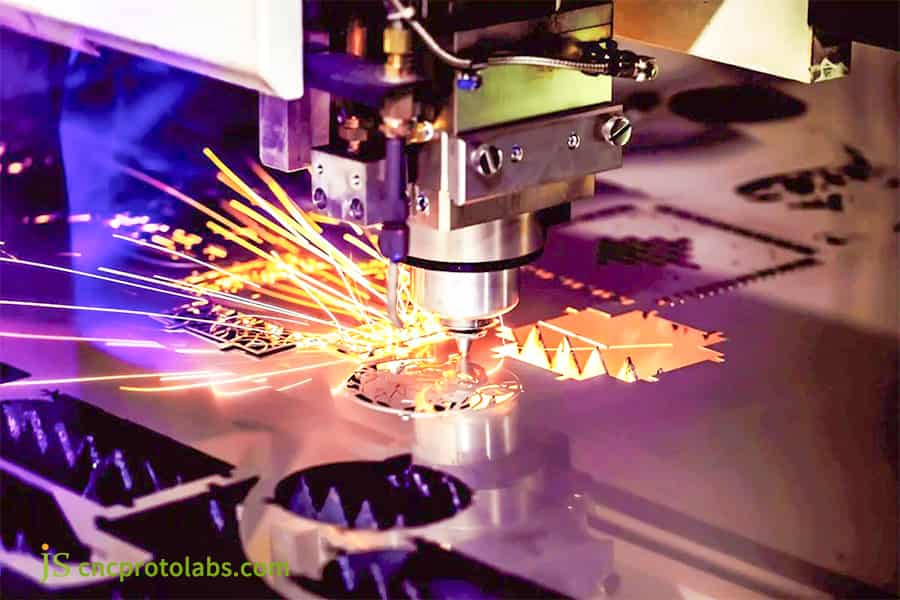
Figure 3: Laser cutting machine cutting a detailed gear shape with bright sparks flying.
How Does Nesting Efficiency and Skeleton Scrap Impact Unit Cutting Cost?
Nesting efficiency dictates unit cost by determining the billable raw material yield per master sheet during laser cutting fabrication. Unoptimized part geometries yielding 65% utilization force the buyer to fund 35% residual skeleton scrap at full raw material price. Advanced algorithmic nesting and common-line cutting (sharing a single cut path between adjacent parts) boost utilization rates past 85%, total cutting beam travel distance by 15% to 30% and directly lowering both raw material consumption and machine run hours.
Skeleton scrap pricing rules and layout optimization
- The cost charged for the scrap skeletons by outsourced manufacturers equals the price of the raw materials. In this case, if the utilization rate of the panel is 65%, the buyer will have to pay for 35% scrap which results in a significant increase per unit cost.
- Utilization through the use of advanced algorithm nesting can be increased beyond 85%, so reducing laser head idle travel by 15%–30%, and also reducing material and machine time cost.
Common edge cutting and micro-connection process
- Common-line cutting lets adjacent parts share a single kerf, eliminating one full pass and cutting pierce count by roughly half. Micro-tabs (micro-joints) hold small parts in the skeleton so they cannot tip up and collide with the cutting head.
- Pairing rectangular parts with L-shaped parts in the nest raised utilisation from 68% to 88% in our 2025 runs, cutting raw material per part by 22.7% and laser processing time by 14.5%.
According to JS Precision 2025 production data, nesting yield optimization directly lowers unit cutting cost by 15%–30%.
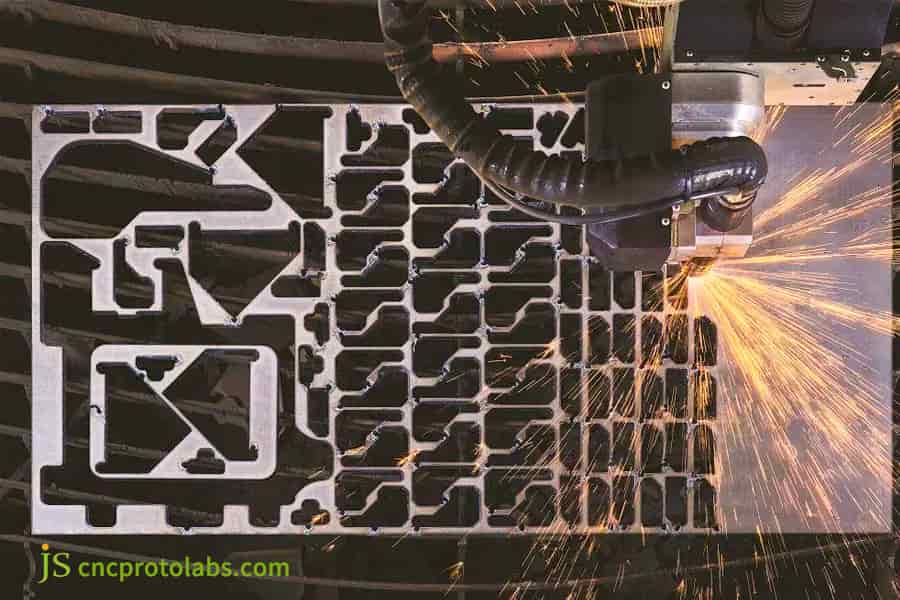
Figure 4: Laser cutting a densely nested metal sheet with various cutouts and bright sparks.
Why Do Post-Processing Requirements Cause Secondary Spikes in a Laser Cutting Quote?
Post-processing specifications cause sudden escalations in a laser cutting quote by introducing secondary manual and mechanical labor cycles beyond the primary cutting bed. While raw as-cut sheet edges retain micro-burrs, dross, and thermal oxidation layers, downstream applications often demand vibratory deburring, automated edge rounding, or surface pickling. Manual dross removal on thick plate adds $0.15 to $0.80 per linear meter, transforming a standard laser cutting fabrication task into a multi-stage production workflow.
Downstream process breakdown and cost increment
- Mechanical deburring, automated edge rounding (to R0.5–R1.0mm to prevent coating delaminating), pickling and passivating the heat-affected zone (HAZ), and leveling (to eliminate thermal stress warping caused by the manufacturing process).
- If a drawing calls for deburring without specifying an ISO 13715 edge condition, the fabricator will quote to the tightest grade by default, adding 25%–40% to unit cost.
Post-Processing Operation Cost Increment Comparison
|
Process Category |
Cost Increment Ratio |
Industrial Standard |
Edge Tolerance Achieved |
|---|---|---|---|
|
Mechanical Deburring |
+10%–15% |
ISO 13715 |
Ra 3.2–6.3 μm |
|
Edge Rounding R0.5–R1.0 |
+15%–20% |
ISO 13715 |
Radius R0.5–1.0 mm |
|
Pickling & Passivation |
+20%–30% |
ASTM A380 / ASTM A967 |
Oxide-free bright |
|
Precision Stress Leveling |
+25%–35% |
ISO 2768-2 |
Flatness ≤0.2 mm |
Clearly indicating the edge tolerance level in engineering drawings can effectively prevent contract manufacturers from calculating polishing costs based on the highest specifications by default, thus avoiding unnecessary price spikes.
According to ISO 13715:2017, Technical drawings — Edges of undefined shape — Vocabulary and indications define edge condition requirements for deburring operations.

How Does Production Volume Dramatically Lower Unit Laser Cutting Price?
Production volume drives unit pricing down exponentially in a sheet metal laser cutting service due to the amortization of fixed non-recurring engineering (NRE) charges and optimized material logistics. On a 1–5 piece prototype run, fixed CAM programming, machine setup, optical alignment and sheet loading cost $50–$150 in total, all of which lands on a handful of parts. Scaling to 1,000+ pieces amortises that overhead down to cents per part and allows automated pallet changes to keep the beam on continuously.
Marginal cost change model and batch effect
- During prototyping (1–10 pieces), unit cost is at its highest: fixed CAM programming and optical registration cost $50–$150 regardless of quantity, and there is no scale effect to absorb them. Above 1,000 pieces, the same charge amortises to cents per part.
- Across the 450 mass-production projects JS Precision ran in 2025, raising order quantity from 5 to 500 pieces reduced average unit manufacturing cost by 72.4%.
Effective light output time and equipment idle time compression
- Automated lines with silo-based sheet loading keep effective beam-on time at 85%–90%, cutting labour and idle-equipment cost per unit by more than 70%.
- Fixed preparatory work — DXF cleanup, material staging, nozzle alignment — takes 20–40 minutes per batch. In a 1,000-piece run that is a negligible fraction of total time; in a 5-piece run it dominates the cost.
How Can DFM Principles Eliminate 30% of Total Laser Cutting Expense?
Design for Manufacturing (DFM) rules directly curb laser cutting sheet metal cost by eliminating unneeded laser travel, cycles, and thermal warping risks. Optimizing minimum hole diameters relative to material thickness (maintaining diameter ≥ 1.0× thickness), avoiding excessively tight internal radiuses (recommending r ≥ 0.5× thickness), and grouping common cuts slash laser cutting for metal fabrication expenditures by up to 30%. These design choices prevent premature nozzle blowout, optical back-reflection, and manual edge deburring.
Minimum aperture limitation and thermal accumulation control
- In fiber laser cutting, keep hole diameter at d ≥ 1.0 × material thickness — and d ≥ 1.2 × thickness for aluminium. Undersized holes trap heat, cause burn-through, and force slow multi-pulse piercing, all of which raise cost.
- Following this rule avoids an estimated 40% of piercing burn-outs, reducing unplanned downtime and consumable spend.
Contour sharp corner transition and kerf spacing control
- Use an internal corner radius of r ≥ 0.5 × material thickness (for example, r ≥ 1.5 mm on a 3 mm sheet). A larger radius lets the cutting head hold constant velocity through the corner, preventing local overburn and dross formation caused by deceleration. Keep the web between adjacent holes at ≥ 2 × material thickness to limit thermal distortion.
- Cleaning overlapping lines and micro-fragments out of the CAD file prevents unnecessary head deceleration and removes 5%–10% of ineffective cut length.
Case Study: How JS Precision Slashed Costs by 28% for Medical Chassis Fabrication?
Customer difficulties
JS Precision slashed costs by 28% for medical chassis fabrication by implementing algorithmic nesting, leapfrog cutting, and compressed air assist. The client's 2.0 mm 304 stainless chassis required 184 closely spaced cooling holes, with linear dimensions held to ISO 2768-m (±0.1 mm). Original supplier's part warped 1.8mm due to heat accumulation, far exceeding the 0.4mm flatness requirement, and heavy dross demanded manual grinding, driving cost to $14.20 per piece.
JS Precision Solution
- Segmented pulse piercing replaced continuous blast piercing. Pierce time per hole dropped to 0.08 s and spatter height stayed under 5 mm, eliminating surface contamination on the panel.
- Thermal-stress dispersion strategy: a leapfrog cutting path in CAM quadruples the interval between adjacent heated zones, letting residual stress disperse instead of accumulating.
- Compressed air cutting process replacement: Validated by salt-spray testing, the assist gas was switched from 20 bar high-purity liquid nitrogen to four-stage-filtered compressed air at 18 bar, cutting gas cost per part by 64.2% while still meeting assembly and coating requirements.
Lessons learned from failures and engineering debugging
In the first 10-piece trial, full-power high-speed feed through corners caused servo micro-vibration, producing corner roughness of Ra 4.5 μm and 0.15 mm of overcut.
By referring to JS Precision's hands-on experience in the medical chassis project of 2025, the engineering re-profiled laser power against acceleration so that power ramps down linearly by 20% during corner deceleration — enough to eliminate the overcut defect entirely.
Final mass production results
The flatness of the workpiece is stabilized within 0.25mm, eliminating the need for secondary manual grinding and mechanical leveling processes; unit cost fell from $14.20 to $10.22 (a 28% reduction), and the first 2,500-piece batch achieved a 99.6% first-pass assembly yield.
Need solutions to problems like thermal deformation in densely packed holes or excessively high cutting costs? Contact the JS Precision engineering team now to get the same skip-step cutting and compressed air optimization solutions, ensuring your parts pass precision verification on the first try!
FAQs
Q1: What is the regular machine hourly rate for custom sheet metal laser cutting work?
The fiber laser cutting machines' hourly cost is generally between $60 to $150 per hour. Machines like 3kW to 6kW lasers for thin sheets can be priced between $60 to $90 hourly, and the pricing for lasers larger than 12kW is around $120 to $150 an hour. These fees cover machine depreciation, electricity cost, and consumables.
Q2: What does JS Precision do to ensure that laser cutting is affordable to its customers yet edge tolerance is not compromised?
JS Precision's in-house CAM nesting algorithm routinely achieves material utilisation above 85%. Combined with high-pressure air assist and common-line cutting, it shortens cycle time while holding ISO 9013 accuracy (±0.1 mm), reducing customer manufacturing cost by 15%–30%.
Q3: Which assist gas delivers the lowest overall laser cutting cost for steel?
Clean compressed air is the most cost-effective option for carbon steel ≤4mm thick, cutting assist-gas cost per part by 64.2% on 3 mm 5052 aluminium in our 2025 trials. For carbon steel thicker than 6mm, low-pressure oxygen utilizes an exothermic reaction, resulting in significantly lower gas costs and power requirements compared to nitrogen, making it the most economical option for thick plates.
Q4: Why is cutting aluminum and copper priced higher than mild steel?
Aluminum alloys and copper have high reflectivity and high thermal conductivity. A high-power laser as well as a device to protect the laser lens is required to prevent damage. In production they need 18–25 bar nitrogen to eject slag from the kerf. The combination of slower feed rate and higher gas consumption pushes unit price above mild steel.
Q5: What are the primary hidden charges to watch out for in a laser cutting quote?
Watch for: non-standard CAD repair ($30–$80 per batch), dense-hole piercing surcharges, labour for film and coating removal, dross grinding, and distortion levelling. Delivering clean 1:1 DXF drawings that are non-overlapping and free of errors can prevent the extra charges.
Q6: What minimum hole size can be cut without triggering specialized drilling charges?
It is recommended that the aperture be greater than or equal to the material thickness (d ≥ 1.0 × plate thickness), and for aluminum alloys, d ≥ 1.2 × plate thickness is recommended. If the aperture is smaller than the plate thickness, heat buildup will cause edge burning and nozzle damage, and the factory will have to switch to CNC secondary drilling, increasing costs.
Q7: How much does common-line cutting reduce manufacturing expenses?
Common-line cutting reduces total head travel by 15%–30% and cuts the number of pierce starts by up to 50%. It lowers machine-time cost and raises material utilisation by 8–15 percentage points.
Q8: Can 3D CAD models (STEP/IGES) be used directly to calculate sheet metal laser pricing?
The engineering system can read STEP or IGES models and unfold them to generate 2D outlines, but providing the unfolded 2D DXF drawings remains the industry's best pricing format. Standard DXF files can be directly imported into the nesting system, accelerating the pricing process.
Summary
The overall cost of sheet metal laser cutting is determined by the net utilization rate of raw materials, the type of auxiliary gas, the perforation density, and subsequent processing. By applying DFM (Design for Manufacturability) early—controlling the hole-to-thickness ratio, using common-line nesting, and selecting assist gas by end use—20%–30% of the hidden cost premium can be eliminated.
When projects have stringent requirements for cutting tolerances (ISO 2768-m), surface finish, and large-volume delivery times, JS Precision pairs a high-power fiber laser fleet with in-house engineering to support you from prototype through mass production. Submit your STEP or DXF drawings and our technical team will return a detailed tiered quote with DFM recommendations within 12 hours.
Disclaimer
The contents of this page are for informational purposes only. For JS Precision Services, there are no representations or warranties, express or implied, as to the accuracy, completeness, or validity of the information. It is the buyer's responsibility to identify specific technical requirements and request a formal parts quotation. Please contact us for more information.
Resource