English



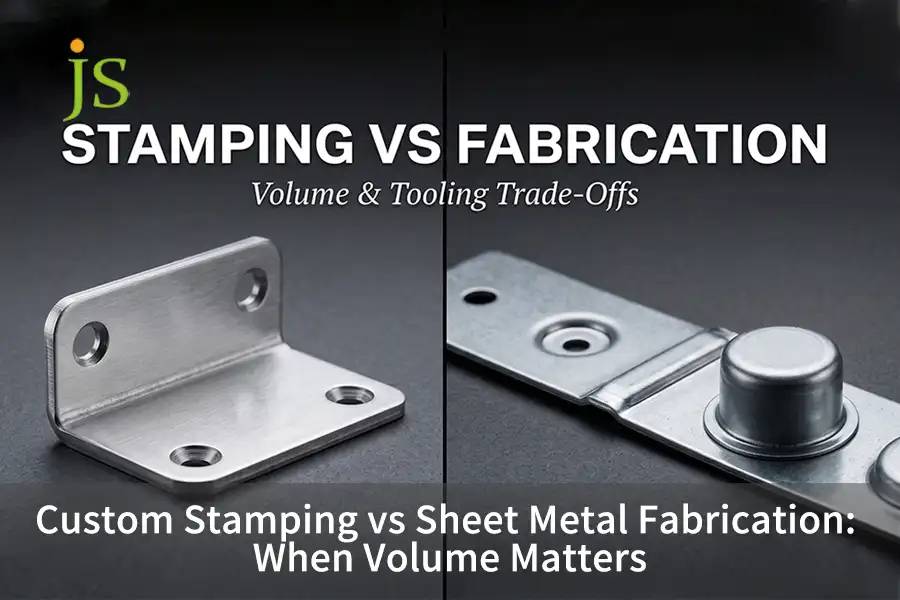

Custom stamping vs sheet metal fabrication is a decision based on production volume and tolerance. CNC laser cutters and press brakes are used in sheet metal fabrication with no dedicated tooling and zero capital costs, which makes it viable for prototype runs under 1,500.
Comparison between stamped parts and fabricated parts favors hard tooling. Custom stamping involves hardened tool steel dies priced at $3,500 to $50,000+. But when press cycles are less than 3 s, part costs become so small that they dominate production beyond 5,000 pieces.
Sheet metal fabrication stays flexible with the use of standard punch dies and programmed laser nests. Custom stamping gives up flexibility in prototypes for the fast strokes of mechanical or servo presses. The selection of the appropriate technique requires figuring out tool cost and geometry.
Core Comparison Summary: Custom Stamping vs Sheet Metal Fabrication
Utilize sheet metal fabrication in case of manufacturing below 1,500 pieces so that tooling cost may be saved, adopt custom stamping for manufacturing more than 5,000 pieces once drawings become frozen and decrease unit cost by 60% at moderate volume and up to 90% at 50,000+ units.
| Comparison Criteria | Sheet Metal Fabrication | Custom Metal Stamping | Selection Rule |
| Tooling Cost | $0 (Standard punches & brake tooling) | $3,500 – $50,000+ (Dedicated tool steel dies) | Zero upfront capital vs high-volume amortization |
| Cycle Time | 60 – 300 s/part (Laser cutting & forming) | 0.5 – 1.0 s/part (60–180 SPM continuous strokes) | Sequential manual runs vs automated high-speed strokes |
| Achievable Tolerances | ±0.005'' (±0.127 mm) general baseline | ±0.001'' (±0.025 mm) hardened die cavity | Standard fit clearances vs high-density tight alignments |
| Economic Volume Threshold | 1 – 1,500 units lowest total cost | 5,000+ parts amortized break-even | Evaluate 1,500–5,000 parts based on secondary welding and draw depths |
How Does Tooling Cost Differentiate Stamping from Fabrication?
Upfront tooling cost defines the primary financial divide in stamping vs fabrication. Sheet Metal fabrication utilizes no initial hard tooling because it employs CNC lasers and typical punch-brake tooling.
On the other hand, custom stamping requires custom-made tool steel stamping dies, which range in price from $3,500 to $8,000 for single-stage dies to $50,000 and more for multi-stage dies. The initial NRE cost makes it impossible for low volume jobs to use stamping.
Tooling Allocation and NRE Breakdown
NRE expenses for sheet metal fabrication will not exceed $150 to $300 for CAM nesting and first article coordinate measuring machine (CMM) inspection. The CNC press brakes utilize standard commercial-off-the-shelf tooling such as standard V-dies and gooseneck punches, hence no custom hardware is required.
Production begins once 3D CAD models unfold into flat DXF patterns.
Construction of custom stamping tools involves full die design prior to manufacture of the first part:
- Die Steels: D2, DC53, and SKD11 alloy steels vacuum heat-treated to HRC 58-62.
- Toolroom Machining: Slow Feed Wire EDM and CNC jig grinding.
- Tool Cost: Single action dies cost $3,500 to $8,000, whereas multiple stations progressive dies cost from $15,000 up to $50,000+.
Design Revision Flexibility: CNC Adjustments vs Die Rework
Drawing revisions create contrasting shop-floor outcomes:
- Fabrication Agility: Changing an aperture size or a bend line location calls for 15 to 30 minutes of CAM reprogramming. Tooling rework cost is $0, avoiding machine downtime.
- Risk Associated with Stamping: Modification of the hard die portions requires cutting new inserts using wire EDM, annealing, welding, and bench work. Tool modification costs $1,500 - $8,000, depending on the complexity of the work, and will take 10- 21 days.
Because a physical die dictates the finished part profile, verify part geometry against the key design and engineering considerations in metal stamping before releasing tool builds.
Sheet metal fabrication comes with no risk of tooling for prototyping iterations, but custom stamping requires that the drawings be finalized to create dies.
How Does Unit Cost at Volume Shift Between Stamped and Fabricated Parts?
The unit cost at volume favors stamped parts vs fabricated parts once production surpasses the die break-even threshold.
Fabricated sheet metal has a flat piece cost ($15–$45) from repeated operator and machine cycle time. Custom stamping reduces incremental piece costs to pennies ($0.25–$2.00) from fast stroke rates. Distributing a $15,000 progressive die over 30,000 parts reduces blended cost below fabricated alternatives.
Machine Runtime and Stroke Cycle Rates
Sheet metal fabrication unit costs are calculated by accounting for the processes sequentially. The fiber laser cutter takes 15-45 seconds to cut each blank, the brake-forming process takes 10-30 seconds for each bend, deburring is a secondary time process.
Machine hours maintain consistent costs regardless of batch sizes.
The stamping process automates the manufacturing of components through the continuous press strokes:
- Throughput: The automatic presses running at 60 to 180 strokes per minute produce parts in a time of 0.3-1.0 second.
- Operator Involvement: Only the activities of changing coils, checking the decoiler, and removing scrap are done by labor.
Below about 100 pieces, machined blanks from plate will win on total cost versus a stamping die, the stamping vs. CNC machining volume curve gives you an idea where that crossover sits.
Break-Even Mathematical Model
Engineers determine the process transition threshold using this formula.
Break-Even Volume Formula:
Q = Tooling Cost / (Fabrication Unit Price - Stamping Unit Price)
- Q: Break-Even Production Volume (units)
- Tooling Cost: Upfront Stamping Die and NRE Expense ($)
- Fabrication Unit Price: Per-piece quote using laser cutting and brake forming ($)
- Stamping Unit Price: Marginal per-piece quote in continuous press runs ($)
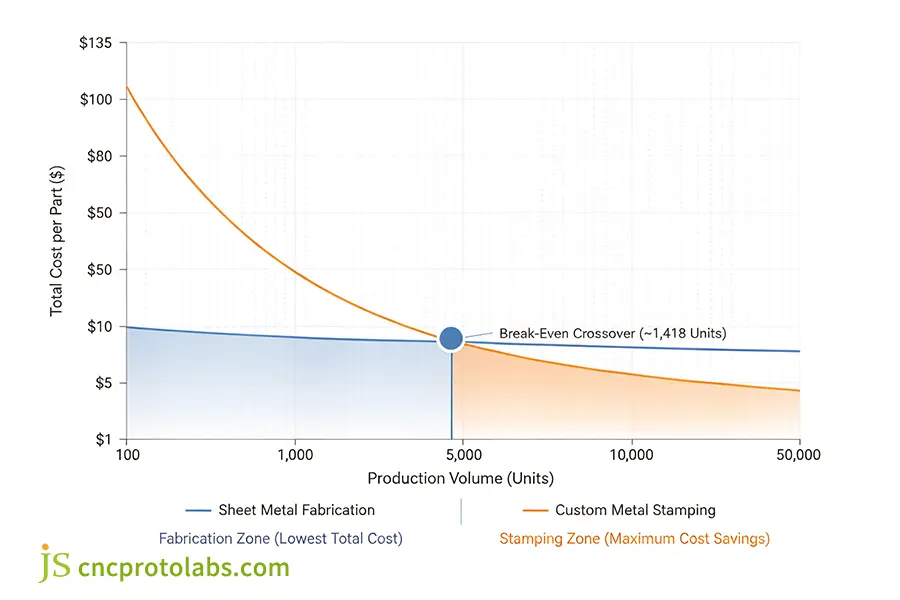
Figure 1: Unit cost break-even curve showing sheet metal fabrication as the cost-effective choice below 1,500 parts, while progressive stamping tooling amortizes to deliver significant unit savings beyond 5,000 parts.
Comparison of Tiered Manufacturing Costs (1.5 mm Galvanized Steel Bracket)
- 100 units: Fabrication is at $18.50/unit ($1,850 total) against Stamping at $151.50/unit ($15,150 total with amortization of dies). Fabrication is the obvious choice.
- 1,000 units: Fabrication is at $16.20/unit ($16,200 total) against Stamping at $16.35/unit ($16,350 total). Cost equivalence is achieved.
- 10,000 units: Fabrication is at $15.00/unit ($150,000 total) against Stamping at $2.85/unit ($28,500 total). Stamping is cost saving on an appreciable scale.
- 50,000 units: Fabrication is at $14.50/unit ($725,000 total) against Stamping at $1.65/unit ($82,500 total). Stamping cuts fabrication costs to their lowest point.
Sheet metal fabrication results in low costs of units up to 1,000 units, while custom progressive stamping saves on costs beyond 5,000 units.
Which Part Geometry Demands Custom Stamping vs Sheet Metal Fabrication?
Feasible part geometry another feature of custom stamping vs sheet metal fabrication. Sheet metal fabrication is confined to creating developable 2.5D geometry using flat blanks and linear press brake forming.
However, custom stamping offers the possibility of producing non-developable geometry, shallow draws, embossed ribs, and coined elements in a single die stroke. Deep drawn shells cannot be manufactured using press brake forming.
Developable Profiles vs 3D Plastic Flow
The viability of the part geometry comes first before a volume is taken into account to establish manufacturability. The press brake punch tool has to be physically accessible on a straight fold line. Flat blanks that are cut off from laser-cut plates and then folded are the second route as explained in the metal stamping vs laser cutting technical comparison.
Alternatively, custom stamping dies utilise hardened cavities to drive sheet metal into three-dimensional plastic deformation.
Feature Feasibility Engineering Checklist
Straight 90° and Acute Angled Flanges:
- Sheet metal fabrication: By direct process through standard V-shaped dies on press-brake machines without any tooling costs.
- Custom stamping: Possible directly through wiping or forming dies in stroke processes.
Deep drawn enclosures with (Depth/Diameter ratio > 0.5):
- Sheet metal fabrication: Impossible with single sheets since this requires laser cutting of sheet pieces and welding of the corners.
- Stamping: Direct process with progressive drawing stations keeping draw ratios (H/D ≤ 0.75).
Integral Embossed Stiffener Beads:
- Sheet Metal Fabrication: Very Limited, because it requires special one-hit punch tooling or additional presses.
- Custom Stamping: By use of high tonnage coining and embossing dies that are integral to the die strip.
Threaded Holes for Direct Thread Tapping:
- Sheet Metal Fabrication: An extra operation, involving the addition of the hardware, including the insertion of PEM nuts or blind rivets.
- Custom Stamping: Directly by the pierce and extrusion process in the die strip, making direct threads in the base metal.
Continuous Hems and Closed Curls:
- Sheet Metal Fabrication: Multi-stage operations demanding specialized flattening dies and manual repositioning.
- Custom Stamping: Automatic curling stations as part of the strip progression.
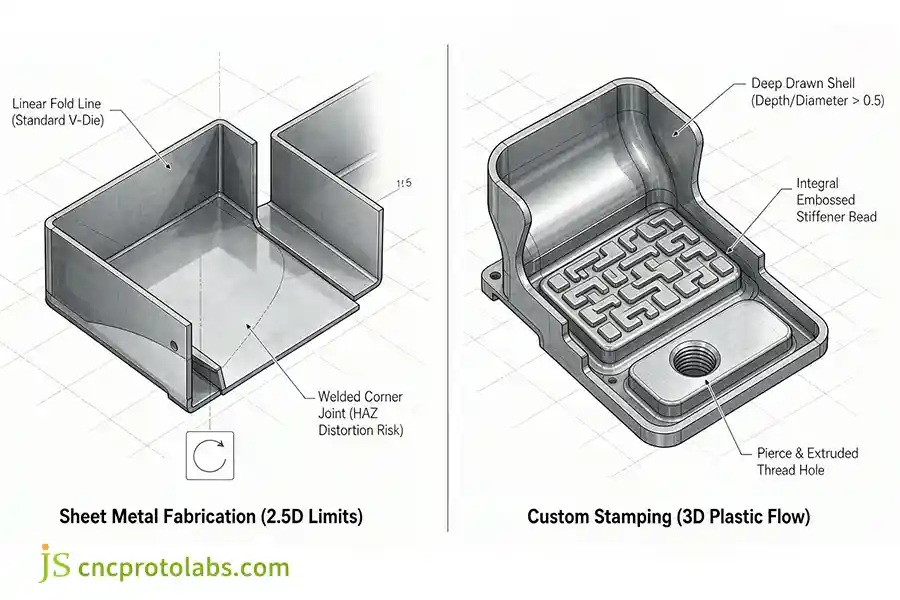
Figure 2: Geometric feasibility breakdown comparing developable 2.5D press-brake profiles against non-developable 3D stamped features, such as deep-drawn enclosures and extruded tapped holes.
Cross Process Fails Modes
Incorrect process selection results in critical defects in structure:
- Welding Thermal Distortion: Creating deep boxes through fabrication involves the welding of the different flat sheets. There is thermal distortion which causes angular distortions of 0.8 mm -1.5 mm which need straightening.
- Heavy-Plate Die Chipping: Over 6.0 mm die stampings create shear forces. High tonnage will make the D2 tool steel blades fatigue after 2,500 strikes.
Sheet metal fabrication uses sheet metal for flat parts of the structure that cannot be unfolded. In case of deep drawn cavities, coinings and built-in ribs, go for custom stamping.
What Tolerances Can Sheet Metal Stamping vs Fabrication Hold?
Critical tolerances and the process decision for sheet metal stamping vs fabrication needs to be judged because of this. The critical tolerances with hardened stamping dies between 0.001" and 0.003" (0.025 mm to 0.076 mm) can be obtained through high CPK value of 1. 33 and above through mass production.
Sheet metal fabrication generally acceptable wide tolerances ranging from 0.005" to 0.015" (0.127mm to 0.381mm). Variances in sheet metal fabrication are affected by operator positioning and material springback drift over multiple bending steps.
Physical Drivers of Positional Drift
Sheet Metal Tolerances Drift Through Physical Mechanisms of:
- Fabrication Stack-Up: Resulting from laser cut edge taper (0.5° to 1.5°), back gauge repeatability (±0.05mm), and material spring back angles (Δθ = 1.0° to 2.5°). Sheet metal thickness inconsistency (±10% nominal mill tolerance) adds error with each bend.
- Stamping Confinement: Part sizes are physically confined by hard cavity die sets. Hole centers are punched simultaneously in single dies, hence eliminating positioning error.
Precision Tolerances and Process Capability Matrix
Compared to sheet metal fabrication, custom stamping results in three to five times tighter dimension accuracy and statistical process capability (CPK ≥ 1.33). Sheet metal fabrication is confined to standard general-assembly clearance envelopes.
| Metric | Sheet Metal Fabrication | Custom Metal Stamping | Engineering Selection Rule |
| Hole Center-to-Center Pitch | ±0.005'' (±0.127 mm) | ±0.001'' (±0.025 mm) | Standard pattern fit vs dense optical alignment |
| Hole-to-Bend Centerline | ±0.010'' (±0.254 mm) | ±0.002'' (±0.050 mm) | Accepts manual brake stack-up vs restrike die control |
| Formed Bend Angular Drift | ±1.0° to ±1.5° variation | ±0.25° to ±0.50° variation | Clearance-fit chassis vs precision coining slide fit |
| Process Capability Index (CPK) | 0.85 – 1.15 (Sampling sorts) | 1.33 – 1.67 (Production stable) | Regulated industrial assemblies mandate stamping dies |
Springback Neutralization and Die Maintenance
Stamping dies control angular springback by incorporating restrike stations. Coining the bend radius past its compressive yield point releases elastic strain, keeping angular variance within 0.25°.
Meeting these limits reflects the manufacturing divide established by industrial standards. Under DIN 6930-2 Stamped Steel Parts (2020),precision stamped blanks and pierced holes hold Class f limits below ±0.05 mm across multi-station runs. In contrast, manual press-brake forming typically tracks standard medium tolerances under ISO 2768-m, allowing up to ±0.3 mm on intermediate lengths.
The long-term repeatability is dependent upon systematic die maintenance:
- Wear Limit: After 100,000 strokes without sharpening, clearance between the punch and material is increased to 15% of the sheet thickness resulting in burrs larger than 0.05 mm.
- Surface Treatments: TiCN PVD coating of the tool and sharpening of the tools every 75,000 strokes for precise CMM measurements.
State custom stamping for assemblies with tolerances below ±0.003" (±0.076 mm), allow sheet metal fabrication for enclosures with sufficient clearance to compensate for ±0.010" (±0.254 mm).
How Do Lead Time and Minimum Order Quantities Impact Project Launch?
Critical lead time and order minimums differentiate custom stamping vs sheet metal fabrication during project prototyping. Sheet metal fabrication delivers finished parts within 3 to 7 business days with zero minimum order quantities (MOQ = 1), enabling rapid validation.
For custom stamping, the tooling development process takes 6 to 10 weeks due to machining, heat treatment and sample trials. Thus, fabrication is possible for bridging production.
Production Lead Time Schedule Comparison
The difference is based on the physical requirements for making the hard tooling. Operational benchmarks compiled by the National Tooling and Machining Association (NTMA Executive Survey 2024) show that specialized toolrooms average 7 to 9 weeks to complete complex progressive dies through design, vacuum heat treatment, and first-off part trials.
The shop-floor sequence illustrates this timing disparity across manufacturing phases:
Phase 1: Design for Fabrication (DFM) and Toolpath Generation
- Fabrication: 0.5 working days for laser cuts generation from STEP models and back gauge coordinates for press-brake.
- Stamping: 5-8 working days for 3D modeling of the tools, strip layout, and forming simulations.
Phase 2: Tooling Construction and Heat Treatment
- Fabrication: None (0 days), modular libraries of tools are used.
- Stamping: 25-35 working days for roughing by CNC machining and slow feed wire EDM cutting, vacuum heat treatment with 36 hours cycles (austenitizing and triple tempering 1020°C and triple tempering).
Phase 3: Assembly, First Article (T1), and CMM Validation
- Fabrication: 1 to 2 business days for setup bending and first part CMM checks.
- Stamping: 10 to 15 business days for manual bench diemaker fitting, T1 trial run in test presses, CMM dimensional reports and punch clearance adjustments.
Overall Lead Time to First Finished Component:
- Fabrication: total turnaround time is 3 to 7 business days.
- Stamping: 40 to 60 business days (6 to 10 weeks) total turnaround.
Bridge Tooling Engineering Strategy
To manage the 8-week stamping build window, engineering teams apply a bridge production workflow:
- Concurrent Tooling Release: Start progressive die manufacturing while releasing identical DXF files to CNC fabrication.
- Bridge Volume Manufacturing: Manufacture 200-1,000 units over a period of 7 days to satisfy the test rig, safety testing, and early assembly needs.
- Volume Cutover: Move to progressive stamping press at T1 sign off to take advantage of sub-second cycle rates and avoid line delays.
If you can manufacture your parts within 10 days before needing them for assembly due to assembly schedules, use sheet metal fabrication. Then go to 8-week stamping build after product drawing freeze for volume manufacturing.
How Do You Choose Between Custom Stamping and Sheet Metal Fabrication in Production?
The choice between custom stamping vs sheet metal fabrication will be based on: year-over-year demand, maturity of geometry, and cost. Consider sheet metal fabrication for volumes less than 1,500 parts per year, when engineering is still evolving, and there is a need for fast delivery.
Use custom stamping when the quantities exceed 5,000 pieces, there is a requirement of complicated stamping geometry, and saving in pennies-per-piece costs more than the cost of the die.
Above the die break-even point the question changes entirely, as detailed in our pillar guide covering custom stamping vs sheet metal fabrication economics.
Process Trade-Off Matrix: Stamping, Fabrication, and Machining
Sheet metal fabrication eliminates the risk associated with validation capital investment, stage tooling allows for batch manufacture, progressive stamping allows for setting low part cost per piece, and CNC machining is done for thick 3D prismatic plate components.
| Dimension | Flexible Sheet Metal | Stage Tool Stamping | Progressive Die Stamping | CNC Plate Milling (Alternative) |
| Tooling Capital | $0 NRE (Standard software tooling) | $3,500 – $10,000 (Modular stage dies) | $15,000 – $50,000+ (High-speed multi-station die) | $0 NRE ($250 custom vise setups) |
| Geometry Scope | Shallow 3D draws, manual transfers | Moderate 3D draws, individual press operations | Progressive draws, ribs, coined forms | 3D pockets, bosses, solid blocks |
| Piece Cost | High ($15–$45), manual brake run-time dominates | Moderate ($4–$12), manual inter-press handling | Low unit cost ($0.25–$2.00), 80+ strokes per minute | High ($35–$120), continuous cutting cycle time |
| Failure Limit | Multi-pass weld warp (>1.0 mm) | Slow cycle time bottleneck | Costly die modifications on premature design revisions | Heavy material waste (>80% chip scrap) |
Engineering Selection Process
Step 1: Annual Volume Threshold
Volume less than 1,500 pieces per year?
Choose sheet metal fabrication. Otherwise, move to Step 2.
Step 2: Geometric Complexity Check
Are there any part features such as cups, coinings, embossed parts, or ribs?
Custom stamping will be a good choice. Otherwise, move to Step 3.
Step 3: Revision Stability
Is the drawing frozen with no expected engineering changes in 12 months?
If yes, proceed to Step 4. If no, use sheet metal fabrication as bridge tooling while the design stabilizes.
Step 4: Tolerance and Cycle Time Requirements
Are tolerances between holes ±0.003 inches or smaller?
Progressive stamping is the right option. If standard tolerances are used, make sure that the die payback period is within the specified production period.
Unsure which process fits your volume? Upload your CAD for a free DFM and tolerance review.
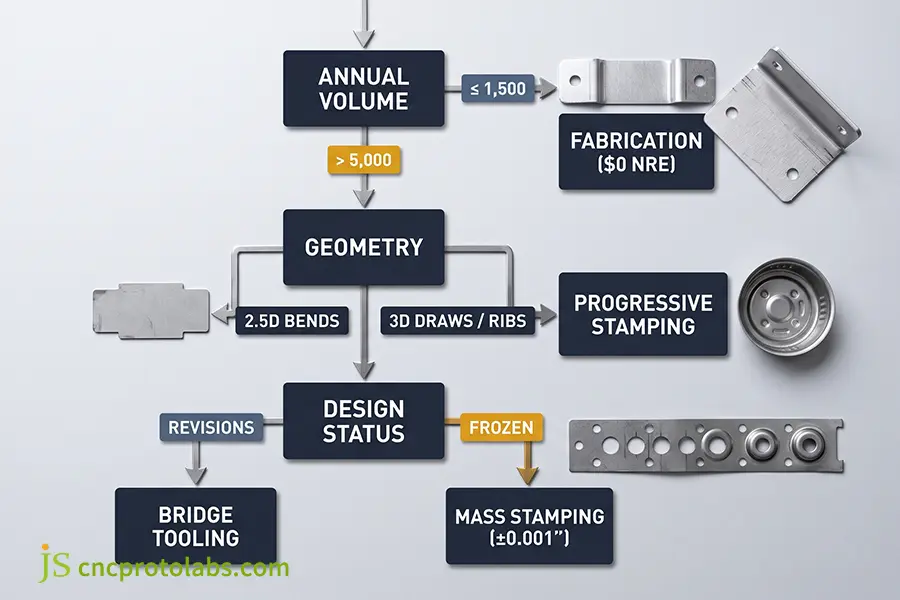
Figure 3: Step-by-step engineering decision framework routing component manufacturing to CNC sheet metal fabrication, bridge tooling, or progressive stamping based on volume and design stability.
Engineering Case: Industrial Server Chassis Bracket
Component Specifications:
- Material: Aluminum AL5052-H32.
- Thickness: 1.5 mm.
- Bounding Box: 210 mm × 65 mm × 35 mm.
- Features: 6 right-angle folds, 4 countersunk mounts, 2 embossed stiffeners, and 24 perforated ventilation slots with ±0.002'' hole centers.
Phase 1: Prototype Validation and Pilot Assembly (2,000 Units)
- Strategy: To implement flexible sheet metal fabrication for initial thermal slot shifting.
- Tooling and Economics: Tooling: $0, Unit Cost: $14.20, Turnaround: 5 business days.
- Engineering Flexibility: During testing, ventilation slots shifted 3.0 mm upward. CAD updates required 20 minutes with zero tooling modification fees. Total pilot cost = $28,400.
Phase 2: Production Ramp (35,000 Units/Year)
- Strategy: As the designs were locked in, the production process moved to a progressive 8-station DC53 die operating at 80 SPM.
- Tooling and Economics: Die Capital: $18,500; Unit Cost: $1.15, Total Cost: $18,500 + (35,000 x $1.15) = $58,750.
Tooling Amortization:
Q = $18,500 / ($14.20 - $1.15) = 1,417.6 Units
The die recouped its entire cost within 1,418 units of volume manufacturing, validating the process changeover.
FAQ
What Are the Key Considerations in Stamping vs Fabrication?
Evaluating common questions in stamping vs fabrication clarifies volume thresholds, tooling capital, and dimensional stability. Below are direct engineering answers to five critical trade-offs encountered during manufacturing reviews.
Is stamping cheaper than fabrication at low volume?
No. Under 1,500 units, stamping is significantly more expensive. Hard dies cost $3,500 to $50,000+, driving unamortized piece prices up on small batches. Sheet metal fabrication uses programmable CNC lasers and press brakes with zero dedicated tooling, making it much more economical for low-volume runs.
When should you choose stamping over sheet metal fabrication?
Choose stamping over sheet metal fabrication when annual volume exceeds 5,000 units and the CAD design is frozen. It is mandatory for parts requiring shallow draws, embossed ribs, or coined profiles. While tooling requires upfront capital, stroke speeds under one seconds deliver far lower unit costs at scale.
Can a stamped part replace a welded fabricated assembly?
Yes. Progressive stamping dies combine forming, coining, and piercing in a single press stroke. This replaces multi-piece welded brackets, eliminating heat distortion, weld-joint fatigue, and secondary grinding. Conversion is recommended once annual quantities justify upfront tooling investment.
When should you choose stamping over sheet metal fabrication?
Choose stamping over sheet metal fabrication when annual volume exceeds 5,000 units and the CAD design is frozen. It is mandatory for parts requiring shallow draws, embossed ribs, or coined profiles. While tooling requires upfront capital, stroke speeds under three seconds deliver far lower unit costs at scale.
How does production volume affect stamping vs fabrication cost?
Volume amortizes fixed tooling capital against cycle time. Below 1,500 parts, zero tooling makes fabrication cheaper. Above 5,000 units, sub-second press cycle times overcome initial die costs. At 50,000+ units, stamping cuts total production spend by up to 90% compared to brake forming.
Summary
In precision manufacturing, deciding between custom stamping vs sheet metal fabrication comes down to annual volume, drawing stability, and tolerance limits. Flexible sheet metal fabrication remains the standard for prototypes and short runs under 1,500 units by eliminating tooling capital. Once designs freeze and demand exceeds 5,000 units, stamping delivers the fast cycle rates, micron-level repeatability, and low piece costs required for production efficiency.
For projects crossing into volume production, evaluating custom precision metal stamping services with a quick DFM and tolerance review helps confirm die payback before cutting tool steel.

Resource