English



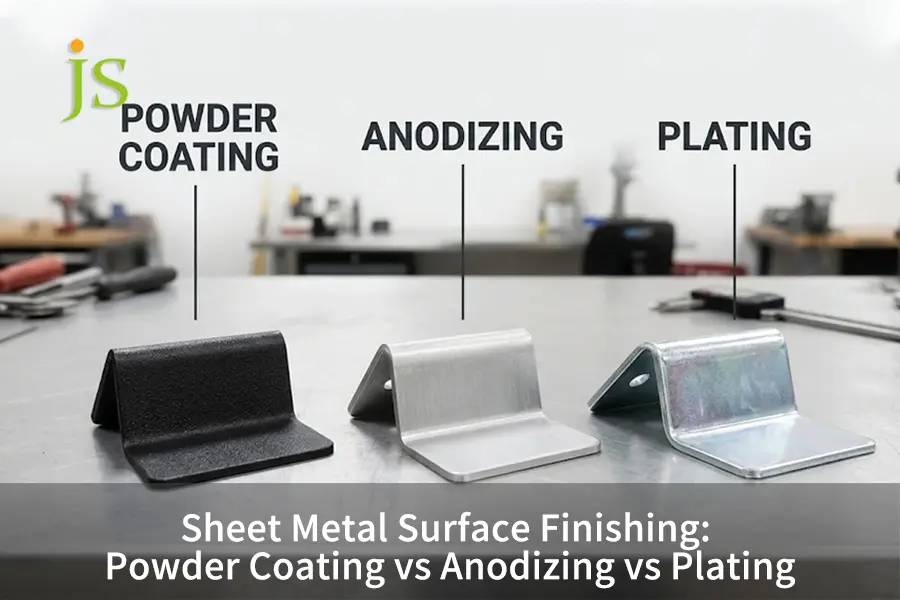

When evaluating powder coating vs anodizing vs plating for sheet metal parts, the best alternatives will be powder coating for outdoor carbon steel enclosures and customized colors, anodizing for precision aluminum housings, and plating for electrical grounding and steel fasteners.
For the first step in post processing of sheet metal fabrication, all the three finishes are effective on certain products:
- Powder Coating: Forms an insulating polymer film of thickness 50-150 μm on steel and aluminum.
- Anodizing: Changes the aluminum material to insulating hard oxide of 5-50 μm thickness.
- Plating: Deposition of 5-25 μm conductive film of zinc or nickel on conductive materials.
Considering the powder coating vs anodizing for sheet metal in conjunction with plating early avoids any hindrances in the assembly process and future rusting.
Quick Overview of Sheet Metal Surface Finishes
The powder coat finish offers good protection from the elements and many colors to choose from, anodizing makes sure there is tolerance of aluminum without any peeling, and plating is the only one with electrical conductivity.
| Comparison Metric | Powder Coating | Anodizing (Type II / III) | Plating (Zinc / Nickel) |
| Compatible Metals | Carbon steel, stainless steel, aluminum | Aluminum, titanium, magnesium only | Carbon steel, copper, brass, conductive metals |
| Electrical Conductivity | Insulating (Blocks current) | Insulating (Blocks surface current) | Conductive (Maintains grounding) |
| Coating Thickness | 50–150 μm (Thick polymer film) | 5–25 μm (Type II) / 25–50 μm (Type III) | 5–25 μm (Thin metallic layer) |
| Primary Engineering Advantage | 500–1,000+ salt spray hours, full RAL colors | Zero peeling risk, high scratch hardness | EMI shielding, preserves fine threads |
Powder Coating vs Anodizing vs Plating: How Do They Compare?
When comparing powder coating vs anodizing vs plating for sheet metal finishing, the differences between these methods are mostly in terms of coating thickness, material compatibility, and electrical conductivity. The powder coating process applies a 50 to 150 μm layer of polymer to steel or aluminum. The anodization process applies a 5 to 50 μm layer of hardened oxide to aluminum. Plating applies a 5 to 25 μm layer of conductive metal.
Core Engineering Specifications and Process Limits
Any surface treatment marks up the part and makes the metal behave differently around moisture or electricity. Early testing prevents surface finishing engineers from requesting incompatible chemical baths materials used in surface finishing are dissolved differently: carbon steel in acidic anodizing bath and aluminum for three different finishes.
Standardized industry testing confirms how each finish performs under stress:
- Salt Spray Endurance: According to ASTM B117-23 and ISO 9227-22 standards of neutral salt spray tests, sealed type II anodizing is able to resist white rust for 336 – 1,000 hours and outdoor polyester powder coating for 500 – 1,000+ hours.
- Coating Thickness and Surface Roughness: Coating thickness is measured through shops using the techniques of magnetic induction and eddy currents as per ISO 1463 and MIL-A-8625. However, engineers also need to check the surface finish roughness charts when releasing the drawing. This is because, thin plating reveals the base scratches but thick powdering conceals them.
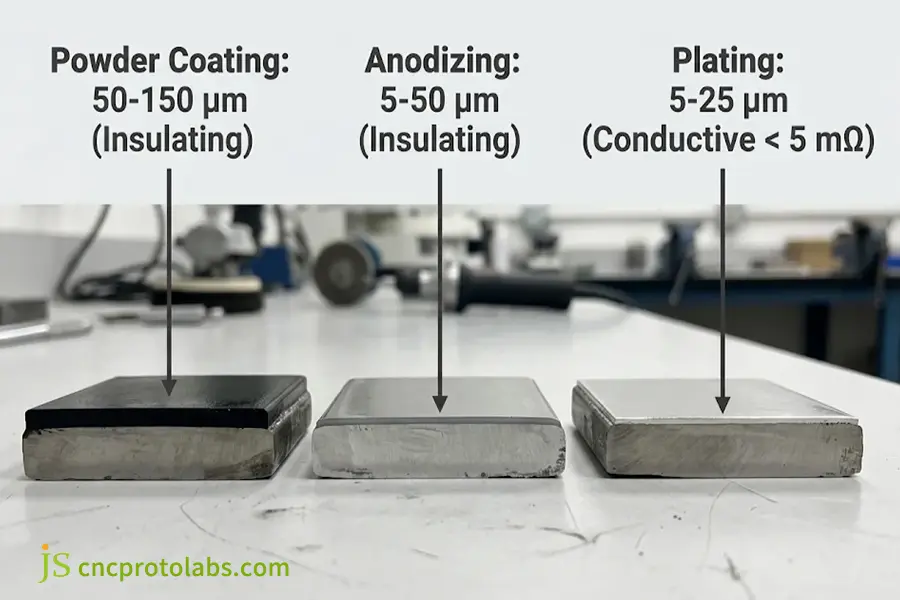
Cross-section coating thickness and electrical conductivity comparison across powder coating, anodizing, and plating.
Sheet Metal Surface Finish Specs and Process Limits
Choose powder coating for abrasion and UV resistance, Type II or III anodizing for wear resistance in aluminum, and plating for conductivity and anti-rust in steel.
| Engineering Dimension | Powder Coating | Type II Anodizing | Type III Hardcoat Anodizing | Plating (Zinc / Electroless Nickel) |
| Thickness & Thread Impact | 50–150 μm, clogs threads ≤ M4 | 5–25 μm, minimal thread change | 25–50 μm, needs ±0.025 mm allowance | 5–25 μm, uniform ±2 μm buildup |
| Salt Spray & Wear Rating | 500–1,000+ hrs, high impact cushion | 336–1,000 hrs, moderate scratch resistance | 1,000+ hrs, 60–70 HRC surface hardness | 96–500+ hrs, moderate wear resistance |
| Substrates & Conductivity | Steel and aluminum, insulating | Aluminum only, insulating | Aluminum only, insulating | Conductive metals, < 5 mΩ resistance |
| Failure Modes & Prohibitions | Cracks if bent after coating, warps thin (< 1.0 mm) sheets at 200°C | Carbon steel dissolves in bath, fades in UV light | Brittle oxide cracks on tight bend radii | Hydrogen embrittlement on hardened steel |
In short, thick polymer powder coating will be used to protect steel outdoors while hard oxide will protect aluminum precision parts.
Powder Coating vs Anodizing: Which Is Better for Sheet Metal?
In the powder coating vs anodizing comparison, select powder coating for carbon steel components, use in outdoor UV environments, and with custom RAL colors, and pick anodizing for precision aluminum housings and tight tolerance requirements. Powder coating results in a 50–150 μm impact-resistant resin coating, and Type II anodizing results in a 5–25 μm aluminum oxide barrier coating that will never chip or peel. Anodizing cannot be used with steel, and it will dull in sunlight.
Welded Seam Coating and Shop Floor Flow
Sheet metal parts go through laser cutting, punching, bending, and welding before surface finishing. This manufacturing process determines which coating will make it through the manufacturing process intact:
- Hiding Surface Imperfections: Powder coating sheet metal creates a film ranging from 50 to 150 μm that hides small laser burrs, press brake die marks, and ground weld joints.
- Revealing Base Metal: Anodizing creates a translucent oxide that shows up scratches and the heat affected zone of the weld, necessitating the use of bead blasting prior to tank dipping.
- Fabrication Sequence Requirement: All fabrication processes including cutting, bending, and installing the PEM fasteners must be done before coating. Bending coated material stresses the outside radius causing cracking of both the cured powder and the anodized oxide.
- Stainless Steel Alternatives: When stainless steel enclosures need a bright reflective finish without paint or chemical baths, engineers specify mirror finishing for stainless steel.
UV Durability Outdoors vs Scratch Resistance Indoors
The application environment clearly distinguishes between these two types of insulating coatings:
- Choose Powder Coating For: SPCC cold-rolled steel boxes, customer RAL colors, and outdoor usage. Architectural polyesters withstand chalking and color fading up to 5 to 10 years when exposed to sunlight.
- Choose Anodizing For: 5052 or 6061 aluminum cases, interior use in hospitals or aircrafts, and laboratory equipment. The oxide film is always part of the aluminum and will never chip off from the corners.
Anodizing vs Plating vs Powder Coating: When Should You Choose Plating?
When comparing anodizing vs plating and powder coating vs plating, choose plating if your sheet metal parts need EMI screening, electrical conductivity or they can't tolerate sub-25 μm dimension variations. Unlike insulating powder coatings and anodized oxide films, electroplated zinc, electroless nickel or tin maintains surface contact resistance below 5 mΩ. Plating also offers a barrier to carbon steel fasteners and deep hole features that are difficult for electrostatic powder spray to penetrate due to Faraday cage shielding.
Electrical Grounding and EMI Shielding Requirements
Telecommunication rack systems, power supply cases, and industrial control panels depend on metal-to-metal contact between doors and frames for EMI shielding. The powder-coated metal is insulated from electrical grounding; therefore, expensive gaskets or laser stripping of the contact points are necessary.
Plating maintains continuous conductivity across the entire part:
- Trivalent Zinc Plating: Prevents carbon steel brackets from rusting, while keeping the grounding of the chassis for $0.50 to $2.00 per part.
- Electroless Nickel Plating (ENP): Provides conductivity, solderability, and excellent chemical resistance without any external electrical power in the bath.
- Process Selection: Engineers comparing bath types can review electroplating vs metal plating to match current-driven or autocatalytic deposition to complex brackets.
Coverage of Deep Cavities and Tolerances
Electrostatic powder spray will not deposit on the inside of deep, U-channels or tight return flanges. Since the powder is attracted to the nearest grounded edge, thin areas fill with powder. Immersion plating will cover blind holes and interior bends evenly.
Dimensional buildup on mating holes varies a lot by finish:
- Powder Coating Buildup: Adds 0.05-0.15mm per side (0.10-0.30mm on hole diameters) and necessitates the use of silicone inserts for any tap hole M4 and under.
- Plating & Anodizing Buildup: Adds 0.005-0.025mm per side and allows standard holes and bent flanges to be assembled without reaming.
- Tolerance Control for Bending: Checking how surface finishing and dimensional tolerance interact after press brake forming prevents cumulative fit-up errors.
What Is the Surface Finish Cost Comparison for Sheet Metal?
In a sheet metal surface finish cost comparison, zinc plating and batch powder coating have the most economical pricing of $0.50-$3.00 per small bracket for high volumes. Anodizing type II will fall in the middle range with $1.50-$5.00 per part, while hardcoat anodizing and electroless nickel plating have double or triple the pricing due to additional tank time and refrigerated baths among other factors.
Sheet Metal Finishing Cost, Setup Fees, and Lead Times
Zinc plating and the general-color powder coating cost the lowest per unit at volume, while small prototype quantities are subjected to minimum tank charges.
|
Cost & Production Factor |
Powder Coating |
Type II Anodizing |
Type III Hardcoat Anodizing |
Plating (Zinc / Electroless Nickel) |
|
Prototype Unit Cost (1–20 pcs) |
$8–$25/part (driven by lot minimum) |
$10–$30/part (driven by tank minimum) |
$20–$50/part (chilled tank setup) |
$6–$20/part (zinc) or $15–$40 (nickel) |
|
Production Unit Cost (500+ pcs) |
$0.80–$3.00/part (standard colors) |
$1.50–$5.00/part (clear or black) |
$3.50–$9.00/part |
$0.50–$2.00 (zinc) or $2.00–$6.00 (nickel) |
|
Minimum Lot / Setup Fee |
$80–$150 ($100–$250 extra for custom RAL) |
$80–$150 per batch |
$150–$250 per batch |
$75–$120 (zinc) or $120–$200 (nickel) |
|
Typical Shop Lead Time |
2–4 business days |
2–4 business days |
3–5 business days |
2–3 business days |
Hidden Cost Drivers and Buyer Savings Rules
As industry cost benchmarks from our 2025-2026 Products Finishing market survey, setup labor and tank dwell time make up more than 65% of the costs for small-batch finishing quotes. Hidden costs included manual masking, where taping off the 15 grounding holes with high-temperature tape and silicone plugs can cost more than the coating.
Three tips to reduce finishing quotes:
- Specify Standard Colors for Prototypes: Use standard matte black, textured gray or clear anodize finish for prototypes to save $100 to $250 in setup cost per color.
- Consolidate Masked Areas: Locate ground pads close to the panel edge where single-plug or fast strip masking is effective.
- Match Plating to Steel: Select trivalent yellow or clear zinc for indoor steel brackets unless chemical exposure requires electroless nickel plating.
How Do You Choose the Best Surface Finishing for Sheet Metal?
To choose the best surface finishing for sheet metal, there are four criteria to consider, in the following sequence: base metal material, need for electrical grounding, allowable tolerance of assembly, and operating environment. Considering the base metal right away will automatically disqualify anodizing of steel components, while the need for electrical grounding will limit plating for EMI-protected enclosures.
Four-Step Engineering Selection Workflow
Check all 2D manufacturing drawings using the following four sequential filters:
- Filter 1 (Base Material): If the base material is carbon steel or stainless steel, rule out anodizing and select powder coating or plating. If the base material is 5052 or 6061 aluminum, proceed to Filter 2.
- Filter 2 (Electrical Continuity): If the housing requires EMI shielding or chassis grounding via seams, use zinc, tin, or electroless nickel plating. Otherwise, go to Filter 3.
- Filter 3 (Assembly Tolerance): If the design involves tight sliding tracks, small PEM clearances, and tolerance of ±0.02 mm without budget for masking, use type II/III anodizing (for aluminum) or thin plating (for steel). If tolerances exceed ±0.15 mm, go to Filter 4.
- Filter 4 (Operating Environment): For outside UV exposure, significant impact resistance, or branding colors, choose polyester powder coating. For high-wear sliding friction on aluminum, choose type III hard coat anodizing.
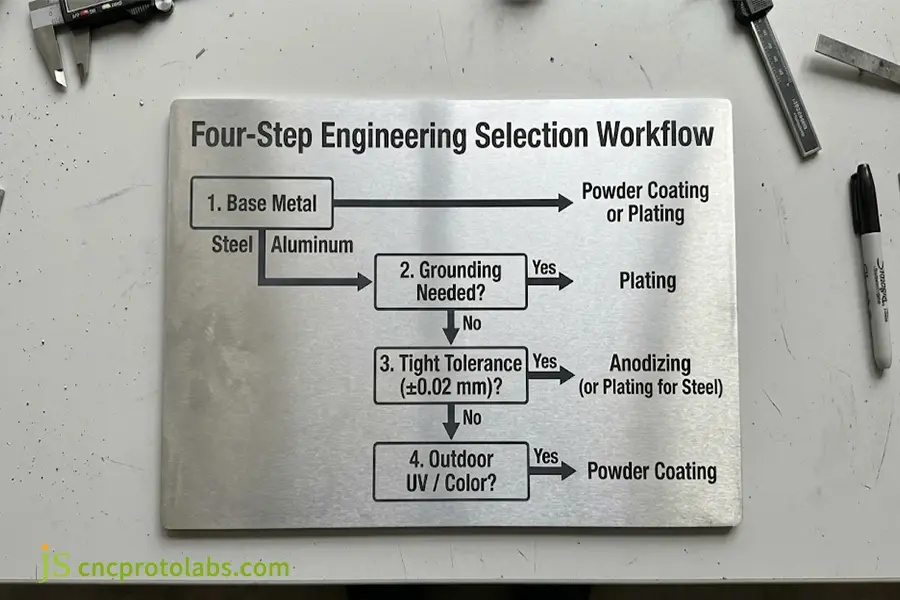
Four-step engineering workflow for selecting powder coating, anodizing, or plating on sheet metal parts.
Shop Floor Case Study: Fixing Grounding and Tolerance Failures on an Aluminum Gateway
Project Scope and Initial Powder Coating Failures
North American industrial IoT customer required to manufacture 300 outdoor wireless gateways' enclosures from 2.0mm thick 5052-H32 aluminum with full-body matte black powder coating. First article assembly identified two production issues:
- Grounding Failure: 95 μm coating thickness for the internal PCB boss insulation resulted in contact resistance > 500 Ω, thereby failing EMC tests.
- Slide Interference: Coating thickness on both sides was increased by 0.19 mm inside the cover guide rails.
JS Precision Hybrid Finishing Solution
JS Precision engineers replaced full-body powder coating with a two-step hybrid workflow:
- Full-Part Conversion Coating: Coated the entire part with a 5 μm trivalent chromate conversion coating to maintain strict rail tolerances and chassis conductivity.
- Selective Exterior Powder Coating: The outer cosmetic faces were only coated with sprayed matte black polyester powder.
Verified Production Results
- Contact Resistance: Reduced from > 500 Ω to 2.1 mΩ, meeting EMC ground requirements.
- Assembly Clearance: Kept gap between sliding cover rail to ±0.015 mm
- Unit Cost Savings: Reduced finishing costs by 22% relative to manually masking 24 internal ground points.
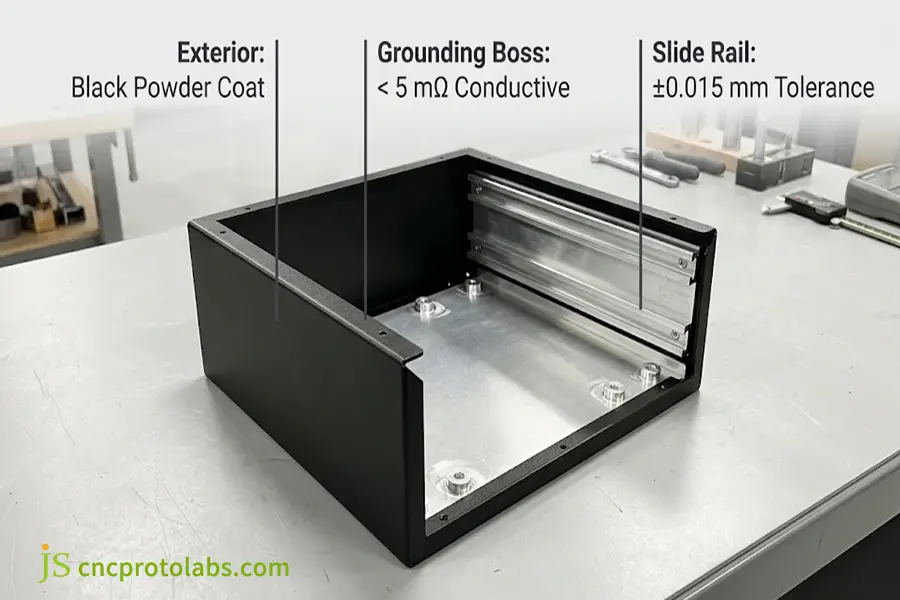
Hybrid finishing on a 5052 aluminum gateway enclosure featuring exterior black powder coating and conductive interior slide rails.
FAQs
How does powder coating vs anodizing cost compare for small batches?
For 1 to 20 prototypes, standard black or white powder coating is more economical than anodizing because it avoids the $100–$250 color set-up charge. Type II clear or black anodizing charges an $80-$150 tank minimum. Type III hardcoat anodizing costs 40%-80% more owing to energy required for chilled bath and long tank runs.
Which is more corrosion resistant: anodizing or powder coating?
Polyester powder coating over zinc primer, used outdoors, lasts longer against corrosion compared to Type II anodizing as the former endures 1,000+ hours in salt spray tests based on ASTM B117-23 but the latter resists only 336 hours. Nevertheless, scratches deeper than the powder coating layer on steel let rust form beneath it, while the anodic oxide layer bonds with the aluminum.
What is the difference between powder coating thickness vs anodizing thickness?
The powder coating creates a 50 to 150 μm layer, adding 0.10 to 0.30 mm over diameter and requires silicone plugs in close tolerance threads. Type II anodizing is 5 to 25 μm thick, entering 50% and exiting 50%. It keeps close sheet metal assembly tolerances.
Can you use anodizing vs plating for steel sheet metal parts?
No, the acid bath used in anodizing will corrode carbon steel and stainless steel by dissolving rather than creating a protective oxide layer. The proper plating for steel sheet metal should be trivalent zinc, electroless nickel or chrome. Plating creates a 5 to 25 μm metal layer to protect from rust and keep accurate threads and conductivity.
How to choose between powder coating, anodizing, and plating for sheet metal?
Look at substrate material, grounding requirements, tolerances, and application environment in that order. Use powder coating for exterior steel enclosure and RAL colors. Use anodizing for tight tolerance aluminum housing. Use plating for steel parts or for grounded aluminum enclosure requiring grounding less than 5 mΩ.
Is anodizing better than powder coating for aluminum enclosures?
Anodizing is better for interior electronics, aerospace, and medical aluminum enclosures where tight tolerances and metal-like surfaces are required, along with non-peeling scratch resistance. Powder coating is better for exterior cabinet and guard applications requiring UV resistance and impact protection, as well as custom RAL colors.
Conclusion
Selecting the right surface finishing for sheet metal comes down to balancing substrate compatibility, electrical conductivity, and tolerance build-up prior to releasing engineering drawings into manufacturing. Powder coating is prevalent on outdoor steel parts as well as painted enclosures, anodizing ensures that close tolerance aluminum enclosures will not chip off paint layers, and plating is necessary for electrically grounded steel components and hardware.
Download our free Sheet Metal Surface Finishing & Tolerance Guide (PDF), or upload your STEP/DXF files to consult JS Precision engineers for a free DFM review and custom surface finishing services quote.