English




For stamped parts with requirements for high spring retention, fatigue endurance, and rigidity of thin gauge structures, 301 stainless steel stamping is the grade of choice due to the fast work-hardening rate that allows ultimate tensile strengths above 1300 MPa in the Full Hard condition. Alternatively, 304 stainless steel is the grade of choice for deep drawn enclosures, complicated contour geometries, and highly contaminated sanitary conditions providing an elongation of over 50% in the annealed state.
Summary of Core Answers
|
Evaluation Dimension |
301 Stainless Steel Stamping (ASTM A666) |
304 Stainless Steel Stamping (ASTM A240) |
Shop Floor Selection Engineering Criteria |
|---|---|---|---|
|
Alloy Composition Baseline |
16.0–18.0% Cr, 6.0–8.0% Ni, ≤0.15% C |
18.0–20.0% Cr, 8.0–10.5% Ni, ≤0.08% C |
Low Ni & high C in 301 promotes work-hardening transformation |
|
Limit Drawing Ratio & Formability |
Moderate-low (LDR≈1.6–1.8, prone to cracking in multiple draws) |
Very high (LDR≥2.1–2.2, suitable for continuous deep drawing) |
Exclude cold-worked 301 if draw depth exceeds 0.5× diameter |
|
Yield Strength & Springback |
Annealed ≥205 MPa; Full Hard ≥1000–1150 MPa |
Annealed ≥205 MPa; Worked 310–550 MPa |
301 springback angle is 2–3 times that of 304; overbend compensation required |
|
Corrosion Resistance & Post-Treatment |
Good (suitable for dry housings, automotive terminals, indoor springs) |
Excellent (neutral salt spray NSS≥96h, FDA compliant) |
Choose 304 for acid/alkali exposure, human contact, or high humidity |
Data source: ASTM A240/A240M:2023 – Standard Specification for Chromium and Chromium-Nickel Stainless Steel Plate, Sheet, and Strip for Pressure Vessels and for General Applications.
For a complete sheet metal stamping process and equipment selection guide, please refer to the complete sheet metal stamping guide.
Which Stainless Steel Stamping Grades Suit Your Stamped Parts: 301 or 304?
Evaluating 301 vs 304 stamping depends on draw ratio, post-forming yield, and spring recovery. Grade 301 uses cold-reduction martensitic transformation to reach yield >1000 MPa for resilient clips. Grade 304 offers higher nickel (8.0–10.5%), giving >50% elongation that prevents micro-cracking in deep-drawn contours.
Differences in Chemical Composition and Austenite Stability
- 301 stainless steel contains 6.0–8.0% nickel and ≤0.15% carbon. It exhibits poor austenitic stability and can be converted to deformation-induced martensite during room-temperature stamping.
- 304 stainless steel has a nickel content of 8.0–10.5% and a carbon content of ≤0.08%, and can maintain a stable austenitic structure even under severe cold deformation.
- Md30 temperatures: 301's Md30 is near room temperature, so conventional stamping can induce martensitic transformation. 304's Md30 is well below 0°C, so room-temperature stamping induces almost none.
Influence of work hardening index and mold wear
- The n-value of 301 is 0.45–0.50, and punch edge wear is 0.08–0.12 mm per 100,000 strokes (1.0mm material thickness, 120 SPM).
- The n value of 304 is 0.30–0.35 and its edges wear rate is only 60–70% of 301 which is about 0.04–0.06 mm.
- In practical material selection, engineers should consider mold life and part performance holistically when evaluating stainless steel stamping grades. For 301 stainless steel stamping, the maintenance cycle of cavity and core mold assemblies is generally about 30% less than that for 304.
Stainless steel is just one of the alloys available for stamping; engineers need to comprehensively evaluate the anisotropy of carbon steel, aluminum alloys, and stainless steel. For a comprehensive overview of commonly used stamping materials, please refer to materials used in metal stamping.
304 Stainless Steel Formability: Why Does It Outperform 301 in Deep Drawing?
304's superior formability comes from higher nickel suppressing premature work hardening. Annealed 304 achieves LDR up to 2.2 with >50% elongation, while 301 rapidly hardens, causing wall thinning, flange wrinkling, and die galling without annealing.
Limiting drawing ratio and anisotropy control
- The LDR of bright-annealed 304 is 2.1–2.2, allowing φ100 mm cups to be drawn from a φ210 mm blank in a single operation.
- The LDR of 301 in the annealed condition is as low as 1.6–1.8, and so the number of passes 2–3 with solution annealing of 850–1050°C may be needed. So, the stamping of 301 stainless steel cannot be done in one pass deep drawing.
- r-value: 304 has 1.0–1.2 with 3–5% ear height; 301 has directional martensite formation, giving 8–12% ear height.
Lubrication and Die Coating Requirements for High-Speed Deep Drawing
- 304 deep drawing: a medium-EP lubricant forms a 5–10 µm oil film; with a TiN or CrN coating, the tool lasts over 100,000 strokes.
- 301 deep drawing: upgrade the die coating to TD (vanadium carbide) infiltration or CVD diamond coating; otherwise the tool seizes within 5,000–8,000 strokes.
Failure Mechanism When the Aspect Ratio Exceeds the Standard
Forcing the use of 301 when the depth-to-diameter ratio is >0.8 will result in: flange wrinkling → strain concentration in the cylinder wall → wall thickness reduction exceeding 25% → circumferential cracks at the bottom rounded corner.
ISO 20482: 2013 specifies that the Eriksen cupping value is ≥12 mm for 304 in the annealed state, but only 8–10 mm for 301 in the annealed state.
301 Spring Temper vs 304 Annealed: How Do Elastic Recovery and Springback Differ?
For spring clips, the 301 spring temper vs 304 annealed trades off elastic deflection vs bending radius limits. Cold-rolled 301 (1/2H to FH) offers 750–1150 MPa, providing cyclic energy absorption without permanent yield, but needs from 5°–15° overbending to compensate for springback.
Comparison of Quantitative Rebound Angles at Different Hardness Levels
Comparison of stamping and bending parameters between 301 and 304 in various hardness grades and annealed state.
|
Temper Grade |
Yield Strength (MPa) |
Hardness (HRC) |
Longitudinal Min Bend Ratio R/t |
Transverse Min Bend Ratio R/t |
Springback Compensation Angle (°) |
|---|---|---|---|---|---|
|
301 1/4 Hard |
550–620 |
25–30 |
1.0 |
1.5 |
3–5 |
|
301 1/2 Hard |
760–860 |
32–38 |
1.2 |
2.0 |
6–9 |
|
301 Full Hard |
1000–1150 |
40–45 |
1.5 |
3.0 |
10–15 |
|
304 Annealed |
205–260 |
≤20 |
0.5 |
0.8 |
2–3 |
Data source: ASTM A666:2021 Table 2 – Mechanical Property Requirements for Cold-Rolled 301 Stainless Steel.
When stamping 301, the hardened sheet must be oriented along the rolling direction, and the bend radius should be at least 1.5t to prevent edge tearing.
Minimum bending radius and sensitivity to rolling direction
For 301 Full Hard, the longitudinal bend-radius R/t is 1.5t, and the transverse R/t should be increased to 3.0t. For 304 annealed stainless steel, the R/t of longitudinal radius is 0.5t and the transverse radius is 0.8t, and the differences are not obvious. Because of this the mold design should be optimized based on the particular DFM guidelines for stamped parts.
Mold Compensation Design Method
Record the free-bending force 3–5 times, then apply corrective (bottoming) bending with 5°–15° overbend (±0.5° tolerance); adding 0.3–0.5 mm extrusion ribs on the inner bend diameter further reduces springback by 2°–4°.
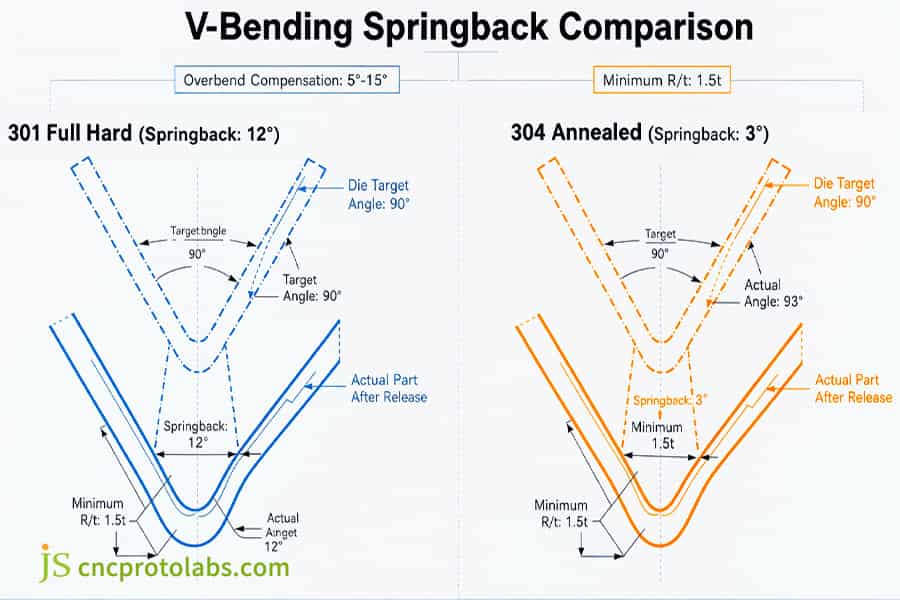
Figure 1: V-bending springback comparison diagram between 301 full hard and 304 annealed stainless steel.
301 vs 304 for EV Battery Contacts and Clips: Which Grade Wins by Application?
Choosing 301 vs 304 for EV battery contacts hinges on contact pressure retention and pitting resistance. Grade 301 excels in busbar spring clips needing constant clamping; Grade 304 is for exterior enclosures requiring salt-spray endurance.
Resistance characteristic of the terminals of power battery in stress relaxation situation
The stress retention of 301 1/2 Hard is 92–96% after 5,000 hours at 85°C (<5% contact-pressure decay), whereas annealed 304 retains only 75–82%. In 10,000 vibration cycles the contact resistance of 301 remains in the range of <15% increase, whereas for 304 this has increased by 150–300%.
Practical engineering case: material change for battery-connector clips
The customer for automotive-grade products elected to go with 304 annealed stainless steel for 0.35mm clamping plates. With annealed 304 (0.35 mm), contact pressure after 5,000 vibration cycles at 85°C was 4.2 N and contact resistance 3.36 mΩ. JS Precision switched to ASTM A666 301 1/2 Hard (yield ≥760 MPa) with 6.5° over-bend compensation and a 1.2t die radius. After the change, shear-stress retention reached 94.6% over 10,000 cycles and 250,000 consecutive strokes at 120 SPM with no edge cracking.
JS Precision Project Data (2025): 301 1/2 Hard clips, 85°C/10000 cycles, average stress retention rate 94.6% (n=50), contact resistance increase 12.3%.
Cross-process comparison: Stamping vs. CNC milling for thin-walled part manufacturing
For thin-walled elastic components (0.15–0.4 mm): CNC milling tool runout >0.02 mm, warpage 0.05–0.15 mm, single piece >15 minutes; high-speed stamping 120 SPM, single piece 0.5 seconds, residual stress standard deviation ±15 MPa (CNC ±60 MPa). For a detailed comparison of stamping and CNC machining, please refer to Metal Stamping vs. CNC Machining. 301 stainless steel stamping is recommended for these parts to achieve efficient mass production.
4×4 decision matrix for stamping parts engineering selection
|
Evaluation Dimension |
301 Work-Hardened Stamping |
304 Annealed Stamping |
304 Cold-Rolled Strengthened Stamping |
Ultra-Thin Wall CNC Milling Alternative |
|---|---|---|---|---|
|
Mechanical Load & Springback |
Yield ≥760 MPa, springback 6°–15°, overbend needed |
Yield 205–260 MPa, springback 2°–3° |
Yield 450–550 MPa, springback 3°–5° |
Fatigue life reduced by 30–50% |
|
Deep Drawing Depth |
LDR 1.6–1.8, not suitable for deep drawing |
LDR 2.1–2.2, suitable for complex deep drawing |
LDR 1.8–2.0 |
Cannot be deep drawn |
|
Corrosion Resistance & Medium |
Salt spray NSS 48–72h |
Salt spray NSS≥96h, meets FDA |
Salt spray NSS 72–96h |
Coating integrity difficult to guarantee |
|
Cross-Process Replacement Failure |
First choice for thin-wall springs, 120 SPM |
Only option for deep-drawn enclosures |
General-purpose moderate formability |
Prone to chatter, warpage, high cost |
Data source: Bend-test method referenced to ASTM E290 (Standard Test Method for Bend Testing of Material for Ductility). Standard versions should follow the edition adopted by the project.
For thin-walled elastic components, 301 high-speed stamping should be preferred, and CNC cutting should be avoided.
For information on metal stamping end applications, please refer to the Applications of Metal Stamping page.
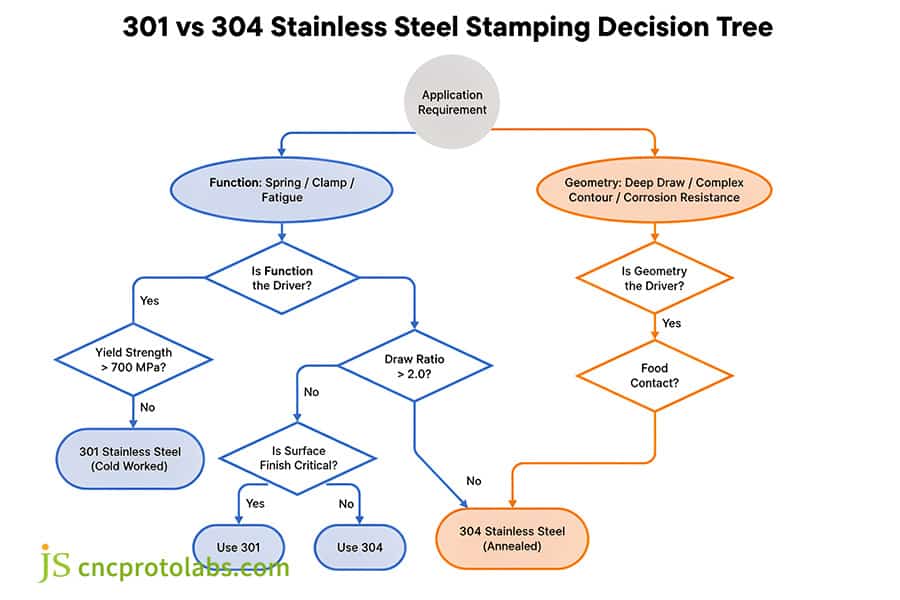
Figure 2: Decision flowchart for 301 vs 304 stainless steel stamping grades in EV applications.
FAQs
Q1: Should I use 301 or 304 stainless steel for stamped spring clips?
For stamped spring clips, choose 301 in half-hard or full-hard tempers (yield >1000 MPa) for excellent fatigue and spring performance. Annealed 304 has a yield of only ~205 MPa, so it yields permanently on every cycle.
Q2: Is 301 stainless steel OK for stamped food equipment, or must I use 304?
The 304 stainless steel, used for food processing equipment, is made up of 18.0–20.0% Cr and 8.0–10.5% Ni. For food contact, passivation, acid resistance, and FDA compliance are required. The 301 stainless steel material consists of low nickel and high carbon, which is prone to pitting corrosion when exposed to humid and acidic environments.
Q3: At what volume does the 301 vs 304 stamping cost difference matter?
Volumes of 50,000–100,000 pieces. At lower volumes, the difference in price is mostly in the cost of the coiled material; at higher volumes, the impact of readily accelerated die wear (301) makes the unit cost different. See high-volume stamping cost for the cost models of high-volume stamping.
Q4: Can 301 stainless steel be deep-drawn like 304?
301 can be shallow-drawn only in the fully annealed condition. Deep drawing is unsuitable because 301 rapidly work-hardens and may wrinkle or crack if drawn in multiple stages. 304 has a elongation of >50%, it's a common deep drawing.
Q5: Why does 301 stainless steel become magnetic after progressive stamping?
The stamping deformation results in 301 austenite converting into ferromagnetic deformed martensite. To remain non-magnetic, use 304 or anneal 301 after stamping to reverse the martensitic transformation.
Q6: How should toolmakers adjust bend radii for 301 compared to 304?
For hardened 301, use an inner-fillet R/t of 1.5–3.0 and avoid bending parallel to the rolling direction. For annealed 304, R/t of 0.5–1.0 is sufficient with low orientation sensitivity.
Q7: Which grade provides better weldability for stamped assemblies: 301 or 304?
For welded components 304 should be selected (e.g. 304L). Cold working steels like 301 have 0.15% carbon and are sensitive to intergranular corrosion in the heat-affected zone. Also in the cold hardened state it will soften after annealing.
Q8: What press tonnage difference is expected between 301 Full Hard and 304 stamping?
301 Full Hard requires 40%–60% more tonnage than 304 annealed (shear strength >800 MPa), calling for a higher-speed press with a larger anti-deflection structure.
Summary
Selecting between 301 and 304 requires balancing work-hardening resilience against formability limits. For fatigue deflection or clamping force, 301 delivers unmatched yield; for deep-drawn geometries or food-grade exposure, 304 remains the standard. Engineers must calculate punch wear and springback early in DFM to avoid costly adjustments.
Want to verify strip tolerances and mitigate springback risks? Download the "Stainless Steel Stamping Design and Tolerance Guide" (PDF), or contact the JS Precision engineering team to review CAD drawings and obtain a 301/304 stamping quote and DFM feedback. Engineers will provide selection advice and die solutions within 24 hours to ensure the first batch of samples meets standards.

Disclaimer
The contents of this page are for informational purposes only. For JS Precision Services, there are no representations or warranties, express or implied, as to the accuracy, completeness, or validity of the information. It is the buyer's responsibility to identify specific technical requirements and request a formal parts quotation. Please contact us for more information.
Resource