English



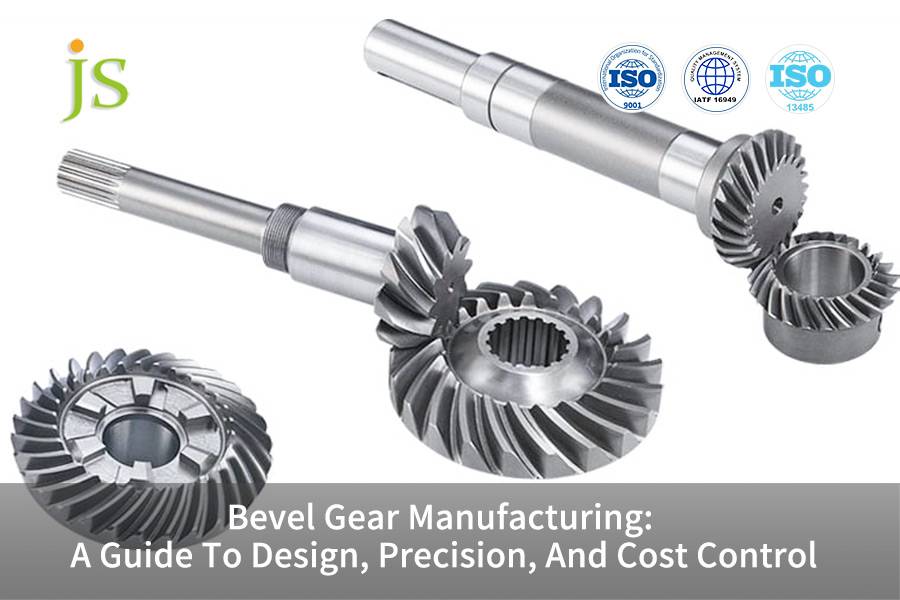

Accuracy of bevel gear manufacturing has a significant impact on the life and noise of transmission systems of different types. When engineers design, they often face the challenge of balancing the selection of spiral level gears, DIN accuracy, and production costs.
This guide will take a deep dive into the whole bevel gear manufacturing process and, using real production experience, disclose the main cost control strategies in bevel gear machining, thus making sure that design and production stages are fully aligned with the real operating requirements.
Quick Overview of Core Answers
| Core Dimensions | Key Answers | Value for You |
| Process Path Selection | The four stages of the bevel gear manufacturing process are forging/cutting → rough machining → heat treatment → precision machining, and the accuracy is positively correlated with the cost. | Select the process based on precision requirements to avoid paying excessive fees for unnecessary precision. |
| Gear Type Selection | Besides the fact that spiral bevel gear lower the noise level by 30%, they are also capable of bearing a higher load, spur gears, on the contrary, are 50% cheaper and hence can be an economical option for low speed, light load situations. | Be sure to accurately match the working conditions to neither perform too much nor be under, loaded. |
| Manufacturing Method Decisions | Use form milling when you have a small batch, face hobbing for a large batch, and gear grinding is required for precision of DIN 5 and above. | Select the most suitable bevel gear manufacturing methods depending on the production scale and accuracy. |
| Supplier Evaluation | Check core equipment (Gleason/Klingberg), examine the quality system (ISO/IATF), and verify testing capabilities (CMM full inspection). | Get a reasonable assessment grid to identify the most reliable bevel gear manufacturer. |
Key Takeaways:
- Precision Threshold:
DIN Grade 5 has been a turning point in the manufacturing industry. If the precision levels are higher, then gear grinding is necessary, which will lead to 40-60% of increase in processing cost.
- Design Cost Reduction:
DFM intervention in the early stage of the project helps undercut optimization and pressure angle standardization thus, tooling cost can be reduced by 20-30%.
- Material Life:
Carburizing and quenching (surface HRC 58-62, core HRC 25-40) are more aligned to the functionality of heavy load scenarios than induction hardening thus, have the potential to increase the gear lifespan by more than 30%.
- Batch Pricing:
Custom gear manufacturing requires shared debugging costs, and increasing the batch size from 10 to 100 pieces can reduce the cost per piece by 40-60%.
Why Trust This Article? JS Precision's 20+ Years In Bevel Gear Manufacturing
JS Precision has held a central role in the field of precision transmission for more than 20 years and has delivered more than half a million spiral bevel gear products. JS Precision has great technical know how and faces the challenge of designing bevel gears and gear machining that fit right from the automotive, construction machinery, robotics, and aerospace industries worldwide.
All content in this article results from JS Precision's genuine production, real process data, and industry solutions. It is not a mere theoretical compilation, but rather aims to reveal the core technical points and cost control secrets of bevel gear manufacturing.
Concerning gear precision and inspection standards, JS Precision accords full compliance with the ISO 1328-1 gear precision specification, thus making the tooth profile and tooth direction errors of each product even lower than those required by the highest industry standards.
Over the past 20 years, JS Precision has solved the pain points of thousands of customers in planetary gear machining, from customized low-speed and light load spur bevel gears, to mass production of high-speed and heavy-duty spiral planetary gears, to the machining of DIN level 3 ultra high precision gears, all of which have formed a standardized and replicable process system.
To address the personalized needs of custom gear manufacturing, JS Precision has also established a rapid-response engineering team capable of completing the process solution output from drawing analysis within 72 hours.
Choosing a reliable bevel gear manufacturer is crucial for the success of your transmission system. If you're struggling with process selection and cost control in bevel gear manufacturing, contact JS Precision's application engineers directly for free one-on-one process consultation. Let their professional team help you avoid pitfalls in design and production.
What Is The Bevel Gear Manufacturing Process And Why Does It Matter?
The scientific aspect of the bevel gear manufacturing process is what ultimately affects the output of the gears. Each step in gear machining influences the trade off between accuracy, durability, and cost, it is basically a system engineering problem with each part interconnected.
Four Core Process Stages
The complete bevel gear manufacturing process consists of four main stages: forging/blanking, rough machining, heat treatment, and finish machining. These stages are critical in determining the final accuracy and cost of a product and therefore are the basis for the next processing step.
Process Route Decisions for Soft and Hard Machining
Bevel gear machining has two parts: soft machining (before heat treatment) and hard machining (after heat treatment):
- Soft machining makes use of high speed steel or carbide tools, which are very efficient and can give precision below DIN 7.
- Hard machining makes use of CBN grinding wheels or ceramic tools, which although expensive, can reach precision up to DIN 3 and are capable of correcting heat treatment deformation.
Key Intervention Points and Technology Selection for Heat Treatment
To a great extent, the life of a gear depends on heat treatment, hence it should be chosen based on requirements:
- Carburization and quenching give a surface with HRC of 58-62, and the core has a core HRC of 25-40, thus giving good toughness and being heavy load capable.
- Induction hardened surfaces have a surface HRC of 50-55, are 30% cheaper, and are suitable for medium carbon steel gears with low speeds and light loads.
How To Choose Between Straight And Spiral Bevel Gear?
Deciding on the tooth profile is the initial phase in the design of bevel gear manufacturing. Straight bevel gears and spiral bevel gear have very different characteristics in terms of performance, cost, and usage. The wrong choice of profile may cause noise problems, early damage, or unnecessary expenditure of money.
Straight Bevel Gears: A simple and reliable choice that is cost effective
Straight reduction bevel gears have a simple structure and are very efficient to manufacture. The teeth are straight, and the mesh is point contact. They can be used in low speed, light load situations with linear speeds <5m/s, and the cost of a unit is 30-50% less than that of a spiral bevel gear.
Spiral Bevel Gear: the king of high-speed and heavy-duty performance
Spiral bevel gears are defined by the helical tooth lines and line contact meshing, which results in the highest smoothness of operation and low noise level.
While high manufacturing precision is needed, these gears are suitable for high speed, heavy load situations where linear speeds >20m/s, and they can carry over 30% more load than straight bevel gears.
Zero Degree Spiral Bevel Gear: technical selection of compromise solution
Zero degree arc tooth helix angle=0 °, which means that they blend the characteristics of straight gears in terms of low axial force and those of spiral gears in terms of smoothness.
The production method is essentially the same as for spiral bevel gears, which makes these gears suitable for very special purposes where the play of axial force has to be extremely small and the functioning has to be very smooth.
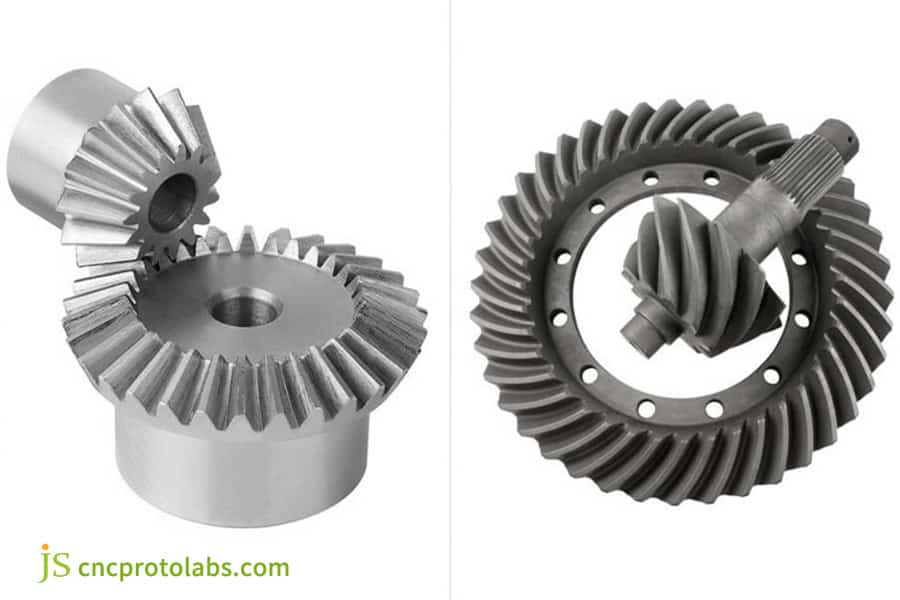
Figure 1: A visual comparison of two bevel gearset designs: a straight-tooth bevel gear set (left) and a spiral bevel gear set (right), showcasing their different tooth geometries.
How To Choose The Right Bevel Gear Manufacturing Methods For Your Project?
The decision of bevel gear manufacturing methods is generally influenced by production volume, precision, and budget. By picking the right method, one can save the costs by more than 40% and still keep the precision level.
Face Milling vs. Face Hobbing: Two Major Cutting Methods
- Face milling is an intermittent indexing process that achieves DIN 5 precision and is ideal for small to medium batches of high precision spiral bevel gears.
- Face hobbing being a continuous indexing process is more than 30% efficient and is used for large scale automotive gear production.
Form Cutting vs. Generating Cutting: Batch Size Determines Which Process to Use
- Form milling cutters are very cheap (US$800-1500/set) but also uneconomical, thus, they are good for modules >8mm and batches <10 samples.
- Generating cutters guarantee stable precision (DIN 6) and high productivity and they are suitable for projects with production volume at the level of tens of thousands pieces or more.
Precision × Output × Budget Decision Matrix
| Relative Cost Index | Annual Output | Recommended Process | Relative Cost Index |
| DIN 8-9 | <100 pieces | Form Milling | 1.0 |
| DIN 6-7 | 100-5000 pieces | Face Milling | 1.8-2.2 |
| DIN 5 and above | >5000 pieces | Face Hobbing + Gear Grinding | 3.0-4.5 |
| DIN 3-4 | Any | Dedicated Gear Grinding Equipment | 5.0+ |
JS Precision possesses a complete set of processing equipment for bevel gear manufacturing methods, including form milling, face milling, face hobbing, and gear grinding. If you want to know which processing method is suitable for your project, you can calculate your production costs free of charge and obtain a cost-effective process solution.
How Do Precision Grades (AGMA/Din) Affect The Entire Production Chain?
Precision grades according to AGMA and DIN standards are vital aspects that go through each part of bevel gear machining. The quality of products relies heavily on them. They set the limits for cutting tools, process, inspection, and therefore costs associated.
Engineers are advised to pick the one that caters to their needs without blindly chasing the highest grade.
Precision Grades: A Simple Explanation of AGMA and DIN Standards
AGMA and DIN are the top two gear precision standards worldwide with a well transitioned grade system. It is normal when going one step up in each precision level, the processing costs will increase by 15-25%.
The main correspondences are stated below:
- AGMA Q6 grade = DIN 7 grade, ideal for general industrial transmission.
- AGMA Q8 grade = DIN 6 grade, ideal for general car transmission.
- AGMA Q10 grade = DIN 4 grade, ideal for premium applications like aerospace.
When is Grinding Necessary?
To get precision levels of DIN 5 or AGMA 12 and more, heat treatment deformation must be rectified by gear grinding. Grinding lowers surface roughness and sound, but also increases equipment investment and working time.
Inspection Plan: Sampling or Full Inspection?
Precision determines the inspection plan:
- For DIN 7 and below, batch sampling (5-10%) + SPC control.
- For DIN 5-6, first piece full inspection + 20% sampling.
- For DIN 4 and above, 100% full inspection and a CMM report are required.
If you want to understand the specific costs of bevel gear machining at different precision levels, you can contact JS Precision engineers to obtain a detailed precision-cost comparison table to clearly understand the investment and return for each precision level.
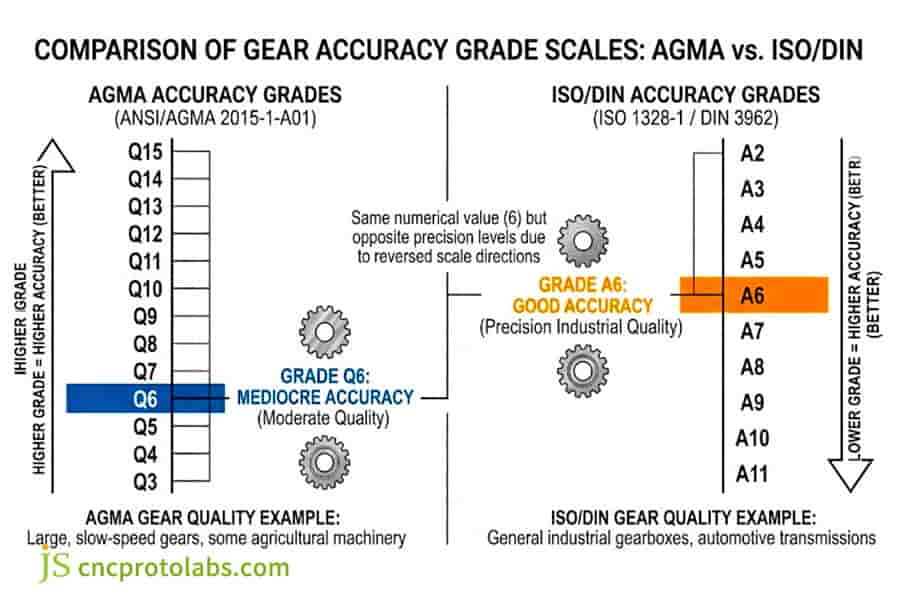
Figure 2: An infographic comparing AGMA (Q3-Q15) and ISO/DIN (A2-A11) gear accuracy grade standards, with examples of applications for specific grades.
What Are The Secrets To Balancing Cost In Custom Gear Manufacturing?
Costs for custom gear manufacture are quite high. A strategy to keep core costs under control is "reducing costs at the design source and controlling costs during the process," combining performance and cost through design, batch and material optimization.
Design for Manufacturing: A few small changes can greatly reduce costs
Performing a few simple adjustments to the design phase can reduce tooling costs by 20-30% without a performance loss. The main directions are:
- Adjusting the root fillet radius (0.3-0.4 of the module) for standard tools.
- Keeping a standard 20 pressure angle to minimize the need for custom tooling.
- Standardizing the design of the internal hole to match universal tooling.
The Effect of Batch Size: Spread Fixed Costs
Custom gear manufacturing involves a fixed upfront cost of a few items (programming and debugging fees of $200-500/time, and custom tooling fees of $800-3000/set). The greatest cost distribution to the least number of parts is with 1-10 pieces, the highest cost performance with 10-50 pieces and a 40-60% drop in the cost per piece with 50 100 pieces.
To more clearly demonstrate the cost differences related to different batch sizes, materials, and precision levels in custom gear manufacturing, the following is a data comparison table compiled by JS Precision:
| Production Batch (pieces) | Material Type | Precision Level | Unit Material Cost (USD) | Unit Processing Cost (USD) | Unit Inspection Cost (USD) |
| 10 | 20CrMnTi (Domestic) | DIN Grade 7 | 18.5 | 45.2 | 4.8 |
| 10 | 8620 (Imported) | DIN Grade 5 | 24.1 | 89.7 | 12.3 |
| 50 | 20CrMnTi (Domestic) | DIN Grade 6 | 17.8 | 58.9 | 8.5 |
| 50 | 8620 (Imported) | DIN Grade 4 | 23.5 | 126.8 | 21.7 |
| 100 | 20CrMnTi (Domestic) | DIN Grade 5 | 17.2 | 65.3 | 10.2 |
| 100 | 8620 (Imported) | DIN Grade 3 | 22.8 | 158.4 | 28.9 |
Material Selection: Short-Term and Long-Term Costs of Imported vs. Domestic Materials
Material costs typically take up 20-30% of the total.
- Imported materials like 8620 are 30% more costly, however, the consistency of the materials from one batch to another is better.
- Top notch domestic materials like 20CrMnTi not only have a cost advantage but also, based on JS Precision testing, are capable of meeting the requirements of automotive and construction machinery.
Identification of Hidden Costs
The hidden costs of custom gear manufacturing may reach up to 8-12% and these mainly comprise fees for CMM testing, rust proof packaging, and insurance plus dedicated vehicle transportation for high end gears.
When Is Custom Gear Manufacturing The Optimal Solution?
Standard gears are cheap and have fast lead times but do not always satisfy all the requirements of the work. In such a case, custom gear manufacturing is the best way to go as specialized manufacturers can upgrade the performance and reliability of the transmission system.
Cost Inflection Point Analysis Between Standard and Customized Products
Custom gear manufacturing becomes more cost effective than standard products if any one of the following conditions is satisfied:
- Module <0.5 or >10.
- Special materials are required for high temperature corrosion resistance.
- Limited equipment space requires non standard dimensions.
- High NVH necessitates gear modification.
Customized Design Optimization: Meeting Specific Operating Conditions
JS Precision is capable of changing gear profiles to suit the operating conditions, for instance, tooth tip trimming for noise reduction and tooth profile bulging (5-15μm) for contact area optimization, thus significantly enhancing gear life (over 30%).
The Value of Co-Engineering
Early collaborative design with manufacturers can uncover processing risks beforehand, decrease costs, shorten the development cycle by 25%, and speed up the product launch.
If you have customized gear requirements, you can send your drawings to JS Precision. Our engineers will analyze the drawings within 3 business days and provide a customized design and process optimization plan.
How To Evaluate And Select a Qualified Bevel Gear Manufacturer?
Choosing an experienced bevel gear manufacturer remains a significant factor for a successful project. You should evaluate the manufacturer in four areas: technology, quality, testing, and mass production, which altogether form a logical framework.
Checklist for Technical Capability Assessment
Technical capability is the most critical aspect. Some of the essential evaluation criteria are:
- Major Equipment: Has the gear manufacturer got the specialized machine tools such as Gleason or Klingberg?
- Process Paperwork: Is the manufacturer able to provide process flow diagrams at a high level of detail and quality control plans?
- Engineering Team: Can the manufacturer supply DFM analysis, gear modification, and failure analysis services?
The Role of Quality System Certification
ISO 9001:2015 is a compulsory minimum standard. IATF 16949 is designed for the automotive industry, and AS9100D is for the aerospace industry, aligning with different industrial capability requirements.
Checking Testing Facilities
Testing is the most significant part of quality control. We must find out if the supplier owns a gear measurement center, is able to provide testing reports that are traceable, and has ways for testing heat treatment hardness.
Flexibility in Sample Production and Mass Production Capabilities
Top notch manufacturers should have complete production capabilities:
- 1-10 samples supplied within 2-3 weeks.
- 100-1000 samples with SPC control.
- More than 10,000 samples with automated production line traceability.
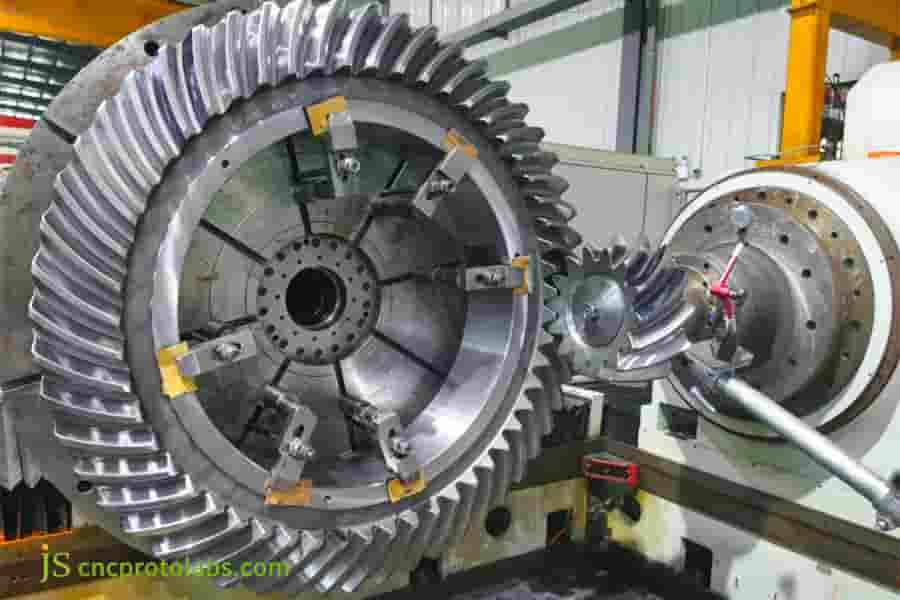
Figure 3: A large spiral bevel gear undergoing a precision machining or measurement operation on an industrial lathe in a manufacturing facility.
JS Precision Case Study: Breakthrough In Reducing The Cost Of Bevel Gears In a Wind Power Gearbox By 35%
Challenge
One of the spiral bevel gears of the wind power company's 2MW gearbox (material: 18CrNiMo7-6, module: 8, helix angle: 25) was misaligned at the contact point, and the gear failed sooner because of it. The lead time of the original supplier was 24 weeks, and the supplier refused to carry out any optimization, which resulted in high import costs.
Solution
JS Precision, after the facilitation, looked out for the whole bevel gear manufacturing process optimization and also leveraged its custom gear manufacturing design optimization capabilities to develop a solution:
1.DFM Optimization:
Changing the tooth profile bulge from 12μm to 8μm, accurately pinpointing the optimization of the contact surface position, narrowing the carburized layer depth from 1.2±0.3mm to 1.2±0.15mm, thus the gear load capacity is enhanced.
2.Process Upgrade:
The process takes the chain of "precision end face milling + carburizing and quenching + CNC grinding," grinding allowance is strictly controlled to 0.15mm, heat treatment deformation is corrected, and gear precision is assured.
3.Supply Chain Integration:
We chose a premium 18CrNiMo7-6 steel from Baosteel that, after our thorough testing and certification, replaced the imported ones, thus lowering the cost of the raw materials by 22% directly.
4.Better Checking:
Incorporation of 100% CMM precision inspection + contact area rolling inspection in order to verify that the contact area of each gear is in accordance with the design requirements, resulting in the batch pass rate being increased to more than 99.2%.
Results
Through full process optimization, the fatigue life of the spiral neck gear has been increased by over 40%, the defect rate has decreased from 3.5% to below 0.8%, the comprehensive procurement cost has been reduced by 35%, and the delivery time has remained stable within 14 weeks.
If you also face problems such as early gear failure, high costs, and delivery delays, you can send your project pain points and needs to JS Precision. Engineers will customize a solution for you. You can also view more industry success stories to understand JS Precision's technical strength.
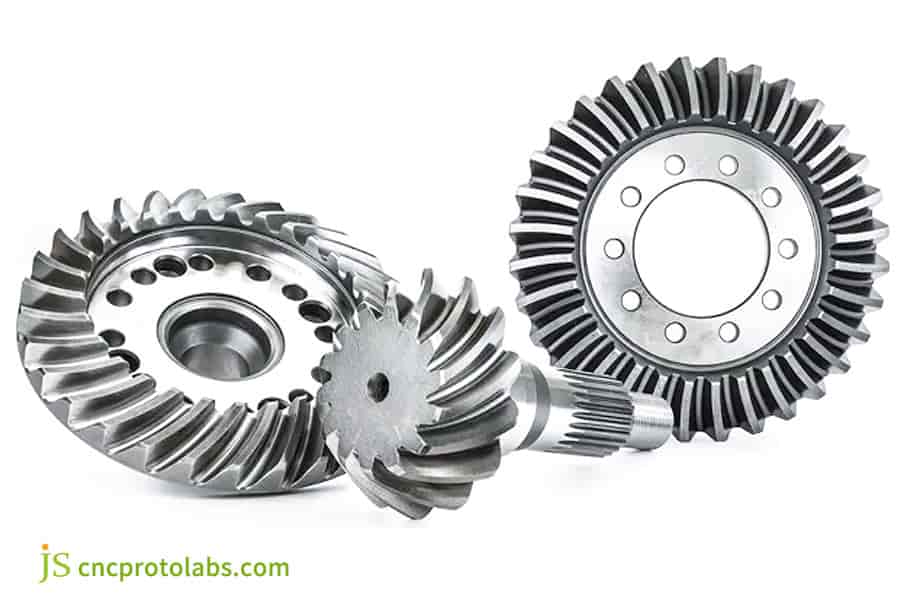
Figure 4: Three different spiral bevel gears made of metal, displayed on a white background, showcasing their intricate teeth and finished surfaces.
FAQs
Q1: What is the fundamental difference between straight bevel gears and spiral bevel gears?
Straight bevel gears are easier and cheaper to make and therefore fit for low speed, light load situations, spiral bevel gears provide quiet operation, high load capacity, and smooth meshing, thus they are preferable for high speed, heavy load applications.
Q2: How to choose between induction hardening and carburizing hardening?
Induction hardening (low cost) is an option for medium carbon steel low speed, light load gears, carburizing hardening is necessary for low carbon alloy steel heavy load gears, which will give the surface a very high hardness and the core a good toughness.
Q3: What is the minimum order quantity for small batch customized bevel gears?
JS Precision can make custom gear manufacturing with a minimum order of 1 piece. For 1-10 pieces, development costs need to be shared. 10-50 pieces are most cost efficient.
Q4: What are the top components of bevel gear manufacturing that contribute to costs?
The main costs of bevel gear manufacturing lie in cutting tools (20-30%), heat treatment (15-25%), machining (30-40%), and inspection (10-15%).
Q5: How much time is required to get a sample after the drawings are provided?
The delivery time for standard bevel gear samples is 2-3 weeks. Due to the time-consuming debugging process, the delivery time for complex shaped spiral neck gears is 3-4 weeks.
Q6: What are the typical failure modes of bevel gears?
Tooth surface pitting, tooth root fracture, and wear are the typical failure modes of bevel gears. These are mainly due to insufficient lubrication, overload, lack of hardness, or poor lubrication, respectively.
Q7: Why is there such a large price difference for bevel gears?
The price difference in bevel gears is mainly attributed to four main factors: materials used in bevel gear manufacturing, precision grade, heat treatment process, and production volume.
Q8: What are the special requirements for export packaging?
Exported bevel gears need to be rust proof packing, rust preventive oil + vapor phase rust inhibitor paper + wooden crate. Precision gears to be shipped by sea require vacuum packaging in addition.
Q9: How can I get a quote for bevel gear manufacturing?
Submit your design drawings and specifications (material, precision grade, quantity, etc.). JS Precision provides a free DFM analysis and a detailed quote, typically within 24 hours. Note that batch size significantly affects unit cost.
Summary
Bevel gear manufacturing is a technically elaborated project that converts engineering principles into a precise geometry, materials science, and heat treatment practice.
It goes from choosing the right processes for the gear machining to designing the spiral bevel gear tooth profiles and eventually to cost control in custom gear manufacturing, where everything must be strictly matched to the operating conditions.
Picking the accurate process, the tooth profile, and the bevel gear manufacturer plays a vital role in meeting the desired performance and cost goals.
JS Precision has been deeply involved in bevel gear manufacturing for over twenty years, providing full-process support from design to mass production. If you have related needs, consider partnering with JS Precision and letting our professional team empower you.

Disclaimer
The contents of this page are for informational purposes only.JS Precision Services,there are no representations or warranties, express or implied, as to the accuracy, completeness or validity of the information. It should not be inferred that a third-party supplier or manufacturer will provide performance parameters, geometric tolerances, specific design characteristics, material quality and type or workmanship through the JS Precision Network. It's the buyer's responsibility Require parts quotation Identify specific requirements for these sections.Please contact us for more information.
JS Precision Team
JS Precision is an industry-leading company, focus on custom manufacturing solutions. We have over 20 years of experience with over 5,000 customers, and we focus on high precisionCNC machining,Sheet metal manufacturing,3D printing,Injection molding,Metal stamping,and other one-stop manufacturing services.
Our factory is equipped with over 100 state-of-the-art 5-axis machining centers, ISO 9001:2015 certified. We provide fast, efficient and high-quality manufacturing solutions to customers in more than 150 countries around the world. Whether it is small volume production or large-scale customization, we can meet your needs with the fastest delivery within 24 hours. Choose JS Precision this means selection efficiency, quality and professionalism.
To learn more, visit our website:www.cncprotolabs.com
Resource