English



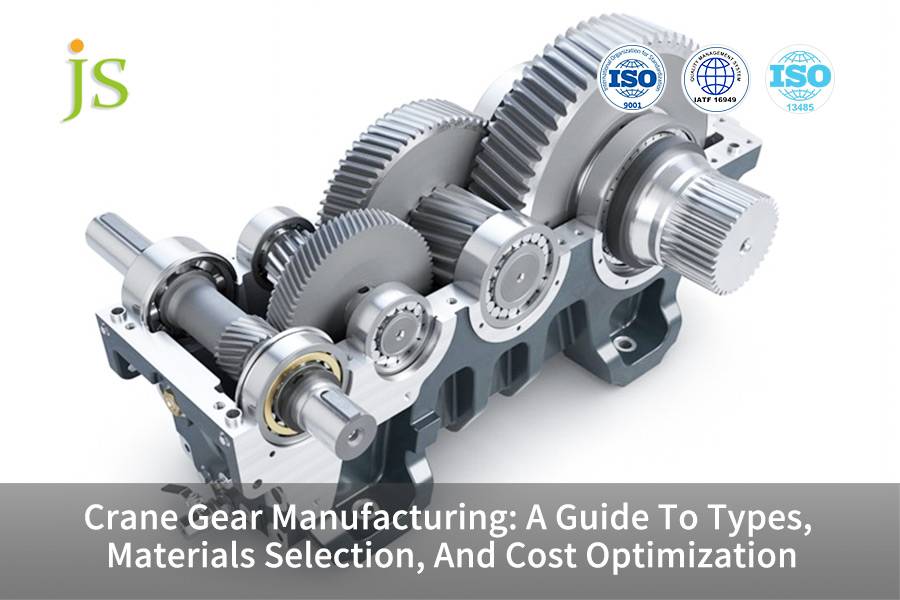

Crane gear manufacturing plays a major role in the reliability of the crane's transmission system. Being devices that perform high-risk, heavy load operations, cranes put their transmission gears under huge impact load and alternating stresses when the load is being lifted and moved.
If the gears break, not only will there be a stoppage of the equipment, but also there can be safety accidents and project delays, which in turn will cause economic losses to be more than the value of the gear performance alone.
Figures reveal that more than 60% of the failures of the crane gearbox are due to gear failures, out of which 90% are caused by the improper choice of material or lack of proper heat treatment. A high-grade gear machining process is the best way to eliminate these issues at the root.
Key Answers Overview
| Key Questions | Key Answers | Value for You |
| How to ensure the reliability and lifespan of crane gears? | Professional crane gear manufacturing processes combine the use of matching 42CrMo4/20CrMnTi materials, precision heat treatment with a 2-4mm carburized layer depth, and gear machining through DIN 5-6 grade tooth surface grinding. | Understanding the technical way of making high-performance crane gears leads to avoiding the risks of early failures right from the start. |
| How to optimize costs while ensuring quality? | By DFM optimization, evaluating batch economics, and choosing a well, established crane gear manufacturing supplier, the overall costs can be lowered by 15-30%. | Have a solid scientific cost control framework that maximizes the value of procurement. |
| When is custom gearing a must instead of standard parts? | If the operating conditions are special (heavy load/impact), if the speed ratios are non-standard, or if there are space constraints, then only custom spur gears or the services of a professional bevel gear manufacturer are the ways to go. | Precisely determine the limits of the customization needs and gear up for the starting of the gear customization project in an efficient manner. |
Key Conclusions:
- Material defines the load, bearing capacity:
For heavy-duty crane gears, 42CrMo4 with a tempered hardness of 280-320 HB, and 20CrMnTi with a surface hardness of 58-62 HRC after carburizing are the typical configurations.
- Heat treatment makes the difference between life and death:
Keeping the carburized layer thickness to 2-4mm and having a gentle transition zone in the hardened layer can raise the gear fatigue life by over 30%.
- Accuracy dictates noise and wear:
Gear grinding can raise the gear accuracy from DIN8 to DIN5-6, thus the contact patterns can be enhanced to more than 80% of the tooth length.
- Buying from local suppliers is not the best:
While looking for "gear machining near me, " make it a point to assess the supplier's technical capabilities first. The Chinese supply chain has considerable cost and quality advantages in this aspect.
Why Trust JS Precision Crane Gear Manufacturing Services?
JS Precision specializes in Research and Development and manufacture of heavy, duty gears in the crane gear manufacturing sector and has more than 15 years of experience in this field. Our core team is composed of experts in top-tier gear machining technology.
Our production standards are rigorously in line with ISO 6336-1:2019 crane gear design specifications. We have also implemented digital control throughout the entire process, from the selection of materials to the inspection of finished products.
On the machinery front, we have large CNC gear hobbing machines with diameters ≤2000mm, Niles high-precision gear grinding machines, and controlled atmosphere carburizing furnaces.
We are capable of integrated machining for various crane gears with a module up to 32mm and can achieve a stable gear machining accuracy of DIN5, which is significantly higher than the industry standard of DIN8.
We own a failure analysis laboratory on our premises and we have helped solve the early failure problems of port, steel, and construction industry crane gears in more than 30 countries worldwide. Our improved carburizing process of heavy-duty gears allows gear fatigue life extension to more than three times that of the industry average.
In one instance, we optimized the gear manufacturing process of a 40-ton crane at a port, which resulted in a gear failure cycle extension from 8, 000 hours to 25, 000 hours and at the same time, procurement costs were reduced by 35%.
In terms of quality assurance, each batch of gears is provided with a complete material warranty, heat treatment testing report, and tooth profile accuracy testing data, achieving full lifecycle traceability and becoming a core crane gear manufacturing supplier for many internationally renowned crane manufacturers.
Want to prevent premature failure and achieve an ultra-long service life for your crane gears? Contact JS Precision's engineering team now, submit your gear operating conditions and parameters, and you can receive a free-customized crane gear manufacturing technical solution to mitigate gear failure risks from the source.
What Are The Core Types Of Gears In Crane Gear Manufacturing?
The three core components of a crane perform different functions, thus each of them requires a different type of gear. Consequently, specific types have to be matched in the manufacturing of crane gears.
Professional gear machining processes guarantee the performance of gears, and the technology of worm gear manufacturing and bevel gear manufacturers are the key factors that decide the quality of special gears.
Key Gear Types in Lifting Mechanisms
As the lifting mechanism is a central heavy, duty component, the gears here must be able to withstand the maximum impact load, hence they require extremely high gear machining precision:
- Helical Gears: A typical type of gear in the modern lifting mechanism of cranes by the virtue of their high meshing overlap, noise is reduced 5-8dB as compared with spur gears, and the capacity of load is increased by 20-30%. Gear surface grinding precision should comply with DIN 5-6 grade.
- Herringbone Gears: Mostly found in ultra, large tonnage cranes, they have a self-balancing axial force, the module is 28-36mm, the helix angle is 20-28°, a single-stage power transmission exceeding 500kW, thus these gears are very high power and require specialised machining equipment.
Slewing mechanisms and planetary gears
- Slewing Bearing Gears: Mostly these are internal gear rings, material 42CrMo4, induction hardened tooth surface hardness 56-62HRC, hardened layer >4mm, quenching deformation ≤0.05mm.
- Planetary Gear Mechanism: A high power density, compact structure, is something which a large tonnage crane reduction mechanism which requires consistent meshing clearance among multiple gears would find very useful.
Applications of Worm Gears in Cranes
Worm gear manufacturing is mainly used for rotating and fine-tuning mechanisms, with self-locking characteristics to prevent slipping under lifting loads.
The classic material combination is 20CrMnTi carburizing quenched worm gear and ZCuSn10P1 tin bronze worm gear, which requires strict control of the roughness of the worm gear tooth surface.
Want to accurately match the gear types of each mechanism of the crane? Please inform JS Precision of your crane tonnage and operating conditions to receive a free gear selection list. Click to view our gear selection guide.
How To Select The Right Material For Your Crane Gear?
Material is the foundation of gear performance. The first step in crane gear manufacturing is precise material selection. Professional suppliers will recommend suitable materials based on load, speed, and other operating conditions to ensure load-bearing capacity and lifespan.
Common Material Grades for Lifting Gears
| Material Grade | Processing Technology | Hardness Range | Applicable Scenarios | Procurement Cost (USD/kg) |
| 42CrMo4/AISI 4140 | Quenched and tempered | 280-320HB | Medium-load gears, gear rings, slewing bearings | 3.2-3.8 |
| 20CrMnTi/ 17CrNiMo6 | Carburized and quenched | Surface 58-62HRC, core 35-40HRC | Heavy-duty lifting gears, high-speed running gears | 2.6-3.2 |
| 40Cr | Quenched and tempered | 220-260HB | Light-load, low-speed auxiliary mechanism gears | 2.0-2.4 |
| 45# steel | Normalized | 180-220HB | Manual fine-tuning mechanism gears | 1.8-2.2 |
Core Decision Factors for Material Selection
- Load Characteristics: Impact loads demand gears made of 20CrMnTi with a good core toughness, for stable medium loads, 42CrMo4 can be chosen.
- Gear Surface Hardness: A surface hardness of HRC>55 needs 20CrMnTi after carburizing/induction hardening, for a medium to low hardness range, 40Cr or 45# steel are the choices.
- Cost Constraints: The purchase price of 42CrMo4 is about 1.2 times the price of 20CrMnTi. Low, cost medium carbon steel can be prioritized for light-load applications.
The Importance of Material Traceability
Reputable suppliers will provide full material quality certificates with the furnace number, chemical composition, and other data, ensuring gear material traceability and preventing premature failure of the gear due to the use of substandard materials.
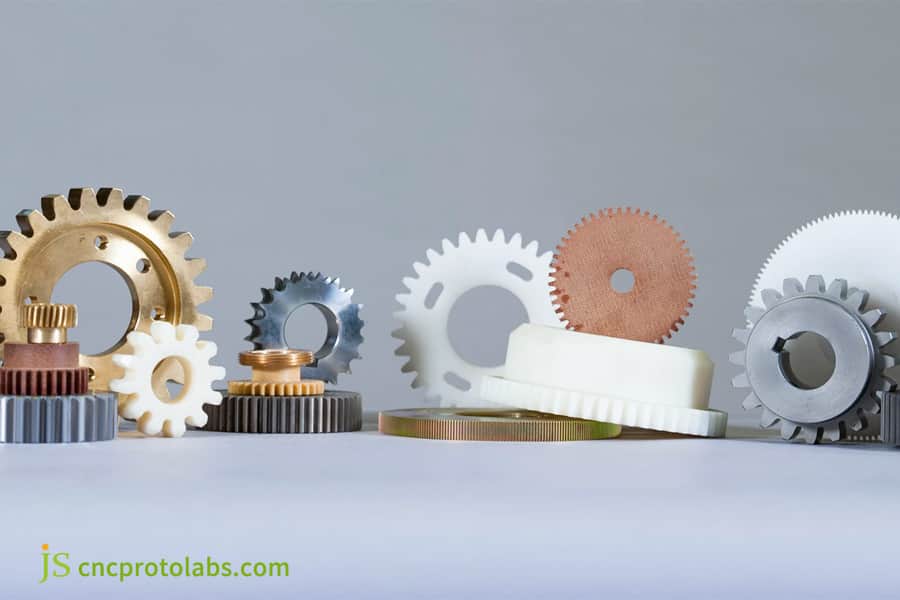
Figure 1: A diverse assortment of finished gears in various metals and plastics, showcasing different sizes and tooth profiles for material selection.
How Does Heat Treatment Optimize Crane Gear Manufacturing For Heavy Loads?
Heat treatment is the core process for improving the fatigue and wear resistance of crane gears. In the crane gear manufacturing process, the parameter control of the heat treatment process directly determines the service life of the gears.
Professional crane gear manufacturing will customize exclusive heat treatment solutions based on gear materials, modules, and working conditions.
Core Parameter Control for Carburizing and Quenching
Carburizing and quenching is the main processing method for heavy-duty gears, and parameters have to be very accurately adjusted according to the size of the gear module:
- Basic parameters: Carburizing temperature 920-950℃, carbon potential 1.0-1.2% during the strong carburizing period, 0.8-0.9% during the diffusion period and oil quenching to ensure uniform hardness.
- Hardened layer depth: 1.2-1.8mm for modules 5-8mm, 1.8-2.5mm for modules 8-12mm and 2.5-4.0mm for modules >12mm.
Application of Induction Hardening in Large Gears
For ultra-large diameter gear rings (>2000mm), integral carburizing is expensive and causes a lot of deformation. So, induction hardening of the gear surface is the usual practice:
- Frequency Selection: Medium frequency (2-10kHz) produces a 2-4mm hardened layer which is suitable for heavy loads, high frequency (20-50kHz) produces a 1-2mm hardened layer which is suitable for light loads.
- Hardness Standard: The hardness of the gear surface after quenching is 56-62HRC, which is enough for wear resistance.
Quenching and Tempering Treatment and Normalizing Treatment
- Quenching and Tempering Treatment: Quenching and subsequent high-temperature tempering produce a sorbitic microstructure whose hardness is approximately 240-320HB. Such a material is suitable for moderate-load applications like 42CrMo4.
- Normalizing Treatment: It is the way to prepare the forging blanks for the elimination of the forging stress, the grain refinement, and the obtaining of a good surface for machining.
Precision grinding compensation after carburizing
Carburizing treatment causes the deformation of the gears, so it is necessary to provide a grinding allowance of 0.15-0.25mm for each tooth surface. After carburizing, do the finishing machining with a Niles gear grinding machine up to the DIN 5-6 grade, with the contact patch being more than 80% of the tooth length."
Comparison Table of Heat Treatment Process Parameters for Crane Gears
| Gear Type | Material Grade | Heat Treatment Method | Core Process Parameters | Tooth Surface Hardness | Hardened Layer Depth (mm) | Applicable Crane Tonnage |
| Lifting Mechanism Helical Gear | 20CrMnTi | Carburizing and Quenching + Gear Grinding | Carburizing 930℃, Strong Carburizing Potential 1.1%, Oil Quenching | 58-62HRC | 1.8-2.5 | 20-50 tons |
| Slewing Bearing Internal Gear Ring | 42CrMo4 | Induction Quenching + Precision Machining | Medium Frequency 2-5kHz, Quenching Temperature 880℃, Air Cooling | 56-60HRC | 3.0-4.0 | 50-100 tons |
| Planetary Gear | 17CrNiMo6 | Carburizing and Quenching + Grinding | Carburizing 940℃, Diffusion Carbon Potential 0.85%, Oil Cooling | 59-63HRC | 2.2-3.0 | 100-200 tons |
| Auxiliary Mechanism Spur Gear | 40Cr | Quenching and Tempering | Quenching at 850℃, high-temperature tempering at 580℃, air cooling | 220-260HB | No hardened layer | ≤10 tons |
| Worm Gear | ZCuSn10P1 | Aging Treatment | Aging temperature 200℃, holding for 4 hours, furnace cooling | 80-90HB | No hardened layer | Suitable for various tonnage fine-tuning mechanisms. |
| Herringbone Gear | 42CrMo4 | Carburizing and Quenching + Gear Grinding | Carburizing at 920℃, strong carburizing potential 1.2%, oil quenching | 57-61HRC | 3.5-4.5 | ≥200 tons |
How To Achieve Cost Optimization Without Compromising Gear Quality?
In crane gear manufacturing, there are ways in which quality and cost can be balanced. Expert suppliers have the ability to help in reducing overall costs by 15-30% while at the same time maintaining performance through design, process, and supply chain optimization.
DFM Optimization Cuts Manufacturing Costs
By working with the manufacturing team when designing the gear for DFM optimization, they can help in improving the processing efficiency and thus reduce processing costs by 10-15%.
Batch Economy and Blank Selection
The size of the production batch determines the blank processing method, which in turn has a direct impact on costs:
- Single piece/small batch: Forged blanks, material utilization rate 60-70%, most suitable for non-standard production such as custom spur gears.
- Large batch: Ring-rolled blanks, material utilization rate 85%, thus saving 25% on material costs, standard gear production can be done through this method.
The Importance of Supply Chain Integration
A full-chain supplier means a single supplier who can supply the whole chain of production starting from blanks, processing, heat treatment, and testing. Such a supplier helps in cutting the overall procurement costs by 15-20% when compared to decentralized procurement.
When Should You Choose Custom Spur Gears Or a Bevel Gear Manufacturer?
Standard gears only fit the general working condition perfectly. Custom spur gears are preferable in special working conditions or non-standard constructions. Professional suppliers can provide a perfect match custom gears.
Typical Scenarios for Custom Spur Gears
Scenarios that require custom spur gears: non-standard center distances, special installation space limitations, and the requirement for integrated shafts or flanges.
Application of Spiral Bevel Gears in Cranes
Spiral bevel gears are one of the right-angle transmissions options in cranes. Compared with straight bevel gears, they have a 30% higher meshing overlap, 25% more load capacity, and are 3-5 dB quieter.
A professional bevel gear manufacturer must have Gleason machine tools and Klingelnberg testing equipment for the machining accuracy of spiral bevel gears.
Process Validation Flow of Custom Parts
Custom gears should be validated thoroughly: 3D modeling and mesh simulation, prototype making and full-size check, bench fatigue testing for more than 5 million cycles, small-batch trial production, and SPC monitoring.
Looking to customize crane gears for special working conditions? Submit your non-standard requirements and design drawings to JS Precision to become a custom spur gears partner and enjoy professional technical support from a bevel gear manufacturer.
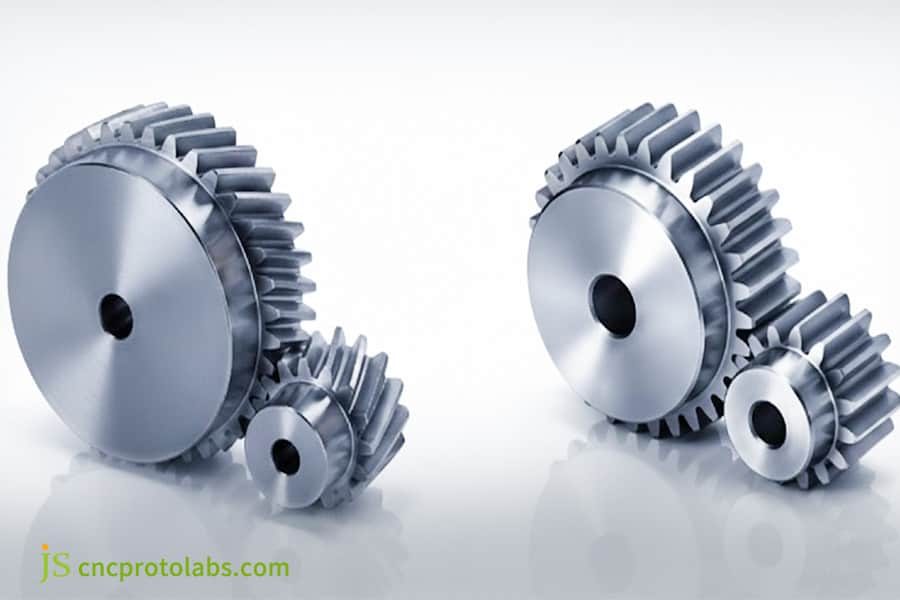
Figure 2: A close-up of three high-precision, metallic spur gears with sharp, well-defined teeth, displayed against a white background.
Is Local Gear Machining Near Me a Cost-Effective Solution?
Customers commonly type "gear machining near me" to find suppliers, but local proximity isn't the main factor. The technical skills of the supplier decide both the quality of gears and the total cost, while the worth of a quality supplier greatly surpasses geographical benefits.
Geographical Distance vs. Technical Distance
Once you have done the search, determine the technical capabilities of the supplier from three perspectives: the availability of large-scale processing equipment, having a full range of heat treatment facilities, and the use of comprehensive testing methods.
Cost Advantages of the Chinese Supply Chain
The industry chain in China is very complete, which leads to great cost advantages over Europe and the US: the price of raw materials in China is 15-25% cheaper, industrial clusters are well developed, and the delivery cycle is shortened by more than 50%.
JS Precision as Your Chinese Manufacturing Partner
Picking JS Precision as your supplier means you will get smooth technical communication, AS9100/ISO9001 quality assurance, one-stop service, and cost-efficient delivery.
Looking for a cost-effective crane gear manufacturing supplier and want to break free from the geographical limitations of "gear machining near me"? Contact JS Precision now to learn about the advantages of China's gear manufacturing supply chain and get a free gear quote.

JS Precision Case Study: 35% Savings On Australian Crane Gearbox Repair
Challenge
A 40-ton gantry crane at an Australian port was plagued by the problem of early pitting corrosion in its rotary reducer gears (42CrMo4, module 12-68 teeth), leading to a gear life of fewer than 8000 hours. The original European crane gear manufacturing supplier had a 26-week lead time, was not willing to perform a failure analysis, and the cost for a single purchase was $12, 000.
Solution
JS Precision, as a professional crane gear manufacturing supplier, has developed a three-step customized solution that utilizes high-precision gear machining technology throughout the entire process:
1.Failure Analysis and Design Optimization:
Through professional testing, it was found that the hardened layer depth of the original gear was only 1.2mm, and the core hardness was less than 250HB, which was the core cause of early pitting corrosion..
We upgrade the gear materials to 20CrMnTi, thereby increasing the depth of the carburized layer to 2.8-3.2mm, and they also change the tooth root fillet radius from R0.8 to R1.2mm in order to improve the gear fatigue resistance.
2. Process Chain Restructuring:
A crane gear manufacturing process is used, which includes "precision forging + isothermal normalizing + controlled atmosphere carburizing + CNC grinding". Dual control with an oxygen probe and a carbon stabilizer are used in the carburizing process to obtain a carbon potential accuracy of ±0.05%. Gear precision is increased to DIN5 level by the grinding process.
3. Comprehensive inspection and SPC Monitoring of 100% Gears:
Every gear is subjected to an extensive inspection program, which besides the tooth profile and direction inspection also includes surface hardness and hardened layer depth inspection and magnetic particle inspection. SPC process monitoring guarantees batch production consistency.
Results
- The gears life was extended beyond 25, 000 hours, thus the pitting corrosion problem was totally eliminated.
- The costs of procurement were cut down to $7, 800, i.e. 35% less than the price from European suppliers.
- The delivery time was shortened to 12 weeks, thus the urgent port demands were satisfied.
Want to replicate the cost optimization and performance improvement results of this case study? Contact JS Precision's case engineer to learn more about the crane gear manufacturing process for crane gear repair and receive a free gear repair solution for your equipment.
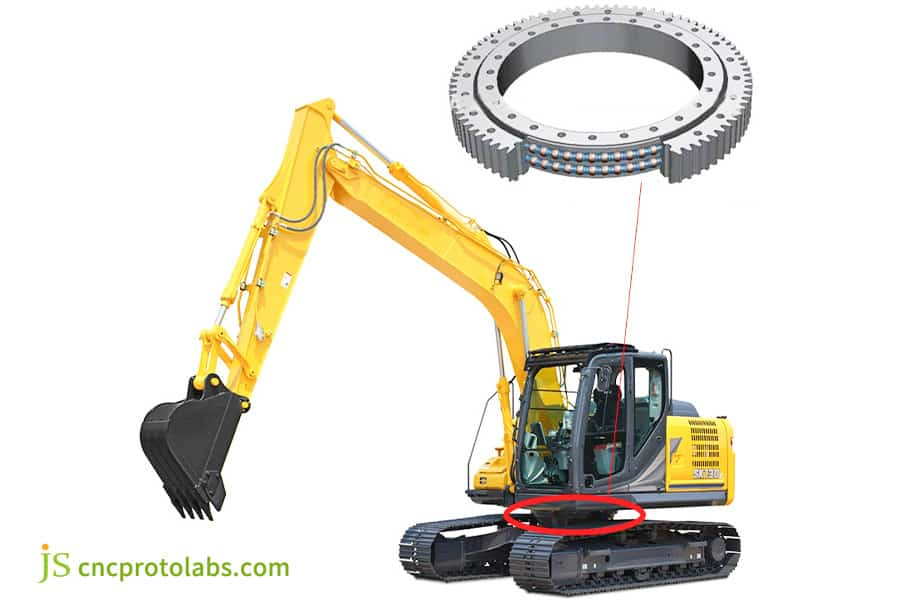
Figure 3: An image of a yellow excavator alongside a close-up detail of its large, metallic slewing ring gear, used for rotation.
FAQs
Q1: What are the most commonly used materials for crane gears?
Two materials are most frequently used for crane gears: 42CrMo4 tempered steel for the conditions of the load_medium and 20CrMnTi carburized steel for heavy-load conditions. The surface hardness is 58-62 HRC after the carburizing and because of this, it is the most suitable material for heavy load gears.
Q2: How is the carburized layer depth determined?
The depth of the carburized layer of the crane gear is determined through a module of 15-20%.If the module is 5-8mm, it will be 1.2-1.8mm, if it is 8-12mm, then it will be 1.8-2.5mm, and if the module is greater than 12mm, then the depth will be 2.5-4.0mm.
Q3: What are the advantages of helical gears compared to spur gears?
Helical gears have a much higher ratio of meshing overlap than spur gears, this means that the transmission is very smooth, the capacity for load is raised by 20-30%, and the transmission noise is lessened by 5-8dB. These kinds of gears are the usual things in lifting mechanisms of cranes nowadays.
Q4: What is the typical precision grade for crane gears?
Nowadays, the profile of the teeth of the crane gears needs to be very close to DIN 5-6. This can only be done by grinding the gear, normal gear hobbing methods can only provide a basic accuracy of DIN 8.
Q5: What is a good tooth surface hardness?
Gears that are going to be used heavily typically get carburizing treatment, where the tooth surface hardness is kept at 58-62 HRC, medium-duty gears are subjected to quenching and tempering treatment, and they have a hardness of 280-320 HB, light-duty gears can be as soft as 180-260 HB.
Q6: What are the signs that a gear is failing?
If a gear has pitting corrosion over 20%, tooth surface scuffing, has suddenly become very noisy, or has excessively large meshing clearance, then it is definitely a sign of failure and the gear will be required to be shut down and replaced immediately.
Q7: How do you decide between induction hardening and carburizing/quenching?
Induction hardening is the one that is favored when it comes to extra-large diameter gear rings (larger than 2000 mm), because it is cheaper to process and easier to control deformation, carburizing/quenching is the one that is chosen for small and medium heavy-duty gears because it results in better tooth surface performance.
Q8: What is the largest gear that can be machined?
JS Precision can machine crane gears with the maximum diameter not exceeding 2000 mm and the maximum module not exceeding 32 mm, which is able to satisfy the requirement of most cranes.
Summary
Crane gear production is a finite engineering process combining the use of different materials, heat methods, and accurate gear machining. The first-rate gears are a result of the right material, strict heat treatment, and high-precision machining levels.
Picking a proficient crane gear manufacturing supplier will guarantee that the gears will be suitable for the operating conditions, at the same time, reducing costs, improving delivery efficiency, and ensuring the safe and efficient operation of crane transmission systems.
JS Precision is a company in the business of crane gear manufacturing, through which it offers one-stop solutions for custom spur gears, bevel gears, etc. By leveraging its skill and experience JS Precision is able to produce strong and dependable crane gears. Send us your gear specifications or drawings and we will start a cost-effective partnership right away!

Disclaimer
The contents of this page are for informational purposes only.JS Precision Services,there are no representations or warranties, express or implied, as to the accuracy, completeness or validity of the information. It should not be inferred that a third-party supplier or manufacturer will provide performance parameters, geometric tolerances, specific design characteristics, material quality and type or workmanship through the JS Precision Network. It's the buyer's responsibility Require parts quotation Identify specific requirements for these sections.Please contact us for more information.
JS Precision Team
JS Precision is an industry-leading company, focus on custom manufacturing solutions. We have over 20 years of experience with over 5,000 customers, and we focus on high precisionCNC machining,Sheet metal manufacturing,3D printing,Injection molding,Metal stamping,and other one-stop manufacturing services.
Our factory is equipped with over 100 state-of-the-art 5-axis machining centers, ISO 9001:2015 certified. We provide fast, efficient and high-quality manufacturing solutions to customers in more than 150 countries around the world. Whether it is small volume production or large-scale customization, we can meet your needs with the fastest delivery within 24 hours. Choose JS Precision this means selection efficiency, quality and professionalism.
To learn more, visit our website:www.cncprotolabs.com
Resource