English



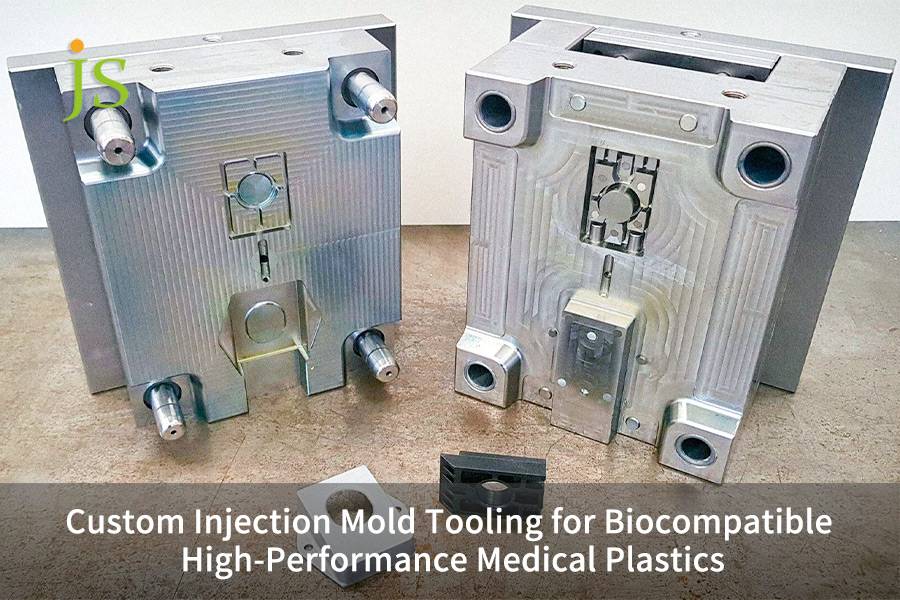

Custom injection mold tooling service is the multi-stage engineering baseline for producing high precision medical devices from biocompatible thermoplastics. Critical line tolerances of, say, ±0.01mm on implantable devices made from PEEK or PPSU require hardened steel cores (≥52 HRC) with venting systems operating down to the micrometer to allow the melt at up to 400℃ to get out without changing the size.
With compliance to IATF 16949 and ISO 13485, JS Precision employs specialized DFM analysis digital tools and custom tool machining of multi-cavity molds mainly to avoid flashing and to prevent material degradation.
Precision Medical Mold Tooling Technical Blueprint: Quick Summary Index
|
Tooling Specification |
Biocompatible Material Demand |
JS Precision Engineering Standard |
Manufacturing Impact |
|---|---|---|---|
|
Mold steel grade & hardness |
Withstand 400°C melt & corrosive gas |
420ESR / H13, heat treated to 52–54 HRC |
≥500k shots life, lowest per-part cost |
|
Vent depth control |
Eliminate PEEK outgas causing short shots |
Vent depth strictly 0.005–0.008 mm |
Zero flash, 100% cosmetic compliance |
|
Mold temp & thermal balance |
Ensure medical crystallinity & ±0.01 mm stability |
Series hot oil circuit, 160–190°C ±1°C |
No internal stress, no post-assembly warp |
Key Findings
- Steel Grading: Steel grades of 420 high-polished stainless steel are preferred for making medical molds that have to be very hard. A hardening treatment to a surface hardness of 52 HRC or higher ensures chemical resistance from chemical corrosion coming from material precipitates.
- Ultimate Venting: Micron-sized venting channels (0.005 mm) are the way to solve the problem of carbonization/charring caused by lack of filling in medical PEEK bone screws and shells.
- Raw Material Control: By balancing the flow channel with precision, medical polymer raw materials efficiency can be heightened for 22%.
Why Trust The Biocompatibility Certification Of JS Precision’s Medical Mold Tooling Service?
Our team having over 15 years of experience in medical injection molding engineering has discovered that suppliers who can manage medical mold tooling require closed-loop data covering three aspects: steel corrosion resistance, venting and temperature control, and multi-cavity consistency.
While working on a PEEK bone screw venture, the client's steel mold made from NAK80 could not meet the test condition for biocompatibility because of poor corrosion resistance leading them to cavity pitting (Ra 0.05→0.31μm) at the time of 8,000 parts. Changing to 420ESR steel (HRC 53) and carrying out three stress-free annealing steps led the mold lifespan to 500,000 cycles with Ra remaining 0.05μm.
According ISO 10993-1:2025 medical device materials that continuously contact human tissue should be subjected to cytotoxicity, sensitization and irritation tests, and the manufacturing process should not result in hazardous substances.
As such we have put in place three-stages of the clean production system - ultrasonic cleaning Class 8 cleanroom injection molding pre-finished product cleaning validation.
Due to JS Precision's method of the database containing more than 200 projects on medicinal mold we have been able to decrease error rate by 35% at least in cases of PEEK, PPSU, and PEI.
Download the Medical Grade Mold Steel Selection and Venting Design White Paper now to systematically understand the corrosion resistance comparison data of 420ESR, H13, and S136, and proactively assess your precision medical mold tooling compliance path.
How to Select Medical Tool Steel to Withstand High Temperature and Corrosion in Custom Injection Mold Tooling Service?
The custom injection mold tooling service is designed to handle PEEK melt at a high temperature of 400℃. JS Precision uses 420ESR steel with a chromium content>13%, which is quenched to achieve a cavity hardness of 52-54 HRC, providing resistance to high-pressure erosion and chemical corrosion from the source.
Steel Wear Resistance Comparison Table
|
Steel Grade |
Hardness (HRC) |
Corrosion Resistance |
Max Melt Temp (°C) |
Wear Life (GF30 shots) |
|---|---|---|---|---|
|
NAK80 |
37–43 |
Low |
350 |
50k |
|
H13 |
48–52 |
Medium |
400 |
200k |
|
S136 / 420ESR |
50–54 |
High |
420 |
500k+ |
Three-Step Stress-Relief Annealing Parameters
- Stress-relief annealing through rough machining: Holding at 550℃ for 2 hrs, furnace cooling down to 200℃ to get rid of internal stresses from rough milling operations.
- Stress-relief annealing through semi-finished parts: Holding at 480℃ for 1.5 hrs, air cooling down to room temperature to stabilize mold cavity size.
- Low temp tempering post finishing: Holding at 180℃ for 4 hrs, to release EDM stress layer and avoid the crack.
IF-THEN: Injection pressure > 160 MPa and temperature > 380℃, then the usage of aluminum molds or mild steel will be forced, and 420ESSR steel will be the designated material.
If you are evaluating dimensional deviations in medical molds due to mold wear, please contact our engineering team. Submit your 3D drawings now to receive a free DFM steel selection assessment.
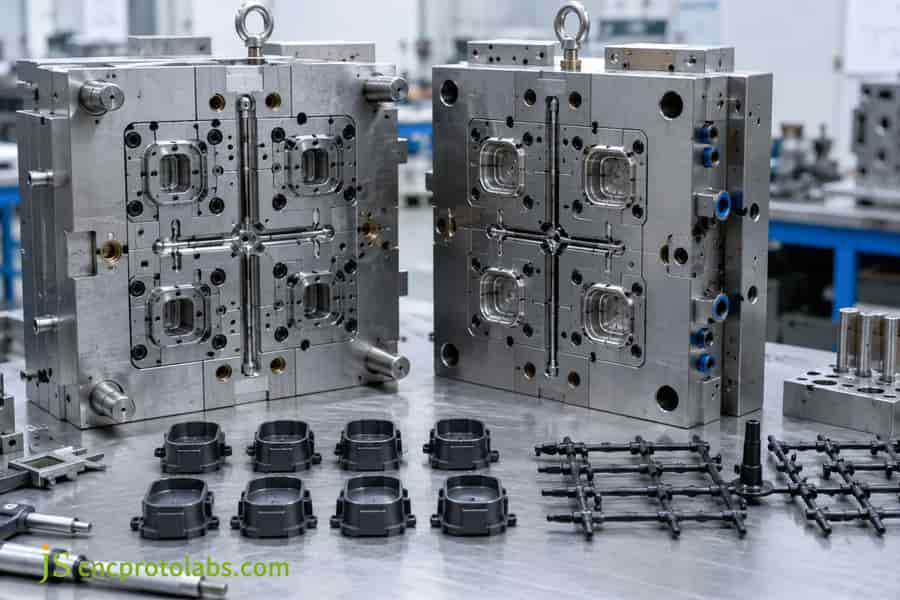
Figure 1: Stainless steel molds and machined parts on factory floor.
How to Design Mold Venting Dimensions to Avoid Burns and Flash in Precision Medical Mold Tooling?
The vents in precision medical mold tooling have a requirement for their depth to be maintained within strict limits at 0.005-0.008 mm. This minute range permits the gas trapped to escape within 1/50th of a second and at the same time condensation viscosity is employed to stop the polymer flow so the problem of scorching or flash is not allowed.
Adiabatic Compression and Carbonization Mechanism
Polymer entering very thin area with high velocity will get adiabatically heated beyond 300℃ through gas compression which will make black spots of carbon formation and lead to the deterioration of the parts' biocompatibility.
Standards on Venting Groove Machining
- Perimeter Venting of the Parting Surface Depth: 0.005-0.008 mm, width 3-5 mm, and lastly open to atmosphere.
- Insert Venting (Sinker): A filter plug (metal vent) of 0.005-0.020 mm diameter is installed in the deep cavity bottom or blind hole termination.
- Inspection Method: Cavity-by-cavity check of the venting groove depth with a Zeiss coordinate measuring machine, error is allowed only when it is ≤0.001 mm.
Going after large venting (>0.01 mm) without a second thought would result in flash of more than 0.01 mm which will make the product unuseful.
That's how medical mold tooling service have to treat venting groove depth as a red line - the simple explanation is that deeper venting grooves are not the solution, the groove has to be of depth between 0.005-0.008 mm to get rid both of the air trapping and flash.
Why Is Dynamic Thermal Control Essential for High Crystallinity Resins in Medical Injection Molding Service?
Medical injection molding service uses a precision hot oil heater heated to a temperature range of 160-190℃ to minimize temperature fluctuations on the mold cavity surface to within ±1℃. This results in the formation of a highly dense spherulite structure of medical-grade PEEK which retains the mechanical strength and dimensional stability of the finished product.
Effects of Mold Temperature on Crystallinity and Post-Sterilization Dimensional Deformation
|
Mold Temperature |
Crystallinity (%) |
Post-Sterilization Shrinkage (%) |
Mechanical Strength |
|---|---|---|---|
|
≥160°C |
35–40 |
<0.05 |
Optimal |
|
150°C |
20–25 |
0.3–0.5 |
Reduced |
|
<150°C |
<20 |
0.8–1.2 |
Poor (amorphous) |
At a mold temperature of not exceeding 150℃, PEEK undergoes freeze-crystallization to form non-crystalline areas. A second crystallization and shrinkage take place during a subsequent high-pressure steam sterilization at 134℃, causing a significant jump in the dimensional deformation rate to more than 0.8%.
Conformal Cooling Water Channel Design
- Traditional Straight-through Water Channel: A difference in mold surface temperature ranging from 8-12℃ and a delay in cooling thick areas.
- 3D Conformal Cooling: The water channel centerline is maintained at a consistent 4.5mm distance from the cavity surface, with a ≤±1℃ surface temperature differential, a reduction of 30% in production cycle time.
We can cite, based on our experience in a PEEK spinal fusion device project, that the initial mold temperature was 145℃ and warpage of the product after sterilization still remained at 0.15mm. After employing a conformal cooling method in association with a 160℃±1℃ hot oil press, warpage was reduced to 0.02mm, and the batch's Cpk increased from 0.78 to 1.52.
For the high dimensional stability requirements of high-temperature medical devices, JS Precision's thermal balance experts can provide you with a free calculation of mold waterway efficiency. Schedule a one-on-one video conference to optimize your mold hot runner design.
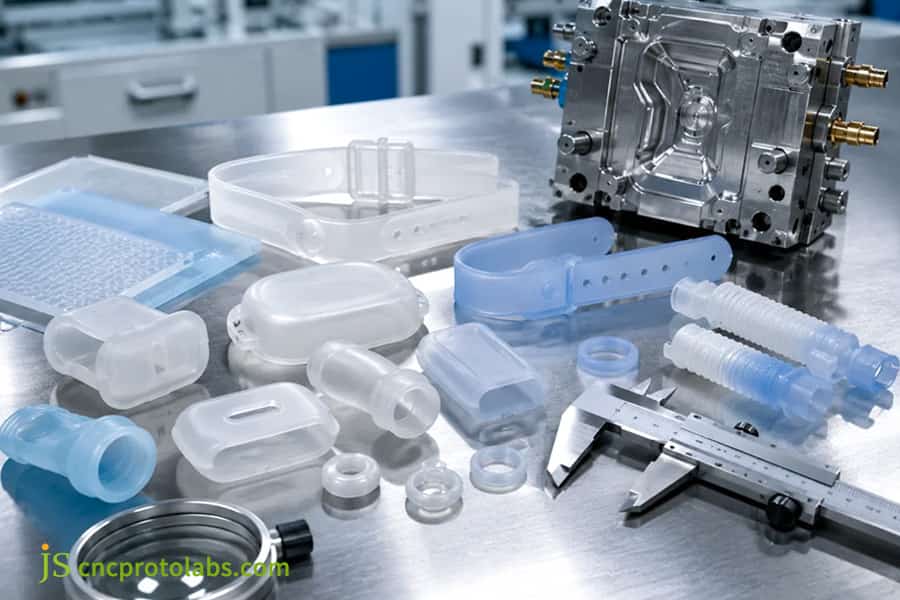
Figure 2: Transparent silicone medical components including masks and connectors on a blue surface.
How to Reduce Premium Material Waste Through Advanced Cold and Hot Runner Design in Medical Mold Tooling Service?
Medical mold tooling service providers can minimize the loss of expensive medical resins by incorporating 0.5-0.8 mm micro-gates with needle valve hot runner systems and dynamic shear runner design. Due to these measures, the waste per mold run will cut down 15-25% which means the cost related to consumables will save a lot.
Runner System Comparison: Cold Runner vs. Hot Runner
|
Parameter |
Cold Runner |
Hot Runner (Needle Valve) |
|---|---|---|
|
Runner waste per shot |
20g (example) |
<0.5g (residual only) |
|
Material utilization |
70–80% |
95–98% |
|
Additional tooling cost |
Base |
+$3,000–$8,000 |
|
ROI payback (PEEK, 10k pcs) |
— |
3–6 months |
|
Manual trimming required |
Yes |
No (auto degating) |
Cost Control Logic Chain
Total Production Cost = Mold Cost + (Part Weight + Runner Residue) × Production Volume × Resin Unit Price + Processing Fee
Taking PEEK $800/kg, annual production of 10000 pieces, 15g per piece, and 20g flow channel as an example:
- Cold Runner: Waste Cost = 20g × 10,000 × 0.80g/g = 16,000/year
- Hot runner: Scrap cost ≈ 0, mold premium $6,000, payback period 6 months.
High-priced raw materials should not be wasted on outdated mold runners. Upload your engineering drawings now and let JS Precision calculate the raw material ROI savings plan for your multi-cavity mold project.
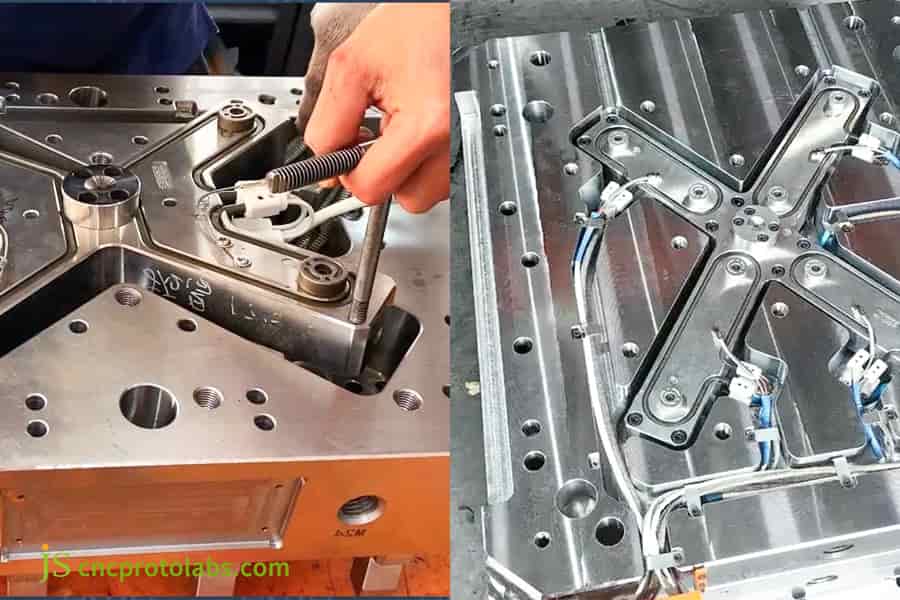
Figure 3: Industrial mold tooling with hot runner systems and various finished plastic parts.
What Tooling Limits Must Be Overcomed for Micro-Scale Parts Under 0.05 Grams in Implantable Device Molding Tooling?
Besides minimizing parting line misalignment to ≤0.003 mm, implantable device molding tooling has to go through high speed micro-milling and slow wire EDM processes (speed ≥40,000 rpm), so that any imbalance in gate filling and micro-stress concentration that is inherent are removed.
Engineering Problems of Micro Injection Molding:
If dimensions of the mold cavity (e.g. 0.3mm wall thickness) and the runner freeze layer thickness differ very little, normal ejection systems can result into part holes, deformation, or tearing of the plastic part.
JS Precision's Micro Mold Movement Route
- Whole Cavity: Without inserts or splices, flashing due to clearances is entirely removed.
- Accuracy Slider Ejection: Only a few millimeters of stroke, air valves are used to aid demolding, so the force needed for ejection is reduced by about half.
- Zeiss CMM testing: Verification of form and position tolerance ±0.003 mm to ensure consistency in each batch.
How to Suppress Shear Heat Degradation of PEEK Resins Within PEEK Injection Mold Tooling?
For PEEK injection mold tooling, JS Precision adjusts the runner radius to 1.5 x diameter and limits shear rate to 10,000 s⁻¹ not to let the frictional heat get out of hand and also prevent resin from carbonizing and getting discolored through heat.
Shear induced Heat Degradation
If the temperature range for processing is extremely narrow (like 380-400℃), any change in the local shear rate will result in overheating and decomposition of PEEK. It's advised that the volume of the cold slug well at the end of the runner should be 1.2 times as large as the volume of the largest part to capture the cold slug leader edge.
Mirror Polishing Levels
- Runner Surface: High-gloss finish through 8000# mirror polishing (meet SPI A-1 standards), surface roughness Ra≤0.05μm, reducing viscous resistance.
- Cavity Surface: Multiple finishing passes by hand to a finish of Ra 0.05μm, to eliminate any regions where high shear rate can cause localized heating.
- Outcomes: Long term medical grade purity, no residual foreign impurities, FDA and ISO 10993 biocompatible plastic injection molding pass 100%.
Figure 4: Machinist adjusting components inside a precision industrial injection mold.
How JS Precision Solved Dimensional Warpage of Biocompatible PPSU Surgical Handles via Advanced Multi-Cavity Tooling Architecture?
In response to the problem of 0.18 mm warpage caused by a temperature difference of 14℃ in the water circuit of the medical PPSU surgical handle with one mold and four cavities, JS Precision uses a Y-shaped balanced flow channel and a 3D conformal cooling oil circuit to reduce the multi cavity temperature difference to ± 0.8℃ and reduce the warpage to ≤ 0.012 mm.
Client's Challenges:
A medical device company wanted to design a PPSU surgical hand instrument that needs to be able to withstand regular 134℃, high-pressure steam sterilization. Unfortunately, the first mold manufacturer's water channels were placed in such a way that four cavities showed temperature variation of about 14℃. After part ejection, the plastic product had bends at both ends with a form and position tolerance that had exceeded their requirement by 0.18 mm, leading to 42% assembly reject.
JS Precision Solution
- Full Digital runner Reconstruction: Utilized SolidWorks + Moldflow to remodel and replace the unbalanced H-type runner by an exactly symmetric Y-type runner that has naturally a balance, pressure weight deviation by filling was less or equal to ≤±0.03 grams.
- 3D conformal Cooling Water channel: The old drilled straight-through water channel method was replaced by the 3D contour milling curved surface method. Cooling oil conduits were laid down at a distance from cavity wall of equal length 6mm through the whole cavity area. Besides that a high-power 180℃ hot oil heater was used so that cavity temperature difference was less than ±0.8℃.
- Precision Fit & Exhaust Linkage: A 3.50 mm wide, 0.006 mm deep exhaust system was put on slide block parting surface so that cavity distortion was maintained to 0.002 mm.
Lessons Learned from Failure:
During initial mold repair and trial molding the engineer team lowered mold temperature to 130℃ to cut the cycling time short. Even though no defects were found on the surface of PPSU the item cracked immediately during the three autovulking destruction tests. This proves that whenever biocompatible and highly crystalline materials are processed we should not break the physical laws controlling mold temperature requirements in materials science to get the cycle time even shorter.
ISO 13485:2016 definitely takes that equipment surfaces which are in contact during production of the product must be smooth, inert, and corrosion-resistant, also that process validation records must be kept.
In our case, as a critical process parameter (CPP) we defined mold temperature of 160℃±1℃ and included it into the PFMEA control plan.
Final Results
- Warpage: Within 0.012 mm (from 0.18 mm)
- Multi-cavity Consistency: 99.7% pass rate
- Single-piece cycle time: Reduced by 12 seconds due to improved conformal cooling efficiency
- Mold investment: Rework/modification cost 12,800 vs. customer's original mold scrap loss 38,000
Click now to submit your medical product customization requirements and view more real-world engineering case studies from JS Precision.
Why Choose JS Precision as Your Technical Partner for High-Performance Medical Injection Molding Service?
JS Precision is certified per ISO 13485 standard and also has ISO Class 8 cleanroom. We design medical molds with the use of state-of-the-art precision CNC machines, offer Free DFM analysis. We are capable of first-trial-molding success rate of ≥92%.
Core Advantages
- Equipment: Sodick Wire EDM (Japan), Fanuc Medical grade electric injection molding machine, 3D vision scanning sterile testing lab.
- First-time mold trial mold working rate: ≥92%, saving time on repeated mold trials.
- Mold maintenance services for the entire lifetime: Free hardness and surface roughness checks done every 6 months with rapid repairs.
Medical injection molding service is not about finding the cheapest mold factory, but about spending every penny on compliance and precision with engineering data - the difference between JS Precision lies in this.
FAQs
Q1: What is the average lead time and pricing for biocompatible PEEK custom injection mold tooling service?
The average price and delivery time can be found out based on the type and cavity count of the molded part and the grade of steel used. For illustration, a 420 mirror-harden steel, single cavity, PEEK bone screw mold tool will cost you about $4,500 to $8,500, and its delivery will require around 22-30 working days (including DFM Report and T1 sample). Alternatively, you can submit your drawings, then JS will prepare for you a price quotation.
Q2: How do you implement cross-contamination prevention during medical mold tooling and manufacturing process?
Our ISO 9001 and GMP compliant company has very strict rules in place for the prevention of cross-contamination. We carry out molds and toolings in an iso 7 clean room where the injection process has to be free and clean. After mold cleaning we leave the molds dry for a while then they will be cleaned again by a soft and non-toxic mold releaser.
Q3: Why are thin-walled parts subject to short filling and edge burning during high-speed injection mold tooling processing for medical devices?
Gas cannot be released due to the high-temperature (>450℃) high-pressure injection molding process that leads to a gas adiabatic compression and charring event through the material. To eliminate this kind of defects as short shotor black spotsJS Precision inserts 0.005 mm of venting precision gap in blind mold cavity areas.
Q4: Can aluminum alloys be utilized for quick prototype runs in medical device injection molding?
Engineering plastics involving PEEK, PPSU and other melts above 380℃ do not support aluminum molds. Aluminum alloy softens above 150℃ and cannot withstand high pressure, making it difficult to sample more than 50 times.
Q5: Do you support custom machining of molds for insert molding with biocompatible plastic injection molding?
Yes. At JS Precision, the company has the facility of customized slide molds made from materials like titanium alloy or stainless steel for spindle cores. We manage the metal-plastic overflow tolerance within 0.01 mm to avoid liquid seepage.
Q6: In what ways does JS Precision tweak multi-cavity tool arrangements to lower costs per unit for high-heat resins?
Through software like Moldflow, the gate diameters and runner lengths can be adjusted to optimize mold cavity design. Cold runner diameters can be decreased or needle valve hot runners can be used to decrease the weight of cold material in single batches by over 20 grams. This can cause considerable material cost savings for mass production of tens of thousands units.
Q7: How low a minimum order quantity are you requesting for molding tooling of an implantable device at an early development stage?
It's just that JS Precision has no MOQ restrictions on its products. A customer will be even able to order 100-2,000 pieces custom made single-cavity soft steel rapid prototyping molds which are small batch and So, can be supplied to get clinically compliant samples with a minimum amount of initial investment quite quickly.
Q8: What is the time taken by JS Precision in sending a technical quotation?
Upon uploading the 3D drawings in the STEP/IGS/X_T format and providing the material type (e.g. PEEK 450G), tolerance class, and surface roughness, the quotation will come in 24 hours (the quotation is bilingual, it includes mold cost, machining fee per piece, lead time, and initial DFM suggestions). This is performed by a senior estimator.
Summary
Custom polymer medical molds manufacturing is a blend of material approval and micro-scale processing precision. For PEEK, PEI, and PPSU, the main problems to be mitigated against due to high temperature, high injection pressure, and strong escape gases are technical risks. For this reason, high-chromium hardened stainless steel (with 54 HRC hardness) should be used in mold manufacturing, combined with a symmetrically distributed precision hot oil circuit control system and 0.005 mm micron-level venting groove structure that essentially solves the warping of the product and edge burning.
You will be able to get rid of the compliance risk for dimensional changes, flash along mold parting lines, or material breakdown of the product. An ISO 13485 certified factory, JS Precision offers you total custom mold making, Class 100,000 cleanroom injection molding and thorough DFM feasibility assessment. Upload your 3D CAD files to receive a detailed quotation within 24 hours.

Disclaimer
The contents of this page are for informational purposes only. For JS Precision Services, there are no representations or warranties, express or implied, as to the accuracy, completeness, or validity of the information. It is the buyer's responsibility to identify specific technical requirements and request a formal parts quotation. Please contact us for more information.
JS Precision Team
Custom manufacturing solutions. With over 15 years of experience serving more than 1,000 customers, we specialize in high-precision CNC machining, sheet metal fabrication, 3D printing, injection molding, and metal stamping. Having successfully delivered over 300,000 precision parts, we maintain a 99.2% on-time delivery rate across all custom projects.
Our facility is equipped with over 100 state-of-the-art 5-axis machining centers and is ISO 9001:2015 certified. We deliver fast, efficient, and high-quality manufacturing solutions to B2B clients across 150 countries. Whether you require low-volume prototyping or large-scale customization, we support your project with lead times as short as 24 hours. Choose JS Precision for unparalleled efficiency, quality, and professionalism.
To learn more or submit your RFQ, visit our website: www.cncprotolabs.com
Resource