English



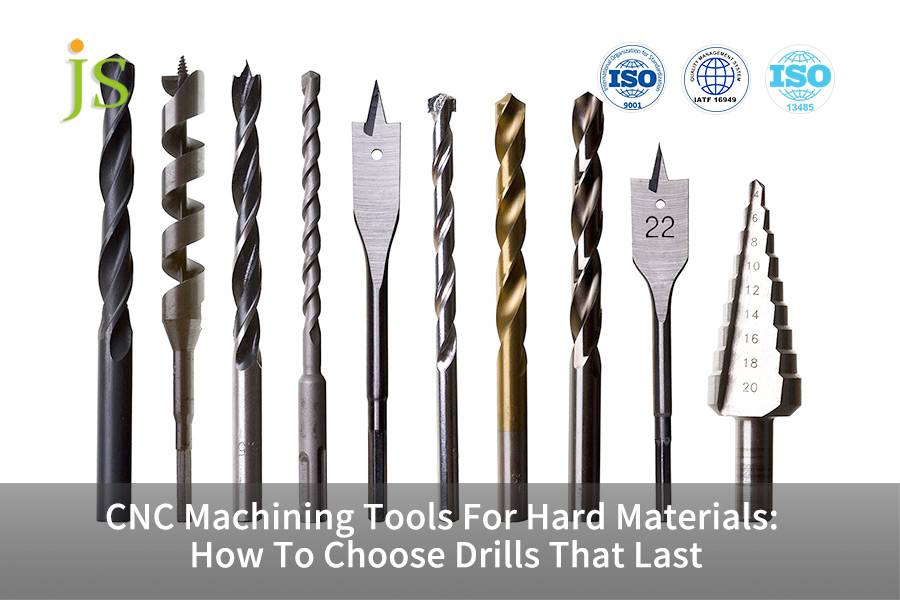

When CNC machining tools are used to process hard materials such as titanium alloys, quenched die steels, and high-temperature alloys, problems such as premature failure of drill bits and sudden reduction in lifespan often occur.
This not only directly raises the procurement cost of the tools but also pulls down production efficiency due to frequent downtime for tool changes and even affects machining accuracy and product quality, becoming a hidden obstacle to CNC machining jobs.
We will break down the whole chain from materials science to geometric design, through to machine tool collaboration, showing how to really reduce total cost by optimizing CNC machining quote and helping you build a stable and predictable hard material machining system.
Core Answer Summary
| Core Questions | Key Answers | Value |
| Tool Life Definition | It is determined by flank wear (VB≤0.3mm) and MTTL. Core is the synergistic effect of the substrate and AlTiN coating. | Establish scientific evaluation standards to reverse-engineer selection criteria. |
| How to Choose a Drill Bit? | A dynamic matching of substrate, geometry and coating is involved. | Get a practical methodology, avoid trial-and-error costs. |
| The Role of Machine Tools | Spindle runout (<0.003mm) and high-pressure internal cooling (>70Bar) determine the potential of cutting tools. | Optimize machine tool and cutting tool configurations to unleash performance. |
| Total Cost Optimization | Quantify all consumption, professional quotation with technological commitments is key to cost control. | Focus on total cost for cost reduction and efficiency improvement. |
Key Takeaways:
- Systems Engineering Perspective: Tool life is the result of interaction among materials, geometry, coatings, machine tools, and parameters. Isolated selection has limited effect.
- Cost Leverage Effect: The cost of the tool itself accounts for only 3-5% of the total machining cost, while its life fluctuations affect more than 30% of the total cost.
- Data-Driven Decision Making: Depending on specific data from CNC machining materials processing tests (e.g., cutting speed Vc, cost per hole) provided by suppliers is more significant than relying on brands.
- Partner Value: The benefit of partnering with experts such as JS Precision is that risk can be anticipated and effectively managed through joint process development, ensuring stable machining economics.
Trust JS Precision: Tool Selection Guide For CNC Machining Services Of Hard Materials
In CNC machining of hard materials, it is important to have experience to help resolve issues.JS Precision has been heavily engaged in the sector for a long time, and we have over 5,000 hard material machining solutions in aerospace, precision mold making, and other industries.
The tool selection success rate for challenging materials such as titanium alloys and high-temperature alloys stands at 98%. All technical staff of JS Precision have over 10 years of experience in the industry.
Tools for machining hard materials must satisfy special demands with respect to the strength of the substrate material and the adhesion of coatings, according to the International Organization for Standardization (ISO) in ISO 3685:1993.
The tool selection systems offered by JS Precision conform to this standard and have been examined for performance by officially recognized third parties.
We also have an exclusive material processing database that includes cutting parameters and tool matching solutions for over 200 types of CNC machining materials, providing accurate advice for your CNC machining jobs quickly.
If you are struggling with tool life issues in hard material machining, contact the JS Precision engineering team immediately. Provide your machining materials, hole diameter requirements, and machine tool model to receive a free, customized CNC drill bit selection plan, avoiding trial-and-error costs and quickly improving machining efficiency.
What Truly Determines The Lifespan Of Your CNC Machining Tools?
The life span of the CNC machining tools depends on the substrate, type, and parameters. Knowledge about this will increase the life span from the root level and, thereby, CNC machining costs.
Quantitative Assessment: Defining End of Tool Life
The end of the life of the tool is not a matter of opinion but is measurable. The criterion for the end of the life of the tool is usually an average wear bandwidth measuring 0.3mm on the flank of the tool, or the appearance of damage, such as chipping or rolling, on the tool.
Mean Tool Life (MTTL) is a significant statistical measure. It indicates an average life span of a group of tools and offers statistical support to the planning process concerning tool replacement cycle in CNC machining milling.
Synergistic Defense of Substrate and Coating
- Substrate Toughness: The cobalt content of cemented carbide (6%-12%) and carbide particle size balance wear resistance and impact resistance.
- Protection by Coating: AlTiN, AlCrN, or SiAlYN coatings are heat-resistant and wear-resistant, suitable for specific CNC machining materials.
Want to know if your current CNC machining tools are reaching their optimal lifespan? Upload your machining parameters and tool model, and JS Precision will provide a free lifespan assessment and targeted optimization suggestions to help you further reduce costs.
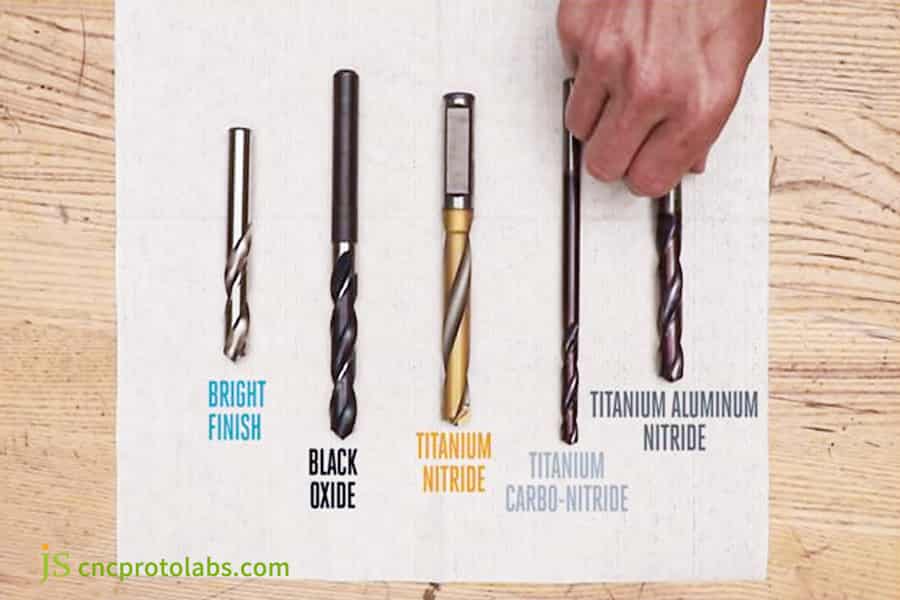
Figure 1 Five twist drills with different surface coatings (Bright, Black Oxide, TiN, TiCN, TiAlN) are lined up.
How To Master The Science Of CNC Drill Bit Selection For Hard Materials?
CNC drill bit selection is crucial for hard material processing, requiring precise matching of materials and geometric design to improve efficiency and lifespan.
Material Choice: Cemented Carbide, Cobalt Containing High Speed Steel, or Powder Metallurgy High Speed
Hard materials machined with drill bits of assorted materials differ considerably in their machining performance. A detailed comparison is as follows:
| Drill Bit Material | Cobalt Content/Characteristics | Lifespan Multiple for Machining HRC 45+ Steel | Applicable Scenarios | Price Range (USD/bit) |
| Cobalt-Containing High-Speed Steel (HSS-Co) | Cobalt content 5%-8% | 1x | Hard steel with lower hardness, small batch machining. | 15-30 |
| Powder Metallurgy High-Speed Steel (P/M HSS) | Finer grains, excellent toughness | 3-5x | Machining hard materials requiring high toughness, complex hole shapes. | 30-60 |
| Integral Carbide | Cobalt content 6%-12%, finer tungsten carbide particles | 10x or more | High-hardness materials, high-volume machining, high-precision requirements. | 60-150 |
Geometric Design: Made for Removing Chips from Processor Centers and Cooling
The drill bit geometric properties have a direct impact on the cutting performance and must be typically selected depending on the machined material:
- Point Angle: 130°-140° for titanium alloys to increase strength of cutting edge, 118°-135° for steel to achieve optimal centering.
- Helix Angle: Around 30° for high-hardness materials, around 40° for viscous materials to facilitate chip removal.
- Wide cutting edge and polished chip grooves, which help to avoid heat and built-up edge, are useful in high temperature alloys.
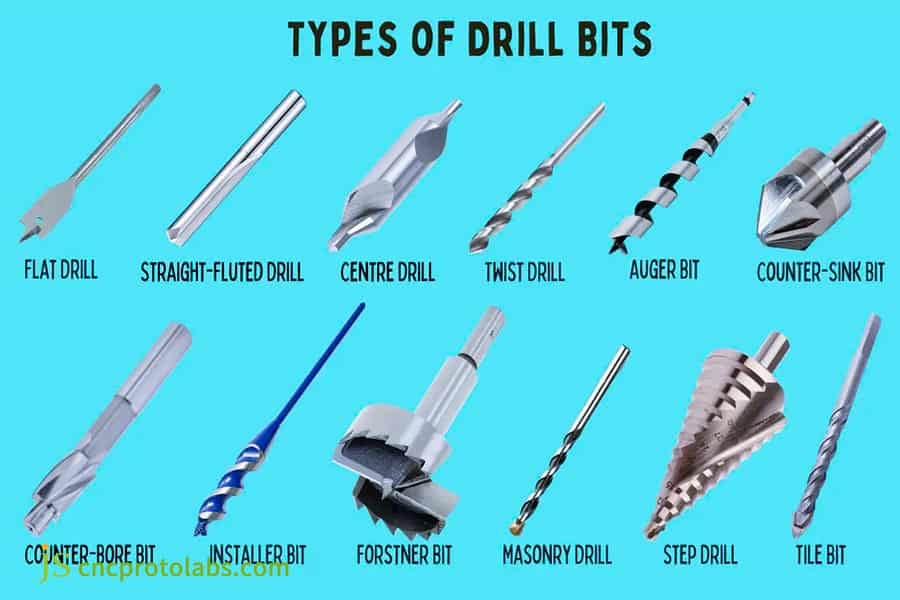
Figure 2 Processing hard materials requires the use of correct strategies and tools.
Why Is Your CNC Machining Center a Make-Or-Break Factor For Tool Life?
A good quality CNC machining center could assure the quality of the CNC machining tools, its precision, stiffness, and cooling system also determine the potential release.
Dynamic Accuracy: The Often Overlooked Tool Killer
Spindle radial run-out is also one of the essential factors influencing the accuracy of drilling and must be controlled to 0.003mm (3μm), because if there is excess run-out, it creates uneven stressing of the drill bit or edge, doubling the load on the cutting edge, and chances of chipping start decreasing.
At the same time, the overall stiffness of the machine tool is also important. If it is not stiff enough, it will produce chatter marks during cutting, and not only will it damage the tool, but it will also influence the quality of the machined surface.
Cooling Efficiency: Auxiliary to Central Process
The performance of cooling is a direct factor in controlling cutting temperatures. High-pressure internal cooling ensures precise delivery of coolant to the cutting edge. High-pressure internal cooling is described as a cooling process that has a minimum of 70 Bar.
For example, in machining materials of lower thermal conductivity like titanium alloy materials, the need for a high-performance cooling system where the spindle center and the tool’s internal cooling hole are accurately aligned cannot be overstated.
According to the American Metalworking Technology Society (AMT) data, the tool life in high-pressure internal cooling for the machining of hard materials gets enhanced by 2-3 times.
Unsure if your CNC machining center is matched with optimal tool performance? Contact JS Precision for a free machine tool performance assessment service. We will optimize tool and parameter combinations based on your equipment to maximize the synergistic value of your equipment and tools.
Who Really Pays For Premature Tool Failure In Your CNC Machining Jobs?
The hidden costs of premature tool failure far exceed the purchase price. Accurate total cost calculation is essential for reducing costs and increasing efficiency in CNC machining jobs.
Hidden Cost Breakdown: Tool Costs are Just the Tip of the Iceberg
The total cost of single hole machining is composed of multiple parts, and the specific formula is:
[ (Tool Cost/Number of Holes in Life) + Tool Change Time Cost + Scrap Risk Cost + Machine Energy Consumption ].
For instance, a drill bit costs $50, and at 100 holes, the cost of the tool will be $0.50, but extending the life of the drill bit to 300 holes will reduce the cost of the tool to $0.17 only.In addition, reduced tool changes will lower the cost of downtime, and stable tools will lower the scrapping percentage, which are all factors that can significantly alter the total cost.
JS Precision's Solutions: Total Cost Optimization from Quotation to Delivery
For CNC machining jobs, JS Precision employs simulation software to calculate the analysis of the cutting forces and thermal load and the machining tooling strategy before the process.
Our CNC machine quote are accurate in estimating tool change cycles, tool life, and scrapping rates. Through technical optimization, our company was able to reduce by 45% the total cost of single-piece machining for our clients.
Which CNC Machining Materials Demand Radical Tooling Strategies?
There is a range of materials that can be machined using the CNC machine. This is due to the varying properties of the materials. There is thus
Extending the Boundaries: Microscopic Coping with High-Temperature Alloys and Titanium Alloys
Inconel 718 and Ti-6Al-4V have strong work hardening and poor thermal conductivity. According to ISO 2296:2018 standard, a combination of "wear-resistant coating+tough substrate+sharp cutting edge" is required, with Vc controlled at 20-40m/min.
Hardness and Abrasion: The Fight Between Hardened Steel and Composite Materials
- HRC50+quenched and hardened steel: Use a negative rake angle drill bit and a small cut peck pattern to avoid chipping.
- CFRP: Use DLC or PCD-coated drill bits to provide abrasion resistance and ensure hole quality.
Below is a table of recommended cutting tools and parameters for different hard materials:
| Machining Material | Recommended Tool Material | Recommended Coating | Cutting Speed Vc (m/min) | Cost per Hole (USD) |
| Ti-6Al-4V Titanium Alloy | Ultrafine Particle Carbide | AlTiN | 20-30 | 0.8-1.2 |
| Inconel 718 High Temperature Alloy | Ultrafine Particle Carbide | SiAlYN | 25-40 | 1.5-2.0 |
| HRC 60 Hardened Steel | High Toughness Carbide | AlCrN | 30-50 | 0.5-0.8 |
| CFRP Composite Material | PCD Diamond Coating | DLC | 100-150 | 2.0-3.0 |
How To Decode And Optimize Your CNC Machining Quote For Long-Term Value?
A professional CNC machining quote has a technical promise behind it. It is important to grasp the important details for successful selection and optimal long-term benefits.
Technical Quote: Finding the Promise Hidden in the Numbers
A quality CNC machining quote should clearly outline recommendations for machining tool type/models, preset S/F values, approximate tool wear rates, among many technical details. In fact, all these details mentioned constitute the greatest guarantee for quality and cost, giving you a foretaste of all potential risks at the machining process.
Working with JS Precision - Translating Risk into Certainty Through Joint Development
JS Precision practices "joint development" collaboration, wherein communication is involved from the early phases of the project. For free in-depth analysis related to design for manufacturing (DFM), we help optimize part design and ease the difficulty of part machining.
For critical components or assemblies, we can additionally provide first-piece sample machining for ordered (paid) or committed ordered (paid) work. By this means, we can together validate the optimal cutting tool parameters for maximum efficiency and lowest costs for the mass production process.
Want a transparent CNC machining quote with technical commitments? Submit your part drawings and machining requirements, and JS Precision will provide you with a detailed quote within 24 hours, clearly outlining all technical specifications and cost breakdowns to give you a more informed decision.

Case Study: Tool Life Increased By 300%, JS Precision Overcomes Aerospace Engine Inconel 718 Deep Hole Machining
Challenge: “Nightmare” of 30x Diameter Deep Holes
Aerospace parts manufacturer required machining of deep holes with a diameter of 6mm and a depth of 180mm, with a depth-to-diameter ratio of 30:1, in Inconel 718 high temperature alloy material.
The conventional method employed conventional carbide drill bits that had a mere average lifespan of 3 holes. Inadequate chip removal was responsible for large deviations in hole location and poor surface roughness Ra values, which contributed to a wastage rate of up to 15%, thereby slowing down project development while incurring a cost of over $2 to machine a hole.
JS Precision's Systemic Breakthrough
Upon the receipt of the request, JS Precision formed a technical team to address the issues:
1. Specialized Cutting Tools: Using an ultra-fine powder matrix of cemented carbide with 10% cobalt, along with a high helix angle of 38°, designed for better removal of chips, and a nano-composite layer of SiAlYN for better high-temperature wear resistance and anti-adhesion capability.
2. Process Innovation: The computer programming involves a process of 'progressive pecking drill + brief retraction', where there is a withdrawal of 2mm for each 5mm drill movement, along with the ultra-high pressure cooling of the machine tool that has 120Bar.
3. Machine Tool Cooperation: The choice of a CNC machining center with a rigid spindle (radial runout <0.002mm) and a precise internal cooling system for machining in tool cooperation.
Results: From Cost Black Hole to Stable Output
After introducing the novel solution, the drill bit lifespan was raised to more than 12 holes (exhibiting a 300% increase), hole positional error was maintained below ±0.01mm, while surface roughness was reduced to Ra ≤ 1.6μm.
The scrap rate has been reduced to below 2%, the cost of single hole processing has been lowered to 0.8 US dollars, the total cost of single piece processing has decreased by 45%, and the project delivery cycle has been shortened by 30%.
Want to replicate similar cost reduction and efficiency improvement results? Contact JS Precision, share your machining challenges, and we will provide you with one-on-one process solutions to help you overcome technical bottlenecks and secure stable profits.
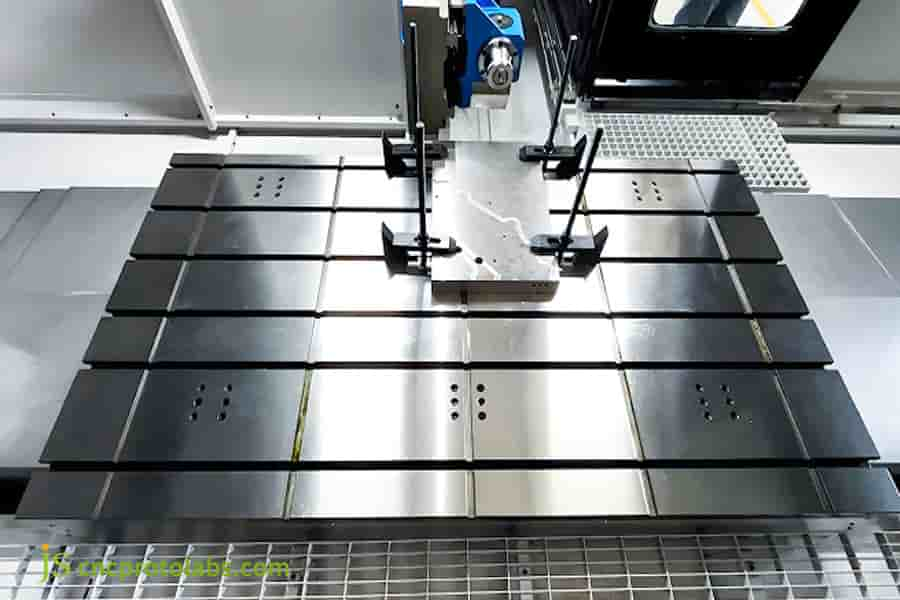
Figure 3 CNC machining of aviation components with deep holes
FAQs
Q1: When machining hardened steel (HRC 60 and above), which drill bit characteristic should be the most important?
The most important thing to focus on is impact toughness. Due to the extremely high hardness of quenched steel, the cutting edge of the tool is subjected to large forces during cutting, making it prone to breakage. Therefore, it is advisable to prioritize hard alloy drill bits with strong cutting edge designs (such as chamfering) and high toughness substrates, rather than simply pursuing hardness.
Q2: Is high-pressure internal cooling (>70 Bar) really necessary? Can't ordinary coolant work?
It plays a critical role in CNC machining of deep holes and difficult-to-machine materials. Normal pouring cooling lacks penetration in the cutting area, thus, it cannot adequately cool and remove metal chips. Internal high-pressure cooling reaches the cutting tip, shattering chips and quickly removing heat, extending tool life several times.
Q3: How to determine whether a drill bit should be regrinded or scrapped?
Basically, examine two features. First, whether the value VB of the uniform wear on the flank is more than 0.3mm, and whether there are microchips on the edge. It is very expensive to regrind carbide drill bits, so discharging them directly is more economic when scrapped.
Q4: Does coating color (gold, black, bluish-purple) represent performance level?
Coating color is related to composition but does not directly represent the level of performance. An example would be AlTiN: purplish-black, AlCrN: grayish-black, and gold might be a TiN coating. The actual performance depends on the specific composition, structure, thickness, and other core indicators of the coating.
Q5: Can JS Precision recommend cutting parameters for my specific material?
Of course. JS Precision has a comprehensive database of CNC machining materials. According to the customer's material type and machine tool conditions, we can provide optimized and proved cutting parameters that can be directly adopted.
Q6: Is it necessary to purchase expensive special drill bits for special materials during small-batch trial production?
Yes, it is. Wrong tools result in more scrap, lost time, and machine tool wear. These costs are much greater than those of special drill bits and have become an important investment for ensuring the success of small-batch trial production.
Q7: How to monitor tool life in mass production?
Implement SPC (Statistical Process Control) to track the number of holes drilled for all CNC machine tools. Hence, monitoring changes in cutting force or spindle power performance to predict tool changeovers to prevent sudden machine breakdowns.
Q8: Does your quotation include tooling costs?
In JS Precision's CNC machining quote, machining service fees and tooling consumption fees are normally differentiated. For long-term projects, ‘one-piece all-inclusive pricing’ involving tools is possible.
Summary
The biggest problem with CNC machining of hard materials has never been the question of "selecting a harder tool." Rather, it has been the establishment of a scientific system that combines materials, tools, machine tools, and parameters.
Though the variation of the life of the CNC machining tools seems insignificant, it can cause a variation of over 30% in the total costs. Only by choosing the right method can we truly reduce costs and increase efficiency.
JS Precision, based on experience and data, can help you with machining difficulties in exotic materials such as titanium alloys, high-temperature alloys, and other exotic materials. Whether it is CNC drill bit selection or CNC machining quotes, we are here to help.
If you are troubled by issues such as premature tool failure and high costs, you are encouraged to contact JS Precision immediately. Send your part drawings and materials details to allow for a comprehensive CNC machining price quote with the inclusion of our expertise.

Disclaimer
The contents of this page are for informational purposes only.JS Precision Services,there are no representations or warranties, express or implied, as to the accuracy, completeness or validity of the information. It should not be inferred that a third-party supplier or manufacturer will provide performance parameters, geometric tolerances, specific design characteristics, material quality and type or workmanship through the JS Precision Network. It's the buyer's responsibility Require parts quotation Identify specific requirements for these sections.Please contact us for more information.
JS Precision Team
JS Precision is an industry-leading company, focus on custom manufacturing solutions. We have over 20 years of experience with over 5,000 customers, and we focus on high precisionCNC machining,Sheet metal manufacturing,3D printing,Injection molding,Metal stamping,and other one-stop manufacturing services.
Our factory is equipped with over 100 state-of-the-art 5-axis machining centers, ISO 9001:2015 certified. We provide fast, efficient and high-quality manufacturing solutions to customers in more than 150 countries around the world. Whether it is small volume production or large-scale customization, we can meet your needs with the fastest delivery within 24 hours. Choose JS Precision this means selection efficiency, quality and professionalism.
To learn more, visit our website:www.cncprotolabs.com
Resource