English



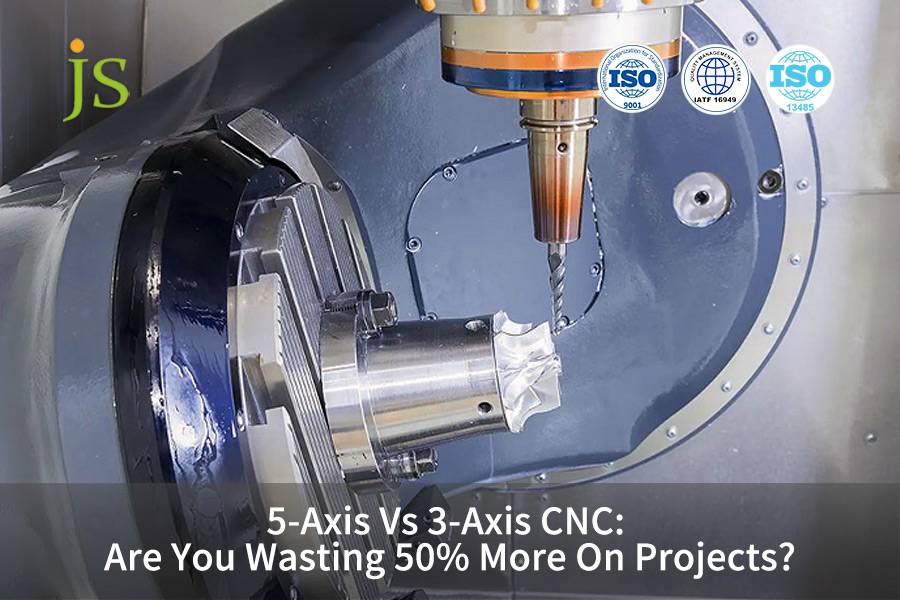

Since its inception in the 1950s, 5 axis CNC machining technology has fundamentally changed the way complex components are manufactured. This technology can complete machining that used to require multiple clamping in one go by controlling the coordinated movement of the cutting tool in five directions.
What in the world makes both aerospace parts and daily necessities possible to produce? Is its working challenge and cost overhyped? Let us start from scratch and lead you to relearn this technology that reshapes the manufacturing sector rules.
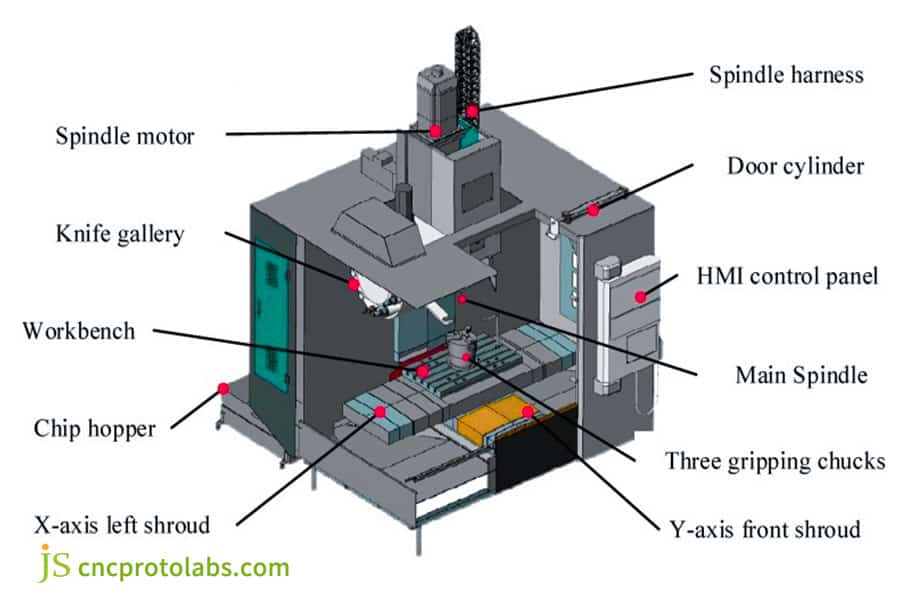
Figure 1:CAD rendering of CNC machining equipment, with the robotic arm preparing to mill circular workpieces.
Summary of Core Answers
| Core Issues | Technology Comparison and Selection Criteria | JS Precision's Solutions and Value |
| How to choose CNC technology? | 3-axis CNC: Suitable for simple geometric parts with low cost.5-axis CNC: Suitable for complex curved parts with higher accuracy. | Based on your part complexity and budget, provide the most cost-effective 3-axis or 5 axis CNC machining solutions. |
| Is 5-axis CNC worth it? | The initial investment is high, but by reducing the number of clamping times, improving accuracy (up to ± 0.005mm) and yield, the comprehensive cost of complex projects can be significantly reduced. | We rely on advanced 5 axis CNC machining centers and rich experience to help you achieve design freedom and accelerate product launch, ensuring investment return. |
| How to ensure accuracy and control costs? | The key lies in matching the geometric complexity of the parts with the machining technology. The "one-time clamping" of 5-axis technology can fundamentally reduce errors and ensure quality. | Provide full process services from DFM analysis to precision manufacturing, ensuring that parts meet the highest standards while optimizing overall project costs. |
Why Do Precision Parts Rely On 5-Axis CNC Machining? JS Precision Shares Practical Experience With You
In the last 15 years, JS Precision has accumulated extensive experience in 5 axis CNC machining. Our experience covers many high-precision fields, such as the manufacture of components for medical devices and the machining of aerospace components.
For instance, we have provided 5 axis CNC machining services to more than 50 leading medical device companies worldwide. We have successfully machined over 100,000 precision parts, including titanium alloy screws and components of artificial joints. In the aerospace field, we use our 5 axis CNC machining center to machine complex aircraft engine parts, with a pass rate of more than 99.8%.
This guide is a summary of our years of practical experience in 5 axis CNC machining projects. You can trust this guide because each point is based on our actual operation and verification.
As the American Society of Mechanical Engineers points out in its "CNC Machining Accuracy Standards," 5 axis CNC machining has irreplaceable advantages in improving the accuracy and efficiency of machining complex parts, and our experience is highly aligned with this important viewpoint.
Want to learn more about 5 axis CNC machining case studies in your industry? Contact JS Precision and submit your industry type to receive a free industry-specific case study manual, which will help you more quickly understand the real-world application scenarios.
What is 5-Axis CNC Machining? A Comprehensive Guide to Its Principles and Advantages
The idea behind 5 axis CNC machining is that the tool can move in five directions, two of which also rotate. This type of processing belongs to the process of multi-axis cutting and forming, which resembles the use of the machine tool as a carving knife to cut the metal raw material into a smooth surfaceor complex structure step by step.
The most comfortable part is that during processing, there is no need to repeatedly disassemble and readjust the parts like in the traditional approach. The machine can itself regulate the cutting angle, and what is even more astonishing is that it is capable of continuous cutting in a single pass.
For example, the machining of high-precision parts such as turbine blades, which in the past required seven or eight operations, can now be cut in circular slices on a five-axis machine tool, doubling productivity.
The core principle can be divided into three key points:
(1)Five-way coordinated motion
The machine tool uses a combination of three linear axes (X/Y/Z axes responsible for forward and backward, left and right, and up and down movement) and two rotation axes (usually marked as A/C axes) to enable the tool to approach the workpiece at any angle in space. For example, when making turbine blades, the tool can cut vertically and tilt 45 degrees to cut sideways.
(2)Advantages of non-flipping processing
Traditional 3 axis machine tools need to disassemble and adjust the direction of the workpiece many times when processing complex parts, while the 5 axis system automatically switches the processing surface through the rotation axis. Just like shooting an object with a panoramic camera, there is no need to manually rotate the subject, and the lens can capture all angles around it.
(3)Dynamic synchronization accuracy
The tool cutting and workpiece rotation can be coordinated in real time. When processing special structures such as spiral grooves, the spindle moves forward while the workpiece rotates at a constant speed. The two are synchronized at the millimeter level through the CNC system, and the final molding accuracy can reach 0.005mm.
Do you want to gain a deeper understanding of how your component design benefits from five axis technology? You may upload your 3D drawings now, and the JS Precision team will provide you with a professional 5 axis CNC machining service manufacturability analysis report.
Deconstructing the 5-Axis CNC Machine: 6 Key Components and Their Functions
1.The main structure of the machine tool
It can be understood as the "skeleton" of the equipment, which is generally made of cast iron or steel structure to support all parts. If the basic frame is not strong enough, it is easy to vibrate during high-speed cutting, which may eventually cause dimensional deviations in the parts.
When selecting equipment, 5 axis CNC machining service provider will focus on the rigidity of the frame, especially when processing hard materials such as aviation titanium alloy, a heavy frame must be used.
2.The structure of the five motion axes
This is the core of the five-axis! The following is a structural description of the five-axis machine tool motion system:
| Movement axis | Direction of movement | Function description |
| X-axis | The workbench moves vertically and horizontally. | Forming the basic machining path, the essential core motion axis for all CNC equipment. |
| Y-axis | Horizontal movement perpendicular to the X-axis. | Cooperate with the X-axis to expand the plane processing range and form two-dimensional processing capability. |
| Z-axis | The tool moves vertically up and down. | Controlling the precision of machining depth directly affects the depth dimension of the mold cavity. |
| A-axis | Rotating motion around the X-axis. | Realize workpiece angle adjustment to meet the requirements of inclined surface machining. |
| B axis | Rotating motion around the Y-axis. | Collaborate with the A-axis to enhance spatial processing capabilities and expand the working angle range of the machine tool. |
To process a twisted turbine blade, the worktable rotates while the tool tilts, and all the arcs can be processed at once without repeatedly disassembling and assembling parts.
3.Spindle system
The spindle system is the core unit of the machine tool to achieve cutting processing, and the speed can range from several thousand to tens of thousands of revolutions per minute.
- High speed is suitable for fine processing (such as polishing the metal shell of a mobile phone).
- High torque is suitable for rough processing (such as digging deep grooves in steel parts).
The selection of this system is directly related to the business capabilities of 5 axis cnc machining center manufacturers, the 12,000rpm spindle of ordinary 3 axis equipment can only handle conventional metal cutting, while the 40,000rpm high-speed spindle configured in the 5 axis linkage machining center can undertake micro-processing orders for precision instruments such as medical bone drills.
4.CNC system and software
The CNC system is responsible for converting design drawings into machine tool action instructions, including hardware such as operation panels and processors, as well as special software from brands such as Siemens.
The software can automatically plan the 5 axis linkage path. For example, when machining an impeller, the system will automatically avoid the collision position between the tool and the workpiece, reducing the difficulty of manual adjustment. This intelligent control allows novices to complete complex parts machining while ensuring machining accuracy.
5.Tool magazine and tool changer
To store tools and complete automatic switching during machining. Mini 5 axis CNC machining center is usually equipped with 12-24 tools, while large equipment can be expanded to more than 200 tools to meet the needs of multi-process machining of complex parts. When the 5 axis CNC machining service accepts small batch orders, it can save time by changing tools quickly. For example, aluminum alloy is made in the morning, and stainless steel is cut directly in the afternoon.
6.Auxiliary accessories
- Coolant nozzle: Spray water or oil while cutting to prevent the material from overheating and deformation.
- Chip conveyor: Clean metal debris like a vacuum cleaner to avoid scratching the workpiece.
- Real case: A medical device factory found a 5 axis cnc machining service provider to process joint prostheses, but the other party did not adjust the coolant properly, and the stainless steel surface was full of burn marks, and the entire batch of parts was scrapped.
Are you evaluating 5 axis CNC machining UK market equipment? By informing you of your processing requirements, JS Precision can share a core component selection guide to help you make precise investments.
Figure 2: Perspective view of complex 5 axis CNC machining center, marking the layout of core components such as spindle and tool magazine.
How to Set Up the 5-Axis CNC Coordinate System: A Step-by-Step Guide
1.Determine the machining zero point position
- Touch the workpiece surface with a tool setting instrument or probe to find the position you want to use as the zero point (such as the corner or center of the workpiece).
- When JS Precision processes turbine blades, our engineers usually set the center of the bottom surface of the blade root as the zero point.
2.Input data to the control system
- Select G54 (or G55, G56) on the machine tool operation panel and fill in the measured zero point coordinates (X/Y/Z values).
- Note: If it is a 5 axis cnc machining center with a turntable, you must also enter the initial angle value of the rotation axis (A/C axis).
3.Deal with the influence of the rotation axis
- During 5 axis CNC machining, the workpiece may be flipped by the turntable, causing the zero point to move.
- Solution: Bind the coordinate system and the rotation axis in the programming software and let the system automatically compensate for the position.
4.Verify the coordinate system
- Run the program empty to observe whether the tool is close to the workpiece as expected. Don't cut it directly!
- Our tips: Raise the Z axis 50mm before trying again, and don’t worry if it crashes.
5.Switching between multiple coordinate systems
- If the same workpiece needs to be processed in multiple areas, after setting G54, repeat the above steps to set another zero point for G55.
- Applicable scenarios: For example, when processing cavities and locating holes on a mold at the same time, using different coordinate systems saves the need to re-calibrate the tool.
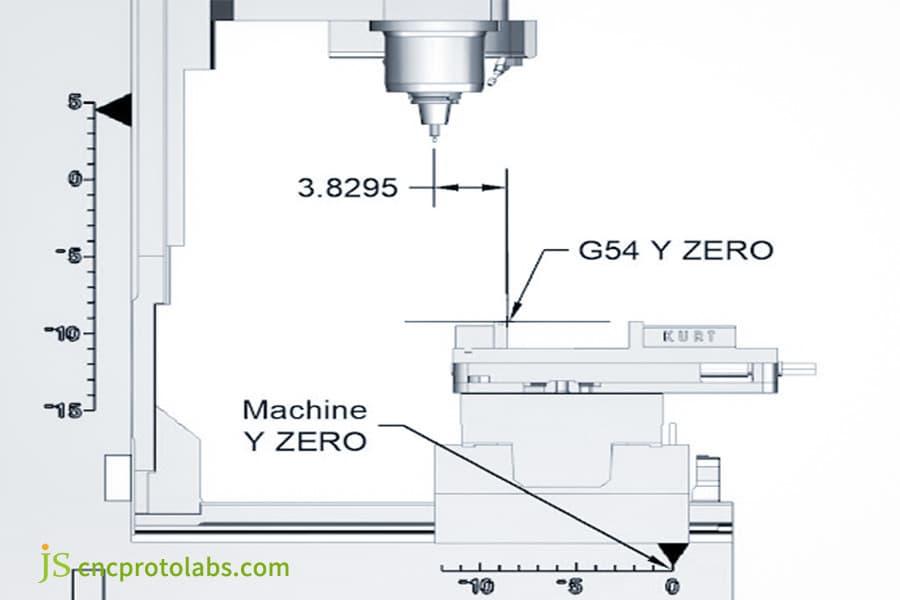
Figure 3: Display the Y-axis positioning of the CNC milling machine, the zero point relationship and offset between the machine tool and the workpiece coordinate system.
5-axis vs. 3-axis: How to distinguish?
1.Core difference
3 axis machine tools are like precise coordinate painters, and can only move tools in three linear directions (front and back, left and right, and up and down) of X/Y/Z. On this basis, 5 axis machine tools have two more rotation axes (usually marked as A/B axes), which is equivalent to equipping the tool with mechanical joints, allowing it to tilt freely during cutting.
| Comparing dimensions | 3 axis machining | 5 axis machining |
| Movement axis | X/Y/Z linear axis. | Add A/B rotation axis. |
| Processing complexity | Flat/simple surface. | Complex three-dimensional structures such as turbine blades. |
| Human intervention needs | Each side of the processing requires manual flipping of the workpiece. | Fully automatic multi angle cutting. |
| Accuracy error | ±0.1mm. | ±0.02mm. |
| Typical cost | $70,000-$210,000. | $420,000+. |
2.Applicable scene selection
Choose 3 axis: Suitable for limited budget (equipment price is 30%-70% cheaper), processing flat/shallow groove parts (such as mobile phone shells), or small batch production(no complex programming).
Choose 5 axis: When encountering deep cavity structures (such as engine cylinder blocks), special-shaped curved surfaces (denture implants), or ultra-high precision requirements (aerospace bearings), five-axis can complete the process that traditional machine tools require 5-6 clampings in one go.
3.Efficiency and cost balance
Although the purchase price of 5 axis machine tools is higher, its continuous processing characteristics can save more than 60% of working hours when processing complex parts such as automotive molds. For example, to manufacture aluminum alloy turbocharger impellers, three-axis requires 7 days + 3 manual calibrations, while five-axis only takes 2 days to complete fully automatically.
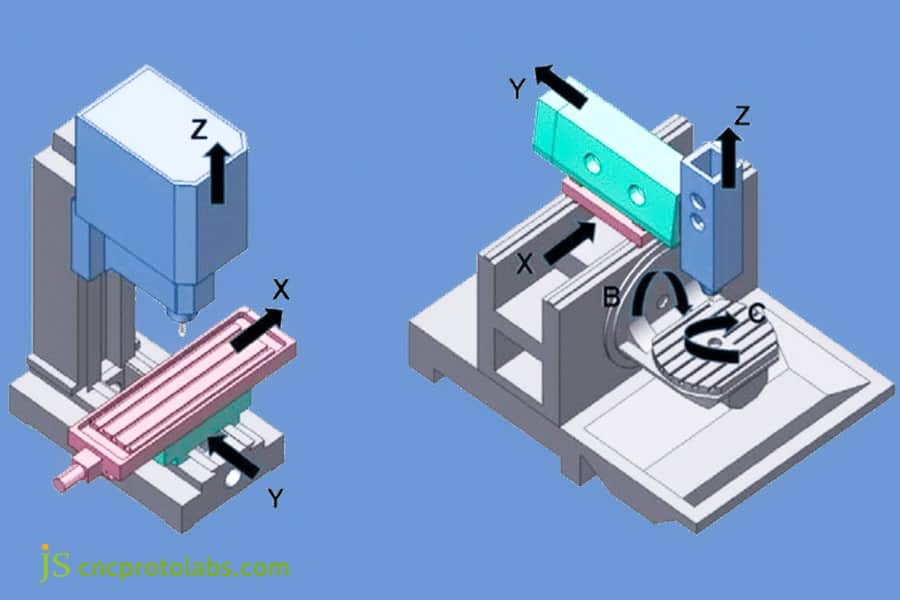
Figure 4: Show the axis structure of CNC milling machines, from basic three-axis to high-precision five axis configuration differences.
Which industries rely most on 5 axis CNC processing technology?
1.Medical industry
- Demand characteristics: Human implants (such as joints and bone plates) need to fit the patient's anatomical structure perfectly, with precision requirements comparable to the thickness of a hair (tolerance ±0.01mm), and the materials need to be biocompatible and have a smooth surface.
- JS Precision's 5 axis CNC machining services advantage: We can process complex surfaces in one go, and provide full-process processing from titanium alloy joints to porous bone implants based on the personalized needs of patients. A single clamping can complete the engraving of special-shaped surfaces, avoiding multiple adjustments in traditional processes.
- Typical applications: Ball and socket structure of artificial hip joints, porous surface of spinal fusion devices, and precision channels of minimally invasive surgical instruments.
2.Electronics industry
- Pain point solution: Electronic products go for thinness and lightness, but small components such as heat sinks and chip interfaces require extremely high precision requirements(e.g. the tolerance of mobile phone SIM card slots should be less than 0.05mm).
- JS Precision technical specifications: Aluminum shells' curved chamfers and internal card slots can be machined in parallel by our 5 axis cnc machining center, and even circuit board positioning holes are engraved on the metal surface to avoid multi-process connection mistake.
- Sample products: Laptop integrated metal body, 5G base station radiator, semiconductor wafer carrier.
3.Customized processing
- Subverting tradition: In the past, manual proofing took 2-3 weeks. 5 axis CNC can transform complex designs (such as gear set prototypes) into physical objects within 48 hours, and materials ranging from plastic to carbon fiber can be handled.
- JS Precision's core value:Our engineers can quickly verify the feasibility of special-shaped structures. For example, automobile clay models are directly upgraded to testable metal functional parts, shortening the development cycle by 60%.
- Typical cases: One-time molding of drone folding joints and precise restoration of customized denture occlusal surfaces.
4.Aerospace
- Ultimate requirements: Aircraft engine blade weight reduction of 1 gram, the whole machine saves 2 tons of fuel per year. Satellite brackets must be both lightweight and radiation-resistant, and the topological optimization structure is as complex as a vascular network.
- 5 axis CNC machining service threshold: We have passed AS9100 aviation certification and can provide micron-level processing for key components such as rocket engine fuel chambers, and even achieve milling instead of grinding, directly milling a mirror effect (Ra≤0.1μm).
- Products processed by our company: Spacecraft fuel nozzles (accuracy up to 1 micron), wing spoiler curved airfoil, rocket engine nozzle cooling channel.
How to Reduce 5-Axis CNC Machining Costs: 4 Practical Strategies for Budget Optimization
1.Pay attention to the price of machine tools
The price of five axis CNC machine tools is influenced by multiple factors, with regular models typically costing hundreds of thousands of dollars, while high-end configurations may exceed millions of dollars. This price fluctuation mainly depends on brand positioning, processing range, technical configuration, and degree of automation.
Taking medium-sized equipment as an example, the basic model quotation is concentrated in the range of 100,000 to 200,000 US dollars, but if it is necessary to expand the processing stroke or add intelligent monitoring modules, the overall cost may double.
It is worth noting that companies in the 5 axis CNC machining UK field tend to choose models equipped with thermal compensation systems, which can automatically correct deformations caused by environmental temperature and are particularly suitable for high-precision mold manufacturing.
2.Core cost composition
Bed of machine tool casting is approximately 25%-30% of the total investment. This part has a tendency to adopt resin sand casting process in order to exhibit improved shock absorption capability. However, as far as what really affects the cost is concerned, it is tied to the core component of the motion control system. This imported precision roller guide rail, could be three times the price of the domestic one, but can keep repeat positioning accuracy in ±0.003mm stable.
For those who are currently considering 5 axis cnc machining center for sale in recent times, please take note. The premium rate of second-hand equipment for direct-drive rotary table equipped equipment is usually more than 15%, as it can rotate to 800°/s, which greatly improves the efficiency of surface processing.
3.Selection of software system
The control system with adaptive machining function is about 20% more expensive than the basic version, but it can automatically optimize cutting parameters and extend the tool life by 30%. If an automatic tool changing system (such as a 24-station tool magazine) is added, the equipment cost will increase by 80,000-120,000 US dollars, but this type of configuration can shorten the tool changing time for mass production to less than 10 seconds.
According to statistics from the British Manufacturing Association, the cost of adding a robot arm to a 5 axis device with a modular design is 40% lower than directly purchasing the whole machine.In the actual operation of our company, the five-axis machine tool can improve the overall efficiency by more than 45% by reducing the number of clamping times.
For example, when machining aircraft engine blades, the traditional process requires five processes, while the five-axis equipment can be completed with a single clamping, which not only saves 70% of the auxiliary time, but also controls the scrap rate below 0.05%. For precision parts with a unit price of more than 1,500 pounds, this means that nearly 10,000 pounds of material losses can be avoided for every 1,000 pieces produced.
4.Cost control suggestions
- Component mix and match strategy: Lightweight aluminum alloy is used for non-load-bearing structures, and key transmission components retain imported configurations.
- Seize the opportunity to purchase: Some British equipment manufacturers launch limited-time discounts at the end of the quarter. In a recent 5 axis CNC machining center for sale event, the price of the standard model has dropped by 12%.
- Phase-based intelligence: Initially configure the basic sensor system, and gradually connect to the Internet of Things platform in the later stage.
- Regional collaboration model: Select several suitable 5 axis cnc machining near me companies to jointly build a technology center and share the right to use high-value equipment.
Processing Speed Increased By 70%, Cost Reduced By 45%: How 5 Axis CNC Brings Significant Advantages To Medical Implants
Background of the Case
Our client is a leading medical device company developing a new generation of titanium alloy artificial hip joint femoral stems. The component features complex anatomical surfaces, with extremely high demands on biocompatibility and long-term stability.
Precisely, the core requirement the client asked for was to achieve an extreme precision of ±0.01mm to ensure a perfect match with the patient's bone, while also requiring a mirror-like surface finish (Ra≤0.1μm), which is very important to effectively promote osseointegration.
In the early stages of this project, the customer employed traditional 3-axis CNC machining with multiple clamping operations. The series of problems included the following:
- Repeated clamping resulted in a situation where cumulative errors would not allow tolerances on critical surfaces to be guaranteed, consequently accompanied by the high scrap rate.
- Meanwhile, more than 5 hours were required for total machining per piece with considerable time spent on manual adjustments.
- In view of the high scrap rate of titanium alloy materials and labor costs, the cost per unit was unaffordably high.
JS Precision's Solution
To tackle the client's challenges, we delivered a comprehensive solution based on a high-end 5 axis CNC machining center. We employed a "one-time setup, complete shaping" machining strategy.
The first thing our technical team did was conduct in-depth Design for Manufacturability (DFM) analysis, optimally making changes to the toolpath to ensure that the tool could continuously cut at the best angle from complex anatomical surfaces.
What's more, we utilized a high-speed spindle and a precision cooling system so that direct milling would achieve a mirror finish: Ra≤0.1μm. As a result, it saved customers subsequent processes and the costs spent in polishing.
Results Achieved
This solution brought in tremendous efficiency improvements.
- Machining efficiency leaped forward, where the processing time of a single piece dramatically decreased from 5 hours to 1.5 hours, with an efficiency increase of up to 70%.
- Product quality was fundamentally improved: the product yield rate reached 99.9%, perfectly meeting the requirements of medical-grade precision and surface finish.
- Overall unit cost decreased by approximately 45%, thus helping our customers win a big advantage in price in the highly competitive marketplace and accelerating the time to market for innovative products.
Do you also want to reduce the cost of medical parts processing and improve efficiency? By submitting part processing requirements to JS Precision, you can obtain a cost reduction solution based on 5 axis CNC machining for free, helping you enhance your market competitiveness.
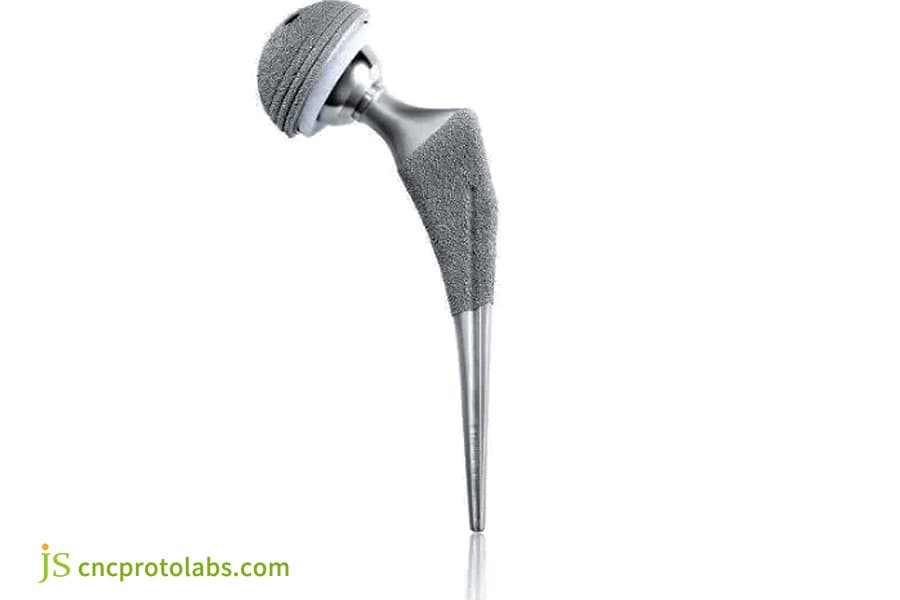
Figure 5:titanium alloy artificial hip joint femoral stem
How to choose the right 5 axis CNC machining service?
1.Look at the equipment hardware
Directly ask the manufacturer what brand of machine tools (such as Germany's DMG and Japan's Mazak) the equipment is used for, and how many years the equipment has been used. As an established manufacturer, we usually have more than 10 5 axis CNC machining centers, which can accept large orders and urgent orders at the same time.
Focus on checking the spindle speed (at least 12,000 rpm) and positioning accuracy (preferably within ±0.005mm). The machine configurations for processing aluminum alloy and titanium alloy are very different.
2.Test technical strength
Requires to see similar parts processing cases, such as joint surfaces of medical devices or aviation impellers. We will provide a video of the processing process, and even let you see how our workshop handles the ultra-precision tolerance of ±0.01mm on site.
3.Compare service flexibility
Test response speed: Send a simple drawing to see how long it will take to get a quote, and JS Precision 's professional team will feedback the process plan within 24 hours.
Ask for the minimum order quantity. We also provide small and large batch processing customization services. Even if the drawings are complex, we can respond within 24.
4.Calculate the comprehensive cost
It is necessary to check the cost details provided by the supplier, and pay special attention to the number of quality inspection processes and whether there are additional charges for tooling design.
Confirm hidden costs before signing a contract: For example, how much extra money is required for special materials (such as PEEK plastic), and whether there is an additional charge for modifying drawings.
FAQs
1.What does 5 axis linkage specifically mean?
Five-axis linkage refers to the synchronous movement of the X/Y/Z linear axis and the A/B rotary axis, so that the tool can continuously maintain the optimal cutting angle and achieve single clamping and forming of complex curved surfaces.
2.How much more expensive is the equipment than the 3 axis?
The price of five-axis equipment is usually 3-5 times that of three-axis, about 210,000-700,000 US dollars, depending on the configuration accuracy.
3.Why is it suitable for processing impeller blades?
5 axis linkage can adjust the tool angle, complete the complex curved surface and thin wall processing of the impeller in a single clamping, ensure accuracy and avoid interference.
4.What skills do operators need?
5 axis operation requires the ability to master CNC programming, system debugging, tool management, collision prevention and 3D drawing analysis.
5.Can 5-axis CNC use the same tools as 3-axis CNC?
In principle, it's universal. However, in order to use the advantages of fast and effective 5-axis machining, we would normally recommend the use of more specialized and robust tools, while at the same time requiring much more rigidity and balance in tool holders.
6.How does 5 axis machining help reduce overall costs?
Multi-facet machining with 5 axis machining is done with just one clamping and greatly reduces the number of clamping times and frequency of secondary operations, and thus the cumulative errors and scrap rate. It fundamentally shortened the overall processing time and labor cost.
7.Do you provide DFM (Design for Manufacturability) analysis for 5-axis CNC?
Yes, we attach great importance to DFM analysis. JS Precision supplies clients with free DFM analysis services. Based on rich 5-axis machining experience, our engineers will support optimizing part designs, saving potential costs and time in the process.
8.How to obtain real-time quotes for 5-axis CNC machining?
Getting an instant quote is very simple. Please visit JS Precision's website to use our online quotation system to upload your 3D design file, and our system will immediately work out a preliminary quotation and estimated delivery time for you, using formats like STEP or IGES.
Summary
5 axis CNC machining technology does have advantages in manufacturing complex parts, especially in the precise control of part details and surface treatment effects. Although it costs more to buy equipment than ordinary processing equipment at the beginning, it is actually quite cost-effective after using it for a long time. The processing time can be shortened a lot, the qualified rate of the parts produced is also high, and there are fewer cases of rework and repair later, and the overall cost can actually be reduced.
In the process of upgrading the manufacturing industry, many companies encounter technical difficulties that are actually related to processing accuracy. Companies in need can contact JS Precision. Our 5 axis CNC machining services provide free machining solution consultation and quickly offer customized production advice!

Disclaimer
The contents of this page are for informational purposes only.JS Precision Services,there are no representations or warranties, express or implied, as to the accuracy, completeness or validity of the information. It should not be inferred that a third-party supplier or manufacturer will provide performance parameters, geometric tolerances, specific design characteristics, material quality and type or workmanship through the JS Precision Network. It's the buyer's responsibility Require parts quotation Identify specific requirements for these sections.Please contact us for more information.
JS Precision Team
JS Precision is an industry-leading company, focus on custom manufacturing solutions. We have over 20 years of experience with over 5,000 customers, and we focus on high precisionCNC machining,Sheet metal manufacturing,3D printing,Injection molding,Metal stamping,and other one-stop manufacturing services.
Our factory is equipped with over 100 state-of-the-art 5-axis machining centers, ISO 9001:2015 certified. We provide fast, efficient and high-quality manufacturing solutions to customers in more than 150 countries around the world. Whether it is small volume production or large-scale customization, we can meet your needs with the fastest delivery within 24 hours. Choose JS Precision this means selection efficiency, quality and professionalism.
To learn more, visit our website:www.cncprotolabs.com
Resource