English




5 axis automotive machining is the core support for the manufacturing of electric vehicle components. In 2024, a top European car company experienced sealing failure in 12% of the parts delivered in bulk due to insufficient machining accuracy of the motor housing.
The root cause is that traditional 3-axis equipment cannot handle the irregular installation holes of the housing, and the machining deviation leads to the risk of oil leakage, resulting in a direct loss of over 3 million euros, and the launch of the new car is delayed by three months.
Nowadays, parts for electric vehicles keep getting more complicated. Old school machines just cant keep up anymore. Because of that, using 5 axis CNC technology is pretty much required these days. Think your current setup can handle what's coming next?
Key Answers Overview
| Key Questions | Key Answers | Value for You |
| Why do EV parts require 5 axis machining? | Complex EV parts have multi-angle features, making it impossible for traditional equipment to complete machining in a single setup. | Eliminating clamping errors, stabilizing tolerances, and improving product reliability. |
| How to choose the best process solution? | Choose a mill-turn center for rotating bodies and a 5 axis machining center for complex box-type parts. | Avoid selection errors, maximize return on investment, and reduce unit cost. |
| How to find a reliable supplier? | Evaluate their large-scale 5 axis machining capabilities, equipment, and specialized fixture configuration. | Find a partner who can share risks and ensure stable batch delivery. |
Key Conclusions
- 5-axis is not an option, but a mandatory option:
With the rise of Giga Casting trend, precision machining of large aluminum parts can only rely on 5 axis automotive machining technology, which can complete six sided machining with a single clamping.
- Efficiency depends on the overall solution:
Efficient cutting is not only a matter of spindle speed, but also requires matching with specialized Visa 5 axis fixtures and optimizing tool paths. The removal rate of titanium alloy materials can reach over 500 cm ³/min.
- Comprehensive cost determines success or failure:
Picking a 5 axis CNC service provider means looking under the hood, how well they manage their process matters most. Stability in production, shown by a solid CPK above 1.33, beats bargain pricing every time.
- The advantages of China's supply chain are clear:
China's EV market accounts for over 40% of the global market, and local 5 axis CNC lathe service providers have accumulated massive experience in processing similar components.
Why Trust This Guide? JS Precision's 5-Axis Automotive Machining Experience
5 axis CNC machining sits at the core of precise production. Over ten years, JS Precision has built experience shaping tough automotive components this way, serving fifty well known global companies.
Motor housings, battery supports, along with control enclosures roll out steadily, making up two hundred major parts for electric vehicles so far. High volume tasks fit their range, especially when forms turn complicated.
Our machining team is proficient in cutting techniques for various difficult to machine materials. For commonly used EV materials such as aluminum alloy, titanium alloy, magnesium alloy, etc., they have standardized machining parameters that have been verified thousands of times.
They can stably control the dimensional tolerance of large part 5-axis CNC machining within ± 0.01mm, and the roughness of key sealing surfaces can reach Ra<0.4 µm.
JS Precision isnt limited to only a handful of imported CNC machine 5 axis, some are paired with lathe, milling setups that turn and mill at once. Parts can stretch up to 2.5 meters long, made possible by extra wide movement paths built into the gear.
Climate inside doesnt shift much, humidity and heat stay fixed day after day. When conditions hold still like that, errors drop off, especially those caused by metal reacting mid cut. Fewer surprises come out of each batch because of it.
Right from the start, precision tools cover every need we have. Focused closely on small details, the CMM measures within ±0.001mm without fail. Each dimension gets verified because results stay neat and easy to track. Since numbers remain correct and out in view, hitting IATF 16949 targets just happens.
What sets us apart is handling everything in house, 5 axis CNC service that goes from early design tweaks right through to full scale manufacturing. Clients across different countries come to us when big cast metal pieces warp or miss tight tolerances. Each run stays under 0.8% flaws, no exceptions.
Want to verify our 5 axis CNC machining technology capabilities? Contact our engineers immediately, submit your part drawings, and we will provide you with a free process feasibility analysis and cost calculation within 24 hours.
Why Is 5 Axis Automotive Machining Becoming The Standard For EV Parts?
Now machines that carve metal must keep up as cars run on batteries instead of gas. Old models with three or four movement directions fall short these days. Five direction cutters handle complex shapes better, so theyre what most factories now rely on. These advanced tools shape car pieces more precisely than before.
Design Complexity Drives Equipment Upgrades
The design process for EV core components has reached a level that generates 3D modeling requirements which exceed the capabilities of standard 3D machining methods.
- The non orthogonal angle installation holes of the motor drive unit require CNC machine 5 axis multi axis linkage for one-time processing.
- The bottom reinforcement ribs and cooling water channels of the battery tray require 5 axis automotive machining to be formed in one go to avoid clamping errors.
Tightening Tolerances
The sealing and fitting standards for electric vehicle components require better performance than those needed for gasoline-powered vehicles which results in continuous improvements of tolerance requirements.
- The motor case seal faces must maintain a distance of 0.02 millimeters or less while the battery supports follow the same strict measurement requirement. The location requires both surfaces to maintain their exact positions throughout surface operation.
- The five-axis machining process for automotive production reduces errors caused by multiple workpiece setups because it maintains part alignment within a margin of half a hundredth of a millimeter.
Machining Difficulties With Lightweight Materials
Lighter parts help electric cars go farther. Yet when walls of components get thinner, making them tests fresh limits in production work:
- Aluminum alloy and magnesium alloy have special cutting characteristics, and 5 axis CNC machining can accurately optimize the direction of cutting force.
- 2-3mm thin-walled components require 5 axis automotive machining to reduce tool impact and avoid deformation.
What Are The Advantages Of CNC 5 Axis Milling In The Processing Of Large EV Components?
For large EV parts, such as the battery trays and motor cases, CNC 5 axis milling is the preferred machining solution.
- Single clamping advantage: Machining big die, cast pieces, between 1.5 and 2.5 meters, happens fully in one round, skipping the limits of older 3 axis models. Precision sticks tight throughout. No extra moves needed. This way holds steady where others cant.
- Complex feature processing: It can efficiently complete difficult to process features such as complex surfaces and cooling channels without the need for multiple clamping.
- Balancing efficiency and quality: Achieving smooth surfaces does not slow things down when machining steps are tuned just right. Speed meets precision without one costing the other.
Want to optimize the machining efficiency of large EV components? Submit your part drawings, and our engineers will design a customized CNC 5 axis milling machining solution for you, achieving a dual improvement in accuracy and efficiency.
CNC Machine 5 Axis Or Turn-Mill Composite: Which Is Better For Your Project?
Equipment selection plays a crucial role in the effectiveness and cost of 5 axis CNC machining. The two systems CNC machine 5 axis and 5 axis CNC lathe have distinct operational environments. The right equipment selection leads to maximum operational advantages.
- Rotary parts: Compatible with 5 axis CNC lathe, it can complete the turning, milling, drilling, and tapping processes in one stop, avoiding process dispersion errors.
- Box-shaped parts: The 5 axis CNC machine serves as the recommended choice. The complex box structure demands specialized equipment for its machining process.
- Complex irregular-shaped parts: The CNC machine 5 axis should be combined with the 5 axis CNC lathe because it provides essential operational benefits.
- Core selection principle: Equipment selection plays a crucial role in the effectiveness and cost of machining. The right equipment selection is essential for achieving maximum business profits.
How To Achieve Efficient Material Removal With CNC 5 Axis Milling On Large Housings?
In the machining of large housings, the material removal rate determines the cycle time, requiring optimization of processes, tools, and parameters. Optimization of CNC 5 axis milling is particularly crucial.
Material Removal Rate Parameter Table for 5-Axis Machining of Different Materials
| Machining Material | Tool Type | Material Removal Rate | Spindle Speed | Depth of Cut |
| 6061 Aluminum Alloy | Large Diameter Corner End Mill | 500 cm³/min or more | 12000-15000 rpm | 3-5mm |
| A356 Die-cast Aluminum | Carbide End Mill | 400-450 cm³/min | 10000-12000 rpm | 2-3mm |
| Titanium Alloy TC4 | Solid Carbide End Mill | 200-300 cm³/min | 3000-5000 rpm | 0.5-1mm |
| 7075 Aluminum Alloy | Coated End Mill | 350-400 cm³/min | 8000-10000 rpm | 1.5-2mm |
Rough machining strategy: determining the total cycle time
- The trochoidal milling process with large diameter corner end mill enables aluminum alloy shell machining to achieve material removal rates that exceed 500% which results in cutting speeds above 500 cm³/min.
- The CNC 5 axis milling method requires lower machining parameters for titanium alloys yet it surpasses traditional 3-axis milling machines in material removal capacity.
Precision machining strategy: Surface quality is a hard indicator
- The CNC 5 axis milling system uses high-speed milling technology which operates at speeds above 15000 rpm and uses minimal depth cutting to produce surfaces with Ra values below 0.8µm.
- The sealing surface quality can be enhanced to Ra values below 0.4µm because there is no requirement for secondary polishing.
Tool path optimization: solving the problem of thermal deformation
- Trochoidal milling enables effective thermal deformation control because it distributes heat sources throughout the manufacturing process of large aluminum alloy shells.
- The Minimum Quantity Lubrication (MQL) technology maintains an environmental balance while it protects the operational lifespan of tools.
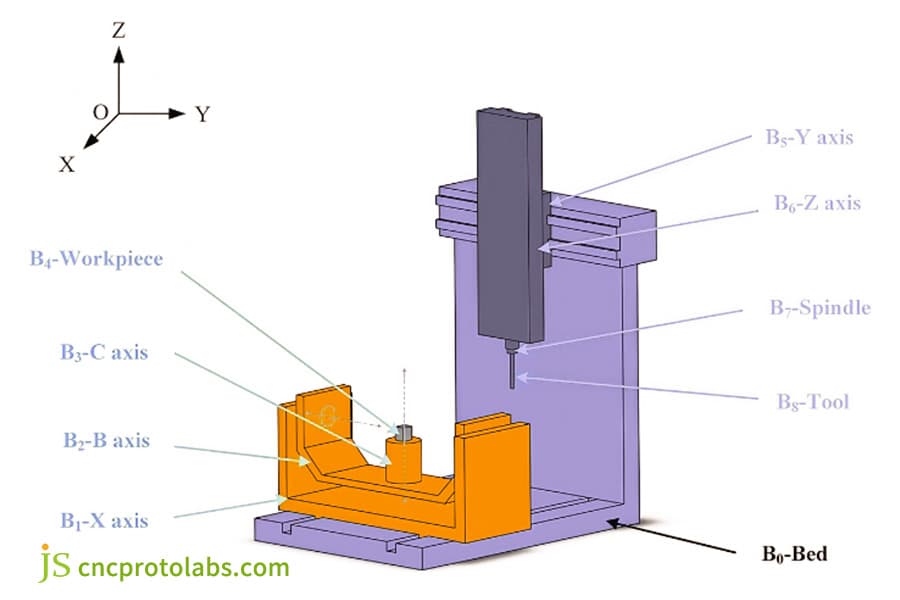
Figure 1: A labeled diagram of a blue 5-axis CNC machine, highlighting key components (Bed, Spindle, Tool, C-axis) and coordinate system (X, Y, Z) for machining a yellow workpiece.
Can Large Part 5-Axis CNC Machining Solve The "Giga Casting" Finishing Challenge?
Giga Casting can integrate parts, but the accuracy of ± 0.5mm cannot meet assembly requirements. Large part 5-axis CNC machining is the optimal solution.
Apart from controlling distortion in large 2-meter molds that easily bend, engineers rely on a vise 5 axis setup to stabilize parts. Cutting pressure gets fine tuned at the same time. Precision holds steady because of how forces are balanced during machining.
Because measurements adjust in real time, spending goes down. Machines run smarter instead of harder. Waste stays minimal over time. Performance climbs without extra effort.
Want to solve the finishing challenges of integrated die casting? Contact us now! We have extensive practical experience in large part 5-axis CNC machining and can provide you with a complete die casting post-machining solution.
Why Does a Specialized Vise 5 Axis Matter For Workholding In Complex Operations?
In 5 axis CNC machining, the fixture is key to accuracy and efficiency. A dedicated Vise 5 axis fixture is perfectly suited for large part 5-axis CNC machining.
Compatibility Table for 5-Axis Machining with Different Fixture Types
| Fixture Type | Clamping Force | Repeatability | Tool Accessibility | Thin-Wall Part Compatibility |
| vise 5 axis Dedicated Fixture | ≥75kN | ±0.005mm | Above 95% | Excellent |
| Ordinary Flat-Jaw Vise | 50-60kN | ±0.02mm | Below 60% | Poor |
| Hydraulic Fixture | 80-100kN | ±0.01mm | Around 70% | Good |
| Vacuum Fixture | 30-40kN | ±0.015mm | Above 90% | Excellent |
Balance between clamping force and accessibility
- 5 axis automotive machining requires small fixtures to avoid interference with tool multi axis linkage.
- Visa 5 axis modular design, small size and clamping force up to 75kN, ensuring stable clamping.
Zero point quick change system significantly improves efficiency
- Visa 5 axis with zero point positioning reduces fixture replacement time by 80% and minimizes non machining time.
- The repeated positioning accuracy reaches 0.005mm, suitable for batch delivery requirements of 5 axis CNC services.
Thin walled component clamping scheme
- Thin walled components need to be clamped with "full support+low pressure" to avoid deformation during clamping.
- Large part 5-axis CNC machining specialized Visa 5 axis fixture, capable of supporting and dispersing cutting forces according to the shape.
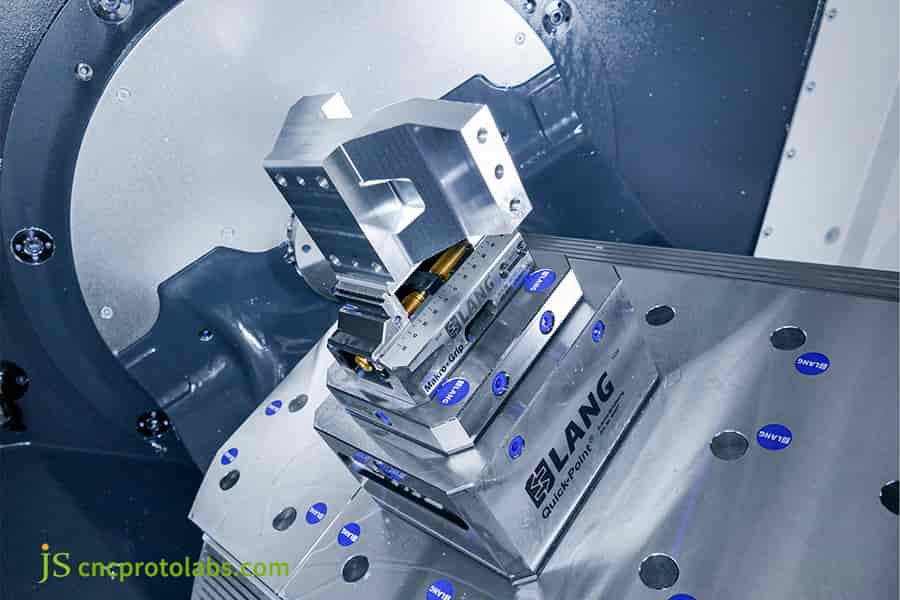
Figure 2: Close-up of a robust, precisely engineered vise securely holding a metallic workpiece on a machine bed, essential for complex 5-axis operations.
How To Choose a Suitable Large Part 5-Axis CNC Machining Service Provider For Your Project?
Finding a reliable large part 5-axis CNC machining service provider is of critical importance to the quality and delivery of EV parts. The evaluation standards are equipment, experience, and quality.
Equipment Capabilities: Balanced Stroke and Precision
- The CNC machine 5 axis and 5 axis CNC lathe must undergo stroke testing to confirm whether their operational limits meet the requirements for manufacturing the specified parts.
- 5 axis CNC machining operations which handle large components require special temperature-controlled facilities because temperature fluctuations can cause processing mistakes.
Process Experience: Similar Cases are Key
- The selection process for service providers should focus first on those who handle materials and structures that match EV specifications.
- The established 5 axis CNC service provides drawing-stage DFM optimization which minimizes processing hazards for customers.
Quality Control: Traceability is the Bottom Line
- The inspection report for CMM and critical dimension CPK > 1.33 must be obtained to verify process consistency through measurement accuracy.
- The service provider needs to demonstrate possession of IATF 16949 certification and ISO 9001 certification together with operational batch tracing capabilities.
JS Precision: Your One-Stop 5-Axis Machining Partner in China
- JS Precision operates several imported 5 axis CNC machines and 5 axis CNC lathes which enable 5 axis CNC machining of large parts that reach 2.5-meter dimensions.
- The engineering team at JS Precision communicates fluently in English while providing services to European and American clients with quick response times and dependable project delivery.
Looking for a reliable large part 5-axis CNC machining service provider? Submit your project requirements now, and JS Precision will provide you with a one-stop 5 axis CNC service, ensuring everything from process design to mass production delivery.
JS Precision Case Study: German Tier 1 Supplier Breaks Through Bottleneck In 2-Meter Motor Housing Processing
Challenge
A top tier German auto parts maker struggled with a two-meter long electric car motor case made of aluminum alloy A356. Not stiff enough, the part bent slightly during production, thanks to its super thin walls, just 2.5 millimeters thick.
That thin structure messed up the inner hole's shape. Roundness should have stayed under 0.02 millimeters but hit 0.035 instead. One out of every eight units failed inspection.
Their existing European factory partner couldnt keep up, running flat out, deliveries dragged on eight weeks per batch. Each finished unit cost more than 200 U.S. dollars to machine.
JS Precision Solutions
1.A fresh take on the fixture: Design a specialized conformal support vise 5 axis fixture, adding adjustable support points in the thin-walled area to distribute cutting force to the reinforcing rib area, effectively suppressing machining vibration.
2.Tool path optimization: By using cycloidal milling path combined with micro lubrication technology, the radial cutting force is reduced by 40%. Precision machining adopts a high speed of 18000 rpm and a small cutting depth strategy to ensure the accuracy of inner hole machining.
3.Process chain integration: One step handles rough cuts, another takes care of fine details. After big parts go through 5 axis CNC work, they get checked on a live CMM system. This check adjusts any shifts, making sure every housing unit hits a CPK number above 1.33 on key sizes.
4.Full process traceability: A digital record follows every item from start to finish, linking raw material heat codes, machine settings, then quality checks. Each step logs into a system that satisfies IATF 16949 tracking rules without gaps. Details stay connected so origins are always clear.
Results
Starting at 0.035mm, the inner holes roundness now holds steady near 0.015mm. Where defects once hit 12%, theyve dipped under 0.8%. Delivery time fell by half, down to four weeks from eight. Machining each unit now costs $144, which trims expenses by nearly one third.
On assembly lines, setup runs 15% faster thanks to smoother fit. Because things moved quicker, the electric car launched in Europe earlier than planned, by about sixty days.
Want to replicate the successful machining experience of this motor housing? Contact JS Precision engineers now, submit your part challenge, and we will customize a 5 axis automotive machining solution for you.
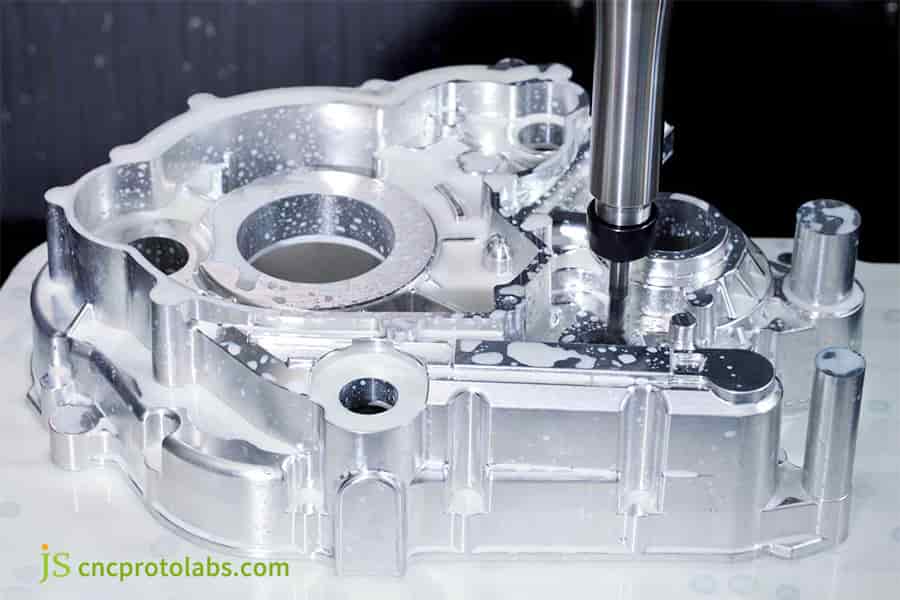
Figure 3: A CNC 5-axis milling tool actively machines a complex, multi-cavity aluminum automotive part, with coolant mist visible for precision.
FAQs
Q1: What parts of EVs are suitable for 5 axis machining?
5 axis machining is applicable for core parts with complex structures and high precision demands, like motor housing, battery trays, inverter housing, and large parts of die-cast aluminum.
Q2: What precision is 5 axis machining able to achieve?
5 axis machining has the precision capability for stable positional accuracy within ±5µm, sealing surface flatness ≤0.01mm, inner hole roundness ≤0.005mm, and surface roughness Ra<0.4µm.
Q3: How much more costly is 5 axis machining than 3-axis machining?
The process cost for 5 axis machining is 20-30% more than that for 3-axis machining, and it reduces clamping and fixture costs and defects, making it more cost-effective.
Q4: How to control deformation during machining large parts of aluminum?
For large parts of die-cast aluminum, heat sources can be dispersed with cycloidal milling, and weak parts can be clamped with a vise 5 axis fixture, and then perform a secondary process for finishing, which can control deformation.
Q5: What is integrated die-casting post-machining?
Integrated die-casting post-machining is a secondary finishing process for die-cast blanks, and large parts 5 axis CNC machining is applied for obtaining the required dimensions for assembly.
Q6: What is the minimum wall thickness that 5 axis machining technology can achieve?
The minimum thickness that 5 axis machining technology can achieve for aluminum alloy parts is 1.5mm, which provides structural strength for the parts.
Q7: What is the lead time for sample and then mass production?
The 5 axis machining samples can be delivered within 2 weeks. After the verification process for mass production, a 4-6 weeks delivery cycle can be achieved.
Q8: How to evaluate the reliability of a 5 axis supplier?
In order to evaluate the reliability of a 5 axis supplier, the 5 axis CNC equipment, EV-related case study, quality certifications, and CMM testing and traceability of the supplier should be verified.
Summary
In the process of the development of the EV industry, the 5 axis automotive machining plays a vital role as a competitive advantage for the enterprise. It cannot be separated from the mature 5 axis CNC machining technology.
With rich experience in the large part 5-axis CNC machining field, JS Precision provides solutions to the machining challenges for the global customers.
Contact us immediately and submit your drawings. Our engineers will provide you with professional technical review and competitive production solutions within 24 hours, helping your new energy vehicle components to quickly compete in the global market.

Disclaimer
The contents of this page are for informational purposes only.JS Precision Services,there are no representations or warranties, express or implied, as to the accuracy, completeness or validity of the information. It should not be inferred that a third-party supplier or manufacturer will provide performance parameters, geometric tolerances, specific design characteristics, material quality and type or workmanship through the JS Precision Network. It's the buyer's responsibility Require parts quotation Identify specific requirements for these sections.Please contact us for more information.
JS Precision Team
JS Precision is an industry-leading company, focus on custom manufacturing solutions. We have over 20 years of experience with over 5,000 customers, and we focus on high precisionCNC machining,Sheet metal manufacturing,3D printing,Injection molding,Metal stamping,and other one-stop manufacturing services.
Our factory is equipped with over 100 state-of-the-art 5-axis machining centers, ISO 9001:2015 certified. We provide fast, efficient and high-quality manufacturing solutions to customers in more than 150 countries around the world. Whether it is small volume production or large-scale customization, we can meet your needs with the fastest delivery within 24 hours. Choose JS Precision this means selection efficiency, quality and professionalism.
To learn more, visit our website:www.cncprotolabs.com
Resource