English



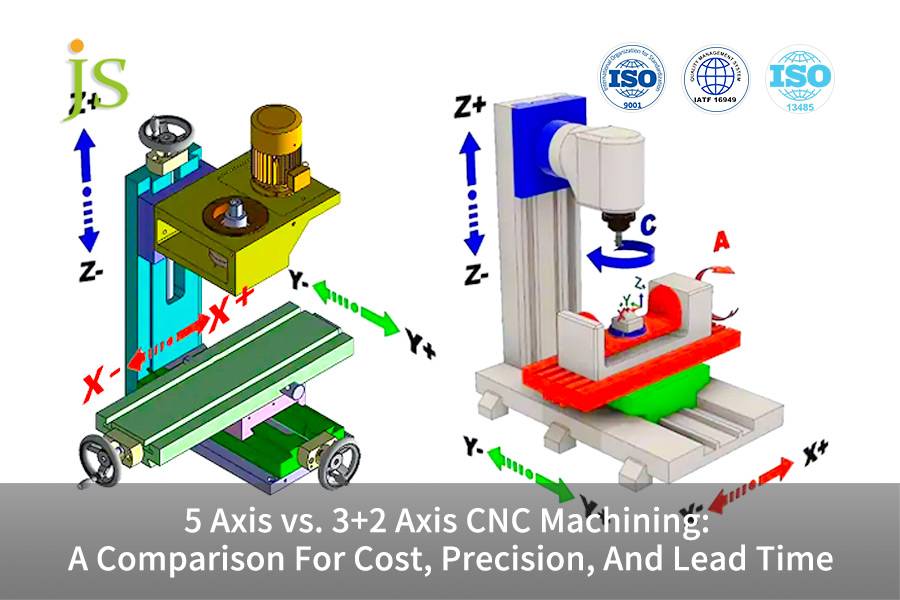

5 axis CNC machining services have always been the core solution for manufacturing high, precision, complex parts. Have you ever noticed the tool marks on curved surfaces or delays in delivery after part delivery?
The fundamental reason is usually not the drawings but the machining strategythe technical differences between 3+2 axis positioning machining and 5 axis simultaneous machining that are affecting your accuracy and efficiency.
This article is aimed at uncovering the crucial distinctions between the two technologies, explaining how complex part manufacturing bottlenecks can be easily solved through expert multi axis CNC machining facilities. Additionally, it also discusses the lightweight application scenarios of desktop 5 axis CNC.
Quick Overview of Core Answers
| Core Questions | Key Answers | Value Brought to You |
| Core Differences Between 5-Axis and 3+2-Axis Machining | 3+2 axis machining is post positioning machining, whereas 5 axis machining is simultaneous machining cutting. The first is suitable for planar machining, while the second is capable of highly complex curved surfaces. | Make a quick decision on which process path to take for your type of part. |
| Optimize Precision And Delivery Time | Opting for professional 5 axis CNC machining services includes the possibility of a single setup for features of the complex one, accuracy improvement can be up to 30%, and delivery time reduction can be 40%. | Understand the comprehensive value of multi axis linkage for complex parts, and avoid repeated clamping and precision loss caused by incorrect process selection. |
Key Conclusions:
- Accuracy difference can be even 5 times:
The surface roughness of 5 axis linkage machining for continuous curved surfaces can be as low as Ra 0.4μm, whereas 3+2 axis machining can achieve only Ra 1.6μm because the tool marks are visible.
- One setup = greater reliability:
5 axis machining can combine several setups of complex parts into one, thus eliminating resultant errors and making it the best choice for custom machined parts.
- Tooling sets the lower limit of efficiency:
By using a dedicated 5 axis vise and 5 axis workholding solutions the setup time of complicated parts can be cut by more than 70%.
Why Trust This Comparison? JS Precision's 5 Axis CNC Machining Services Experience
JS Precision has been a major player in the 5 axis CNC machining industry for more than ten years, supplying over 10,000 aerospace, medical, and automotive custom machined parts.
Our multi axis CNC machining process system can fully satisfy the 5 axis CNC machining requirements, effectually solving the problems of lack of precision and long lead times in 3+2 axis machining. Moreover, we are able to customize desktop 5 axis CNC machines for the production of small parts.
AS9100D aerospace quality certification has been implemented to guarantee the complete traceability of our machining process. In the medical industry, for example, we helped a company to surface finish surgical implants by improving the surface roughness from Ra 2.0μm in 3+2 axis machining to Ra 0.3μm, and at the same time, we halved the delivery time.
On a project for an aerospace company, we facilitated single clamp machining of hydraulic valve bodies, thus avoiding the accumulation of errors from various clamping operations and cutting the defect rate from 18% to 0.3%.
In our technical team, each member has more than 5 years of working experience with 5 axis CNC machining.We are able to tailor make machining work for parts which require machining in different materials and structures.
With the latest gear from top 5 axis machining center manufacturers in Germany and Switzerland, we not only guarantee the quality of the machining but also the stability.Besides that, we offer the service of selecting and commissioning desktop 5 axis CNC machines according to the customer's requirements.
Want to quickly solve your machining pain points for custom machined parts? Contact JS Precision's application engineers now, submit basic part information, and you'll receive a free customized 5 axis CNC machining services process assessment report. Accurately predict machining results and costs, giving you a competitive edge in high-efficiency production.
What Is The Core Difference Between 3+2-Axis And 5 Axis Machining?
Choosing the appropriate machining process depends on a key factor recognizing the fundamental distinction between 3+2 axis and 5 axis machining. Essentially, their kinematic principles explain the difference in the level of machining capability and the accuracy that each one can achieve. To elaborate:
3+2 Axis Machining (Cutting After Positioning)
The two rotary axes are only utilized to set the angle of the workpiece and keep it still. The machine tool runs the workpiece through the X, Y, and Z linear axes onlyit's like setting the workpiece up before actually making it.
5 Axis Machining (Rotation During Cutting)
The three linear axes synchronize their movements with the two rotary axes during cutting, changing their relative positions and angles continuously to the cutting angle. This is the main aspect of multi axis CNC machining.
Difference in Accuracy Sources
In line with ISO 230-2 standards, 3+2 axis machining requires several angle adjustments which accumulate in tool contact error ranging from 0.02 to 0.05mm. 5 axis machining is free from repositioning error due to a single clamping, which is its primary advantage in accuracy.
Comparison of Core Parameters for 3+2 Axis and 5-Axis Linkage Machining
| Parameter Indicators | 3+2 Axis Machining | 5-Axis Linkage Machining | Applicable Part Types | Surface Roughness | Number of Clamping Cycles |
| Motion Mode | Cutting after Positioning | Linkage during Cutting | Plane/Simple Hole System | Ra 1.6μm and above | Up to 5-6 times |
| Positioning Error | 0.02-0.05mm | ≤0.005mm | Freeform Surface/Deep Cavity | Ra 0.4μm and below | Only 1 time |
| Tool Life | Conventional (prone to vibration) | Extended by 2-3 times | Undercut/Complex Internal Cavity | Ra 0.8μm and below | Only 1 time |
| Machining Cycle | Long (including implicit time) | Shortened by 40-60% | Aerospace/Medical Precision Parts | Ra 0.3μm and below | Only 1 time |
Is it still uncertain which machining process is suitable for the part? Upload your 3D drawings and provide the basic requirements for your parts. JS Precision engineers will analyze the feasibility for you free of charge, match suitable machining solutions, and provide desktop 5 axis CNC selection advice to help you avoid process selection risks.
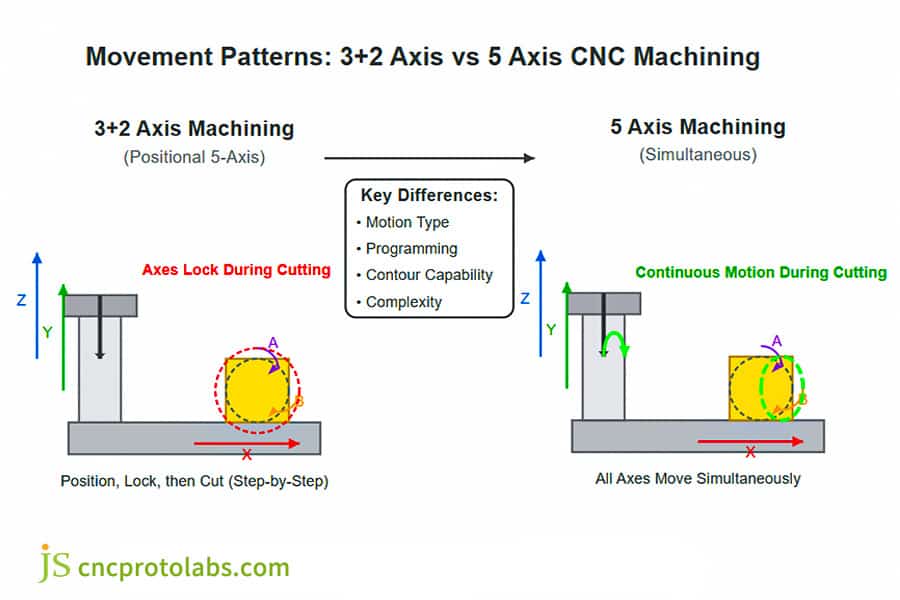
Figure 1: A chart comparing the movement patterns of 3+2-axis and 5-axis CNC machining, highlighting step-by-step vs. simultaneous motion and key technical differences.
For Contour Machining, What Precision Advantages Does 5 Axis Multi Axis CNC Machining Offer Over 3+2?
Custom machined parts with curved surfaces such as impellers and turbine blades are examples where the limitations of the precision of 3+2 axes are very evident. 5 axis CNC machining services, benefiting from multi axis CNC machining, can provide a higher level of precision performance, especially as shown below:
The problem with tool marks in 3+2 axes
When the rotation axis angle is adjusted several times, tool marks (0.02-0.05mm high) may appear at the junction of the machining trajectory due to accumulated errors, thus, part performance will be affected.
Features of 5 axis continuous tool posture
The continuous change in the tool posture, the smooth trajectory of the tool contact point, the absence of joint marks, the contour of the continuous curved surface 0.01mm, and the surface roughness that reaches Ra 0.4μm.
A curved surface example
Medical implants require high biocompatibility, and 3+2-axis tool marks can lead to excessive friction coefficient. 5-axis linkage can achieve tool free machining, balancing performance and accuracy.
For Small-Batch Complex Parts, How Much Lead Time Can Choosing 5 Axis CNC Machining Services Save?
Lead time remains a significant pain point in manufacturing small batch complicated parts. 5 axis CNC machining services can help shorten the production time dramatically through the process advantages, including:
Clamping Optimization
While 3+2 axis machining typically requires 5-6 clamping operations, 5 axis CNC machining can perform all machining in a single clamping operation, thereby reducing clamping time by 70%.
Removal of Hidden Expenses
Transfer and alignment times, which are not readily apparent, caused by multiple clamping operations in 3+2 axis machining, account for 40% of the total processing time. Implementing 5 axis machining can completely avoid this, thus the total processing time may be cut by 40%-60%.
Example
JS Precision is a company that provides parts for orthopedic implants of a medical company. 3+2 axis machining lasted 3 weeks, while 5 axis CNC machining was able to achieve the required precision in only 5 working days.
For Custom Parts With Deep Cavities & Overhangs, Why 5 Axis Is Better For Custom Machined Parts?
When it comes to custom machined parts with deep cavities and undercuts, 3+2 axis is a bit limited in terms of tool accessibility and rigidity. To overcome these issues 5 axis linkage is the best choice, see the salient features below:
- 3+2 Axis Rigidity Issues: Increasing tool overhang is a must when machining deep cavities. Hence, with every 10mm increase in overhang, rigidity is reduced by 30% which results in vibrations and subsequently, quality degradation.
- 5 Axis Obstacle Avoidance: The tiltable tool feature means that deep cavity areas can be machined with a short tool thus avoiding even the rigidity issue. Besides that, the tool stays at the best cutting angle which helps in extending its life up to 2-3 times.
- 5 axis vs 3+2 Accessibility: 3+2 axis is incapable of forming complex internal cavities and undercuts in one step. On the other hand, 5 axis linkage has the advantage of complete tool accessibility, thus enabling design freedom.
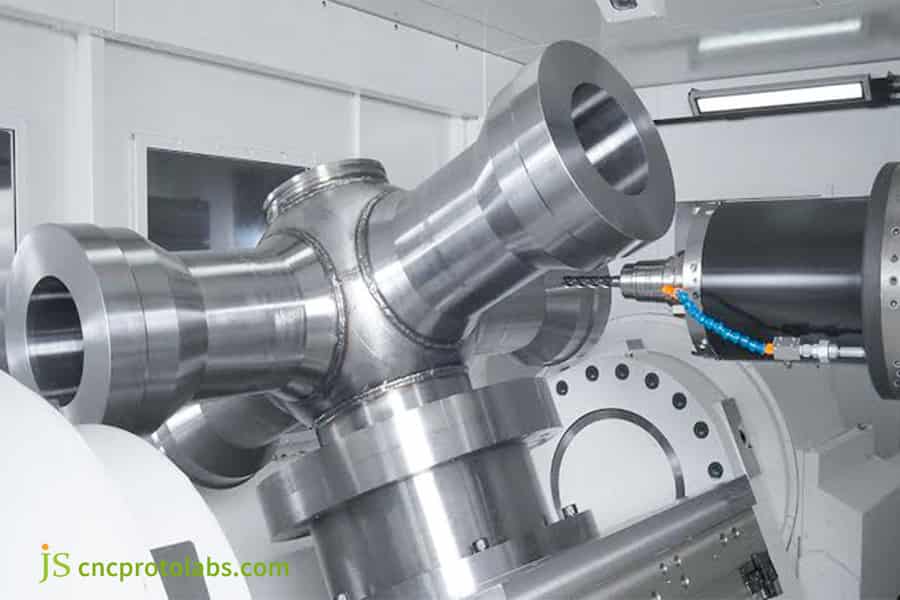
Figure 2: A multi-axis CNC machining center is actively cutting a large, complex metal workpiece with cylindrical features.
Compared To Standard Vises, How Does a Dedicated 5 Axis Vise Enable Fast Positioning And Clamping Of Complex Parts?
Fixtures play a significant role in achieving accurate and efficient machining operations. The benefits of a 5 axis vise and 5 axis workholding include:
Standard vise interference risk
Normally, a regular vise can limit the spindle and tool movement in the 5 axis rotary machining operations as it is quite tall. That means the machining angles would be limited and new clampings would need to be done for those angles not accessible in the first operation.
Advantages of 5 axis vise design
It is very low in height (50-70mm), which makes it possible to have a high clamping force, avoids interference, provides stable clamping and supports quick changes, thus the time for clamping is reduced from 15 minutes to 2 minutes.
Flexible tooling system
JS Precision adopts a 5 axis vise as the center, together with quick change jaws and zero point positioning, which makes it extremely fast in changing to different parts and perfect for multi variety small batch machining.
Different 5-axis Vise core performance parameters
| 5-axis Vise Model | Clamping Height (mm) | Maximum Clamping Force (kN) | Clamping Time (min) | Compatible Part Type | Quick Change Support? |
| SC5X | 65 | 50 | 2 | Large and complex valve body | Yes |
| C5X | 70 | 40 | 3 | Medium-sized bracket parts | No |
| grepos-5X | 55 | 40 | 1.5 | Small precision shafts | No |
| C2.0 | 60 | 50 | 2.5 | Multi-variety, small-batch parts | Yes |
| C3 | 50 | 16 | 1 | Miniature medical parts | Yes |
Looking for the optimal 5 axis workholding solution for your complex parts? Contact JS Precision for free fixture selection and clamping optimization advice.
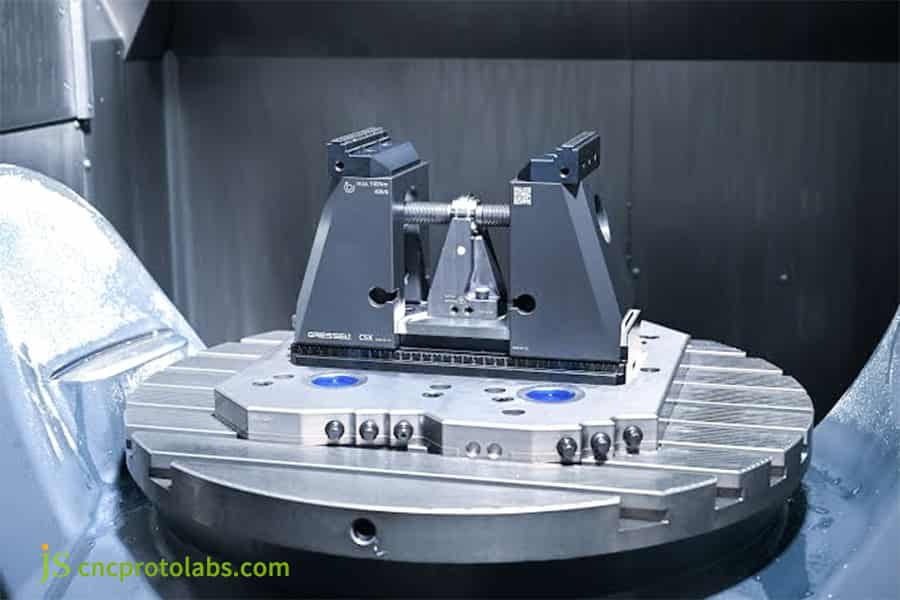
Figure 3: A dedicated 5-axis vise with symmetrical jaws is securely clamping a metal workpiece inside a machining center.
How Does The Choice Between 3+2 Axis And 5 Axis Affect Quoted Lead Time And Cost?
The decision between 3+2 axis and 5 axis linkage affects the pricing, lead time, and cost of custom machined parts.
- Hidden Costs: Time, inspection, and scrap costs caused by multiple clamping operations on 3+2 axes can elevate total machining costs by 30% to 50%.
- Value per Clamping Operation: One single clamping operation of a 5 axis machine is enough to remove hidden costs. Thus, if the complex bracket part is taken as an example, the labor cost of the 3+2 axis clamping is $200, while the 5 axis cost is only $50, hence saving 75%.
- Lead Time Advantage: While the hourly rate for 5 axis machine tools is 30% to 50% higher, by not having to wait between processes, the overall machining cycle is shorter, thus better pricing and lead time.
When Should I Choose 5 Axis CNC Machining Services Over 3+2?
The deciding factor between a 3+2 axis and a 5 axis linkage is basically your part and its characteristics, how big the batch is, and the material. The main points should be:
Part Geometry
If you're dealing with planar or simple contour parts, it's better to go with 3+2 axis to keep the expenses down, when it comes to free form surfaces, deep cavities, and undercut parts, 5 axis is the way to go to ensure precision, for small light parts, a desktop 5 axis CNC is a good choice.
Batch Size
If you're doing a one piece or a small batch (<100 pieces), opt for 5 axis to avoid the expense of multiple fixtures, for large batches, assessing the trade off between the machine cycle time and the fixture costs is necessary.
Material Hardness
When working with hard to machine materials like hardened steel and titanium alloys, 5 axis linkage by itself can provide constant chip load control, thus tool wear is significantly reduced.
How To Evaluate Linkage Accuracy Of 5 Axis Machining Center Manufacturers?
It is essential to choose dependable 5 axis machining center manufacturers if you want to guarantee accuracy. Below are the main aspects to consider when assessing:
RTCP Function
The heart of genuine 5 axis machining, it maintains the tool center point unchanged. Without this feature, it is not possible to achieve high precision in linkage machining.
Precision Indicators
The equipment of industrial grade must comply with the following criteripositioning accuracy ≤0.005mm, repeatability ≤0.003mm, and rotary axis resolution ≤0.001°.
Equipment Differences
A desktop 5 axis machine can only be accurate to 0.01-0.02mm and is thus suitable for low precision parts, industrial grade equipment that can achieve accuracy ≤0.005mm is suitable for high precision machining.
Machine Tool Rigidity
The heavier the machine itself, the more likely the bed is made of mineral casting, and the guideways are more likely to be hardened, the better the rigidity, thus making the machine more suitable for machining hard to machine materials.
Want to learn about the equipment selection techniques of leading 5 axis machining center manufacturers? Download JS Precision's "5-Axis Machine Tool Selection White Paper" to master professional evaluation methods and selection key points.
JS Precision Case Study: 5-Axis Linkage Transforms 17 Clamping Cycles Of Aerospace Hydraulic Valve Bodies Into 1 Clamping Cycle
Challenge
One of the parts of an aerospace hydraulic valve body is a highly precise custom machined component. It is made of 7075-T6 aluminum alloy. The part has 36 precision holes, 4 intersecting oil passages, and 2 deep cavity structures.
The first supplier used a 3+2 axis process with 17 clampings and 5 machine cycles. The hole position accuracy was ±0.05mm, but the deep cavity inner wall roughness was only Ra 3.2μm, which resulted in a defect rate of 15% and the delivery was delayed for 8 weeks."
Solution
By permitting the benefit of experience gained from 5 axis CNC machining operations, JS Precision team changed the multi axis CNC machining process path for the part as follows:
1.Tooling Revolution:
To single clamp all machining surfaces and eliminate the errors resulting from multiple clampings, a custom 5 axis workholding solution was implemented using a low height 5 axis vise in combination with a zero point quick change system.
2.Toolpath Optimization:
By the use of high level programing strategies for multi axis CNC machining, trochoidal milling with tool tilting was used for the deep cavity features, thus the tool overhang was reduced from 120 mm to 60 mm and the tool rigidity was improved.
3.In-Machine Inspection:
By utilizing a machine tool probe, the team performed closed loop feedback compensation for all the critical dimensions in one single clamping operation. This process helped to correct machining errors real time and ensured the accuracy of the workpiece.
Results
After being reprocessed with a 5 axis CNC, the hydraulic valve body was able to achieve a complete performance upgrade of its machining:
- The hole position accuracy was improved from ±0.05mm to ±0.01mm.
- The inner wall roughness of the deep cavity was reduced from Ra 3.2μm to Ra 0.8μm.
- The total machining time was drastically shortened from 35 hours to 12 hours, and the delivery time was reduced from 10 weeks to 3 weeks.
- The defect rate fell from 15% to 0.5%, and overall machining costs per part were lowered by 42%.
Have similar complex part machining needs and want a quick solution? Call the JS Precision service hotline now to schedule a one-on-one consultation with an engineer. Leveraging the advantages of multi axis CNC machining technology, we will customize a customized machining solution for you, efficiently solving your machining challenges.
FAQs
Q1: How much more expensive is 5 axis machining than 3+2 axis machining?
5 axis machining hourly machine rate is about 30-50% more expensive than 3+2 axis machining, however, it is able to completely remove hidden costs and thus the total machining cost of complex parts can be reduced by 20-40%, which basically results in better cost effectiveness.
Q2: Is 5 axis programming difficult?
Yes, it is moderately difficult and requires a deep understanding of multi axis tool axis vector control strategies. JS Precision is capable of providing DFM analysis to help optimize the design and ease the programming process.
Q3: What brands of 5 axis machine tools do you use?
To guarantee the precision and stability of multi axis simultaneous machining, we mostly employ first tier brands like Hermle (Germany), Mikron (Switzerland), and Mazak (Japan).
Q4: Is there a minimum order quantity?
We have no minimum order quantity. Being specialists in the field of small batch, ultra precision parts processing, we can accept single piece orders and yet you will still have access to professional 5 axis simultaneous machining services.
Q5: What accuracy level can 5 axis machining achieve?
It can consistently provide a positioning precision of ±0.005mm and a repeatability of ±0.003mm which is sufficient for the processing of high precision customized parts.
Q6: What is the typical lead time for 5 axis machining?
The lead time for a single sample is generally around 5-7 working days, while the batch lead time is 2-4 weeks, which is considerably shorter than 3+2 axis machining. If you need faster processing, just ask, and we'll do our best to help.
Q7: Can you machine hardened steel?
We have hard milling capabilities and can directly finish machine HRC58-62 hardened steel, thus reducing the subsequent EDM process and increasing our machining efficiency.
Q8: How do you ensure batch consistency?
With the help of a zero point positioning system and SPC process control, we keep an eye on the entire machining process. Consequently, we are able to make sure that the batch error of customized parts does not exceed 0.01mm.
Summary
3+2 axis and 5 axis linkage are more than just process upgrades. They are a pair of solutions each adapted to different parts. The selection of the proper process plays a decisive role in achieving a balance of accuracy, lead time, and cost.
If the parts are complicated, one should go for 5 axis CNC machining services to quickly realize the transformation of design blueprints into real objects.
JS Precision, through world class equipment, matured processes, and years of experience, can take away most if not all of your machining troubles.
Don't let improper process selection erode your production efficiency. Send your 3D drawings to JS Precision now, and you'll receive a professional process assessment within 4 hours. Let our expert team safeguard the machining of your parts!

Disclaimer
The contents of this page are for informational purposes only.JS Precision Services,there are no representations or warranties, express or implied, as to the accuracy, completeness or validity of the information. It should not be inferred that a third-party supplier or manufacturer will provide performance parameters, geometric tolerances, specific design characteristics, material quality and type or workmanship through the JS Precision Network. It's the buyer's responsibility Require parts quotation Identify specific requirements for these sections.Please contact us for more information.
JS Precision Team
JS Precision is an industry-leading company, focus on custom manufacturing solutions. We have over 20 years of experience with over 5,000 customers, and we focus on high precisionCNC machining,Sheet metal manufacturing,3D printing,Injection molding,Metal stamping,and other one-stop manufacturing services.
Our factory is equipped with over 100 state-of-the-art 5-axis machining centers, ISO 9001:2015 certified. We provide fast, efficient and high-quality manufacturing solutions to customers in more than 150 countries around the world. Whether it is small volume production or large-scale customization, we can meet your needs with the fastest delivery within 24 hours. Choose JS Precision this means selection efficiency, quality and professionalism.
To learn more, visit our website:www.cncprotolabs.com
Resource