English



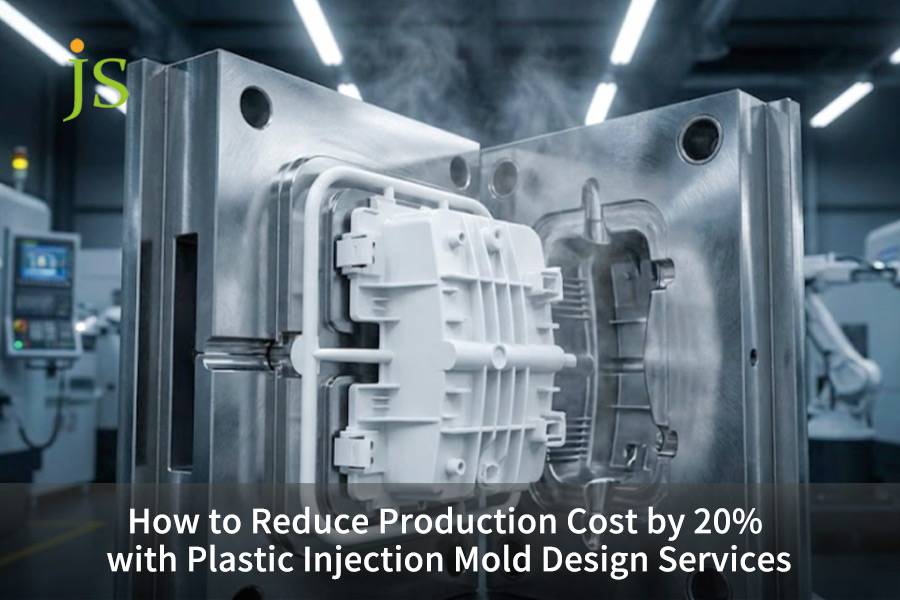

Plastic injection mold design service is a structured engineering process that minimizes the cost per part by 20% or more via upfront DFM optimization of wall thickness, runner systems, conformal cooling, and mold steel selection, without impacting material quality or reducing part strength.
With this method cycle time is reduced 15%-30%, scrap rate is lowered 10%-15%, and secondary operations are completely wiped out. This means immediate cost saving right at the very first production run. You will also see an illustration of7 different saving methods which were verified through the experience of senior mold engineers of JS Precision.
DFM Injection Molding Service Cost Reduction Path & Engineering Parameters Overview
|
DFM Strategy |
Key Engineering Action |
Cycle & Material Savings |
Cost Reduction |
|---|---|---|---|
|
Wall thickness & rib optimization |
Eliminate thick sections, ribs at 40%–60% of main wall |
Cooling time reduced 20%–30% |
6%–8% |
|
Runner & gate redesign |
Switch to hot runner or pinpoint gate, optimize fill balance |
Material waste reduced 12%–15% |
4%–6% |
|
Undercut & slider simplification |
Use lifters or split-line optimization, reduce complex slide mechanisms |
Mold fabrication cost reduced 15%–25% |
3%–5% |
|
Conformal cooling application |
3D-printed cooling channels, mold surface temp variance ≤ ±2°C |
Overall cycle time reduced 18% |
5%–7%t |
Key Takeaways
- Optimizing wall thickness and rib structures through early-stage DFM (Design for Manufacturability) can significantly shorten the cooling phase, which typically accounts for over 60% of the injection molding cycle.
- Using Mold Flow Analysis to accurately predict weld lines and deformation helps avoid secondary mold modification costs that could otherwise reach hundreds of thousands of dollars.
- Optimizing mold structure to minimize complex side-core pulls and slider mechanisms directly reduces mold manufacturing costs and enhances production automation.
- Partnering with JS Precision for a customized DFM assessment allows you to lock in the optimal comprehensive unit procurement price during the preliminary project planning stage.
Why Trust JS Precision's Injection Mold Design Service To Cut Costs By 20%?
According to industry best practices, the main way to cut injection molding costs is not by asking the suppliers to bear the burden but rather by cutting waste from the production process at the design stage. For example, an automotive sensor housing project's client initial design included six side-core pulls at one side, irregular wall thickness (2.0mm - 4.5mm), and an unduly expensive mold. And, uneven cooling resulted in 0.45mm of warpage. The average cycle time was almost 53 seconds and the client's production costs were very much over budget.
Benefiting from DFM-driven structural changes, we decreased side sliders from six to two, we uniformly distributed the wall thickness of 2.2mm, we incorporated intersecting ribs of 1.2mm and as a result, we created a conformal cooling circuit through 3d printing. In the end, the manufacturing cost dropped by 22% in respect to the old design, the cycle time was reduced to 34 seconds, and the complete product unit cost was cut down to 21.8%.
The ISO 9001:2015 standard literally says the organization shall create, put into practice, preserve, and periodically enhance, the quality management system to meet the requirements of the customers and regulations for the product and service consistency.
To follow the rules of this particular standard with no exception, JS Precision operates within a fully closed-loop quality control system during plastic injection mold design service as a minimum requirement.
Want to know how DFM optimization can save you 20% on production costs? Download the JS Precision Injection Molding Cost Reduction White Paper to access cost calculation formulas and detailed explanations of seven key cost-reduction strategies.
How to Reduce Injection Molding Cost with Wall Thickness and Rib Optimization?
Optimizing wall thickness and reinforcing rib design can directly shorten the cooling time that accounts for more than 60% of the injection molding cycle, reducing injection molding cost from the source.
The physical relationship between cooling time and wall thickness
Cooling time is inversely proportional to the square root of wall thickness: t ∝ h². By decreasing the wall thickness from 4.0mm to 2.0mm, the cooling time can be reduced by 75%. In other words, halving the wall thickness leads to a quarter time required for cooling.
- Wall thickness control standards: JS Precision requires that the main wall thickness be uniformly between 1.5mm and 3.0mm during the plastic part design for manufacturing audit, and the transition ratio between adjacent wall thicknesses be less than 3:1.
- Ribbing design to eliminate sink marks: The thickness at the bottom of rib should not be more than 40%-60% of main wall thickness to completely eliminate surface sink marks. Also, to avoid the concentration of stress, at the tip of a root we have radius R = 0.5t.
- Cost-cutting effects: At the same time, a wall thickness optimization cuts the usage of raw materials and processing time for machine, which reduces the total injected molding cost.
In the practical application of plastic injection mold design service, we have found that many customers overly rely on increasing wall thickness to enhance strength, which in turn leads to a doubling of cooling time. Putting the ribs at the right places in a planned way enables the stiffness needs to be fulfilled without the need to thickness up the wall.
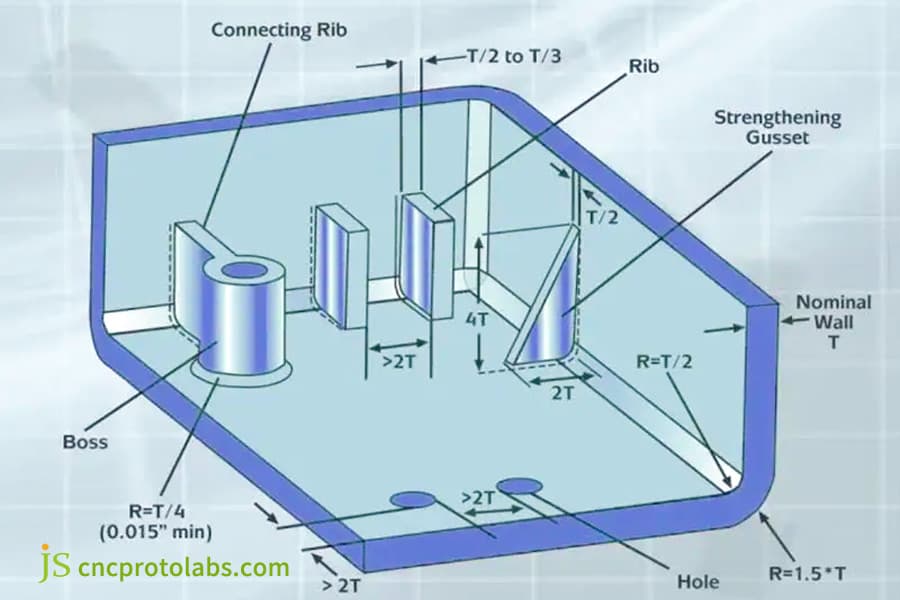
Figure 1: Injection mold design diagram showing nominal wall thickness, rib dimensions, and boss specifications for manufacturing.
How Does Injection Mold Flow Analysis Service Eliminate Warpage and Sink Marks?
JS Precision's injection molding flow analysis locates and corrects problems like warping and sink marks before production commencement.
Defect identification through numerical simulation
JS Precision's DFM injection molding service uses mold flow analysis to accurately calculate melt front temperature, shear rate, and volumetric shrinkage, so that uneven filling and air traps become detectable early.
- Gate location optimization: Gate positioning should be made at thick-walled area to guarantee packing pressure and prevent voids.
- Holding Pressure Profile Adjustment: Plastic part DFM optimization was performed on high shrinkage materials such as PA66+30% GF, with a holding pressure set to 85 MPa and the part warpage deformation locked within ± 0.1mm.
- Shear Rate Control: Shear rate limits to 100,000 s⁻¹ so that the material is not thermally degraded.
Mold Trial Cost Savings
Use of mold flow analysis avoids 2-3 runs of mold trials (T1-T2) and related modification costs which makes the first-shot success rate to be very high. It takes around 2,500-8,000 modification costs per one-time and a few more mold flow analysis pays off big time in return on investment.
Submit 3D CAD drawings to JS Precision to receive a custom quote that includes mold flow analysis, simulation reports are delivered within 48 hours.
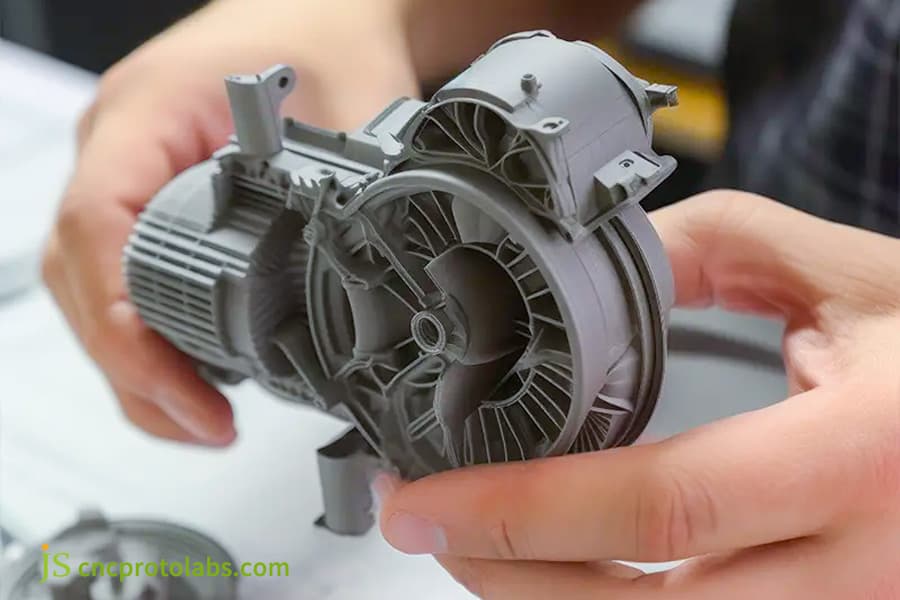
Figure 2: Complex gray plastic engine part analyzed for injection mold flow to prevent warpage and sink marks.
What Mold Structure Modifications Yield Instant Custom Injection Molding Cost Reductions?
Simplifying the geometric structure of the product and reducing complex side core pulling mechanisms can achieve custom injection molding cost reduction, significantly reducing mold processing time and post production maintenance costs.
Cost-saving Through Mold Machining
- Two-Plate Mold vs. Slider Mold: The mold having four side-action sliders is priced 40%-60% higher than a standard two-plate mold mainly due to the higher time required for CNC machining and EDM processing.
- Cost per Slider: Each hydraulic side-action mechanism adds 1,800-4,500 to the mold cost.
Engineering Optimization to eliminate Undercuts
Utilizing our custom injection molding design service, JS Precision converts lateral undercuts into features that are released directly at the parting line through these approaches:
- Orientation Adjustment of Snap-fit: Modifying the direction of the snap-fit so that it is molded along the mold opening direction.
- Process Opening for Through-hole Self-locking: Generating a process opening beneath the snap-fit to achieve direct molding with a steel-to-steel shut-off between the moving and fixed mold halves.
- Increased Draft Angle: A forced ejection is obtained with adding a draft angle of 1.5°-2.0°.
Reduction in Maintenance Costs
Simplifying the structure can achieve injection molding cost reduction, reducing production failures and downtime. By reducing one slider, the annual maintenance cost is reduced by approximately $1200.
We frequently see clients overcomplicate slide mechanisms in our DFM injection molding service by designing with functional limitations as a major constraint, yet, through smart design of simple hollow through-holes, it is quite a normal thing to produce internal undercuts without slides.
How Do Hot Runner Systems and Gate Designs Minimize Raw Material Waste?
Using hot runner and point-gate systems eliminates cold runner waste, saving over 15% on raw material procurement costs for expensive engineering plastics.
Cold Runner vs. Hot Runner Comparison
|
Parameter |
Cold Runner |
Hot Runner |
|---|---|---|
|
Material waste per shot |
20%–40% of total weight |
< 2% (only sprue) |
|
Suitable for expensive resins |
High waste cost |
Minimal waste |
|
Payback period (PEEK) |
— |
3–6 months |
|
Maintenance complexity |
Low |
Moderate |
Payback Period Calculation
Payback Period = (Hot Runner Premium) ÷ (Annual Material Savings)
With costly engineering plastics such as PEEK and PPS, the waste portion has a large impact on the cost of an item. JS Precision, plus providing the customer the option of valve-gated and point-gate hot runner systems through its plastic injection mold design service, also factors in the ROI and gives recommendations. These systems retain the melt in a heated condition for the entire duration of the process and they allow waste-free molding.
- Material Savings: An immediate material cost drop of 15%-20%.
- Cycle Time Reduction: By not having to cool and remove cold runners, the cycle time gets reduced up to 8%-12%.
- Sustainable Cost Reduction: Achieving sustainable injection molding cost reduction.
It is very important that injection molding cost control doesn't only refer to the material itself, but also encompasses such elements as waste disposal and post-processing steps. Hot runner systems take care of both concerns right away.
Submit your projected production volume to JS Precision to receive a hot runner ROI analysis and a free calculation of your payback period.
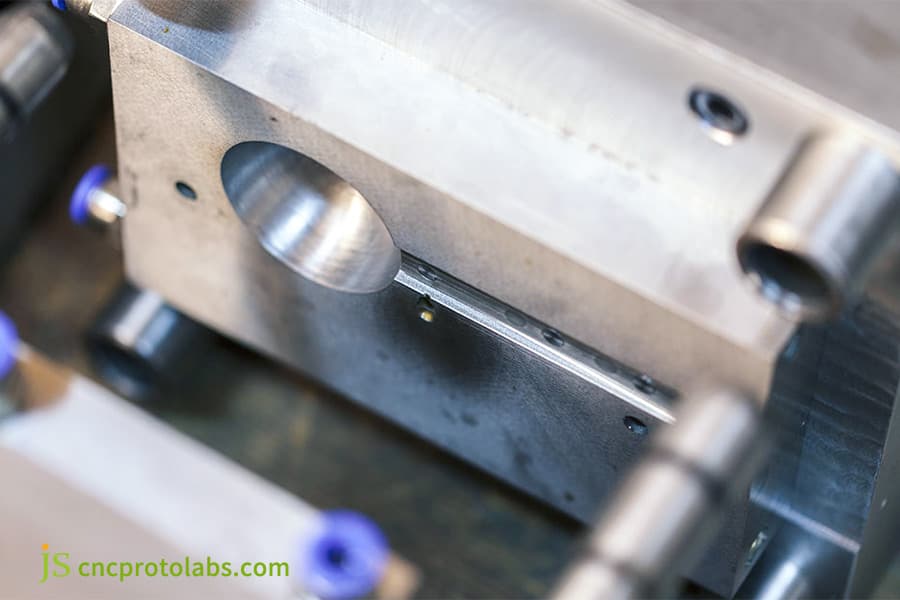
Figure 3: Precision stainless steel mold component with hot runner system and valve gate for material saving.
How Does Conformal Cooling Technology Reduce Injection Molding Cycle Time?
By implementing conformal cooling channels, JS Precision can reduce injection molding cycle times by over 15%.
Comparison: Traditional Channels vs. Conformal Cooling
|
Parameter |
Traditional Drilled Channels |
Conformal Cooling (SLM 3D Printed) |
|---|---|---|
|
Channel shape |
Straight, fixed diameter |
Follows cavity contour |
|
Distance to cavity surface |
15–25 mm (uneven) |
Constant 3.0–5.0 mm |
|
Mold surface temperature variance |
±15°C |
±2°C |
|
Cycle time |
45 s |
28 s (-38%) |
|
Part geometric tolerance |
±0.05 mm |
±0.01 mm |
The Physics of Conformal Cooling
Conventional, drilling-based channels are constrained and are not suited to adapt to intricate, irregular surfaces, resulting in heat build-up and lack of uniform cooling within the mold.
In a plastic part DFM optimization, JS Precision uses 3D-printed metal conformal cooling inserts. As a result, the cooling circuit matches the shape of the product being cooled and still keeps a distance ranging from 3.0 mm to 5.0 mm.
- Temperature Control: The surface temperature on a mold insert never drifts ±2℃ from the intended value.
- Cycle Time Reduction: The injection molding cycle time will be cut down almost to the same level by 15%-25% through this method.
- Warpage Elimination: Thermal stress is neutralized so that the geometric tolerances remain within ±0.01 mm.
As a professional DFM injection molding supplier, JS Precision provides a complete set of custom injection molding design service to ensure that each set of conformal cooling solutions can match your specific part geometry.
How to Lower Production Costs with Material Selection and Tolerance Relaxation?
By choosing suitable alternative raw materials and allowing the loosening of non-critical tolerances, the complexity of mold manufacturing and machining can be minimized without compromising quality or performance.
Cost Reduction via Tolerance Rationalization
- Tolerance Grade Vs. Cost: A general tolerance of ±0.05 mm is a hard requirement for mold machining.
ISO 20457:2018 specifies that this document specifies the possible manufacturing tolerances for plastic molded parts.
In order to strictly comply with this standard, JS Precision implements ISO 20457 TG6 grade (± 0.15mm to ± 0.20mm) for non mating surfaces in its custom injection molding design service, which not only meets international tolerance standards but also reduces processing and scrap costs by 10% -15%.
- Only critical areas are precisely controlled: Sealing and bearing surfaces meet to ISO 20457 TG4 levels of precision while non- mating surfaces conform to TG6 standards.
Material Substitution Recommendations
JS Precision's custom injection molding design service includes a component for evaluating potential material substitutions:
- Using PP modified with TALC instead of PA66 results in cost savings up to 25%-35% without compromising strength.
- When it comes to opaque parts, ABS can substitute PC reducing material costs with a margin of 40%.
- For non-high temperature applications, POM is a good substitute for PEEK and will bring about a cost saving of about 60%.
Two-fold Optimization Advantages
Double optimization reduces injection molding cost from the root. By combining tolerance relaxation with material substitution, the overall cost of a single piece can be reduced by 15% -20%.
When talking about plastic part design for manufacturing, we consistently counsel clients to give preference to standard tolerance grades and to allocate precision work on the key functional surfaces only.
Upload your BOM and drawings to JS Precision to evaluate opportunities for tolerance and material optimization, and receive a free comparison report on alternative solutions.
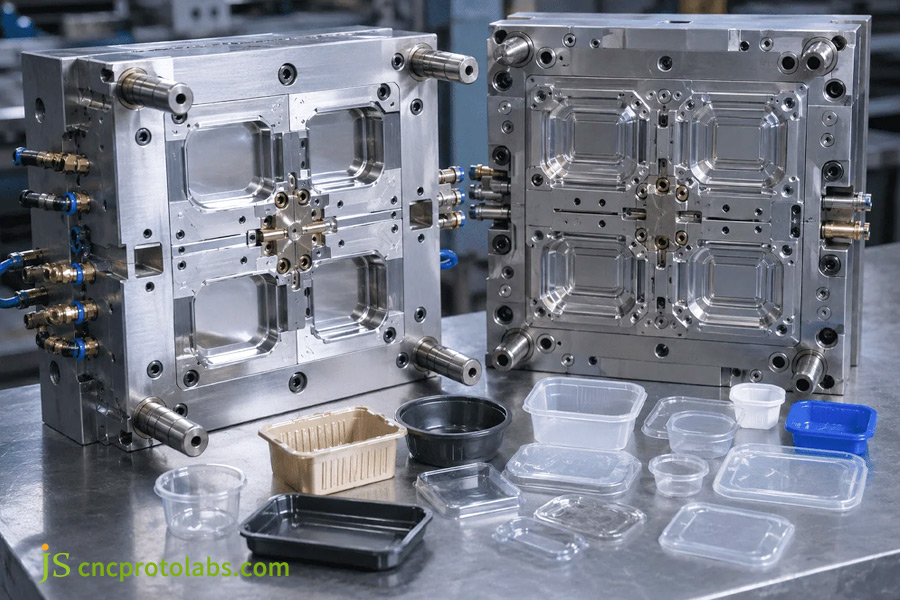
Figure 4: Multi-cavity precision molds with assorted plastic containers for cost efficiency.
JS Precision Automotive Sensor Housing Custom Injection Molding Case Study
Challenges Faced by the Client
An automotive parts supplier from Europe had original mold design with six core slides of the side and very different main wall thickness (2.0-4.5mm) so that mold cost was too much. A 0.45mm warp caused unequal cooling (tolerance requirement ±0.1mm) and long 52-seconds cycle time lead to major extra expense.
JS Precision Solution
- Design to be Mould-friendly (DFM): We took out the plastic undercuts and with our plastic injection mold design service, we substituted them with the snap-fit hole through to cut down side slide numbers from six to two.
- Thinning of thick walls and optimization of ribs: Areas with walls of 4.5 mm thick were hollowed out, the main wall thickness was standardised to 2.2 mm, and intersecting ribs of 1.2 mm were added to maintain structural integrity.
- Mold flow analysis and layout of conformal cooling channels: Run injection mold flow analysis, change the sprue to a center needle hot sprue, and introduce a 3D printed conformal waterway into the mold core.
Lessons Learned
The first trial integrated classical cooling tubes and high-thermal-conductivity beryllium-copper alloy, but upon inspection, warpage of -0.22 mm was discovered (which did not fit within the specifications), and it was evident then the only way to handle highly detailed pieces was a mix of wall hollowing and conformal cooling.
Final Results
|
Parameter |
Before DFM |
After DFM |
|---|---|---|
|
Number of sliders |
6 |
2 |
|
Main wall thickness |
2.0–4.5 mm |
2.2 mm (uniform) |
|
Cycle time |
52 s |
34 s (-34.6%) |
|
Warpage |
0.45 mm |
0.06 mm |
|
Mold fabrication cost |
Baseline |
-22% |
|
Per-part cost |
Baseline |
-21.8% |
This case study clearly exemplifies how DFM is a cost-saving asset in injection molding: injection molding costs can be reduced by more than 20% through DFM by making intelligent changes to optimize the process while product functionality isn't impacted at all.
If you are facing similar bottlenecks with high cost injection molding projects, contact JS Precision for a similar DFM assessment and a free, customized cost-reduction plan.
Why Choose JS Precision for Your Injection Mold Design and Manufacturing?
Collaborate with JS Precision for a hassle-free production process for your plastic injection molding projects, as we are all-equipped with complete end-to-end solutions to support your needs.
JS Precision Plant Credentials
- More than 15 years of experience: JS Precision has the knowledge of precision mold making and is injection molding experts, having delivered work to a varied, worldwide clientele throughout this period.
- Equipment capabilities: In our workshop are precision CNC, EDM SODICK, and a large stock of automated injection, from 80T to 1200T sizes.
- ISO Certification: Quality management system under ISO 9001:2015 that the company strictly follows resulting in a Cpk≥1.33.
JS Precision Service Commitment
- 24-Hours DFM: After the drawings have been received your DFM (mold flow included) report will be back together 24 hours.
- Total solution: We handle all aspects of your custom injection, whether starting up the project, trying out sample pieces or scaling up production.
- Cutting costs: Lock in the optimal unit cost and delivery cycle through high-level DFM injection molding service.
In the custom injection molding design service, we always adhere to the principle of engineering prioritization, solving all manufacturability issues before mold manufacturing, which is the fundamental guarantee for achieving the 20% cost reduction goal.
FAQs
Q1: How does plastic injection mold design service reduce costs without sacrificing part strength?
By carving out thick-walled parts and making ribs (with the size 40%-60% of the wall thickness of the main part), we reduce material requirements up to 20%-30%, preserving physical strength and at the same time getting rid of sink marks and internal stress.
Q2: How long does a DFM injection molding design review take at JS Precision?
JS Precision engineers are able to complete DFM manufacturability and quotation review without charge after receiving a 3D CAD model (STEP/IGES) and materials requirements in under 24 hours.
Q3: Does injection mold flow analysis service add extra costs to the project?
At JS Precision, flow analysis of the mold for personalized jobs is part and parcel of the DFM work package. Doing a simulation at the design stage to improve filling and cooling is an investment you can't get any other way, and you don't have to go mold rework 2-3 times which is actually very costly.
Q4: Is a hot runner system worth investing in for low-volume production?
Given the grade of material that's going to be injected, a hot runner system can result in a 15%-20% saving on the material cost. This can cover the increased price of the mold within just a couple of months. Upload your engineering drawings through our online quoting system and our specialists will give you the ROI of the hot runner.
Q5: How do I get a quote for custom injection molding services from JS Precision?
Send your 3D and 2D drawings, material grade, surface finish requirements and estimated annual volume to JS Precision. Our staff will reply with a list of costs and suggestions for cost reduction within 24 hours.
Q6: Can relaxing non-critical dimensions really lower injection molding costs?
Ideally, you just need to make your requirements match ISO 20457 guidelines (e.g. ±0.15mm) for the tolerance of non-critical elements. You'll get more machining precision of molds and a wider injection molding process window that will let you save about 10%-15% in the actual manufacturing cost.
Q7: How does JS Precision ensure the quality and mold life of custom plastic parts?
JS Precision follows strictly the ISO 9001:2015 quality management systems. We work with high-quality tool steels only and CMM full-dimensional inspection is used to validate every production batch.
Q8: Why is early-stage DFM optimization the most critical factor in cost control?
Yes, because 80% of the manufacturing cost for injection-molded part is decided in the design stage alone. Through DFM optimization, it's possible to identify the problems of the wall thickness and structure design before the mold is made, which is the best way to cut the cycle time and mold cost.
Summary
Through systematic DFM design and engineering optimization, including uniform wall thickness control, mold flow analysis, structural simplification (eliminating undercuts), conformal cooling, and rational tolerance allocation, companies can achieve a 20% reduction in total injection molding production costs without compromising product quality. Reducing costs is not about squeezing supplier margins, it is about technological innovation and eliminating waste within the manufacturing process.
Are you ready to cut the production budget for your next injection molding project by 20%? Don't let inefficient designs eat into your profits. Contact JS Precision’s engineering experts today—upload your 3D CAD files to receive a free DFM manufacturability assessment and a competitive quote for custom injection molding. Our engineering team is available around the clock to provide technical support!

Disclaimer
The contents of this page are for informational purposes only. For JS Precision Services, there are no representations or warranties, express or implied, as to the accuracy, completeness, or validity of the information. It is the buyer's responsibility to identify specific technical requirements and request a formal parts quotation. Please contact us for more information.
JS Precision Team
Custom manufacturing solutions. With over 15 years of experience serving more than 1,000 customers, we specialize in high-precision CNC machining, sheet metal fabrication, 3D printing, injection molding, and metal stamping. Having successfully delivered over 300,000 precision parts, we maintain a 99.2% on-time delivery rate across all custom projects.
Our facility is equipped with over 100 state-of-the-art 5-axis machining centers and is ISO 9001:2015 certified. We deliver fast, efficient, and high-quality manufacturing solutions to B2B clients across 150 countries. Whether you require low-volume prototyping or large-scale customization, we support your project with lead times as short as 24 hours. Choose JS Precision for unparalleled efficiency, quality, and professionalism.
To learn more or submit your RFQ, visit our website: www.cncprotolabs.com
Resource