English



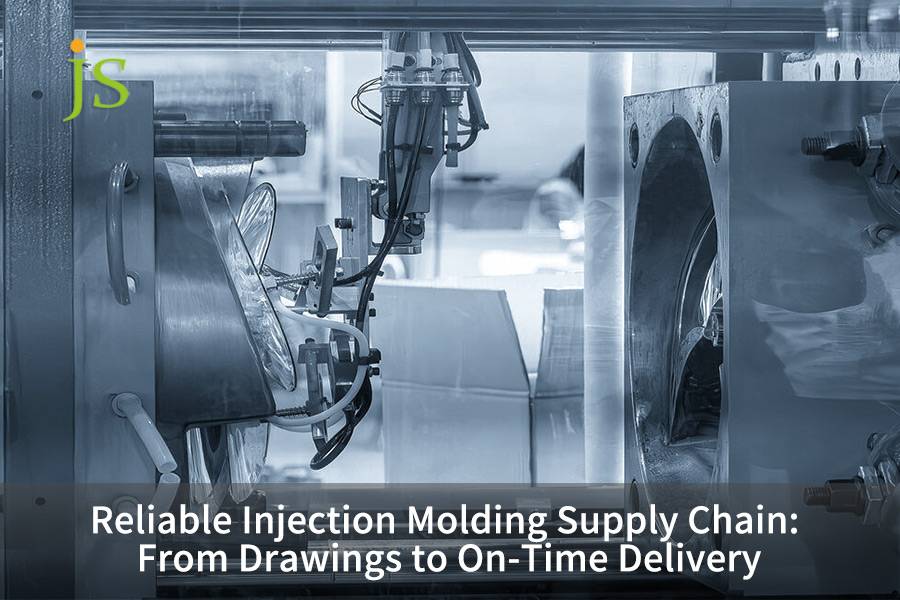

Injection molding supply chain is the vital link that connects product drawings with timely product delivery. With 24-hour DFM audit, ISO 9001 process control, and CMM inspection, standard and precision parts can be tightly controlled within tolerances of ±0.02 mm to ±0.05 mm, over 98.5% deliveries are delivered on-time (OTD).
This guide will explain how to make your injection molding workflow more efficient and how to eliminate the risk of sourcing. When technical DFM is combined with certified quality systems as well as predicting logistics, every CAD file can be converted into the delivered part, in compliance and on schedule.
Injection Molding Supply Chain Overview & Core Metrics
|
Supply Chain Stage |
JS Precision Key Metric |
Quality & Delivery Assurance |
Customer Value |
|---|---|---|---|
|
Drawing DFM Audit |
24-hour Moldflow report |
Eliminates >95% potential sink marks & voids |
Avoids late-stage mold rework |
|
Mold Manufacturing & T1 Trial |
NAK80/S136 steel, CMM inspection |
T1 sample dimensional pass rate ≥98% |
Shortens sample approval cycle |
|
Mass Production & Quality Control |
Real-time CPK ≥1.33, ISO 9001 system |
Full FAI & in-process inspection |
Outgoing yield ≥99.2% |
|
Logistics & On-Time Delivery |
Dynamic buffer stock, 98.5% OTD |
Critical parts 48-hour emergency response |
Zero assembly line stoppage |
The above table shows the project statistics of JS Precision from 2024 to 2025.
Key Findings
- DFM Risk Prediction: By performing a 24-hour moldflow analysis with a detailed study, 95% of possible mold defects are removed before manufacturing.
- Measured Tolerance Control: Dimensional tolerances of both standard and precision parts remain at around ±0.02mm to ±0.05mm by the combination of an ISO 9001 system and CMM measurement.
- On-Time Delivery Guarantee: By making use of automatic production scheduling and spare parts management, we reach a rate of successful deliveries of more than 98.5% (OTD).
- Transparent Procurement Decisions: Models for standardized cost and delivery enable Procurement Managers to have fully controllable supply risk management.
Why Trust JS Precision's Injection Molding Supply Chain? From Drawings to Delivery
A dependable injection molding supply chain should not be viewed as only one skill set. It is a whole system of activities involving technical drawing, mold production, process control, and logistics coordination. Our work experience in automotive electronic connector projects has exposed us to delays of 3-4 weeks in traditional supply chains largely due to communication delays and recurrent mold changes.
We have reduced the trial cycle by 30% through mold flow analysis and a well-setup delivery coordination network.
IATF 16949:2016 Clause 7.1.5.1 reads: The organization shall verify that the external laboratory services meet the requirements of this standard.
Adhering to IATF 16949 quality standards, JS Precision carries out the check throughout the whole custom injection molding sequence: CAM programming, CNC machine work, EDM discharge, trial molding CMM inspection (full), mass run product delivery. Together, we operate a TCO accounting model to maintain that molds of our clients are not only traceable but also quantifiable and can be optimised. During our 3-month machine shop monitoring experiment, when CPK was kept above 1.33(data sourced from AIAG PPAP production approval baseline, Evok Poly 2026), the change in size was controlled within ±0.02mm.
Want to get your injection molding supply chain optimization solution? Download JS Precision's Injection Molding Supply Chain Fulfillment White Paper, which includes a DFM audit checklist and OTD calculation model.
How to Ensure Seamless Execution from Drawings to On-Time Delivery via Injection Molding Supply Chain Management?
The injection molding supply chain relies on rigorous early-stage DFM reviews, precision mold processing, ISO 9001 process control, and proactive logistics and inventory management. JS Precision is able to ensure that drawings are reliably converted into premium grade, defect-free, timely delivered products using end-to-end digital control.
End-to-End Collaborative Network
An injection molding supply chain involves a well-coordinated series of activities including Design for Manufacturability reviews, procurement of mold steel materials, precision machining, trial molding, and logistics fulfillment. Injection molding supply chain goes beyond simply mold opening + injection molding.
- Technical Audit and DFM Prediction: The supply chain undergoes the technical audit phase once the buyer has sent CAD drawings (STP/IGS).
- Cycle Locking and Risk Control: If you lock the procurement cycle of mold steel (e.g. S136, NAK80) and combine it with 24-hour DFM feedback, the R&D trial molding cycle will be directly reduced by 30%.
- Standard delivery model assessment: You should first set delivery constraints and risk control limits for every node of the supply chain.
Traditional Supply Chain vs. JS Precision Digital Supply Chain
|
Dimension |
Traditional Supply Chain |
JS Precision Digital Supply Chain |
|---|---|---|
|
DFM Feedback Timeliness |
5–7 days |
24 hours |
|
Tool Steel Procurement Cycle |
Unlocked, fluctuates 15–30 days |
Pre-locked, fluctuation ≤3 days |
|
Trial Mold Cycle |
Delayed 3–4 weeks |
Shortened by 30% |
|
T1 Sample Pass Rate |
≈80% |
≥98% |
|
On-Time Delivery Rate (OTD) |
85–90% |
98.5% (JS Precision 2024–2025 stats) |
Data Source: The industry's world-class OTD benchmark is 98%+, with a scrap rate of<1% (MoldMinds 2025).

Figure 1: Engineer measuring white plastic gears on technical drawings.
How Does Precise Injection Molding Service Guarantee On-Time Delivery and High Fulfillment Rates for Complex Parts?
Standardized production planning, mold maintenance on-demand, and control of parameters in the molding process guarantee on-time delivery. JS Precisionon-time delivery injection molding minimizes downtime risks through the use of automated injection molding machines and real-time monitoring. As a result, OTD gets improved to over 98.5%.
Molding Parameter Closed-Loop Control
- Multi stage Holding Pressure Control: Variations in single part molding cycle time due to changes in holding pressure and melt temperature are minimized through closed-loop control. As a result, single part molding cycle is stabilized with a tolerance of 0.5 seconds.
- Cooling Water Control: With sufficient water channels, unobstructed water flow, and high-quality sealing, there are no leakage risks or mold cycle fluctuations due to scale.
- Decision Logic:
- If the part wall thickness changes by more than 15%, the cooling time is increased by 25%.
- If the melt temperature deviates from the set value by ±3℃, an alarm is triggered and the mold cycle is automatically reduced.
Emergency and Spare Parts Mechanism
- Safety Stock Buffer Strategy: Set up a pre-stocked spare parts system specially for mold components with high breakage rates (e.g. Ejector pins, slides etc).
- 2-Hour Production Recovery: If a machine breakdown happens, the standby unit can start the molding process production again without delay and will be able to deliver on-time delivery injection molding.
- Plastic Injection Molding Service Commitment: Outgoing product qualification rate 99.2%, CMM full inspection of critical dimensions.
Planning delivery milestones for complex injection molded parts? Contact JS Precision's engineering team for customized production scheduling and spare parts solutions, ensuring zero downtime on your assembly line.
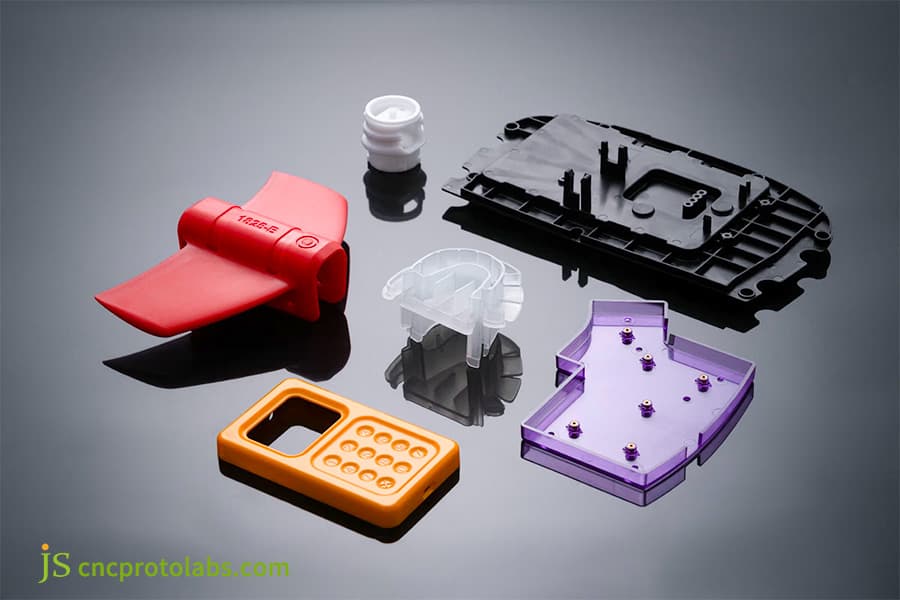
Figure 2: Various plastic molded parts arranged for final quality inspection.
How to Select a Reliable Injection Molding Service Provider to Minimize Sourcing and Quality Risks?
Selecting a good injection molding service provider necessitates a good look at whether the technical DFM capability, measurement equipment accuracy, and ISO standards implementation are adequate. A reliable injection molding service provider such as JS Precision will help its customers not only with the materials selection but also reduce the procurement risk throughout the production.
Supplier Screening Checklist
- Review inspection hardware: Check whether the factory has a fully functioning Keyence optical measurement projector and a Zeiss CMM coordinate measuring machine.
- Quality Documentation Assessment: Confirm that the supplier can provide an FAI Report (First Article Inspection) and also a CpK Report demonstrating the capability of the production process to be equal to or greater than 1.33.
- Timeliveness In Engineering Drawing Reply: Evaluate if the draft angle and wall thickness irregularities issues in the drawings will be identified and corrected within 24 hours.
- Experience in machining of common materials: Request to see the actual machining cases and databases of machined engineering plastics like ABS PC PA66+30% GF, POM.
- Entity Standard Certification: Check if the company genuinely holds the required entity certification like ISO 9001:2015 and IATF 16949 through proper means.
Need to assess whether the supplier's capabilities match your project? Upload drawings to obtain JS Precision's supplier benchmarking assessment report to identify gaps and improvement paths.
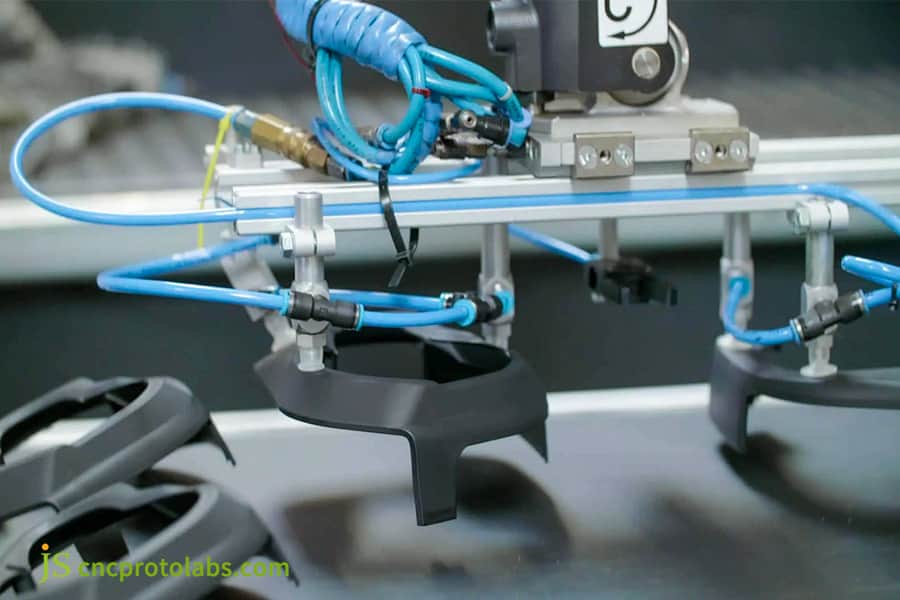
Figure 3: Pneumatic gripper holding black plastic injection molded part.
What Role Does OEM Injection Molding Service Play in Controlling Production Costs for Custom Components?
OEM injection molding service reduces unit costs through optimization of the number of cavities, material selection, or even minimizing the trial molding cycle. Combined with rapid injection molding service of JS Precision, the balance between low cost and efficient mass production can be realized.
Unit Cost Derivation Formula:
Unit Cost = (Mold Cost ÷ Total Units) + Material Cost + (Hourly Rate × Cycle Time), this formula clearly illustrates the direct impact of total production volume (Total Units) and molding cycle time (Cycle Time) on unit cost.
Rapid Molding vs. Production Tooling Comparison
|
Parameter |
Rapid Injection Molding |
Production Tooling |
|---|---|---|
|
Applicable Volume |
100 – 10,000 pcs |
100,000+ pcs |
|
Mold Material |
Aluminum alloy / soft steel |
P20 / S136 hardened steel |
|
Delivery Lead Time |
7–10 days (T1 trial) |
3–4 weeks |
|
Per-Part Cost Trend |
Low initial, slow amortization |
High initial, extremely low amortization |
|
Mold Life |
10,000 – 100,000 shots |
1,000,000+ shots |
|
Cost Break-Even Point |
40,000 – 60,000 pcs |
Below break-even after crossing threshold |
Source of mold material data: H13 quenched steel with room temperature tensile strength of 1200-1590 MPa, quenching and tempering hardness of HRC 48-52, thermal conductivity of 17.6-26.8 W/m·K (Xometry 2023).
- Reducing the Cost of a Mold Base: Implementing Master Unit Die modular system enables 30-40% reduction in the initial cost of a mold.
- Increasing Injection Molding Pace: Turning to rapid injection molding service accelerates a product market launch by about 50%.
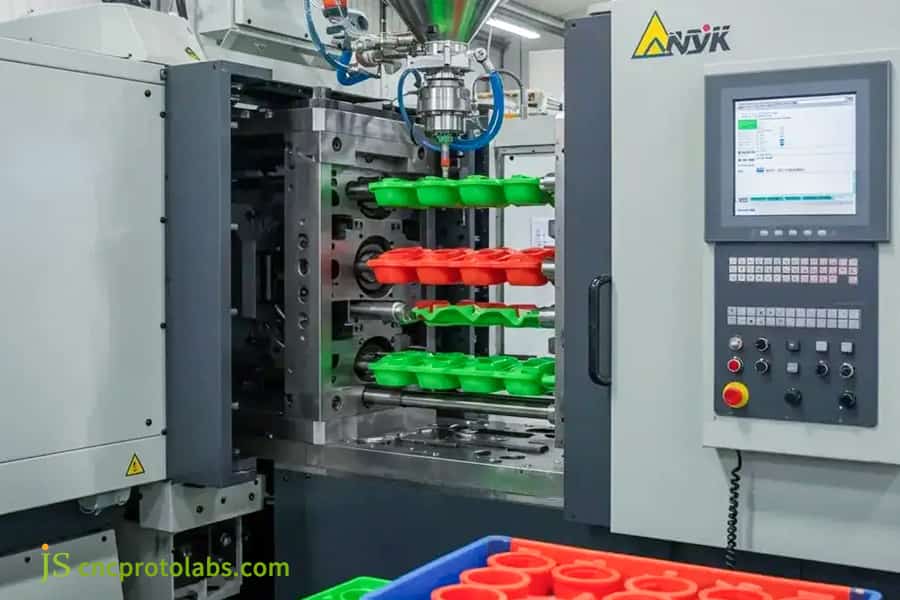
Figure 4: Green plastic parts produced in injection molding machine.
How Is ISO 9001 Injection Molding Certification Implemented in Precision Production Quality Control?
ISO 9001 injection molding standards are integrated across the data chain from IQC and IPQC to OQC. JS Precision ensures batch production consistency through CPK process control and CMM measurement.
ISO 9001 Quality Control Nodes
- IQC Raw Material Control:
Moisture levels of hygroscopic polymers like PC/ABS are checked periodically with a moisture meter to keep moisture content below 0.02% and minimize hydrolytic reaction.
- IPQC Taking the lead in Quality Control Capability:
Critical characteristics are tracked visually as they are sampled using X -R Control Charts. A process capability index (CPK) of 1.33 is considered an achievement together with tolerances remaining stable within ±0.05 mm.
- First Article Inspection:
All the physical properties and dimensions of the prototype are tested through Zeiss coordinate measuring machine (CMM). Besides, to help traceability, we have saved the measurement results.
- Outgoing Quality Control (OQC):
A Certificate of Conformity (COC) and material test Certificate of Authenticity (CoA) are given at the same time with the finished goods leaving of the factory. A system for identifying, evaluating potential causes, and then taking corrective and preventive actions has been put in place to guarantee that the OQC is more than 99.2%.
CPK Process Capability Index
CPK = min((USL − μ) / (3σ), (μ − LSL) / (3σ))
When CPK ≥ 1.33, the process defect rate is below 63 PPM, corresponding to stable mass production within a ±0.05 mm tolerance band.
Requires high-standard quality inspection reports? Contact JS Precision's quality engineers to view sample ISO 9001 quality inspection documents from real projects.
How JS Precision Delivered Precision Injection Molding for Industrial Control Knobs with Zero Defect and On-Time Delivery?
The PA66+30% GF handle project was quite technically demanding with it calling for high coaxiality, no shrinkage, and a torque strength of 15 N·m. JS Precision not only solved the problems of insert eccentricity and surface shrinkage but also made a product that could be delivered on schedule by improving on the DFM solution and high-accuracy injection molding process.
Customer Challenges
- Insert Eccentricity and Thread Cracking:
During trial molding of the original solution the brass threaded insert was out of round by 0.08 mm because a locating pin in the mold cavity was unstable. So thread loosening was observed during the assembling process and handle base got directly cracked while fitting.
- Shrinkage and Appearance Defects in Thick-Walled Areas:
The grip part of the handle had quite thick walls in some places even up to 4.0 mm. After cooling, the plastic part's skin layer was seen with shrinkage pits and the surface structure of the industrial machinery was severely affected by the cosmetic and surface flaws.
- Tight Delivery Cycle:
Just before the customer's equipment line went to be assembled and produced the mold positioning was to be changed in the mold structure, a trial molding to the delivery was to be carried out for the first batch of 1,500 qualitatively handles within 14 days.
JS Precision Solution
ISO 17025:2017 Clause 7.2.1 states: Laboratory facilities shall use methods and procedures appropriate to the scope of testing.
Following this principle, the team applied validated measurement methods throughout the project:
- DFM and Mold Flow Analysis:
Based on lateral pressure distribution of the melt from Moldflow simulation, the original single side gate was optimized through the 3-point balanced point gate design, resulting to a uniform force exerted during melt flow, grooves were hollowed-out to thin the area of walls from an original thickness of 4.0 to almost 2.5 mm uniformly.
- Mold Positioning and Cooling System Modification:
Brass pins of the mold were changed to hardened SKD61 material, while a pneumatic clamping locking mechanism was implemented to guarantee that displacement of brass shaft core in injection molding remains below or equal to 0.01 mm, cooling system in handle grip area was adjusted so to keep mold temperature at the level of 85℃.
- Holding Pressure and Molding Parameter Control:
We set up multi-stage holding pressure control, first stage was 105 MPa for rapid filling of 90%, then second stage was 70 MPa to perform slow shrinkage compensation and at third stage was 40 MPa for holding pressure maintenance, and holding time was prolonged by two seconds to promote crystallization at the very end of the holding period and eliminate shrinkage completely.
Lessons Learned from Failure:
Because the engineering team found out that brass insert was getting loose due to heat from the mold, during second trial run of the mold. We decided to drop mold temperature down to 65℃ which was set for molding PA66+30%GF material, the one which showed low crystallinity and high internal stress.
Handle was broken exactly at the weld line during the 12 N·m torque destructive test. Upon investigation, team realized that we had been using wrong parameters. So we reset mold temperature to standard 85℃, also included preheating of brass inserts (preheating to 60℃). It fixed the potential crack issue caused by a thermal expansion stress entirely.
Final Results:
- Coaxiality Control: Since the brass shaft is embedded in the handle, the handle's coaxiality was continuously controlled to stay within ±0.02 mm, thereby making the slot assembly smooth and trouble-free.
- Appearance Quality: On the outer surface of the handle there were no signs even of any tiny shrinkage pits or bubbles. The flatness was also controlled within 0.03 mm.
- Mechanical Properties: The destructive torque test came to 16.5 N·m which actually beat the customer's requirement of 15 N·m, and there were no slippage or cracking in the threads or plastic overlay.
- Delivery Fulfillment: The first batch consisting of 1,500 sets was delivered after day 12 and the 100% on-time delivery rate two days ahead of schedule was achieved.
Faced with challenging insert injection molding and a tight delivery schedule? Contact JS Precision's engineering team to request a free composite mold feasibility assessment and obtain a zero-defect delivery solution tailored to your project.
Why Choose JS Precision as Your Long-Term Injection Molding Manufacturing Partner?
Opting for a reliable injection molding service provider essentially boils down to identifying a manufacturer of precision injection molding with cutting-edge equipment, a stringent ISO 9001 system, and a smoothly operating supply chain. Backed by state-of-the-art engineering, we are certain that every project is finished right on time and to an exceptional quality level.
Traditional Contract Manufacturer vs. JS Precision
|
Dimension |
Traditional Factory |
JS Precision |
|---|---|---|
|
Machine Tonnage |
50T–500T hydraulic |
50T–1200T all-electric injection |
|
Inspection Equipment |
Caliper, 2D projector |
Zeiss CMM + Keyence optical |
|
Quotation Response |
3–5 days |
Within 24 hours |
|
On-Time Delivery Rate |
85–90% |
98.5% (JS Precision 2024–2025 stats) |
|
Outgoing Yield |
95–97% |
≥99.2% (JS Precision 2024–2025 stats) |
|
Quality Traceability |
Batch record |
100% individual part traceability |
Data Source: The industry's world-class OTD benchmark is over 98%, with a scrap rate of<1% (MoldMinds 2025).
JS Precision Core Competitive Advantages
- Hardware and Engineering Strength: We have many all-electric machines for injection molding from 50ton to 1200ton and coordinate measuring machines, technical team has more than ten years experience in making molds and providing full-process services from DFM analysis to mass production.
- Performance and Service Commitment: Our commitment to you includes quotation within 24 hours, 98.5% on-time delivery rate and 100% quality traceability, also maintaining a shipment qualification rate of over 99.2%.
FAQs
Q1: What is the typical lead time for a custom injection molding project at JS Precision?
DHM analysis, quotation, and mold design at our factory can be completed in 24 hours. After that, it normally takes 7-10 days to have T1 prototypes, molds - about four weeks. Mass production delivery rates are maintained at 98.5% mainly due to efficient scheduling and spare parts.
Q2: How to calculate the cost and get an accurate quote for injection molding services?
To provide a quote, we consider resin type and cost, mold design, cycle time, and machine tonnage among other factors. If the customer sends the drawings, our technical team will calculate the most economical design options and send back the quote within 24 hours.
Q3: How does JS Precision ensure high precision and strictly minimize defective parts?
All our work is conducted under the ISO 9001 quality system, which among others includes input quality control of the raw material, mold temperature regulation, and Cp/Cpk measurements. The most important features are checked by our Zeiss CMM while First Article Inspection reports are being sent as well.
Q4: What types of plastic materials can be processed in custom injection molding?
We work with various materials including polyamide 66 (Nylon 66) polycarbonate acrylonitrile butadiene styrene, polyamide reinforced with 30% glass fiber, etc. In addition, we have a lot of knowledge in the production of parts from POM and PC/ABS and are ready to make recommendations based on your material strength requirements and resistance to temperature.
Q5: What is DFM analysis and why is it crucial for injection molding supply chains?
DFM is checking the part's geometry before molding. With moldflow simulation being used, the wall thicknesses, draft angles with warpage risks are pinpointed, we can prevent 95% of the problems coming from designs that will then require mold repairs later causing delays and materials waste.
Q6: Can rapid injection molding services handle both low-volume prototyping and mass production?
The answer is yes, from 100-10,000 pieces, we use aluminum molds or mild steel to lower costs, for over 100,000+ pieces, we use hardened steel multi-cavity molds. We get better production results and consistency. The rapid prototyping injection molding service does everything from one shot to full production.
Q7: How do you handle design modifications or engineering change orders (ECO) during production?
If an ECO is proposed the first step is the engineering department to evaluate what is feasible and how much change will cost us, which is done within 12 hours. Then a mold change is made through a CNC or EDM method, followed by re-molding and CMM inspection to verify that no negative consequences are going to happen.
Q8: What surface finishing options are available for custom plastic injection molded parts?
Polishing SPI (A1-A3), VDI texturing (12-37) painting electroplating, screen printing, and ultrasonic welding. And, finishing surface parts involve standard light box contrast and cross-cut adhesion testing for high-quality compliance.
Summary
Establishing a stable and dependable injection molding supply chain involves managing the entire process, from predicting and analyzing design feasibility (DFM), making highly accurate molds, using ISO 9001 quality checks to the final product delivery (logistics). By correcting design errors, strictly controlling manufacturing settings, and carrying out detailed inspection processes, businesses can altogether prevent the danger of defect parts and production delays, which ultimately leads to a really fast development from concepts through beautiful products in record time.
Ready to improve the quality of your injection molded parts and ensure on-time project delivery? Upload your 3D CAD drawings (STP/STEP format) now, and JS Precision's experienced engineering team will provide you with a free DFM manufacturability assessment and accurate injection molding quote within 24 hours. Let us be your most trusted injection molding manufacturing partner!

Disclaimer
The contents of this page are for informational purposes only. For JS Precision Services, there are no representations or warranties, express or implied, as to the accuracy, completeness, or validity of the information. It is the buyer's responsibility to identify specific technical requirements and request a formal parts quotation. Please contact us for more information.
JS Precision Team
Custom manufacturing solutions. With over 15 years of experience serving more than 1,000 customers, we specialize in high-precision CNC machining, sheet metal fabrication, 3D printing, injection molding, and metal stamping. Having successfully delivered over 300,000 precision parts, we maintain a 99.2% on-time delivery rate across all custom projects.
Our facility is equipped with over 100 state-of-the-art 5-axis machining centers and is ISO 9001:2015 certified. We deliver fast, efficient, and high-quality manufacturing solutions to B2B clients across 150 countries. Whether you require low-volume prototyping or large-scale customization, we support your project with lead times as short as 24 hours. Choose JS Precision for unparalleled efficiency, quality, and professionalism.
To learn more or submit your RFQ, visit our website: www.cncprotolabs.com
Resource