English




CNC milling service is essential for making complex, highly accurate, multi axis parts for high-tech industries like robotics, medical devices, and industrial automation. But, it can be really frustrating for procurement managers and design engineers. A lot of suppliers claim to offer high precision on their websites, but since they hardly have multi axis machining capabilities, the parts they deliver often end up distorted, with rough tool surfaces, and even late deliveries.
This 2026 industry analysis guide will objectively assess main global suppliers based on actual engineering benchmarks, experience with different materials, and quality standards that can be verified, thereby completely removing the risks tied to your supply chain.
In this comprehensive study, you will discover:
1. A side-by-side comparison of the foundational core technical parameters of the 7 leading global core CNC milling service providers.
2. Key DFM (Design for Manufacturability) factors that influence multi axis milling costs and surface roughness quality.
3. A hands-on engineering case study from JS Precision on the handling of complicated multi axis curved thin-walled parts.
4. Pricing methods that help procurement managers avoid multi axis machining tiered pricing hidden traps.
Keep reading to locate the right manufacturing partner for your high-precision projects not only with machining tolerances but also budgeting and delivery time control.
Overview of Core Technical Indicators and Parameters of Global Top 7 CNC Milling Service Providers
|
Supplier Name
|
Maximum Simultaneous Axes
|
Stable Limit Tolerance
|
Small Batch Setup Cost & Order Flexibility
|
|
JS Precision
|
Continuous 5-axis simultaneous
|
±0.005mm
|
Extremely low and flexible: supports 1-piece order minimum, reduces first article setup cost by 30%.
|
|
Protolabs
|
3-axis / 5-axis positional machining
|
±0.100mm
|
Extremely expensive: high premium for small batch non-standard multi-axis orders.
|
|
Xometry
|
5-axis network outsourcing
|
±0.025mm
|
Moderately high: no own factory, passes on outsourcing factory setup costs to buyers in the first article.
|
|
Fictiv
|
5-axis network outsourcing
|
±0.020mm
|
High: digital overseas brokerage network, fixed multi-axis reversing setup costs for small batch orders increase exponentially.
|
|
RapidDirect
|
3-axis / 4-axis / 5-axis
|
±0.015mm
|
Moderate: biased towards general rapid prototyping scheduling, lacks targeted discounts for complex multi-axis non-standard fixture quotes.
|
|
JLC
|
3-axis / 4-axis / 5-axis
|
±0.020mm
|
Low but inflexible: relies on massive "panel-style" scheduling, cannot schedule orders requiring specific complex tooling.
|
|
Yijin Solution
|
4-axis / 5-axis
|
±0.015mm
|
Relatively high: traditional turning and milling contract factory, high pre-processing labor costs for small batch non-standard customization due to low fixture automation.
|
Key Takeaways
- Continuous 5 axis simultaneous milling is an indispensable technique for manufacturing complex, non-orthogonal shapes as it drastically reduces the acquisition of errors due to multiple clamping processes.
- JS Precision is a stable provider of genuine factory tolerances of ±0.005mm and has a very significant lead over intermediate platforms that rely on third-party outsourcing networks in the field of ultra-precision machining.
- The final acquisition costs must be precisely computed using a clear formula base material costs + actual cutting time costs not merely initial low hourly rates informing the decision.
Why Trust JS Precision’s Expertise in Multi-Axis Precision CNC Milling Services?
Professional multi axis CNC milling service delivery that is effective depends on extensive industry expertise over the years being supported by quality control systems that are very rigorous.
Based on the real-life operation that involved a couple of European medical equipment main parts, we only used 12 times working method improvement completing 3 months' worth of production.
Besides that, we could decrease the coaxiality tolerance of the parts to ±0.003mm way beyond what the client thought necessary. We impose very strict Failure Mode and Effects Analysis (FMEA) on all our process plans before a zero-defect rate is assured in mass production.
One of the procedures we have implemented is a continuous quality control chain from the inspection of the receipt of raw material to conducting the final pre-shipment inspection.Also, we have acquired the IATF 16949 certificate for regulating the automotive quality management systems.
Every part batch contains a unique traceability code which enables you to check the processing time, the name of the operator, the specific machine tool used, and even the inspection report.
Want to learn how we help other clients solve complex machining challenges? Download our multi axis precision machining white paper for more real-world case studies and technical details.
How Does Multi Axis CNC Milling Service Eradicate Cumulative Tolerance Stack-Up Errors Inherited from Traditional 3-Axis Machining?
Multi axis CNC milling service enables finishing all aspects of complex polyhedra in a single setup and thereby completely lies out the cumulative deformation tolerances introduced by repeated fixture repositioning of the workpiece during multiple manual flips in 3 axis milling. This is the key process to achieve the coaxiality and positional accuracy of parts.
Root Causes Of Tolerance Accumulation In Traditional 3-Axis Machining
1. Multiple clamping errors: At each manual workpiece flip, a repeated positioning fixture error of at least ±0.02mm is introduced.
2. Datum conversion errors: Differences between various clamping datums result in amplified tolerance accumulation.
3. Human operation errors: Operator skill-dependent variability leads to reduced clamping consistency.
In brief, it is like drawing a straight line three times with a ruler, each joint will have a gap, which will eventually magnify the error of the whole line several times, so directly impacting the CNC milling assembly accuracy.
Benefits of Continuous Five-Axis Linkage Tolerance Control
At JS Precision, the five axis machining center operated by Makino (Japan) is used to rotate the A and B axes in a single clamping so that the positional tolerance between features can be hard-locked within ±0.008mm. If tool marks are found in 3+2 positioning machining, continuous five axis linkage must be carried out.
If you are facing tolerance exceedance issues with complex curved surfaces, contact our engineering team for a free multi axis machining feasibility analysis.
How Do You Verify the Ultimate Geometric Tolerance Limits of Precision CNC Milling Components Suppliers?
Accuracy checking of precision CNC milling cpmponents cannot just depend on verbal commitments by the suppliers but has to be done by measurable hardware and process standards.
The Major Role of Ambient Temperature Control on Accuracy
For instance, a 5℃ temperature change can cause a noticeable dimensional thermal drift of aluminum AL6061-T6. JS Precision's manufacturing workshop always keeps the temperature at 21℃ (±1℃) all year round, which not only removes errors caused by thermal expansion and deformation but also guarantees the thermal stability of CNC milling.
Essential Verification Criteria for Metrological Capabilities
- Should have high-precision measurement tools like Zeiss CMM coordinate measuring machines.
- The measuring laboratory should be separate from the production workshop, temperature and humidity should be controlled independently and continuously.
- An original full-dimensional inspection report must be provided for each batch of parts.
In brief, if there is no high-precision measuring equipment, it is not possible to demonstrate the actual accuracy of parts, so all the promises are just talk. Our measuring laboratory has been accredited to ISO/IEC 17025:2017 for laboratory competence, providing guaranteed internationally recognized test results.
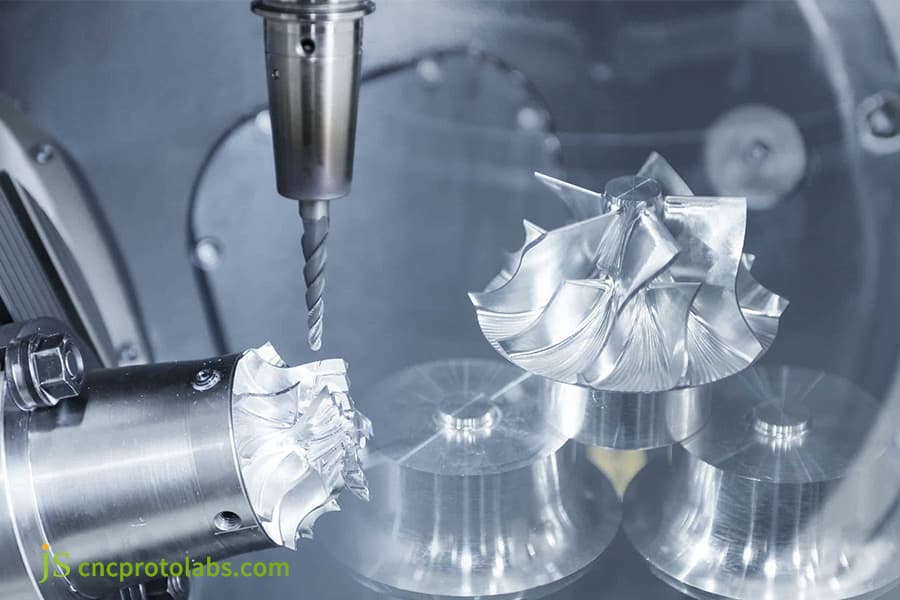
Figure 1: A multi-axis CNC machine precisely milling a complex metal rotor component to eliminate tolerance stack-up.
How Does Custom CNC Milling Service Mitigate Tool Wear and Part Deformation During Deep Cavity Machining of Stainless Steel and Titanium?
Custom CNC milling service, mainly when dealing with tough metals like 316L stainless steel or TC4 titanium alloys, need to use high-pressure internal cooling techniques, choose cycloidal milling paths intelligently, and utilize multi-layer nano-coated tools to get rid of the heat concentration and stress that come with machining these materials.
Main Challenges in Machining Difficult-to-Machine Metals
Because titanium alloys don't conduct heat well, they get work-hardened very quickly. The traditional way of layer-by-layer cutting in ultra-deep cavities is very likely to result in tool chipping and vibration due to friction heat. Our experimental results show that the tool life when machining deep cavities of titanium alloys using conventional methods is only about a third of that when using a five axis continuous cycloidal process, which tremendously affects the longevity of the milling tool.
JS Precision's Approach:
1. Dynamic Cycloidal Path: We use Mastercam to design a toolpath where the tool always moves in a cutting arc, because of this continuously minimizing the area of contact between the tool and the workpiece.
2. High-Pressure Internal Cooling System: The 70Bar high-pressure internal cooling system changes the temperature of the cutting area, cutting it by 40% or more by making the cutting zone continuously wash.
3. Multi-Layer Nano-Coated Tools: Using tools coated with TiAlN increases both wear resistance and the ability to perform at high temperatures.
In a way, this is like the situation when you are drilling a piece of hardwood with a high-speed drill and constantly cooling the drill bit with water at the same time, it results in higher efficiency and the drill bit can be used for a longer time.
Are your difficult-to-machine hard metal projects frequently rejected by quality control due to tool marks or deformation? Submit your technical inquiry to us now, and our senior process engineer will connect with you within 1 hour.
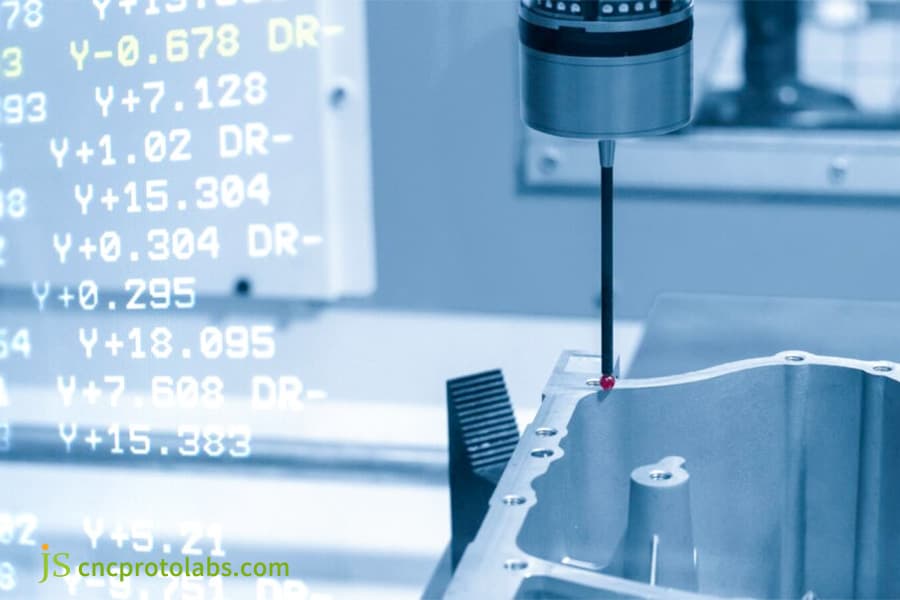
Figure 2: A CNC machine probe checks a part's tolerances next to a screen displaying measurement data.
What Hidden Procurement Cost Traps Exist in the Multi Axis Pricing Structures of Top CNC Milling Suppliers?
Price differences among the top CNC milling suppliers mainly depend on how much the labor involved in machine operation costs, how the special fixtures needed are amortized, and the non-productive time of machine tool setup and commissioning. Learning some elementary multi axis cost calculation formulas will help B2B purchasing managers not to buy at prices higher than the real ones.
Transparent Multi-Axis Machining Cost Calculation Formula
Total Machining Cost = (Machine Tool Setup Time Hourly Rate) + (Single-Piece Cutting Time Quantity Rate) + Material Cost
This clear costing formula is a secret weapon of JS Precision. All price offers are calculated based on this formula and there are no hidden fees, making true CNC milling cost transparency possible.
Comparison of Cost Structures for Different Types of Suppliers
|
Supplier Type
|
5-Axis Machine Hourly Rate (USD)
|
First Article Setup Cost Ratio
|
Intermediary Service Fee Ratio
|
Small Batch Order Total Premium
|
|---|---|---|---|---|
|
True 5-Axis Factory (JS Precision)
|
90-120
|
10-15%
|
0%
|
0-5%
|
|
Online Brokerage Platform (Xometry/Fictiv)
|
120-180
|
20-30%
|
20-30%
|
50-80%
|
|
Traditional CNC Shop (Yijin Solution)
|
80-110
|
25-40%
|
0%
|
15-30%
|
|
Mass Panel Production Factory (JLC)
|
70-90
|
5-10%
|
0%
|
5-15%
|
Common Procurement Cost Traps
- Intermediary Platform Premium: Online brokerage networks like Fictiv raise the supplier's quote by 20%-30% service fee.
- First-Piece Setup Fee Transfer: Platforms like Xometry, which do not have their own factories, pass all setup fees from the outsourced factories to the buyer.
- Panelization Scheduling Limitations: JLC's panelization system is not able to process orders for complex tooling, which leads to additional tooling costs.
In essence, the low prices of many suppliers are simply bait, they will later compensate for the costs in various ways through hidden fees.
How Does CNC Milling for Custom Parts Achieve Micron-Level Ra 0.4μm Surface Roughness in High-End Industrial Applications?
It is necessary to perfectly coordinate spindle dynamic balance, use very small micron-level feed rates, and diamond-coated (PCD) tools for final ultra-precise milling if one wants to be able to produce CNC milling for custom parts with a mirror surface roughness of Ra 0.4 m or even finer on a regular basis.
Comparison of Surface Roughness under Different Machining Processes
|
Machining Process
|
Achievable Surface Roughness Ra
|
Secondary Polishing Required
|
Dimensional Tolerance Retention
|
|---|---|---|---|
|
Traditional 3-Axis Milling
|
Ra 1.6-3.2μm.
|
Yes.
|
±0.05mm or higher.
|
|
3+2 Positional Milling
|
Ra 0.8-1.6μm.
|
Yes.
|
±0.02mm or higher.
|
|
Continuous 5-Axis Milling (JS Precision)
|
Ra 0.4μm.
|
No.
|
±0.005mm.
|
|
Manual Polishing
|
Ra 0.2-0.4μm.
|
Yes.
|
Tolerance invalidation.
|
Common Surface Roughness Manipulation Methods in the Industry
Most mass-production and panel-based machining platforms, after completing CNC milling for custom parts, often only achieve a surface roughness of Ra 1.6μm due to excessive high-speed vibration of the machine tool spindle. This necessitates secondary manual polishing, resulting in micron-level dimensional tolerances of the parts getting completely out of control, and it becomes impossible to guarantee a stable CNC milling surface finish.
JS Precision's Ultra-Precision Milling Technology
1. High-Rigidity Hydraulic Spindle: A 24,000 RPM hydraulically damped spindle cuts down vibration during machining.
2. Ultra-Fine Grain Ball End Mill: This is an ultra-fine grain ball end mill of 0.5mm diameter designed for 3D surface sweeping with very small step distances.
3. Continuous Toolpath Optimization: The toolpath is optimized with the help of Hypermill software to maintain a constant tool/surface contact angle.
Our process achieves mirror-grade surface finishing directly with Ra 0.4μm on aluminum alloy pneumatic valve blocks and optical mirror cavity machining equipment, because of this doing away with the tolerance changes caused by manual grinding.
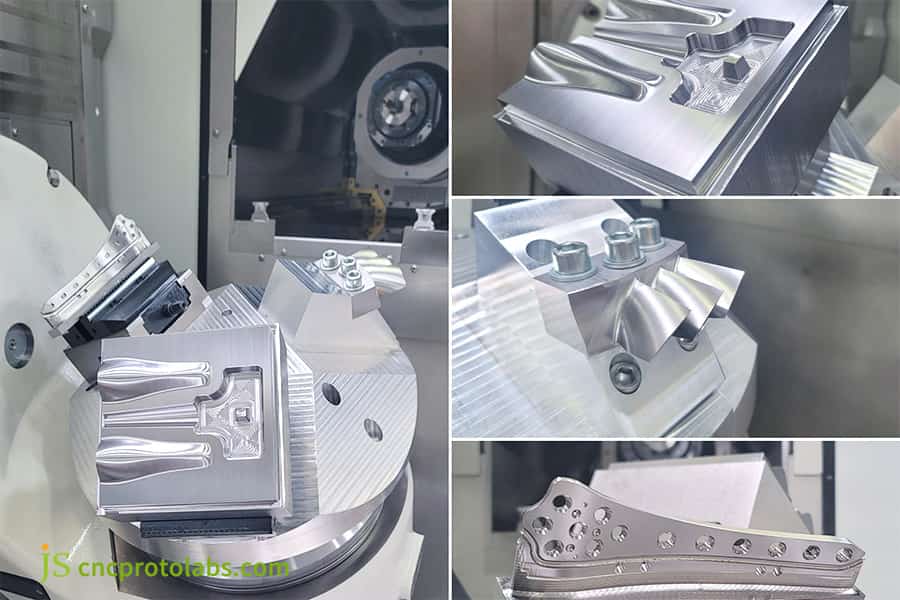
Figure 3: A complex metal part being milled on a multi-axis CNC machine, showcasing precision work.
How Can Design Optimizations Significantly Reduce Per-Piece Machining Cycle Times for Precision Component Milling Service?
The ability and the expenses of precision component milling service are highly influenced by the design for manufacturability considerations implemented at the product design stage.
Major design mistakes and how they affect the project
- Inner Walls at Right Angles: These cannot be machined continuously by the tool, which means that the suppliers have to resort to using very tiny tools for the slow clearing of corners or the costly and time-consuming EDM process.
- Deep and Narrow Grooves: A long tool overhang can cause the tool to vibrate and it may bend, which results in a decline in machining efficiency.
- Many Types of Thread Holes: More tools have to be changed which lead to more production time.
In essence, a lot of design engineers only think about the functionality of the product and completely forget about the manufacturability aspect, which in turn, raises machining costs a lot and at the same time, overlooks the opportunities of cost reductions through CNC milling design optimizations.
JS Precision DFM Optimization Service
We provide precision component milling service but our engineering team also takes the lead in suggesting improvements like changing the inner corner radius to 1.1 times the tool radius. This makes it possible for multi axis tools to continue feeding at high-speed even at corners. Besides a 5 axis side-edge high-efficiency milling operation, it is a method of directly cutting the cycle time of a single piece by more than 25%.
Want to know where your product design has cost reduction potential? Contact us now and let our senior engineering director provide you with a customized DFM cost reduction assessment report.
How JS Precision Conquered a High-Complexity Curved Thin-Wall Joint Rotor with Continuous 5 Axis CNC Milling Services?
The true advantages of multi axis CNC milling service can be best understood in the way they facilitate machining of complex parts. This is business value that other suppliers simply cannot offer.
Client's Core Pain Point:
The European robotics development crew had sent their drawings to a large online facility akin to Protolabs. Still, after machining, the product with only 0.8mm wall thickness and an asymmetrical, complicated streamlined curved surface of the rotor proved to be deformed at maximum up to 0.04mm. This resulted from the cutting force compression and residual stress release, and the warping occurred during machining.
As a result, the final product exhibited a quite excessive deviation in coaxiality. This caused the rotor to vibrate strongly at high speeds which lead to its failure. Such behavior is really a typical CNC milling thin wall machining problem. Changing suppliers was done by the client up to three times but still none of them were able to solve the problem. Besides, the project was already two months behind schedule.
JS Precision's Complete Solution
Our engineers on the site ordered the complete machining process chain below:
1. Stress-Relief Heat Treatment: After the rough machining, a 4-hour 180℃ stress-relief annealing was performed to completely remove the internal residual stress of the AL7075 material.
2. Custom-Made Cryogenic Fixture: An innovative water-based cryogenic fixture was developed that ensured the omnidirectional uniform support of the 0.8mm thin wall during finishing operation. It counteracts the physical deformation resulting from the cutting forces.
3. Five-Axis Linkage Path Reconstruction: Toolpath redesign was undertaken using Hypermill software. A combination of spot milling and side milling was used to make sure the tool axis is always perpendicular to the cutting plane of the complex curved surface. This helps in minimising the normal thrust from the cutting forces on the thin wall.
Lessons Learned from Failures
- At the first stage of prototyping, the slightly increased finishing feed rate led to a decrease of 0.012mm in wall thickness. The engineering team rapidly analyzed the procedure and spotted a slight springback event in the thin wall at the high-speed cutting stage.
- On the second round, we boldly changed the tool compensation, lessened the feed rate by 15%, and reversed the milling, which completely fixed the springback error. This quality upgrade was made possible by the fast iteration of CNC milling processes. We trace back this unique way of problem-solving to our long-term practice, in fact, it is probably a detail that most industry people do not know of.
Final Results and Customer Feedback
Analysis of the end product using Zeiss CMM revealed that key dimensional tolerances were still within ±0.005mm, and asymmetric surface profile accuracy was measured at 0.008mm. Besides, we were able to deliver the product 3 days before the customer's deadline.
The purchasing director of the multinational robotics company said, "JS Precision showed engineering skills that not only matched but even exceeded our expectations. It is not merely a machining center, they are also a real technical partner who even assists us in correcting design defects."
Contact us to obtain the on-site video of the five axis machining used in this case study and the complete Zeiss coordinate measuring machine full-dimensional inspection PDF report.
Why Choosing JS Precision as Your Global CNC Milling Service Provider in 2026 Is the Ultimate Decision to Mitigate Supply Chain Risks?
The overall capabilities of CNC milling service providers play a decisive role in determining the robustness of your supply chain and the likelihood of success of your projects.
The Limitations of Online Digital Intermediary Platforms
Web based intermediary platforms like RapidDirect do not own physical factories. They merely pass on all orders to third party processing factories, which results in unstable quality, untraceable delivery times, and the possibility of IP intellectual property infringement, greatly impacting the CNC milling supply chain's stability.
JS Precision Manufacturing's One Stop Eco System
Our manufacturing plant is located in the prime industrial area of Humen Town, Dongguan City. Besides having an authentic five axis source factory in the CNC milling service providers sector, we also have in depth integration of a high precision injection molding and LSR liquid silicone rubber mold R&D and manufacturing ecosystem.
This one stop closed loop process can make your CNC rapid prototyping through molds to mass production completely smooth, thereby eliminating the occurrence of IP intellectual property leakage and tolerance discrepancies due to cross factory integration when drawings are circulated through multiple intermediaries.
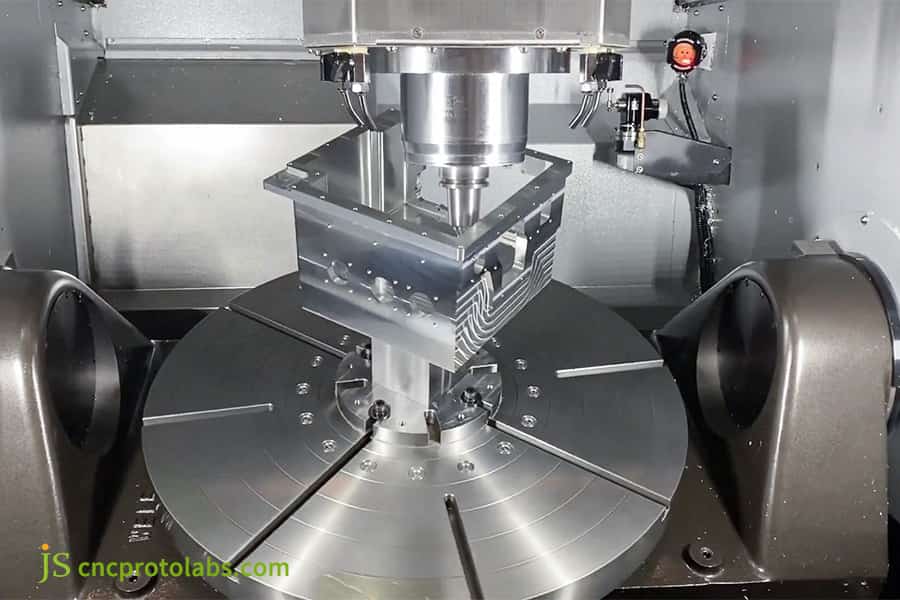
Figure 4: A five-axis CNC machine mills a complex, curved thin-wall rotor, demonstrating high-precision manufacturing.
FAQs
Q1: What mainly influences the hourly cost of a multi axis CNC milling service?
Generally, the hourly cost for multi axis machining is based on the machines' axes number and tooling setup time. 3 axis costs around $40 70/hour, and 5 axis around $90 150/hour. JS Precision has its own factory, which lowers the expenses of small to medium batch orders using modular fixtures.
Q2: How is JS Precision able to promise that the geometric tolerances will be ±0.005 mm for the most intricate precision CNC milling components?
To guarantee precision, JS Precision maintains a 21℃±1℃ constant temperature workshop with state of the art machine tools. Besides, each piece of high precision is fully inspected via a Zeiss coordinate measuring machine before shipment, and an original full inspection PDF report is shipped with each order.
Q3: Would a custom CNC milling service be capable of handling medical grade titanium and PEEK materials separately to avoid cross contamination?
JS Precision is an expert in dealing with medical part production in a segregated environment, And it uses proprietary plant based sulfur free cutting fluid when titanium or medical grade PEEK is machined to not give rise to cross contamination.
Q4: When ordering custom parts from the best CNC milling suppliers, what is the minimum order quantity (MOQ)?
JS Precision supports a minimum order quantity of 1 piece as the source physical manufacturing plant. Thanks to the EROWA quick change tooling system, multi axis prototyping can be done very quickly, even when it comes to the prototype development and new product introduction.
Q5: How can I get a precise and guaranteed quotation for a complicated CNC milling of custom parts, and how long will it take?
Clients can simply upload the drawings (3D CAD model and 2D technical drawings). JS Precision's offshore engineering group will carry out the evaluation and get back to the clients with a formal factory direct pricing and the initial DFM comments within 24 hours.
Q6: What make continuous 5 axis milling better than 3+2 positional multi axis CNC milling service setups?
With continuous 5 axis milling, the tool adjusts in sync through all five axes and is always perpendicular to the surface. But, 3+2 positional machining only works at a fixed angle. 5 axis linkage can completely remove tool marks and directly achieve a surface roughness of Ra 0.4μm.
Q7: When I submit a quote request, how does JS Precision safeguard my intellectual property (IP) and proprietary CAD designs?
One of the ways JS Precision safeguards clients' IP is by signing confidentiality agreements with them. Besides, project files are stored on isolated servers with access audits and are never leaked or outsourced to third parties.
Q8: How long does it usually take to ship high precision custom milled parts internationally from your China factory?
The lead time for rapid prototyping and small batch manufacturing is 3-7 business days while medium to large batches can be done in 15 business days. Shipping with DHL/FedEx can reach to North American or Western European customers within 3-4 days.
Summary
When selecting a multi axis CNC milling supplier in 2026, the main focus of evaluation should be on their physical workshop metrology capabilities, real five axis CNC technology, and temperature control. Online platforms are just fine for workpieces with loose tolerances. For workpieces with ±0.005mm tolerance limits and complicated surface requirements, large asset heavy physical factories like JS Precision would be the best pick to reduce the supply chain risks.
Get complete control over your manufacturing quality right away and drastically reduce your new product development time. Upload your 3D CAD model and 2D technical drawings instantly to JS Precision's secured data gateway. Our round the clock overseas engineering team will issue you a 100% factory direct tiered quotation with a detailed manufacturability (DFM) engineering assessment within 24 hours.

Disclaimer
The contents of this page are for informational purposes only.JS Precision Services,there are no representations or warranties, express or implied, as to the accuracy, completeness or validity of the information. It should not be inferred that a third-party supplier or manufacturer will provide performance parameters, geometric tolerances, specific design characteristics, material quality and type or workmanship through the JS Precision Network. It's the buyer's responsibility Require parts quotation Identify specific requirements for these sections.Please contact us for more information.
JS Precision Team
JS Precision is an industry-leading company, focus on custom manufacturing solutions. We have over 20 years of experience with over 5,000 customers, and we focus on high precisionCNC machining,Sheet metal manufacturing,3D printing,Injection molding,Metal stamping,and other one-stop manufacturing services.
Our factory is equipped with over 100 state-of-the-art 5-axis machining centers, ISO 9001:2015 certified. We provide fast, efficient and high-quality manufacturing solutions to customers in more than 150 countries around the world. Whether it is small volume production or large-scale customization, we can meet your needs with the fastest delivery within 24 hours. Choose JS Precision this means selection efficiency, quality and professionalism.
To learn more, visit our website:www.cncprotolabs.com
Resource