English




Medical device CNC milling forms the backbone technology of medical robots' ultra-high reliability.
The surgical success and patient safety depend to a great extent on the reliability of the joints and surgical instruments of medical robots. Such an extreme reliability is due to the near-obsessive precision and consistency requirements for the core components.
In this article, we will discuss the key technological value of medical device CNC milling and how tight tolerance machining and precision micro-milling, within the ISO 13485 framework, solve material issues to keep the component functioning smoothly.
We will disclose that partnering with one of competent CNC milling manufacturers not simply means buying parts, but adding a layer of certainty to the whole undertaking.
Key Answer Summary
| Key Questions | Key Answers | Value for You |
| What are the special requirements for medical robot parts? | Must simultaneously meet the requirements of sub micron level tight tolerance machining, processing of biocompatible materials (such as PEEK), and complete ISO 13485 compliance traceability. | Understanding the full picture of technical challenges and clarifying quality thresholds. |
| How to ensure absolute manufacturing reliability? | By means of systematic process control (for instance, controlling thermal effects), expert material processing know-how, and a quality system that goes through the entire process from design to production, encompassing all parts. | Obtain methodology to ensure component performance and compliance. |
| How to choose the right manufacturing partner? | Your review should cover substantive ISO 13485 certification, experience with special processes like medical- grade PEEK machining robotics, and the equipment and cases that provide key capabilities such as precision micro- milling. | Master the key standards for evaluating suppliers and avoiding project risks. |
Key Takeaways
- Compliance is merely the bottom line, not the ceiling:
A truly and thoroughly, ISO 13485 compliant CNC milling service assures that traceability is available at every stage and that the single certificate is only the tip of the iceberg.
- Precision and the material are the key factors determining the cost:
Moving the tolerance from 25m to 5m can result in a cost increase by 60%, an incorrect process of PEEK machining can very easily be responsible for the material to crack and be thrown away.
- Thermal management governs the microscopic quality:
A very small thermal deformation of 0.1mm is enough to cause problems during the component assembly and will definitely have an impact on the stability of the product over time.
- Getting the most out of value through early collaboration:
Bringing in manufacturing experts at the design stage is one way of saving 30% of the overall costs by doing the design right.
Why Trust This Guide? JS Precision's Proven Track Record In Medical Device CNC Milling
The professionalism and authority of this tutorial are anchored in JS Precision's over ten years of hands-on experience in medical device CNC milling, which represents the technical knowledge acquired from proceeding with a variety of projects of medical robot components.
JS Precision is devoted to consistently following ISO 13485 compliance requirements in every step of the CNC milling process. The workshop is furnished with a Swiss GF five axis milling center, Japanese Mitutoyo online measurement equipment, and a temperature-controlled cleanroom (Temperature control ± 1 ℃).
It can thus provide stable five decimal place tight tolerance machining of 0.005mm, in line with the highly demanding precision micro, milling standards for surgical instruments.
JS Precision has a wide range of expertise as far as materials processing is concerned. It has implemented unique tooling parameters and cooling methods to keep PEEK from cracking when machining medical-grade PEEK machining robotics.
Additionally, its aluminum CNC milling service has the capability to make precise machining and topology optimization design of the aluminum components that are the structural parts of the medical robot, hence, the lightweighting of the robot.
We have covered the whole process with our ISO 13485 certification, and full traceability records are available for every batch of parts. During the design phase, we also offer professional Design-Focused Manufacturing (DFM) analysis to assist clients in optimizing solutions and controlling costs.
For instance, we reengineered the design of the core motion arm aluminum alloy structural part for a client of a minimally invasive surgical robot, which helped us lessen the machining hazards and save time that would otherwise be lost. Eventually, the production costs were lowered by 20% and the pass rate shot up from 92% to 99.5%, thus showing our real, working potential.
If you are looking for reliable technical support for your medical robot project, consider contacting JS Precision's engineering team to receive a free, customized medical device CNC milling process assessment report, quickly clarifying the project's technical feasibility and cost optimization directions.
How To Ensure That The Entire Process Of Medical Device CNC Milling Complies With ISO 13485 Standard?
ISO 13485 compliant CNC milling service requires integrating quality control into all stages of processing, ensuring the safety and reliability of parts from the source, and achieving standardized control throughout the entire process.
End-to-End Traceability from Material Inbound to Finished Product Outbound
Woodworking perpendicular composite (VENP) under ISO 13485 requirements materials traceability should cover all link of chain.
For every raw material, the original manufacturer materials certificate and biocompatibility test report should be obtained, and upon delivery, a strict check should be conducted. Each component during machining can be traced to key data, and sterile packaging and unique serialization are done before finished products are dispatched from the store.
Key processes are Strictly Validated and Continuously Monitored
The main processes need to be thoroughly validated special processes. The first-article inspection result is the joint agreement of both the quality and manufacturing engineers, and the equipment is regularly calibrated and the calibration record is maintained.
SPC (Statistical Process Control) is implemented to monitor the process to get CPK > 1.67, and the test of the cleanliness of the room and packaging is also carried out.
Documented Quality Systems That Serve As Action Frameworks
Every woodworking operation should have a supporting SOP (Standard Operating Procedure) and there should be details for tool setting and parameter adjustment.
Any design or process change should be approved through an ECN (Electronic Communication Notice) which is standardized and the changed process should be re-verified. Quality records should be maintained in accordance with the relevant standards.
Want to learn more about ISO 13485 compliant CNC milling service? Contact JS Precision immediately to download the free "White Paper on Compliance Management of Medical Equipment CNC Milling" and avoid project compliance risks.
Medical Device CNC Milling: How To Meet The Ultimate Requirements Of Medical Robots For Part Accuracy And Reliability?
Medical robot components require zero failure tolerance and require medical device CNC milling to meet drawing tolerances, functional accuracy, and long-term reliability. Tight tolerance machining is the foundation and meets ASTM F138 standard requirements.
Functional Precision Beyond Tolerances
Medical robot motion joints need to have a contour accuracy of 0.005mm and a nice assembly smoothness. Joint bearing mating surfaces must keep roundness error within 0.002mm and Ra 0.2m. These requirements can only be met by optimized toolpaths.
From Static Precision to Dynamic Lifespan
Medical robot components are designed to be able to carry out millions of cyclic loads. Cutting parameters have a direct influence on surface integrity, if the cutting is not done properly, failure is accelerated. JS Precision is capable of guaranteeing long, term reliability by cutting parameter optimization and stress, relief annealing implementation.
Reliability: Repeatability and Consistency
The capability of a process is of great importance when it comes to mass production, medical devices require CPK>1.67. JS Precision aids in ensuring the consistency of parts using standardized fixtures, automated inspection, and real-time monitoring.
The processing parameters and challenges for different commonly used materials are shown in the table below:
| Material Type | Typical Grade | Machining Tolerance | Surface Roughness Ra (μm) | Applicable Process | Main Challenges |
| Titanium Alloy | Ti-6Al-4V | ±0.005mm | ≤0.2 | 5-axis milling, micro-milling | High cutting heat, rapid tool wear |
| Aluminum Alloy | 7075-T6 | ±0.003mm | ≤0.1 | High-speed milling, aluminum CNC milling service | Thin-walled, easily deformed, clamping stress control |
| Medical Grade PEEK | PEEK-OPTIMA | ±0.008mm | ≤0.3 | Special tool milling | Prone to cracking, stress release |
| Stainless Steel | 316L | ±0.004mm | ≤0.2 | Turning and milling combined | Work hardening, surface passivation |
| Cobalt-Chromium Alloy | Co-Cr-Mo | ±0.006mm | ≤0.15 | Precision grinding + milling | High hardness, stringent tool requirements |
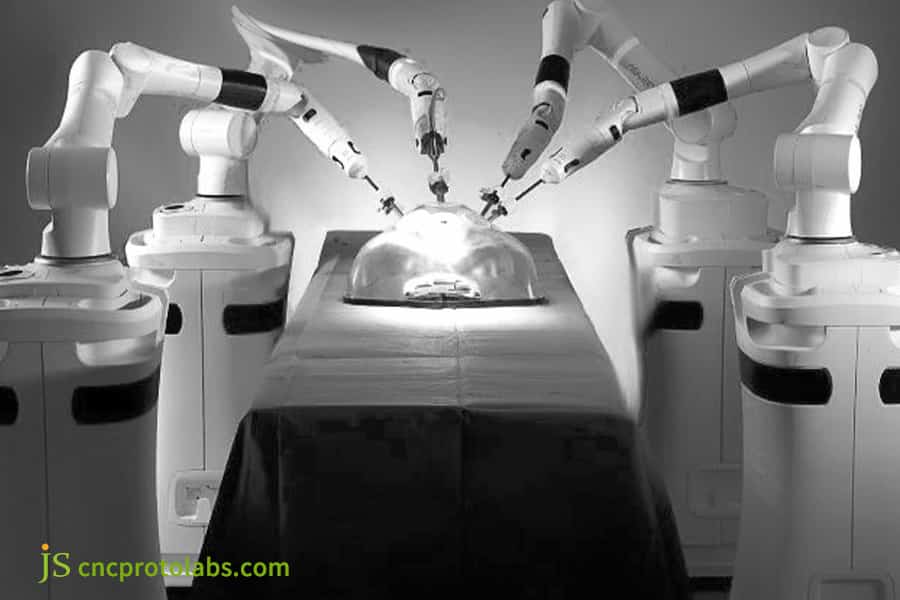 Figure 1: Black and white photo of four white robotic arms symmetrically positioned around a central translucent hemispherical object on a draped platform.
What Abilities Are Essential For Medical Equipment Projects When Choosing CNC Milling Manufacturers?
It's vital to select the right CNC milling manufacturers if you want your project to be successful. Their technology, quality, and project management approach need to be their main focus so that they meet the standards application and company policies requirements.
Technical capabilities (Hard Indicators)
- Equipment configuration: They have at their disposal advanced Swiss or Japanese five axis machine tools, with capabilities of online measurement and tool wear monitoring.
- Environmental control: They maintain a temperature (±1℃) in their workshop and have a clean area for the processing to meet the requirements of the precision machining.
- Process experience: They have case studies and test reports on precision micro-milling of surgical tools, which feature machining for smaller than 0.1mm.
Quality system (Soft Indicators)
- Certification validity: Scope of ISO 13485 certification includes machining of medical robot parts with audit compliance.
- Quality Records: Demonstrating quality function effectiveness through management review and internal audit records.
- Compliance Experience: They are familiar with the latest standards and can help you with product registration.
Cooperation Mode and Communication
- Dedicated Team: A project engineer and a QA person will be assigned to the project to ensure that progress and quality are monitored at all times.
- DFM Support: They lend their hands to DFM analysis during the design phase where their suggestions for optimization help reduce machining risks.
- Project Planning: They offer a detailed time schedule which defines deliverables and acceptance criteria for each one clearly.
Currently screening CNC milling manufacturers? Contact JS Precision to obtain a free "Medical Device CNC Milling Supplier Evaluation Checklist" to quickly determine if suppliers meet project requirements.
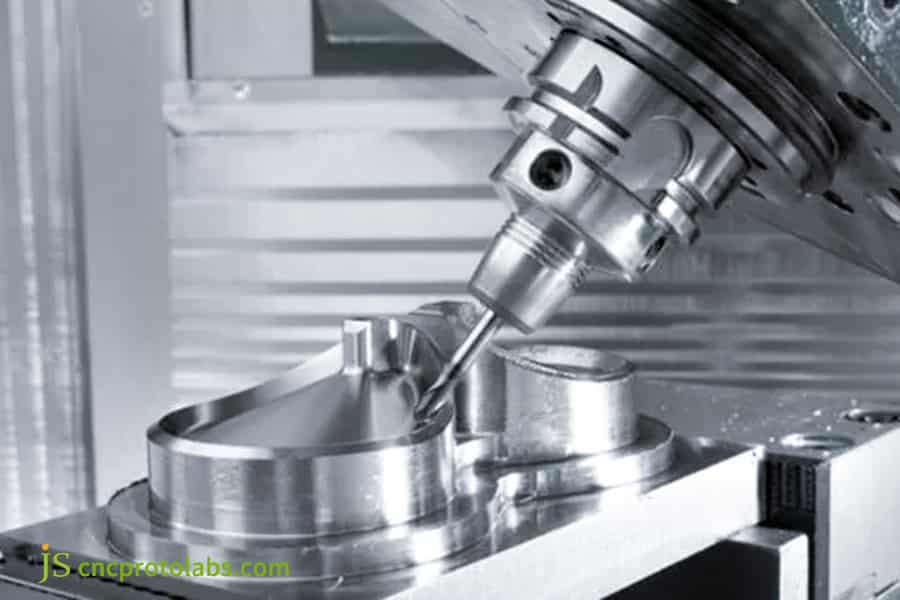 Figure 2: Extreme close-up of a rotating metal cutting tool machining a reflective silver workpiece, generating fine metal chips against a blurred grey background.
What Are The Thermal Effects In Medical Device CNC Milling And How To Control Them?
Cutting heat is a key factor affecting the accuracy of medical device CNC milling, especially when precision micro- milling of surgical tools is used. Local overheating can cause part deformation or performance degradation, and targeted control is needed.
Quantitative Effects of Thermal Deformation
Changing the size of the workpiece and the machine due to heat is one of the factors that influence the cutting accuracy. A 100mm aluminum alloy frame will expand by about 2.3 μm when heated to 1 ℃, which has a fatal impact on parts with a tolerance of ± 5 μm. Titanium alloys are prone to oxidation at high temperatures, which affects their biocompatibility.
The thermal deformation characteristics of different materials are shown in the table below:
| Material | Coefficient of Thermal Expansion (μm/m·℃) | Expansion per 100mm dimension at a 10℃ temperature rise (μm) | Maximum Allowable Temperature Fluctuation (℃) | Temperature Control Measures |
| Aluminum Alloy 6061 | 23 | 23 | ±1 | Constant temperature workshop, coolant temperature control |
| Titanium Alloy Ti-6Al-4V | 8.6 | 8.6 | ±2 | Low-temperature MQL lubrication, thermal compensation |
| Medical Grade PEEK | 80 | 80 | ±0.5 | High-pressure air cooling, thermal insulation cooling |
| Stainless Steel 316L | 16 | 16 | ±1.5 | Cutting fluid cooling, tool optimization |
| Cobalt-Chromium Alloy | 13 | 13 | ±2 | Low-speed cutting, sufficient cooling |
Process Chain Temperature Control Strategy
JS Precision controls the thermal impact of a cut through a full process chain temperature control strategy. The main points are:
- Workshop Environment: Maintain a workshop with a constant temperature whose fluctuation is within ±1℃ to reduce the impact of ambient temperature.
- Raw Material Pretreatment: Raw materials are brought to the workshop equilibrium temperature before processing in order to get rid of temperature differences.
- Machining Process: Leverages a high precision coolant temperature control system, keeping a consistent temperature of 20±0.5℃, changes cutting parameters to reduce generated heat.
- Machine Tool Compensation: Is equipped with machine tool thermal compensation for real time correction of spindle and table deformation.
Local Overheating in Micro-milling
Due to very small feature cutting, heat generated by the cutting becomes hard to dissipate and thus, easily results in overheating. JS Precision adopts an 80, 000 rpm ultra-high frequency spindle with micro-droplet lubrication to help reduce frictional heat and the use of adaptive feed to prevent heat accumulation.
How To Avoid Cracking And Stress Concentration In Medical Grade Peek Machining Robots?
One of the main features of medical-grade PEEK is that it has a high toughness and low thermal conductivity, so it is easily crushed and the layers are separated when it is machined. Hence, special process solutions are required to tackle these problems.
Thermal Management and Cooling Strategies
PEEK has a glass transition temperature of about 143℃. The temperature during machining in the cutting zone should be controlled below this value, otherwise, it will become soft and melt. JS Precision uses high pressure air cooling or medical-grade coolant to stabilize temperatures. Larger parts after machining need to be insulated and cooled to lower the internal stress.
Tool Geometry and Cutting Parameter Optimization
- Tool Selection: The facility uses sharp and dedicated PEEK tools with a large rake angle to decrease cutting resistance and heat generation.
- Cutting Parameters: The approach involved using a high speed, shallow depth-of-cut, high feed "fast-cut" strategy that shortens tool, workpiece contact time.
- Tool Wear Monitoring: Conditions of wear are monitored in real, time, and replacements are made promptly, thus preventing an increase in cutting forces and overheating.
Stress Relief and Post-Processing
Stress of residual internal in machined PEEK parts has the potential to cause cracks easily. JS Precision carries out annealing at 120 degrees Celsius for 2 hours on critical parts, then slow cooling to room temperature, which can successfully eliminate internal stress.
Encountering cracking problems with medical-grade PEEK machining robotics? Contact JS Precision immediately for a free PEEK precision machining process guide to reduce scrap rates.
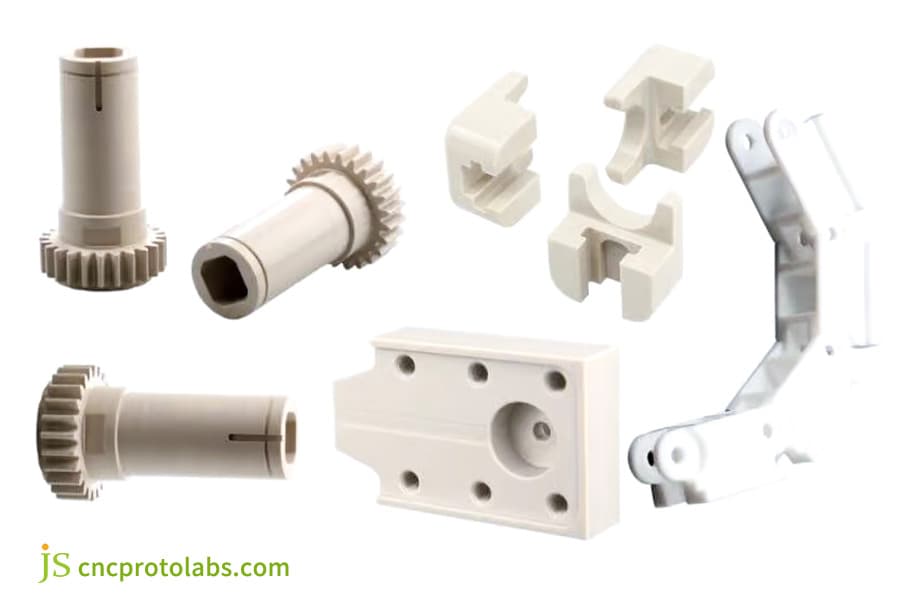 Figure 3: Five beige or off-white plastic mechanical parts, including gears and linkages, scattered on a pure white background.
Why Choose a Professional Aluminum CNC Milling Service To Manufacture Lightweight And Sturdy Robot Structural Components?
Medical robots have an urgent need for lightweight construction. A professional aluminum CNC milling service can reduce weight while ensuring the rigidity and precision of structural components through tight tolerance machining.
Material Selection
Different aluminum alloys have significantly different properties. The grade must be selected according to the load of the part. Specific parameters are shown in the table below:
| Aluminum Alloy Grade | Strength (MPa) | Density (g/cm³) | Strength-to-Weight Ratio | Machinability | Applicable Scenarios |
| 6061-T6 | 276 | 2.7 | 102.2 | Excellent | Non-load-bearing structural components, shells |
| 7075-T6 | 503 | 2.8 | 179.6 | Good | High-load joints, frames |
| 2024-T3 | 470 | 2.78 | 169.1 | Medium | High-precision mounting base |
Rigidity and flexibility structural design mixture
Topology optimization design can be a very effective method in weight reduction, where it is capable of decreasing the weight of structural components made from aluminum alloy by 30%, without loss of rigidity.
JS Precision takes advantage of a low-stress clamping strategy that helps to avoid thin wall deformation, and five axis linkage is utilized for the machining of complex parts in a single clamping operation.
Post weight reduction dynamic performance confirmation
Lightweight parts can be a great concern for verification of dynamic performance and prevention of resonance. JS Precision combines FEA finite element analysis with actual vibration testing to be doubly sure that the process intentionally keeps the robot's operating frequency out of the way, thus no vibration is caused which may negatively impact the accuracy.
Case Study: JS Precision Helps American Surgical Robot Company Achieve Rapid Iteration And Mass Production Of Titanium Alloy Complex Bone Drills
Challenge
The customer is a new generation surgical robot core titanium alloy (Ti-6Al-4V) bone drill with a complex structure and internal cooling channels. The tolerance requirement is ± 0.01mm and ISO 13485 compliant CNC milling service is required.
The original European supplier offered a lead time of 8 weeks and a cost of $280 per unit, which was impossible to meet clinical iteration requirements.
JS Precision Solutions
1.Process Reconfiguration:
A Swiss GF 5 axis high speed milling center with custom fixtures is used to machine multi-faceted features and internal cooling channels of the bone drill in a single setup, thus reducing positioning errors and improving precision concentration.
To overcome deep cavity flow channel issues, micro-milling technology and custom tools are used to optimize the path and vibration control, thus ensuring smooth flow channels.
2.Thermal Management and Quality Control:
Low-temperature MQL technology is used to keep the cutting heat under control during titanium alloy machining with minimal temperatures, thus preventing surface oxidation and performance degradation, and ensuring biocompatibility.
100% online laser inspection is carried out to check key dimensions and surface roughness in real time. Inspection data is merged into the customer's QMS system for full traceability.
3.Parallel Process Optimization:
The outsourced heat treatment and passivation processes are internally coordinated, and the two processes are being concurrently developed by separate dedicated teams, thus drastically reducing the overall cycle time.
The channels for raw material procurement are also optimized by working with suppliers of the highest quality to ensure a stable supply at controllable costs, which also brings the customer cost requirements to the table.
Results
A time reduction of 35% in machining a single piece, cost cut to $195 per piece, and lead time reduced from 8 weeks to 3 weeks, the first batch of 500 pieces obtained a CPK of 1.83 which meets the requirements of iteration and mass production, and thus the product was helped to get into clinical trials 2 months ahead of schedule.
Interested in rapid iteration and mass production of titanium alloy medical robot parts? Contact JS Precision, submit your part requirements, and receive a free mass production cost optimization solution.
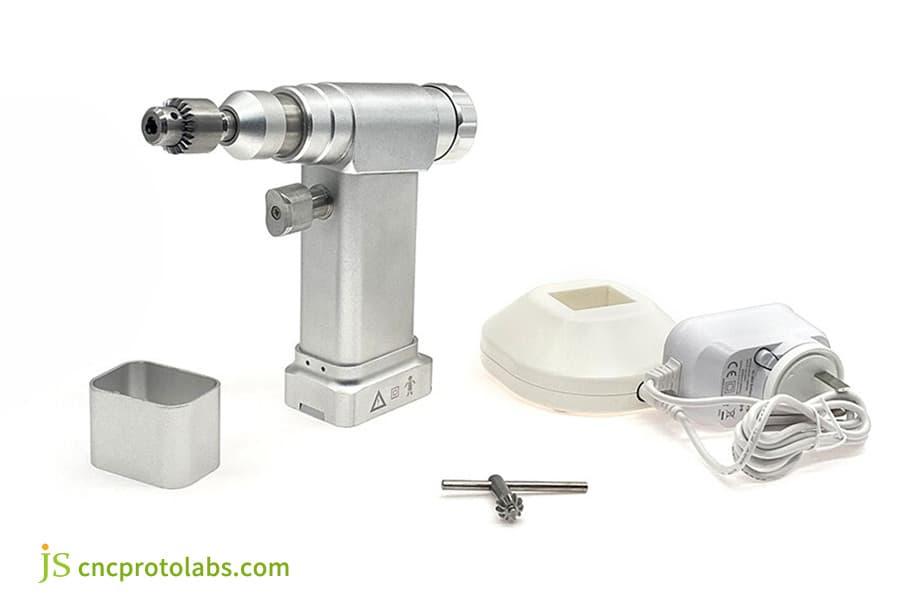 Figure 4: A titanium alloy (Ti-6Al-4V) bone drill system including a handheld driver, drill bits, charger, and accessories on white.
FAQs
Q1: Is ISO 13485 certification a must if one intends to use CNC machines for medical device manufacture?
Definitely. ISO 13485 represents the worldwide standard for medical device quality management systems, signifying the very essence of safety, efficiency, and regulatory compliance of such products. The level of its requirements significantly exceeds those of regular ISO 9001 standards.
Q2: What typically goes wrong when machining medical-grade PEEK which leads to failure?
Main culprit is overheating. Using incorrect tools and speeds can cause the material to soften, stick, and build up stresses, leading to the part cracking or losing its dimensional stability.
Q3: Is it possible through CNC milling aluminum parts to attain the rigidity level that is necessary for medical robots?
Of course. One can meet the structural rigidity requirements and at the same time make the parts lighter by selecting high strength aluminum alloys (like 7075, T6), using topology optimization, and designing with reinforcing ribs.
Q4: What does precision micro-milling mean? What level of accuracy does it have?
It primarily relates to milling operations in which the machining feature size is less than 0.1mm. The most advanced machines can provide a machining accuracy within 2μm and a surface finish of Ra 0.1μm, which is especially suitable for pointed surgical instruments.
Q5: Does the CNC machining strategy need to change from prototype to mass production?
Most of the time, yes. Prototype is all about flexibility and mostly use general, purpose fixtures, whereas, mass production is all about process cycle time optimization, designing dedicated tooling fixtures, and establishing statistical process control, amongst other things, for consistence.
Q6: What is the level of Chinese manufacturers in CNC machining of medical devices?
Top, tier manufacturers such as JS Precision are typically equipped with world-class international machines and are ISO 13485 system deeply integrated, thus they have great benefits in the areas of cost, lead time, and speed of technical response.
Q7: How do you ensure the biocompatibility of materials is not compromised during processing?
Contamination and material degradation are prevented when only medical-grade raw materials are used, application of special cutting fluids and dedicated cleanroom for post-processing (cleaning, packaging) are practiced.
Q8: Can you provide a one, stop service from CNC machining to surface treatment and clean packaging?
Absolutely. JS Precision provides a complete ISO 13485 process, compliant service from precision machining to passivation/anodization, laser marking, cleanroom cleaning, and vacuum packaging, thus making supply chain management easier.
Summary
The manufacturing of medical robot parts is a triple challenge of precision, materials, and regulations, and medical device CNC milling is the core bridge for innovative implementation.
From ISO 13485 compliance to precision breakthroughs in tight tolerance machining, from PEEK cracking to aluminum alloy lightweighting, every step is related to patient safety.
When you select JS Precision, you are choosing more than just a CNC milling manufacturer. You are selecting a partner who is familiar with medical technology, procedures, and compliance issues. We protect your projects by using state, of, the, art equipment, well, established processes, and thorough process control.
Go for it now! Send your medical robot part drawings to JS Precision. Our engineers will give you a professional evaluation with a detailed DFM analysis and compliance plan, thus jointly embarking on a production path that is safe, precise, and efficient.

Disclaimer
The contents of this page are for informational purposes only.JS Precision Services,there are no representations or warranties, express or implied, as to the accuracy, completeness or validity of the information. It should not be inferred that a third-party supplier or manufacturer will provide performance parameters, geometric tolerances, specific design characteristics, material quality and type or workmanship through the JS Precision Network. It's the buyer's responsibility Require parts quotation Identify specific requirements for these sections.Please contact us for more information.
JS Precision Team
JS Precision is an industry-leading company, focus on custom manufacturing solutions. We have over 20 years of experience with over 5,000 customers, and we focus on high precisionCNC machining,Sheet metal manufacturing,3D printing,Injection molding,Metal stamping,and other one-stop manufacturing services.
Our factory is equipped with over 100 state-of-the-art 5-axis machining centers, ISO 9001:2015 certified. We provide fast, efficient and high-quality manufacturing solutions to customers in more than 150 countries around the world. Whether it is small volume production or large-scale customization, we can meet your needs with the fastest delivery within 24 hours. Choose JS Precision this means selection efficiency, quality and professionalism.
To learn more, visit our website:www.cncprotolabs.com
Resource