English



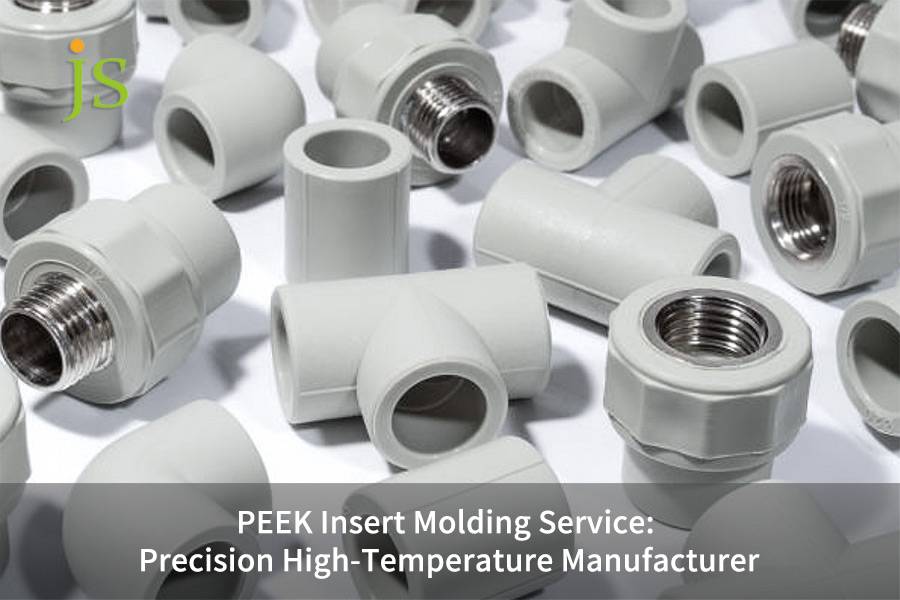

PEEK insert molding service opens a new direction for producing high performance plastic parts. Due to the very high technical threshold, PEEK insert molding has become the topic of discussion among engineers.
Thus, engineers who handle high-performance thermoplastics like PEEK usually encounter problems such as insert loosening, material thermal degradation and dimensional inaccuracies, especially when processing temperatures rise above 343℃.
Through precision mold design and process control, this article will discuss how to address bonding strength and deformation issues in PEEK insert molding.
Besides, it gives the technical parameters measured by JS Precision, including the core process parameters and insert preheating standards. Being proficient in these is the key to guarantee the extended stability of aerospace or medical-grade parts.
Overview Of PEEK Insert Molding Service Technical Indicators
|
Core Dimension
|
Key Technical Specifications/Parameter Indicators
|
Customer Benefits
|
Operational Points
|
|
Processing Temperature Control
|
Melt temperature 360°C-400°C, mold temperature 160°C-200°C.
|
Ensure PEEK crystallinity and improve wear resistance.
|
Use an oil temperature machine for precise temperature control with an error of <±1°C.
|
|
Insert Process Standard
|
Preheating at 150°C-180°C with knurling/grooves.
|
Enhance bonding force and prevent peeling and cracking.
|
Automated robotic arm for precise placement of hot inserts.
|
|
Dimensional Tolerance Control
|
Stable at ±0.02mm.
|
Meet the strict requirements of aerospace and medical grades.
|
100% inspection with coordinate measuring machine (CMM).
|
|
Service Process
|
DFM analysis - mold design - injection molding production - inspection and delivery.
|
Full-process worry-free and shorten project cycle.
|
Provide detailed cost analysis report within 24 hours.
|
|
Material Adaptation
|
Victrex 450G, Solvay KetaSpire, etc.
|
Match different performance requirements and extend part service life.
|
Exclusive parameters for different PEEK models.
|
Key Takeaways:
- Mold Temperature is Key: Crystallinity governs the PEEK wear resistance, which makes it necessary to precisely control the mold temperature with an oil temperature controller.
- Preheating is Essential: When the metal insert is preheated, the interfacial thermal stress is eliminated, which in turn prevents cracking or peeling of the PEEK substrate.
- DFM Priority: Design changes and optimization of wall thickness layout at the earliest stages of part development are the most effective ways of reducing shrinkage cavities in peek injection molding.
Why Trust JS Precision’s PEEK Insert Molding Service?Expertise In High-Temperature Manufacturing
Our insert molding technology major competitive edge is probably the ability to very accurately control the properties of high temperature materials and also the deep engineering experience behind us.
When a customer is choosing a PEEK insert molding supplier, the main thing they worry about is if we can successfully address their main issues like weak bonding strength and dimensional deviations - those are actually our main skills.
We are a very experienced team of 20 years working with high-performance plastics. Our speciality in insert molding of highly technical materials like PEEK sets us apart from the majority of injection molding companies.
Also, that means that we are able to correctly tackle problems which standard manufacturers are not capable of handling, for instance, changes in crystallization, carbonization of spots, and so on.
Our injection molding workshop for high temperatures is not only equipped with tools but also highly specialized high-temperature screw heads which make sure that the PEEK at 380℃ the melt temperature is not degraded.
Customers who choose us get fully tailored services, including DFM analysis to optimize part design and reduce shrinkage cavities, plus mold manufacturing, process debugging, and testing and delivery - all steps accompanied by the recorded data.
Thus, for an aerospace components customer, being supplied by a company with improper mold temperature control, the wear resistance was low. After coming over to us, the pass rate went up from 82% to 99.7%.
Our technology is in line with the ASTM D6869 material standard, guaranteeing a steady quality of parts. Besides, we operate a clear pricing system, offering a detailed cost breakdown within a day to assist customers in managing their budgets and steering clear of unexpected expenses.
Whether for medical-grade or aerospace-grade parts, stable quality and professional technical support are core requirements for our customers. If you are struggling with quality issues in PEEK insert molding, contact our engineers for a free technical feasibility assessment and to unlock a customized insert molding solution.
How To Solve The Bonding Problem Of High Difficulty Medical Device Parts Through PEEK Insert Molding Service?
As for the problem of easy delamination between PEEK and stainless steel inserts, it mainly comes down to upping the delamination strength by more than 40% through 180℃ preheating and a micron-level mechanical interlocking pattern.
A lot of medical device customers complain that their products leak after autoclaving because the bonding strength isn't high enough. Scientific management of PEEK insert molding service is really the only way to totally get rid of this problem.
Analysis of Heterogeneous Interface Stress Distribution
PEEK experiences cooling and contraction at the same time, which together with different thermal expansion coefficients of metal insert results in interfacial thermal stress.
This is in fact the main reason why bond delamination occurs. We resort to simulation software to precisely forecast stress distribution, make insert design modification before hand, and lessen stress concentration.
Customized Injection Pressure Profile Techniques
Because the shape of medical devices is usually complicated, we prepare tailored injection pressure patterns for insert molding services. Main points are:
- The injection pressure is regulated to range between 70-120 MPa, depending on the thickness of the part's wall, i.e. the thicker the wall, the pressure should be nearer to the upper limit.
- To prevent displacement of the insert by high pressure, a three-stage pressure control system is used so that the insert is not directly hit with a high pressure.
- The injection molding process is held for 15-25 seconds to ensure that the PEEK completely fills the gaps of the insert and facilitates the interweaving of molecular chains.
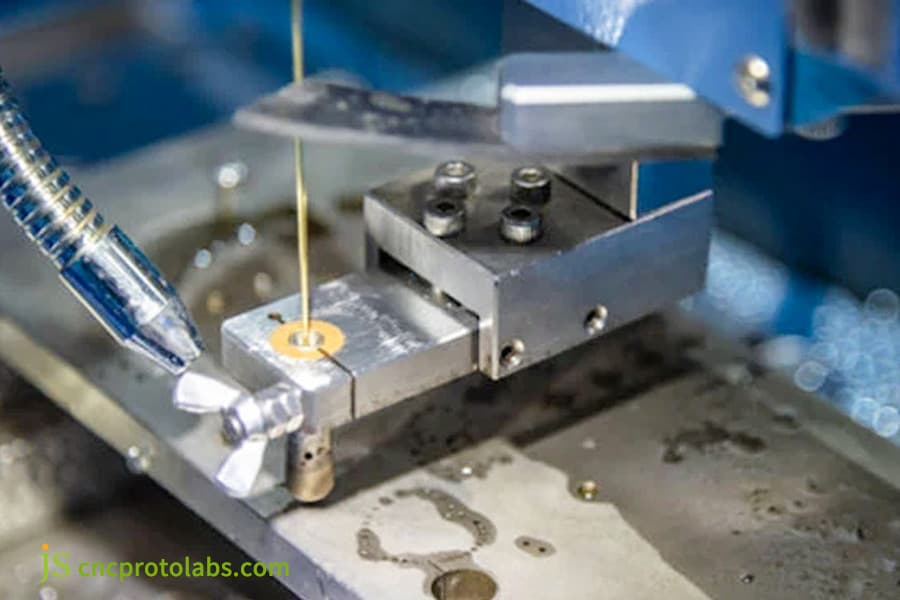
Figure 1: Close-up view of a CNC machine tool performing precision machining on a metallic medical component.
How Can Professional Insert Molding Services Maintain Precise Dimensions In a High Temperature Environment Of 380°C?
When it comes to high temperatures, the major culprit that causes the dimension of a component to fail is the differences in thermal expansion. We manage to obtain 0.02mm precision control by selecting mold steel, which has a low coefficient of thermal expansion and different stages of holding pressure process.
To go along with professional insert molding services, a thorough high-temperature control system is considered as a prerequisite to meeting the tough requirements of aerospace and high-end medical applications.
Selection Criteria for Mold Material
During the process of high temperature insert molding, the thermal property stability of the material with which the mold is done is going to have a direct impact on the dimensional accuracy. We give preference to two kinds of mold steel, of which the parameters are presented in the table below.
|
Mold Steel Model
|
Thermal Expansion Coefficient (10^-6/°C)
|
High Temperature Resistance Limit (°C)
|
Hardness (HRC)
|
Application Scenarios
|
|
S136
|
11.2
|
400
|
52-56
|
Medical-grade precision parts.
|
|
H13
|
11.5
|
550
|
48-52
|
Aerospace-grade complex parts.
|
|
Ordinary Mold Steel
|
13.8
|
300
|
40-45
|
Ordinary plastic parts.
|
|
SKD11
|
12.0
|
350
|
58-62
|
Small precision inserts.
|
Synergistic Control of Temperature Control and Holding Pressure System
By employing a closed-loop temperature control system, we are able to monitor temperature variations per mould cycle and keep the error within 1℃ to maintain a steady mold temperature.
Alongside this, we study the levels of PEEK crystallinity resulting from the interplay of holding pressure time and cooling rate, and we eventually determine a good compromise between product quality and productivity.
Precision dimensional control in high-temperature environments hinges on the synergy between mold material and temperature control and holding pressure processes. Looking for a high-stability insert molding services supplier? Contact us to obtain the high-temperature molding technology white paper and quickly master the core techniques of high-temperature insert molding.
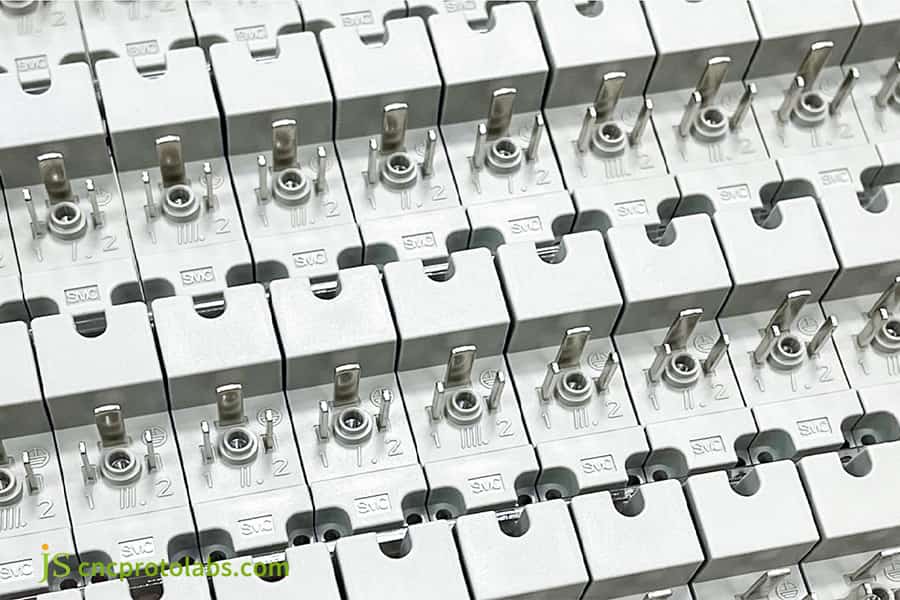
Figure 2: Close-up of electronic connectors manufactured using insert molding technology.
Why Does Custom Insert Molding Require Secondary Preheating Treatment Of Metal Inserts?
Not preheating inserts before molding can cause cold spots and stress concentration in specific areas. Raising the temperature to about 150℃-180℃ can greatly aid the molecular chain entanglement at the PEEK-metal interface.
It is really surprising how many customers are still skipping the preheating step, as this usually results in cracked parts, loose inserts, and higher rework costs. Custom insert molding cannot do without preheating.
Performance Comparison Between Preheated and Unpreheated Inserts
The SEM image analysis revealed that molecular chain entanglement density at the PEEK interface of inserts preheated at 160℃ increased by 60%. Correspondingly, the pull-out force climbed to 2500N whereas the force for unpreheated inserts was only 800N and there was a tendency for interfaces to delaminate.
Automated Preheating and Placement Solution
1.Manual putdown of hot inserts in custom insert molding will cause time lag and heat dissipation, changing preheating effect. So, robot arm operation automation is needed.
2.Robotic arms can automatically pick up preheated inserts and control the placement time at 2 seconds so that heat loss is no more than 5℃, which results in the same preheating temperature of the insert each time.
3.A special induction heating unit for PEEK molding service is launched that helps in the homogenous preheating of inserts, thus preventing carbonization of the inserts and still further enhancing the bond stability.
How To Reduce Expensive Material Waste Through Channel Design When Choosing PEEK Injection Molding?
PEEK is a high-cost material. One way to reduce the overflow rate to less than 5%, which will result in a significant decrease in the cost per piece, is by adjusting the hot runner system or minimizing the length of the cold runner.
The key to runner optimization in PEEK injection molding lies in cost reduction for customers who are mass-producing items.
Needle Valve Hot Runner Structure Changes
- Changing the needle valve hot runner design for PEEK injection molding, by using high-temperature resistant needle valves that can endure melt temperatures of 380℃, is a way of completely preventing runner blockage.
- The hot runner diameter must be adjusted according to the part weight, and usually, it is controlled between 4-8mm to reduce material residence time and the risk of PEEK material degradation.
- The connection between the hot runner and the cavity should be modified to ensure the smooth flow of melt, and thereby, the reduction of overflow and waste of material.
Trade-off between runner recovery rate and material degradation
Recovery of PEEK material should be limited within a certain range. Too much recovery may cause the degradation of the material. Below is our comparative data obtained from mass production of PEEK component insert molding:
|
Scheme Type
|
Runner Length (mm)
|
Flash Rate (%)
|
Recovery Ratio (%)
|
Part Qualification Rate (%)
|
Unit Material Cost (USD)
|
|
Old Scheme (Cold Runner)
|
120
|
12
|
30
|
92.5
|
8.6
|
|
New Scheme (Hot Runner)
|
40
|
4.2
|
50
|
99.3
|
5.3
|
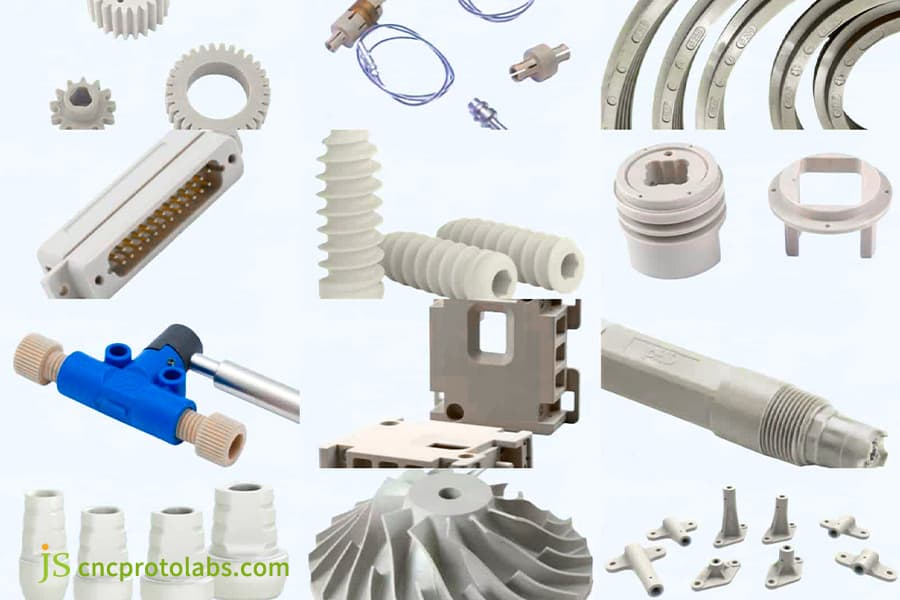
Figure 3: Assortment of engineering plastic parts produced via PEEK injection molding.
JS Precision Medical Grade PEEK Sensor Shell Precision Insert Molding Service Successful Case
The wearable sensor components for healthcare are indeed subject to extremely strict requirements in the areas of sealing, wear resistance and dimensional accuracy. Additionally, they must retain the same high-level performance even after being sterilized several times in an autoclave.
Therefore, it is extremely difficult for precision insert molding service to meet such high standards. A case in point is a tailored medical sensor solution that we prepared for a medical sensor company.
Client Concerns
A medical sensor company's sealing elements made of PEEK and the stainless steel substrate started to show leakage after 10,000 autoclave cycles. The conventional injection molding method resulted in a failure rate of 12%, which led the product to fail the medical certification.
The client was mainly concerned with solving the leakage problem, achieving a pass rate of more than 99% after 15,000 sterilization cycles and cost effectiveness.
JS Precision Solution
On receiving this request, our initial step was to apply DFM analysis to spot the main issues:
- The metal insert surface did not have a sufficiently effective mechanical interlocking structure and thus the bonding force was very low.
- The mold temperature control that was unstable caused the PEEK crystallization to be uneven and as a result, the sealing was poor.
- Holding pressure process was not suitable leading to filling that was insufficient.
From this, we have come up with the following three main solutions:
- Changed the dovetail groove design of metal inserts so as to allow for the interface contact area to be increased thereby mechanical interlocking effect will be enhanced and bonding force will be improved.
- Deployment of a high-precision oil temperature controller to keep the mold temperature continuously at 190℃, which will enable the PEEK to crystallize adequately and at the same time sealing and wear resistance will be enhanced.
- Set three-stage pressure holding logic and the peak pressure was locked at 95MPa. The first stage of pressure holding stabilizes filling, the middle stage compensates for shrinkage, and the last stage eliminates stress, so that the filling in the complicated structures is complete.
Lessons Learned from Failure
We initially lowered the mold temperature to 160℃ to cut down the cycle time, but this led to uneven crystallization of PEEK, brittleness of parts, and increased leakages. We realized that in processing PEEK, quality stability has to be given highest priority even at the cost of the production cycle time.
During the course of our experiments, we changed the mold temperature to 190℃ and also decided on 20 seconds for holding time, so that the crystallization problem was fixed.
Final Results
After optimization, the parts passed 15,000 high-pressure sterilization cycles virtually with zero leakage. The percentage of batch pass which was 88% rose to 99.8%, thereby complying with medical certification requirements and enabling the client to take forward the project implementation.
Client Satisfaction: "JS Precision's profound technical knowledge has helped us to crack the high-end medical market. Their detailed attention is so brilliant that they solved a technical problem that we could not overcome for a long time."
The case validates that expert precision insert molding services are capable of addressing the fundamental issues of medical-grade PEEK parts.If you also face the challenges of machining medical-grade PEEK parts, upload your drawings and let JS Precision optimize and customize a unique solution for you, helping your product successfully pass certification.
How To Meet The Stringent Tolerance Requirements Of Aerospace Grade Through PEEK Molding Service?
To produce aerospace-level parts, it is necessary to ensure the highest level of dimensional consistency. We perform a 100% check with a coordinate measuring machine (CMM) and fine-tune the pressure holding switching point so that there are no pressure pulses at peaks.
The tolerance control capability of the PEEK molding service is directly associated with the safety of aerospace parts.
Position Tolerance Control for Multiple Insert Layouts
For precision insert molding services, one of the difficulties is in controlling the position tolerance of multiple insert layouts.
We are able to guarantee the zero displacement of inserts during injection molding by employing customized fixtures, then the position tolerances can be held within 0.015mm. At the same time, we improve the runner layout so that dimensional deviations caused by uneven filling are avoided.
Effect of Injection Rate on Shrinkage
The shrinkage rate of PEEK is one of the factors influenced by injection rate, and therefore the dimensional accuracy of the parts is also impacted. A series of comprehensive field tests allowed us to come up with the following data on how different injection rates influence part shrinkage:
- In the range of 50-80mm/s injection rate, the shrinkage rate remains unchanged at 1.2%-1.5%.
- At the rates below 50mm/s, the shrinkage rate experiences major fluctuations and the maximum value is 2.3%.
- The rates above 80mm/s can cause melt fracture, which will result in deterioration of part surface quality and dimensional accuracy.
Why Is JS Precision Your Preferred PEEK Insert Molding Service Partner?
With 15 years in processing high-performance plastics, JS Precision integrates DFM design, high-precision mold manufacturing, and AI-assisted injection molding to offer one-stop PEEK customization solutions and help clients reduce technical risks, control costs and shorten project cycles.
Complete Quality and Service Guarantees
1.Certified with ISO9001 and ISO 13485:2016 medical device quality system, we ensure that every batch PEEK parts produced maintains international standards and the quality is guaranteed.
2.We operate a very transparent pricing policy and provide a detailed PEEK insert molding service cost breakdown report within 24 hours. In this way, clients will be able to plan their budgets in advance.
3.Our fully established comprehensive testing system equipped with advanced professional testing machines carry out full-process testing that guarantees no defective products will be released from the factory and will minimize the usage risk for clients.
Customer-Oriented Service Benefits
We put our customers first and even make our efforts at the DFM analysis stage to alter the part design to make it production-friendly and cost-effective. For costly PEEK materials, we envisage the loss rate to be less than 3% apart from that, we possess worldwide quick delivery capabilities for both prototype prototyping and mass production.
Working with us gives our clients access to expert technical support, a reliable quality assurance system, and a comprehensive worry-free service from start to finish that can fully address the challenges of PEEK component insert molding. Are you ready to begin your PEEK project? Contact our engineers for a professional PEEK insert molding service quotation and solution assessment within 24 hours.
FAQs
Q1: What is the average price for PEEK insert molding?
The price will depend on the PEEK material, the complexity of the part, the insert material, and the number of mold cavities. The cost of mold development is anywhere between $3,000 and $15,000. The unit price is determined by the weight and time of machining. We provide a free first quote evaluation.
Q2: How to ensure the bonding force between the metal insert and PEEK does not fail?
Besides chemical cleaning, it is better to have knurling or circumferential grooves on the metal surface. The mechanical interlocking structure of precision insert molding service can resist pull-out forces 3-5 times higher than smooth surfaces.
Q3: What is the maximum temperature limit during PEEK processing?
The continuous operating temperature of PEEK is about 260℃, but molding melt temperature must be as high as 380℃. With our high-temperature screw head, we make sure that at high temperatures the material will not degrade.
Q4: Which types of PEEK materials can JS Precision process?
We have the capability to work with Victrex 450G, Solvay KetaSpire, and carbon/glass fiber reinforced PEEK. We will adjust the corresponding processing parameters to meet the part performance requirements.
Q5: Is there a minimum order quantity (MOQ) limit?
We are quite open with the order quantity for high-value PEEK materials. We are able to offer PEEK molding services for 10 prototype samples or tens of thousands of pieces for mass production.
Q6: Do PEEK insert molding parts require post-treatment annealing?
Normalization annealing is actually post-treatment and should be done after injection molding. The annealing is usually at 200℃ as controlled annealing. This process is able to get rid of the injection stress, lead to better crystallinity, and the parts will be less affected by thermal distortions.
Q7: How to prevent insert displacement under high injection pressure?
For insert molding, precision mold locating pins, a hydraulically assisted clamping system, and a runner balance simulation are utilized to ensure the uniform distribution of pressure around the insert and prevent its displacement at high pressure.
Q8: Why choose JS Precision instead of other general suppliers?
First of all, processing of engineering plastics is our main focus. We have a high-temperature injection molding workshop and also a group of very experienced engineers. We have the capability to solve the specialized PEEK processing problems which normal injection molding plants are not able to handle and ensure stable quality.
Summary
PEEK insert molding is an intricate engineering feat combining materials science, thermodynamics, and precision mold design at a deep level.
Accurate control of the mold temperature in the range of 160-200℃ along with proper insert preheating and DFM optimization in advance can be the perfect solution to the problems of bonding strength and dimensional deviations resulting in parts able to work under extreme conditions.
JS Precision's PEEK insert molding is a great way to break through technical barriers, lower the price, and keep quality. Require proficient help with your PEEK work? Share your design files, and our well-trained team will be ready to give you a free DFM report and an attractive quotation in 24 hours.

Disclaimer
The contents of this page are for informational purposes only.JS Precision Services,there are no representations or warranties, express or implied, as to the accuracy, completeness or validity of the information. It should not be inferred that a third-party supplier or manufacturer will provide performance parameters, geometric tolerances, specific design characteristics, material quality and type or workmanship through the JS Precision Network. It's the buyer's responsibility Require parts quotation Identify specific requirements for these sections.Please contact us for more information.
JS Precision Team
JS Precision is an industry-leading company, focus on custom manufacturing solutions. We have over 20 years of experience with over 5,000 customers, and we focus on high precisionCNC machining,Sheet metal manufacturing,3D printing,Injection molding,Metal stamping,and other one-stop manufacturing services.
Our factory is equipped with over 100 state-of-the-art 5-axis machining centers, ISO 9001:2015 certified. We provide fast, efficient and high-quality manufacturing solutions to customers in more than 150 countries around the world. Whether it is small volume production or large-scale customization, we can meet your needs with the fastest delivery within 24 hours. Choose JS Precision this means selection efficiency, quality and professionalism.
To learn more, visit our website:www.cncprotolabs.com
Resource