English



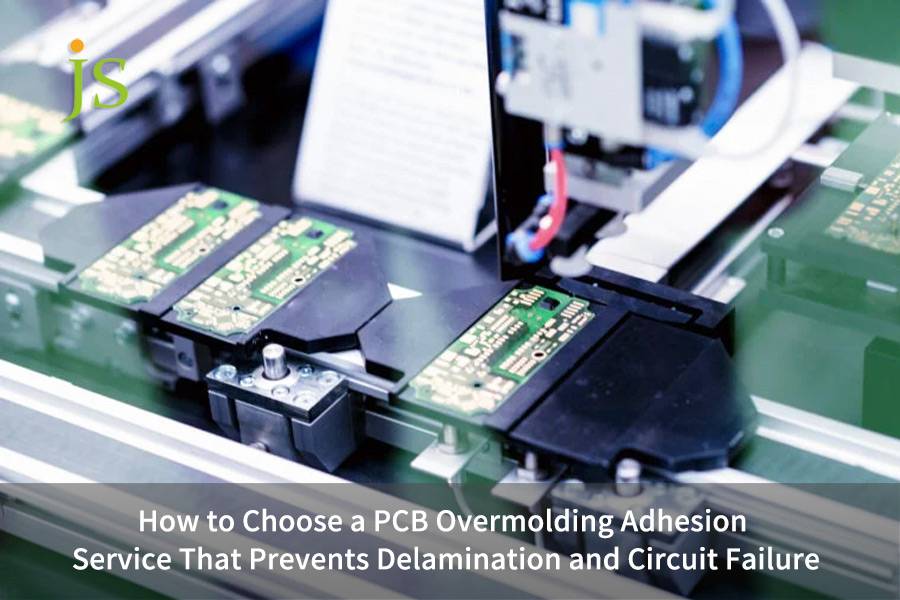

PCB overmolding is commonly used for protecting circuit boards in the hostile environment but sometimes hidden delamination or internal circuit failure is detected in mass production, which can delay product launch.
What most electronics engineers and purchasing managers with no exception frequently complain are the pain points: low surface energy of substrates, incompatible coefficients of thermal expansion, forego injection pressures, which cause to delaminated overmolded PCB during the thermal cycling test. Micro-components such as 0402 and 0201 are extremely fragile, which directly lead to mass production slow production line and re-work cost.
This article will segment some core solutions of preventing delamination overmolding from practical ideas of material selection compatibility, surface modification, parameter control. It brings practical supplier base market evaluation standards for purchase and production, which is benefits for long-term stability circuit production. Please read what comes next core engineering principles to improve your purchase technology decision-making accuracy.
Overview of Key PCB Overmolding Manufacturing and Selection Indicators
Quality stability of PCB overmolding depends wholly on numerical process parameters. A qualified PCB overmolding process should ensure all technical specifications in a fixed number of overmolding processes to prevent the delaminates and damage components.
|
Core Evaluation Dimension
|
Quantitative Manufacturing Standards for Preventing Delamination and Failure
|
Customer Quantitative Value and Quality Assurance
|
|
Circuit Protection (pcb overmolding)
|
Interface shear strength τ>8.5 MPa, insulation resistance >10¹² Ω, 100% pass 24-cycle thermal shock test.
|
Avoid thermal peeling risks and ensure the overmolding layer remains non-delaminated and waterproof under extreme working conditions from −40℃ to +125℃ to meet IP68 protection standards.
|
|
Plastic Injection Overmolding
|
Melt filling shear rate <1200 s⁻¹, secondary holding pressure drops to 45%−55% of injection pressure.
|
Realize zero damage to 0201 micro-components and eliminate wire floating, displacement and fracture problems to greatly improve batch yield.
|
|
Prototype Overmolding
|
Surface energy increased to ≥52 mN/m, ultrasonic testing interface void rate <2%.
|
Lock mass production risks in advance and ensure batch production stability based on non-destructive inspection and mold flow analysis data.
|
|
Process Qualification Control
|
Possess ISO 9001:2015 and IATF 16949 certifications, with CMM full-size reports and X-Ray void rate reports for samples.
|
Full-process standardized traceability avoids batch failures caused by non-standard processes and reduces procurement risks.
|
Key Takeaways:
- Bond strength is critical: To overmolding delaminates surface energy must obtain 48 m N/m. Suppliers should require dyne pen or contact angle testing.
- Prevent impact of components, when injected molding of overmolding circuit board, the shear rate of filling melt injection should be limited at no more than 1200s⁻¹, if exceed, there will be flying wires or internal 0201 component to move.
- Stringent process and multiple approvals: While choosing an over moulding manufacturer, it's good to check the presence of ISO 9001:2015 and IATF 16949 system certified manufacturer. Starting samples should get a complete size CMM report along a non destructive X-ray void rate report.
Why Trust JS Precision's Expertise in PCB Overmolding Delamination Prevention Solutions?
Professionally overmold protection solutions are based on hands on experience and standard data handling, not on experience based trial and error.
Informed by professional hands-on experience of thermal overmolding of medical electronics PCB, our team dedicated for three months on iterative tests for flexible circuit board delamination problems, conducting a total of 48 batches of temperature shock comparison experiments.
Technical A prospective, IPC-2221A 6.3 suggests that more than 80% of all material quality overmolding delamination failures are on the market are caused by inferior surface treatment and variation within the injection molding parameters.
As it is, most processing plants in the industry do not standardize parameters for quantitative control and all parameters change together with changes in equipment and operators, which can bring easily late failure.
Our team has accumulated many years of experience in precision electronic overmolding, during which we have been researching the pain point of overmolding the circuit boards under complex working conditions, and have developed a large volume of exclusive troubleshooting data as well as process optimization solutions.
As industry practice, all process improvements are implemented based on real measurement, and all mass production parameters are confirmed by first prototype test, without any trial and error cost, making sure providing quality customized processing support to top electronic project.
To quickly verify whether your project has delamination risks, you can receive a free industry-exclusive anti-delamination process white paper and simultaneously obtain one-on-one process risk screening services.
How To Achieve Circuit Airtightness Protection In High And Harsh Environments Through PCB Overmolding Technology?
PCB overmolding is a technology which precisely applies low melt viscosity thermoplastics/elastomer over PCBA surface, totally isolates it from moisture, salt spray and mechanical stress.It is from a physical level and by crossing the molecules, forming a firm front for circuit protection.
Mainstream Overmolding Material Substrate Compatibility Standards
Material compatibility matching is one of the essential conditions for protective effectiveness. Compatibility of various overmolding materials with the FR-4 substrate varies widely which really affects the airtightness and delamination resistance.
1.TPU Material: It applies to the medical materials and the precision electronic apparatuses such as the handle. It has the excellent elasticity and the sturdiest impact resistance. It is used to the switching situation of high-frequency high-low temperature.
2.PA Polyamide Material: the mechanical strength is high and the high-temperature resistance is superior. It is used under high-load industrial environments, like industrial control, automobile application electronic.
3.Altered plastic materials: tailored given types of specific corrosion and water-proof requirements. It has to be compared the thermogravimetric analysis data of substrate before application.
Precise Thermal Balance Control Process
The control of Thermal balance ensures that the solder mask does not undergo thermal degradation. JS Precision adopts multiple customized zone mold temperature control system to control strictly the temperature when the melt reaches PCB to a specific level.
We develop the computation of heat release of the melt tie and the application of solder mask TGA reaction with. PCB to avoid excess of processing temperature of exceed at 245℃ and make sure the PCB maintain the strong physical tie and no damage to the substrate.
In a simply way, the heating process needs to be controlled at a specific point so that plastic quickly holds onto the circuit board without burning through the protective coating.
|
Process Type
|
Surface Energy Standard (mN/m)
|
Shear Rate (s⁻¹)
|
Thermal Shock Cycles
|
Interface Void Rate
|
|
Conventional Overmolding Process
|
≤45
|
≥1500
|
≤10
|
≥8%
|
|
Precision Anti-Delamination Process
|
≥52
|
≤1200
|
≥24
|
≤2%
|
|
Medical-Grade Precision Process
|
≥55
|
≤1100
|
≥30
|
≤1.5%
|

Figure 1: Green circuit board with black overmolded plastic components in a grid pattern.
What Engineering Equipment Qualifications Must Be Reviewed When Evaluating PCB Overmolding Service Suppliers?
A top ranking PCB overmolding service supplier must have high-precision servo driven electric injection molding machine, pre-vacuum drying oven, fully-automatic precision mold temperature controlling system, to guarantee the parameters repeatability absolute. The precision of the equipment directly affects the overmolded product yield rate.
Core Equipment Precision Quantification Standards
Cleaning of batch errors, injection precision calibration is the basis. For production equipment, qualified manufacturers must meet strict operating parameters.
- Micro-injection efficiency: injection weight error is controlled within + 0.01g to preclude bubbles and layer separation resulting from inconsistent injection.
- Control of raw material drying: The moisture of raw material is strictly monitored by an online moisture analyzer to make sure stay below 0.02% to avoid vaporization and introduction of porosity.
- The injection molding workshop of Class 10,000 clean room is adopted to prevent the dust and impurity from influencing the interfacial bonding strength.
Brand-branded equipment gives consistent quality
Advanced molding facilities greatly enhance process stability: JS Precision utilize very high accuracy of our prominent supplier KraussMaffei equipment to implement fully automated control of parameters without human intervention which results in consistent parameters in each batch and zero-defects large volume production for high-end electronic overmolding.
Want to quickly calculate the mass production cost of your project? Feel free to schedule an appointment with our senior project engineer. Upload your 3D step drawings with one click to receive a customized mass production feasibility assessment.
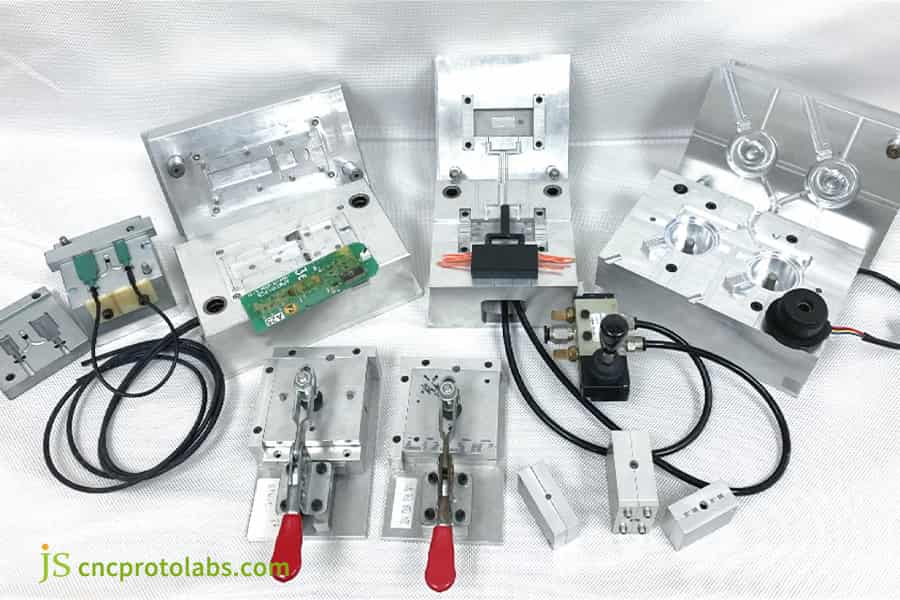
Figure 2: An arrangement of metal molds, red clamps, and circuit boards for overmolding tool setup.
How To Use Flow Field Simulation To Prevent Internal Electronic Component Displacement In Processing Overmolding Circuit Boards?
Achieving a controlled overmolding circuit boards is a challenge due to the need for adequate control of the melt flow rate to ensure the best gate position for the minimization of shear forces during the fill (simulated by a Moldflow finite element flow field simulation.)
Flow Rate and Pressure Linkage Control Mechanism
Switching of the flow velocity is the main means of component protection, using the dynamic pressure holding switching quantization logic.
1. Filling: During the initial fill-up stage of the process, a stable laminar flow which lasts until the cavity of the mold is 98% filled should be ensured. This is important to prevent the melt at high speed from impinging on mold components.
2. Pressure switching: switch to low-speed holding pressure immediately after the filling stage is complete, the holding pressure to be 45%-55% injection pressure.
3. Gate Optimization: Use multi-point fan-shaped gate to completely remove local high-pressure effects in turbulence.
Low-Stress Injection Molding Value
Component stress reduction retains 100% of the electrical characteristics of the substrate. This is powerful in protecting delicate components like 0402 resistors and tight pitch BGA chips removing flying wires displacements breakages and the associated problems ensuring the function of the circuit board is unaffected.
How To Finely Control The Mold Temperature And Thermal Stress When Choosing High-Quality Plastic Injection Overmolding Process?
During plastic injection overmolding, the mold temperature need be tightly controlled within design limit of 1℃ for the reason of high internal stress due to uneven cooling in the process of microcrack formation that causes PCB warping. Thermal stress imbalance is the root cause of finished product deformation.
Differentiated Mold Temperature Control Solution
Differentiated mold temperature can offset the effect of plastic shrinkage stress.
The group adopts the high-precision dual-loop mold temperature controller to achieve the differentiated temperature control on the upper mold and the lower mold, for example 85℃ and 75℃ for the upper and lower molds to exactly balance the bending moment due to the plastic shrinkage.
Standardized Post-Mold Stress Relief Process
The post-molding stress relieving can greatly reduce the finished product deformation rate.
After demoulding the finished product should be placed in 60 constant temperature oven for 4 hours for the completion of the annealing stress relieving process, so that the PCB internal anisotropic shrinkage rate can be reduced below 0.3%, defect causing the finished product deformation can be eliminated from the source.
In other words, it is to give the finished product "constant temperature relief" and eliminate the residual internal stress.
For processing high-precision, large-size automotive electronic overmolding components? Please submit an inquiry to our factory to receive a customized thermal management solution tailored to your technical manager.
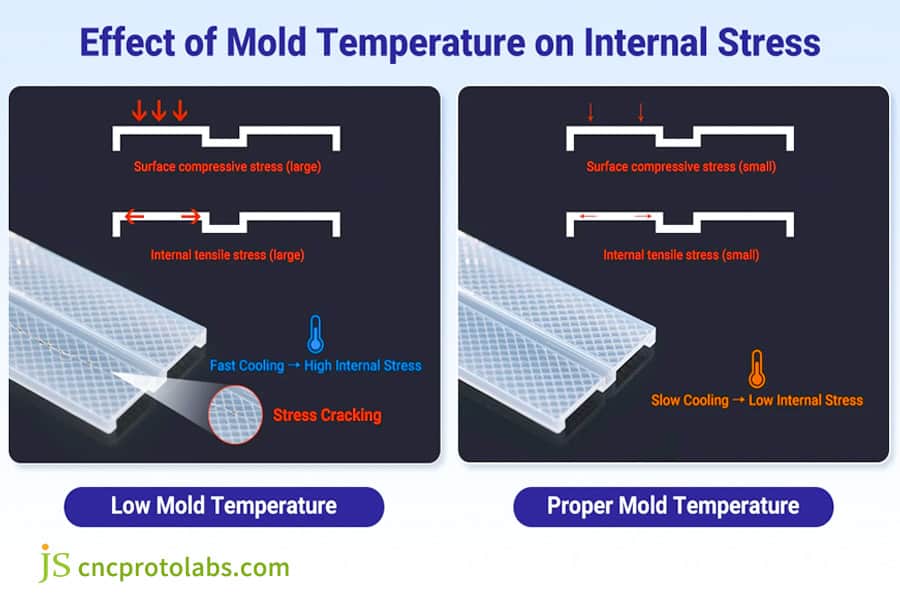
Figure 3: Stress comparison diagram for overmolding with different mold temperatures.
Why Is Initial Prototype Overmolding Sample Testing An Essential Step In Reducing Production Risks?
Starting with prototype overmolding enables early validation of both design, mold sealing configuration, venting grove orientation, and type and size of material shrinkage rate.It avoids 95% of systematic failures issues before mass produced injection molds are built up, which should have been the core pre-step in mass production risk management.
Extreme Condition Simulation Testing System
Extreme condition tests identify possible process defects in the early stages. As a part of the prototyping stage, demonstrations are run at -40℃ at +85℃ and 95% humidity, these tests are run for 48 hours.
Precise Microvoid Inspection and Optimization
Microvoid inspection is one of the critical factors for the prevention of delamination. During the inspection, the void rate at the solder pad to plastic bonding is observed through a metallographic microscope.
When the void rate is > 5%, micro venting pin is added as soon as possible to optimize the mold structure and guarantee the quality of mass production.
What Are The Quantified Surface Modification Steps Involved In Performing a Solid Overmolding Surface Preparation?
To ascertain the bonding strength of the overmolding layer, standard on the overmolding surface preparation is not only necessary but also decisive, which should be performed by a synergistically multi-cut technology composed of plasma cleaning, mechano-scratched blunting and the overmolding surface coating with a special chemical coupling agent, as referred to in IPC-A-600G 8.2.
Standardized Three-Step Pretreatment Process
The surface activation gradually enhances the interfacial adhesion. The standardized quantitative procedure is:
- Precision Cleaning: Isopropanol is used in a 300s ultrasonic bath to clean the surface of the board of hydrocarbon contaminants.
- Plasma Activation: 450W low pressure plasma sweep to increase energy of surface to equal or greater than 52 m N/m from an initial energy of about 32 m·N/m.
- Chemical Strengthening: Silane coupling agent to exposed metal surfaces is used to form covalent bonds to ensure stable bond.
Surface Energy Calibration Quality Control Standards
Surface energy calibration is an essential part to avoid delamination. The process is carried out in two steps with dyne pen and contact angle tester respectively to check the surface energy. The result should be as the standard to avoid delay delamination.
Need a surface treatment solution tailored to your specific PCB material? Our engineering lab can perform customized surface energy matching tests for your PCB material. Send an inquiry now to get a customized solution.
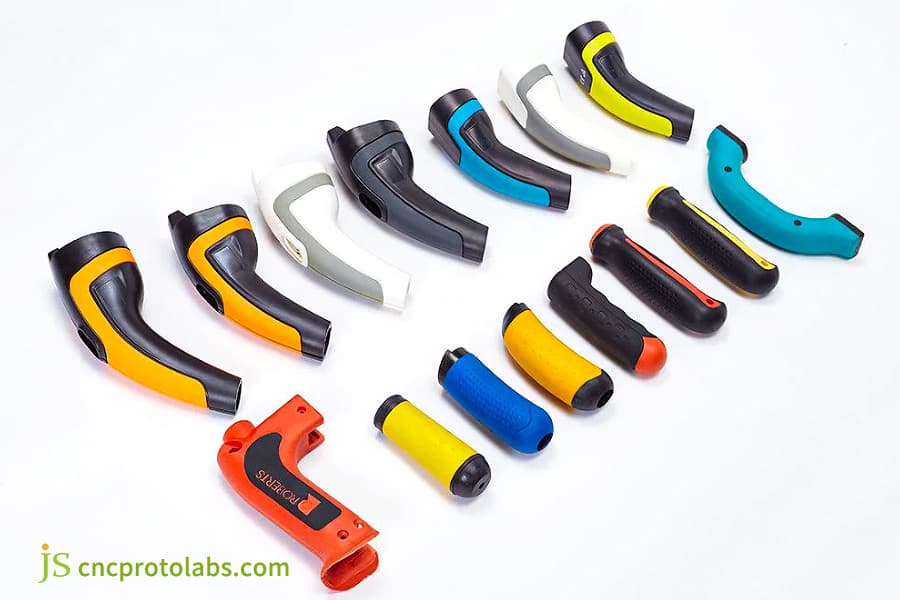
Figure 4: An array of multi-colored parts for prototype overmolding surface testing.
How To Evaluate An Overmolding Service Provider With a Comprehensive Customized Quality Management System?
To decide the quality of an overmolding service provider, the ultimate measure is the rigorous evaluation of the presence of NDT to be applied in the whole process and the adoption of SPC (Statistical Process Control) on major process. Systematic controlling is inevitably much better than single point process optimization.
Comprehensive Non-Destructive Testing Control
Non destructive testing coverage is totally defect free. The entire line is equipped with online-X-ray inspection instrument that can capture 100% defect such as weld porosity, wire break. Positive pressure holding of 20kPa for 15 Sec. IP67/IP68 protection test.
Transparent Compliance System
RoHS/REACH compliance certification management of the products. All the finished product and parts are provided with RoHS/REACH material certification and CoC declaration of conformances.
The complete processing data traceability is assured and conformity with global high-end project procurement requirements.
|
Test Item
|
Test Equipment
|
Test Frequency
|
Qualified Threshold
|
Control Purpose
|
|
Interface Shear Strength
|
Universal Tensile Testing Machine.
|
Three pieces sampled per batch.
|
>8.5MPa.
|
Prevent interface delamination.
|
|
Surface Energy Test
|
Contact Angle Measuring Instrument.
|
Full inspection for each piece.
|
≥52mN/m.
|
Ensure interface bonding strength.
|
|
Internal Void Test
|
X-Ray Flaw Detector.
|
100% full inspection per batch.
|
<2%.
|
Avoid internal structural defects.
|
|
Dimensional Accuracy Test
|
Three-Coordinate Measuring Machine.
|
First piece inspection plus batch sampling.
|
Tolerance ±0.02mm.
|
Guarantee assembly compatibility.
|
How To Prevent Delamination And Prevent Secondary Circuit Failure After Overmolding Through Precise Parameter Control?
Closed-loop control for prevent delamination overmolding demands the connecting of the melt injection temperature, mold temperature, injection pressure and cooling holding time, with a connected parameter curve to completely prevent the subsequent failure, due to the parameter fluctuation.
Parameter Fixation and Locking Mechanism
Locking process parameters takes no human intervention. Once the prototype has been tested up to requirements, main parameters like injection pressure, dwell time, mold temperature are locked on the actual equipment via the PLC chip so that no operator can access them.
Mold Preheating Standard for Mass Production
Molds preheating makes the production stable. Before each start-up at least 3 molds have to be preheated to avoid fluctuations in the process due to temperature variation between the machine and the molds (needed to keep the interface bonding stable after the long-term).
Quantitative Manufacturing Case Of Complex Secondary Encapsulation Molding For JS Precision Medical Monitor PCBA
This case study highlights how JS Precision overcame the technical challenge of overmolding cracking of a medical grade multi-layer FPC rigid-flex board by the precise control of a two-color plastic multi-stage injection molding process, and fully replicating the process that resolved the failure to overmolding circuit boards.
Client Challenges:
Our customer for this collaboration was a Europe and United States medical electronics company. This company's self-design high-end medical monitor multilayer rigid-flex PCBs at after passing plastic injection overmolding at an external factory, displayed interface delamination of 0.35mm even following 5 times of thermal cycling test.
This PCB has failed a medical grade reliability testing and suspended the project. The value of the client was that of low thermal stability flexible polyimide material and low erosion resistance of micro-solder joints. So the traditional process was not suitable for the features of this ultra-slim board.
JS Precision Solution:
From the practical point of view of our precision overmolding experience for medical electronics, our group used our own cost calculation formula to develop a complete solution: Total Cost = T + (U V), in which the process optimization cost T is balanced with the long term yield benefits U times V.
1.Changed the single point jet gate to a two sided asymmetrical balanced edge submarine gate. Where the melt scouring force was reduced by 40%.
2.The temperature control mode of 4 stage for the barrel was applied per the melting characteristics of plastic.
3.120 sec vacuum plasma cleaning was included before processing to raise the surface energy of the board to 55mN/m.
4.Simultaneously, the parameters controlling mold flow were optimized, maintaining shear rate below 1100 s-1 within component to be used without causing damage.
Lessons Learned:
In the first trial mold round, a lot of flash was found at the gold finger position due to the thermal deformation in flexible section. Team rapidly improved the solution by applying micron-graded PTFE sealing gasket into system mold insert, which reduced filling time by 0.8 second and eliminated overflow issue entirely.
In the end, 100% of 1500 pieces trial production samples successfully passed 30 thermal shock tests (interface void rate < 1.5%), greatly over industry requirement.
Customer Feedback:
The client's Senior Hardware Quality Director was very impressed with JS Precision after seeing the final testing/cross-section report.
Here are some of his comments: "JS Precision have a brilliant data driven engineering approach!They totally fixed the delamination problem that had been dogging us for months. We can now see JS Precision as a strategic manufacturing partner and can have absolute trust.”
Faced with similar complex rigid-flex PCB or multi-material precision overmolding challenges? Submit your customization requirements to JS Precision immediately to receive expert technical support and a quote.
Why Choose JS Precision As Your Long-Term Trusted Partner For Customized PCB Injection Molding And Packaging Processing?
The selection of JS Precision does not just equate a contract manufacturer, but a technology-oriented strategic partner with complete failure analysis laboratory, data support etc. The main selling point of JS is one-to-one, divisible, and highly stable customized service capability.
The brand can meet all a comprehensive range of needs from prototype prototyping to the mass production of several million units by using IATF 16949 and ISO standards.
The ISO 9001:2015 dual-system standards would give any customers a comprehensive flow of technical support by loads of DFM analyses, collaborates with CMM maps and environmental reliability tests. All the coordination is done by senior engineers has more than 10 years of experience.
It much reduces the communication gap, greatly improve the efficiency of the project and save the cost of trial-and-error.
FAQs
Q1: What is the typical MOQ for PCB overmolding, and how exactly are costs or quotes put together?
We can do prototype overmolding for single-piece tests and then go into mass production, generally from 500 pieces. You can just upload your drawings, and we quickly estimate the price and return a quote. The total cost usually includes mold fees, plus separate processing charges per step, not only one thing.
Q2: What is the key difference between a standard plastic processing shop and a proper overmolding service provider?
Most regular plants don’t have a consistent PCBA surface treatment workflow. This gap can cause delamination, quite easily, especially when materials meet at the interface. A professional provider performs plasma pretreatment to raise the board’s surface energy to above 52 mN/m. That means the delamination risk is basically removed, no big surprise defects.
Q3: Why would people pick TPU or polyamide (PA) as the outer layer to cover an overmolding circuit board?
TPU offers strong elasticity and impact endurance, so it fits medical equipment and handheld electronics. Polyamide brings strong heat tolerance and higher mechanical strength, so it matches the protection needs of heavy-duty circuitry in industrial control, automotive electronics, and similar use cases.
Q4: How do you make sure fragile 0201 components, and those fine-pitch lead chips, do not get ruined by the high pressure during injection molding?
We use Moldflow flow-field simulation to control the melt shear rate strictly under 1200 s⁻¹. After the cavity is filled 95%, we switch to secondary holding pressure, and we slow down the finishing stage. In practice this helps safeguard the 0201 precision parts, keep them intact even under the molding cycle.
Q5: How does JS Precision really guard the IP of enterprise clients when the electronic overmolding customization becomes complicated or very “detail heavy” ?
Before any collaboration begins, a compliant NDA confidentiality agreement is signed, then an internal engineering data isolation system is put in place. In the workshop, photography is simply prohibited, and all data is sealed in a strict manner to protect the client’s intellectual property in a proper and secure way.
Q6: How can you confirm by testing that the finished product after overmolding does in fact satisfy the high bar for preventing delamination during the overmolding process ?
The finished product has to pass 100% of the 24 high-and-low temperature thermal shock tests , then it also needs ultrasonic flaw detection. This is to make sure the void rate at the overmolding interface is below 2% , so it aligns with the anti-delamination process standard and requirements.
Q7: If the solder mask peels off from the plastic after months of actual use, what are the underlying reasons, or what typically goes wrong ?
Usually it comes down to inadequate surface pretreatment and cleaning. Residual contaminants reduce the surface energy , which then weakens adhesion. Over time, long-term thermal stress accumulation can trigger delayed delamination at the encapsulation interface, even if the initial bonding looked OK.
Q8: Generally, how long is the full customization and delivery cycle from submitting 3D drawings to receiving the final encapsulated PCB?
Within 24 hours after we receive the 3D drawings, we provide a DFM review and a quotation. Prototype prototyping takes about 10-12 working days, and mass production delivery is typically 20-25 working days, consistently.
Summary
Precision injection molding overmolding of PCBs is a challenging engineering task, involving many related technologies. Problems encountered during production, such as delamination, components fracture and airtightness failure, resulted from inadequate process management.
The application of strict control over surface energy parameter, solidifying low-stress mold flow curves and prototype limit test could reflect the circuit protection risk and guarantee the reliable operation equipment during prolonged period.
This kind of high-end electronical assemblies tolerates very few errors. JS Precision offers professional PCB overmolding to much reliable with our mature hands-on practice platform excellent quality-control-system. For process selection, the calculation of mass production, delaminating rectification, contact our engineer for custom DFM report and accurate quotation in time 24 hours.

Disclaimer
The contents of this page are for informational purposes only.JS Precision Services,there are no representations or warranties, express or implied, as to the accuracy, completeness or validity of the information. It should not be inferred that a third-party supplier or manufacturer will provide performance parameters, geometric tolerances, specific design characteristics, material quality and type or workmanship through the JS Precision Network. It's the buyer's responsibility Require parts quotation Identify specific requirements for these sections.Please contact us for more information.
JS Precision Team
JS Precision is an industry-leading company, focus on custom manufacturing solutions. We have over 20 years of experience with over 5,000 customers, and we focus on high precisionCNC machining,Sheet metal manufacturing,3D printing,Injection molding,Metal stamping,and other one-stop manufacturing services.
Our factory is equipped with over 100 state-of-the-art 5-axis machining centers, ISO 9001:2015 certified. We provide fast, efficient and high-quality manufacturing solutions to customers in more than 150 countries around the world. Whether it is small volume production or large-scale customization, we can meet your needs with the fastest delivery within 24 hours. Choose JS Precision this means selection efficiency, quality and professionalism.
To learn more, visit our website:www.cncprotolabs.com
Resource