English



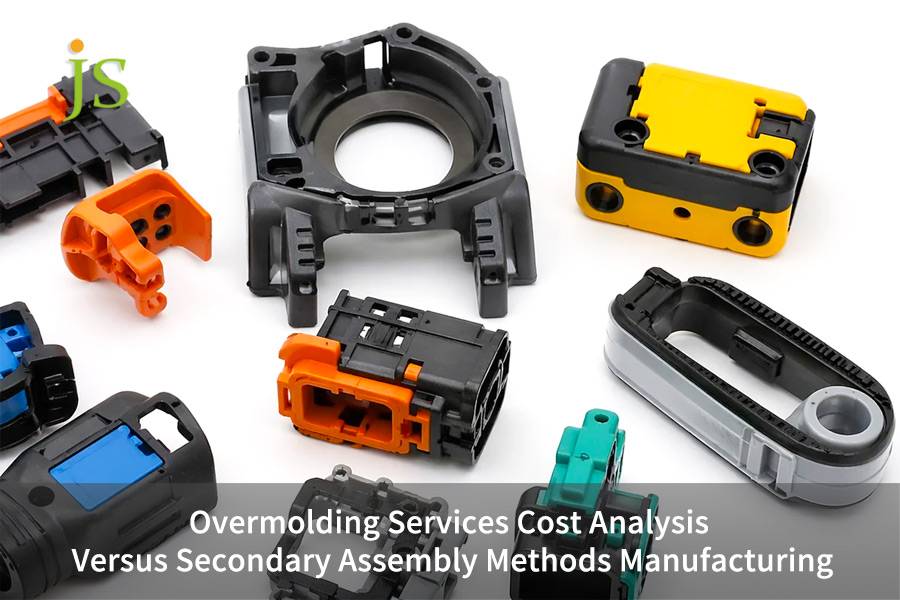

Overmolding services costis a very important factor that hardware engineers and buying managers have to consider when they plan the growth of multi-material, high-precision parts business from prototyping to mass production. Two-color injection molding or manual secondary mechanical fastening might look easy enough during the initial product design review,but if you do not precisely calculate the cost behavior during production scale-up, quite often, you would end up with a big loss in your profits.
To give you a hand in making sure that your investment in complex industrial, medical, and robotics products remains well protected, this complete guide to cost control and optimization explains the engineering basis of custom overmolding return on investment (ROI):
1. Total Cost of Ownership (TCO) Matrix:Looks at the contrasts between custom overmolding service and secondary assembly ones with mold costs, cycle time, and finishing steps.
2. Micro-engineering Boundary Deconstruction:Breaks down the four geometric parameters of multi-material structural components, analyzing mechanical interlocks, shear stress, runner residue, and interface temperature quantitatively.
3. Quantitative Cost Reduction Calculation Modeling:Offers production ROI calculation equations together with the JS Precision case study that depicts the cost and defect reduction results of process optimization.
Continue reading if you want to know how accurate choice of materials and very specificmold structure designscan help you reduce assembly defects and cost per component by a large margin.
Overmolding Services Cost and TCO Overview
|
Cost Driver
|
Custom Overmolding Service
|
Secondary Mechanical Assembly
|
Ultrasonic / Adhesive Bonding
|
|
Initial Tooling CapEx
|
High (multi-cavity mold 8,000-25,000)
|
Low (single-material mold 1,500-3,500)
|
Medium (special fixture 3,000-6,000)
|
|
Unit Labor & Cycle Cost
|
Very low (zero post-processing, 0.45-1.20)
|
Very high (manual assembly, 1.80-4.50)
|
High (curing & clamping, 1.20-2.80)
|
|
Production Break-Even Volume
|
Optimal ROI at volume >5,000 pcs
|
Cost advantage only for low volume <1,500 pcs
|
Suitable for low-stress medium & small batches
|
|
Component Defect & Failure Rate
|
<0.1% (automated parameter control)
|
1.5%-3.5% (manual misalignment & loosening)
|
1.0%-2.5% (adhesive degradation)
|
Key Takeaways:
- For production runs over 5,000 units Overmolding canhelp reduce per-component manufacturing costs by up to 65%as it totally eliminates manual secondary assembly on the production line when talking about component manufacturing.
- Amortization of mold cost is a major cost barrier at the initial stages.The product team must embed the Total Cost of Ownership (TCO) physical formula for dynamic break-even accounting in product design even before mold opening.
- To avoid interface delamination and breakage, chemical shrinkage rates need to be matched with the geometric-mechanical interlocking design which is a must engineering standard.
Why Trust JS Precision’s Expertise In Cost-Reducing Manufacturing For Overmolding Services?
From our hands-on experience in the large scale manufacturing of medical endoscope handles, the potential savings from overmolding arelargely dictated by how well the initial design work and production process control are combined. Our manufacturing chain from start to finish complies rigorously with theISO 9001:2015quality management standard, and we have established closed-loop verification points from DFM review to mass production shipment.
Our technical staff,with an average multi-material molding experience of most 12 years, are capable of foreseeing mass production risks involving material shrinkage and flash sealing, thereby preventing additional costs arising from repeated mold modifications. For medical-grade components, our cleanroom manufacturing operations are capable ofsatisfying stringent biocompatibility and dimensional stability requirements.
We have assisted clients in reducing piece manufacturing costs by 53% andmaintaining defect rates under 0.1%using mold structure improvements and fine process parameter adjustments. We are able to provide exact project solutions in line with different production volumes and precision needs, This way allowing clients to realize the highest possible ROI.
Mature engineering experience and standardized systems can mitigate mass production risks from the outset, reducing unnecessary mold modification and rework costs. You cansubmit part drawingsto receive a free DFM mold structure design and life asset assessment report from the JS Precision team, allowing you to lock in project cost boundaries in advance.
What Engineering Variables and Tooling Decisions Form the Core Drivers of Overmolding Services Cost?
One of the main factors that determine overmolding services cost is the level of complexity of mold cavity replication, substrate preheating protocols, cavity closing mechanism tolerances, and the geometric tolerances of the molded parts.By adjusting these components change in a design for manufacturing (DFM) stage, one could eradicate unnecessary mold modification capital expenditures.
Cost Impact of Mold Structure and Equipment Selection
Mold automation levels and structural design are two major variables that influence overmolding services cost, as they directly contribute to the initial investment and unit cost afterward.Main points that come into play are:
1. Rotary automated molds with very high initial investment but very short unit cycle times are appropriatefor high-volume mass production of tens of thousands of units. But, manual insertion and shifting molds with very low initial cost are operated manually, resulting in very low mass production efficiency.
2. The clamping force tonnage of the injection molding machine is determined by the part's projected area and Because of this it also changes theovermolding cavity pressure distribution. By increasing the projected area by 100 square centimeters,the required clamping force goes up by about 150 kN, and the equipment operating costs go up Because of this.
3. The more complex the core-pulling mechanism is, the shorter the mold maintenance cycle, but the higher the long-term maintenance cost.
The Long-Term Value of Mold Steel and Tolerance Control
Usually a professional overmolding manufacturing service chooses mold steel as the specifications of the project. The scientific overmolding mold steel selection is one of the factors leading to a balanced initial investment and long-term maintenance costs.A few core parameters of different steels are compared below:
|
Steel Grade
|
Hardness After Quenching (HRC)
|
Max Temperature Resistance (℃)
|
Nominal Molding Life (shots)
|
Relative Cost Coefficient
|
|
P20
|
28-32
|
250
|
300,000
|
1.0
|
|
H13
|
50-54
|
550
|
800,000
|
1.8
|
|
S136
|
48-52
|
300
|
600,000
|
2.2
|
|
718H
|
33-37
|
280
|
400,000
|
1.3
|
In short, more expensive steel calls for a larger amount to be committed during the first purchase. Yet, due to a longer life,it a lot decreases the amount of money spent yearly on the average piece of mold. And, to get rid of micro flash, the parting line sealing tolerance is kept to 0.02mm. Besides, the level of cutting line control of the overmolding is so stringent that it practically reduces the work of manual cutting.
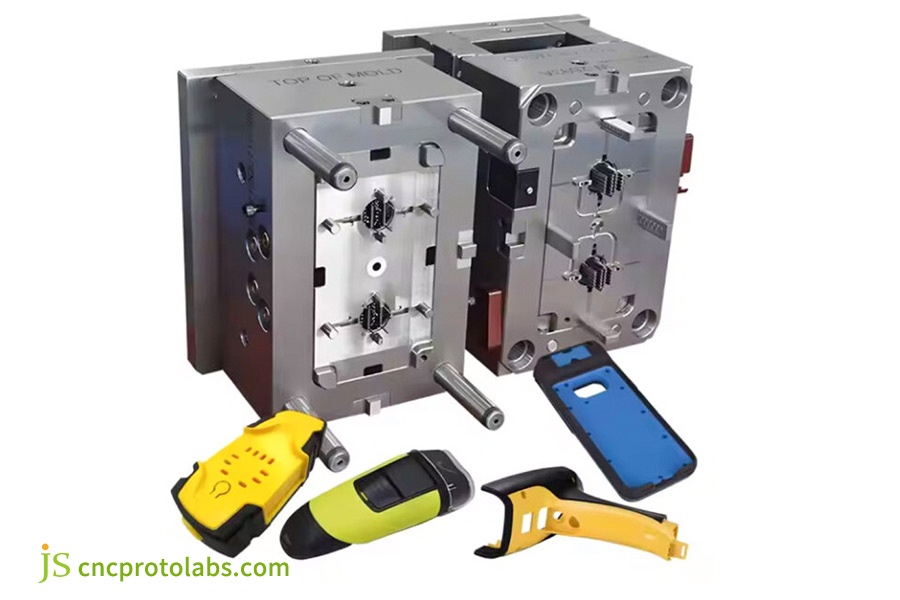
Figure 1: Precision injection molds and overmolded consumer products like power tool grips and phone cases.
How Can a Custom Overmolding Service Systematically Eliminate Secondary Assembly Manual Bench Operations?
By opting for acustom overmolding service, different resin layers can be integrated into one strong component only by one injection molding cycle, because of this completely removing the necessity for costlymanual secondary assembly, thread embedding, and gluing operationsat the production line source.
Mass Production Quality and Cost Risks of Secondary Assembly
Secondary assembly conducted traditionally depends on manual or semi-automated workstations and So has the risk of several errors during mass production.Labor reduction in overmolding assembly is the biggest reason for this process, and also the prime motivation for custom overmolding service to replace the whole technique:
- Manual operation and torque fluctuations and assembly misalignment can directly lead to 1.5%-3.5% of component failure risk.
- Assembly stations needfixtures, testing equipment, and labor costs, which keep on consuming production line resources.
- Adhesive or welding processes are prone to material aging and interface failure that can cause long-term reliability being not quite enough.
Mechanical Interlocking Strengthening Mechanism of Overmolding Injection Molding
Bonding principle is the biggest reason differentiatingovermolding vs secondary assembly. With overmolding injection molding, dovetail grooves, through-holes, and ribs are created on the substrate surface by using a mold.A well-thought-out overmolding mechanical interlocking design can boost the interfacial shear strength remarkably. Once the molten resin fills the cavities and cools, a strong mechanical interlock is formed plus molecular thermal entanglement resulting in a bonding strength that is much greater than that of assembly processes.
Consistent molecular bonding coupled with physical locking structures represent the main features that separate good overmolding manufacturing from mere adhesive bonding.
In other words,it's quite like making a mortise and tenon between parts and bonding themby the thermal fusion of molecules, the resulting strength and stability are several times better than screws or glue fixation.
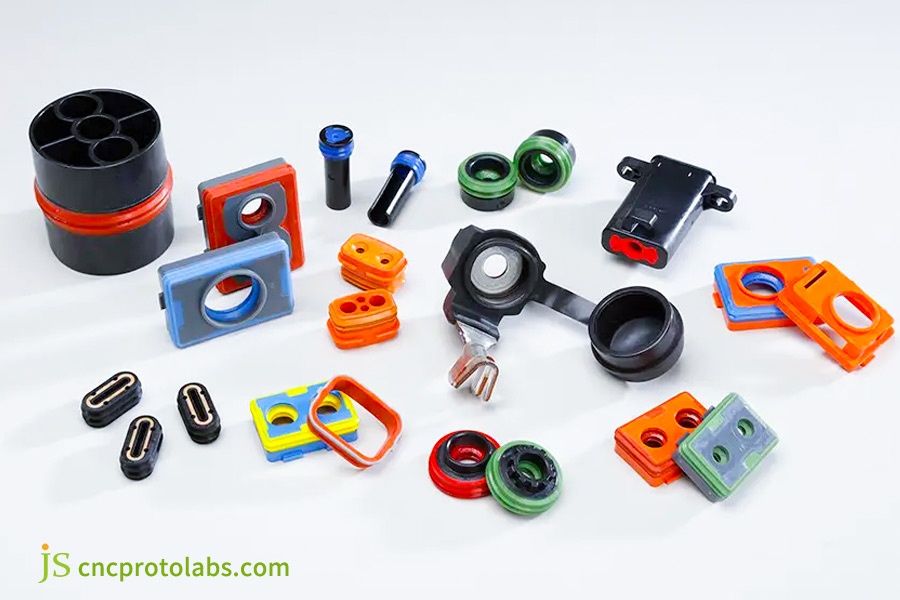
Figure 2: A diverse range of custom overmolded components in various colors and complex geometries.
At What Production Volume Thresholds Does a Low Volume Overmolding Service Outperform Mechanical Assembly?
Whether it is economically worthwhile to go with alow volume overmolding servicewill be decided by the time when the labor cost savings completely negate the initial capital cost of two-color molds.Typically for a complicated industrial part, this number is between 3,000 and 5,000 parts.
Mistaken Ideas about Small-Batch Overmolding Costs
Many people wrongly think that overmolding cannot be used for small-batch projects. This is mainly because they associate overmolding with fully hardened steel mass production molds. Actually, light weight overmolding low volume tooling cangreatly bring down the initial costs. Experts of low volume overmolding service can take down the initial level through using mild steel or aerospace-grade aluminum that allows rapid prototyping for validation and small to medium batch processes.
Progressive Changing of TCO as Production Volume Hierarchy
Production cost per item varies drastically between the use of a standardized overmolding manufacturing service andassembly relying on conventional methods, which in turn reflects the variation of break-even point in overmolding production.
A specific comparison is as follows:
|
Annual Production Volume
|
Secondary Mechanical Assembly (USD/pc)
|
Standard H13 Overmolding Tool (USD/pc)
|
Aluminum Rapid Overmolding Tool (USD/pc)
|
|
500 pcs
|
3.20
|
18.50
|
7.80
|
|
1,000 pcs
|
3.00
|
10.20
|
5.10
|
|
3,000 pcs
|
2.80
|
4.50
|
3.20
|
|
5,000 pcs
|
2.70
|
3.10
|
2.90
|
|
10,000 pcs
|
2.60
|
1.90
|
Not applicable
|
The core optimization methods for achieving low volume overmolding include:
1. The use of standard mold bases with modular cavity inserts will help tominimize duplication of investment in mold bases.
2. Utilize a single-cavity design to reduce mold processing complexity and cycle time.
3. Simplify the runner and cooling system toa more efficient small batch process.
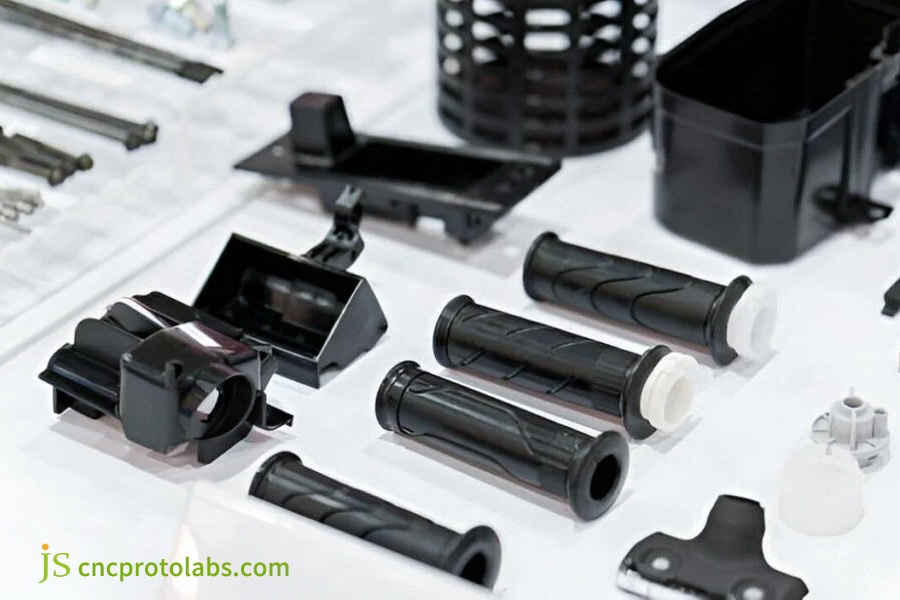
Figure 3: High-performance black engineering plastic components produced via precision molding processes.
What Methods Quantify a True Overmolding Service ROI Versus Secondary Assembly and Fastening Techniques?
Scientifically evaluating theovermolding service ROItakes a detailed total cost of ownership (TCO) calculation model that includesupfront mold amortization, unit material costs, production line labor hours, and scrap rate adjustment factors.
TCO Calculation Model Explained
To identify accurately the cost difference between overmolding services and traditional processes,a complete TCO model must be created.An overmolding TCO calculation model that is standardized can include all cost factors through the product lifetime. Below is the formula for secondary assembly overall cost of ownership:
TCO_Assembly = T_Sub + T_Over + (V [P_Sub + P_Over + L_Assembly]) 1 / (1 - R_Scrap)
Definition of variables:
- T_Sub and T_Over represent the mold expenditures for base material and overmolding respectively.
- V refers to the total production quantitywhile P_Sub and P_Over are the unit prices of the respective materials.
- L_Assembly is the labor cost for manual assembly of one unit, R_Scrap - the percentage of scrapped units in the whole process.
Cost Analysis Logic for Payback Period in Mass Production
By comparing the entire lifecycle expenditure of overmolding vs secondary assembly, the difference in their TCO can be used to find the payback period for overmolding.This period is the break-even volume necessary to justify the extra investment in molds. Since labor costs and scrap rates per unit are lower in overmolding, the cost benefit will become more evident as output increases.
This costing tool is the central method for estimating the overmolding service ROI. In essence, the same formula is used for calculating long-term investment payback andit must include costs in all areas, i.e. materials labor, and scrap, to get a true comparison.
Accurate TCO calculation helps decision-makers clearly determine the long-term benefits of process selection. You cancontact the JS Precision teamto obtain an interactive Excel-based automatic TCO and ROI calculation tool to quickly calculate the project's payback period.
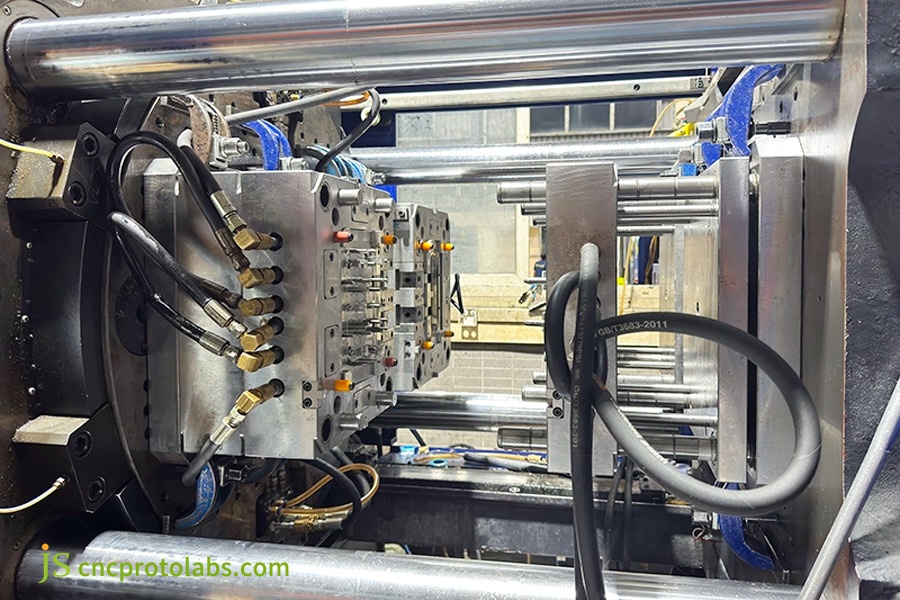
Figure 4: High-tonnage injection molding machine internal mechanism.
How Does Insert Molding vs. Overmolding Cost Behave When Amortizing Tooling CapEx and Cycle Efficiencies?
The fundamental challenge in comparing the insert molding vs. overmolding cost lies in striking the right production trade-off whereinitial slightly higher mold development costs are offset by shorter cycle timesin the long-term due to elimination of manual insert placement.
Underlying Technical Differences Between the Two Processes
Before sorting out the differences betweeninsert molding vs. over molding cost, it is necessary to clarify the process logic of both. Both insert molding and overmoldingstart with a conventional injection of molten polymer into a mold, but the first involves simply placing the insert in the mold before material injection, whereas the two-color overmolding operates quite differently: it involves the sequential injecting of two types of material into the same mold using a rotary table - Because of thisremoving the need for additional automation of overmolding insert placement.
The major differences refer to:
1. The insert is preheated before the process to achieve a certain result inside the module (stress distribution), which makes stress control thatmuch more difficult for insert molding.
2. At a certain level of automation, insert molding can become robotic load implemented but in this case, the cost of reworking the equipment is higher than that of 2-color injection molding.
3. The parting line of the insert molded part is affected more by the substrate tolerances andso it is more likely that flash will occur.
Cost-effectiveness comparison at mass production scale
Research finds, the starting mold expense forinsert moldingis 30%-40% less than that of the overmolding injection molding,but the cycle time per part is 20%-30% longer. When production goes beyond 10,000 pieces, custom overmolding service that are already mature in the market, with their continuous overmolding cycle time reduction and zero misalignment risk, get a cost advantage over insert molding,the advantage is only getting biggerif the production volume keeps on increasing.
How Can Engineers Prevent Interfacial Delamination Caused by Thermal Discrepancies and Shrinkage in Overmolding Manufacturing?
Overmolding manufacturing that is perfect depends mostly on the melt compatibility of two heterogeneous resins at the interface.To completely avoid the occurrence of delamination defects, their heat distortion temperature (HDT) and anisotropic chemical shrinkage rate should be matched with each other in a very accurate manner.
Material Compatibility by Core Parameter Matching
It is an essential first step to accurately match the material parameters to guarantee the bonding strength of the interface inovermolding manufacturing. Proper scientific overmolding material compatibility matching will be an effective preventive measure against delamination.The key parameters for material combinations commonly used are:
|
Substrate Material
|
Overmold Material
|
Substrate Shrinkage (%)
|
Overmold Shrinkage (%)
|
Recommended Melt Temperature (℃)
|
Interfacial Shear Strength (MPa)
|
|
PC
|
Medical grade TPU
|
0.5
|
1.2
|
230-240
|
12-15
|
|
PA30%GF
|
TPE
|
0.4
|
1.5
|
240-250
|
8-10
|
|
ABS
|
TPR
|
0.6
|
1.1
|
220-230
|
10-12
|
|
PEEK
|
Fluororubber
|
0.3
|
1.8
|
360-380
|
6-8
|
Mechanical Interlocking Design of Geometric Structure
Merely relying on hot melt bonding of materials is not enoughto cope with high stress scenarios. Professionalovermolding manufacturing servicewill supplement mechanical interlocking through structural design, and use overmolding shrinkage difference compensation to counteract internal stress.
The core design points include:
- Design a total V type at the edge of the base material.
- Design anti-reversal grooves or through-hole undercutwith the depth of not less than 0.5mm.
- Use a progressive wall thickness design to eliminate as far as possible the stress concentration in the area of transition as well as the uneven shrinkage with sudden change in wall thickness.
Gate position should be improved so as not to allow high pressures melt to directly gouge thin-walled sections of substrate. Proper material matching and structural design can eliminate the risk of delamination from the source. You can send your project material list to JS Precision's senior process engineer for free advice on heterogeneous material compatibility design optimization.
What are the True Precision Tolerance Boundaries Achievable with an Advanced Overmolding Manufacturing Service?
By using high-precision overmolding manufacturing service, through closed-loop speed control and dynamic multi-segment holding pressure parameters, the form and position tolerances of main assembly contact surfaces canvery closely be controlled within the extreme limit of ±0.05mm.
Shrinkage Compensation Mechanism in Secondary Molding
Initially, the first injection of the substrate causes a slight shrinkage. A top-notch overmolding manufacturing service will pre-compensate for the shrinkage byadjusting the cavity size before secondary overmoldingto achieve high-precisionovermolding dimensional tolerance control. At the same time, the flow path balance design makes sure that the melt from multiple cavities reaches the core at the same time, doing away with core deformation caused by localized over-pressure and ensuring dimensional consistency.
Micron-level Tolerance Quality Assurance
We have a Zeiss coordinate measuring machine and a Keyence imaging measuring instrument thatallow high-precision, non-contact inspection of low-hardness elastomers. Standardized overmolding non-contact inspection is an integral component of the quality control chain for high-end custom overmolding service.
Some of the core inspection standards are:
1. Geometric tolerances of key assembly surfaces conform to 0.05mm.
2. Parting line flash height iscontrolled within 0.02mm,thereby excluding the necessity for manual trimming.
3. Dimensional dispersion of multi-cavity products is controlled within 0.03mm.
JS Precision Case Study: How Custom Engineering Solved Delamination and High Tooling Costs for a Medical Endoscope Handle Assembly?
This comprehensive review of a mass production case study highlights how JS Precision managed toremove the two main bottlenecks (heterogeneous material delamination and high scrap rate)in the manufacture of a high precision medical endoscope handle through a structural redesign and automated mold upgrades.
Client Challenges
A European medical device manufacturer faceda 4.2% delamination rate of the soft medical elastomerfrom the 30% glass fiber reinforced nylon when manufacturing surgical handpieces. The client could not figure out an effectiveovermolding delamination defect solutionfor a long time, and the high defect rate kept increasing the cost of overmolding services. The original supplier used two sets of single-cavity molds plus manual gluing, which resulted inchemical residues, uneven torque, and a single-piece cycle timeof up to 75 seconds, leading to high labor costs.
JS Precision Solution
Our engineering team fully took over the project,simultaneously optimizing both the structure and process, and using precise overmolding melt temperature control to improve the interface bonding strength:
- The substrate CAD edge was designed with 0.8mm continuous mechanically closed grooves to create a physically interlocking structure.
- The mold was upgraded to a two-color rotary injection mold, Swedish Uddeholm H13 steel was used, andthe mold hardness is HRC 52±2.
- A secondary injection pressure of 110MPa was set, and"melt temperature was optimized to 235℃"through mold flow analysis. To melt the substrate surface while avoiding erosion deformation, a low-speed, high-pressure injection process was adopted.
Lessons Learned from Failures
T1 trial molding was uneven thermal expansion of the large core area resulted in 0.03mm flash at the sealing area. We solely useda 3° mismatched taper bevel sealing solution, which makes use of local elastic deformation to completely eliminate flash without increasing the injection molding machine tonnage.
Final Results
The final mass production verification indicated that the scrap rate of the interface delamination decreased from 4.2% to below 0.08%,and the cycle time for a single part was reduced from 75 seconds to 39 seconds.Manual assembly was completely eliminated, and it was shown that a mature custom overmolding service can effectively solve the quality and cost challenges of multi-material molding.
This overmolding medical part optimization solutioncut the overall manufacturing cost per part by 53%. The client's chief R&D engineer remarked that the solution solved a delamination problem that the client had been struggling with for months by producing parts with perfect dimensions, no flash, and compliance withISO 13485:2016 standards.
Extensive frontline troubleshooting experience allows for rapid resolution of mass production challenges, ensuring efficient project implementation. You can view more successful case studies of JS Precision's high-difficulty two-color overmolding manufacturing to understand process optimization paths in different industries.
Why Choose JS Precision as Your Strategic High-Precision Overmolding Manufacturing and Sourcing Partner?
When you choose JS Precision as your main B2B supplier of manufacturing, it means your projects will have a direct link with the state-of-the-art multi-color, multi-shot injection molding machines, trained on-site DFM R&D engineers, anda comprehensive closed-loop compliance quality control system.
Our manufacturing system is certified under the ISO 9001:2015 quality management standards. We operate a range ofprecise injection moldingmachines from 50 to 450 tons,which allow us to have a steady supply of high-quality custom overmolding service. Automated servo robots have been integrated into our process and with these fully automated robots, we can do everything from small-batch rapid prototyping to mass production of hundreds of thousands of pieces.
Once you upload your drawings, a senior process engineer will dedicate one-on-one assistance to you, using mold flow prediction, tolerance chain optimization, and mold life management toimprove production timelines and minimize mold changes. We provide open cost analysis and live production status updates, meeting at the same time the requirements for large-scale mass production and low-volume overmolding service small-batch verification, which makes us a strong technical partner for hardware innovation teams.
FAQs
Q1: Which core mold geometry features directly determine the initial mold opening cost of a custom overmolding service?
The complexity of the parts, the number of cavities, and the steel grade influence the cost of a custom overmolding service. Two-color molds needa rotating turntable and a tightly sealed adhesive surface. Although H13 steel raises the initial expenditure by 25%, it can perform 300,000 cycles without wear, So it effectively amortizes long-term costs.
Q2: How does JS Precision ensure extremely high surface peel strength between two dissimilar materials in custom two-color overmolding manufacturing?
We use both molecular thermal bonding and geometric physical interlocking for strength. Resin polarity is checked during the DFM stage, andvarious injection parameters are adjusted in a closed loopto allow melting of the substrate surface and polymer chain interweaving.
Q3: Is a low minimum order quantity two-color injection molding service economically viable for medical or electronic components with a production volume of less than 1,000 units?
Amortizing the cost of a fully automated two-color mold becomes challenging if the production volume is below 1000 units. We propose embedded molding alongsideusing a standard mold base and aluminum cavity. This versatile method can halve the cost of mold opening and is considered the best option for low-volume production.
Q4: What is the typical engineering cycle from design to T1 trial molding for a typical two-color overmolding high-precision mold?
A typical two-color injection molding engineering cycle isfrom 25 to 35 working days. A DFM and mold flow analysis is done in 3 days, after that the mold drawing review and processing heat treatment takes place within 5 days, and finally, samples and preliminary FAI dimensional inspection reports are provided on the same day as T1.
Q5: When designing soft overmolding edges, how should the product development team reduce or even completely eliminate flash at the parting line?
The "sealing barrier" design is the biggest reason in flash elimination.A straight-walled step with a draft angle of 3°-5°, and a depth of 0.5mm, should be cut in the CAD to act as a physical barrier preventing melt overflow during mold closing, Because of this avoiding a gradual bevel at the edge of the soft plastic.
Q6: When resisting harsh outdoor environments and frequent cleaning, can the sealing gaskets of secondary mechanical assembly replace the direct overmolding integral seal?
Manual placement of O-rings as in traditional assembly often results in uneven torque, gasket twisting, and leakageleading to inadequate long-term stability. In contrast, two-color injection molding overmolds TPE into a rigid groove, thereby making it an integrated seal and one that can reach the IP68 waterproof rating.
Q7: How can I stop macroscopic deformation or localized warping of rigid plastic substrates when secondary high-temperature and high-pressure melt impact is involved?
Control the cooling water and adjust internal stress between the two injections have to be balanced. The substrate should becompletely and uniformly cooled in the mold in the first stage. While performing secondary molding, the gate location should be changed so that the thin walls are not directly hit, and also the back support core should be constructed to physically restrict the substrate from being pressed into the high-pressure phase.
Q8: What kind of input data do we need to provide to get a highly accurate, financially auditable quote for two-color injection molding and mold making?
There are two sets of data that you have to provide to us: first, a set of3D CAD drawings(STEP or IGES format) showing the base material and the overmolded object. Second, a list of technical requirements includingresin grade, annual production volume, minimum order quantity and surface requirements.
Summary
In industrial manufacturing environments striving for maximum cost-efficiency and zero defects, merely comparing the initial purchase price of molds isreally not enough for procurement at the highest level. Hardware development teams need to take a big-picture view of total cost of ownership (TCO). As the models and case studies in this piece point out, while the initial cost of overmolding injection molding is quite high, mass production can mechanize what were previously individual manual operations, among other benefits, like a substantial reduction inlabor costs, less material waste, and better sealing performance over time.Control over interface heat melting, shrinkage matching and sealing tolerance are what determine the return on investment over the full lifecycle of the project.
Do not allow initial mold development uncertainties to stop your product launching.Send multi-material 3D CAD designsto JS Precision without delay. Senior engineers who work on-site will issue a complete DFM (Design for Manufacturing) feasibility report within 24 hours and will prepare the most ROI-competitive tiered production plan and unit price for you.

Disclaimer
The contents of this page are for informational purposes only. For JS Precision Services, there are no representations or warranties, express or implied, as to the accuracy, completeness, or validity of the information. It is the buyer's responsibility to identify specific technical requirements and request a formal parts quotation. Please contact us for more information.
JS Precision Team
ustom manufacturing solutions. With over 15 years of experience serving more than 1,000 customers, we specialize in high-precision CNC machining, sheet metal fabrication, 3D printing, injection molding, and metal stamping. Having successfully delivered over 300,000 precision parts, we maintain a 99.2% on-time delivery rate across all custom projects.
Our facility is equipped with over 100 state-of-the-art 5-axis machining centers and is ISO 9001:2015 certified. We deliver fast, efficient, and high-quality manufacturing solutions to B2B clients across 150 countries. Whether you require low-volume prototyping or large-scale customization, we support your project with lead times as short as 24 hours. Choose JS Precision for unparalleled efficiency, quality, and professionalism.
To learn more or submit your RFQ, visit our website: www.cncprotolabs.com
Resource