English




Precision CNC turning services are one of the key support technologies for manufacturing components for industrial automation.
When the repeatability of robot joints must be as tight as ±0.02mm, and actuators are expected to run without any flaws for 10, 000 hours, how sure are you that your precision component supplier can really deliver such high end demands?
Generally, engineers find it very difficult to meet precision, delivery and cost issues simultaneously especially when it comes to automated component machining.
This article aims at clarifying how exactly precision CNC turning services determine industrial automation and assist you in making the right manufacturing decisions.
Quick Overview of Core Answers
| Core Dimensions | Core Dimensions | Value for You |
| Process Performance | CNC lathe equipments can do work with permitted errors of ±0.01mm and surface roughness Ra of 0.4μm, which can be robot joints and robot axes. | Have a guarantee that the parts moving fit get very precisely and that the whole system gets more reliable. |
| Quality Norms | ISO 9001:2015 is the basic quality management standard, AS9100 is for aerospace, and AGMA 12 is the standard for gear accuracy. | Select the suitable standard for your application to avoid unnecessary expenses. |
| Costs Factors | Material costs 30-40%), tolerance requirements (±0.01mm is 40% more expensive than ±0.05mm), batch size determines the unit price. | By understanding the cost structure and improving the design, you can save up to 20-30%. |
| Supplier Selection | Verify the machinery (multi, axis turning centers), review the types of inspections (CMM full inspection capabilities), and check case studies (experiences in automation industry). | Partner with a machining supplier who really understands automation. |
Key Conclusions
- Accuracy threshold: ±0.01mm is the watershed, and stricter tolerances require additional grinding processes, resulting in a cost increase of 40-60%.
- Material wise: 7075 aluminium is the lightest (60% less weight), 17-4PH stainless steel stands up to corrosion, and PEEK plastic is fine for small loads.
- Watch out for the batch effect: unit cost drops by 40-60% when production increases from 10 to 100 pieces, key is the cost amortization of debugging.
- Inspection level: DVT/PVT full process verification can cut down 80% of mass production problems.
Why Trust This Article? JS Precision's 20+ Years In CNC Machining What Are Precision
JS Precision has a long history of involvement in precision manufacturing. Especially its CNC turning process technology is among the industry's leading ones.
We have delivered more than 2 million CNC turned parts globally over these years, working mainly with industrial robots, vehicle automation, and medical equipment.
This article discloses the CNC machining secrets of how to produce high precision parts at low cost, based on real production data and processes verification cases. All the process parameters of the article meet the dimensional requirements of the ASME Y14.5-2018 standard.
JS Precision is one of the leaders in precision CNC turning services. We have more than 50 multi axis turning centers and Swiss type lathes in our workshop, allowing us to produce parts with a tolerance of ±0.001mm.
Besides aerospace and industrial automation, high end extremely tight tolerance job is a specialty.
More than 1000 component projects for industrial automation have been carried out by this team, which also has resolved over 200 most common industry pain points issues.
Not to mention that actuaetor seal failure, and insufficient robot joint fit precision are among the problems solved.
Last but not least, just as one example, re design of joint axes components for a well known robot company not only reduced the overall failure rate of the machine from 1.2% to 0.1%, but also it allowed the company to shorten its delivery time by 50%
CNC turned parts at JS Precision are fully inspected by CMM and SPC process control. Their quality system is based on international standards like ISO 9001:2015 and AS9100D, which allows them to meet the demanding requirements of top, tier clients such as Automation Solutions Inc.
More than twenty years in the industry have equipped us with a profound knowledge of precision CNC turning as well as a thorough understanding of industrial automation component requirements. We are capable of delivering comprehensive services to clients starting from design optimization all the way to mass production and delivery.
If you are struggling with the machining accuracy, delivery time, or cost of precision automation components, contact JS Precision engineers now for a customized precision CNC turning services solution. Let our professional team safeguard your project.
What Are Precision CNC Turning Services And How Do They Enable Robotic Arm Manufacturing?
Robot arm mass productiondepends on precision CNC turning services as a basis. CNC turning, which is the main method, is actually responsible for ensuring the high accuracy of parts in industrial automation technologies.
Precision CNC Turning Services: What They Are and Their Technological Base
Precision CNC turning services refer to computer, controlled rotary cutting processes that turn bar stock into precision cylindrical components, these components are essential for supporting robot joint movement and power transmission.
Automation Technologies and Turning Processes
In industrial automation technologies, the accuracy of ±0.02mm repeatability and stability in operation are traits directly impacted by components such as joint shafts and harmonic reducers manufactured through precision CNC turning.
Raw Material to Finished Product: The Whole Production Cycle
At JS Precision, the precision CNC turning capability extends from bar preparation to final cleaning and packaging. By metric high precision CNC machining, the components are brought up to the level required by automation systems.
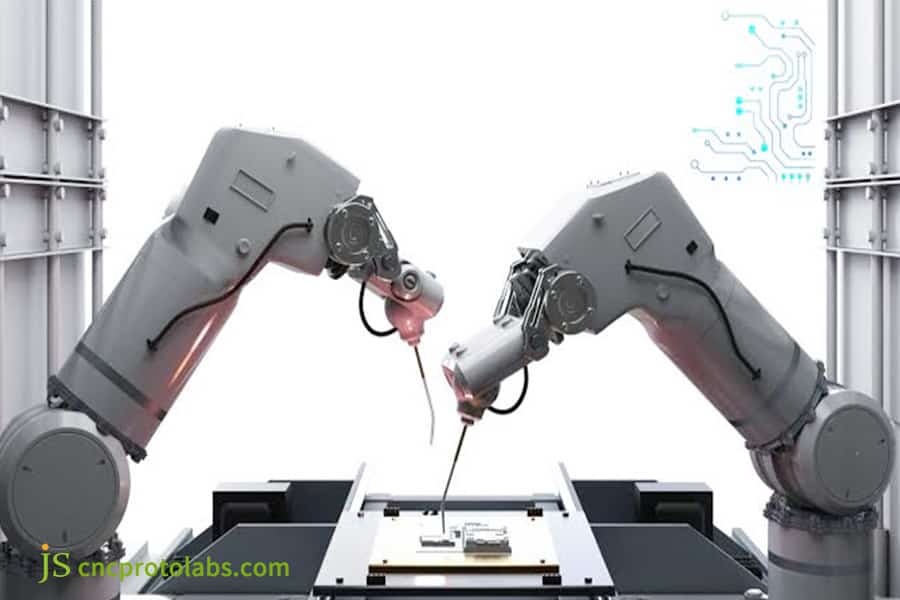
Figure 1: Two industrial robotic arms work in tandem on a CNC machining task, with one positioning a metallic component and the other performing a precision operation, set in a modern manufacturing environment.
Why Is High Precision CNC Machining Essential For Industrial Automation Technologies?
Industrial automation technologies require components to be more precise and stable than ever. High precision CNC machining, as a high-level application of precision CNC machining, is the core means to meet requirements and determine device performance.
Physical Basis of Repeatability
The robot repeatability of ±0.02mm is possible thanks to high precision CNC machining which makes sure that errors are removed, with the CNC turned parts having mating clearance ≤0.01mm.
Thermal Stability under High Speed Operation
Even when the automated equipment run without a break, high precision CNC machining combined with material like titanium alloy can be used to control thermal deformation of parts to ≤0.01mm, which is enough for the requirements of temperature rise and fit of industrial automation technologies.
Fundamental Guarantee of Lifespan and Reliability
A design life of 10, 000-20, 000 hours for actuators means that high precision CNC machining is necessary to control the surface integrity of components. This will result in over 30% increase in fatigue life, among other things.
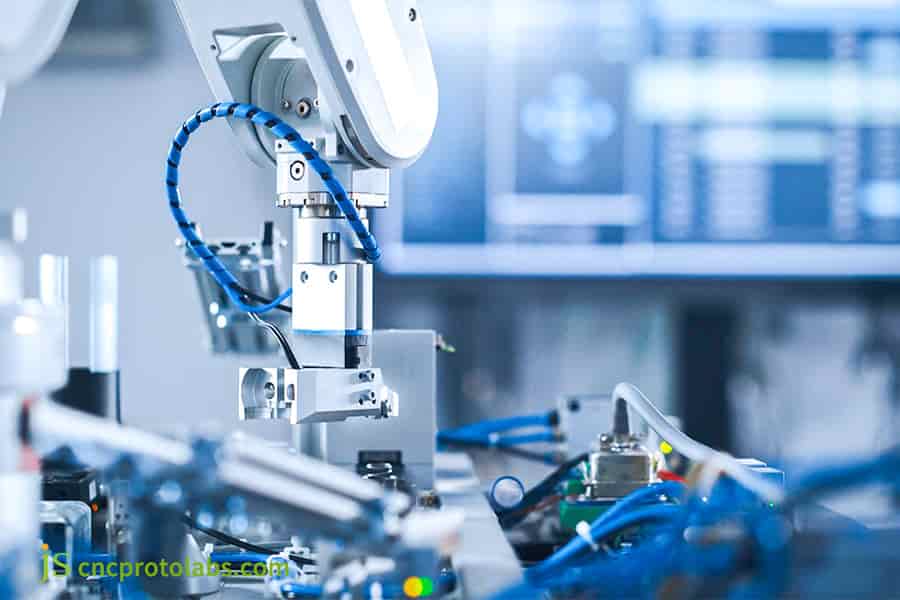
Figure 2: A close-up view of a CNC machine in the process of precision turning a metallic part, with a robotic arm visible in the blurred background of an advanced factory.
What Key Automation Components Can Precision CNC Turning Manufacture?
Precision CNC turning services have the capability of working on different core cylindrical elements in the automation industry. With high precision CNC machining the accuracy and performance of CNC turned parts is ensured, including robots, actuators and other equipment.
High Precision Components of Robot Joints and Arms
Different CNC turned parts are utilized in robot joint harmonic reducers, bearings, etc. High precision CNC machining is able to secure co, ordinations clearances ≤0.01 mm and Ra ≤0.4μm, thus aligning perfectly with the precision requirements of industrial automation technologies.
Gears and Shafts for Various Transmission Systems
Transmission systems require CNC turned parts such as servo motor shafts and planetary gear carriers. Through precision CNC turning, it is possible to produce parts at AGMA 12 level precision (tooth pitch error ±0.007mm) that fulfill the requirements for high speed and heavy load.
Techincal Actuator Housings and Main Structural Parts
Parts like actuator cylinder barrels and hydraulic valve sleeves with sealing surface precision controlled by precision CNC turning (cylindricity ≤0.005mm) have been giving solid support to clients like Automation Solutions Inc.
Machining Parameter Table for Core Turning Components in Automated Systems
| Component Name | Machining Tolerance | Surface Roughness Ra | Applicable Material | Core Process |
| Robot Joint Axis | ±0.005mm | 0.2μm | 17-4PH Stainless Steel | Multi-axis Turning + Grinding |
| Servo Motor Axis | ±0.01mm | 0.4μm | 40Cr | Precision Turning + Heat Treatment |
| Cylinder Barrel | ±0.008mm | 0.4μm | 6061 Aluminum | Honing + Finish Turning |
| Planetary Gear Carrier | ±0.01mm | 0.8μm | 20CrMnTi | Milling and Turning Composite |
| Hydraulic Valve Sleeve | ±0.003mm | 0.2μm | Brass H62 | Mirror Turning |
What Quality Standards Apply To CNC Turned Parts Used In Actuator Assemblies?
The quality of CNC turned parts directly affects the performance of equipment. High precision CNC machining needs to be compatible with international standards.
A precision CNC machining quality system is one of the ways of ensuring that the implementation of these standards does happen and that the demands of high end customers are met.
Understanding International Quality Standards
CNC turned parts can be aligned with various international standards such as ISO 2768-M, AGMA 2000, ISO 9001:2015, and AS9100D depending on their application scenario.
Key Quality Indicators for Actuator Components
For actuator CNC turned parts, the focus must be on precision CNC machining to be able to regulate the main indicators of the parts, which are sealing and wear resistance. The main indicators are cylindricity 0.005 mm and surface roughness (Ra) 0.4 μm.
Inspection Plan: Verification Process from First Article to Mass Production
- Prototype Stage: Full inspection with a CMM + 3D scanning to confirm the conformity of the drawing and the physical product.
- EV R/DVT Stage: Engineering verification to confirm load requirements compliance away.
- Mass Production Stage: SPC control + batch sampling inspection to ensure batch consistency.
Actuator Component Quality Standards and Inspection Methods Correspondence Table
| Quality Indicators | Standard Requirements | Inspection Equipment | Inspection Frequency |
| Dimensional Tolerance | ±0.01mm | Coordinate Measuring Machine | First article full inspection, mass production sampling inspection 10%. |
| Surface Roughness | Ra≤0.4μm | Roughness Tester | Batch sampling inspection 20%. |
| Cylindricity | ≤0.005mm | Roundness Tester | First article full inspection, mass production sampling inspection 5%. |
| Hardness | HRC 50-60 | Rockwell Hardness Tester | Batch sampling inspection 15%. |
| Coaxiality | ≤0.01mm | Runout Tester | First article full inspection, mass production sampling inspection 8%. |
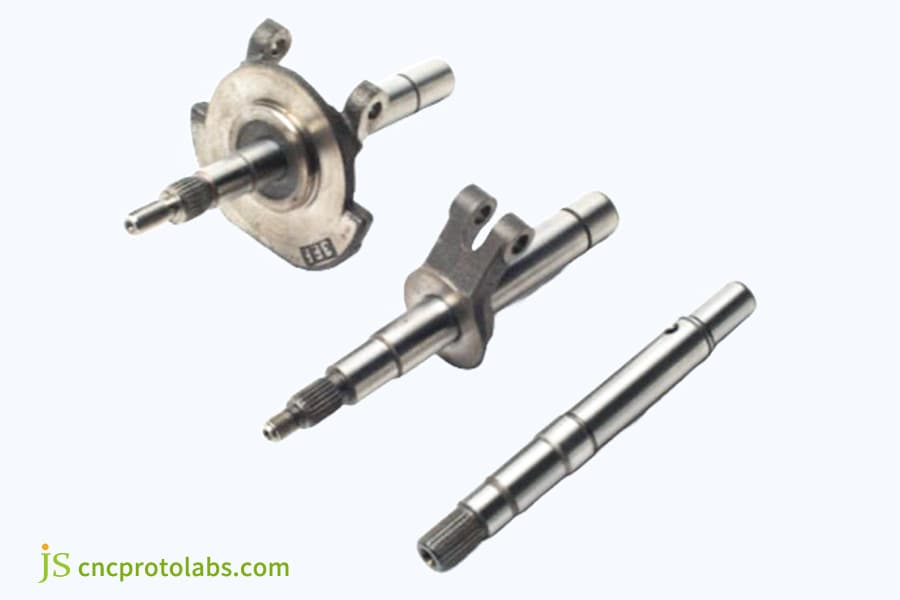
Figure 3: Three precisely machined stainless steel shafts with features like splines and keyways, displayed on a neutral background.
What Is The Difference Between Machining Turning And Other Processes In High Precision Applications?
In the field of high precision CNC machining, machining turning complements processes such as milling and grinding. Precision CNC machining is the core quality requirement, and multi process collaboration can achieve optimal machining results for CNC turned parts.
Turning vs. Milling: Rotational Symmetry vs. Complex Geometry
Machining turning perfectly fits the production of shafts, which are rotationally symmetrical and can be machined with only one setup.
On the other hand, milling fits non rotational structures like housings. Moreover, both of these technologies can use a turning milling combined process to avoid secondary setup errors.
Turning vs. Grinding: Efficiency vs. Ultimate Precision
Efficient precision CNC machining can produce parts with a tolerance between IT6 and IT7 (±0.01mm).
On the other hand, grinding can bring out still higher accuracy at the cost of longer processing times. ±0.01mm can very well serve as the benchmark between the two processes.
Turning vs. Additive Manufacturing: Batch Size vs. Complexity
- Machining turning: Medium to large batch sizes can be processed by machining turning, in fact, precision CNC turning can drastically cut the costs of batch production.
- Additive manufacturing: Complex structures can be built by additive manufacturing, however, they will need machining turning afterward to be finished.
- Complementarity: The combination "Additive manufacturing + turning" can give structural complexity and surface precision at the same time.
Want to choose the optimal process combination for your high-precision parts? JS Precision engineers can compare the cost and precision of machining turning with other processes based on your part requirements and provide you with a free cost calculation.
How To Consider Cost When Choosing Precision CNC Turning Services?
Pricing for provision of high precision CNC turning services depends on a number of factors. The very design and batch size of CNC turned parts are main keys to cost optimization, understanding their composition can go a long way in making machining more cost effective.
Main Factors Affecting the Price of CNC Turned Parts
Materials (30-40%) and tolerance requirements play major roles in the cost of precision CNC turning. For example, machining to ±0.01mm precision costs about 40% more than ±0.05mm.
Ways to Align Budget and Performance Requirements
Adopting a graded precision strategy can balance cost and performance: high precision CNC machining is not required for non mating surfaces, precision CNC machining is used for critical mating surfaces, and special benchmarks are combined with turning and grinding processes.
Cost Advantages of Long Term Partnerships and Batch Production
Going from 10 to 100 pieces in batch size can result in 40-60% unit cost reduction of CNC turned parts. Making a yearly contract with JS Precision will help in securing the production capacity and cutting down costs of procurement in the long run.
Reference Table for CNC Turning Unit Costs with Different Batch Sizes and Tolerances (Taking 7075 Aluminum Shaft as an Example)
| Batch Size (pieces) | ±0.05mm Tolerance (USD/piece) | ±0.01mm Tolerance (USD/piece) | ±0.005mm Tolerance (USD/piece) |
| 10 | 85 | 120 | 180 |
| 50 | 55 | 77 | 110 |
| 100 | 32 | 45 | 68 |
| 500 | 20 | 28 | 42 |
| 1000 | 15 | 21 | 31 |
What Are Some Successful Automation Solution Application Cases?
JS Precision has helped industrial automation technologies by offering precision CNC turning services to solve many component problems. Our CNC turned parts have been used in various industries, and our partnership with Automation Solutions Inc is a proof of our very precise CNC machining tools and techniques.
Case Study 1: Manufacturing Example of Complex Robot Components
- Challenge:
Components of the six axis collaborative robot joints of a European robot manufacturer (made of 17-4PH stainless steel, with critical tolerance ±0.005mm, surface roughness Ra 0.2μm) produced a yield of only 82% when sourced from the original supplier, which led to serious delivery delays and the overall robot's mass production being disrupted.
- Solution:
JS Precision took measures to help and a high precision CNC machining solution was implemented. For maximum efficiency, internal and external cylindrical machining were performed in a single mill turn setup.
Finishing cuts were done with CBN tools to minimize the effects of thermal deformations during the cutting process. At the same time, 100% CMM inspection and surface roughness sampling were carried out. For sea freight, vacuum packaging and independent compartments were used to prevent corrosion.
- Results:
The yield of components was raised to 98.5%. Price per unit was reduced by $22. Delivery schedule was cut down from 18 weeks to 10 weeks. The overall robot's repeatability accuracy was maintained inside ±0.02mm, which is in line with application requirements of industrial automation technologies.
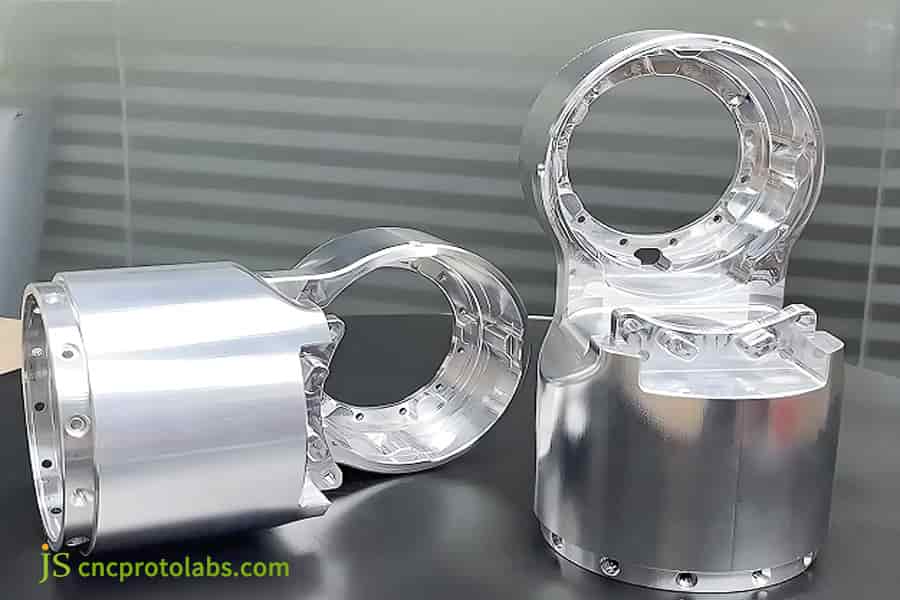
Figure 4: Two finished, complex robotic arm joint components made of stainless steel, showcasing a high-quality machined finish.
Case Study 2: Tailor Made Gear Solution to Increase Production Line Efficienc
- Challenge:
Noise level of the gearbox in a transmission line of Automation Solutions Inc. was beyond permissible limit (78dB), and the gear only lasted for less than 5000 hours. The main issue was the lack of precision in gear machining.
- Solution:
After the finishing of gear blank with precision CNC turning, JS Precision gear experts influenced the profile of gear teeth for better meshing (8μm of camber) + carburizing and quenching (HRC 60±2) + gear grinding (AGMA 12 grades), which was the best combination of gear treatments.
Accuracy was strictly controlled by using high precision CNC machining for all processes.
- Results:
The noise of the gearbox was cut down to 68dB, gear life was tripled to 15000 hours, transmission efficiency of CNC turned parts was shot up by 15%, and production line's operational stability was greatly enhanced.
Case Study 3: Top notch Linear Module Slider Component Solution
- Challenge:
A North American automation integrator was determined to get their hands on linear module slider components with high performance but at a low price. The components imported originally were too high priced, so they adversely impacted the competitiveness of the product on the market.
- Solution:
JS Precision selects high quality 20CrMnTi, made in China, to substitute for imported materials, keeps the most important quenching processes, and by precision CNC turning, not only are the tolerances on the non mating surfaces optimized, but the machining difficulty is also reduced without compromising the requirements of high precision CNC machining for the critical mating surfaces.
- Results:
Component material costs were reduced by 35%, unit costs decreased by $18, performance fully met design requirements, and the customer's annual purchase volume increased from 5,000 units to 30,000 units.
Do these case studies resemble your project's pain points? View more component machining case studies from JS Precision's industrial automation technologies section to find the precision CNC turning services solution that suits your needs, or submit your project requirements directly for a customized solution.
How To Start Your Precision Component Manufacturing Project?
Choosing a professional precision CNC turning services provider is very important. JS Precision not only provides the full range of services but also offers CNC turned parts machining that is more efficient and precise, which is the perfect match to the needs of industrial automation technologies.
Important Stages from Designing to the Final Product
- DFM Analysis: Drawings are fine tuned by JS Precision engineers to make precision CNC turning flows unhindered.
- Quotation Finalization: A clear quotation for precision CNC turning services will be made based on materials, tolerances, and batch size.
- Prototype Production: High precision CNC machining guarantees the accuracy of 1-10 samples that could be completed within 7-10 working days.
- EVT/DVT Verification: Parts are not only meeting system requirements but also getting through process optimization.
- Mass Production Delivery: SPC control + batch full inspection make sure the CNC turned parts of different batches are stable and the quality is consistent.
Effective Technical Drawings and Requirements
To avoid mistakes in machining, please provide the following information when submitting a precision CNC turning manufacturing request:
3D/2D drawings, a description of the materials, heat treatment requirements, surface treatment specifications, estimated annual consumption, target unit price, and delivery cycle.
Prototyping & Small Batch Trial Production
JS Precision can deliver a one off piece. 1-10 pcs are primarily aimed at design verification, 10-50 pcs are offering the best costperformance ratio, 50-500 pcs provide the possibility of SPC data accumulation, and 500+ pcs enable bulk pricing, thus, company adapting to needs different clients.
Ready to start your precision component project? Submit your technical drawings and requirements to JS Precision now to quickly obtain a detailed quote for precision CNC turning services and begin efficient precision manufacturing collaboration.
FAQs
Q1: What level of precision can CNC turning achieve?
Standard precision CNC turning can achieve a tolerance of ± 0.01mm, precision machining can reach ± 0.005mm, and with grinding processes, it can reach ± 0.002mm, suitable for high-end automation component requirements.
Q2: What materials are commonly used for robot joint components?
Mechanical parts for robot joint turning are made primarily of 7075 aluminum (lightest), 17-4PH stainless steel (corrosion resistant), and 20CrMnTi (wear resistant), which can be selected according to needs.
Q3: What is the minimum order quantity for small batch custom CNC parts?
JS Precision allows to place orders with the minimum of 1 piece. For 1-10 pieces orders, debugging costs need to be shared, while 10-50 pieces orders are most cost effective and are suitable for small batch testing requirements.
Q4: What are the main components of CNC turning prices?
Price of precision CNC turning mainly comes from the materials (30-40%), machining, heat treatment, and inspection. Surface treatment is not included and will be an extra charge.
Q5: How long does it take to get a sample after providing drawings?
Simple turning parts can be sampled in 7-10 days. Complex parts require 2-3 weeks as they not only include main processes but also material acquisition and script debugging time.
Q6: What does AGMA Grade 12 gear mean?
AGMA Grade 12 represents the finest gear level attainable through CNC machining of excellent quality. The tooth pitch error is only ±0.007mm and gear grinding is inevitable. This type of gear can be used for high speed precision transmission.
Q7: How to ensure batch consistency?
We utilize SPC process control + first piece full inspection + batch sampling inspection to ensure batch consistency of turned parts. The core dimension CPK value is 1.33, which complies with the standards of precision machining.
Q8: Does anodizing affect dimensions?
Yes, anodizing does change the dimensions of turned parts. The usual thickness of the film is from 5 to 25μm. If precision CNC turning is done, the reciprocal dimension normal have to be made allowable.
Q9: What is the difference between CNC turning and Swiss type automatic lathes?
Swiss type automatic lathes offer the best solution for machining slender shafts with diameters <42mm, delivering higher precision levels. CNC turning centers are the tools that allow to produce large diameter, complex parts, and they have a wider machining range.
Q10: Are there any special requirements for export packaging?
Exported turned parts are packaged with rust preventive oil + VCI vapor phase rust inhibitor paper + independent compartments + vacuum packaging, which is an effective method to prevent contamination, corrosion, and damage during sea transport.
Q11: What tests are necessary at the prototype stage?
The prototype phase needs comprehensive CMM inspection, surface roughness measurement, hardness testing, and assembly verification to thoroughly check the turning accuracy and the effectiveness of component assembly.
Q12: How to identify a trustworthy CNC machining supplier?
If you want to select a reliable precision CNC turning supplier, it is mandatory to check their machining equipment, quality certification (ISO/AS9100), and review cases of automated component machining within the same industry.
Summary
Precision CNC turning services represent the lifeblood of industrial automation systems' stable functioning. The machining quality of each CNC turned part is a decisive factor for the performance, lifespan, and stability of automated equipment.
With more than two decades of experience in high precision CNC machining, JS Precision deeply understands the needs of industrial automation technologies. We, as your trusted partner, can solve the 3 main challenges accuracy, delivery time, and cost by precision CNC turning.
Send us your drawings immediately for free DFM analysis and quotation. Make JS Precision a reliable partner on your path to automation success.

Disclaimer
The contents of this page are for informational purposes only.JS Precision Services,there are no representations or warranties, express or implied, as to the accuracy, completeness or validity of the information. It should not be inferred that a third-party supplier or manufacturer will provide performance parameters, geometric tolerances, specific design characteristics, material quality and type or workmanship through the JS Precision Network. It's the buyer's responsibility Require parts quotation Identify specific requirements for these sections.Please contact us for more information.
JS Precision Team
JS Precision is an industry-leading company, focus on custom manufacturing solutions. We have over 20 years of experience with over 5,000 customers, and we focus on high precisionCNC machining,Sheet metal manufacturing,3D printing,Injection molding,Metal stamping,and other one-stop manufacturing services.
Our factory is equipped with over 100 state-of-the-art 5-axis machining centers, ISO 9001:2015 certified. We provide fast, efficient and high-quality manufacturing solutions to customers in more than 150 countries around the world. Whether it is small volume production or large-scale customization, we can meet your needs with the fastest delivery within 24 hours. Choose JS Precision this means selection efficiency, quality and professionalism.
To learn more, visit our website:www.cncprotolabs.com
Resource