English



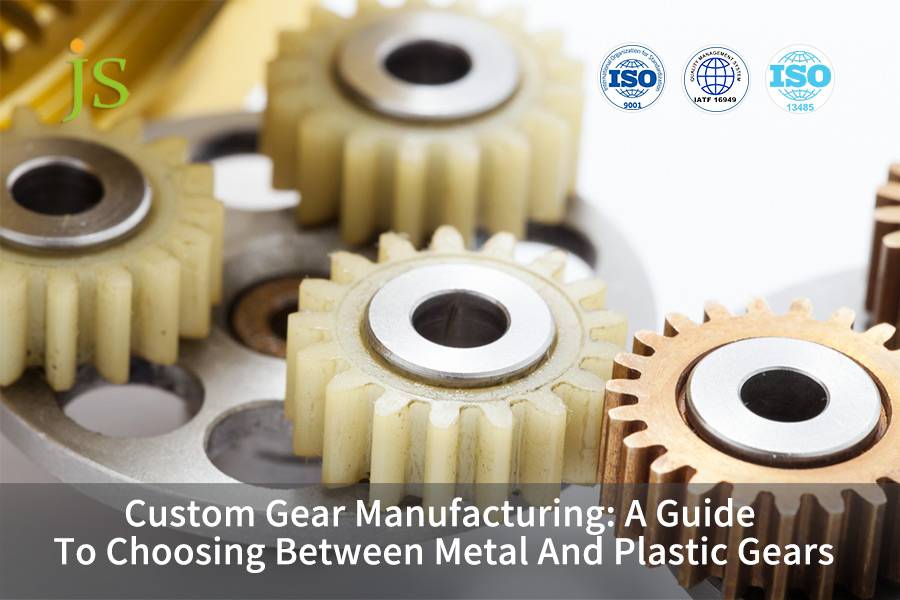

In custom gear manufacturing, the most crucial decision is the first step: metal or plastic? The selection sets the stage for product effectiveness, pricing, and the eventual triumph or setback of the product in the market.
An erroneous choice of material might cause problems ranging from mere noise to the early wear of the components, and even the collapse of the whole system with enormous losses. How can engineers and procurement decision-makers clear the fog?
This piece aims to offer explanatory, practical, and well-supported advice on the issue of why it is essential to team up with manufacturers who are competent in dual-material processes like JS Precision. JS Precision utilizes its well-established CNC machining expertise to deliver custom gear solutions.
Key Answers Overview
| Key Questions | Key Answers | Value for You |
| How to scientifically choose between metal and plastic? | Based on load (>500MPa metal selection), environment (corrosion selection Stainless Steel/plastic), noise (<60dB plastic selection), and full lifecycle cost system evaluation. | Get a measurable decision-making tool to eliminate subjective guesswork. |
| What is at the heart of metal gears high reliability? | Tool sticking is the problem when machining stainless steel and it is overcome by the combination of custom gear manufacturing (e.g. steel worm gear machining) and modified heat treatment (e.g. carburizing and quenching to HRC58-62). | Understanding the complexity of the process as well as setting up a reasonable cost expectation is very important. |
| What are the ways in which plastic gears can surpass performance limits? | A combination of high-performance engineering plastics (e.g. PEEK) and precise injection molding or CNC machining is absolutely indispensable for lightweight and self-lubricating applications. | Recognizing the points of innovative applications, e.g. integrated design for assembly cost reduction, is very important. |
| How to confirm the choice effectively and cheaply? | Prototype gear manufacturing is a must-have step and small batch runs are used to check the viability of the design, materials, and processes. | Reducing the investment is the way to mitigate batch risks and reduce the level of project uncertainty. |
Key Takeaways:
- Prioritize metal for performance and consider plastic for comprehensive optimization:
Metals are the first choice when the gear faces heavy load and high temperature demands (>150℃), however, for sensitivity to weight, noise, and corrosion, and the situation of moderate loads (surface contact stress <100MPa), plastic gear manufacturing can bring substantial benefits.
- Spending in prototyping and testing can be tremendously beneficial:
Investing in prototype gear manufacturing for functional and lifespan testing is the most cost-effective way to avoid batch failures, especially for custom gear projects.
- Supplier appraisal should material neutrality consideration:
Leading gear machining companies, through their ability and knowledge, are expected to suggest material options most beneficial to the customer rather than single-process promotion.
- Total Lifetime Cost (TCO) reveals the real cost:
The figures used must be based on not only the initial processing cost but also the maintenance and replacement costs, as well as the losses in production time.
Why Is The Material Selection For Custom Gear Manufacturing In This Guide Trustworthy?
The material selection recommendations in this guide are not based on subjective guesses. They are worked out from actual cases and standardized process data. Its credibility is mainly supported by the following core points:
1.Authoritative and traceable data sources:
All performance parameters come from the industry, tested data that cover the core process indicators such as metal heat treatment and engineering plastic injection molding.
For example, the guide explains that the high-temperature tensile strength of acetal copolymers filled with 25% short glass fiber can be raised by 2 times. The selection logic of this guide is in accordance with international standards since it adopts the ISO 1328 standard.
2.Verified Process Implementation:
The processes of steel worm gear machining, stainless steel worm gear machining and plastic gear manufacturing, which are referred to in the guide, have all been checked several times by JS Precision through the use of CNC machining tools that have successfully addressed the problems such as tool sticking and truncation during machining.
3.Case Studies Covering All Scenarios:
Case studies of different industries have been provided such as heavy-duty industrial applications and the consumer electronics one, wherein the losses caused by the inappropriate use of materials as well as the effectiveness of the scientific selection have been exemplified, thus, they provide decision-making with positive and negative references.
For example, JS Precision has provided custom gear manufacturing material selection guidance to industrial customers, avoiding the misuse of plastic gear overload and helping customers reduce nearly $30000 in downtime losses.
Essentially, the heart of custom gear manufacturing is materials selection which are most suitable to needs. Of course, every tip in this guide comes along with specific engineering practices and is backed up by data.
JS Precision's CNC machining expertise allows total control over product from prototype to mass production thereby raising the trustworthiness of chosen solutions.
Want to verify whether your gear material selection is appropriate? Contact a JS Precision engineer now, submit your requirements, and you can receive a free customized solution including material performance comparisons and process recommendations.
What Is Custom Gear Manufacturing And How Does It Address The Limitations Of Standard Parts?
Standard gears cannot adapt to special scenarios. Custom gear machining precisely solves this problem, relying on CNC machining to achieve high-precision, personalized production.
When Standard Gears Cannot Meet Requirements
Standard gears may be inadequate in the following situations:
- Use of special modules and tooth profiles, for example, a non-standard involute tooth profile or pressure angles
- Very harsh conditions of use, e.g., high-temperature, high-corrosion, or low-temperature use of outdoor machinery
- Light-weight or integrated design, e.g., the gear being molded as a single piece with other components
In these situations custom gear manufacturing can offer perfectly matching solutions, together with materials and processes uniquely aligned with the needs.
Summary of the Customization Process: From Drawings to Final Product
Typically the custom gear manufacturing without a doubt support to custom gear machining process will go through the following steps:
- Identification of Requirements and Design Collaboration: The engineers and the clients have a core parameters discussion and through the collaborative work optimally design.
- Materials and Process Assignment: Materials are selected according to the needs and then the appropriate processing technologies are paired.
- Custom Gear Machining or Molding: Metal gears are manufactured by CNC turning and hobbing, plastic gears are precision injection molded or CNC machined.
- Heat Treatment and Post-treatment: Metal gears go through carburizing and quenching, plastic gears are deburred and polished.
- Accuracy Checking and Confirmation: Tooth profile accuracy is verified with a coordinate measuring machine to make sure the standard is met.
Comparison of Core Differences between Standard Gears and Custom Gears
| Comparison Dimensions | Standard Gears | Custom Gears (custom gear manufacturing) | Core Supporting Processes |
| Module Compatibility | Only covers common modules (0.5-5mm) | Can achieve modules of 0.2-10mm, including non-standard specifications. | Custom gear machining, precision injection molding |
| Operating Condition Adaptability | Only suitable for normal temperature and low-corrosion environments | Adaptable to extreme operating conditions such as high temperature, high corrosion, and high load. | Material modification, heat treatment, surface coating |
| Integration Capability | Cannot be integrally molded with other components | Can achieve integrated design of gears with bushings, flanges, etc. | CNC machining, insert injection molding |
| Precision Level | Generally ISO 8-10 | Up to ISO 3-5 | Precision gear hobbing and grinding processes |
Metal And Plastic Gears: a Direct Showdown That Determines Performance And Cost?
The performance differences between metal and plastic gears determine product reliability and economy. The following will compare data and analyze the losses from choosing the wrong material.
Comparison of Eight Key Dimensions
Performance Comparison of Metal and Plastic Gears in Eight Core Dimensions
| Comparison Dimension | Metal Gears (Steel/Stainless Steel) | Engineering Plastic Gears (POM/PEEK) | Performance Advantages |
| Ultimate Strength and Toughness | 500-1000+MPa, high toughness | 50-100MPa, relatively weak toughness. | Metal Gears |
| Wear Resistance | Can be strengthened through heat treatment, HRC58-62. | Good self-lubricating properties, low wear rate but limited load. | Each has its advantages |
| Weight (Density) | 7.8g/cm³ (Steel) | 1.1-1.4g/cm³ (POM), approximately 1/7 of steel. | Plastic Gears |
| Noise and Damping | Operating noise 65-80dB, poor damping. | Operating noise 50-60dB, natural noise reduction 5-15dB. | Plastic Gears |
| Corrosion Resistance | Ordinary steel is prone to rust, stainless steel requires special processing. | Resistant to acid, alkali, salt spray and other corrosive environments. | Plastic Gears |
| Operating Temperature Range | -40 ° C to+300 ° C | -20°C to +150°C (PEEK up to +250°C) | Metal Gears |
| Initial processing costs | Higher, requires CNC machining and heat treatment. | Lower, injection molding batch costs are even lower. | Plastic Gears |
| Long-term maintenance costs | Requires regular lubrication, maintenance costs are moderate. | Basically no lubrication required, maintenance costs are low. | Plastic Gears |
The Real Cost of Choosing the Wrong Material
- Misuse of plastic gears for heavy load: A production line which used just ordinary nylon gears to transmit a torque of 500 Nm experienced tooth breakage and downtime within one month which in turn led to losses of more than $20, 000.
- Misuse of ordinary steel gears in wet conditions: Steel gears in food processing equipment were not rust, proofed and hence rusted and corroded within three months thus leading to the scrapping of the goods.
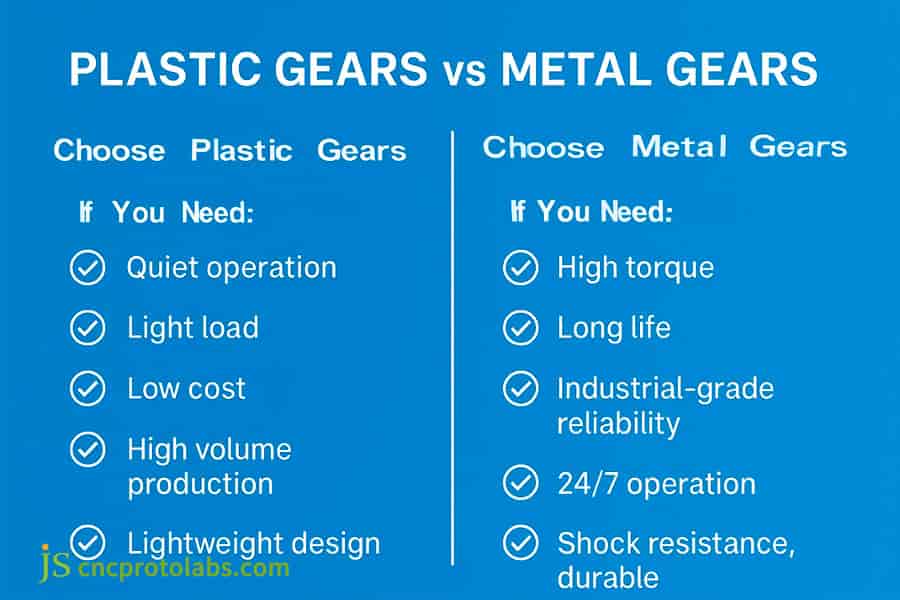 Figure 1: Infographic titled “PLASTIC GEARS vs METAL GEARS” comparing selection criteria for quiet, light-duty plastic gears versus high-torque, durable metal gears.
When Should I Choose Metal Gears, Especially Steel Worm Gear Machining?
Metal gears play an important role in heavy load, high-temperature works. Steel worm gear machining and stainless steel worm gear machining form the basis of worm gear drives that comply with AGMA 6022 standards.
Application Areas of Metal Gears
Metal gears can be used in the following cases:
- High Load: Gears of industrial gearboxes and construction machinery with torque > 500 N·m.
- High Impact: Equipment for mining, metallurgy, and other sectors with frequent impact situations.
- High Precision: Instrumentation and aerospace equipment with the tooth profile error < 0.01 mm.
- High Temperature: Components of internal combustion engines and heat treatment facilities with working temperatures > 150℃.
Worm Gear Drives: The Decision Between Steel and Stainless Steel Precision Machining
- Steel worm gear machining: It is the way a steel worm gear is processed, it is quite suitable for most industries and guarantees the precision of the worm helix, which after quenching is ground to Ra≤0.8μm.
- Stainless steel worm gear machining: This is the way a stainless steel worm gear is processed, it fits the highly corrosive resistant industries, uses carbide tools, and special cooling is employed to prevent tool sticking and deformation.
Need custom steel worm gears? Inform JS Precision of your torque and precision requirements to receive a detailed steel worm gear machining process plan.
How Can Plastic Gear Manufacturing Become The Ace Of Lightweight And Silent Design?
Plastic gear manufacturing is being increasingly recognized as the go-to solution due to the advantages of lightweight and quiet operation. It has become the first choice of consumer electronics and medical devices manufacturers, and cannot be substituted in low-load cases.
Four Main Advantages of Plastic Gears
Here are the four main advantages of plastic gears:
- Lightweight reduces inertia: The plastic density is only 1/7 of steel, which can significantly reduce the rotational inertia of the transmission system, improve response speed, and is suitable for devices such as unmanned aerial vehicle gimbals and smart door locks.
- Self lubrication reduces maintenance: POM, nylon and other materials have self-lubricating properties and do not require additional lubricants, reducing maintenance costs. They are suitable for scenarios such as food processing equipment and office printers.
- High damping achieves ultra quiet operation: The damping characteristics of plastic can absorb vibrations, and the operating noise is less than 60dB, making it an ideal choice for smart home devices.
- Chemical corrosion resistance and integrated complex structure: Plastic gears are resistant to acid and alkali corrosion, and can be molded into complex tooth shapes and integrated structures through injection molding, reducing assembly processes.
Excellent applicative scenarios
- Consumer Electronics: Drone gimbals, mobile phone camera drivers.
- Office Equipment: Printer and copier drive gears.
- Medical Devices: Infusion pumps, precision drives for surgical robots.
- Automotive Interiors: Electric seats, window adjustment gears
Want to develop quiet and lightweight gear products? Consider JS Precision's plastic gear manufacturing service and get a free DFM (Design for Manufacturing) solution with optimized tooth profiles.
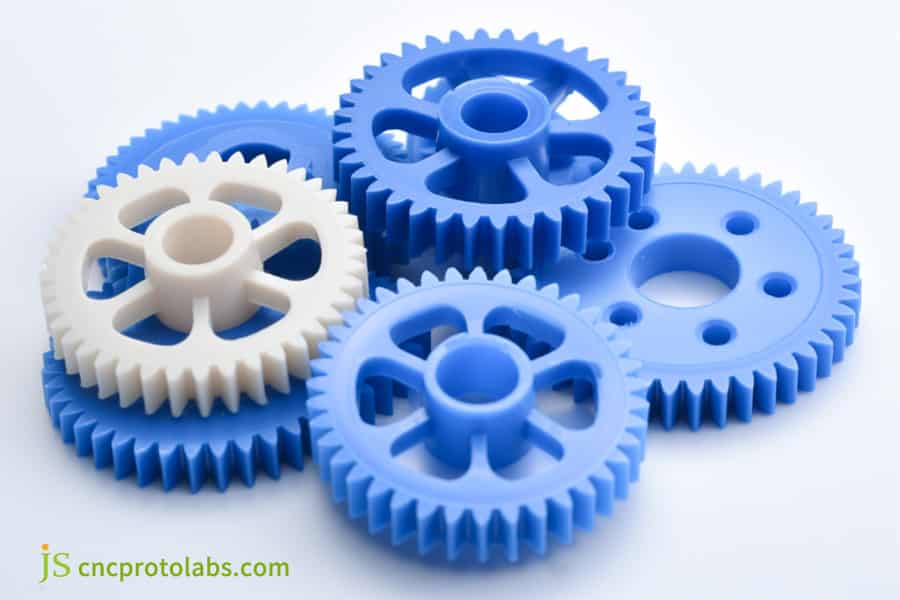 Figure 2: A cluster of five blue and white plastic gears of different sizes, interlocked on a white background, showcasing the compact and lightweight design.
How To Minimize Your Selection Risk Through Prototype Gear Manufacturing?
Prototype gear manufacturing is a bridge between design and mass production, which can verify the compatibility between materials and processes and reduce batch risks.
Three Goals of the Prototype Stage
- Verify Design Assembly: Test the assembly accuracy of gears and related components so that no mass production interference occurs.
- Test Basic Performance: Use load and noise indicators to see if the product is in line with the design criteria.
- Confirm Process Feasibility: Check the stability of the machining process and adjust parameters for its optimization.
Implementation Path of Dual-Material Prototypes
- Metal Prototype: CNC machining of a small batch to check the size and the load-bearing capability.
- Plastic Prototype: CNC machining or 3D printing to rapidly check the tooth meshing.
Comparison of Metal and Plastic Prototype Manufacturing Processes
| Process Type | Processing Cycle | Cost (per piece, USD) | Applicable Scenarios | Precision Level | Process Advantages |
| Metal CNC Machining | 3-5 days | 50-100 | Heavy-duty, high-precision prototypes, load testing. | ISO 5-6 | High precision, good load-bearing capacity, can directly simulate mass production performance. |
| Plastic CNC Machining | 2-3 days | 20-50 | Medium-precision structural verification, meshing testing. | ISO 6-7 | High cost-effectiveness, processing efficiency superior to metal CNC. |
| Plastic 3D Printing | 1-2 days | 10-30 | Rapid tooth meshing testing, design verification. | ISO 8-9 | Fastest speed, lowest cost, suitable for rapid iterative design. |
What Abilities Are More Important Than Proximity When Choosing Gear Machining Companies?
When it comes to selecting gear machining companies, the process and the service matter a lot more than the distance. On the other hand, dual-material manufacturing suppliers are great at offering unbiased selection advice.
Finding Experts Capable of Processing Two Materials
Core Competencies of Top Gear Machining Companies:
- Highly skilled at both metal cutting and plastic molding processes, including the core technology of steel worm gear machining.
- Offer unbiased material choices that are based on the customers' needs rather than only their own preferred processes.
- Have a complete quality control system to guarantee the precision of gear machining.
Supplier Capability Assessment Checklist
- Technical Breadth: Having steel worm gear and plastic gear manufacturing skills.
- Design Support: Helps with gear profile optimization and selecting materials to save costs and increase efficiency.
- Mass Production Integration: Goes from prototype to mass production smoothly.
- Quality and Communication: It is an ISO 9001 certified company allowing for smooth communication.
Looking for reliable gear machining companies? Contact JS Precision to view our metal and plastic gear manufacturing case studies and verify our technical capabilities.
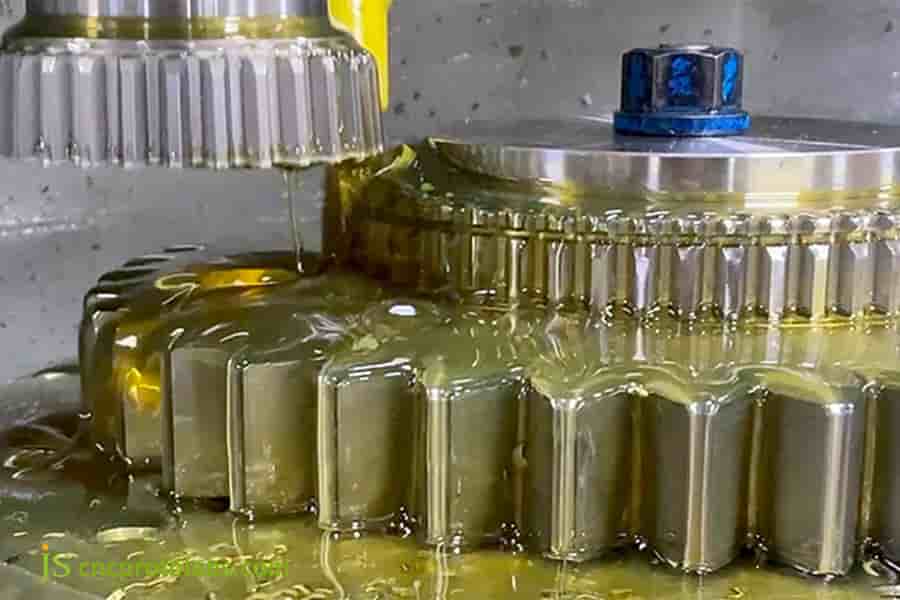 Figure 3: Close-up of a cutting tool machining brass gear teeth submerged in coolant, highlighting the precision and technical expertise required.
JS Precision Case Study: How Smart Home Giants Optimize Transmission Systems Through Material Replacement
Challenge: The Dual Bottlenecks of Noise and Cost
The manufacturer of high-end smart curtain motor that was originally using powder metallurgy gears had slight operating noise (65dB) and a unit cost of $1.20. The manufacturer was aiming to get the noise down to below 60dB without compromising the reliability, at the same time they wanted to reduce the unit cost.
JS Precision's Collaborative Design and Material Replacement
1.In-depth Analysis and Simulation:
JS Precision engineers performed an analysis on the motor's load curve and discovered that the peak torque was only 3N·m and that it ran intermittently, thus indicating that there was a possibility of substituting powder metallurgy with high-performance plastics.
2.Material and Process Innovation:
Wear-resistant reinforced POM material was the one they suggested, in addition to changing powder metallurgy to precision injection molding in plastic gear manufacturing, and also a tooth profile optimization was done to increase the meshing smoothness.
3.Prototype Verification and Iteration:
CNC machined prototype gears were manufactured through prototype gear manufacturing and bench tested, proving that the fatigue life totally exceeded clients requirements (500, 000 cycles), and the operating noise was lowered to 58dB.
Results: A Win-Win Situation in Quiet Operation, Cost, and Delivery
- Noise Optimization: The final product's operating noise level was lowered from 65dB to 58dB, which is a great improvement in terms of user experience.
- Cost Reduction: The cost of a single gear dropped from $1.2 to $0.93, which is a 22.5% decrease.
- Accelerated Delivery: By capitalizing on the superior output capacity of plastic injection molding, the time required for batch delivery was cut down by 30%, thus the manufacturers' peak season supply requirements were fulfilled.
Want to replicate the cost reduction and efficiency improvement results of this case? Contact JS Precision now, submit your product pain points, and you can get a free customized gear optimization solution.
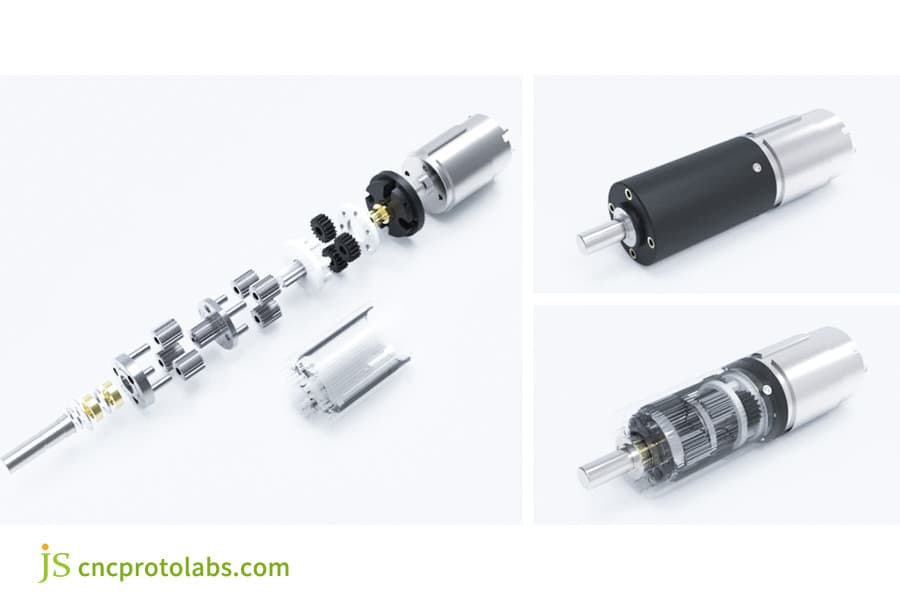 Figure 4: Exploded view of a smart curtain motor's gear transmission assembly, showing metal gears, plastic housings, and a transparent cover on a light background.
FAQs
Q1: Which is the cheaper option between metal and plastic gears?
If only the cost of making a single piece is taken into consideration, then plastic gears will generally be cheaper, especially when mass production is done via injection molding. Nevertheless, metal gears might turn out to be more cost effective considering the entire lifecycle in the case of long-term, high-load usage.
Q2: How long do plastic gears last? Could their durability be comparable with metal gears?
If the design load is properly matched, high-grade engineering plastic gears are capable of running for millions to tens of millions of cycles, that is, they can satisfy the requirements of the majority of commercial products, but the durability of heat, treated metal gears is generally still higher.
Q3: What is the minimum module gear size we can manufacture?
JS Precision's high-precision machining has the ability to stably produce module 0.3mm metal gears and 0.2mm plastic gears. The exact machining tolerance is dependent on the gear material and structural design.
Q4: In addition to corrosion resistance, are there any other differences between stainless steel gears and ordinary steel gears?
Yes. Stainless steel has a higher machining difficulty, a greater tendency for tool sticking during cutting, and the tool also wears out quicker. Besides that, the heat treatment process is different from that of ordinary alloy steel and its mechanical properties such as hardness and toughness also vary.
Q5: What measures do you take to ensure the consistency of batches of plastic gears?
We guarantee the dimensional and performance consistency of batches of plastic gears by utilizing high-precision molds (mold core accuracy 0.003mm), tightly controlling the injection molding process parameters (temperature, pressure, time), and SPC statistical process monitoring.
Q6: Do you provide support for one-stop service from design to production?
Yes. JS Precision is capable of providing a full range of custom gear manufacturing services starting from the conceptual design, DFM analysis, prototype gear manufacturing all the way to mass production.
Q7: Can you manufacture bimetallic gears or insert-molded gears?
Yes. JS Precision is capable of offering composite processes such as worm gear local hardening and plastic gears with embedded metal bushings to satisfy specific customer performance requirements.
Q8: What is the typical lead time?
For prototype gear manufacturing, samples can be delivered within 1-2 weeks after submitting drawings. The lead time for mass production depends on the quantity and process, typically 3-6 weeks.
Summary
Material selection for custom gears should not be regarded as a mere two, option choice but as a scientifically accurate decision aligned with the requirements.
Metal gears are capable of handling heavy loads and high temperatures, whereas plastic gears are ideal for quiet operation and lightweight construction. Creating prototypes and having dependable manufacturing partners are the key elements of such a decision.
By opting for a manufacturer like JS Precision, who is experienced in the dual-material process, you can rest assured that the customization of your gears will be a seamless journey from the design stage to the mass production of your product, thereby making a dependable transmission core.
Should you be grappling with the issue of gear material selection or seeking to improve your current design, do not hesitate.
Contact us or submit your requirements or drawings, and within 24 hours, a professional solution will be provided to you, which will include data comparisons, process suggestions, and a transparent quote. Allow JS Precision's technical knowledge to be the rock-solid foundation of the dependable transmission of your products.

Disclaimer
The contents of this page are for informational purposes only.JS Precision Services,there are no representations or warranties, express or implied, as to the accuracy, completeness or validity of the information. It should not be inferred that a third-party supplier or manufacturer will provide performance parameters, geometric tolerances, specific design characteristics, material quality and type or workmanship through the JS Precision Network. It's the buyer's responsibility Require parts quotation Identify specific requirements for these sections.Please contact us for more information.
JS Precision Team
JS Precision is an industry-leading company, focus on custom manufacturing solutions. We have over 20 years of experience with over 5,000 customers, and we focus on high precisionCNC machining,Sheet metal manufacturing,3D printing,Injection molding,Metal stamping,and other one-stop manufacturing services.
Our factory is equipped with over 100 state-of-the-art 5-axis machining centers, ISO 9001:2015 certified. We provide fast, efficient and high-quality manufacturing solutions to customers in more than 150 countries around the world. Whether it is small volume production or large-scale customization, we can meet your needs with the fastest delivery within 24 hours. Choose JS Precision this means selection efficiency, quality and professionalism.
To learn more, visit our website:www.cncprotolabs.com
Resource