English



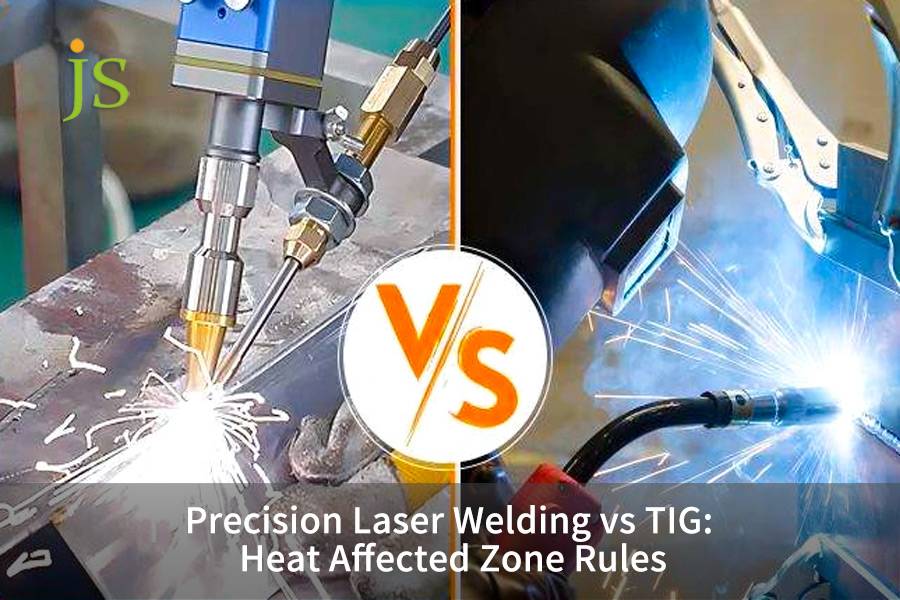

Precision laser welding service produces a heat affected zone (HAZ) of only 0.1–0.5 mm versus 3.0–8.0 mm for TIG welding — a 10- to 20-fold difference driven by energy density. This guide compares the two processes across HAZ width, residual stress, distortion, cost, and DFM rules, and explains when each process is the right choice.
Precision Laser Welding Service vs TIG HAZ Control Quick Overview
|
Core Evaluation Dimension |
Precision Laser Welding |
TIG Welding |
Engineering Decision Impact |
|---|---|---|---|
|
Heat Input Line Energy |
20–100 J/mm |
300–800 J/mm |
Determines temperature rise around molten pool |
|
HAZ Width |
0.1–0.5 mm |
3.0–8.0 mm |
Directly affects thin-wall angular distortion |
|
Power Density |
10⁶–10⁷ W/cm² |
10²–10⁴ W/cm² |
Laser depth-to-width ratio up to 10:1 |
|
Post-Weld Distortion |
Angular < 0.1°, tolerance ±0.02 mm |
Angular 1.5°–5°, requires jig straightening |
Laser eliminates secondary correction |
|
Total Cost per Meter |
Higher depreciation, 65% less post-work |
Low equipment cost, high grinding labor |
Batch precision favors custom laser welding |
Data shows that for components having the wall thickness less than or equal to 2.0mm and dimension tolerance being less or equal to plus or minus ±0.05mm, using a precision laser welding machine cuts down the rework rate tied to thermal distortion to 50%–80% of the rate achieved using TIG welding (Data Source: JS Precision internal test data, 2025).
Key Takeaways
- Laser welding vs TIG HAZ width: HAZ width of Laser welding is about 1/10 to 1/5 of TIG HAZ width.
- Residual stress minimization: Laser has very narrow and deep molten pool, so reduces macro thermal shrinkage stress, keeping fatigue strength of the joint at over 95% of the base metal.
- Full lifecycle cost reduction: all secondary straightening and surface pickling/polishing time being removed, custom manufacturing in batches is also faster.
Why Is Heat Affected Zone Control the Defining Standard in Metal Welding Service?
Heat affected zone control is achieved through precisely limiting the thermal diffusion range during welding, which prevents the distortions of the component shapes and deterioration of the metal properties of the unmelted part of the base metal. In critical applications, HAZ control is one of the direct factors determining the assembly precision and the long-term life of the mechanical structural parts.
Welding Thermal Cycle and Residual Stress Damage Mechanism
- Heat input and residual tensile stress: too much heat input often means residual tensile stress becoming more than 70% of material's yield limit, which results in delayed cracking and dimensional deviations of thin-walled components.
- JS Precision closed-loop control: in our case of an aerospace sensor housing product, the use of real-time power feedback and seam tracking systems allowed the strict limitation of thermal deformation to design tolerances, resulting in the batch delivery pass rate of 99.2%.
AWS D17.1 standard needs that for aerospace-grade thin-walled structures with a thickness 2.0 mm, the width of the heat-affected zone should not be more than 1.5 times the width of the base material and the hardness change on both sides of the weld must not go beyond 15 HV.
JS Precision applies the AWS D17.1 HAZ requirements in its metal welding service, backed by a fully closed-loop heat input control system, guaranteeing HAZ consistency on all production runs.
See JS Precision's welding application library for precision to learn how we assisted aerospace and medical clients in rectifying this HAZ problem of the excess being over the limit.
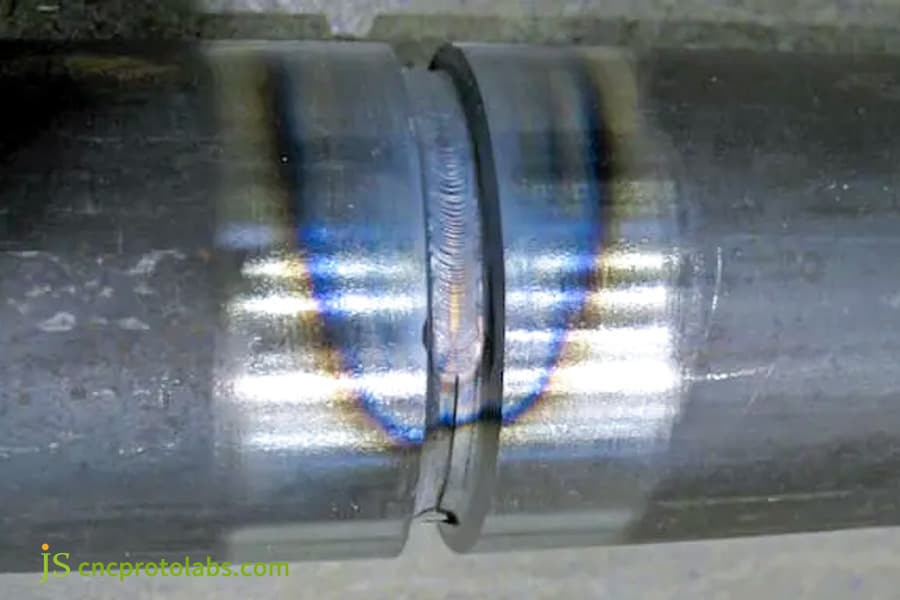
Figure 1: TIG welded metal pipe joint showing heat affected zone color changes.
What Are the Linear Heat Input Quantification Discrepancies Between Precision Laser Welding Service and TIG?
A precision laser welding service can achieve welding speeds of 1.5 to 5 meters per minute with line energy of only 20 to 100 J/mm whereas the conventional arc welding process results in a higher welding energy (300-800 J/mm) because of the wide arc spread.
Heat Input Formula Quantitative Derivation
Welding heat input formula:
E = (U × I × η) / v
Where E is line energy (J/mm), U is voltage (V), I is current (A), η is thermal efficiency, and v is welding speed (mm/s).
- TIG arc divergence angle: Traditional TIG welding, even in pulsed mode, has an arc divergence angle of 30°–45° with thermal efficiency η ≈ 0.65, causing considerable heat conduction to the underlying base metal and so ineffective. So precision laser welding has an unrivaled advantage for heat-sensitive materials.
- Laser thermal efficiency advantage: JS Precision's precision laser welding service is based on fiber laser sources and has thermal efficiency η > 0.90, making it possible to achieve 10:1 depth-to-width ratio of deep penetration welds. Laser power density is several times higher (2–4) than arc welding. Generally, HAZ width for lasers is between 0.5 and 2 mm whereas for TIG it is about 3–10 mm.
Parameter Comparison Table
|
Parameter |
Precision Laser Welding |
TIG Welding |
|---|---|---|
|
Line Energy (J/mm) |
20–100 |
300–800 |
|
Travel Speed (m/min) |
1.5–5.0 |
0.15–0.4 |
|
Heat Efficiency η |
> 0.90 |
~ 0.65 |
|
HAZ Width Laser vs TIG |
0.1–0.5 mm |
3.0–8.0 mm |
|
Arc Divergence Angle |
0.1–0.5° (beam) |
30°–45° |
Data indicates: Precision laser welding HAZ width is 0.1–0.5 mm, TIG welding HAZ width is 3.0–8.0 mm, laser power density exceeds 1 MW/cm² (Data Source: Li J., Yu H., Wang B., et al. Journal of Materials Research and Technology, vol. 33, pp. 3242–3249, 2024).
The fundamental constraint of TIG welding service derives from its naturally low thermal efficiency however precision laser welding service offsets it with high energy density.
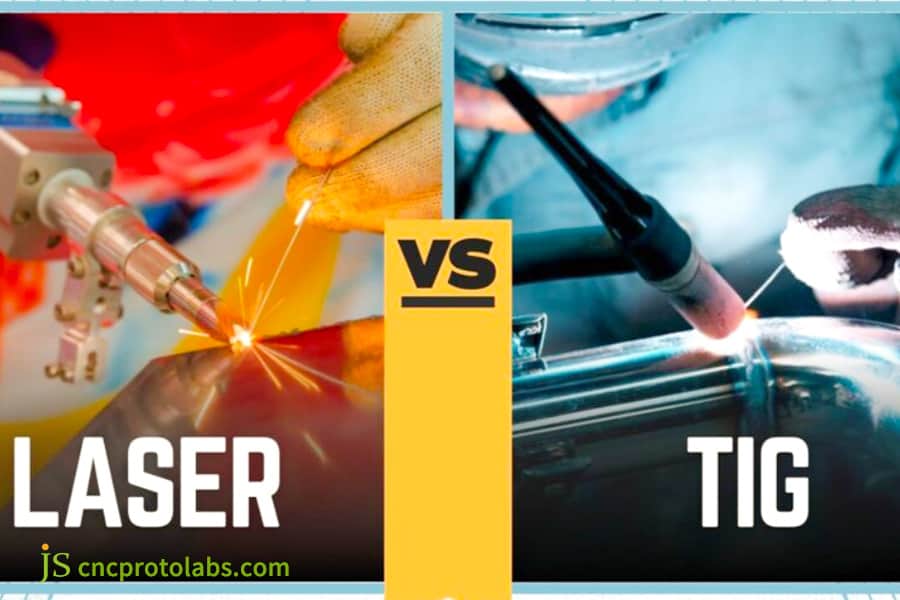
Figure 2: Side by side comparison of laser welding and TIG welding processes.
How Do Laser Welding vs TIG Comparison Metrics Reflect Distortion Control in Thin Metals?
Laser welding vs TIG comparison reveals that laser welding can generate a thermal residual stress which is only 15% to 25% of that from TIG. The limited angular distortion of 0.8 mm sheet metal is below 0.1 degree, but using TIG leads to an angular distortion of 2.5 to 4 degrees.
HAZ Width Laser vs TIG Thin Sheet Deformation Comparison
- Deformation of buckling and instability: when it comes to buckling and instability warping problems, TIG welding produces large molten pool size and high heat input. So, it generates very large temperature gradients, making it the usual culprit in scrapping 1.5 mm stainless steel thin-walled enclosures. Laser welding vs TIG comparison clearly highlights laser welding being so much more effective in thin sheet fabrication.
- JS Precision solution: it employs robot multi-axis synchronized laser welders with pneumatic clamping water-cooled fixations, resulting in overall flatness of at most 0.05 mm/100 mm with no requirement of manual hammer work to be done later.
- Laser welding vs TIG comparison core point: difference of the HAZ width governs warpage directly: laser welding gives HAZ only 0.1–0.5 mm, but TIG reaches even 3.0–8.0 mm so distortion difference is 10-fold.
Deformation Data Comparison
|
Sheet Thickness (mm) |
Laser Angular Distortion |
TIG Angular Distortion |
|---|---|---|
|
0.8 |
< 0.1° |
2.5°–4.0° |
|
1.2 |
< 0.15° |
1.8°–3.0° |
|
1.5 |
< 0.2° |
1.5°–2.5° |
Data indicates: For < 1 mm stainless steel sheet, laser welding deformation can be controlled within 0.1 mm, while typical TIG deformation is 0.5–2 mm (Data Source: Ma Ran et al., Chinese Journal of Lasers, vol. 41, no. 5, article 503003, 2014).
The appropriate metal welding process selection should be based on the wall thickness of the part and the required tolerances. For example, if wall thickness is no more than 1.5 mm (0.05 mm tolerances) then precision laser welding should be your main choice of the welding process.
Dealing with welding distortion in thin-walled parts? Get a free cost estimate. JS Precision will give you a distortion control solution together with your quotation.
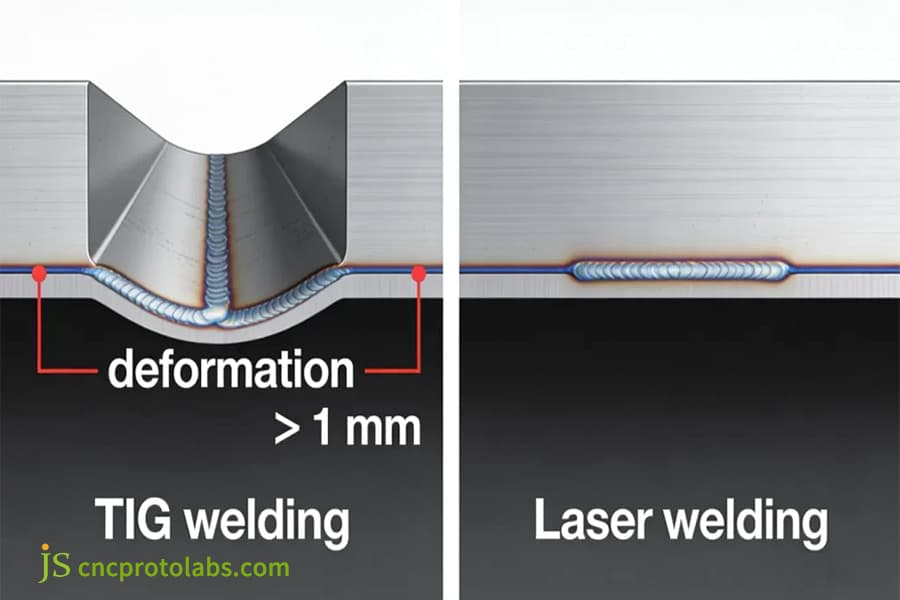
Figure 3: Diagram comparing TIG welding deformation and laser welding on thin metal.
How to Implement Metal Welding Process Selection for Heat-Sensitive Alloys and Geometries?
Metal welding process selection decision depends on the material heat tolerance and the size of the gap in the joint. Laser welding is appropriate for joints with gaps < 0.1 mm involving thin-wall parts and heat-sensitive alloys. Then again, TIG is the right process for joints with gaps > 0.5 mm involving thick-plates that require backing welds.
Joint selection decision criteria
- Joint gap 0.1 mm, thickness 3.0 mm, heat-sensitive alloy: Select precision laser welding. Fast cooling rate helps retain strengthening phases and avoids thermal damage. This case is one of the predominant in metal welding process selection.
- Gap > 0.5 mm, thickness > 6.0 mm, wide assembly tolerance: Select TIG welding. Low cost, adaptable to loosely-fitting parts with filler wire and low filler wire.
- Gap 0.1–0.5 mm, mixed batch: Combine laser with wire feed. This hybrid process gives balance between a high-performance and versatility and is a cost-effective method.
Material Compatibility Remarks
- Titanium alloy Ti-6Al-4V: the use of laser welding with its fast cooling minimizes -phase coarsening besides preserving strengthening phases well. Comparison experiments of a commercially-pure titanium tube indicate the laser welding HAZ is 0.9 mm only, while the TIG welding HAZ is 6.3 mm.
- High-strength aluminum alloy 6061-T6: Laser welding reduces hot cracking rate to under the 0.1%, while TIG welding easily causes solidification cracks.
JS Precision's Complete Production Line
JS Precision has 3D fiber laser welders and pulsed TIG welders for producing customized production processes, which enable us to offer the best solution to balance performance and cost per the drawing tolerances of the work and annual volume of the customer.
To put it in simple terms, picking a metal welding service that can use a laser solution is practically the only way to prevent any damage caused to the parts through heat when your part is either a heat-sensitive type of material or a thin-walled structure.
How Does Precision Laser Welding Service Compare to TIG in Total Fabrication Cost?
Precision laser welding service can produce 4-8 times the welding throughput compared to conventional arc welding. As a result, it reduces the per-part manufacturing cost by 35-55% in batch production.
Complete Total-Cost analysis
- TIG hidden costs:
Welding at slow speed, only 0.15-0.4 m/min, causes a heavy oxide scale and bead that calls for 3–5 minutes of post weld polishing per weld to be completed. Precision laser welding is able to reduce costs first and foremost because this aspect is totally eliminated.
- Laser welding features:
JS Precision's fully automatic laser welding line can achieve a welding speed of 2.0-4.0 m/min, with silver white bright welds that can be directly polished after welding. Choosing precision laser welding service means eliminating all secondary processing steps. Using laser welding completely removes all types of post processing operations. Introducing an automated laser welding system increases production further while minimizing human error-related quality variations.
Batch Cost Model
|
Cost Item |
Laser Welding (per meter) |
TIG Welding (per meter) |
|---|---|---|
|
Welding labor |
$0.12 |
$0.85 |
|
Grinding & polishing |
$0.00 |
$0.65 |
|
Straightening |
$0.00 |
$0.40 |
|
Gas & consumables |
$0.08 |
$0.15 |
|
Total per meter |
$0.20 |
$2.05 |
Data indicates: Laser welding speed can reach 4 times that of TIG, thin sheet deformation reduced by 50%–80% (Data Source: JS Precision internal test data, 2025).
For high-volume purchase, selecting JS Precision's custom laser processing services can effectively shortening lead time and reducing hidden quality costs. The hidden quality cost will be generally underestimated by the TIG welding service in a high-volume purchase.
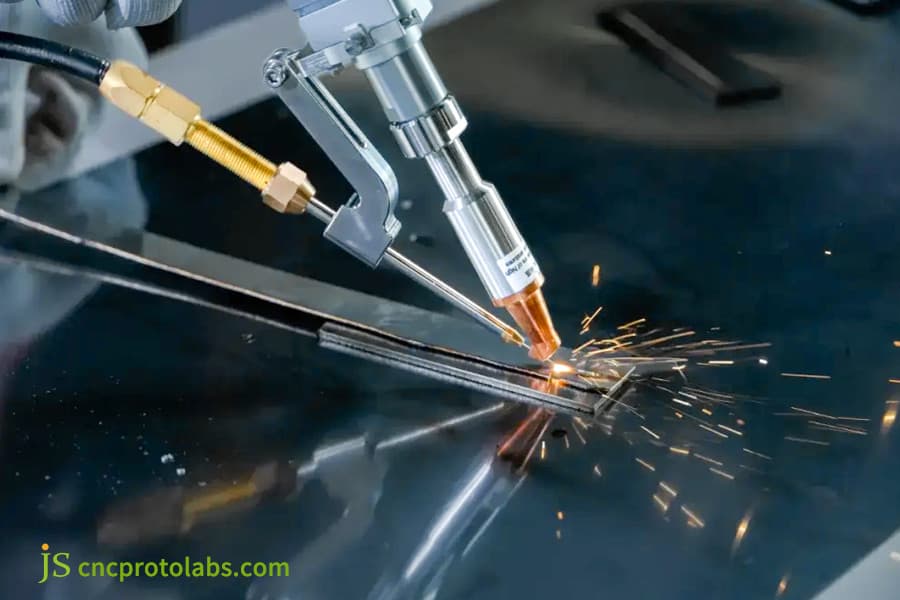
Figure 4: Worker using handheld laser welding machine on metal sheet fabrication.
JS Precision Case Study: 316L Stainless Steel Medical Sensor Enclosure Laser Welding HAZ Failure Resolution
The combination of precision laser welding service and heat management system capable of monitoring temperature at the micron level narrowed the HAZ width of the weld in the 316L diaphragm to only 0.12 mm which ultimately allowed helium leak test failures to be eliminated completely.
Customer Challenge.
At first the customer applied traditional precision micro-TIG welding to weld a 0.3 mm thick 316L piezoresistive sensor diaphragm with a housing. When HAZ width was up to 2.8 mm the diaphragm suffered too large a wave deformation from thermal expansion (tolerance exceeded by 0.08 mm) and the helium mass spectrometer leak test pass rate dropped below 62%.
JS Precision Solution
- 1070 nm single-mode fiber laser: Concentrated spot size of the beam is brought down to 0.06 mm.
- Beryllium copper water-cooled heat sink jig: rapid, powerful heat removal 0.5 mm from all sides to the weld.
- Wobble welding: the transverse oscillation set at 400 Hz and amplitude at 0.2 mm leads to heat affected zone control through highly accurate and combined parameters that are suitable for aerospace-grade fusion welding process control.
Failure Experience and Lessons
During the first experiment, when the welding speed was just increased to 4.5 m/min, it resulted in an unstable keyhole and the closure of the weld was not correct. This produced a microporosity in a chain pattern with the diameter of pore being 0.02 mm. To remove gas entrapped in the pool, a shielding gas was changed from a single-side blowing to a coaxial annular one (flow 18 L/min) by the engineers.
Final Results
Welding HAZ was only 0.12mm, the flatness deformation was kept to less than 0.01 mm, and the helium mass spectrometer leak test (leak rate < 1 × 10⁻⁹ mbar·L/s) had 99.85% pass rate. All these results show the significance of high-quality metal welded joints by expert welders for the most challenging jobs.
If you are experiencing similar difficulties with welding integrity? A tailored approach could be a way out, reach out to JS Precision team to enjoy our unique and cost-effective weld process improvement, with a free sample testing.
Which DFM Guidelines Must Engineers Follow in Custom Precision Laser Welding Service?
To achieve a custom laser welding service DFM assessment, tight control of an assembly gap 0.05 mm and misalignment up to 10% of sheet thickness is necessary. Self-locating steps and heat dissipation channels should be the basic elements of the assembly if one needs high depth-to-width ratio welds.
Laser Welding Structural Design Geometric Rules
- Joining clearance: as the typical focused spot size is 0.06–0.2 mm, the joining clearance should be 0.05 mm or maximum 10% of the sheet thickness to keep within the precision laser welding constraints that separates it from others.
- Self- aligning step design: A feature or component should be integrated into the part to ensure a consistent position of parts and eliminate the effect of tolerances while preventing 90° optical reflection from damaging the lenses.
- Balanced heating Pattern: Symmetry in the heating layout would help in the reduction of residual stress and distortion after the heat is applied through the weld line.
JS Precision Free DFM Review
When a customer needs metal welded, JS Precision will be a great choice - a free DFM review by JS Precision will optimize beam accessibilities and heat dissipation of channel design, thereby decreasing the welding residual thermal stress by about 75% from the very point where the stress comes from. The selection of an appropriate metal welding process should be a holistic decision taking four factors: 1) types of material, gaps, thickness, batch sizes into account.
The ISO 13919-1:2019 standard defines that: For electron and laser welded joints, quality level B corresponds to the highest finished weld requirement, applicable to steel nickel titanium and their alloys, with a material thickness 0.5 mm; individual surface porosity maximum dimension d 0.3s and a maximum of 3 mm.
In the precision laser welding service, JS Precision uses the standard mentioned above as a minimum requirement for weld acceptance and carries out an X-ray inspection of 100% of welds for all precision-grade orders.
To get a free DFM manufacturability assessment report and thermal simulation advice from JS Precision you may upload your 3D CAD drawing.
FAQs
Q1: What is the primary physical advantage of precision laser welding over TIG regarding Heat Affected Zone control?
Thanks to the very high laser power density level (more than 1 MW/cm²), a material melts in a fraction of a second and forms a narrow and deep hole. Laser welding uses much less total energy line (at least by 80%) which results in such a narrow HAZ that it even prevents warping of the material.
Q2: At what sheet thickness and tolerance level must an engineer switch from TIG to Precision Laser Welding Service?
Sheet thickness ≤ 1.5 mm and structures next to heat-sensitive parts or dimensional tolerances within ±0.02 mm must switch from TIG to the service of precision laser welding. With the broad heat of TIG welders, sensitive parts could be destroyed.
Q3: Does precision laser welding significantly lower the post-weld distortion correction cost for B2B procurement?
Of course it does. With thin sheets, TIG welding results in angular distortion of 2.5°–4.0° that need to be corrected manually a lot. Using precision laser welding allows to keep flatness to within ≤ ±0.01 mm so straightening is no longer needed, and downstream costs for B2B products drop by 45%.
Q4: What joint clearance tolerances are required for components processed via industrial automated laser welding?
Joint gap in laser autogenous welding should be no more than 0.05 mm or 10 percent of sheet thickness to achieve precision. For tolerance parts with wide scatter, JS Precision employs automatic wire feeding or wobble beam technology to permit gap relaxation up to 0.2–0.4 mm.
Q5: How does JS Precision suppress solidification cracking during the precision laser welding of 6061-T6 aluminum alloys?
JS Precision uses combination of high cooling rate laser welding to refine dendrites and 4047 filler alloy to narrow brittle temperature range, bringing hot cracking of aluminum alloy down to below 0.1%.
Q6: What is the general RFQ and drawing submission pathway to obtain a custom Metal Welding Service quote?
Buyers can upload 3D CAD drawings and 2D engineering drawings (specifying weld penetration, hermeticity, and tolerance requirements) via JS Precision's inquiry portal. JS Precision's free DFM evaluation and tiered quotation will take no longer than a workday.
Q7: How can a buyer evaluate the piece-part price differences between laser and TIG for large-scale custom orders?
The initial tooling for laser welding is slightly above TIG. But the time required for grinding in production by TIG is 4 times more in case of a quantity above 1,000 items which also reduces comprehensive labor time per unit by 60% against laser welding. JS Precision's price tiers illustrate in detail the cost per piece advantage of laser welding with rising order quantities.
Q8: Why is a CNC multi-axis automatic laser welder superior to a standard handheld laser welder for commercial components?
Tolerances of the weld in welding with handheld laser are roughly ±0.5 mm, quality depends on the skills of operator. JS Precision's high-quality industrial CNC multi-axis welders rely on enclosed guide rails and vision seam tracking, resulting in a penetration repeatability level of ±0.01 mm, fulfilling automotive and medical certification standards.
Summary
The physical width of the heat-affected zone is a big part in a weld's fatigue strength and dimensional stability. By combining high energy density with micron-level focused spot, precision laser welding is limited to the size of this micro area, effectively resolving the industrial challenges of thin-walling part warping and expensive post-welding rework. It becomes the method of choice in high-end instruments and precision sheet metal manufacturing.
Contact JS Precision today to improve your welding solution. Forward your 3D CAD model and tolerance requirements to JS Precision. Our precision welding application engineering team will, without cost to you, carry out a complete DFM manufacturability check, provide thermal simulation advice and rapid sample prototyping services.

Disclaimer
The contents of this page are for informational purposes only. For JS Precision Services, there are no representations or warranties, express or implied, as to the accuracy, completeness, or validity of the information. It is the buyer's responsibility to identify specific technical requirements and request a formal parts quotation. Please contact us for more information.
Resource