English



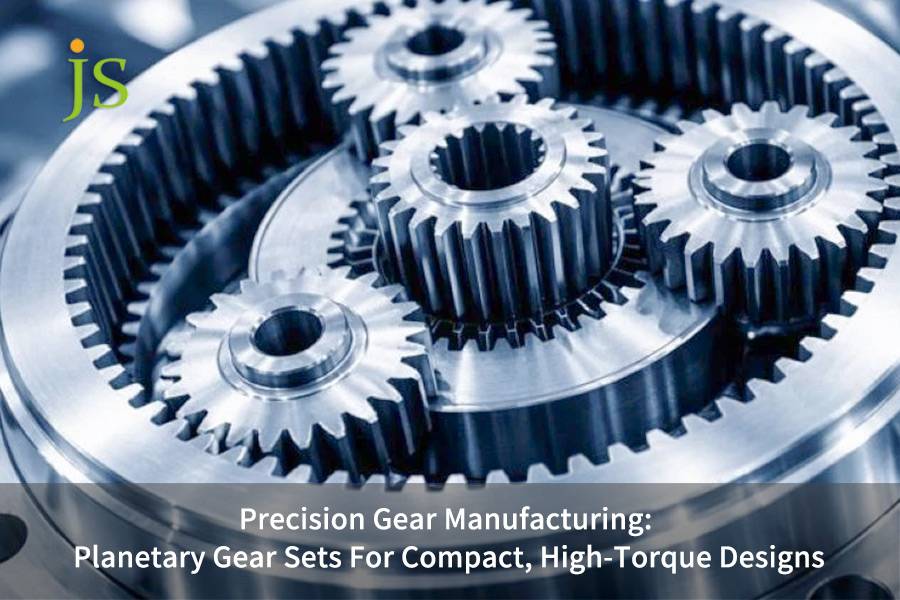

Precision gear manufacturing is the core technology for high end equipment research and development.
In the design of a wrist joint for a minimally invasive surgical robot, the control torque with no backlash must be output within a space of less than 50mm in diameter, so it is very difficult for standard reducers on the market to be adapted.
Planetary gear sets are a kind of answer to the problem and the precision of gear machining is the key to their success. This article will explain the precision gear manufacturing process step by step and show you how to pick a trustworthy precision gear manufacturing company.
Core Answer Table
| Core Content | Quick Solution |
| Precision Manufacturing Process | The precision manufacturing process starts by selecting the highest-purity alloy steel. Precise control throughout the process leads to achieving micron-level precision and a torque density of as high as 300 Nm/kg. |
| Planetary Gear vs. Worm Gear | Efficiency for single-stage planetary gear is as high as 97%-98%, however it drops to only 50%-90% for worm gear. Worm gears possess self-locking properties, planetary gears however based on mechanical system will need additional brakes. |
| Customized Value | By using non standard tooth counts, integrated design, and special coatings, application issues are effectively addressed such as severely limited space, inadequate lubrication, and impact loads. |
| Large Scale Manufacturing Frontier | Techniques such as deep carburizing and press quenching, induction hardening of tooth surfaces, and flexible pin technology allow to surpass the boundaries of lightweight and torque in megawatt level transmissions. |
| Supplier Selection | The core evaluation targets on the agility of the supplier in responding, capability in implementing AGMA standard and being equipped full load testing platform. Technical collaboration ensures the basis of long term cooperative relationship. |
Key Conclusions:
- With the help of the latest precision gear manufacturing, the torque density of planetary gears can be maximized up to an impressive figure of 300 Nm/kg, and hence, they are the most preferred solution for very compact, high torque mechanical systems.
- The accuracy of gear, its durability, and capability of torque transmission are directly decided by each and every step in high precision gear manufacturing.
- Extreme situations require custom gear manufacturing as the only viable option to address and resolve the challenges that arise from such applications.
- The determining factors which matter the most are the technical partnerships and the hands on testing for the actual performance of a precision gear manufacturing company.
Why Trust JS Precision In Planetary Gear Manufacturing?
For over ten years, JS Precision has been extensively engaged in gear machining and the precision gear manufacturing. This is a production company with the complete chain of capabilities from design and R&D through to mass production and delivery.
We have supplied more than 100,000 sets of high precision planetary gears to the industries such as aerospace, medical robotics and wind power equipment and has resolved more than 500 engineering design challenges related to small spaces and high torque situations.
JS Precision draws a clear line in the sand when it comes to the ISO 6336-1:2019 gear design standard in precision gear manufacturing.
All products are checked for AGMA level 12 or above precision and the company owns a 6.4MW enclosed power test bench that is capable of measuring product noise, temperature increase and efficiency under full load conditions, so that reliability of the product is ensured right at the source.
The average experience of the gear machining staff at JS Precision is 15 years which allows them to come up with tailor made processing solutions for different applications. They can achieve micron level control of the whole process from choosing the materials to surface coating.
With regard to the manufacture of large wind turbine planetary gears, the deep carburizing and quenching process of JS Precision can keep the deformation of gear rings with diameters of more than 2 meters to the the micron level.
In the manufacturing of gears for micro medical robots, their gear grinding process consistently achieves DIN 3 precision, meeting the ultimate requirement of zero backlash.
Moreover, JS Precision has set up a worldwide supply chain and service system. They offer global clients a full quotation package comprising technical solutions, process routes, and project schedules within 48 hours to ensure transparent communication and timely delivery.
Choosing JS Precision not only guarantees high precision planetary gear products but also provides you with technical collaboration support at a deep level. Our engineers will assist you at every step, from the first design DFM analysis to the process optimization in mass production, thereby helping you avoid unnecessary detours in product design.
Contact JS Precision engineering team now for a free precision gear manufacturing technical assessment to quickly bring your design solutions to fruition.
What Is a Planetary Gear Set And Why Is It The Core For Achieving High Torque And Compact Design?
In the gear machining of high end equipment, planetary gear sets are the core of high torque and compact design, with significant advantages in power splitting. ISO 6336-1:2023 also specifies their design and manufacturing specifications.
Basic Structure and Working Principle of Planetary Gears
A planetary gear set consists of four core components which are arranged in a coaxial configuration that includes a sun gear, planet gears, a ring gear and a planet carrier.
The sun gear serves as the power source which transfers power to the planet gears that distribute power to the planet carrier and ring gear system. The system achieves its compact design through its use of coaxial components.
Core Advantages of Planetary Gears in Space Utilization and Torque Density Compared to Traditional Gear Designs
Planetary gears provide better advantages than parallel axis helical gears because their benefits depend on advanced gear manufacturing techniques.
Planetary gearboxes require more than 50% less space according to the same reduction ratio and torque requirements while industrial grade products reach 300 Nm/kg and aerospace products exceed 150 Nm/kg.
| Process Steps | Precision Control Indicators | Applicable Standards | Equipment Requirements |
| Forging | Grain flow direction deviation 5° | ISO 8633 | CNC precision forging machine |
| Gear Hobbing | Tooth profile error 0.01mm | DIN grade 6 | 5 axis CNC gear hobbing machine |
| Carburizing and Quenching | Hardened layer depth deviation 0.1mm | ISO 6336 | Vacuum carburizing furnace |
| Gear Grinding | Tooth profile error 0.001mm | DIN grade 3-5 | Worm wheel grinding machine |
| Shot Peening | Surface compressive stress 500MPa | AGMA 9005 | CNC shot peening machine |
| Assembly | Coaxiality deviation 0.005mm | AGMA grade 12 | Precision assembly platform |
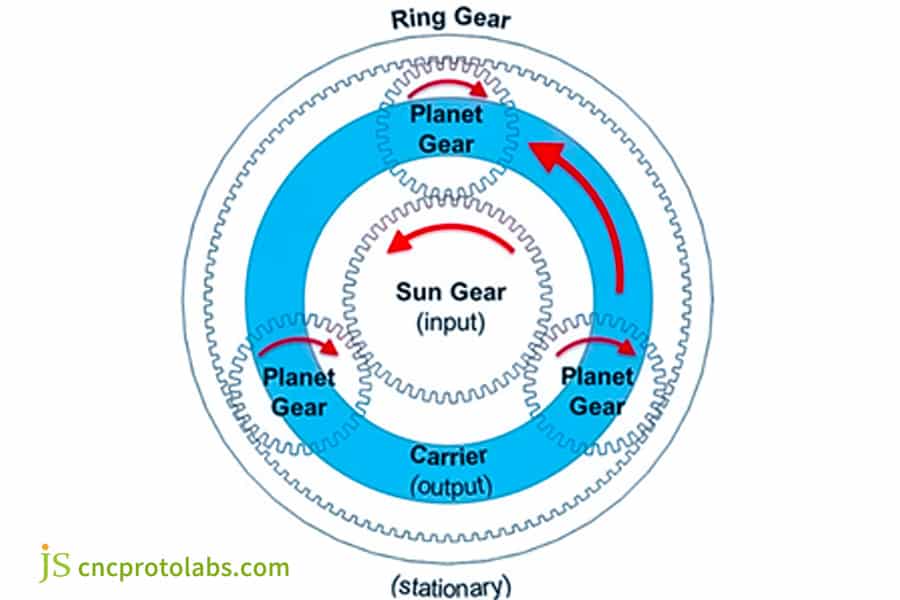
Figure 1: A schematic diagram of a planetary gear set, showing the labeled sun gear, planet gears, stationary ring gear, and planet gear carrier.
What Are The Advantages And Disadvantages Of Planetary Gears Compared To Worm Gear In Compact Transmission Solutions?
The decision between planetary gears and worm gears in precision gear manufacturing needs to consider three factors which include operational efficiency, spatial requirements and performance capabilities.
The two processes require different manufacturing methods which depend on particular project needs.
Direct Comparison of Transmission Efficiency and Self Locking Characteristics
Single stage planetary gears which undergo high precision gear manufacturing achieve operational efficiency 97-98% while three stage systems maintain efficiency levels above 90%.
The efficiency of worm gear ranges 50-90% because sliding friction forces reduce their efficiency when speed ratios increase.
Planetary gears need extra brakes while worm gears have self locking capabilities.
Difference in Space Occupancy for the Same Torque Output
The three stage planetary system displays a dimension of 120mm × 200mm and a weight of 18kg at 1000 Nm torque output and 60:1 reduction ratio.
Worm gear can achieve this with a single stage but measures 200mm × 250mm and weighs 35kg which makes it much heavier than the planetary system.
| Performance Parameters | Single stage planetary gear | Worm gear, 60:1 ratio |
| Transmission Efficiency | 97%-98% | 55%-60% |
| Torque Density (Nm/kg) | ≥150 | ≤50 |
| Space Utilization | High (coaxial design) | Low (requires heat dissipation housing) |
| Self Locking Feature | None, requires additional brake | Yes, achieved when lead angle < friction angle |
| Operating Noise | 50-60 dB(A)(optimized) | 45-55 dB(A) |
| Lifespan (hours) | ≥20000 | ≤8000 |
| Maintenance Frequency | Low | High (requires regular grease replacement) |
Make the Right Choice Based on the Application Scenarios
- Pursuing efficiency, compactness, long lifespan, and zero backlash, such as robot joints and CNC turrets, planetary gears are preferred, and high precision gear manufacturing can achieve ultimate performance.
- If you need self-locking, low noise, and low efficiency requirements, such as small lifting platforms, choosing a worm gear is more suitable.
Contact JS Precision engineers for a free cost estimate for planetary gears and worm gear solutions, and choose the transmission solution best suited to your application scenario.
How To Achieve High Precision Gear Manufacturing? Key Process Revealed
High precision gear manufacturing is a systematic process that requires micrometer level control from material selection to precision machining, directly determining the accuracy, torque density, and service life of planetary gears. It is the core of high-performance planetary gear sets.
Gear Steel Selection and Pre-treatment
Planetary gears primarily use high purity alloy steels such as 18CrNiMo7-6 and 20CrMnTi to ensure core toughness and surface hardness. The pre-treatment process starts with forging and normalizing before proceeding to rough machining which establishes the base required for precision machining work.
Core Manufacturing Processes: Precision Hobbing, Gear Shaping, and Gear Grinding Technology
The processes of gear hobbing and gear shaping work together to create rough parts which require further processing. The CNC hobbing machines at JS Precision operate with consistent precision results that meet the DIN 6-7 standard.
The gear grinding process serves as the main procedure for high precision gear manufacturing because it repairs heat treatment distortion and produces DIN 3-5 precision results which enable the system to function without any backlash.
Heat Treatment and Surface Finishing
The main heat treatment process requires carburizing and quenching. The effective hardened layer depth of module 5 gears needs to be controlled between 0.8-1.2mm.
According to AGMA 938-A05 information sheet, shot peening can improve gear bending fatigue life by more than 20%. In situations where lubrication is insufficient, the use of DLC and W-S-C coatings helps to decrease friction levels.
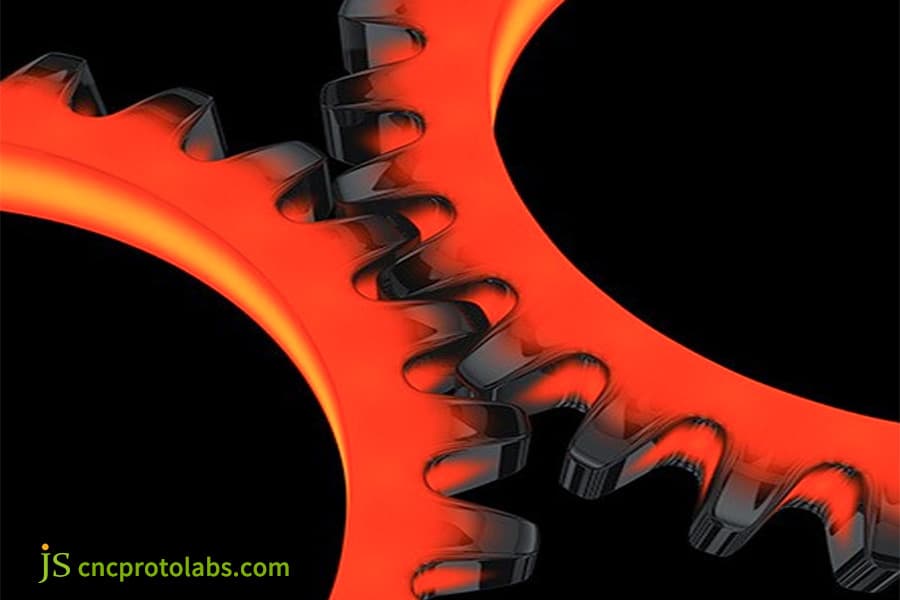
Figure 2: A close-up view of two precisely machined, metallic gears with a glossy finish interlocking against a dark background.
How Does Custom Gear Manufacturing Solve Application-Specific Challenges?
In precision gear manufacturing, off-the-shelf products usually don't satisfy the very high end equipment demands. Custom gearmanufacturing enables, through tailored alterations, the full adjustment of planetary gear sets to specific conditions, this is itsmain value.
Speed Ratio and Phase Adjustments: Tailoring Gears for Specific Combinations
Custom gear manufacturing can provide non standard gear combinations so that exact speed ratios with an error 0.1% can beobtained. Besides, transmission noise can be decreased by 3-5 dB(A) through planetary gear phase optimization, therebymeeting the requirement of medical robots etc. for quietness.
Integration of Planetary Carriers with Bearings and Differentials
Integrated design is a significant trend in custom gear manufacturing. The combination of the planetary carrier with bearings anddifferential housings reduces the number of parts and the assembly errors. After this optimization, electric vehicle reducers canhave their sizes cut down by more than 15%.
Special Coatings: For Poor Lubrication or Impact Load Scenarios
In aerospace and other environments, gears are coated with W-S-C or DLC coatings through custom gear manufacturing, whichcan lower the friction coefficient to less than 0.1, eliminate the failure of "cold welding", and also enhance the capability ofresisting impact.
How Is Large Gear Manufacturing Evolving For Megawatt-Scale Planetary Drives?
Large gear manufacturing caters to megawatt scale drive applications requiring very high torque capability, light weight, and high reliability. Micro level precision gear manufacturing controls quality at every stage of production and encourages constant innovation.
Deep Carburizing and Quenching: Tackling the Deformation Control Issue of Large Gear Rings
When deep carburizing (>4mm) large gear rings with a diameter of more than 2 meters, quenching can easily cause deformation. Large gear manufacturing uses pressure quenching, which can control deformation down to the micron level, in order to assure the high precision of the gear ring.
High Torque Density Challenge: Induction Hardening Technology Application
Ultra large internal gear rings may use tooth surface induction hardening and obtain a hardened layer of more than 5mm. Residual compressive stress beneficially at the tooth root greatly enhances the gear's torque capacity and its fatigue resistance as well as making it compliant with megawatt scale requirements.
Thin walled Gear Ring Design Incorporating Flexible Pin Technology
Weight reduction is a major consideration for large gear manufacturing. Thin walled gear rings allow a weight cut of more than 30%. When supplemented with flexible pin technology, deformation and machining inaccuracies can be compensated for, thus ensuring uniform load and stable operations.
View JS Precision's successful large gear manufacturing case studies to understand the manufacturing and optimization solutions for megawatt level planetary gears.
How To Select a Precision Gear Manufacturing Company For Long-Term Success?
Choosing a reliable precision gear manufacturing company should be determined through their technical collaboration, process capabilities, and practical testing & verification capabilities and not by mere purchasing parts only. It is one of the main points to successfully carrying out planetary gear designs.
Response Speed and Transparency: Detailed Quotation Package Within 48 Hours
First class precision gear manufacturing companies will be able to present a comprehensive quotation package containing technical solutions, process routes, and pricing within 48 hours. Besides that, they will keep you up to date with any potential problems they come across during project execution in order to guarantee delivery.
Global Footprint and Local Service: Familiarity with AGMA Standards
If you are selecting a precision gear manufacturing company for products that will be exported to North America, you will have to go for one that is very familiar with the AGMA standards and at the same has a global footprint and local service capabilities so as to reduce supply chain risks.
High Power Test Bench for Full Load Validation
A megawatt level enclosed power test bench owned by a precision gear manufacturing company focused on research is a good indicator. It emulates the actual working conditions in order to check product validity, supplies test reports, and lessens application risks.
One-on-one consultation with JS Precision's selection engineers to learn how to scientifically evaluate the comprehensive capabilities of a precision gear manufacturing company.
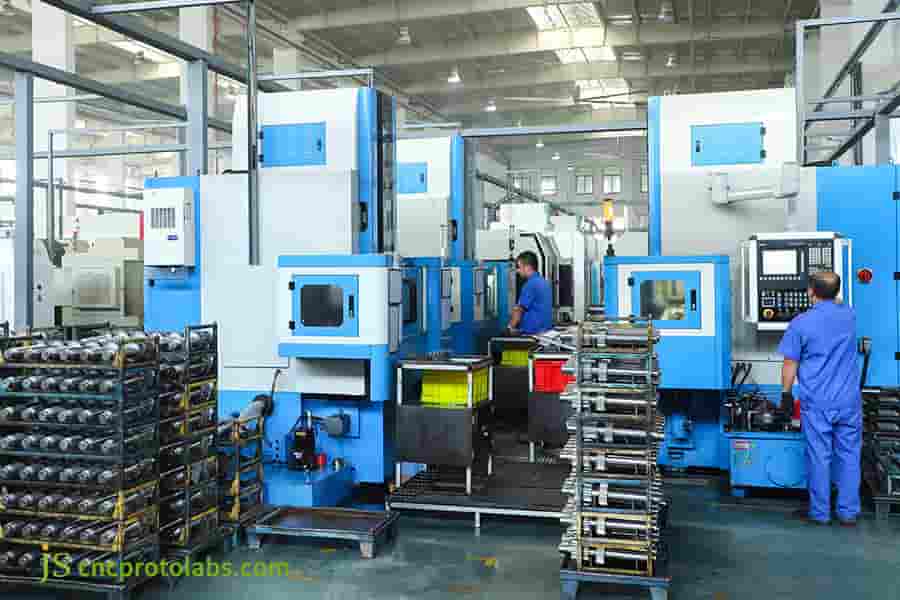
Figure 3: Inside a large manufacturing workshop, workers operate large gear-cutting machines under bright lighting, with racks of parts nearby.
JS Precision Case Study: Lightweight Joints Of a Collaborative Robot From 450kg To 360kg
In the application of precision gear manufacturing and custom gear manufacturing, we have solved the problem of lightweighting and torque improvement of 7-axis robot wrist joints for a leading collaborative robot enterprise, and achieved performance breakthroughs through gear machining process optimization.
Client Background
This client is a world famous collaborative robot company that had to create wrist joints for the new generation of 7 axis collaborative robots. The main requirements were lightweight, high torque, and zero backlash. The current solution had already reached its performance limits and could not satisfy the design requirements of the new product.
Original Solution
The client first used a regular harmonic reducer solution. The wrist joint module weighed 450 g, which is the limit of torque density in the industry, so there is no way to further weight reduction. Besides, the small space has not allowed the torque output to be increased, which makes the new product development being frustrated.
JS Precision's Solution
JS Precision's engineering team intervened in the customer's design process early on, collaborated with the customer to develop, and changed the standard harmonic scheme to a planetary reduction scheme based on custom gear manufacturing.
The main optimization methods include these following activities:
- The gear uses 18CrNiMo7-6 high purity alloy steel which manufacturing process produces DIN 4 precision while maintaining zero backlash through its high precision gear manufacturing techniques that include carburizing, quenching, and grinding.
- The planetary carrier, output flange, and crossed roller bearing inner ring design is combined into one component which decreases assembly errors through its reduced number of parts.
- The custom gear manufacturing process enables precise phase design of planetary gears which enables smooth operation through gear backing design.
- The application of DLC (diamond like carbon) coating to all planetary gears and sun gear surfaces enables friction reduction which enables the gears to transmit identical torque within a smaller space.
Results
The joint module weight decreased to 360g from 450g after optimization work, which represented a 20% weight reduction. The system maintained its same volume while delivering a 15% increase in peak torque. The system operated at a noise level below 50 dB(A), which satisfied the zero backlash requirement.
- Customer Testimonial:
Our design goal of a higher load to weight ratio for robots Williams achieved through JS Precision's precision gear manufacturing technology and customized design capabilities. Our new products have been successfully launched in the global market and have received high praise from our customers.
Contact JS Precision's engineering team immediately to submit your robot joint design requirements and obtain exclusive custom gear manufacturing lightweight solutions.
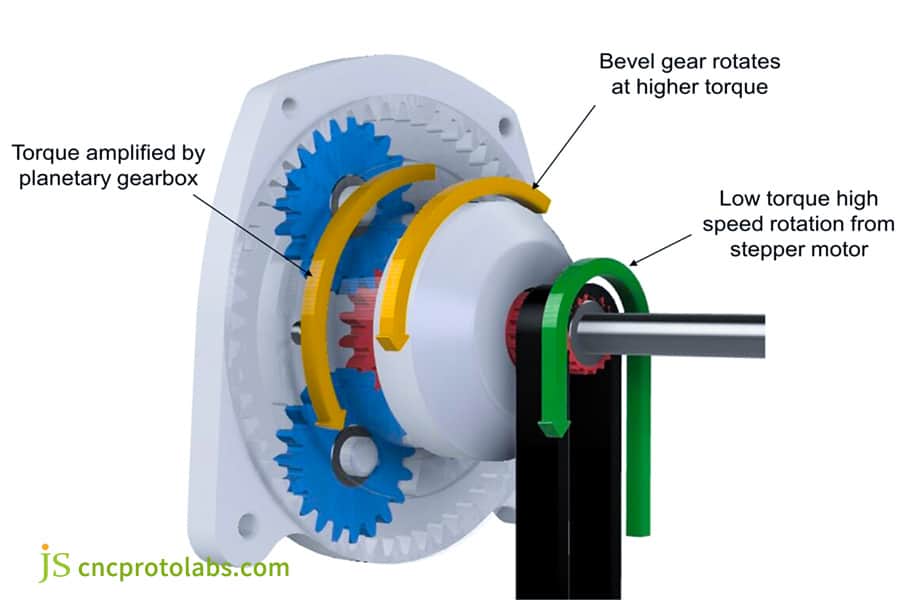
Figure 4: A cross-sectional diagram illustrating torque amplification through bevel and planetary gear stages.
FAQs
Q1: What level of precision can precision gear manufacturing achieve?
Precision gear manufacturing achieves revolution levels such as DIN 5 or AGMA 13 or higher for planetary gears through precision manufacturing techniques. Gear grinding can achieve a precision level of DIN 3 or even a zero backlash requirement.
Q2: What are the main advantages of planetary gears compared to worm gears?
Planetary gears are characterized by very high transmission efficiency (97%-98% per stage), compact size, and large torque density. Worm gears offer only the advantage of self locking, but their efficiency is quite lower than that of planetary gears.
Q3: What is the gear grinding process in high precision gear manufacturing?
Gear grinding comprises the main finishing process in high precision gear manufacturing. It can be used to erase gear deformations after heat treatment and reach the highest possible surface finish and tooth profile accuracy.
Q4: What happens if gears deform after heat treatment?
If gears are deformed after heat treatment, the deformation range can be limited to 0.05mm by pressure quenching, a kind of precision gear manufacturing method, and the following gear grinding can correct the further error and ensure the gear accuracy.
Q5: What materials are commonly used for planetary gears?
In precision gear manufacturing, planetary gears usually leverage high performance alloy steels such as 20CrMnTi, which is a material that can provide sufficient core toughness and surface hardness to meet the requirements of high torque.
Q6: What hardware should be considered when choosing a precision gear manufacturing company?
It is a best practice to focus on CNC forming grinding machines, coordinate measuring machines, and high power enclosed testing benches or similar core equipment when choosing a precision gear manufacturing company.
Q7: Can JS Precision provide gearbox test reports?
Besides having a 6. 4MW-class enclosed power testing bench, JS Precision is capable of generating full test reports on noise, temperature rise, efficiency, and other aspects of analyzed under full load conditions.
Q8: How long does it take from custom design to mass production?
Typically, a simple prototype delivery period in custom gear manufacturing will be 4-6 weeks, while the delivery of complex project including molds and testing can take 12-16 weeks.
Q9: How to get a quote for precision gear manufacturing?
Submit design requirements. A comprehensive quotation package, including technical solutions, process routes, and project schedule, is typically provided within 48 hours.
Summary
Precision gear manufacturing is very important for getting ultimate planetary gear performance. Besides that, custom gear manufacturing and large gear manufacturing are also the ways to help application limits.
As a professional precision gear manufacturing company, JS Precision can provide you with full technical support for your high torque compact designs bringing them into life.
Ready to turn your design blueprints into reality? [Contact our engineering team now for a free technical assessment]

Disclaimer
The contents of this page are for informational purposes only.JS Precision Services,there are no representations or warranties, express or implied, as to the accuracy, completeness or validity of the information. It should not be inferred that a third-party supplier or manufacturer will provide performance parameters, geometric tolerances, specific design characteristics, material quality and type or workmanship through the JS Precision Network. It's the buyer's responsibility Require parts quotation Identify specific requirements for these sections.Please contact us for more information.
JS Precision Team
JS Precision is an industry-leading company, focus on custom manufacturing solutions. We have over 20 years of experience with over 5,000 customers, and we focus on high precisionCNC machining,Sheet metal manufacturing,3D printing,Injection molding,Metal stamping,and other one-stop manufacturing services.
Our factory is equipped with over 100 state-of-the-art 5-axis machining centers, ISO 9001:2015 certified. We provide fast, efficient and high-quality manufacturing solutions to customers in more than 150 countries around the world. Whether it is small volume production or large-scale customization, we can meet your needs with the fastest delivery within 24 hours. Choose JS Precision this means selection efficiency, quality and professionalism.
To learn more, visit our website:www.cncprotolabs.com
Resource