English




In 2026, the best plastic prototype companies for custom parts are JS Precision, 3ERP, Xometry, Fictiv, WayKen, LKPrototype, Evok Polymers, and ICOMold. These are distinguished by factory ownership and use of brokers, tolerances ranging from ±0.01 mm to ±0.30 mm across processes, and batch sizes from 1 to 10,000+ parts. Their services include CNC machining, 3D printing, urethane casting, and rapid injection molding.
The best decision is the choice of the supplier in terms of unit cost, true resin strength, and DFM speed.
Overview of the Top 8 Plastic Prototype Suppliers
For plastic prototypes with high accuracy (tolerance from ±0.01 to ±0.05 mm), in real engineering plastics, direct manufacturers in Asia like JS Precision and 3ERP are more accurate compared to instant quote providers without brokers.
| Supplier Tier | Top 8 Companies | Business Model | Best Batch & Tolerance |
| Direct Agile Factories | JS Precision, 3ERP, WayKen, LKPrototype | In-house CNC, vacuum casting & aluminum molds, zero broker fee | 1–2,000+ pcs, ±0.01–±0.05 mm (CNC) / ±0.10 mm (molding) |
| Digital Broker Platforms | Xometry, Fictiv | Instant online quotes across outsourced shop networks | 1–500 pcs, ±0.05–±0.15 mm (varies by partner shop) |
| North American Molders | Evok Polymers, ICOMold | Domestic trial molding & bridge injection molding | 500–10,000+ pcs, ±0.08–±0.15 mm (ISO 20457, size- and resin-dependent) |
How Do You Evaluate the Best Plastic Prototype Companies?
In selecting the best plastic prototype companies, there are four difficult criterias that have to be taken into account when choosing the best plastic prototype companies: tolerance (from ± 0.01mm to ± 0.15mm), factory control of prices and not using broker pricing, engineering resin material, and the speed of DFM. It is impossible to create functioning plastic prototypes using brittle 3D-printed photopolymer instead of thermoplastic material.
Direct Factory Ownership vs. Broker Networks
The websites look effective, however, what happens in reality is that they are brokerages that operate with algorithms determining the price of STEP files and sending the orders to unknown shops.
- Hidden Broker Markups: The platforms mark up the price by 25%-45%.
- Slow DFM Loops: If the rib thickness or inner radius turns out to be too large, the DFM loop will take place slowly going from the client via account rep to a mysterious machinist.
- Direct Shop-Floor Access: The direct factories having more than 100 in-house CNC machines have direct access to the machinists from the engineering team.
Full-Lifecycle Process Continuity
A reliable vendor supports a part across every volume stage without mid-project requalification, a core benchmark in any rapid prototyping buyer's guide:
- 1 to 20 Units (Engineering Prototypes): CNC machining from plastic stock (Delrin, PEEK, ABS, PC) or SLA/SLS for fit tests.
- 15 to 80 Units (Design Prototypes): Urethane casting from master patterns and silicon molds for decorative housing parts.
- 150 to 2,000+ Units (Prototype Bridge Runs): Rapid aluminum (7075) or steel (P20) molds to evaluate gate positions, weld lines, and shrinkage rates.
Keeping the 5-piece CNC assembly and the 300-piece bridge mold together ensures the integrity of datum faces, which matters when evaluating rapid prototyping companies across U.S. and Asian hubs.
Must-Have Quality and Tolerance Documentation
Three base documents needed prior to purchase order issuance:
- CMM Inspection Reports: Proves tight bore holes, press-fit pins, and mating lips meet print callouts.
- Resin Certificate of Analysis (COA): Proves true brand-name material (SABIC Lexan, DuPont Delrin) as opposed to substandard regrind.
- Clear Tolerance Callouts: Proves machine and mold part dimensions adhere to ISO 2768-m and ISO 20457 standards respectively.
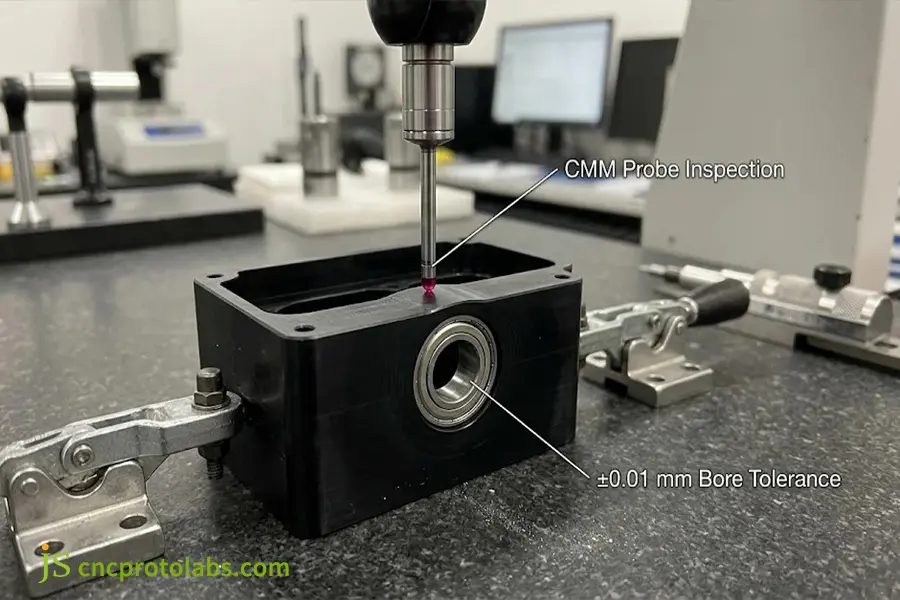
CMM probe inspection verifying ±0.01 mm bearing bore tolerances on a CNC-machined custom plastic prototype.
What Are the Strengths and Limits of the Top 8 Plastic Prototype Companies?
The top 8 plastic prototype companies, there is the category that includes direct Asian factories (JS Precision, 3ERP, WayKen, LKPrototype), global quotation platforms (Xometry, Fictiv), and North American bridge molders (Evok Polymers, ICOMold). Whereas online portals offer instant quotations for simple shapes, direct plastic prototypes manufacturers reduce unit prices by 30%-50% and offer better CNC tolerance of ±0.01 mm.
JS Precision
JS Precision has a Dongguan plant with over 100 CNC machines, lathes, and CMMs and is North American supported. JS Precision can handle tolerances of ±0.01 mm - ±0.05 mm for CNC plastic machining, vacuum casting, and rapid aluminum or P20 mold (1 to 2000+ parts).
- Best For: Prototype manufacturing needing tight tolerance, no middleman fees, and direct DFM service.
- Limitation: There is no immediate online ordering available for intricate parts; quotation requires 4 to 12 hours of engineering analysis.
3ERP
3ERP is a China direct prototype service with multiple-axis CNC milling, urethane casting, and rapid tooling capabilities of ±0.05 mm for milled plastics and surface finish Ra 0.2 μm through vapor polishing.
- Best For: Combines multiple processes such as CNC frames along with vacuum cast covers in one shipment.
- Known Limit: Needs manual quoting for complicated parts and early slot booking.
Xometry
Online service where you can get AI instant quotes in more than 10,000 partner facilities for 3D printing (SLA SLS MJF, FDM), CNC machining, and injection molding.
- Best For: Quick budget estimates, price comparison between different types of resins, and rapid visualization test.
- Known Limit: The use of external companies makes tolerances inconsistent from one order to another, as well as price rises due to fees on the platform.
WayKen
WayKen is a prototyping company based in south China. The company specializes in working with transparent plastic material such as PMMA and PC vapor polishing, multiaxis CNC machining, and fast aluminum tooling.
- Best For: Light pipes, optical lenses and cosmetic covers that demand high optical clarity similar to that of glass.
- Known Limit: Designed for prototypes and small scale production below 10,000 units.
Fictiv
Fictiv partners approved US and Asia partner shops with in-house quality control engineers, providing live wall-thickness DFM alerts and order updates.
- Best For: Groups that require digital order tracking, standardized inspection packages, and controlled overseas QC.
- Known Limit: Partner-shop fees raise unit cost 25%–45% above factory-direct quotes at 50–500 piece volumes.
LKPrototype
LKPrototype is a prototype shop that specializes in polyurethane vacuum casting, CNC machining, 3D printing, and soft tooling, making 15 to 80 duplicate units using silicone molds.
- Best For: Ergonomic testing of 15–80 cast urethane housings (typical 20–60) before investing in costly metal molds.
- Known Limit: Micro-features smaller than 0.5 mm and bearing bores of ±0.01 mm tolerance are not part of its primary vacuum casting service.
ICOMold
ICOMold is an online platform that offers instant quotes and bridge injection molding services in the USA presses and off-shore mold building services for 500 to 10,000+ parts. Teams comparing domestic molders against overseas factories often explore alternatives for injection molding services to clarify mold ownership and lead times.
- Best For: Molded parts whose designs have been proven for production purposes as well as aluminum/steel molds requiring bridge tooling.
- Known Limit: Not designed for 3-day CNC machining and standalone 3D printing.
Evok Polymers
Evok Polymers is an American company offering quick tooling solutions for medical elastomers and two-shot overmolding, and engineering resins testing in American time zones.
- Best For: Teams from the medical and aerospace industries that need resin testing in American time zones and live engineering support.
- Known Limit: Mold costs are too high when compared to Asian rapid mold shops and it does not offer 1 to 5 piece CNC runs.
How Are Plastic Prototyping Services Compared Across Cost, Tolerance, and Failure Risks?
When plastic prototyping services compared on unit price, accuracy, and strength, CNC machining holds the tightest tolerances (±0.01–±0.05 mm) in solid engineering plastics for 1–50 parts. However, SLA/SLS 3D printing breaks when dropped and cannot handle temperatures higher than 60°C because of its Z-axis layer lines. Rapid injection molding only becomes cost-effective after 80–150 units, once the $1,500–$4,500 aluminum tooling cost is amortized.
Plastic Prototyping Methods Compared by Tolerance, Cost, and Failure Limits
|
Evaluation Metric |
3D Printing (SLA / SLS / MJF) |
CNC Plastic Machining |
Urethane Vacuum Casting |
Rapid Injection Molding (Al / P20) |
|
Tolerance & Finish |
±0.15–±0.30 mm, layer lines (Ra 3.2–6.3 μm) |
±0.01–±0.05 mm, smooth cut (Ra 0.8–1.6 μm) |
±0.15–±0.25 mm (+0.15% shrink), copies master |
±0.08–±0.15 mm (ISO 20457), SPI A1–D3 finish |
|
Batch & Cost ($) |
1–15 pcs, $15–$80/pc, $0 tooling |
1–50 pcs, $40–$250/pc, $0 tooling |
15–80 pcs, $25–$90/pc, $300–$800 silicone mold |
150–2,000+ pcs, $1.50–$6.00/pc, $1,500–$4,500 mold |
|
Lead Time & Resin |
1–4 days, photopolymers or sintered PA12 |
3–7 days, solid extruded engineering plastics |
7–12 days, 2-part thermoset PU (ABS/PC-like) |
10–18 days, real production resin pellets |
|
When NOT to Use |
Snap-fit fatigue, fluid seals, >60°C heat |
Deep blind undercuts or closed hollow shapes |
Runs >30 shots (silicone swells, ±0.20 mm drift) |
Orders <80 pcs (break-even typically 80–150 pcs) |
Use CNC plastic machining for bench tests under 50 pieces. Rapid aluminum injection molding can be used over 150 pieces where mold costs have been recovered and molding weld lines validated.
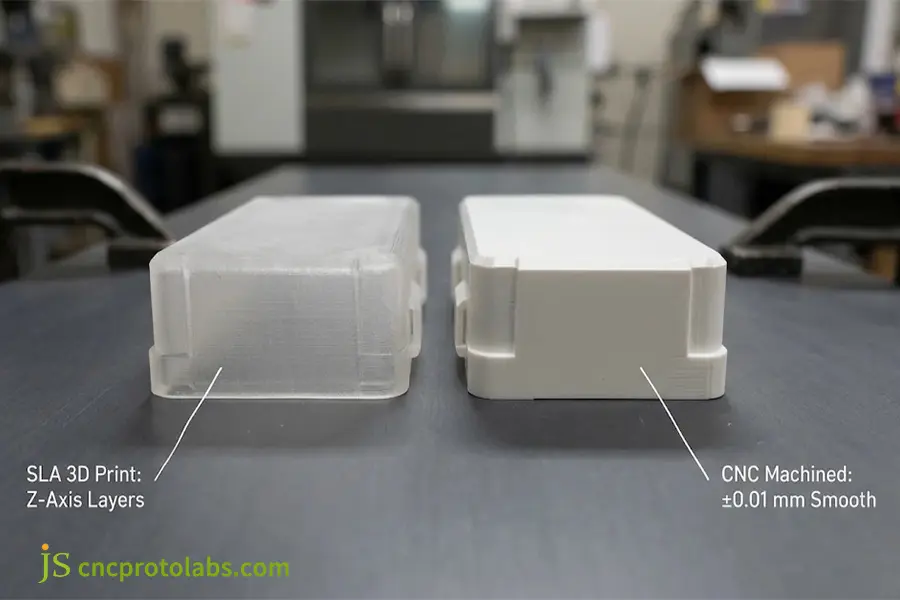
Surface finish comparison across plastic prototyping services: SLA 3D print Z-axis layers (left) versus ±0.01 mm smooth CNC-machined plastic (right).
Why Plastic Thin Wall Prototype Models Warp or Fail During Process
Reasons why milling process and resin printing fails in producing 1.0 mm thin wall model are:
- Internal Stress Warping (CNC): Heavy cuts per pass heat extruded POM and PA66, causing 0.15–0.40 mm of warpage after the part is unclamped when walls are only 1.0 mm thick.
- Z-Axis Layer Weaknesses (3D Printing): As per the Wohlers Report 2026, there are weak layers in the build axis SLA snap-fits fail at roughly 30% to 50% of the impact strength of solid ABS because the build axis has weak interlayer bonds. This driving teams to compare 3D printing vs CNC machining for prototypes.
- Tooling Break-Even Inflection Points: Machining beyond the 80–150 piece break-even wastes money, as softer aluminum tooling becomes cheaper per part. Curves of costs of rapid injection molding vs 3D printing for bridge production reveal that aluminum tooling pays off after 80–150 pieces. Comparison of costs of rapid prototyping vs traditional prototyping production reveals situations where 7075 aluminum tooling (500–3,000 shots) beats steel molds.
How to Choose a Plastic Prototype Company for Custom Plastic Prototypes?
Choose a plastic prototype company for custom parts starts by locking three specs: batch size, closest tolerance and resin certification. Use direct factory CNC machining for 1 to 50 close tolerance (±0.01 to ±0.05mm) pieces, urethane casting for 20 to 100 cosmetic housing components and aluminum rapid molding for more than 150 pieces.
Four-Step Engineering Selection Decision
- Step 1: Fixed Quantities: CNC or 3D print 1-15 pieces ($0 tooling), CNC vs. urethane casting 15-80 pieces, finally advance to rapid aluminum 7075 or P20 tooling for 150-2,000+ pieces.
- Step 2: Tolerances Check: When tolerance needed is from ±0.01 mm to ±0.05 mm (bearings bores, O ring grooves or lens seats) remove 3D printing and vacuum casting, then directly ship parts to CNC shops like JS Precision or 3ERP.
- Step 3: Verify Resin Specifications: If UL94 V-0, 30% glass-filled nylon (PA66-GF30), or autoclaving sterilization required, then no photopolymer resin is permitted, otherwise, choose any one of the approved materials available either as stock or in pellet form as per the prototype manufacturing guide.
- Step 4: Select Supplier Level: For quick quotes within 10 minutes for simple bracket, select Xometry or Fictiv, for uploading complicated files with a 30-50% reduction in cost, choose JS Precision, 3ERP, or WayKen and DFM manual check, and for mass production of more than 1,000 units, choose ICOMold or Evok Polymers.
Case Study: Medical Housings, From Bad 3D Print to 120 Rapid Molded Parts
A medical firm in the USA needed 120 flame retardant PC/ABS housings, UL94 V-0, with 1.2 mm walls and snap-fit latches and PCB bosses to ±0.03 mm tolerance.
- The Problem: First 15 SLA 3D prints were a disaster – four snap-fits snapped off at Z-axis layers in drop test, and resin was warped due to inside heat of 65°C. The quoted cost of a conventional US steel production tool was $18,500 with a six-week lead time.
- DFM Solution: Within 8 hours, JS Precision examined STEP files, finding the problem in sink with 1.0 mm ribs versus 1.2 mm wall. After changing the ribs to 0.6 mm (wall ratio 50%) and adding 1.5 degrees of draft angle, the shop made the 7075 aluminum tooling.
- Shop-Floor Results: Supplied T1 parts in 9 days and all 120 PC/ABS housings in 12 days. CMM check held the PCB bosses dimensions to ±0.025 mm, and saved 42% versus the quoted US steel tooling cost on genuine SABIC Cycoloy material.
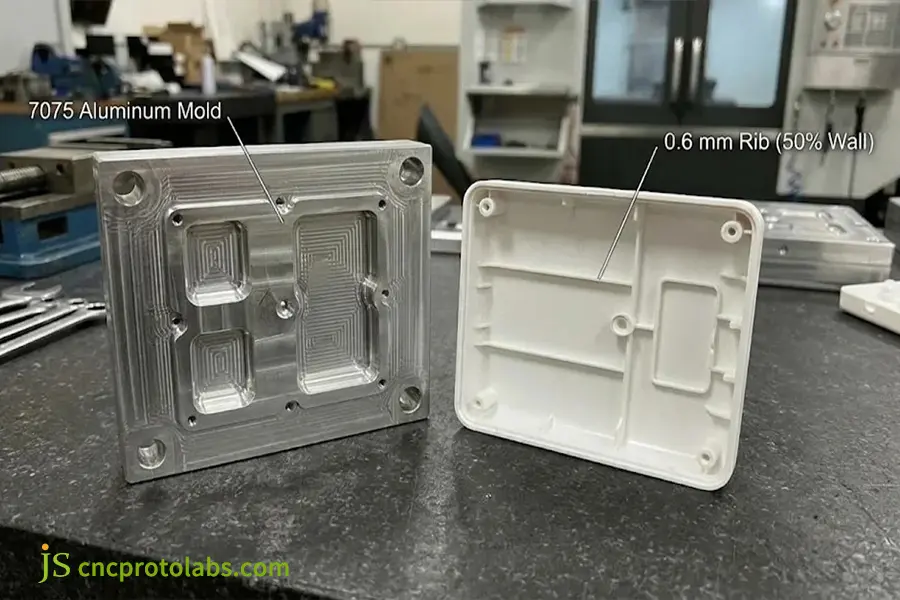
7075 aluminum rapid injection mold and molded PC/ABS medical housing with 0.6 mm ribs (50% wall thickness ratio) to prevent sink marks.
FAQs
How much do custom plastic prototypes cost per part in 2026?
3D printing parts will be priced at $15 to $80 per part ($0 tooling). CNC machining will cost from $40-$250 per part. Urethane casting price will average $25 to $90 with production of 20 to 50 units. Rapid aluminum mold injection molding will have a cost range of $1,500-$4,500 for tooling and $1.50-$6.00 per shot.
Which plastic prototype company is best for low-volume production of 100 to 1,000 units?
The most appropriate company will be the direct factory with rapid tooling like JS Precision, 3ERP, and WayKen. The 7075 aluminum molds will take about 10-15 days to deliver, cutting down unit costs by 60%-75% from CNC machining, and will also manufacture thermoplastics.
Can 3D printed plastic prototypes match the strength of injection molded parts?
No. The SLA photopolymer has 30% to 50% of the impact strength of ABS and will break along the Z axis layers, while the sintered PA12 is more porous. Stock and rapid injection molding prototypes should be used for impact/pressure/snap fit testing.
How do I select a plastic prototyping supplier in China without IP risks?
Sign an NNN agreement that is in bilingual form with Chinese laws and not just an NDA for the West. Ensure that the company has a business license and ISO 9001 certification to ensure that there are no middlemen involved, and exclude extraneous assembly data in STEP files.
What tolerances can plastic prototype manufacturers realistically hold?
Precision CNC machining tolerance ranges from ±0.01 mm to ±0.05 mm on critical dimensions (tolerance ±0.02 mm to ±0.10 mm overall). Rapid Injection Molding meets the standards of ISO 20457 and ±0.08 mm to ±0.15 mm tolerance, with wider tolerance range required owing to larger shrinkage rate of PP (1.5%-2.5%).
When should I switch from CNC machining to rapid injection molding for prototypes?
When the total cost of CNC is higher than the total cost of mold and the molding of parts, change to molding. When you compare the total cost of $95 in CNC housing with the mold cost of $2,800 and cost per shot of $4, the break-even point is roughly 31 parts (before setup and yield), in practice most shops quote 80–150 pieces.
Conclusion
The selection between the top plastic prototype companies boils down to getting the batch size, tolerance (fitting that requires ±0.01mm precision vs. visual check with ±0.15mm tolerance), and resin properties in sync with the right shop type. The web-based quoting systems are perfect for quick and simple parts production, while the precise factories do away with brokers’ fees and build from one-offs to bridging molding.
Do you have a 3D CAD model prepared? Upload your STEP or IGES files to the engineers at JS Precision for a complimentary DFM analysis and multi-process cost quote within 24 hours.
Editorial Note: Supplier evaluations are based on specifications, tolerances, and cost structures for 2026. Quotes and lead times will be subject to geometry and resins used.