English




Rapid prototyping is becoming a core means of breaking traditional constraints in the field of product development. But has the extended delay in getting a prototype made silently and slowly killed your innovation momentum in product development?
If you are in a situation where you desperately need a prototype to test your design or grab a market opportunity, should you continue with the traditional pattern of making molds that take weeks, or should you go for the more nimble rapid prototyping alternative?
Here, we dissect the two routes and give you a thorough insight into their crucial differences. It will assist you in determining the best trade-off between speed, accuracy, and cost.
Key Answers Overview
| Key Questions | Key Answers | Value for You |
| Why is speed king in prototyping? | Speed is the main factor determining product launch time and the efficiency of R&D iteration, and it is the core competitive advantage of a company in seizing market opportunities. | Understand the business logic of speed and make it a priority to validate quickly. |
| Is rapid prototyping really cheaper? | During the early phase of R&D, rapid prototyping cost comparisons reveal that it makes need for mold go away, thus the cost is very low, however, at the mass production stage, traditional injection molding has a stronger advantage in the cost per unit. | Understand clearly the right cost model for each stage to prevent making wrong decisions. |
| When should you choose rapid prototyping services? | When the need is for functional verification, appearance evaluation, small-batch prototyping, or when design uncertainties are involved. | Clarify the application scenarios of rapid prototyping, accurately initiate projects, and shorten the development cycle. |
Key Takeaways:
- Speed is the main criterion for value:
With rapid prototyping, product innovation and iteration are substantially accelerated by shortening delivery cycles from weeks to days.
- The degree of certainty is subprocess-dependent:
In a rapid prototyping laser cutting the precision (0.01mm) can be almost as good as traditional methods, while it is 3D printing that is able to handle the most intricate geometries.
- Price is a variable:
Starting with rapid prototyping is a good decision as it is saving the cost of molds, however, injection molding can be used to bring down the per unit cost during the mass production phase, a comprehensive view is necessary.
- The Chinese supply chain serves as a powerful tool:
By partnering with a Chinese supplier like JS Precision you not only get the cost leverage but you also get the efficiency of engineering collaboration.
Why Trust This Guide? Practical Experience In Rapid Prototyping With JS Precision
JS Precision has been committed to rapid prototyping for more than ten years, helping over 3, 000 companies globally, including high-end manufacturing sectors such as automotive, medical, and aerospace.
We have made more than 100, 000 tailor-made prototypes and have a solid practical background in meeting the prototyping requirements and technological challenges of different industries.
The core engineers from our team each have more than 15 years of experience in precision manufacturing, which allows them to finely tune the key parameters of rapid prototyping methods like CNC and 3D printing, thus saving clients from various design and production risks.
Our rapid prototyping services are carried out under the strict aerospace quality standard AS9100D, and the whole set of operations holds the ISO 9001:2015 quality system certification. Every stage, from choosing the material to product testing, is performed under controlled, standardized procedures.
We assisted an aerospace company in the US with a high-precision titanium alloy prototype, production time was cut down from the traditional 6 weeks to only 4 days, and the accuracy deviation was controlled within 0.008mm, thus perfectly satisfying the clients' highly demanding standards.
Moreover, we gave a medical device company in Europe the support of rapid prototype iterations, resulting in 3 design changes done in just 15 days, and the total cost was 60% less than that of the traditional model.
Real-world case studies, a standardized quality system, and extensive industry experience make JS Precision a reliable partner for rapid prototyping for global enterprises.
Want to mitigate process risks and achieve ultra-fast delivery for your prototyping projects? Contact the JS Precision engineering team now, tell them your product area and prototyping needs, and you can receive a free, customized rapid prototyping solution.
What Is The Prototyping Process And Why Does Speed Matter?
What is prototyping? Prototyping fundamentally refers to the process of taking design ideas through to physical and multi, dimensional verification. As an important step in a product's transformation from concept to mass production, rapid prototyping is an extremely efficient upgraded version of it.
Speeding up the prototype development cycle allows for more design iterations, quicker error detection, and ultimately, a faster time-to-market, which hence is considered its main value.
Conventionally, making prototypes from molds and handwork took an average of 4-6 weeks, whereas, rapid prototyping, which is a digitized process, can reduce the first-piece lead time to 3-5 days.
Market research indicates that for every month a product enters the market earlier it can acquire about 15% of the market share, therefore, rapid prototyping has become a key competitive advantage for companies.
Comparison of Traditional and Rapid Prototyping Delivery Cycles
| Prototype Type | Complex Part Delivery Cycle | Complex Part Delivery Cycle | Design Iteration Time Per Cycle | Maximum Annual Iterations |
| Traditional Prototyping | 2-3 weeks | 4-6 weeks | 1-2 weeks | 10-12 iterations |
| Rapid Prototyping | 1-2 days | 3-5 days | 1-3 days | 50-60 iterations |
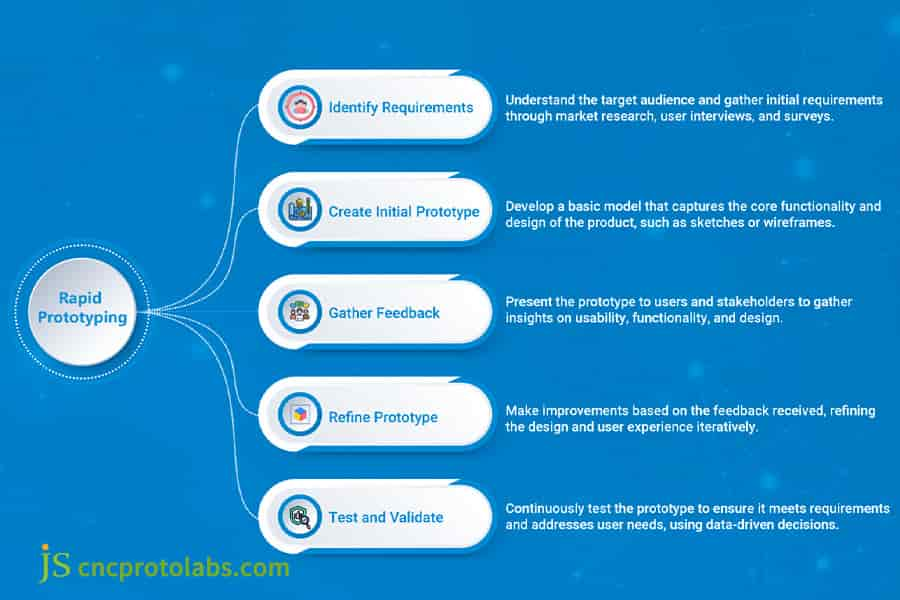
Figure 1: A blue-themed infographic outlining the five key stages of rapid prototyping: Identify Requirements, Create Prototype, Gather Feedback, Refine, and Test.
How Does Rapid Prototyping Actually Achieve Faster Delivery Cycles?
Rapid prototyping can overturn the efficiency of traditional prototyping, with the core being digital processes and flexible technology selection, eliminating the need for time-consuming molding and enabling prototyping rapid to be implemented.
Its process compliance meets ASTM E1340-96 standards, and the core is divided into subtractive and additive manufacturing.
1. CNC Precision Machining (subtractive):
As the core process of rapid prototyping, it discontinues the use of molds thus, it can reach the accuracy of ±0.01mm. It serves a wide range of materials, aluminum 6061 and ABS included, satisfying the majority of functional prototype requirements.
2. 3D Printing (additive):
It is through successive layers of material that the model is constructed and therefore this is the secret of rapid prototyping achieving complex structures feature.
Although it is able to manufacture complex structures that traditional processes cannot accomplish, the surface finishing and material density of the product are not of the same level as those produced by CNC.
To more clearly present the key data differences in the core processes of rapid prototyping, the following is a parameter comparison table for different processes, providing accurate reference for process selection:
| Process Type | Precision Range | Processing Speed | Applicable Materials | Unit Processing Cost (USD) |
| CNC Precision Machining | ±0.01-0.05mm | Medium Speed (20-50mm/min) | ABS, Aluminum 6061, Titanium Alloy, etc. | 80-300 |
| SLA 3D Printing | ±0.1-0.2mm | Fast Speed (50-100mm/min) | Photosensitive Resin, Medical Grade Resin | 50-180 |
| SLS 3D Printing | ±0.15-0.25mm | Medium Speed (30-60mm/min) | Nylon, PA66, Carbon Fiber Composite Materials | 70-220 |
| Traditional Injection Molding Prototype | ±0.1-0.2mm | Slow Speed (5-15mm/min) | ABS, POM, PC, etc. | 150-500 |
| Vacuum Molding | ±0.2-0.3mm | Medium speed (15-35mm/min) | Silicone, PU resin, ABS replicas | 60-200 |
JS Precision unites the benefits of different rapid prototyping technologies to pick the optimal prototyping rapid path according to the customer's needs for accuracy, structure, and material, thus balancing delivery efficiency and quality.
Is Rapid Prototyping More Accurate Than Traditional Methods?
It is a typical mistake that the notion "faster speed means lower precision" is false. The precision of rapids prototype varies with the process and sometimes it even surpasses the precision of the traditional one. In fact, the benefits of rapid prototyping are seen in the two-folded assurance of precision and usefulness.
Lateral Comparison of Precision Indicators
Prototypes of traditional injection molding are dependent on the mold and therefore, they usually have a precision of 0.1-0.2mm. Rapid prototype gives superior core process precision:
- CNC machining accuracy is always at IT7-IT9 level, and the tolerance can be as small as ±0.02mm at a diameter of 50mm, which is perfect for functional testing.
- SLA/SLS 3D printing precision is 0.1mm/100mm, thus, it can be used for appearance and assembly verification.
Surface Quality and Material Performance Related Issues
The benefits of rapid prototyping are also reflected in material adaptability. JS Precision's rapid prototype can use production grade materials such as ABS and AL6061 to complete real performance testing, with reference value far exceeding traditional simple models.
Want to verify if your product prototype's precision meets mass production requirements? Contact JS Precision engineers for a free rapid prototype precision simulation test.
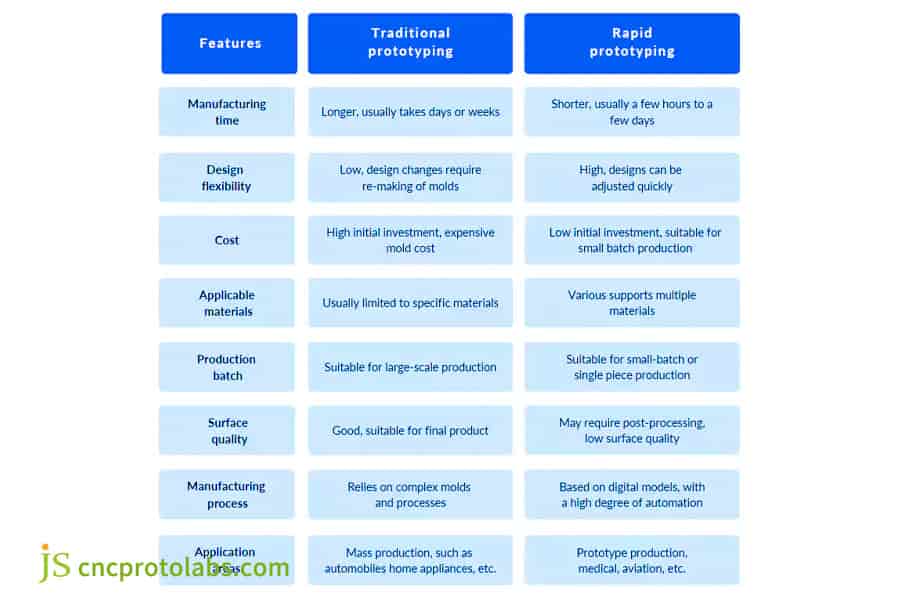
Figure 2: A comparison table listing differences between rapid and traditional prototyping across time, cost, flexibility, materials, and applications.
Rapid Prototyping Cost Comparison: Is It Really Cheaper Than Traditional Methods?
'Quick is expensive' is a misconception about rapid prototyping. The rapid prototyping cost comparison shows that it has significant cost advantages in the early stages and can save full cycle time and opportunity costs. After 78% of enterprises use it, their R&D costs are reduced by more than 30%.
Short-Term Cost Analysis
Almost the whole cost of traditional prototyping is in the mold, with one mold opening costing $5, 000-$20, 000. Design failure leads not only to a loss of cost but also to a loss of time.
Rapid prototyping does not require molds, and every iteration costs only a few hundred to a few thousand dollars. The cost of three iterations is only 20%-30% of what is typical for a traditional model.
Long-Term Value Analysis
Rapid prototyping has the potential to accelerate the time a product is brought to market, thereby creating the opportunity for extra revenue. Besides, it aids in discovering design problems at an early stage, thus saving the company from having to spend hundreds of thousands of dollars on engineering changes at a later stage.
JS Precision, making use of its Chinese supply chain, is able to further cut the material and processing costs of rapid prototyping by 25%.
Cost Comparison of 3 Iterations between Traditional and Rapid Prototyping (Unit: USD)
| Prototype Type | Mold Cost | Processing Cost | Material Cost | Material Cost | Total Cost |
| Traditional Prototype | 15000 | 3000 | 1500 | 2500 | 22000 |
| Rapid Prototyping | 0 | 4500 | 4500 | 800 | 6500 |
Want to calculate the true cost of your product prototype iterations for free? Submit your iteration plan to JS Precision to get a detailed rapid prototyping cost comparison report.
How Does Rapid Prototype Compare To Injection Molding?
During product development, the key decision is whether the company should carry out rapid prototype or proceed with injection molding, which can even be decided straightaway at R&D. The basic differences between the two would essentially dictate at which level of their adaptation one's going to be. Certainly, prototyping aims at a facilitation of mass production.
Core Difference: Presence or Absence of Molds
- Rapid Prototype: No mold cost, constantly changing design, perfect for design verification and less than 100 pieces, etc. Trial sales demand can be met quickly.
- Injection Molding: Requires mold making work (costing anywhere from a few thousand to a few tens of thousands of US dollars). Although, after mold opening, the unit price is low, mold modification is expensive. Mostly large-scale mass production is appropriate after the design is finalized.
How to methodically determine the best route with respect to quantity?
JS Precision, with a combined experience of years in prototyping and mass production, has no trouble setting forth a decision-making framework:
- 1-50 pieces: Opt for a CNC or 3D printing rapid prototype.
- 50-1000 pieces: Either rapid prototyping or small-batch CNC could be considered.
- Over 1000 pieces: Injection molding becomes the cheaper choice and additionally, this route makes for a smooth transition.
When Should You Choose a Rapid Prototype Over a Production-Ready Prototype?
Different phases of product development call for different types of prototypes. Correctly identifying the right time for a rapid prototype can enhance R&D effectiveness and save from unnecessary cost investments.
Ideal Situations for Rapid Prototyping
- Proof-of-Concept Stage: When it is necessary to demonstrate ideas and obtain approvals quickly, a rapid prototype can convert ideas into a tangible object in no time.
- Functional Testing Stage: When it is essential to carry out real-world testing on the main components, a rapid prototype can be made from mass-production-grade materials, and the results are more trustworthy.
- High Design Uncertainty Stage: When it is crucial to test and iterate quickly, the low iteration cost of a rapid prototype allows for the consideration of several design options.
When is it Required to Switch to a Production, Ready Prototype?
If testing under extreme conditions is required, or in case there are very stringent requirements for the consistency of mass-production materials and processes, a production-ready prototype is a must. JS Precision has the capability of a smooth handover from a rapid prototype to a production-ready prototype.
Can I Get a Customized Rapid Prototyping Quote Online?
JS Precision enable the rapid prototyping inquiry process be simplified, fast quotation, and service system that can quickly provide customized quotes and delivery dates administrations be done, thus providing more rapid prototyping services with efficient use of time.
Rapid Quotation and Service Process of JS Precision
- Step 1: Submit 3D drawings online (STEP/IGES format) along with the quantity and material requirements.
- Step 2: Complete DFM analysis within 24 hours and provide optimization suggestions.
- Step 3: Provide a competitive rapid prototyping quote and a precise delivery date.
- Step 4: Start production and provide full progress tracking.
Key Features of Clear Pricing
JS Precision is thorough with their rapid prototyping price, which is clear and without any hidden costs. The main factors that were influenced are materials, precision, surface treatment, and quantity, which are all clearly listed in the quote.
Want a customized rapid prototyping quote? Upload your 3D drawings to JS Precision now and receive a detailed quote and delivery date within 24 hours.

JS Precision Case Study: How American Medical Equipment Companies Utilize Chinese Rapid Prototyping Services To Seize The Market
Challenge
A US-based medical device manufacturer wanted to create a working handle for a surgical instrument, which would be intricate internal wiring and precision latches, hence, it had to be tested with medical-grade ABS-M30i material.
If they continued with conventional injection molding for prototype development, it would take them 8 weeks and cost more than $8, 000, the slightest design change would be discarded completely. They were in a bind for a dependable rapid prototyping service.
Solution
The company reached out to JS Precision for help and engaged our rapid prototyping service.
1. Optimal Process:
To obtain high precision tolerances of product snap, fit fit 0.05mm JS Precision engineers through DFM (design for manufacturability) analysis recommended high-precision CNC machining.
By using this process along with ABS-M30i biocompatible material, a material density of 99.8% could be obtained, which is significantly higher than the 92% achieved with 3D printing. It paves the way for absolute control of snap-fit gap, which is very hard to realize with 3D printing due to the nature of interlayer bonding.
2. Concurrent Engineering:
Waiting for the arrival of the medical, grade material, JS Precision team finished CNC programming, toolpath simulation, and process parameter debugging in less than 3 days, that too-ahead of schedule.
Simulation errors were controlled within ±0.01mm that not only helped to start production procedure immediately after material arrival but also resulted in maximum production cycle compression and very efficient concurrent engineering.
3. Agile Iteration:
The first component was finished and transported to the US by air within five days. After the customer put the assembly together, their feedback revealed a snap-fit offset of 0.03mm.
Once we got the new drawings, we did the programming modifications within an hour and were able to finish the machining, precision testing (100% pass rate), and shipment of the second optimized part within 24 hours, thus, showing great customer iteration support.
Results
The whole process from placing the order through getting the optimized prototype took only 10 days thereby saving 80% of the time, the total cost of two iterations was $3, 200, which is only 40% of the traditional mold-making cost, the client was able to launch the product 3 months ahead of the schedule, thus, gaining a market share in this category by 15% that year.
Want to replicate this client's success and quickly capture the market for your product? Contact JS Precision now to start your rapid prototyping project and enjoy efficient prototype customization services.
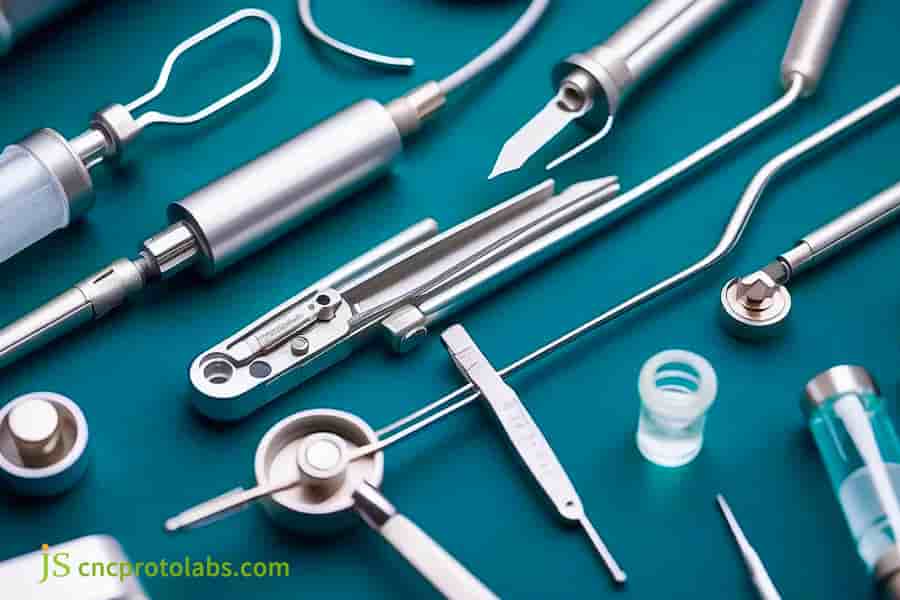
Figure 3: A set of finely machined, polished stainless steel components, such as clamps and adapters, representing high-precision medical device prototypes.
FAQs
Q1: Can my final mass-production materials be directly used in the rapid prototype?
Yes. JS Precision's rapid prototyping service offers the possibility of using mass-production materials such as ABS, POM, AL6061, and medical-grade PC for CNC machining, which allows product performance testing in real-world conditions.
Q2: Which is stronger, a 3D-printed prototype or a CNC-machined prototype?
In general, CNC machined prototypes are stronger. Since CNC machining employs a solid blank, the material is of high density and its mechanical properties are closest to the final injection-molded parts, thus making it more capable of functional testing.
Q3: What is the minimum order quantity (MOQ) for a rapid prototype?
The MOQ for rapid prototyping is one piece. This is the main benefit of rapid prototyping, eliminating high mold costs, thus it is suitable for a single-piece prototype verification.
Q4: How long does it take from sending the drawing to receiving the first part?
JS Precision can ship parts within 72 hours with an expedited service for parts of simple structures, in the case of parts with complex structures, the rapid prototyping lead time is generally 3-5 business days.
Q5: To what extent can rapid prototyping guarantee the level of precision?
Based on JS Precision's rapid prototyping services, the accuracy of CNC machining can be at the level of ±0.01-0.05mm, the accuracy of industrial, grade SLA/SLS 3D printing is usually ±0.1-0.2mm, thereby fulfilling different requirements.
Q6: Would you support me in redesigning my product to make it more rapid prototyping, friendly?
Q7: The prototype of my complex assembly has to be verified. Can you do that?
Of course. JS Precision will arrange the best rapid prototyping process such as CNC or 3D printing for each part of the complex assembly, thus ensuring overall assembly accuracy.
Q8: Are rapid prototyping and CNC small-batch machining just different names for the same thing?
No, rapid prototyping and CNC small-batch machining are totally different things. Rapid prototyping is the purpose of product prototype verification while CNC machining is only one of the most popular methods to realize this purpose, especially when it comes to the manufacturing of metal and high-performance plastic parts.
Summary
These days in product development, rapid prototyping has long since ceased to be an optional solution and has become a key to corporate success. It enables companies not only to drastically reduce the time of product prototype delivery but also to efficiently experiment and iterate during the R&D phase, thus, achieving the right combination of cost and innovation.
As a professional and high-quality rapid prototyping service provider, JS Precision has gained the trust of businesses worldwide due to its excellent crafts, fast delivery, and transparent pricing.
Don't let outdated prototyping cycles hamper your innovation. Visit our website immediately, upload your 3D drawings, and get free, professional quick prototyping quotes. Let's embark on your product acceleration journey together!

Disclaimer
The contents of this page are for informational purposes only.JS Precision Services,there are no representations or warranties, express or implied, as to the accuracy, completeness or validity of the information. It should not be inferred that a third-party supplier or manufacturer will provide performance parameters, geometric tolerances, specific design characteristics, material quality and type or workmanship through the JS Precision Network. It's the buyer's responsibility Require parts quotation Identify specific requirements for these sections.Please contact us for more information.
JS Precision Team
JS Precision is an industry-leading company, focus on custom manufacturing solutions. We have over 20 years of experience with over 5,000 customers, and we focus on high precisionCNC machining,Sheet metal manufacturing,3D printing,Injection molding,Metal stamping,and other one-stop manufacturing services.
Our factory is equipped with over 100 state-of-the-art 5-axis machining centers, ISO 9001:2015 certified. We provide fast, efficient and high-quality manufacturing solutions to customers in more than 150 countries around the world. Whether it is small volume production or large-scale customization, we can meet your needs with the fastest delivery within 24 hours. Choose JS Precision this means selection efficiency, quality and professionalism.
To learn more, visit our website:www.cncprotolabs.com
Resource