English



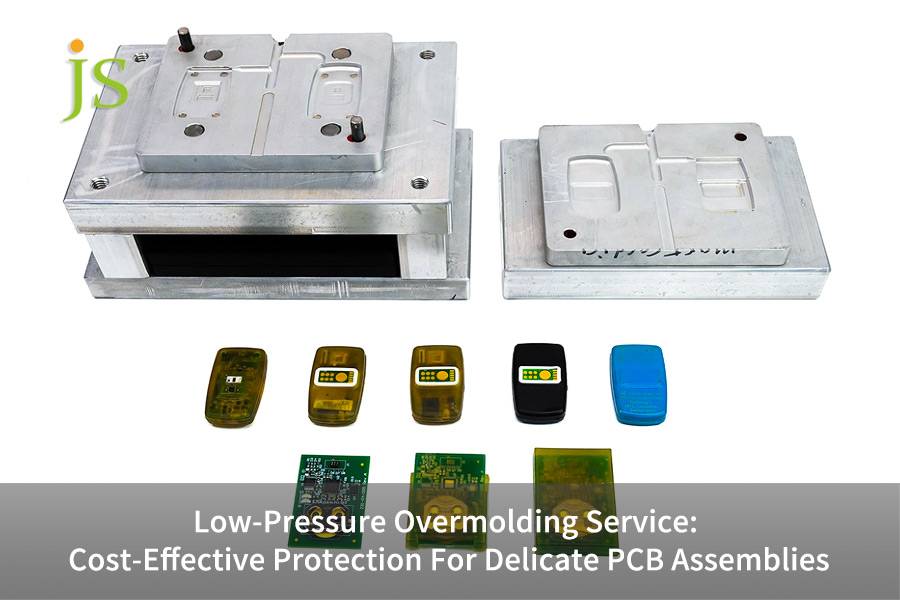

Low pressure overmolding is a cutting edge packaging technique in the electronics manufacturing industry that completely removes the limitations of traditional high pressure injection molding and potting.
Firstly, traditional injection molding generally applies a very high pressure (more than 1000 bar) which can cause damage to the most delicate parts, secondly, potting processes have been identified as time consuming and heavy in nature.
In this regard, JS Precision, a leading customized processing expert in China, offers low pressure overmolding solutions along with the protection of precision PCBAs.
This extremely low pressure packaging method allows for waterproofing, insulation, and structural strengthening simultaneously thus becoming the perfect solution for high precision electronic products.
Key Content Summary
| Dimensions | Low pressure Molding (LPM) Technology Parameters and Advantages | Commercial Value |
| Processing Pressure | 5-40 bar, only 2%-5% of traditional injection molding. | Protects fragile components, achieving zero scrap rate. |
| Cycle Time | 30-60 seconds of rapid physical cooling and curing. | Eliminates 24-hour curing wait, significantly increasing production capacity. |
| Protection Rating | Meets IP67/IP68 sealing standards. | No additional shell required, achieving product lightweighting. |
| Material Properties | Environmentally friendly polyamide material, UL 94-V0 flame retardant. | Simplifies the supply chain, reducing total cost of ownership by 30%. |
Key Takeaways:
- Physical Safety: The mould with the ultra low pressure of 5-40 bar completely removes the risk of high pressure molding causing damage to solder joints and gold wires.
- Cost Revolution: By the shell less concept, it can help to minimize the number of components, assembly labor, as well as warehousing and logistic costs.
- Efficiency Leap: Thanks to its aluminum mold technology, JS Precision can reduce the timeframe from R&D to delivery to only 7-10 days.
- Reliable Sealing: The material chemically bonds at the molecular level with the PCB substrate, thereby providing stable signals even in the harshest environments.
Why Trust This Guide? JS Precision’s Experience In Low Pressure Overmolding
While choosing an electronics packaging partner, your main points of concern would most likely be the partner's technical capabilities, track record of implementation, and quality assurance measures.
JS Precision has had continuous exposure to precision manufacturing for more than a decade and a half and currently holds three levels of the most reputable certifications: ISO9001:2015, ISO13485, and IATF16949.
We have successfully completed customized production of over 300,000 precision parts and catered to more than 1,000 customers worldwide, maintaining our on time delivery rate at 99.2%.
We are skilled in low pressure overmolding research and implementation as well as various overmolding operations, offering a comprehensive service system that starts from DFM analysis and rapid mold making and goes all the way to mass production delivery.
We have created more than 500 real low pressure overmolding projects that addressed four main areas: automotive electronics, medical devices, consumer electronics, and industrial sensors.
It is reported by industry sources that the typical scrap rate of automotive sensor packaging is 8%, whereas we are able to decrease the scrap rate of your product to only 0.02%.
Medical electronics packaging projects comply with ISO 10993 biocompatibility standards, industrial electronics projects have achieved IP68 protection and underwent extreme environment testing from -40℃ to 150℃.
We strictly follow the quality inspection standard of IPC-A-610 for electronic components throughout the whole process, and each product we deliver is accompanied by a full FAIR first article inspection report and material certification. Third party testing reports are available as supporting documents.
In a nutshell, this hands on experience really works for you by addressing the main areas of concern like component breakage, sealing failure, expensive cost, and slow delivery. You don't have to experience the technical risks of packaging processes anymore, our team of engineers will take care of your project all the way.
Want to quickly master the key points of low pressure overmolding technology? Contact our engineers now to get a free industry white paper, easily clarify your process implementation strategy, and avoid initial selection risks.
Why Is Low Injection Pressure Overmolding The Best Physical Solution For Protecting Fragile Components?
With low injection pressure overmolding, the pressure will be controlled at a level between 5 and 40 bar. A slow filling technique will be used with high viscosity materials to minimize damage to the delicate parts thus physically, this is the best way to protect the fragile parts by overmolding.
1000 bar vs. 40 bar: Comparison of Physical Impact of Injection Pressure
Traditional injection molding at 1000 bar creates the highest clamping and material flow impact forces, which are transmitted to the PCBboard and can easily result in the formation of microcracks.
On the contrary, low injection pressure overmolding, with a 40 bar maximum pressure, is only 2%-5% of the traditional process, resulting in absolutely no structural changes or damages to the PCBboard. Simply put, it's akin to a gentle breeze enveloping the component, totally avoiding any high pressure damage.
| Process Type | Processing Pressure | Cycle Time | Protection Rating | Material Cost (per piece) | Delivery Time |
| Traditional High Pressure Injection Molding | 1000+ bar | 120 seconds+ | IP54 | $2.0 | 15 days |
| Traditional Potting Process | Atmospheric Pressure | 24 hours | IP65 | $1.8 | 20 days |
| Low Pressure Overmolding | 5-40 bar | 30-60 seconds | IP67/IP68 | $1.2 | 7-10 days |
Technical Details for Preventing Wire Bonding Breakage
Micron level gold wire bonds (precision electronic core connection structures, only 25μm in (diameter) are highly prone to be broken by high speed flowing material.
Low injection pressure overmolding uses high viscosity hot melt materials, with the flow rate kept strictly below 0.5m/s, thereby removing shear stress and maintaining 100% the integrity of the gold wire bond structure, thus addressing your worry about core connection damages.
Preventing Component Washout when Exposed to High Pressure:
Very small surface mount components such as 01005 are extremely lightweight, and typically, high pressure injection molding can cause component washout, resulting in component displacement and poor soldering.
Low injection pressure overmolding, due to its low pressure and slow flow rate, is able to fix those tiny components quickly and thereby completely eradicate the issues of component washout.
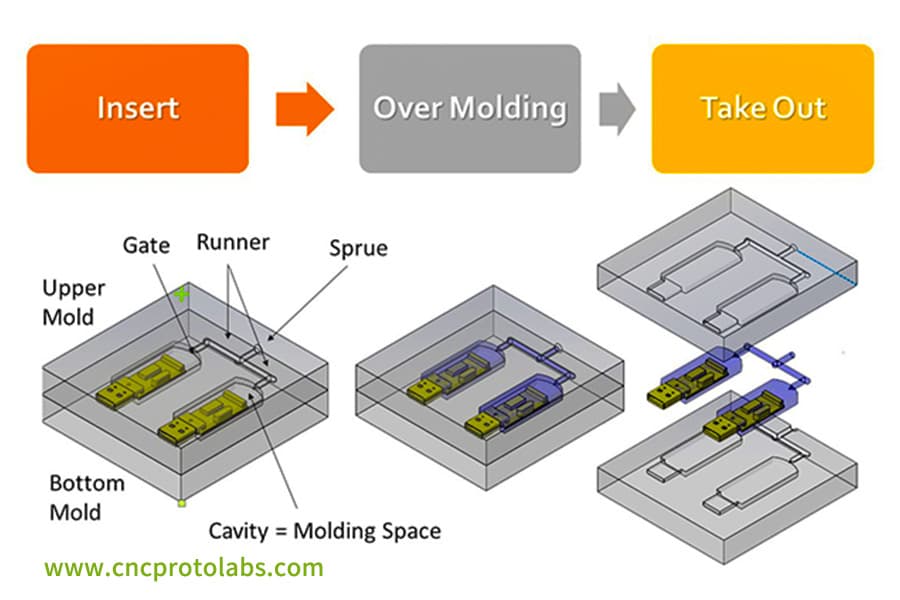
Figure 1: A three-stage diagram illustrating the low-pressure overmolding process: inserting components, injecting material through the sprue-runner-gate system, and ejecting the finished, encapsulated part.
How To Achieve 100% Sealing Reliability When Executing The Low Pressure Overmolding Electronics Process?
Low pressure overmolding electronics can provide a 100% sealing reliability and IP67/IP68 protection rating by combining molecular level bonding between polyamide material and the PCB substrate, with precise temperature control.
The Molecular Level Bonding Principle between Polyamide and FR4 Substrate:
When the hot melt polyamide material is melting, it penetrates the FR4 PCB glass fiber structure. After solidification, this forms a mechanically interlocking structure.
This deep fusion, rather than surface bonding, is like cement embedded in brickwork, thus resulting in a sealing effect that is much better than traditional potting and sealing rings. This is the main secret to obtaining a high sealing rating.
Precise Temperature and Pressure Control for IP68 Protection
You may want to consider two stage injection molding: the first stage involves basic filling, and the second stage low pressure holding, thus completely releasing air bubbles within the encapsulation.
This also guarantees an ideal fit between the material and the substrate. Furthermore, a temperature control accuracy of ±1℃ is obtained for optimizing wetting, and this is what has helped us achieve an IP68 protection rating consistently.
Balanced Heat Dissipation Path for High Performance Materials in Confined Spaces
LPM polyamide material is a compatible material with a thermal conductivity of 0.5 W/mK, providing a good balance between sealing protection and heat dissipation needs.
This material is able to encapsulate components for protection and release heat from components quickly, thereby reducing heat accumulation and extending the life of components.
| Material Type | Thermal Conductivity | Flame Retardant Rating | Biocompatibility | Operating Temperature | Shrinkage |
| LPM-PA100 | 0.5W/m·K | UL 94-V0 | Complies with ISO 10993 | -40℃~150℃ | 0.5% |
| LPM-PA200 | 0.6W/m·K | UL 94-V0 | Industrial Grade | -40℃~160℃ | 0.4% |
| LPM-PA300 | 0.45W/m·K | UL 94-V0 | Medical Grade | -45℃~145℃ | 0.3% |
Curious about the sealing effect of low pressure overmolding electronics? View real world sealing cases now to intuitively understand the implementation details of IP68 protection and quickly determine process compatibility.
How To Effectively Prevent Circuit Delamination And Solder Joint Cracking During The Overmolding Flex PCB Process?
Overmolding Flex PCB use inventoried elastic materials together with limiting mold technology to offset CTE misalignment stress through a buffer, thus effectively preventing circuit delamination and cracking of solder joints as well as ensuring FPC conductivity.
Accurate mold restricting design for the easy displacement characteristics of FPC:
You may employ slider positioning and bed-of-pin fixing technology to accurately fix the FPC position inside the mold.
During packaging the FPC will neither shift nor wrinkle, thus ensuring correct solder joint and component positioning. The mold is like your custom bracket that holds your FPC fixed throughout the process.
The function of low modulus materials in stress relief through CTE misalignment:
Elastic polymer materials with a modulus of 100-300MPa are available to you for selection. Their flexibility is almost the same as that of the FPC substrate, and the difference in the thermal expansion coefficient is controlled within 5ppm/℃.
There won't be any misalignment stress during the thermal cycling which makes it possible to prevent circuit delamination and solder joint cracking in your products at a fundamental level.
Data Support from Dynamic Bending and Reliability Testing
We have done tens of thousands of bending tests on the packaged FPC.
According to the data, your FPC, made using the overmolding flex PCB technology, only suffers an electrical performance degradation of less than 1% after 100,000 bending cycles, a level that is much better than the industry average which is 3%. This proves that your product has excellent dynamic performance.
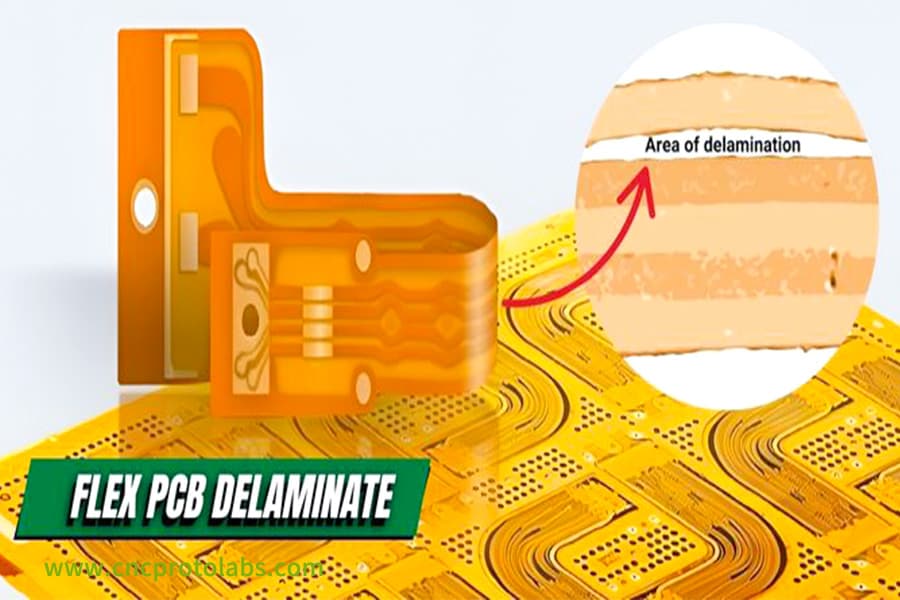
Figure 2: A close-up image showing the "Area of delamination" on a flexible printed circuit board (Flex PCB), highlighting the separation of layers that can occur as a defect during overmolding.
How To Balance Perceptual Sensitivity And Extreme Environmental Tolerance In Precision Packaging For Overmolded Sensors?
Overmolded sensors are made by using selective overmolding technology where the boundary of the packaging is defined so that the circuitry is protected but the signal transmission is not hindered.
In this way, the balance between the sensing sensitivity and the extreme environmental tolerance is achieved.
Selective Overmolding Boundary Sealing
With a mold sealing structure, the sensor probe can be precisely isolated from the circuit area.
The probe area is left open to the signal transmission, while the circuit area is completely covered for protection, which is like providing the sensor with a tailor made protective suit, precisely guarding the essential parts.
Stress Fatigue Analysis under Extreme Thermal Cycling (-40℃ to 150℃):
Your LPM material compatible with the sensor has the capability of being subjected to 500 cycles of extreme thermal cycling from -40℃ to 150℃ without cracking or debonding, and still maintain over 95% of its mechanical properties.
Against the industry average of 85% retention, your encapsulated sensor can have a lifespan that surpasses 10 years, making it ideal for long term automotive and industrial applications.
Evaluation of the Impact of Encapsulation Wall Thickness on Sensor Signal Penetration:
The test results indicate that when the wall thickness of the encapsulation is kept from 0.8 to 1.5mm, the electromagnetic and pressure signal attenuation rates are below 3%.
This range provides structural protection without compromising the sensing sensitivity of the sensor thereby the need for making a compromise is removed.
How Overmolding Electronic Components Meets High-Integration Needs in Medical & Automotive?
Overmolding electronic components are capable of doing away with external casing. This way, one can use compliant materials while achieving a high level of integration, a lightweight design, and a high degree of reliability in medical and automotive devices.
From Casing to Casing Free: The Path to Lightweight PCBAs
Where traditional casing assembly involves elements such as shells, screws, and other hardware which together only manages 60% space utilization, overmolding electronic components means that the PCBA and packaging materials are directly integrated, achieving over 95% space utilization.
Simply put, your product volume can be reduced by 40%, and its weight by over 35%.
Medical Grade Biocompatibility and Automotive Flame Retardant Standards Compliance
The materials with which your devices are compatible are those that conform to medical biocompatibility standards of ISO 10993 and also meet automotive flame retardant (UL 94-V0) and environmental (ISO 16750) standards.
Besides being free of any hazardous substances, they are also directly usable in your implantable medical devices and automotive cockpit electronics without any compliance risks.
Rugged Packaging Strategies for Withstanding Mechanical Shocks Above 50G
The electron beam crosslinked low pressure molding (LPM) material possesses a solid filled structure that by dampening internal resonance within your PCBA leads to absorption of mechanical shock energy above 50G.
Upon impact testing, your parts exhibit no displacement and solder joints are intact, thereby completely satisfying shock resistance requirements of both automotive and industrial equipment.
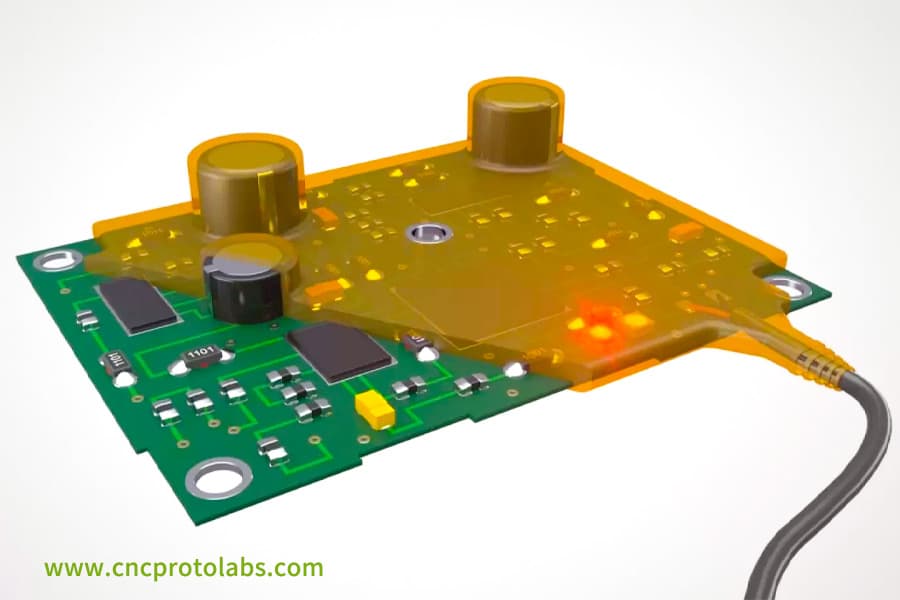
Figure 3: A green printed circuit board (PCB) with various chips and components partially encapsulated by a translucent brown plastic material during the overmolding process.
Why Choosing a Professional Low Pressure Overmolding Service Can Significantly Reduce Your Total Cost Of Ownership (TCO)?
A professional low pressure overmolding service can dramatically reduce production cycles, cut housing costs, and lower defect rates. This, in turn, helps nearly halve the total cost of ownership.
Eliminating Material Costs for Injection Molded Housings, Screws, and Seals
In automotive sensors, for instance, with conventional packaging the material cost for each unit is about $2.50, as besides the sensor one has to purchase the housings, screws, and other materials.
If a low pressure overmolding service is used, since no additional structural components will be required, the material cost per unit will be only $1.30, which corresponds to a 48% reduction.
Impact of Reduced Curing Time on Cash Flow
Whereas conventional potting needs 24 hours to cure, in low pressure overmolding it only happens in 30-60 seconds. This way the production cycle is shortened from 2 days to 2 hours. Consequently, a project payment cycle is 70% shorter. This makes cash flow much more efficient.
Contribution of Simplified Supply Chain to Reduced Return Rates
Traditionally, packaging entails several phases such as procurement, assembly, and testing. Failures of interfaces are responsible for about 5% of returns.
LPM (Low Pressure Molding) product supply reduces the number of layers in the supply chain which results in lowering the return rate to less than 0.1% and the after sales maintenance costs essentially fall by 98%.
| Project Indicators | Before Packaging | After Low Pressure Molding | Improvement Rate |
| Product Scrap Rate | 8% | 0.02% | 99.75% Reduction |
| Production Efficiency | 10 pieces/hour | 150 pieces/hour | 15x Improvement |
| Protection Rating | IP54 | IP69K | Upgraded to military grade |
| Overall Cost | Baseline | 35% Reduction | Significant Cost Savings |
Want to precisely control project costs? Provide your product specifications to receive a free cost calculation for low pressure overmolding service, clearly identifying cost reduction potential and assisting with project budget planning.
What Key DFM Issues Must Be Addressed Before Implementing Low Pressure Overmolding In Your Project?
Before implementing low pressure overmolding, key DFM issues such as material flow simulation, pad spacing, and mold selection need to be addressed to ensure seamless mass production of the design.
Dynamic Simulation of Component Height Layout and Flow Path
With the help of specialized software, the flow path simulation may be done ensuring that the gate is located away from the tall and fragile components.
The flow path ends up smoothly going around the sensitive components, thus preventing their displacement and also removing the possibility of packaging defects in the design phase.
Pack Spacing and Flash Prevention Physical Limitations
Meeting your DFM requirements, pad spacing of more than 1.5mm is necessary to be able to prevent the molten material from flowing over the pads and creating short circuits. Using precision mold design, the flash rate can be kept below 0.01%.
Design Lifecycle Recommendations for Aluminum Rapid Tooling
Allow us to offer you multi level tooling options:
Within 100 prototypes, use economical aluminum molds to reduce costs by 60%. High grade aluminum molds are used for mass production of up to 100,000 pieces, with a lifespan of 50,000 to 100,000 cycles.
You can choose the optimal solution based on your own production scale and accurately control the cost of mold investment.
Worried about manufacturing risks in your design? Upload your CAD files and get a free low pressure overmolding DFM evaluation report to proactively mitigate risks and ensure your design is suitable for mass production.
JS Precision Case Study: LPM Packaging Of Onboard Pressure Sensors In High Vibration Environments
Challenges encountered
A famous automotive parts supplier's automotive pressure sensors faced issues with traditional potting processes: uneven curing resulted in an 8% solder joint breakage rate, the production line occupied a large area, and the delivery cycle was 15 days.
Many suppliers were disqualified because they couldn't fix the issue, and finally, they went for JS Precision for a low pressure overmolding solution.
Solution:
1. DFM Analysis:
The engineering team acted immediately and found out that the customer's sensor was used in a very high vibration environment of the automotive industry, which was the main cause of solder joint detachment.
Based on the sensor's structural features, a tailor made low pressure overmolding solution was designed to make sure the process was in line with the customer's requirements.
2. Custom Mold:
An injection pressure of exactly 12 bar was set using the custom aluminum mold, which matched the capacity the internal components of the customer's sensor could withstand, thereby avoiding any pressure damage.
3.Optimized Design:
The gate layout was changed on the basis of the same careful principles but least regime in order to allow the molten material to move in a very smooth way so as to fill remarkably effective the encapsulation zone of the customer's sensor.
4.Specialized Materials:
The team opted for medical grade polyamide material because it had extremely high impact resistance properties. Besides, it also satisfied flame retardant and vibration resistance requirements of the automotive sector, thereby capable of supporting customer's extreme automotive environment.
5.Pressure Holding Process:
A two stage pressure holding design was used to completely eliminate air bubbles inside the customer sensor's encapsulation thus enhancing sealing stability and giving reliable sensor protection.
Final Results:
- After implementing the project, the scrap rate of the customer's products was immediately brought down to 0.02%, indicating near-zero-defect production.
- The single mold cycle time was shortened to 42 seconds, production efficiency soared 15 times, and the customer's production line footprint was cut by 70%.
- The final product passed three extreme environment certifications: IP69K high pressure spraying, -40 to 150 thermal cycling, and 50G mechanical shock therefore was fully compliant with automotive standards.
- The customer lowered overall production costs by 35%, delivery time came down from 15 days to 7 days, and product competitiveness was greatly enhanced.
- This example confirms that low pressure overmolding is capable of entirely resolving the packaging problems of electronic components in high vibration environments.
Want to solve sensor packaging challenges? Submit your sensor drawings to receive a customized Low Pressure Overmolding Service solution for rapid, high reliability packaging.
FAQs
Q1: What is the maximum operating temperature that LPM material can withstand?
LPM is generally capable of withstanding temperatures ranging from -40 to 150, which means it can operate in the environments of most automotive and industrial electronic devices.
Q2: How are low pressure molding dies less expensive than traditional ones?
Low pressure molding operates under extremely low pressure and thus, molds made of more machinable aluminum can be used, eliminating the need to use hardened steel and significantly reducing mold material and processing costs.
Q3: What is the usual low pressure injection cycle time?
Low pressure injection cycle time depends on the product volume. If single molds are produced, the cycle time is from 30 to 60 seconds. This method features a fast cooling of the material and is highly efficient.
Q4: Are the substances environmentally friendly and RoHS compliant?
The polyamide materials that JS Precision use meet the requirements of RoHS 2.0 and REACH international environmental standards, do not contain any harmful substances, and are safe to use.
Q5: Can LPM substitute the metal shielding caps?
LPM process can offer only physical protection. If EMI electromagnetic shielding is a must, a metal shield needs to be either added prior to encapsulation or a special conductive filler used.
Q6: What is the lifespan of aluminum molds?
It has been evidenced that high quality aluminum molds retain their capabilities well for 50,000 to 100,000 injection cycles if operated at a regular pressure of 5-20 bar. This is perfectly suitable for small and medium batch manufacturing.
Q7: Does the LPM process generate bubbles?
Through JS Precision's excellent mold venting design and the use of two-stage pressure holding process, the product's internal porosity can be reduced to less than 1%, which is practically air bubble free.
Q8: Why choose JS Precision in China for processing?
Some of the major reasons to go with JS Precision are affordable price, 7-day prototype manufacturing, DFM expert service, and good quality control system. Besides that, we are 30% faster in delivery and 15% cheaper in mold costs compared to our competitors. Hence, we are the best partner for your low pressure overmolding requirements.
Summary
Low pressure overmolding is a new approach to electronic packaging, offering ultra low pressure, efficient cycle time, and good sealing at a very low pressure.
It not only safeguards your delicate parts but also is a great way to cut costs, make products smaller and more integrated. Besides, it can be used in very challenging environments like medical and automotive.
By combining technology and real world experience, JS Precision's low pressure overmolding service will take care of your entire packaging needs.
Want to make your electronic packaging solution even better? Just upload your 3D CAD model now, and our experienced engineers will perform a detailed DFM evaluation and provide a quote within 24 hours.
Select JS Precision for smarter, and more budget friendly total protection of your high precision electronic components.

Disclaimer
The contents of this page are for informational purposes only.JS Precision Services,there are no representations or warranties, express or implied, as to the accuracy, completeness or validity of the information. It should not be inferred that a third-party supplier or manufacturer will provide performance parameters, geometric tolerances, specific design characteristics, material quality and type or workmanship through the JS Precision Network. It's the buyer's responsibility Require parts quotation Identify specific requirements for these sections.Please contact us for more information.
JS Precision Team
JS Precision is an industry-leading company, focus on custom manufacturing solutions. We have over 20 years of experience with over 5,000 customers, and we focus on high precisionCNC machining,Sheet metal manufacturing,3D printing,Injection molding,Metal stamping,and other one-stop manufacturing services.
Our factory is equipped with over 100 state-of-the-art 5-axis machining centers, ISO 9001:2015 certified. We provide fast, efficient and high-quality manufacturing solutions to customers in more than 150 countries around the world. Whether it is small volume production or large-scale customization, we can meet your needs with the fastest delivery within 24 hours. Choose JS Precision this means selection efficiency, quality and professionalism.
To learn more, visit our website:www.cncprotolabs.com
Resource