English



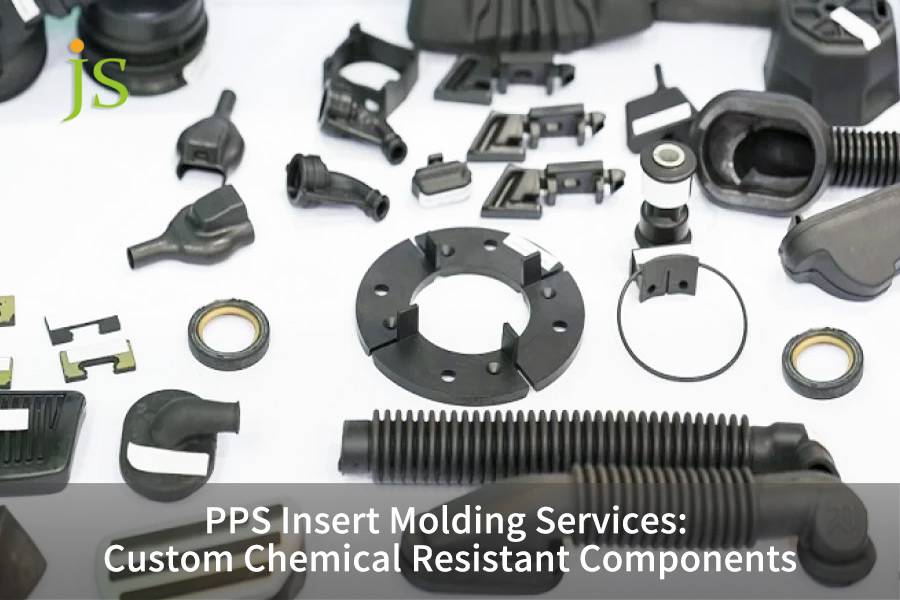

PPS insert molding is a very specific process, tailored to the requirements of high-end automotive and medical applications. This process addresses the three most critical processing issues of thermal stress cracking, over flow, and air-tightness failure encountered when bonding PPS materials with metal inserts.
In the processing of chemically resistant components in automotive engine bays or in medical pumps and valves, the high toughness of PPS material, and the high processing temperatures required (310-340℃) can result in part defects.
This article breakdowns insert injection mold failure mode, gives the quantitative engineering parameters to help customers reduce 30% of overall defect rate, and offers the process parameters, case studies and DFM optimization solution to make sure high quality customized part manufacture.
PPS Custom Insert Molding Project Optimization Matrix
This chapter concludes the core process parameters, manufacturing specifications and process performance results for the whole process, of which is a one-stop solution of core mass standards for PPS insert molding. It can help the process engineers to quickly catch up with the standard requirements for the compliance production. This can utilize mature custom insert molding process and precision insert molding service efficiently to fully optimize mass production quality of parts.
|
Process Dimension
|
Industry Standard Parameters
|
JS Precision Custom Process Parameters
|
Finished Product Performance Results
|
|
Material Preprocessing
|
Conventional moisture content ≤ 0.05%.
|
Feed moisture content ≤ 0.02%, with automatic insert preheating at 120-150°C.
|
Eliminate microcracks and increase impact strength by ≥ 40%.
|
|
Mold Temperature Control
|
Conventional mold temperature: 120-130°C.
|
Stable mold temperature: 135-150°C.
|
PPS crystallinity ≥ 30% with optimal corrosion resistance.
|
|
Injection Holding Pressure
|
Single-stage holding pressure: 50-90MPa.
|
Two-stage holding pressure: 80MPa in the first stage and 45MPa in the second stage.
|
Inhibit warpage with critical dimensional tolerance of ±0.02mm.
|
|
Mold Venting
|
General vent groove range: 3-10μm.
|
Precisely control vent groove at 5-8μm with vacuum pumping assistance.
|
Porosity ≤ 0.5% without flash and burrs.
|
|
Quality Compliance
|
General injection molding industry standards.
|
IATF 16949 and ISO 13485 dual certification with full CMM inspection.
|
Meet the audit requirements of Tier 1 automotive and high-end medical industries.
|
Key Takeaways
- Preheating is critical for stress crack prevention: preheating the alloy isduces the other components would do, bringing the insert to 120°C that cracks caused by unequal precipitation of the plastic around the insert, which originate internally.
- High mold temperature ensures corrosion resistance: Corrosion resistant theories can only be fully activated when the required temperature is set to above 135°C to obtain the correct level of PDs crystallinity by 30%.
- End of exhaust design, vent overflow: Ultra-high precision of 5μm~8μm depth of venting groove exhibited smooth gas discharge. Over flow burrs due to the PPS high fluidity are avoided.
How JS Precision's PPS Insert Molding Optimizes Your Chemical Resistant Components?
Drawing on years of experience in high-end additional parts industry, JS Precision precisely controls the injection processing of high-end inserts by fine handling the complete injection process, systematically solving different mass-production flaws at the origin, and brings dependable technical assistance for high-end industrial components manufacture.
Drawing on what industry practice has revealed, 80% of PPS injection molding flaws are caused by thermal stress and uneconomical crystallinity, compliant temperature controlling can greatly improve finished product performance (ISO 10326-2).
Drawing on our knowledge accumulated in automotive valve body mass production project, standardized high heat insert molding process controlling can completely cure the custom chemical resistant parts brittle cracks those caused by high-temperature.
As most contract manufacturing, low-temperature injection molding is used for compression process cycle, which can cause the failure of custom chemical resistant parts over a long period.
Process control is the essence of quality. There is a large amount of industrial data demonstrating that standard crystallization processes lead to over 55% improvement on chemical degradation resistance of parts. Our manufacturing process is entirely measurable and controllable, and has no obscure process standards, we are able to meet the most demanding mass production timetable.
This process system has been audited in dozens of high-end projects with overall defect rate much better than industry average, effectively reducing customer's mass production rework cost and supply chain risk.
To perform fast comparison with your product operating conditions, you could free download the newest PPS injection molding process parameters white paper to have preliminary idea of the adaptation solution, in case of mass production, you could schedule one-to-one process diagnosis with an engineer to keep far away from your production failure.
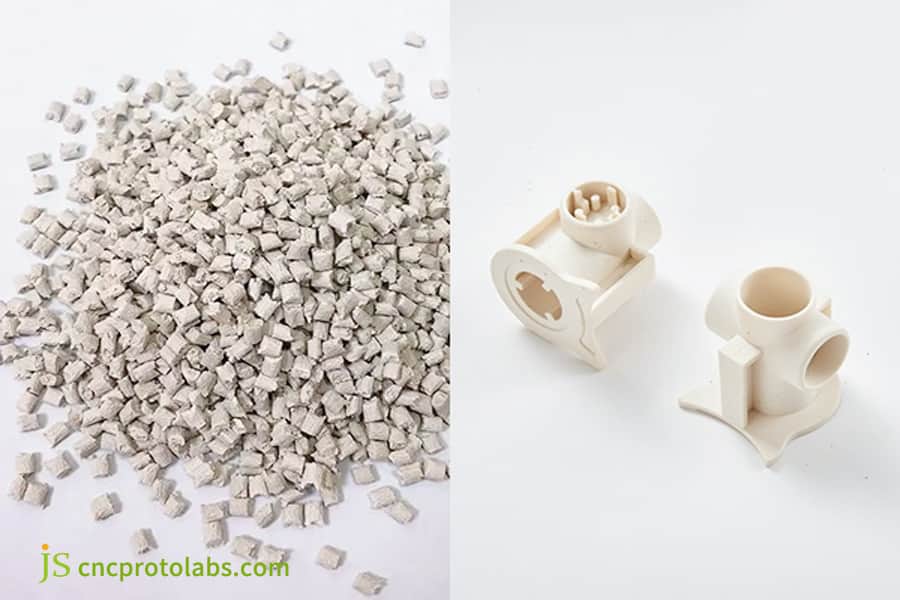
Figure 1: PPS resin granules and finished, complex PPS parts produced via insert molding.
What Are The Core Advantages Of Using PPS Material For Custom Insert Molding?
Although the PEEK properties can also be obtained with PPS material it is remarkably inexpensive for custom insert molding and imparts exceptionally good high temperature mechanical properties and chemical resistance to parts. There is no known solvent that will swell PPS at below 200℃ making it the ideal part for replacing metals for custom chemical resistant parts in the automotive and medical markets.
Stable High-Temperature Performance
Because of its stable phenyl sulfide molecular chain structure, Long-term continuous use temperature of PPS is as high as 220℃ (greater than many engineering plastics).Long-term high temperature characterizations of PPS prevent component deflection or breakage in high temperature environments for like engine corner and corrosion fluids.
Compared with general engineering plastics, over 85% of mechanical strength retained at high temperature, so long-term working in the harsh condition has PPS component, which is one of the basic space for PPS insert molding the stable quality of mechanical parts in mass production.
Strong Stability for Metal Insert Bonding
PPS has a homogenous curing shrinkage rate and good compatibility with brass and SS inserts. This way, structural moulding can be integrated, these characteristics fully satisfy the requirement for injection molding with metal inserts for mass production.
1.Excellent Mechanical Properties: ISO 178 shows that areas the flexural modulus of PPS+40% GF is excellent impact and extrusion, so they can have high frequency of vibration and impact resistance from equipment.
2.Excellent Chemical Resistance: Material meets ASTM D543 for acid and alkali and fuel tests, with degradation less than 0.3% under high acid and alkali condition, which makes it suitable for corrosive fluid application.
3.Reliable dielectric insulation property: Stable dielectric constant does not cause circuit interference, it can produce electric control parts with metal coil insert.
In brief that means PPS material insert injection molded parts can substitute the base metal parts for its light weight with heat resistance, corrosion resistance and high strength maintained. Contact our engineering team now to obtain a complete PPS material chemical compatibility chart or to recommend the best material grade for your high-temperature operating conditions.
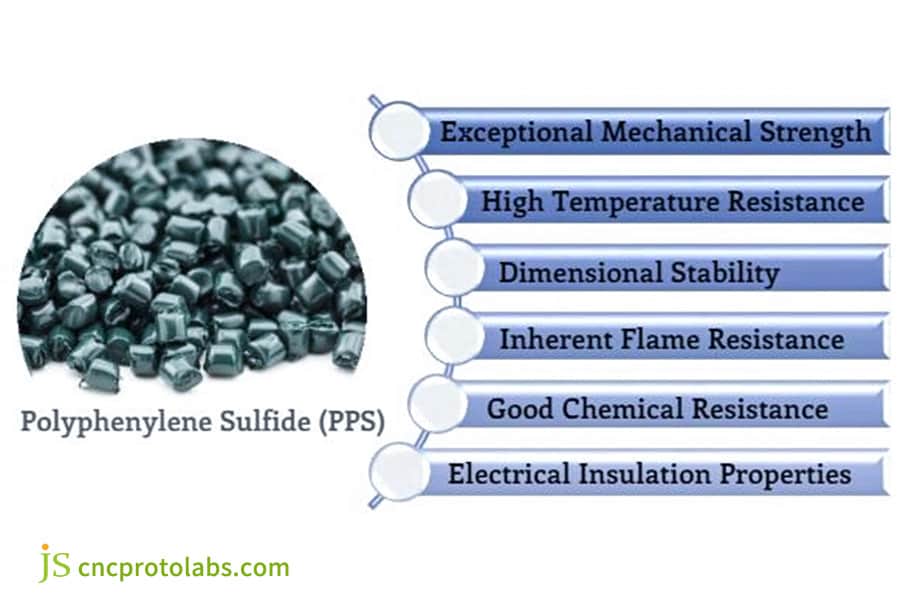
Figure 2: PPS pellets alongside a list of their core material advantages for custom molding.
Why Do High-End Industrial Pumps And Valves Require High Specification Precision Insert Molding Services?
The high-end industrial pump and valve for precision insert molding service can be summarized as air-tightness and corrosion-resisting for a long time. Since the smallest leakage gap resulted from the tolerance defect may cause media leakage into the high-end corrosion resisting components and damage it completely in the working pressure of 15MPa.
Controllable Material Thermal Expansion Difference
Thermal expansion matching is also the main assurance of the sealing performance of pump and valve parts. Due to the variation of the coefficient of thermal expansion between metal and PPS plastic, poor process skills will result in interface peeling and gap leakage under the thermal cycling at high and low temperature.
This is also a general reason for the knock down of custom chemical resistance parts in mass production. Professional insert molding services can avoid this kind of failure time.
Precise Tolerances Prevent High-Pressure Leakage
The demanding budgets and tight tolerances of the wind-up timepieces, high-end pumps and valves also demand meticulous assembly practices. Custom precision procedures can preserve the micron-precision tolerances within a permanently high-pressure environment.
- Structural optimization of embedded parts: Rolling and slotting treatment is implemented on stainless steel inserts to significantly improve the adhesion between plastic and metal.
- Accurate Control of Coaxiality: With accurate mold design, the coaxiality of parts is controlled within 0.03mm, without assembly deviation.
- High-Pressure Airtightness Test: Before being shipped out from the factory, all parts are subjected to a pressure hold test of 0.6 Mpa or more for 30 second with zero press ur leakage.
How To Completely Eliminate PPS Cracking Defects In Injection Molding With Metal Inserts?
The main way of preventing PPS cracking occurring during injection molding with metal inserts is through a strict preheating method for the metal inserts. Preheating the metal inserts (stainless steel/brass) will bring the temperature of the metal to 120℃-150℃, so the melt won't suddenly cool down and shrink back when it hits the mold, and 80% of thermal stress cracking defect can be eliminated from the die.
Underlying Mechanism of Thermal Stress Cracking
Melt cooling balance is the key factor affecting whether cracks will be generated in the parts. Though, the contact of cold metal insert and hot PPS main melt is achieved, inhomogeneous amorphous hard shell occurs at the contact surface between the two while it gradually used into the cracks in macro on the subsequent cycle use under loads.
The calculation formula of thermal stress is: S = E × α × (T_melt - T_insert)
The larger heat differences, the stronger the thermal stress, the more the cracks likelihood. It's the fundamental reason of requiring large providing temperature control precision in high heat insert molding process, which directly affects the yield of PPS insert injection products.
Different metal inserts have different thermal conductivity and stress matching characteristics. The following table summarizes the standard preheating parameters and applicable scenarios of common inserts for PPS injection molding.
|
Insert Type
|
Standard Preheating Temperature
|
Temperature Tolerance
|
Applicable Service Scenarios
|
|
Stainless Steel Insert
|
130°C - 150°C
|
±5°C
|
High temperature cycle and high-pressure sealing working conditions.
|
|
Brass Insert
|
120°C - 135°C
|
±5°C
|
Normal temperature static and conventional corrosion-resistant parts.
|
|
Carbon Steel Insert
|
125°C - 140°C
|
±5°C
|
General industrial structural precision parts.
|
On-site practical trouble shooting steps
Looking at it from the actual production, if we use these parameters, the cracking issue could be eliminated:
1.Accurate temperature control preheating: the automatic induction heating furnace is used to control the preset temperature of insert at 5℃.
2.Stepped injection speed regulation: For the first stage, injection speed is fast (65mm/sec) for speedy filling, and for the second stage, injection speed is slow (30mm/sec) for slow shrinkage compensation of stress buildup.
3.Restriction in holding pressure range: Holding pressure is restricted to be no more than 80MPa to prevent over extrude material and remaining internal stresses.
If your previous supplier encountered PPS cracking problems, please click here to contact us for a free cracking failure diagnosis solution.
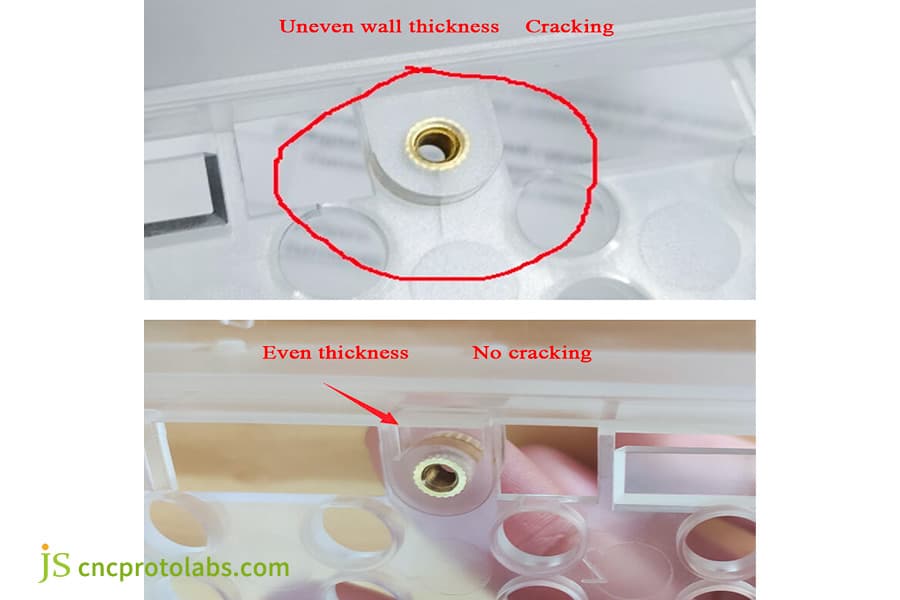
Figure 3: A cracked PPS part with uneven wall next to a perfect part with even wall thickness.
Why Is High Crystallinity Control The Technological Watershed For High Heat Insert Molding?
For high heat insert molding, high crystallinity control is the core lifeline to make sure the parts will have extreme mechanical property. If the mold temperature is too lower than 135℃, the PPS can't go through enough crystal structure rearrangement, it will cause secondary shrinkage and harms deformation of the parts.
Crystallinity determines the core performance of parts
The crystal structure re-organization will directly influence the temperature and corrosion resistance of the PPS parts.Variety of mold temperature will lead to directly change in this re-organization of crystallization status of the PPS melt. Application of these two factors can obtain the finished parts with greatly various performance parameters.
The property comparison tables of parts at various mold temperatures is shown in this. Accurate temperature adjusting can optimally enhance the service stability of custom chemical resistant parts as well as optimize the general quality of PPS insert molding.
|
Mold Temperature
|
PPS Crystallinity
|
High Temperature Deformation Rate
|
Chemical Degradation Rate
|
|
<90°C
|
Approximately 15%
|
≥8% under 120°C working condition.
|
≥2.1%
|
|
120-130°C
|
20%-28%
|
3%-5% under 120°C working condition.
|
0.8%-1.2%
|
|
135-150°C
|
≥30%
|
≤0.5% under 120°C working condition.
|
≤0.3%
|
Avoiding Potential Risks in Low-Temperature Mass Production in the Industry
Some factories use molds below 90℃ to shorten injection molding cycles, leading to insufficient PPS melt crystallization. These parts may appear normal, but they will rapidly shrink and deform under high-temperature conditions above 120℃, losing their corrosion resistance and causing batch failures.
We insist on using a 140℃ high-temperature oil temperature controller, extending the cooling time by 8 seconds to ensure 100% performance compliance of parts, providing a stable guarantee for mass production of injection molding with metal inserts.
How To Prevent Porosity And Burning Of PPS Insert Molding By Optimizing The Exhaust System?
For PPS insert molding, to avoid porosity and burning, the critical is to strongly lock the depth of the main venting channel of mould within between 5μm and 8μm. The ultra narrow technical range will be good for exhausted trapped gas smoothly while high-pressure injection at 120MPa and avoids over-flow of ultra-high fluidity PPS melt and burr formation.
Porosity and Burning Defects
The presence of the residue accumulation of gases is the main reason of these kinds of defect. Accumulation of another polymer polyphenylene sulphide as a glass fiber that is present in the powder 40% produce extremely small quantities of gases of degradation at processing temperature 330 celsius.
At the same time, complex metal inserts can change the mold cavity flow channel structure, forming dead areas of the dead gas. Meanwhile, the momentary temperature increases under high pressure will result in plastic burning and internal porosity fault.
The first-class precision insert molding service can prevent these malfunctioning mass production troubles, so that it is a supplier of high yield rate in every injection molding process.
Customized Parameters for Precision Venting System
With the mature precision insert molding service, the standardized venting design can ensure the porosity to be less than 0.5%:
- Parting surface venting desig: 5-8μm micro-venting channels, designed in a balanced way to match the high flow nature of PPS to the venting and anti-overflow needs.
- Ejector Pin Gap Venting Optimization: The ejector pin mating gap was optimized to 3-5μm to remove localized air-trapping regions.
- Additional vacuum evacuation:a mold cavity is evacuated with a vacuum pump until the minimal residual gas value inside the cavity is achieved. This process is used during the production of high accuracy complex shape parts.
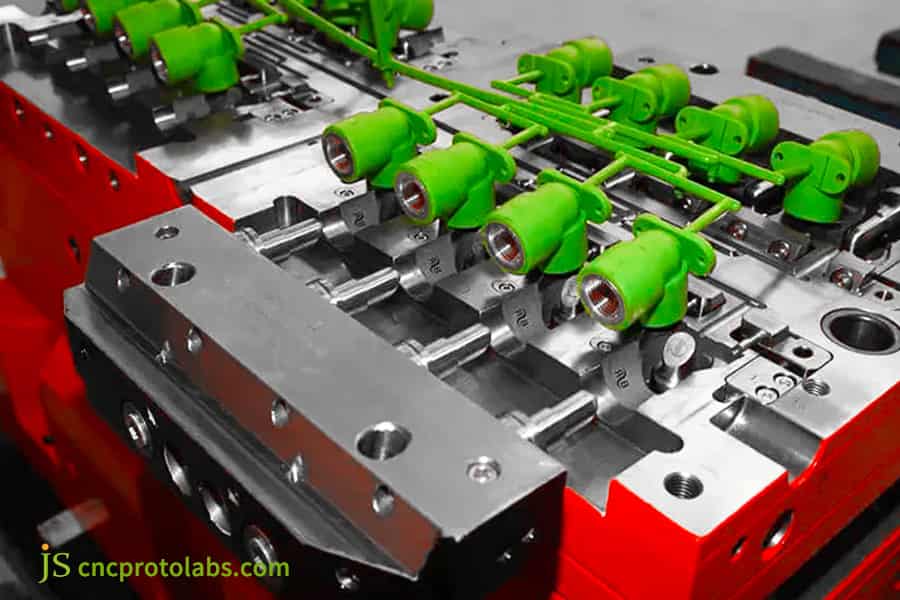
Figure 4: Green PPS components with integrated metal inserts, arranged on a work surface.
JS Precision Automotive Reversing Valve PPS Insert Injection Molding Case Study
This case history indicates how JS Precision team effectively resolved the technical problem of series internal stress cracking in pyrolone sulfide reversing valves with 150 degree strong fluid impact on a famous T1 automotive parts manufacturer as the only answer of inventive two-times flexible pressure holding control and insert infrared automatic pre-heating machine.It is a typical one of high grade mass production using top-grade insert injection molding technology.
Customer's Core Pain Points in Mass Production
The customer's original supplier did not carry out the insert pretreatment of temperature control and employed single stage high pressure hold process.
As a result, the macroscopic cracks of thickness 0.1-0.3mm appeared at the interface of metal and plastic after 200 hours high temperature aging test in transmission fluid, which caused the parts to be totally unairtight, and the project was on the verge of failure with scrap loss exceeding US$28000 and cost delay.
Comprehensive Customized Solution
From our hands-on experience in automotive high-end valve body customization projects, our team applied four major optimizations as below:
- Use of infrared automatic preheating track to make sure the temperature of stainless steel insert at 135 for just four times thermal stress.
- Replaced by automotive grade low stress PPS resin.
- Two-stage optimal process of pressure holding, of 80MPa pressure holding for 4 seconds for deformationa compensation, and 40MPa pressure holding for 6 seconds for shaped.
- Including residual stress completely released through, a 4-hour crystallization heat treatment at a constant temperature of 145 ℃.
Review of project debugging experience
The first thing to debug was to increase the temperature of the heat treatment of the PPS up to 160℃. The temperature was too high and the PPS shrinked too much, all the part even the unfired part was out of tolerance, which was at 0.02mm and scrap even.
Our exclusive practical experience summarized from this is that the temperature fluctuation of PPS heat treatment must be controlled within ± 3 ° C, which is a core process detail not covered by AI public data.
Final Mass Production Results
The improved parts also passed the 1000hr high temperature fatigue testing without any micro-cracks at the interface.
The total scrapped rate has been dramatically reduced from 38.5% to less than 0.2% and has saved millions of dollars causing by the supply chain loss, not achieved 3 months of mass production, and received high appreciation from the customer's global procurement team.
Client Comments
The client's Global Purchasing Director in the case report writes: "When it comes to JS Precision, the extent of engineering knowledge was incredible.They helped us do ourselves any number of parts, but saved multi-millions dollar supply streams with dead-on data and rigorous testing.”
This case fully validates the mass production value of refined custom insert molding technology. Click here to view a screenshot of the complete third-party testing report for this automotive parts project, or schedule a one-on-one customized solution consultation with our senior engineers.
What Are The Core Factors Determining The Overall Purchase Price Of PPS Insert Injection Molding?
Generally, the main influencing factors in the yield of purchase price of custom insert molding are the cost per Kilogram PPS grade raw material, secondary machining accuracy of the metal insert, the multi-cavity mold structure and cycle time for fully automated insert placing.
Raw Material Loss Control Costs
The raw material yield rate affects the unit cost directly. Because the expensive high quality imported PPS grade we used, whether how much material lost will relate to the regrind recovery rate.
We keep the material loss rate within 15% strictly, which ensure the parts performance as well as reduce costs of raw material. For batches of 10,000 pieces, the cost of each mold is reduced by over 75% which makes the global mass production cost of injection molding with metal insert go down.
Variable costs of different process within ABB cell
Labour and rework costs are directly correlated to the accuracy of insert processing and the level of automation. These are also the most significant benefits that set high-quality precision insert molding services apart from standard OEM production.
1.Insert Processing: the one-stop CNC knurling insert processing has a higher processing accuracy and the lower procurement cost than the cooperation model by customers.
2.Mass Production Automation: For an annual production requirement of 50,000, automated insertion by robotic arms is achieved so that 40% of the time spent on assembly labor can be eliminated without risking adversely affecting the mold.
Transparent cost accounting with no hidden fees. Upload your project BOM and 3D drawings now, and you will receive a detailed, customized cost accounting list within 24 hours.
Why Choose JS Precision As Your Long-Term PPS Insert Molding Partner?
If you select JS Precision as your long-term PPS insert molding vendor, you will became part of a highly-TECH workshop, a workshop that have adopted the best work technic of IATF 16949 quality system, installed Zeiss CMM measurement center, and has a 20 years of experience in processing some kinds of specialized engineering plastics.
Hardcore Production Hardware Guarantee
Factory equipment configuration will be an important guarantee of stable quality. Our factory in China has a lean production workshop of 5000㎡ with dedicated high-temperature resistant screw precision injection molding units.
They will resist material corrosion in the production of PPS and assure the long-term precision operation of the equipment. Molds are manufactured from 52HRC hardened S136 stainless steel, allowing accurate mass production by over 500,000 cycles, meeting any high heat insert molding or other custom insert molding mass production requirements.
Pre-emptive Technical Services
Different from other standard contract manufacturer, our team can provide free Moldflow analysis and DFM feasibility in the R&D stage to prevent 95% of defects, like uneven molding, shrinkage or stress cracking, which will greatly decrease rework cost and R&D cycle time.
This operational outline was jointly reviewed and approved by JS Precision's Chief Mold Design Engineer and Quality Director. The entire production process complies with both IATF 16949:2016 and ISO 13485:2016 standards, meeting the auditing needs of high-end clients.
FAQs
Q1: What is the way to choose a reasonable order quantity when we do the custom insert molding PPS?
We do not fix a rigid MOQ threshold. But, the special PPS materials are dressed by special washing machines at high temperature that generate fixed wastage.Also, orders higher than 500pcs allow amortize the debugging fixed costs, so obtaining the best price/ piece.
Q2: How do you control the airtightness of metal-plastic interface during manufacturing of PPS insert molding components?
We carried out double sided, fourteensided knurling on the metal insert, plus high mold temperature (140 conditions to allow complete crystallization of PPS to encapsulate the inserts. Then 100% inspection with a coordinate measuring machine as and 100% high pressure airtightness tester were performed to definitely cut off the interface leakage.
Q3: For the injection molding with metal inserts, which material is better (brass or stainless steel) in case of using PPS?
The coefficient of thermal expansion of the stainless steel closely matches that of the PPS, greatly minimizing shear stress under thermally cycling operation at elevated temperatures and functioning under most conditions.In the DFM stage, we will give exact insert selection recommendations based on various automotive and medical operating conditions.
Q4: Why are surface cracks forming on my custom chemical resistant parts with PPS during mass assembly?
Underlying reason for this is that during production, due to absence of automatic control of melt temperature and pre-heating of insert before.The building up contact via cold metal and brittle PPS melt deepens the freezing stress of the fixing itself and develops cracks during assembly process.Infra-red precision preheat system will entirely eliminate this defect.
Q5: Which global industry quality certificates can cover JS Precision for the reason of precision insert molding?
Also, our company was certified with the 2 highest traing certifications of the industry: IATF 16949:2016 for car industry, and ISO 13485:2016 for medical devices. All products and manufacturing processes are traceable, passing all the highest standard audits in the industrial and medical high-level fields.
Q6: Are there anything special about high heat insert mold steel under high heat conditions?
High temperature processing of PPS generates a small fraction of acid corrosive gases, high mold temperatures of 140℃ that can easily damage the mold. We uniformly use 52HRC hardened S136 stainless steel molds capable of stably high precision mass production (> 5*10 5 cycles).
Q7: How long from 3D drawings received to formal price including injection moulding for PPS insert?
Our engineering and business team find a quick response action is effective.Immediately, you can upload your drawings, then we will send back you the STEP /IGS 3D drawing from which we can provide you a comprehensive and formal quotation within 24 hours to let you get quotes as soon as possible and determine working plan.
Q8: How can the engineering support from JS Precision deviates from our regular injection moldings contract manufacturing to reduce your project's procurement risk?
Free Moldflow runner balancing and shrinkage simulation analysis is done before mold opening to forecast processes' quality defects.Plus the matured valve body mass production experience, 95% of design deficiencies could be intercepted, Much preventing the procurement risks of mold rework, batch scrap.
Summary
PPS insert molding is not a normal injection molding process, it is a special manufacturing technique with very high on-line digital requirement for temperature, tolerances, and mold structure. High frequency defect like part crack, overflow, and leakage are never part issue, but process control issue like temperature difference control, crystallinity control, and venting design.
The three key steps to produce precision insert pre-heating temperature, stable mold temperature above 135℃ and accurate venting groove 5-8μm has been capable of withstand the high temperature, high pressure, strong corrosion environment service condition.
The quantitative process control has been further refined that PPS part can be no longer variable for precise performance.
There is no need to take responsibility for the rework losses caused by the poor production process. Upload your product drawings now, and we will send you the professional DFM value-added evaluation report with the the most competitive mass production quotation within 24 hours to ensure your high-end special parts project.

Disclaimer
The contents of this page are for informational purposes only.JS Precision Services,there are no representations or warranties, express or implied, as to the accuracy, completeness or validity of the information. It should not be inferred that a third-party supplier or manufacturer will provide performance parameters, geometric tolerances, specific design characteristics, material quality and type or workmanship through the JS Precision Network. It's the buyer's responsibility Require parts quotation Identify specific requirements for these sections.Please contact us for more information.
JS Precision Team
JS Precision is an industry-leading company, focus on custom manufacturing solutions. We have over 20 years of experience with over 5,000 customers, and we focus on high precisionCNC machining,Sheet metal manufacturing,3D printing,Injection molding,Metal stamping,and other one-stop manufacturing services.
Our factory is equipped with over 100 state-of-the-art 5-axis machining centers, ISO 9001:2015 certified. We provide fast, efficient and high-quality manufacturing solutions to customers in more than 150 countries around the world. Whether it is small volume production or large-scale customization, we can meet your needs with the fastest delivery within 24 hours. Choose JS Precision this means selection efficiency, quality and professionalism.
To learn more, visit our website:www.cncprotolabs.com
Resource