English



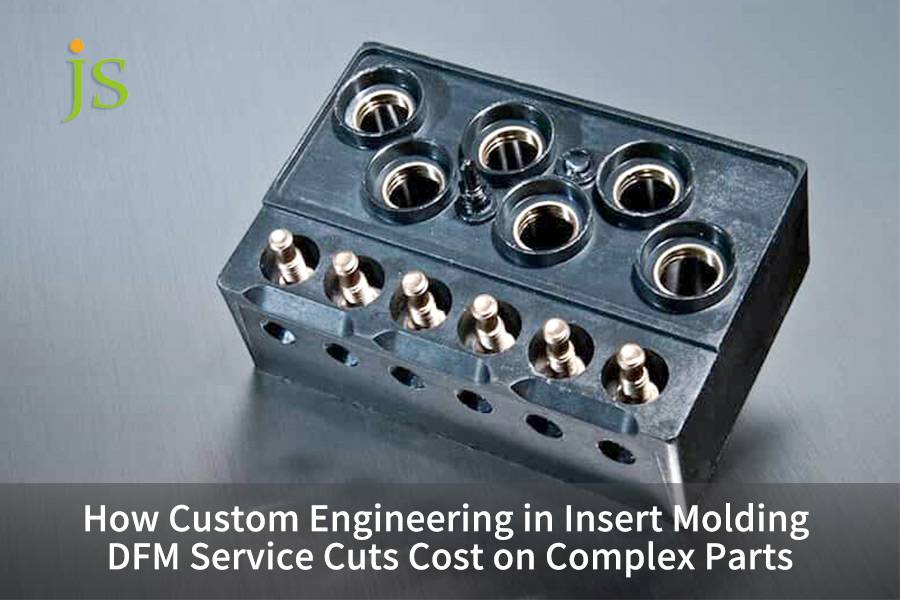

Insert molding DFM service is a key thing that determines the most economical efficiency of mass producing highly complex hybrid parts, fixing the industry-wide issues like metal insert displacement, severe flash and long production cycles. Research indicates that professional DFM optimization before mold opening can prevent 80% of mold rework expenses and lower the individual procurement costs by more than 30%.
By reading this article, you will quickly grasp the following core key points:
1. Rigid Locking of Wall Thickness and Tolerances: Scientifically designed gradual transition steps around the insert strictly control the warpage deformation of the part within ±0.05mm.
2. Mold Cost Restructuring and Optimization: By simplifying the knurling and anti-pull-out structure of the metal insert, unnecessary EDM corner clearing is eliminated, and the number of sliders is reduced.
3. Cyclic Cycle Limit Compression: Utilizing 3D-printed conformal cooling water channels to control the temperature difference on the mold surface within ±2°C, thereby cutting cooling time by more than 25%.
Next, let's dive straight into the underlying engineering strategies of precision insert injection molding and see how true manufacturing experts transform complex drawings into high-profit mass production realities.
Quick Reference Table for Cost Reduction and Efficiency Enhancement of Insert Molding DFM Service
|
Core Optimization Dimension
|
Traditional Design Defect
|
JS Precision DFM Solution
|
Quantified Cost Reduction Result
|
|
Insert Positioning
|
Easy displacement caused by unilateral clamping.
|
Symmetric multi-point hydraulic pins + blind hole nesting.
|
Mold rework rate reduced by 45%.
|
|
Wall Thickness Control
|
Warpage and cracking caused by uneven thickness.
|
Gradient transition + flow front optimization.
|
Warpage amount controlled within ±0.05mm.
|
|
Mold Structure
|
Multiple sliders + EDM corner cleaning required.
|
Standard straight parting surface + simplified insert design.
|
Mold hard cost reduced by 20%.
|
|
Cooling Efficiency
|
Large temperature difference with linear water channels.
|
3D printed conformal cooling water channels.
|
Injection cycle time reduced by 25%-35%.
|
Key Takeaways:
- Early DFM Intervention: Conducting a DFM assessment before mold opening for complex insert injection molding can prevent up to 80% of the cost of changes to design made later on.
- Tolerance and Yield Lock-in: The ability to control the tolerance of precision metal insert (0.005mm) and running gas-assisted simulation are the main elements to yield improvement and unit cost reduction.
- Automation Reduces Labor Time: Inserting robotic machines that completely automate embed and get results by real-time CMM inspection bring a dramatic decrease in manual labor time and also remove the cost of the secondary process completely.
Why trust JS Precision’s Experience In Insert Molding DFM Services For Manufacturing Complex Parts?
We base our knowledge on two decades of working in the field, and global high-end manufacturing standards. Design phase oversights of thermal expansion differences between materials and dynamic stress characteristics of the mold cause 80% of mass production failures.
Each member of our engineering team has more than 20 years of experience in precision machining and injection molding, which allows us to tackle the metal tolerance control and plastic fluid molding problems simultaneously. From the ISO 9001:2015 quality system, we have developed a thorough project traceability and quality control process.
During the last three years, we have done DFM optimization of complicated insert injection molding to more than 200 clients around the world, which helped save $5 million in mold rework costs and increase mass production yield to more than 99.9% all the time. All solutions have been proven by mass production testing in our workshops.
Want to leverage our professional team's experience to mitigate mass production risks and optimize product yield? Contact our senior injection molding engineers to receive a free customized industry standard compliance assessment report and preliminary project optimization plan.
How to Lock in Potential Costs at the Early Design Stage Through Precision Insert Molding Service?
Performing early DFM evaluation in a precision insert molding service is the perfect opportunity to reduce the very high costs of complex parts. Research confirms that if the thermal expansion coefficient of the inserts is matched and the mold gate location is optimized at the early stages of engineering only 20% of the modification costs during the online commissioning phase may still be necessary which leads to a reduction of more than 15% in the cost per unit overall.
Materials Thermal Expansion Coefficient Matching Optimization
One of the main factors causing project cost overruns is the disregard of the differences in thermophysical properties between metal inserts and a plastic matrix. A difference in coefficients of thermal expansion will result in the generation of internal stress which will further cause problems of part cracking and dimensional inconsistencies in mass production.
- Give priority in your material choices to those having almost equal coefficients of thermal expansion like SUS316L stainless steel and PPS + 40% GF plastic.
- Incorporate annular stress relief grooves in the insert-plastic interface to effectively distribute the stresses caused by cooling shrinkage.
- Control the temperature gradient of the mold to achieve a simultaneous metal and plastic cooling and shrinkage to avoid internal stresses.
Following this principle is the cost-effectiveness success factor in precision insert molding service.
Mold Flow Analysis and Gate Location Optimization
JS Precision leverages the injection mold simulation software e-SIM to create virtual mold filling processes, including injection and holding pressure, and to predict final product warpage before mold opening, allowing potential molding defects to be eliminated during the design stage.
- Try to modify the number and position of the injection gates so that severe weld lines around the metal insert don't occur at the melt front.
- Change the holding pressure curve to make sure that micro-cracks at the insert root don't happen.
- Check multi-cavity flow balance to be certain that filling pressure and time are the same for each cavity.
Insert molding DFM service carrying out a reliable flow analysis is the key technology to proactively recognizing mass production risks. Identifying the best combination of materials and adjusting the flow both completely prevent various structural defects and the subsequent cost loss during mass production.
Professional engineering intervention is introduced immediately after your design drawings are completed. Send us your project specifications, and we will provide you with a free preliminary manufacturing feasibility assessment.
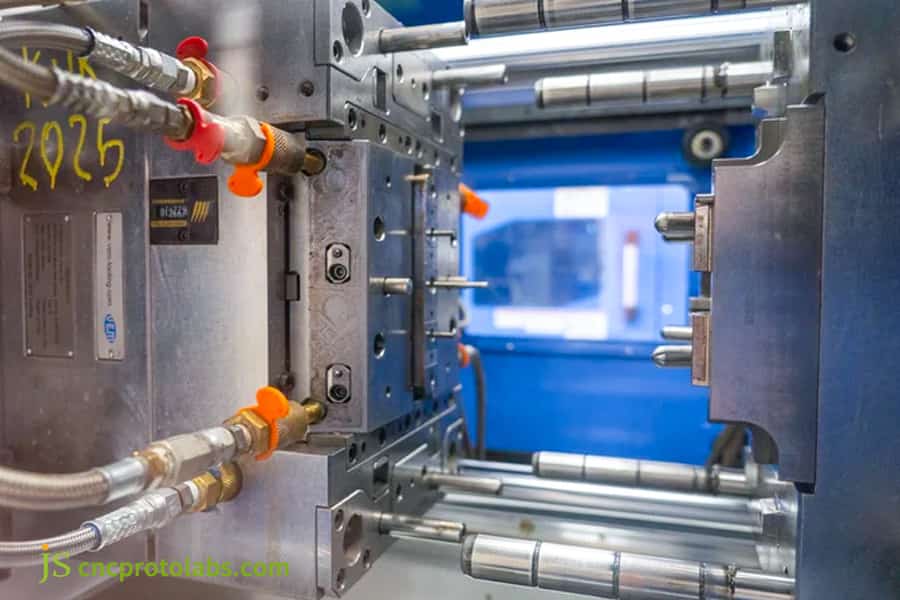
Figure 1: A detailed view of an injection molding tool with various components and hoses, set against a blue background.
How to Solve Warpage Challenges of Manufacturing Complex Injection Molded Parts via Scientific Wall Thickness Design?
One of the main issues when manufacturing complex injection molded parts is the varying thickness of plastic walls around the insert, which easily causes unbalanced cooling and stress concentration. High-quality DFM wall thickness optimization can strictly limit part deformation to a tolerance of 0.05mm.
Critical Wall Thickness Control Principles
In the production of complex injection molded parts, designers usually try to reduce the plastic wall thickness around metal inserts for structural compactness. Incorrect wall thickness can cause serious quality issues and is one of the main reasons for production failures in the manufacturing complex injection molded parts.
1.A wall thickness of less than 0.8mm may cause the polymer melt to undergo shear stress overheating during high-speed and high-pressure filling, which can bring carbonization of the plastic or incomplete filling.
2.A wall thickness of more than 3mm will cause areas of the part to shrink a lot and form internal pores, this way lengthening the cooling stage.
3.The difference between the thickest and thinnest parts of the wall in the same component should not be more than 2:1.
Stress Concentration Elimination Design
JS Precision abides by the principle of gradual transition and through their structural optimization methods completely remove the risk of stress concentration in the parts decisively this way they can warrant stable molding.
1.At metal insert corners, design rounded corners with a radius of 0.5mm to avoid stress concentration caused by sharp corners.
2.Add ribs for reinforcement and keep their thickness within 60% to 70% of the main wall thickness.
3.Apply gradual transitional steps to make sure that wall thickness changes are smooth and abrupt changes in cross-section are avoided.
Top-notch insert injection molding services treat stress concentration elimination as a fundamental feature of wall thickness design.
Quality Issues and Solutions for Different Wall Thicknesses
|
Wall Thickness Range (mm)
|
Common Quality Defects
|
Solution
|
Expected Effect
|
|
<0.8
|
Incomplete filling, plastic carbonization.
|
Increase local wall thickness to 1.0-1.2mm.
|
100% filling qualification rate.
|
|
0.8-2.0
|
Slight shrinkage, warpage deformation.
|
Design gradient transition + reinforcing ribs.
|
Warpage amount controlled within ±0.03mm.
|
|
2.0-3.0
|
Obvious shrinkage, internal blowholes.
|
Adopt hollow structure + multi-point glue feeding.
|
No obvious appearance defects.
|
|
>3.0
|
Severe shrinkage, long cooling cycle.
|
Split parts or use foaming materials.
|
Cooling time reduced by 40%.
|
Frequent warpage and shrinkage issues in parts? Submit your 3D CAD model, and our engineers will customize a wall thickness optimization solution for you free of charge. Relying on professional insert molding structural optimization technology, we can efficiently solve deformation defects in complex injection molded parts.
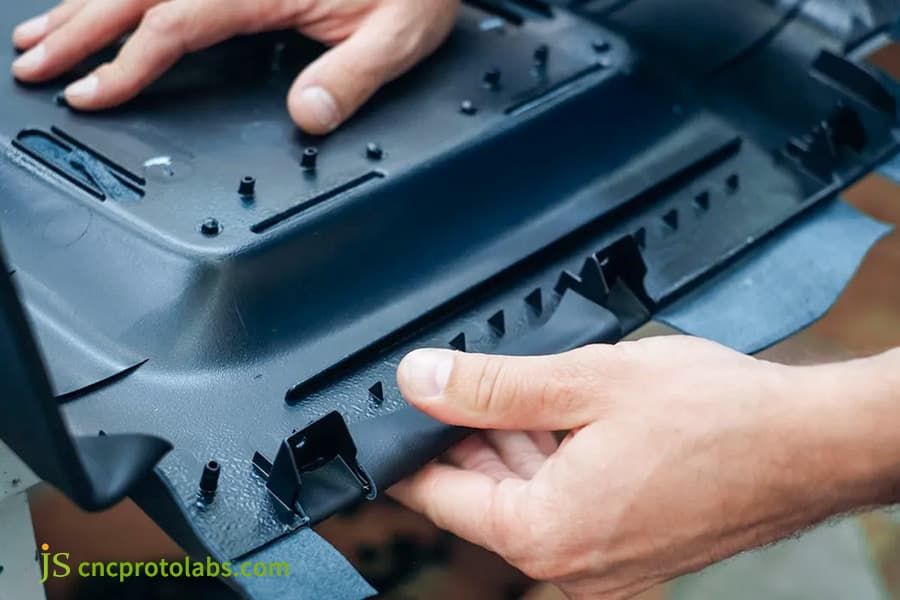
Figure 2: Hands carefully assembling black plastic components with holes and notches for precise alignment.
How Should Anti-Rotation and Anti-Pullout Structures be Optimized in Insert Molding Design for Manufacturing to Cut Tooling Expenses?
Incorrectly designed knurling and slot structures will lead to a large increment of the difficulties of mold processing and production costs. Optimizing the insert interlocking structure through professional insert molding design for manufacturing can increase pull-out resistance by 35%, simplify mold structure, and reduce costs.
Simplify Insert Knurling Structure
The bonding force between metal and plastic is guaranteed by the use of complex insert structures in the design of most traditional products. Scientific insert molding design for manufacturing can simplify the insert shape while preserving the stability.
- Overly sharp or deep knurling can inhibit plastic from thoroughly filling the gaps, thereby causing the formation of microscopic air gaps.
- Using non-standard insert shapes will Much increase the difficulty of mold processing and, in addition, will require highly expensive EDM corner clearing operations.
- The more complex the structures, the longer the time for machining the insert and the higher the cost of procuring the insert.
Mold Structure Simplification and Optimization
JS Precision recommends the use of standard straight knurling combined with stepped anti-pull-out annular grooves, which will not only guarantee the bonding strength but also simplify the mold structure.
- Employ standard straight knurling, and control the tooth depth between 0.2 and 0.3 mm.
- Instead of the deep slot structures, design stepped anti-pull-out annular grooves.
- Use standard straight parting surfaces so that there is not a need for oblique pins or lateral parting sliders.
Thanks to this enhancement, the insert molding tooling cost for insert molding will be directly reduced and the mold development cycle will be shortened. Non-standard custom designs are replaced with standardized structure optimization, which results in cost savings, shortening of cycles, and improvement of the stability of product molding.
Figure 3: Tools like screwdrivers and pliers on a work surface, relevant to manufacturing and assembly tasks.
How Does Tolerance Matching Between Inserts and Cavities Form the Baseline for Cost Control in Insert Injection Molding Services?
The gap tolerance between the insert and the mold cavity is an important factor for the prevention of flash and overflow in the insert injection molding services. A very tight control of the tolerance to +0.01/+0.03mm can cause no trimming and the batch scrap rate can be controlled strictly within 0.05%.
Dangers of Mismatch of Tolerances
Almost all insert injection molding quality issues arise from the non-standard tolerance marks in the insert clamping section. These can pose serious mass production risks to insert injection molding services.
1.If the insert outer diameter tolerance is too loose (e.g. 0.1mm), it is likely that exceeding the upper limit will result in damage to the mold cavity.
2.Falling below the lower limit would be equivalent to creating a 0.1mm single-sided gap, which would be the cause of thick flash when the injection pressure is 80MPa.
3.Flash leads to manual deburring, which is approximately 0.5 minutes per piece. For a project with millions of pieces, this means that 8333 hours of labor will be added.
Tolerance Matching Optimization Solution
Plus standardized insert machining tolerances, our DFM service gives flexible compensation structures to not only counteract slight dimensional deviations but also offer molding precision.
1.The tolerance of the metal insert clamping section is controlled within + 0.01/+0.03mm.
2.At the mold assembly position, flexible compensation sealing rings are created to absorb small dimensional deviations.
3.Insert dimensions are monitored by CMM in real time, automatically the rejected are defective inserts.
Our precision insert molding service is based on exact tolerance control for the production of high-yield mass production.
Flash and Labor Costs Corresponding to Different Tolerance Fits
|
Insert Tolerance Range (mm)
|
Unilateral Gap (mm)
|
Flash Severity
|
Single Piece Deburring Time (min)
|
Labor Cost for 1M Pieces (USD)
|
|
±0.1
|
0.1
|
Extremely severe
|
0.5
|
41667
|
|
±0.05
|
0.05
|
Severe
|
0.3
|
25000
|
|
+0.01/+0.03
|
0.01
|
None
|
0
|
0
|
|
+0.00/+0.02
|
0.005
|
None
|
0
|
0
|
Rejecting high scrap and deburring costs, relying on professional insert molding tolerance calibration technology, we accurately control fit precision. Contact our tolerance experts for free professional tolerance matching optimization advice.
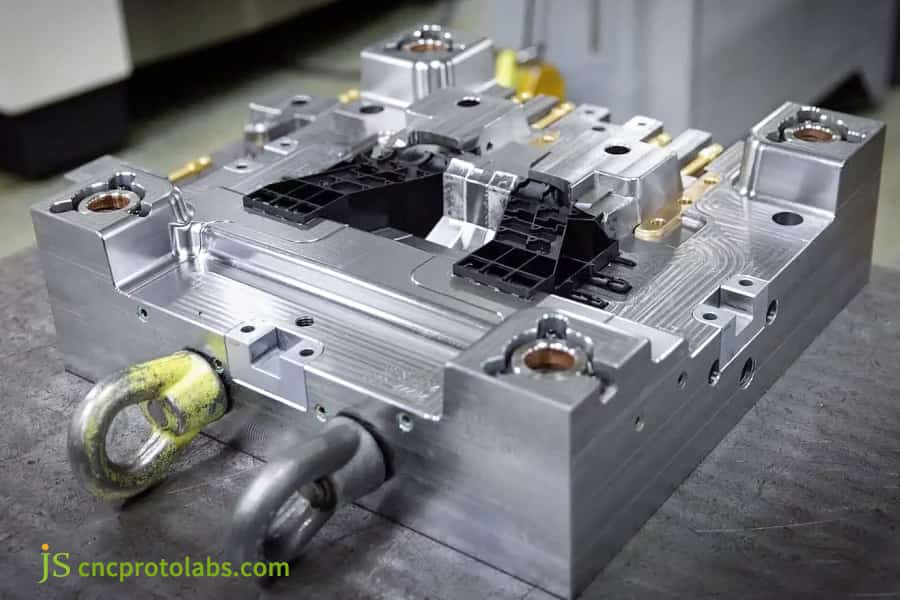
Figure 4: A metallic mold with a complex-shaped cavity and alignment features, used for insert molding.
How Can Conformal Cooling Channels in Custom Insert Molding DFM Service Shorten Cycle Times and Reduce Piece Prices?
Injection molding cycle time makes up for more than 60% of the production cost for each part. By making use of our professional insert molding DFM service together with the conformal cooling technology, we are able to effectively disperse heat around the insert, reducing the cooling time by more than 25% and in a very big way lowering the unit cost for production at large scale.
Problems of Traditional Cooling Channels
Molds with cooling channels drilled straight through have very limited adaptability. Metal inserts get heated up very fast and cool down very slowly, which is basically why traditional insert molding service are not able to shorten production cycles much.
- When the plastic layer next to the metal insert gets cooled unevenly, it can cause the material to shrink and sag.
- Temperature differences on the mold surface can reach up to 10℃ or even more, which will lead to warping and deformation of the parts.
- Lengthy cooling times will make it impossible to reduce cycle times.
Benefits of Conformal Cooling Channels
We can 3D printing mold inserts enabling us to create cooling channels that take the shape of the product. With our expert custom insert molding DFM service we can tailor the best cooling solution, one that gives an excellent compromise between molding efficiency and quality.
- The distance between the water cooling channel and the cavity surface is kept constant in the range of 3.0 to 4.0 mm.
- The temperature differences on the mold surface are controlled to be within 2℃, which greatly reduces the deformation of parts.
- Cooling time is reduced by 25%-35%, and cycle time also sees a significant decrease.
Comparison of Performance of Different Cooling Methods
|
Cooling Method
|
Mold Surface Temperature Difference (°C)
|
Cooling Time Reduction Rate
|
Part Warpage Amount (mm)
|
Mold Cost Increase Rate
|
|
Traditional Linear Water Channel
|
±10
|
0%
|
±0.15
|
0%
|
|
Semi-Conformal Water Channel
|
±5
|
15%
|
±0.08
|
15%
|
|
Full Conformal Water Channel
|
±2
|
30%
|
±0.03
|
30%
|
For manufacturers who produce on a large scale, using the mature insert molding thermal balance technology, shortening the cycle time by even a second can bring significant cost savings.
Unit cost equation: Part Cost = Material Cost + (Hourly Machine Rate Cycle Time). For instance, if the cooling cycle duration is 40 seconds initially and then it is reduced to 28 seconds, upon using a proficient insert molding cycle optimization tool, each machine will be capable of manufacturing 15 additional units per hour, and the saving from processing time cost is roughly $35,000 for a project involving one million units.
Why Does In-Depth DFM Review in Prototype Insert Molding Form the Core Strategy for Tooling Cost Mitigation?
Prototype insert molding is more than just making a simple prototype, it is actually what the mass production process is all about. By thoroughly reviewing the design for manufacturing (DFM) at the level of mass production, one can completely eliminate the risk of structural changes like insert misalignment and inadequate venting before mold opening.
Misconceptions of Traditional Prototyping
Just checking the external dimensions by simple prototyping is risky. Opening problems during mass production can be caused by improper prototype insert molding.
1.Aluminum or mild steel molds, which have insufficient strength, cannot endure the high-pressure injection during mass production.
2.Multi-cavity runner balance and venting design are ignored, resulting in filling imbalance and scorching problems during mass production.
3.The ejection arrangement is not properly planned, causing deformation or whitening of the ejected part during mass production.
Mass Production Prototype DFM Review
We adhere to the concept of prototype mass production, and the soft steel prototype mold is designed completely according to mass production standards, incorporating the insert molding design for manufacturing concept throughout the entire sampling process.
1.Mechanical calculations are conducted with mass production molds while assuming lateral pressure bearing rigidity.
2.Insert positions for venting are pre-allocated to guarantee venting is adequate.
3.An ejection system and runner structure that are closely matched to mass production molds are designed.
Additional to that, we offer a rapid tooling service to assist you with prototype verification and speed up your transition to mass production in the shortest possible time.
How JS Precision Optimizes the Injection Molding Project for Stainless Steel Pull-Pin Inserts in Automotive Connectors?
High-precision automotive connector injection molding projects form one of the major scenarios for the challenge adaptability test of professional insert molding service in complicated working conditions. We have cooperated with several automotive parts clients for problem-solving through multiple trial moldings failures, resulting in yield and cost production optimization.
Client's Original Pain Points
The client was looking for the customization of an automotive electronic control connector consisting of four high-precision machined SUS316L pins. The design as it was before, caused the pins to tilt 0.12mm displacement under the injection pressure of 95MPa so resulting in the dimensional deviations.
The top two suppliers were out of warranty for the five consecutive trial moldings leading to the batch scrap rate as high as 15%. Besides that, the cost of the precision-machined inserts was really high so the project risked delay and cancellation.
JS Precision's Comprehensive Solution
1.Revised Metal Insert Design:
Our DFM team suggested that instead of fully machined pins, they should be made by a hybrid process of partial cold heading + high precision turning at the tail. Cold heading drastically enhances the production efficiency while still maintaining pin coaxiality. Besides, it cuts down the unit procurement cost of metal inserts by 22% and still the tensile strength is not compromised.
2.Two-way hydraulic locating pin mold structure:
We left behind the old method of the passive cavity nesting and with the use of hydraulics, we have come up with the dynamic hydraulically driven carbide locating pin. For the first 70% of the injection filling, the hydraulic pin locks the suspended section of the stainless steel pin, when the melt fills 70% of the cavity and the pressure reaches the equilibrium boundary, the hydraulic pin retracts rapidly within microseconds, so allowing the remaining plastic to perfectly surround the insert.
3.Pressure holding curve control optimization:
With scientifically adjusting the sequence of the two-stage pressure holding operation, we managed to effectively avoid the formation of micro-cracks at the insert root. Initially, the pressure was kept generously high for rapid filling but later on, when the holding stage was reached, the pressure was lowered to a minimum level to achieve slow holding.
Experience and exclusive problem-solving tips
We found in our study that traditional locating devices with mechanical spring are vulnerable to thermal fatigue when the machine runs continuously at a high temperature which can make the positioning less accurate.
Solely Troubleshooting Tips: If you want to maintain the accuracy for the insert injection molding at high load conditions for a long time then you must go for a hydraulic forced limiting structural with separately water cooling and pressure feedback to avoid drift in accuracy due to thermal fatigue. That is a very valuable exclusive practical experience that only mass production from the front line can supply.
Final Outcomes
By quite a few rounds of DFM optimization and upgrading the mold structure, the deviation of the inserted eccentricity was accurately kept within 0.015mm that ended up with totally free of mold rework costs, drastically cutting down cost per unit and the project was finally completed and delivered in time two weeks ahead of schedule.
Customer's Reaction
The customer procurement director highly recognizes us: "JS Precision has solid frontline production experience, accurately solving our core project problems and is a trusted professional manufacturing partner."
Facing challenges in mass production of precision automotive inserts, or repeated mold trial failures? We leverage our mature insert molding interface bonding technology to precisely solve insert misalignment and high scrap rates. Contact us for customized DFM optimization solutions and rapid mass production implementation.
Why Choose JS Precision as Your Premium Partner for Precision Insert Molding Service in China?
Excellent precision insert molding service that is highly reliable top the list as the key factor for the success of very complex projects involving injection molding. JS Precision has been disposing of its 0.005 mm ultra-precision inspection instruments and transparent cost accounting system to successfully make technical and procurement decisions for their foreign clients.
Multidisciplinary Manufacturing Skills
Elaborate insert molding brings together the two technologies of precision machining and injection molding. Our precision insert molding service is an integration of those core technologies from both sides, so making up for the technical defects of the single manufacturers.
Pure injection molding factories but have limited knowledge of metal insert tolerance control, and machining factories, for their part, are not very familiar with the characteristics of injection fluids. In JS Precision, we have precision machining and injection molding workshops. This way, we can provide a one-stop solution for all molding challenges.
Stringent Quality Control System
We put into practice the IATF 16949 and ISO 9001:2015 quality management systems, with highly precise testing tools, and we use our insert molding DFM service to perform total quality control during the running of the production process.
Before going out of the factory, all items must be 100% dimensionally checked and functionally tested. This, and a stable insert molding dimension stability process, guarantees that the finished items perfectly comply with our customers' very strict mass production requirements.
Open Cost Accounting System
Based on the actual measurements and the scientifically derived injection molding curves, we offer customers highly detailed reports on the cost structure of insert molding tooling, with clear and transparent cost breakdowns.
We, as a trustworthy precision supplier in China, are opening the way to help our global customers get cost-effective and highly stable one-stop insert injection molding products with the help of our precisely matched insert molding material strategies.
FAQs
Q1: What design variables mainly affect the cost of insert injection molds?
Usually, the primary determinants of mold cost are the complexity of the product structure, the number of cavities, and the layout of the slider pins. We optimize and simplify the mold structure through professional DFM (Dual Dimensioning Modeling), which can effectively reduce the overall insert molding tooling cost.
Q2: How does the DFM solution prevent displacement of metal inserts during injection molding?
The key is the combined use of rigid mold restriction and Moldflow melt front filling simulation. Based on our expert insert molding DFM, we can fix the insert positioning tolerance to 0.01mm, because of this completely resolving any deviations.
Q3: How to solve the airtightness failure problem caused by the different coefficients of thermal expansion between metal and plastic?
Using our premium insert molding service, we engineer annular water-stop grooves or interfacial hot melt adhesive in metal inserts, and carry out full inspection with a helium mass spectrometer leak detector to guarantee parts sealing performance.
Q4: Which prototyping process should be used to balance speed and cost during the prototype testing phase?
Prototype insert molding is a good choice during the R&D testing phase. Also, using flexible mold frames and mild steel/aluminum cavities allows a quick lead time for samples of only 10-14 days, so balancing verification efficiency and project cost.
Q5: How do you directly cut the cost of complex parts by using better plastic matrix materials?
We took advantage of our professional insert molding service and, after taking into account the temperature resistance of the product and its need for structural rigidity, we decided to use modified engineering plastics to replace expensive raw materials. As a result, we have not only lowered material costs mostly but also maintained the quality.
Q6: How much can automated insert molding investment be paid off by left over production of inserts?
We have thoroughly discussed and decided to implement automated insert molding for production over 50000 units for the manufacturing of complicated injection molded parts. In this way, we not only stabilize the injection cycle but also prevent mold damage, effectively increase yield, and reduce labor costs.
Q7: In the DFM evaluation stage, how does JS Precision assure the B2B clients overseas that their drawing ownership will be kept confidential?
As a leading insert injection molding services provider, we have entered into a double confidentiality NDA agreement, physically isolated design data internally, and encrypted and traced all operations for the drawings throughout the whole process.
Q8: What is your typical negotiation steps to determine price for prototyping and large quantities production of highly complex insert injection molded part?
Customers can get a quote instantly by just uploading their drawings, submitting STEP format 3D files, and letting us know their purchase quantity. Within 24 hours, we deliver a turnkey solution, and within 3 days of cooperation, we present a full set of customized DFM optimization solutions.
Summary
High-difficulty insert injection molding system engineering. It is precision mechanics, polymer fluids dynamics, high grade mold design integrated engineering projects. Using professional insert molding DFM services, can optimize the wall thickness structure, insert localization, conformal cooling, tolerance matching, can avoid 80% of the risks in designing, to increase the rate of successful into machines before mass production and reduce unit production cost by more than 30%.
Don't keep throwing R&D dollars and trading lead-times away buying trial molds from unskilled suppliers because of excessive flash and insert rotation issues. Hand over your project to experts that know tolerances, materials and injection fluid movement.
[Click here now to upload your 3D CAD drawings] to gainyour free personally tailored insert injection molding DFM evaluation report and accurate special commercial quotation, built for you by JS Precision senior content operation business and technical expert team within 24 hours!

Disclaimer
The contents of this page are for informational purposes only.JS Precision Services,there are no representations or warranties, express or implied, as to the accuracy, completeness or validity of the information. It should not be inferred that a third-party supplier or manufacturer will provide performance parameters, geometric tolerances, specific design characteristics, material quality and type or workmanship through the JS Precision Network. It's the buyer's responsibility Require parts quotation Identify specific requirements for these sections.Please contact us for more information.
JS Precision Team
JS Precision is an industry-leading company, focus on custom manufacturing solutions. We have over 20 years of experience with over 5,000 customers, and we focus on high precisionCNC machining,Sheet metal manufacturing,3D printing,Injection molding,Metal stamping,and other one-stop manufacturing services.
Our factory is equipped with over 100 state-of-the-art 5-axis machining centers, ISO 9001:2015 certified. We provide fast, efficient and high-quality manufacturing solutions to customers in more than 150 countries around the world. Whether it is small volume production or large-scale customization, we can meet your needs with the fastest delivery within 24 hours. Choose JS Precision this means selection efficiency, quality and professionalism.
To learn more, visit our website:www.cncprotolabs.com
Resource