English



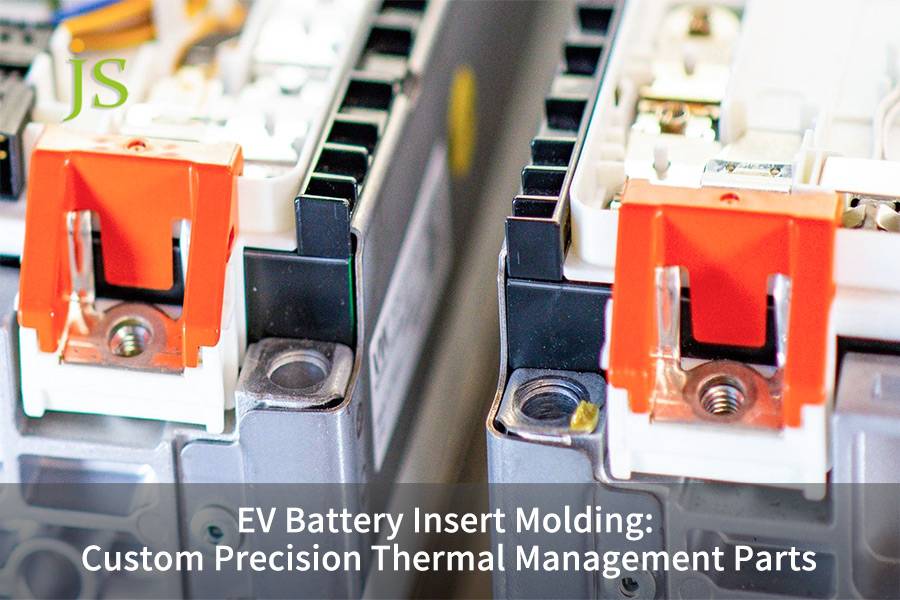

EV battery insert molding is a major method for resolving the thermal issues of rapid charging in electric vehicles.
During fast charging of electric vehicles beyond 2C, the thermal resistance of the thermal grease layer between the square battery cell and the liquid cooling plate jumps by 300% after 800 thermal cycles, with the hotspot temperature difference reaching localized areas exceeding 15°C.
This leads directly to the enhancement of cell aging and even the risk of thermal runaway.
The old three layer design of "heat sink + thermal pad + insulating film" is not able to solve the problem of the interface unevenness and long term reliability. Insert molding, due to its integrated and high precision features, has emerged as the main technology for defeating this problem.
Core Answer Summary
|
Core Problem
|
Solution
|
Key Data
|
|---|---|---|
|
Interface Thermal Resistance
|
EV battery insert molding Direct metal insert covering
|
Thermal resistance ↓40%, in mold pressure 50-120MPa
|
|
High Voltage Creepage
|
Custom insert molding T type/Z type barrier
|
Creepage distance 4.1mm, withstand voltage 4000V
|
|
Insert Displacement
|
Real time feedback pressure holding by in mold sensors
|
Scrap rate reduced from 12% to 1.5%
|
|
Mold Wear
|
Injection mold inserts
|
Replacement time reduced from 4h → 40min
|
Key Takeaways
- Remove interfacial air gaps: Molding with insert method removes air gaps by applying 50-120MPa molding pressure, and the thermal resistance is decreased by 40% as compared to thermal grease solution, this is a major cause of the cooling system enhancement and a significant delay of cell degradation.
- Unitary component: Replacing three layer structure with one custom plastic part avoids assembly tolerance and aging risks and at the same time reduces maintenance costs.
- Cost control: Injection mold inserts are a great tool for costing quantifiable maintenance, parts that experience high wear can be changed after 50,000 mold cycles, thus resulting in accurate budget planning.
- Productive Process: In mold process control sensors raise insert location CPK from 0.67 to 1.33, thus improving product yield.
Precision Battery Components: Insert Molding Solutions From JS Precision
The dedicated expertise of our insert molding specialists enables us to design EV battery thermal management systems which meet the precision manufacturing requirements of our clients. This is the core reason why you should choose JS Precision which specializes in this field.
When you are seeking R&D and mass production support for core products such as EV battery insert molding and injection mold inserts, JS Precision has provided customized solutions for over 20 global car companies.
The system enables you to deal with fundamental production issues while meeting standard industry requirements which include 800V high voltage fast charging and extended driving distance capabilities.
Taking a similar scenario as an example, a certain leading car manufacturer experienced an issue during its main SUV battery pack project when insert displacement problems caused 12 percent of materials to become waste and their thermal resistance measurements exceeded approved limits by 30 percent.
The customer achieved a 1.5 percent reduction in scrap rate through JS Precision's in mold sensor closed loop control and insert mold insert design which enabled them to decrease thermal resistance by 40 percent while saving more than $120000 every year in operating costs which you can obtain by selecting us as your partner.
JS Precision provides full support to help you meet your production requirements which demand complete compliance with the IEC 62133-2:2017 international safety standard for all custom plastic parts to maintain their safety and uniformity.
Our company developed a complete quality control system which runs from material selection through mold design until mass production delivery.
This system gives you complete testing reports and reliability verification data which helps you feel secure during our collaboration while we handle all aspects of quality control.
Choosing professional insert molding services can help customers mitigate technical risks and control production costs. If you are facing challenges such as thermal resistance and insert displacement in EV battery components, contact our engineers for free technical consultation and solution evaluation.
How Can EV Battery Insert Molding Solve The Interface Thermal Resistance Problem Between The Liquid Cooled Plate And The Battery Cell?
Many customers have the same question: how does EV battery insert molding actually address the issue of interfacial thermal resistance between the liquid cooling plate and the battery cell?
First, a separate piece made of aluminum alloy or copper is used as a heat dissipation insert. Then it is coated with plastic having high thermal conductivity (PPS + thermally conductive filler) by means of insert molding.
The pressure in the mold during this operation is maintained at 50-120MPa to get rid of interfacial air gaps, thus the thermal resistance can be reduced by around 40%.
In mold pressure gets rid of the interfacial air gaps
In the course of injection molding, the injection mold inserts are subjected to a holding pressure of 50-120MPa at this stage as a result of which the molten plastic is forced to fill the surface irregularities of the metal insert surface and the contact area is increased to 95% or more thereby resulting in a great enhancement of thermal conductivity.
In essence, it is equivalent to using high pressure to fill the tiny gaps in a wall with cement, which enables the plastic and metal insert to be tightly bonded, thus greatly improving thermal conductivity and also preventing issues with heat dissipation due to inadequate contact.
Single Component Replacement of Three Layer Structure
The custom plastic parts, which are designed through molding, simultaneously accomplish the tasks of thermal conductivity (2.5 W/mK), insulation (4000V withstand voltage), and structural support.
This means that there is no need for thermal grease and insulating film, which in turn leads to lower procurement and assembly costs and also minimizes the aging risks.
To learn how EV battery insert molding can further reduce your battery pack's thermal resistance, download our technical white paper to clearly understand the core points of in mold pressure control.
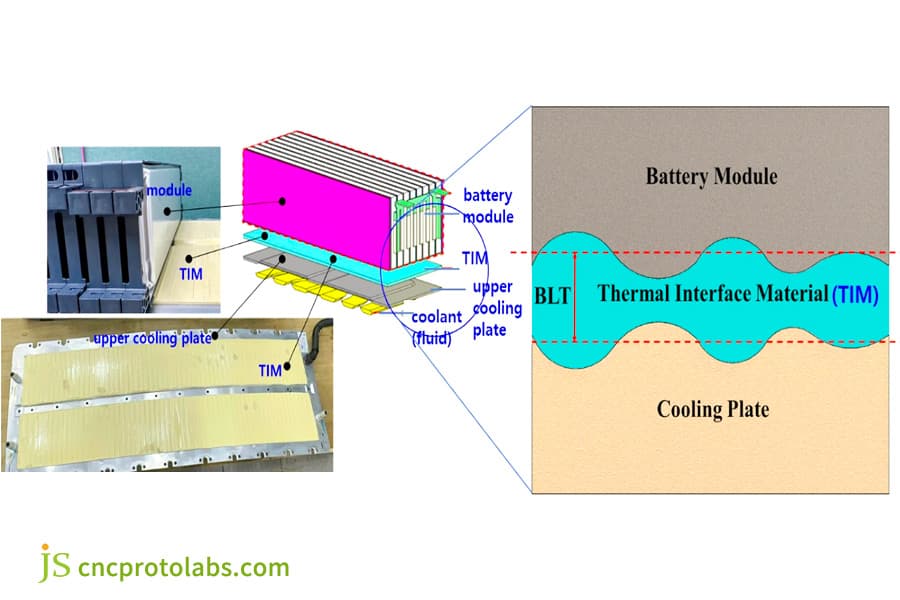
Figure 1: A composite image showing a real battery module alongside a schematic diagram and a cross-section, illustrating how Thermal Interface Material (TIM) is applied between the battery and cooling plate via insert molding to manage heat.
How Can Custom Insert Molding Achieve a Balance Between Double-Sided Heat Dissipation And Creepage Distance Within Limited Battery Pack Space?
Resolving the interface thermal resistance problem is one thing, but another crucial aspect for customers is balancing double sided heat dissipation with a sufficient creepage distance inside a small battery pack space. Custom insert molding provides an ideal solution to these challenges.
For example, copper busbars or heat pipes can be employed as inserts in 8mm cell spacing. A plastic T supports a two function insert: one side conducts heat (2.5 W/m·K), and the other one insulates (creepage distance 4.1mm).
The plastic, shaped with the help of a 3D printed conformal water channel mold, forms this T shaped feature.
The T Shaped Barrier Concept Defies Lack of Space
Custom insert molding for 800V high voltage platforms (creep distance 3.2mm) adopts an alternate insert arrangement. The plastic wall is thickened to 2.5mm on the side where an insulating barrier is required. Hence, both heat dissipation and insulation are attained without volume increment.
It is like stacking various storage solutions in a limited space, one side is for heat dissipation while the other is for insulation, and none of them would meet any interference.
So, within the limited battery pack space, this allows you to accomplish both high voltage safety and heat dissipation requirements simultaneously.
3D Printed Molds Enable Differentiated Wall Thicknesses
The mold for conformal water channel permits an accurate regulation of plastic flow, thus enabling the production of a 0.8mm thermally conductive thin walled area and a 2.5mm insulating thick walled area on the same customized plastic part simultaneously, so part design flexibility is also improved.
Which Materials Are Best For Injection Mold Inserts In Battery Modules?
The decision regarding the materials for injection mold inserts has a direct impact on mold longevity, product precision, and production expenses. Through usage we have pinpointed the best choice solution.
In the case of high frequency thermal cycling (-40°C to 85°C, 3000 cycles), H13 steel mold inserts have a dimensional change rate of 0.012%, which is a better performance than S136's 0.025%.
The CTE mismatch between metal inserts (copper/aluminum) and PPS plastic has to be limited to 2.5 ppm/°C, which complies with the dimensional accuracy requirements of ISO 12165:2019.
Mold Steel Selection Comparison
Among injection mold insert materials, the best option is H13 steel with surface nitriding treatment (hardness 1100HV). Even after 3000 thermal cycles the cavity dimensional change is 0.008mm.
The performance comparison of different steels is as follows:
|
Mold Steel Type
|
Surface Treatment
|
Dimensional Change after 3000 Thermal Cycles (mm)
|
Hardness (HV)
|
Applicable Scenarios
|
Replacement Cycle (Mold Times)
|
|---|---|---|---|---|---|
|
H13
|
Nitriding Treatment
|
≤0.008
|
1100
|
High voltage fast charging battery components
|
50,000 (high wear area)
|
|
S136
|
Polishing Treatment
|
≤0.025
|
950
|
Ordinary battery components
|
30,000 (high wear area)
|
|
H11
|
Nitriding Treatment
|
≤0.015
|
1000
|
Medium voltage battery components
|
40,000 (high wear area)
|
|
Beryllium Copper
|
None
|
≤0.010
|
850
|
Precision insert positioning
|
20,000 (high wear area)
|
|
W7718
|
Nitriding Treatment
|
≤0.012
|
1050
|
Large Plastic Part Molding
|
60,000 (High Wear Zone)
|
CTE Matching Calculation
The CTE difference of copper inserts (CTE=16.8) and 30% glass fiber reinforced PPS (CTE=14.3) is quite small (only 2.5), whereas the difference for aluminum inserts (CTE=23.6) is as high as 9.3, which means that an interference compensation of additional 0.2mm is required.
The smaller the CTE difference, the better the product accuracy.
Essentially, this is like the suitability of the clothes on your body. The smaller the CTE difference, the better the "fit" between the plastic and the insert, thereby preventing loosening or deformation caused by temperature changes and ensuring long term product precision stability, as well as a reduction in defective products.
|
Insert Material
|
CTE (ppm/°C)
|
Plastic Material
|
Plastic CTE (ppm/°C)
|
CTE Difference (ppm/°C)
|
Interference Compensation (mm)
|
Applicable Scenarios
|
Thermal Conductivity (W/m·K)
|
|---|---|---|---|---|---|---|---|
|
Copper
|
16.8
|
30% Glass Fiber PPS
|
14.3
|
2.5
|
0
|
High end Fast Charging
|
≥2.5
|
|
Aluminum
|
23.6
|
30% Glass Fiber PPS
|
14.3
|
9.3
|
0.2
|
Normal Range
|
≥2.2
|
|
Copper
|
16.8
|
50% Glass Fiber PPS
|
11.2
|
5.6
|
0.1
|
High Voltage Platform
|
≥3.0
|
|
Aluminum
|
23.6
|
50% Glass Fiber PPS
|
11.2
|
12.4
|
0.3
|
Low Cost Solution
|
≥2.0
|
|
Stainless Steel
|
10.8
|
30% Glass Fiber PPS
|
14.3
|
3.5
|
0
|
High Reliability
|
≥1.8
|
Forecasting of Mold Wear Life
The mold inserts that are placed near the gate have to be replaced when the wear reaches 0.003mm after every 50,000 molding cycles. Areas that do not wear can function for 200,000 cycles, thus assisting customers to precisely schedule their mold maintenance cycles.
Can Your Insert Molding Services Handle Large-Scale Structural Components?
As the EV battery packs get bigger, the plastic molding large parts also becomes more challenging. Clients frequently ask if the insert molding services can support the demand of large scale production.
We change their minds by showing a strong, mature team of technology and production that are ready to handle any challenge.
With an automated robotic arm, 8 threaded sleeves + 2 liquid cooling plates are set with a repeatability of 0.05mm on a battery base plate of 850mm length.
Pressure balancing in multi cavity injection has also been implemented to ensure that the deviation of shrinkage rate of the plastic part is no more than 0.08%, which is compliant with the accuracy requirement).
Automated Pre-positioning System
After the position of the insert is confirmed with laser measuring, the six axis robotic arm picks up the insert and places it into the mold. Insert molding services can achieve a production cycle of 90 seconds per piece, balancing accuracy and efficiency.
Multi Cavity Pressure Balancing Technology
Four independent hot runners, combined with pressure sensors, adjust the injection pressure of each cavity in real time, ensuring the flatness of plastic molding large parts is controlled within 0.15mm/m, guaranteeing product consistency.
One Stop Vertical Integration Process
With one stop delivery of custom plastic parts from mold design, insert processing to injection molding mass production, JS Precision helps to shorten project cycles and reduce customer communication costs.
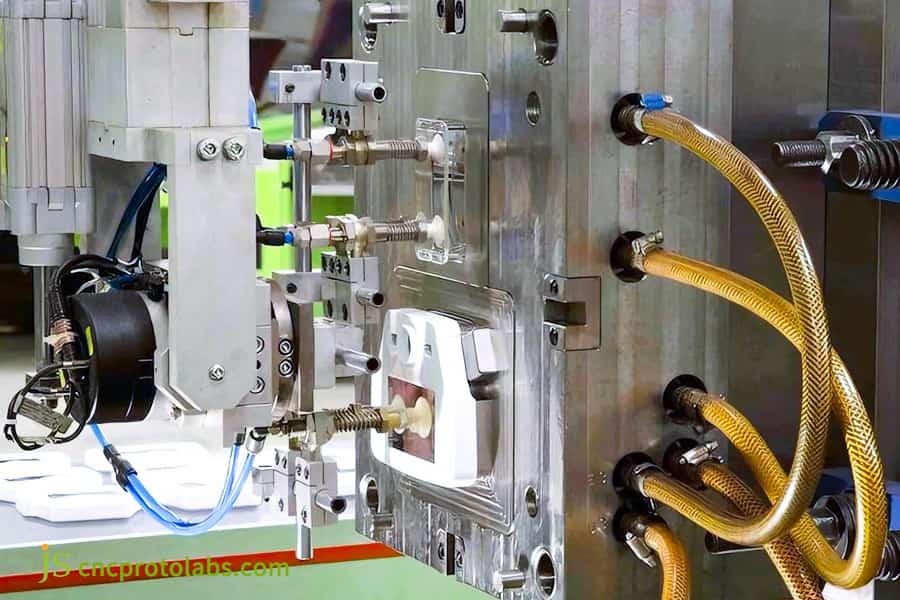
Figure 2: A close-up of an industrial insert molding setup, featuring a large metallic mold with fluid lines, positioned on a machine bed within a factory environment, capable of producing substantial battery components.
How Does The Wear And Replacement Frequency Of Injection Mold Insertions Affect The Cost Per Piece?
In mass production, the wear and replacement frequency of injection mold inserts directly dictate the unit cost. Our method really helps customers figure out how to keep this cost under control.
Beryllium copper inserts have a friction loss of 0.003mm per mold cycle. When the wear of the locating pin goes beyond 0.02mm, the chance of the insert being out of alignment becomes quite high.
By adopting an insert type design, the unit cost of mold maintenance goes down to around $0.025 per item (assuming a total production of 500,000 molds).
Wear and Misalignment Thresholds
The wear on the diameter of the injection mold inserts locating pin has reached 0.02mm, and as a result, the standard deviation of insert position misalignment has changed from 0.02mm to 0.07mm, and the scrap rate has gone up to 8%, hence worn parts should be replaced in time.
Insert Type Quick Replacement Design
Making the highly worn parts as separate mold inserts allows replacement to be done by just removing four bolts, thereby drastically cutting down the replacement time from 4 hours to 40 minutes, and at the same time limiting downtime and increasing efficiency.
Single Piece Cost Calculation Model
With an overall production volume of 500,000 units, the replacement cost of high wear areas is $1758, low wear areas $293, and downtime loss $439.5. Maintenance cost per mold is around $0.025.
Want to accurately calculate the single piece cost due to wear on injection mold inserts? Submit your production scale, and we will provide you with a free cost calculation report.
What Are Critical Tolerances For Plastic Molding Large Parts In EV Battery Parts?
Tolerance control for plastic molding large parts is a major factor influencing assembly accuracy. From our ongoing work, we've identified the major tolerance criteria and how to control them.
Real time compensation of shrinkage is done via an in mold pressure sensor. The final flatness of the sealing surface is 0.05mm, while 3D blue light scanning is employed for comprehensive inspection prior to shipment.
Warpage Control Standards
As the length of plastic molding large parts increases by 100mm, the allowed warpage also increases by 0.06mm. So, the standard for a 620mm part that is acceptable is 0.37mm. In reality, we limit the control to 0.35mm, which is even better than the industry standard.
Dynamic Shrinkage Compensation Technology
Pressure sensors are installed in all four cavities. If a pressure variation 3% is found, the respective nozzle holding pressure is adjusted automatically by 5MPa, thus avoiding uneven shrinkage and possible tolerance issues.
Full Inspection Methods
The very first and last parts of a batch are subjected to 3D blue light scanning (0.008mm accuracy). Image measuring tool is used to map the critical mounting surfaces. Only the parts with a CPK 1.33 are released, thereby ensuring no defective parts are passed on to the next process.
How To Prevent Displacement Of Plastic Molding Large Parts And Multiple Inserts Through In Mold Sensors During One-Time Molding?
Insert displacement is a frequent defect occurring when molding large plastic parts with multiple inserts in a single process. We have a very effective method to eradicate this problem developed using in mold sensor technology.
For the battery base plate comprising 8 threaded sleeves and 2 liquid cooling plates, a tiny magnetostrictive displacement sensor (with an accuracy of 0.01mm) is embedded in each insert to modify the nozzle holding pressure instantaneously. As a result, the CPK was elevated from 0.67 to 1.33.
Insert Displacement Failure Mode
At just 0.28mm the injection pressure can cause the two middle manifolds to be misaligned, which is more than three times the 0.10mm specification limit. This results in 12% scrap item rate, hence increasing production costs and causing delivery delays.
Sensor Closed Loop Control System
A displacement sensor is used with each mold insert, the sensor can sample 1000 times per second. Hot runner needle valve of the one insert is closed with a 0.3 second delay after an offset of more 0.05mm is detected by referring to a different channel, and the offset is corrected in the same time.
Yield Improvement Data
Following the installation, the insert location CPK was 1.33 (mean offset 0.02mm, standard deviation 0.015mm), and the scrap rate was reduced to 1.5%. On an annual production of 200,000 pieces basis, this equals annual cost savings of approximately US$126,000.
JS Precision Case Analysis: Thermal Management Insert Molding for 800V Ultra-Fast Charging Battery Pack
Using a project case from the real world as a reference, this article details the thermal management issues of an 800V ultra fast charging battery pack that we have resolved, and you can take it as a project reference.
Difficulties Encountered
The flagship sedan 800V ultra fast charging battery pack project of a leading car company faces three major pain points:
- The cell spacing is only 9mm and must meet a crawling distance of ≥ 3.2mm.
- The liquid cooled plate is in contact with the curved surface of the cylindrical battery cell, and the thermal resistance of the heat-conducting silicone grease increases to 480mm² · K/W after aging.
- Three copper heat dissipation tubes and twelve busbar inserts are prone to displacement, resulting in a scrap rate of 18%.
Solution (Provided by JS Precision)
JS Precision delivered a complete custom insert molding solution to resolve the presented challenges.
1. Structural Design:
We use a Z-shaped plastic barrier to bias the copper tube to one side, achieving an insulation side wall thickness of 2.6mm (creepage distance of 4.5mm) and a thermal conductivity side wall thickness of 0.6mm, which not only meets insulation requirements but also ensures heat dissipation efficiency.
2. Mold and Process:
Our injection molds use H13 steel with surface nitriding treatment for their mold inserts. The in mold pressure control system operates at 855MPa. The laser roughening process creates a surface on the copper tube that reaches Ra=3.2μm which enhances plastic metal material adhesion and stops material failure at the bond point.
3. Displacement Control:
Every bus insert contains a small magnetostrictive displacement sensor which operates as a built in sensor system. The sensor provides continuous position information which allows for automatic adjustments of holding pressure to enable precise control of insert offset.
Final Results
The project outcome was a big surprise to all the stakeholders:
- Thermal resistance was lowered to 84 mmK/W (82% reduction compared to aged thermal grease, and 44% reduction compared to conventional insert molding solutions).
- Creepage distance was 4.5 mm, withstand voltage passed 5000V/60s.
- Insert position CPK=1.41, scrap rate reduced to 2.1%, annual cost savings exceeding $170,000, unit cost reduced by 22%, and assembly efficiency improved by 30%.
If you are facing similar challenges in an 800V battery pack project, please send your battery pack 3D drawings to our engineering team to receive a custom insert molding solution and quote within 24 hours.
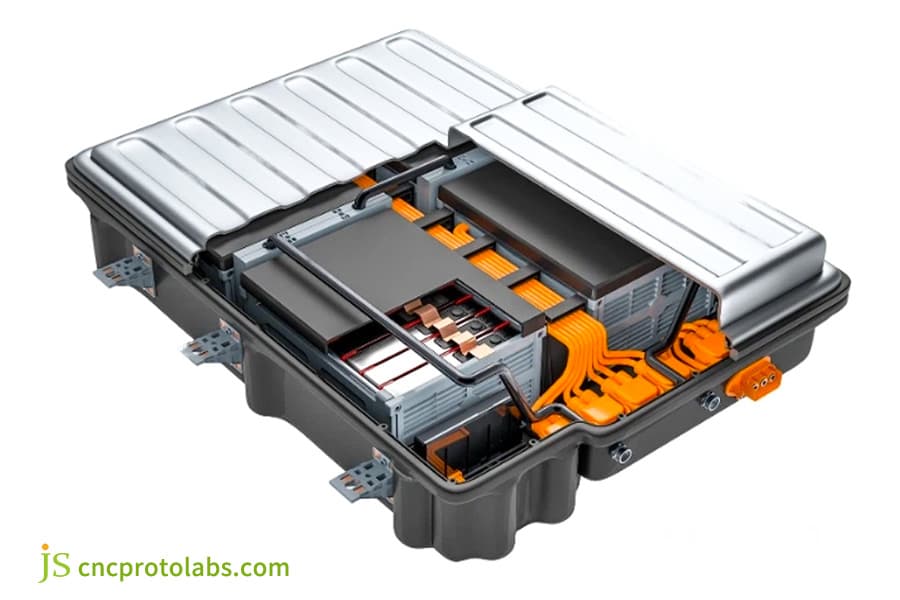
Figure 3: A detailed internal view of a high-voltage battery pack, showcasing stacked battery cells, integrated metal and plastic components, and organized wiring harnesses, exemplifying the complexity achieved through precision insert molding.
Why Does Your EV Battery Thermal Management Project Require Professional Insert Molding Services?
The optimal method for clients to decrease project risks and expenses while increasing project efficiency involves their partnership with expert insert molding services. The project requires efficient EV battery thermal management because the professional services deliver essential support for project success.
JS Precision provides advanced engineering solutions which include material CTE matching and mold insert management and in mold sensor control while also delivering complete one stop delivery support system.
Lightweight and Integrated Design
The use of one custom plastic part instead of a three layer structure leads to a 35% weight reduction. We have reduced the battery pack assembly steps from four to one because this change enables us to decrease pack weight while achieving a longer vehicle range and reducing both assembly costs and errors.
Reliability Verification
The product underwent testing which included 3000 cycles of thermal cycling from -40°C to 85°C and showed that thermal resistance changed by 15% while creepage distance remained unchanged so the results demonstrated that the product would last longer and decrease after sales service expenses for customers.
Scalable Delivery Capability
JS Precision operates 10 injection molding machines which range from 160 to 1000 tons and combine with an automated insert feeding system to meet customer demands for large scale production while maintaining stable delivery cycles which reach an annual output of 2 million units.
FAQs
Q1: What is the thinnest wall thickness that can be achieved in insert molding?
The thinnest wall thickness in insert molding is limited by plastic flow length and the shape of the insert. For thermally conductive areas, the minimum thickness is 0.6mm, and for insulating zones, it is 0.8mm, which most EV battery design standards require.
Q2: Is the insert supposed to be preheated?
Aluminum and copper inserts should ideally be preheated to 120-150°C to avoid rapid cooling of the melt front that can create a weld line and to enhance the bonding strength between the custom plastic parts and the inserts.
Q3: What is the typical time required to deliver insert molding molds?
Insert molding mold lead times can be classified into two categories: simple single insert molds (30-35 days) and complex multi insert molds (8 or more inserts) (45-50 days), which can be aligned with the customer's project timeline.
Q4: How is the position of inserts in the mold controlled?
A combination of magnetic attraction and mechanical positioning pins is employed for the dual fixing method. The positioning pin hardness is HRC55, and the wear is monitored every 50,000 molding cycles to guarantee precise insert positioning and to minimize the risk of displacement.
Q5: What are the flatness requirements for large plastic molded parts?
Flatness tolerance for large plastic molded parts is determined by the length of the part: 0.25mm for parts less than 500mm, 0.35mm for parts 500-1000mm. Straightening is necessary for trim parts.
Q6: Can insert molding produce threaded inserts?
Yes, threaded inserts can be made with insert molding. The insert must be knurled or milled to prevent rotation. Besides, the gate should not be hit directly during the injection molding in order to keep the threaded insert stable.
Q7: What is the difference between insert molding and secondary injection molding?
Simply put, insert molding is a process where the insert is loaded in the mold and the molding is done in one operation, while secondary injection molding requires first making a part and then covering it. So basically, they are for different cases.
Q8: What is the minimum order quantity for JS Precision's insert molding services?
JS Precision's insert molding services require a minimum of 100 pieces for prototype validation and 5000 pieces per year for mass production. The mold cost is quoted separately.
Summary
With the arrival of 800V high voltage fast charging, EV battery insert molding is not an option but a must-have process to fix the contradiction between battery pack thermal management and electrical safety.
This technology helps you remove the interface air gaps, combine components, keep control of costs, raise the yield, and also make battery packs safer, more reliable, and more cost effective.
JS Precision, a highly experienced insert molding services provider, combines its rich experience, strict quality control, and full technical support to guarantee your project's success from the beginning to the end.
Submit your battery pack 3D drawings to our engineering team, and we will issue you an insert molding feasibility study and a unit cost estimate within a day. JS Precision - China's precision injection molding and insert molding service provider - stands ready to assist you in tackling the challenges of EV battery manufacturing.

Disclaimer
The contents of this page are for informational purposes only.JS Precision Services,there are no representations or warranties, express or implied, as to the accuracy, completeness or validity of the information. It should not be inferred that a third-party supplier or manufacturer will provide performance parameters, geometric tolerances, specific design characteristics, material quality and type or workmanship through the JS Precision Network. It's the buyer's responsibility Require parts quotation Identify specific requirements for these sections.Please contact us for more information.
JS Precision Team
JS Precision is an industry-leading company, focus on custom manufacturing solutions. We have over 20 years of experience with over 5,000 customers, and we focus on high precisionCNC machining,Sheet metal manufacturing,3D printing,Injection molding,Metal stamping,and other one-stop manufacturing services.
Our factory is equipped with over 100 state-of-the-art 5-axis machining centers, ISO 9001:2015 certified. We provide fast, efficient and high-quality manufacturing solutions to customers in more than 150 countries around the world. Whether it is small volume production or large-scale customization, we can meet your needs with the fastest delivery within 24 hours. Choose JS Precision this means selection efficiency, quality and professionalism.
To learn more, visit our website:www.cncprotolabs.com
Resource