English




Aerospace CNC machining remains the fundamental technology in the quest for supreme manufacturing in the aerospace sector. At such altitudes as tens of thousands of meters and in near, Earth orbit, the performance of each and every component decides whether the mission is successful and the crew safe.
The aerospace area is the ultimate phase for the trial of precision manufacturing. It demands parts that can function consistently even in extreme environments.
Thus, CNC machining aerospace has to be extremely reliable and have an ultralight nature so that they can be subjected to stringent mechanical and thermal challenges. By far, simple and ordinary CNC machining cannot meet such requirements.
This article will take a close look at the fascinating niche of aerospace CNC machining from a double perspective: material character and process boundary as well as quality certification. JS Precision, united or integrated capabilities in, depth (united CNC machining), choosing a partner explains, is the key factor in making projects from blueprint to flight a reality.
Key Answers Overview
| Key Questions | Key Answers | Value for You |
| Why is aerospace CNC machining considered special? | Aerospace CNC machining process is influenced by three main factors, and it is required to produce results that surpass the regular industrial standards of the sector. | Clarify industry barriers and establish reasonable expectations for quality and compliance. |
| How can one be sure that parts are of aerospace, grade quality? | We maintain strict controls over surface integrity by means of a dedicated process chain. | Besides that, we have mastered the methods for evaluating supplier processes and quality. |
| How to select a trustworthy aerospace machining partner? | A service provider with full process united CNC machining capabilities should be your first choice. | Get the evaluation criteria for selecting high quality partners. |
Key Takeaways:
- Certification is the entry barrier: The AS9100 quality system is the aerospace CNC machining's ticket to the market, providing complete traceability and extremely high standards from materials to finished products.
- Process determines performance: Changes in CNC machining processes to suit different materials such as titanium alloys and aerospace aluminum alloys, especially high-speed machining aerospace aluminum, are essential for guaranteeing part fatigue life and precision.
- End-to-end integration is crucial: The success of CNC machining aerospace parts projects depends on the smooth integration of design (DFM), process, inspection, and project management (united CNC machining).
Why Is This Guide To Aerospace CNC Machining Services Trustworthy?
This guide is trustworthy for three main reasons: it breaks down the industry, it steps out with exclusive validation data, and JS Precision has a mature project experience. More than 8 years of work experience in aerospace CNC machining has been the base of our technical know, how and practical methods, thus enabling us to produce both professional and useful content.
We do not use general terms and give more emphasis to the data that can be used. For example, our team attained a 99.5% pass rate and held the tolerances within 0.0127mm for 0.8mm thick 7075-T6 aluminum alloy thin walled parts.
Through Ti-6Al-4V titanium alloy parts optimization, the tool life has been extended by 35% and each piece produced has been able to save $2, 000, thus, these are some of the issues directly dealt with, such as deformation and high cost.
Besides, our professional skills are proved by the very strict and top level standards we are following, which are AS9100D and NADCAP certifications.
JS Precision has been able to successfully provide the main fuselage structural components and the engine turbine assembly for an electric vertical take, off and landing (EVT) aircraft for the customers of North America and Europe, thus it has solved the mass production bottlenecks that the local suppliers could not.
In line with the requirements of SAE AS9100D (clause 7.5.3) on traceability, we carry out comprehensive data recording of the whole process.
A digital twin file is created for each part containing the respective material certificates, machining parameters, and inspection reports, meeting the legal requirements and enabling customers to have completely transparent production visualization services.
Besides that, JS Precision is here to support you with a broad range of issues such as deformation of thin, walled parts, working with hard, to, machine materials, or passing compliance audits through the combination of our knowledge and experience.
To date, we have assisted more than 12 aerospace startups in reducing their manufacturing costs by approximately 25%-30% and guaranteeing their scheduled deliveries which serves as a proof of our capability as a trustworthy partner.
If you are looking for a trusted partner for your aerospace projects, please submit part drawings to the JS Precision engineering team. We will provide a free DFM analysis report, including process optimization suggestions and cost estimates, laying a solid foundation for your project.
What Is Aerospace CNC Machining, And Why Is It Unique?
Aerospace CNC machining is a high-precision CNC machining method designed specifically for the aerospace industry. Its core is to pursue the ultimate performance, compliance, and comprehensive balance of parts, and it is also a high-level application form of CNC machining technology in this field.
Beyond the Limits of Regular Machining
Really, the components of an aircraft have to function without fail at very high and very low temperatures, like from 55C quite drastically up to +300C. The CNC machining process to the materials science and aerodynamics must be tightly combined, not simply to the shapes of the parts which ordinary CNC machining can do only.
Certification and Standards: A Passport to Industry Access
AS9100 system is the backbone of CNC machining for aerospace, defining the necessity for full traceability, document control, and defect prevention. When paired with NADCAP accreditation, it becomes the key to unlocking the aerospace supply chain.
A Triple Balance of Precision, Reliability, and Lightweighting
These three factors were equally balanced and became the main hurdle in CNC machining aerospace parts: the crucial dimensional tolerances are often as tight as 0.0127mm, thus 100% non destructive testing is required to guarantee reliability, and at the same time, the thin walled structure after topology optimization becomes a very serious issue of deformation control.
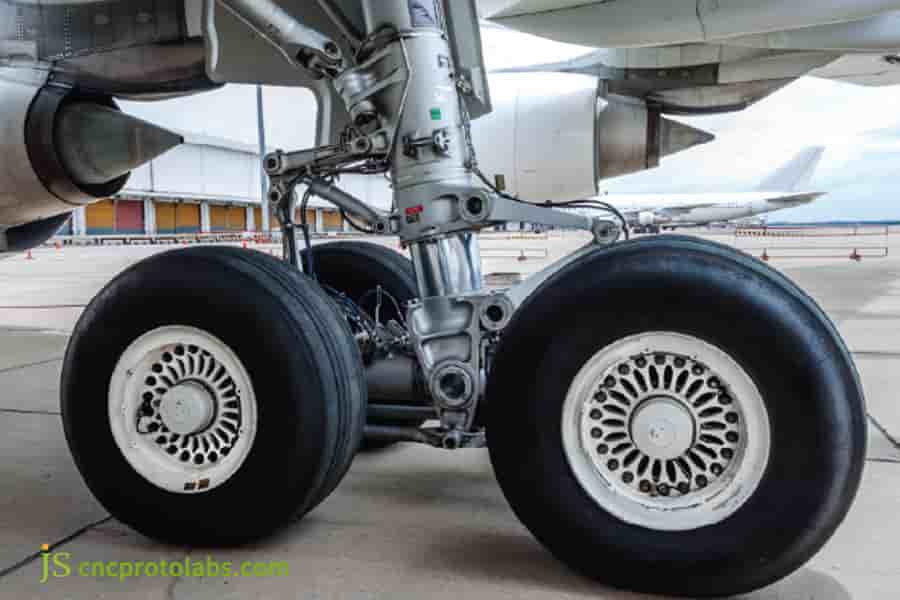
Figure 1: Close-up view of an aircraft landing gear's wheels and metal structure.
How Does The Aerospace CNC Machining Process Guarantee Extreme Quality?
The ultimate quality of aerospace CNC machining is essentially traced to the full coverage control of the process chain from start to finish. Each step is accurately carried out with the CNC machining process being at the center of the process, quality, wise no corners or blind spots were left out.
Five Axis Machining, The Ultimate Solution for Complex Geometries
Five axis machining is one of the normal capabilities of aerospace CNC machining. It manages to perform the machining of complex features on different sides of a part in a single clamping, thus, it avoids the repetitive positioning errors caused by multiple clampings. At the same time, it ensures a high degree of precision and machining efficiency.
A Comprehensive Quality Control System
Quality control is one of the things that happen during the entire CNC machining aerospace lifecycle.
- In the CAM stage, the cutting forces and the risk of deformation are predicted through the simulation.
- While machining, using machine tool probes, online monitoring and a real time parameter adjustment are realized.
- The 3D inspection and the non destructive testing using a coordinate measuring machine (CMM) completely removes the defects.
Surface Integrity, The Cornerstone for Fatigue Life
Through the optimization of the cutting parameters, the selection of specialized tools, and the combination of these with post, processing operations such as deburring and shot peening, the fatigue life of the parts can be enhanced by more than 20%, thus, it is with great precision that surface integrity and operational safety are guaranteed.
Why Is High-Speed Machining Critical For Aerospace Aluminum Parts?
High-speed machining aerospace aluminum is one of the main ways to manufacture aerospace aluminum alloy parts. It can be regarded as a triple, play achievement of efficiency, precision, and cost. In addition, it represents a main application area of CNC machining for aerospace.
Perfect Balance of Efficiency and Precision
This method utilizes a spindle speed of more than 20, 000 revolutions per minute, along with very small step depths, to quickly and forcibly remove the material while at the same time by lessening the cutting force and the heat input, controlling the 7075-T6 aluminum alloy thin walled parts' deformation to within 0.1mm.
Achieving Superior Surface Quality
High speed machining can realize a surface roughness level of Ra 0.4m that satisfies the extremely high requirements of aerodynamic surfaces or precision assembly surfaces in aerospace components. This makes manual polishing unnecessary, thus the production lead time is reduced.
Key Strategy for Reducing Overall Production Costs
Although the specialized cutting tool is more expensive, high speed machining produces fine chips that are easily and smoothly removed, hence the tool wear is lowered. Also, efficient machining reduces machine tool downtime, thus it is suitable for the mass production of aluminum alloy parts.
Want to calculate the cost advantages of high-speed machining for your aluminum alloy parts? Provide JS Precision with the material and dimensions of your parts to receive a free machining cost comparison plan and clearly understand the potential for cost reduction.
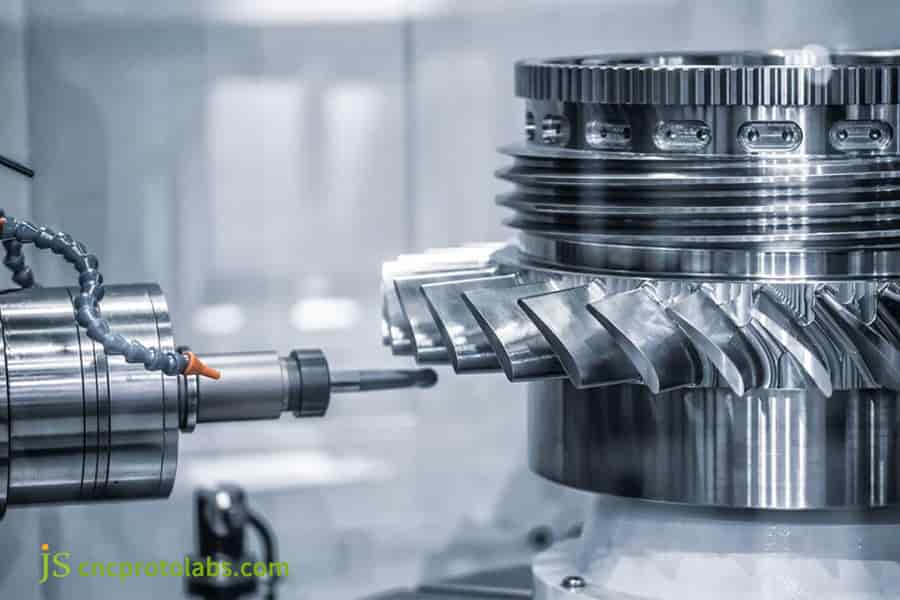
Figure 2: CNC cutting tool machining a metallic part with coolant flowing.
Which Materials And Parts Define CNC Machining For Aerospace?
The core of CNC machining for aerospace is about understanding the nature of high, performance materials, selecting the right machining process for each, and accurately fabricating various essential parts.
Preferred Materials for Aerospace
| Material Type | Representative Grade | Core Characteristics | Machining Challenges | Typical Applications |
| High-strength Aluminum Alloy | 7075-T6 | Yield strength 500MPa, lightweight | Thin-walled and easily deformed | Fuselage frame, skin |
| Titanium Alloy | Ti-6Al-4V | High specific strength, corrosion resistant | Rapid tool wear | Landing gear, engine nacelle |
| High-Temperature Alloy | Inconel 718 | Maintains high strength at 700℃ | Severe work hardening | Turbine blades, nozzles |
| Composite Material | CFRP | High strength and lightweight | Prone to delamination | Wing secondary structure |
Typical Part Material Applications
- Most of the structural components are made of aluminum alloys, where the primary requirement is control of deformation.
- The engine core components are made of titanium or high temperature alloys, thus requiring five axis machining to guarantee the accuracy.
- The airborne parts have very high precision requirements, thus adapting to the complex multi material machining scenarios of CNC machining aerospace.
View JS Precision's aerospace materials machining case study library to learn about the machining process details of different materials and get free material selection advice.
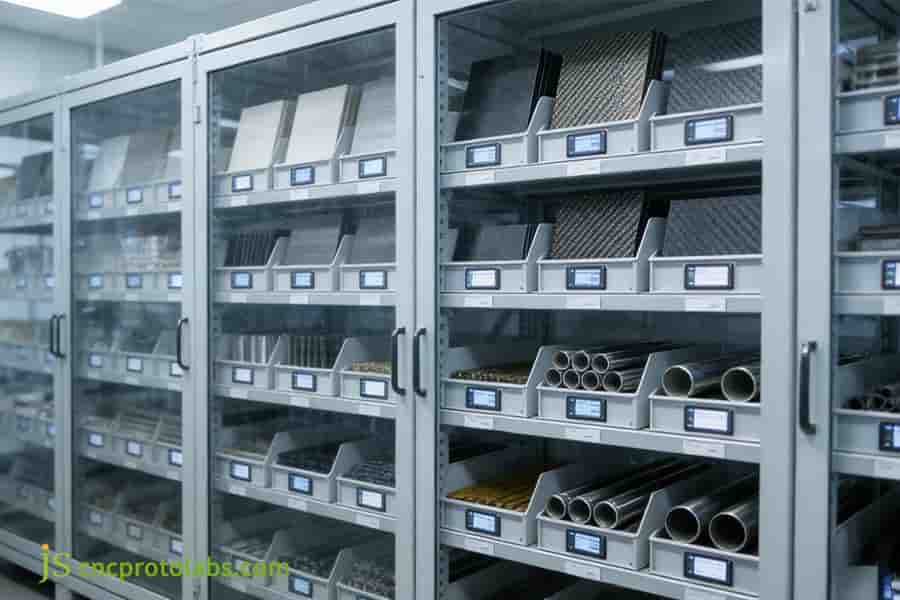
Figure 3: Various machined materials stored in a multi-drawer industrial cabinet.
What Are The Key Challenges In CNC Machining Aerospace Parts?
CNC machining aerospace parts mostly deals with three fundamental issues: processing of materials, deformation of parts, and compliance traceability, thus necessitating well thought out solutions.
Handling Difficult, to, Machine Materials
Employing liquid nitrogen cooling, aluminium titanium nitride (AlTiN), coated tools, and a low cutting rate constant feed strategy are necessary to overcome heat concentration and rapid tool wear issues when machining challenging materials like titanium alloys and high, temperature alloys.
Deformation Control of Thin, Walled and Complex Features
Residual stress in thin, walled parts (wall thickness <1mm) can be controlled effectively through simulation optimization of tooling design, layered progressive cutting, and intermediate stress release processes to ensure the accuracy of the parts after machining.
Compliance Requirements for Traceability and Data Recording
There exist definite standards for machining parameter limits for different materials and types of parts, which are required to be strictly adhered to in order to satisfy compliance requirements.
Specific parameter standards are shown in the table below.
| Material Type | Part Type | Maximum Cutting Temperature (°C) | Allowable Residual Stress (MPa) | Surface Roughness Limit (Ra/μm) | Accuracy Grade (IT) | Non-Destructive Testing Standard |
| 7075-T6 Aluminum Alloy | Fuselage Frame | 450 | ≤80 | 0.8 | IT5 | No Visible Defects |
| Ti-6Al-4V Titanium Alloy | Landing Gear | 600 | ≤50 | 0.4 | IT4 | RT Defects ≤0.1mm |
| Inconel 718 | Turbine Blades | 850 | ≤60 | 0.2 | IT3 | UT Acceptance Rate 100% |
| CFRP | Wing Structure | 300 | ≤40 | 1.0 | IT6 | No Delamination Fracture |
| 304 Stainless Steel | Avionics Bracket | 550 | ≤70 | 0.6 | IT5 | FPI No Linear Defects |
The core of compliance is establishing a digital twin archive for parts, retaining full-process data, and conforming to the SAE AS9132 process standard.
JS Precision Case Study: Breakthrough In Mass Production Of Structural Components For Electric Vertical Takeoff And Landing Vehicles (eVTOLl)
Challenge:
The 7075-T651 fuselage main load, bearing frame of a Silicon Valley eVTOL company's prototype, stage aircraft demonstrated over thin wall deformation and weight issues beyond specifications. Meanwhile, the North American supplier was unable to produce at mass, production scale due to high costs and delivery time problems.
Solution:
JS Precision put together a specialist team and presented a united CNC machining end-to-end solution to resolve the problem:
1.Collaborative Design and Process Optimization (DFM):
The engineering team changed the internal stiffener configuration of the parts, thus optimizing wall thickness and keeping the parts rigid. Some deep cavities were changed to insert structures, which greatly facilitated the machining of CNC machining aerospace parts.
2. Customized High, Speed Machining Strategy:
Develop a specialized multi axis high-speed milling (high-speed machining aerospace aluminum) tool path and vacuum fixture scheme for the large-area thin-walled characteristics of parts, effectively controlling machining deformation and keeping tolerances within ± 0.0127mm.
3. Supply Chain and Production Process Integration:
By using a mature domestic aerospace aluminum supply chain to lower raw material costs, adopting lean production processes, getting small batch rapid turnaround, and shortening production cycles.
Results:
- Part weight was effectively decreased by 15%, thus completely satisfying the flight range requirement.
- Machining pass rate was raised from 70% to 99.5%, thus rework costs were drastically reduced.
- Total project manufacturing costs were cut by around 30%, which is a saving of over $2, 000 per part.
- Mass production lead time was cut by 35% against the original plan, thus the client was able to get through the key stage reviews successfully.
If you also face challenges related to deformation, cost, or delivery time in cnc machining aerospace, submit your project requirements. JS Precision's dedicated team will customize a solution for you, quickly achieving mass production breakthroughs.
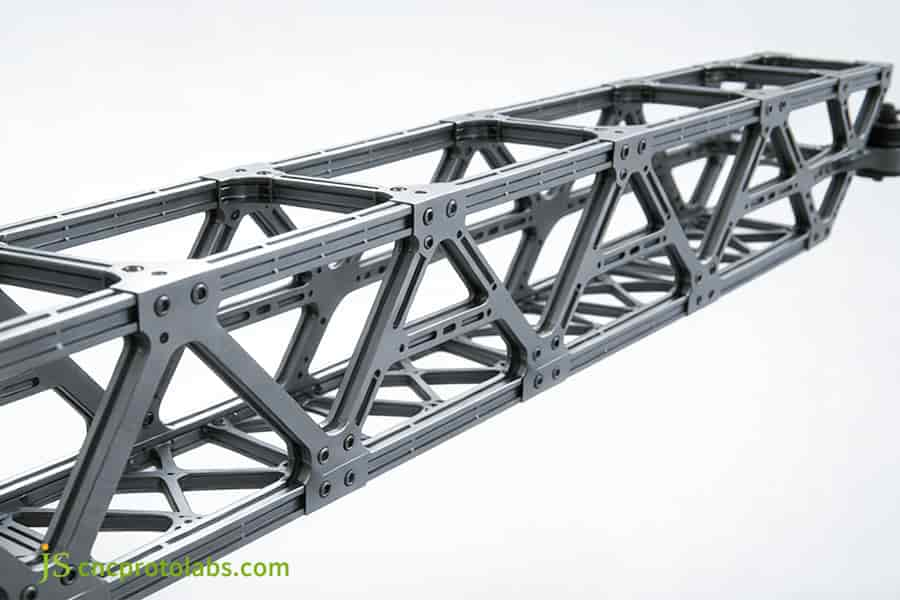
Figure 4: Close-up of a geometrically complex, silver eVTOL structural frame with bolt holes on a white background.
How To Choose a Reliable United CNC Machining Partner For Aerospace Projects?
Choosing a reliable united CNC machining partner is a key factor in the success of aerospace projects. The assessment should be more than just a look at basic machining capabilities, it should also emphasize the supplier's technical strength, compliance qualifications, and end-to-end service capabilities.
Core Competency Assessment Checklist
| Assessment Dimensions | Key Indicators | Compliance Requirements |
| Technical Equipment | 5-axis Machining Center | Equipped with 5-axis or 9-axis simultaneous machining equipment, spindle speed ≥ 20,000 RPM. |
| Technical Equipment | Inspection Equipment | Possesses high-precision CMM, surface roughness tester, and non-destructive testing equipment. |
| Certifications and Qualifications | Industry Certifications | Holds AS9100D and NADCAP certifications. |
| Certifications and Qualifications | Project Experience | Has more than 3 similar aerospace parts machining cases. |
| Quality Infrastructure | Quality System | Establishes a full-process quality traceability system and can provide FAI reports. |
| Quality Infrastructure | Personnel Capabilities | Technical team has more than 5 years of aerospace machining experience. |
Full-Process Service Capability
A top notch supplier should be capable of offering DFM feedback during the design phase to adjust the part structure and thereby, make the CNC machining process less difficult and cheaper.
On the other hand, it should possess excellent project management and supply chain coordination skills, thus, be able to integrate purchasing of raw materials, heat treatment, surface treatment, and other processes to ensure on, time delivery of the complicated projects.
Communication, Transparency, and Risk Management
A real united CNC machining partner should be considered as an addition to the client's engineering team. Regularly communicate production progress, openly share processing problems, and develop a risk contingency plan on a systematic basis, for example, by setting aside alternative suppliers and progress buffer periods to deal with different emergencies.
Want to quickly screen qualified aerospace CNC machining partners? Contact JS Precision to obtain a free "Aerospace CNC Machining Partner Evaluation Checklist" to benchmark against each item and avoid choosing the wrong supplier.
FAQs
Q1: What are the most commonly used materials for aerospace CNC machining?
Structural parts made from aluminum alloys (e.g., 7075-6061), load, bearing components made from titanium alloys (e.g., Ti-6Al-4V), and engine hot, end components made from high, temperature alloys (e.g., Inconel series).
Q2: What are the typical tolerance requirements for aerospace parts?
In general, critical dimensional tolerances lie within the range of 0.025mm to 0.076mm, with some precision fit features demanding even tighter tolerances of 0.0127mm or less.
Q3: What does AS9100 certification mean for customers?
This means that the supplier has established the highest level of quality management system in the aerospace industry, ensuring controllable production processes, traceable issues, and reliable delivery, which is the core guarantee for project risk control.
Q4: Why is five-axis machining important for aerospace parts?
Thanks to it, complex curved surface such as impeller and casing can be finished in a single setup, thus ensuring positional accuracy, reducing error accumulation, and massively cutting down delivery cycles.
Q5: What are the core advantages of high-speed machining of aluminum alloys?
They include high productivity, low cutting forces (thus less deformation of the part), great surface finish, and long tool life, resulting in the overall lowering of production costs.
Q6: How to control machining deformation of thin-walled parts?
Different methods were used such as optimizing the clamping scheme, adopting a layered milling strategy, selecting sharp special tools, and rationally planning the machining sequence. These different methods altogether effectively manage residual stress thus reducing deformation.
Q7: Can you provide complete material certification and test reports?
Certainly, JS Precision is fully committed to the AS9100 standard. Each batch of material is accompanied by an original manufacturer's certificate, and full, size inspection reports and performance test reports are also made available.
Q8: What is the typical delivery cycle from drawings to the first sample?
For typical aluminum alloy and titanium alloy parts, usually, the first sample can be delivered within 3, 4 weeks after the final drawings are received. The exact lead time depends on the complexity of the part.
Summary
Aerospace CNC machining is not just about making simple parts, rather it encompasses a complete challenge of technology, standards, and collaboration. The selection of materials, optimization of processes, quality control, and compliance management are aspects that directly impact the safety and performance of the aircraft.
It is crucial to select a partner that has full process united CNC machining capabilities as that is the main assurance of the project's success. JS Precision, with its profound technical knowledge and hands on experience, is the one to offer a safe shelter to your aerospace projects.
Contact JS Precision's aerospace expert team immediately to submit your project requirements or drawings. Allow us to utilize our vast expertise in CNC machining for aerospace and our wide array of solution capabilities to enable your creative ideas to soar.

Disclaimer
The contents of this page are for informational purposes only.JS Precision Services,there are no representations or warranties, express or implied, as to the accuracy, completeness or validity of the information. It should not be inferred that a third-party supplier or manufacturer will provide performance parameters, geometric tolerances, specific design characteristics, material quality and type or workmanship through the JS Precision Network. It's the buyer's responsibility Require parts quotation Identify specific requirements for these sections.Please contact us for more information.
JS Precision Team
JS Precision is an industry-leading company, focus on custom manufacturing solutions. We have over 20 years of experience with over 5,000 customers, and we focus on high precisionCNC machining,Sheet metal manufacturing,3D printing,Injection molding,Metal stamping,and other one-stop manufacturing services.
Our factory is equipped with over 100 state-of-the-art 5-axis machining centers, ISO 9001:2015 certified. We provide fast, efficient and high-quality manufacturing solutions to customers in more than 150 countries around the world. Whether it is small volume production or large-scale customization, we can meet your needs with the fastest delivery within 24 hours. Choose JS Precision this means selection efficiency, quality and professionalism.
To learn more, visit our website:www.cncprotolabs.com
Resource