English




CNC machining medical devices is a key manufacturing process that enables the growth of the medical implant industry today. The accuracy and cost controls of this technology have a direct impact on how effective the implants are clinically and how competitive they will be in the market.
For example, if the machining accuracy of a titanium alloy ace tabular cup is changed from ±0.01mm to ±0.005mm, the cost will go up by 35%. However, does this mean that the implant's fatigue life is really doubled?
In the face of FDA's rigorous regulations on process traceability and the requirement of centralized procurement policies which put a strain on end-user prices, how can implant manufacturers effectively balance the quality and costs of the CNC machining for medical devices supply chain?
Quick Overview of Core Answers
| Core Dimensions | Key Solutions | Value for You |
| Quality Foundation | Having an ISO 13485 system, chemical composition certification of each batch of materials, and performing 100% first-piece inspection are the main barriers for implant production. | Help ensure the process can be traced and lower the risks of FDA review issues. |
| Titanium Alloy Pain Points | The main element of titanium CNC machining is the thermal management. With micro-lubrication + adapted tool paths can increase tool life by 30%. | Lower the cost per tool for hard-to-machine materials and also improve the efficiency. |
| Cost Inflection Point | Rapid prototyping CNC machining (1-week delivery) at the prototyping stage. Swiss-type Swiss-type lathes for one-time molding in the mass production stage, decreasing overall costs by 40%. | R&D and mass production needs are perfectly matched to each other with no mold waste. |
| Supplier Selection | Suppliers with multi-axis linkage + Swiss-type lathe clusters + aseptic packaging capabilities can lower the risks related to secondary processing and logistics contamination. | Discover Chinese manufacturing partners that have vertical integration capabilities to make the supply chain simpler. |
Key Takeaways
- Accuracy Threshold: When considering fatigue strength, a thread accuracy of ±0.005mm for load-bearing implants is basically the point of no return.
- Cost Reduction in Design: An initial DFM consultation, if used for changing the non critical chamfers, may lead to a 20% decrease in the tooling costs.
- Biocompatibility: Surface roughness with Ra≤0.2µm is crucial for osteoblast adhesion.
- Batch Effect: Simply by increasing batch size from 50 to 5000 units, a 55% unit price drop can be attained due to process optimization.
Why Trust This Guide? JS Precision's Experience In Rapid Prototyping Medical Devices
CNC machining is the main technological capability of JS Precision. For over 15 years, we company has been primarily engaged in the manufacture of medical devices and, as a result, has developed deep expertise in the rapid prototyping and mass production of medical implants.
We have gathered a wealth of mature process knowledge that can be applied to different types of implants and has medical clients in more than 20 countries and regions around the world.
We are certified to ISO 13485:2016 and have successfully undergone FDA QSR compliance audits. We have helped global clients to develop more than 200 medical implant products and provide ongoing production services.
These products belong to multiple medical fields including orthopedic, dental and neurosurgery implants. Our project delivery has consistently recorded a high quality, above 99.8% project pass.
The CNC machining medical devices team that we have consists of 12 senior materials engineers, 8 process engineers and 10 dedicated quality inspectors, all of whom have more than 5 years of experience in medical implant manufacturing.
We offer a one-stop solution ranging from design optimization and process debugging to mass production and quality inspection, thus ensuring project compliance and controllability throughout the entire process.
For titanium alloy spinal implant production, JS Precision has attained critical dimension precision control of 0.005mm, along with a consistent CPK value of production at over 1.33, which is much higher than the industry standard.
One of our successful projects was the manufacturing of 4.2mm diameter spinal screws for a European customer. We handed over 1200 pieces in 3 months with the defect rate only 0.3%, which is the factor that brought us the clients long-term cooperation and recognition.
Our rapid prototyping CNC machining service provides accurate metal prototypes in 7 business days at the latest. The materials used are the ones that go into regular production.
Deviations from a prototype are kept within ±0.008mm thereby clients can carry out product fit test, assembly verification, and animal testing with the help of the prototypes. Overall, the R&D cycle can be shortened by more than 30% thanks to our prototyping services.
For over a decade, JS Precision has earned the trust of global clients through its professional technology. If you are looking for a professional CNC machining for medical industry partner, contact our engineering team immediately for free professional technical consultation and project feasibility analysis. Let our professional team solve your implant processing pain points.
Why Choose CNC Machining For Medical Implants Over Traditional Methods?
Medical implant industry relies heavily on CNC machining as the principal manufacturing technology. Its accuracy and complexity advantages are incomparable to traditional processes, and it has become the preferred method for CNC machining for medical devices.
Limitations of Traditional Craftsmanship
It's unable to meet the requirements of complex surfaces and irregular structures.
- Casting presents micro-shrinkage cavities and material inhomogeneities, thus lowering implant fatigue strength.
- Forging is hardly workable in trabecular bone structures, secondary processing is necessary and therefore low precision.
Both methods present large batch deviations that do not meet quality requirements leading to CNC machining medical projects.
Multi-axis linkage technology
5 axis linkage CNC machining for medical devices gives opportunity to finish the whole operation of complicated parts, like hip joint stems, in single clamping with positioning accuracy kept within ±0.003 mm, making the prosthetic connection trustworthy.
In mass production, its CPK value is more than 1.33, so that it effectively lessens the chance of rework and recall.
JS Precision Case Study: How To Achieve ±0.005mm Tolerance On a Spinal Screw?
Spinal screws are standard small load bearing devices used in CNC machining medical devices, and their precise manufacturing limits determine their medical applicability.
The fundamental advantages of CNC machining medical technology center on spinal screw machining, which presents its main difficulty through the three requirements of hollow design and self-tapping thread creation and deep hole drilling.
Machining accuracy requirements for miniature medical devices
The machining process for 3.5mm titanium alloy spinal screws generates the following operational obstacles.
- The hollow design needs deep hole drilling because it requires the hole to maintain straightness within 0.008mm. Traditional machining methods are prone to drill breakage and hole misalignment.
- Self tapping threads require high precision in tooth profile and surface finish. Errors in the position of the threaded bottom hole can lead to unstable tightening torque during surgery.
- The small workpiece size results in clamping instability which creates machining deformation that decreases overall machining precision.
Solution: Application of Swiss-type Swiss-type Swiss-type Lathes
JS Precision uses a Swiss-type lathe to solve its spinal screw machining problems through precision machining.
- The machine includes a specialized Φ3.5mm guide bushing which limits runout to 0.001mm while providing strong support for thin workpieces and maintaining clamping deformation below 0.002mm which results in improved clamping stability that prevents miniature workpieces from wobbling during machining.
- The machine performs all operations needed for deep hole drilling and thread milling and parting of titanium alloy screws without needing to clamp the workpiece multiple times which results in an error margin of ±0.003mm and improves process success rates to 99.8% or higher, and significantly reducing rework costs.
- The machine operates with a high-precision tool setting system which achieves repeatability accuracy of ±0.0005mm and permanent accuracy monitoring system. The system performs parameter calibration every 10 seconds which enables operators to make real-time adjustments for cutting speed and feed rate until the process accuracy reaches the required ±0.005mm tolerance.
Results
JS Precision achieved control over the threaded bottom hole of spinal screws through its Swiss-type CNC machining center which maintained positional accuracy at below ±0.005mm during surgical procedures while preventing screw breakage.
The product defect rate decreased from 5% to 0.5%, production efficiency increased by 40%, and the product passed ASTM F136 material performance testing and ISO 13485 quality system audit. The product has entered mass production and now serves customers throughout the world.
This case fully demonstrates JS Precision's strong technical capabilities in the field of CNC machining medical devices. If you have machining needs for micro-medical implants such as spinal screws, please contact our engineering team to obtain a free DFM analysis report, allowing our professional team to optimize your product design and machining process.
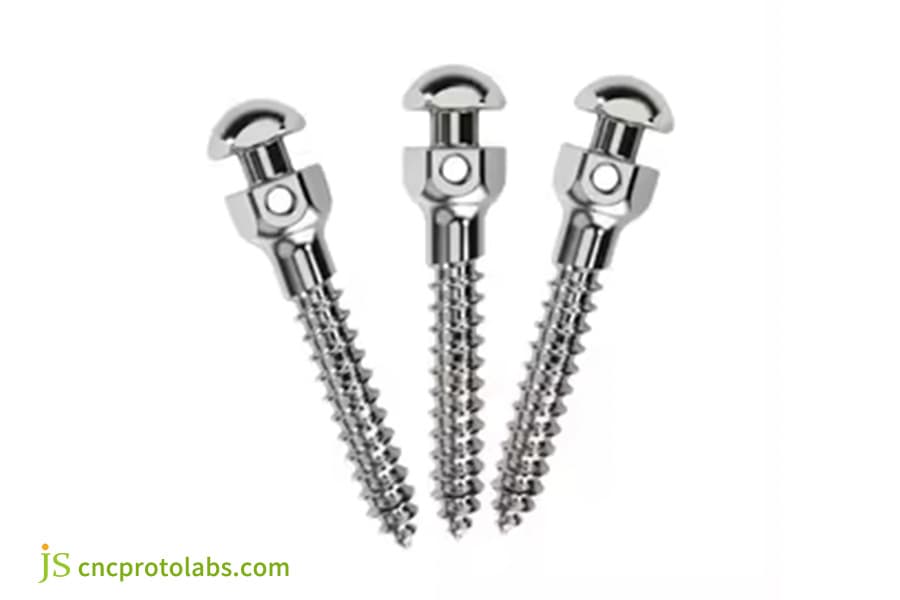
Figure 1: Three identical, finely machined titanium alloy spinal screws with rounded heads and threaded shafts, arranged standing on a white background.
What Are The Critical Standards For Titanium CNC Machining Of Implants?
Titanium CNC machining is the core of medical implant production, and Ti6Al4V, as the mainstream medical titanium alloy, has high processing difficulty. Compliance with relevant standards is a basic requirement for CNC machining for the medical industry.
Processing characteristics and challenges of titanium alloys
Ti6Al4V has poor thermal conductivity and high chemical activity, making it prone to high-temperature tool sticking and rapid tool wear during cutting. This is the core reason for the high processing cost of titanium alloy implants.
The core parameters and performance data of different specifications of Ti6Al4V titanium alloys in CNC machining are as follows, providing a precise reference for optimizing process parameters.
| Ti6Al4V Specifications | Cutting Speed (m/min) | Feed Rate (mm/r) | Depth of Cut (mm) | Tool Life (pieces) | Surface Roughness (Ra/µm) | Machining Efficiency (pieces/h) |
| Ti6Al4V (Hot-rolled) | 65 | 0.12 | 0.35 | 320 | 0.28 | 18 |
| Ti6Al4V (Cold-rolled) | 58 | 0.10 | 0.30 | 280 | 0.22 | 15 |
| Ti6Al4V ELI (Medical Grade) | 60 | 0.09 | 0.25 | 260 | 0.18 | 14 |
| Ti6Al4V (Aging-hardened) | 52 | 0.08 | 0.20 | 240 | 0.15 | 12 |
| Ti6Al4V (Forged) | 62 | 0.11 | 0.32 | 300 | 0.25 | 16 |
Case Study: Breakthrough in Thermal Management of Spinal Fixation Systems
A customer faced difficulties with tool chipping and workpiece micro-burning which occurred during long-segment titanium alloy bar production because the cooling and machining paths were not designed properly.
JS Precision introduced micro-lubrication technology and optimized the cycloidal milling path, effectively controlling the cutting temperature. Ultimately, tool life was extended by 30%, the product passed ASTM F136 testing, and machining efficiency improved by 25%.
Impact of Cooling Strategies on Cost
The cost and effectiveness of two cooling strategies in titanium CNC machining differ significantly:
| Cooling Strategy | Environmental Friendliness | Coolant Cost | Workpiece Contamination Risk | Machining Efficiency | Tool Life |
| Traditional Emulsion Cooling | Poor | High | High, easily penetrates implant micropores | Average | Short |
| Micro-Lubrication Technology | Excellent | Low | Low, no coolant residue | High | Long |
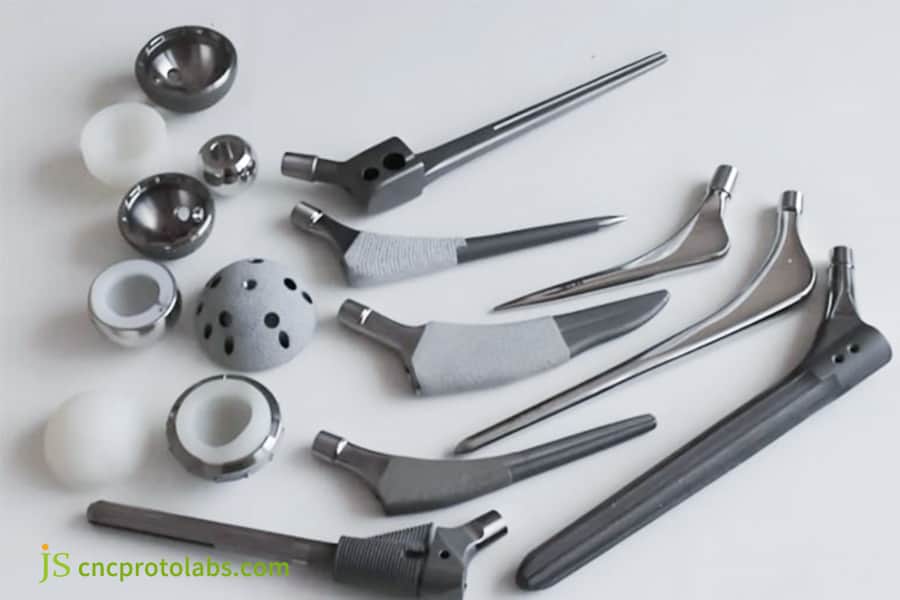
Figure 2: A collection of various precision-machined metal parts for medical devices, including screws, rods, and spherical joints, arranged on a white surface.
How Does CNC Machining For The Medical Industry Ensure Biocompatibility?
Biocompatibility serves as the main measurement standard which determines how well medical implants function. The CNC machining method establishes how well the implant will match human body requirements.
From Cutting Parameters to Surface Integrity
JS Precision conducts titanium CNC machining by implementing strict controls over cutting speed and feed rate while operating specially coated tools which protect the workpiece from micro cracks and residual tensile stress. The workpiece undergoes simultaneous stress relief treatment which maintains its material characteristics at a stable state.
Case Study: Surface Treatment of a Titanium Alloy Acetabular Cup
Rough machining of the customer's acetabular cup created burrs which restricted proper coating adhesion. We company adopted the "turning instead of grinding" process to control the roughness of key surfaces within Ra ≤ 0.2 µm, ensuring compatibility with polyethylene lining and laying the foundation for bone integration.
Cleanliness Control
Cleaning after CNC machining medicine is crucial. We company operates a specialized cleaning line which uses ultrasonic washing and high pressure water washing and vacuum drying before it packages items in a sterile workshop for protecting against contamination during transportation.
Biocompatibility is the lifeline of implants. If you would like to learn about the biocompatibility control process for your implant products during manufacturing, please refer to our medical implant manufacturing quality control case library to learn more professional quality control methods and standards.
When Should You Use Rapid Prototyping CNC Machining Vs. Full Production?
The process of medical implant development requires matching rapid prototyping CNC machining with mass production capabilities at every stage. This process proves essential because it enables better cost management and higher operational efficiency in CNC machining medical projects.
The Value of Prototyping Validation
Rapid prototyping CNC machining can deliver metal parts of the same material as mass production within one week for fit testing assembly verification and animal experiments. The process enables quick design changes while it protects research development projects from potential risks.
Case Study: Knee Implant Development
The design team for a bionic knee joint received three Ti6Al4V prototypes from JS Precision within a week after they completed their design work. The design process achieved its objectives through testing which reduced R&D costs by $50,000 while decreasing the product development time by three months.
DFM Feedback from Prototype to Mass Production
Manufacturing data which includes information about tool wear and the smallest machinable radius from the prototyping phase enables manufacturers to create better production systems while establishing quality control measures and sustaining consistent product output.
Choosing the right machining method is key to reducing R&D costs. If you are in the medical implant R&D stage and require rapid prototyping services, contact our engineering team for a quick quote on rapid prototyping CNC machining to start your product validation work as soon as possible.

How Is CNC Machining Medical Devices Driving Down Implant Costs?
CNC machining for medical devices enables manufacturers to produce highly accurate medical devices while achieving lower production expenses for medical implants. JS Precision has achieved overall cost reductions of over 40% for multiple products through process integration and material optimization.
The Value of Process Integration
Milling and turning centers and similar equipment can complete multiple processes in one operation, which eliminates process transfer errors and secondary clamping errors, while decreasing both equipment needs and labor requirements, and reducing manufacturing expenses.
Cost Optimization for Trauma Implants
Taking a trauma locking plate order as an example, JS Precision achieved significant cost reductions through process optimization:
| Machining Stage | Number of Processes | Single Piece Machining Time (mins) | Single Piece Cost (USD) | Delivery Qualification Rate |
| Before Optimization | 4 (Milling Contour, Drilling, Chamfering, Tapping) | 18 | 15 | 98% |
| After Optimization | 1 (One-Step Molding) | 9 | 9 | 100% |
Improved Material Utilization
JS Precision increased the utilization rate of titanium alloy from 15% to 25%-30% through nesting programming and an automatic bar stock feeding system, achieving significant hidden cost savings.
How To Select a Partner For CNC Machining Medical Components In China?
The process of selecting a Chinese CNC machining partner for medical components requires companies to assess three factors which will help them achieve their goals of maintaining implant quality while managing costs.
Technical Capability Assessment
The core assessment focuses on equipment configuration, material experience, and process capabilities. The supplier must provide both Swiss-type machining centers and 5 axis CNC machining centers together with complete surgical material processing solutions which include design work and production execution.
Quality System Certification
ISO 13485:2016 certification is the bottom line. The supplier needs to demonstrate their ability to provide aseptic packaging and electronic record-keeping systems which meet FDA 21 CFR Part 11 requirements in order to achieve complete process control and tracking.
Commercial Terms and Communication
The evaluation process focuses on three criteria which include whether the minimum order quantity meets R&D and mass production requirements, the availability of various payment methods, and the engineering team's proficiency in English communication combined with their ability to provide CNC machining cost estimates within a short time frame.
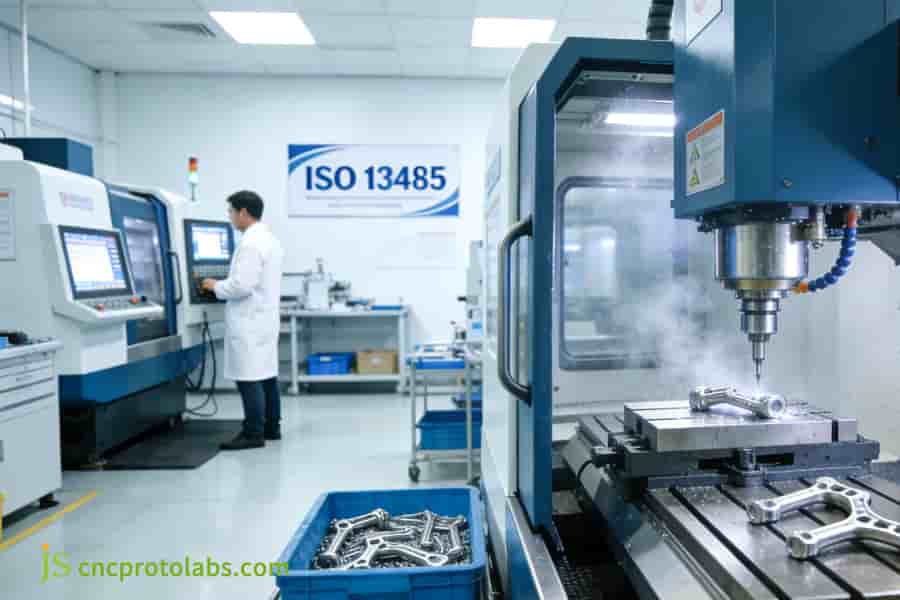
Figure 4: A technician operates a CNC machine in a workshop with an “ISO 13485” certification sign clearly visible on the wall.
FAQs
Q1: Why is CNC machining of titanium alloy implants expensive?
The core costs are concentrated in tool wear and machining efficiency. The unit cost increases because titanium alloys possess low thermal conductivity, experience strong work hardening, have limited tool lifespan, and operate at only one third of aluminum alloys machining speeds.
Q2: What does ISO 13485 certification mean for CNC machining plants?
The organization possesses a quality system which fulfills all medical device manufacturing standards needed for their complete manufacturing process from raw material acquisition to process monitoring and product tracing. The medical device supply chain requires this as a mandatory requirement for entry into its compliant pathways.
Q3:Can the materials used in rapid prototyping CNC machining beused for the final product?
Yes, they can. Mass-produced medical materials such as Ti6Al4V and PEEK can be used to ensure that the prototype testing performance is highly consistent with the final mass-produced product.
Q4: How to ensure that the surface of the machined implant will not cause thrombosis?
The key is to control surface roughness. Blood contact surfaces which require Ra levels below 0.05µm can achieve thrombosis reduction through precision grinding and polishing methods.
Q5: What is the most common cause of thread breakage in spinal screws?
Generally, it is the deep tool marks made in the thread bottom that trigger high-stress concentrations leading to breakage. Thread's fatigue strength can be significantly enhanced by using thread milling that produces smooth thread roots.
Q6: What is a Swiss-type automatic transmission machine, and why is it suitable for implantation?
This machine is a CNC with very high accuracy, which employs a guide sleeve for the twin support of material rotation and feed. The extreme rigidity it achieves makes it ideal for the making of tiny implantable devices like bone pins and screws.
Q7: What is the typical lead time? How is the transition from prototype to mass production handled?
The manufacture of the prototype takes 1-2 weeks while your entire mass production to 4-6 weeks (dependent on the volume of the order). Supplier's pre-involvement leads to tooling parallel designing thereby paving the way for even a shorter transition time.
Q8: How much lower are the CNC machining costs for Chinese suppliers compared to Europe and America?
When manufacturing costs are normal and equivalent technologies and quality are considered, China suppliers still have an edge in lower prices by 40-60% in comparison with USA and Europe. This price difference is due to wages, supply chain support, and large-scale production.
Summary
For medical implant manufacturers, quality is a must, while cost cuts to the heart of competitiveness. Discovering the golden mean between them is a matter of comprehensively optimizing materials, processes, and suppliers.
Being a professional medical CNC machining supplier, JS Precision offers one-stop solutions according to ISO 13485, which can balance the implant quality and cost control.
Contact us immediately to convert your implant design drawings into cost-effective compliant products.

Disclaimer
The contents of this page are for informational purposes only.JS Precision Services,there are no representations or warranties, express or implied, as to the accuracy, completeness or validity of the information. It should not be inferred that a third-party supplier or manufacturer will provide performance parameters, geometric tolerances, specific design characteristics, material quality and type or workmanship through the JS Precision Network. It's the buyer's responsibility Require parts quotation Identify specific requirements for these sections.Please contact us for more information.
JS Precision Team
JS Precision is an industry-leading company, focus on custom manufacturing solutions. We have over 20 years of experience with over 5,000 customers, and we focus on high precisionCNC machining,Sheet metal manufacturing,3D printing,Injection molding,Metal stamping,and other one-stop manufacturing services.
Our factory is equipped with over 100 state-of-the-art 5-axis machining centers, ISO 9001:2015 certified. We provide fast, efficient and high-quality manufacturing solutions to customers in more than 150 countries around the world. Whether it is small volume production or large-scale customization, we can meet your needs with the fastest delivery within 24 hours. Choose JS Precision this means selection efficiency, quality and professionalism.
To learn more, visit our website:www.cncprotolabs.com
Resource