English




Automotive CNC machining plays a key role in the manufacturing of automotive parts, yet quite a few buyers fail to understand the reasons behind differences in prices for the same aluminum alloy housing, fluctuations of prices in mass production, and scrap rates that are not under control.
Just to illustrate, some suppliers may quote $80/hour to machine aluminum alloy housings, and others may charge $120/hour, is it really possible for the unit price to be halved when the batch size goes up from 100 to 1000 pieces?
It's not only a game of pricing by suppliers, but a simple difference in understanding the cost structure of automotive CNC machining which causes this situation.
This article unfolds the entire cost logic of automotive parts from single-piece prototyping to mass production of millions, thus helping you comprehend pricing, choose the correct materials, and locate the appropriate suppliers.
Key Answers Overview
| Key Questions | Key Answers | Value for You |
| How to read the real cost of the CNC machining quotes for automotive parts? | Real cost = Fixed amortization + Variable costs + Hidden costs, the price curve starts to flatten after 500 pieces. | Don't fall into pricing traps and have precise budget control. |
| Why is aluminum alloy the most popular material for automotive parts? | 6061 aluminum has a machining speed of 2000, 3000 RPM, tool life of 8, 10 hours, and an overall cost 20% lower than steel. | Dramatically cutting the costs while still keeping the performance. |
| How to pick a trustworthy mass production supplier? | Check the IATF certification, SPC implementation records, and experience with similar cases, and not just the hourly rates. | Choose a long-term partner with stable delivery capabilities. |
Key Takeaways:
- Cost transparency is an essential basis for making procurement decisions:
If suppliers are asked to give a detailed account of the breakdown of their quotes (materials + labor + amortization + surface treatment), clients will be able to spot vague pricing that should be avoided.
- Aluminum is the cheapest and the most efficient material for 85% of car parts:
6061-T6 aluminum combines the best of machining efficiency and mechanical properties, so it is a good choice for housing and bracket parts.
- High quality at a large scale depends on a well, established system:
SPC process control + Cpk 1.33 + PPAP documentationform the iron triangle for stable mass production.
- Chinese suppliers have a big cost, performance advantage in the whole scope of their operations:
Having the same equipment, they manage overall costs that are 30-50% cheaper than in Europe and America, and their delivery times are more flexible.
Why Trust This Guide? JS Precision's Experience In High-Volume Manufacturing
CNC machining mass production is all about professionalism that comes from "controllable processes, calculable costs, and traceable quality", that is what makes JS Precision powerful technically and competitively, as it has been deeply engaging in automotive and industrial CNC machining for 15 years.
We focus on the high precision machining of the automotive components that are at the core of the vehicles and serve more than 200 automotive parts companies around the globe (including 12 of the world's top 20 automakers).
We have produced over 500 million CNC automotive parts comprising such core categories as engine housings and, at the same time, breaking new grounds in obtaining a standardized process library for the processing of different materials.
Our 38 five-axis machine tools are fully imported (including 12 DMG MORI CMX 1100 V ones), internally fitted with a Renishaw in-machine detection system. The accuracy of the core processes achieves ±0.005mm, a precise way of resolving the major pain points of the customers in the mass production and at the same time fully complying with IATF 16949:2016 standards.
We fine-tuned the manufacturing process of the 6061-T6 aluminum alloy valve body for a European luxury car brand. By DFM optimization, toolpath reconstruction, and automation upgrade, we shortened the cycle time for single-piece machining from 12 minutes to 7.2 minutes, cut the costs by 32%, attained a Cpk 1.33, and saved more than $2 million annually.
We also produced in bulk battery trays for a North American new energy vehicle manufacturer, implementing a full-process inspection model and reaching 18 consecutive months of zero-defect delivery.
The sequences and information presented in this handbook are all based on field practice, comply with AS9100 aerospace-grade standards, and meet ISO 230-1 machine tool accuracy standards.
Choosing a reliable CNC machining partner is crucial for successful mass production of automotive parts. Want to achieve cost reductions of 30%+ and zero-defect delivery in your automotive parts mass production project? Contact JS Precision, tell us your part material, annual usage, and tolerance requirements, and you can receive a free, customized mass production cost optimization solution.
What Is The True Hourly Rate Of Automotive CNC Machining?
The hourly rate of a CNC machine comprises of several expenses. Buyers can easily underestimate the real price if they ignore it. Variations in machinery, methods, and work in the production of automotive parts can cause rate fluctuations.
So, knowing the cost structure is the secret to keeping the costs down. More especially, it can be divided into three parts:
Undisclosed Expenses
The real hourly rate with all the hidden costs is the value of depreciation of the equipment, operating expenses, labor consumption of materials, and quality control expenditures.
For instance, a DMG MORI 5-axis CNC machine tool depreciates at a rate of around $25 per hour, and the consumable costs of aluminum parts processing are $5-8 per hour.
After optimizing the power consumption of the equipment, an auto parts factory realized an energy saving of $1500 per month on average for each 5-axis CNC machine tool, which led to the hourly rate reduction of $3-5.
Time Gaps
Automotive parts need more production hours than usual as the main parts have to be machined with tolerances ±0.01mm, thus after the processes there will be multiple steps of measuring and inspection, plus the processing of high-silicon aluminum is much more difficult. Engine housings demand 40-60% more in machining time than regular structural components.
Guidelines for Asking
Avoid general pricing traps by getting a supplier's detailed cost breakdown, you should be able to clarify core costs, verify the equipment details, negotiate testing fees, and agree on the standards of compensation for scrap rate.
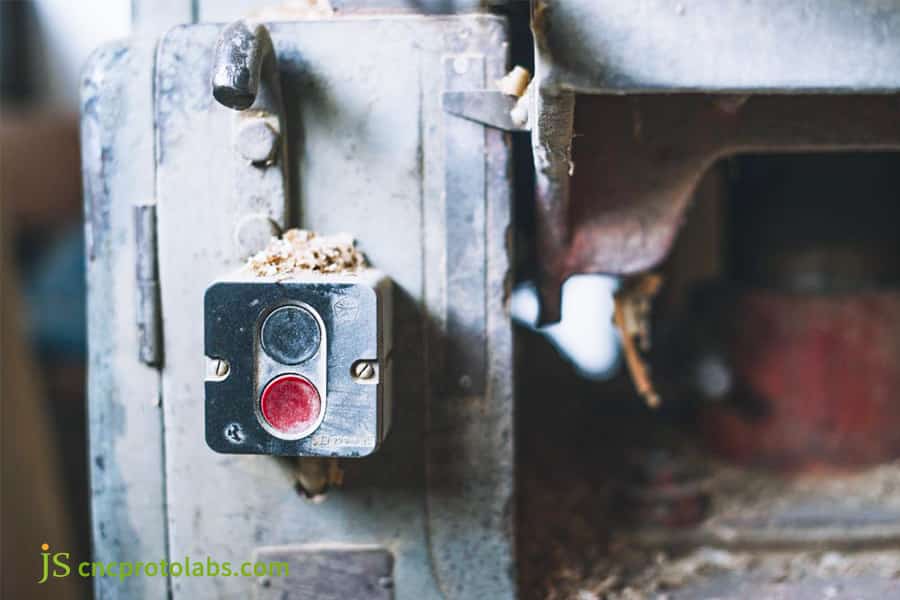
Figure 1: A close-up of a well-used CNC machine's control panel with buttons and scattered metal shavings, illustrating equipment depreciation in an industrial setting.
How To Calculate The Unit Price Of CNC Automotive Parts In High Volume?
Mass production is the core of reducing the unit price of CNC automotive parts. The non-linear decrease in unit price is determined by fixed cost amortization and variable cost. Mastering this logic can achieve optimal procurement negotiation costs.
Core Formula: Fixed Cost Amortization + Variable Costs
CNC automotive parts batch unit cost = Fixed Cost Production Volume + Unit Variable Cost.
Fixed costs are those that remain unchanged over a period of time and may include single investments such as programming and fixture design. Variable costs are those which continue to rise with production volume, the cost of high-silicon aluminum machining tools can become twice as much.
Quantitative Model: Tiered Pricing Example
For instance, the 6061-T6 aluminum alloy bracket which is widely used in the car industry, the tiered pricing of CNC automotive parts clearly shows a scale effect. Specific data is shown in the table below:
| Production Volume | Unit Price (USD) | Fixed Cost Percentage | Core Cost Reduction Reason |
| 100 pieces | 85 | 35% | High fixed cost allocation, mainly manual clamping. |
| 500 pieces | 35 | 12% | Reduced fixed cost allocation, semi-automated processing. |
| 2000 pieces | 23 | 5% | Automated production line launch, toolpath optimization. |
| 5000 pieces | 19 | 3% | Long-term raw material procurement, reduced consumable costs. |
| 10000 pieces | 15-18 | 2% | Annual framework cooperation, full-process cost optimization. |
Why Is CNC Machining Aluminum The Top Choice For Auto & Industrial Parts?
Aluminum alloys take the biggest share of the automotive parts market, over 85% of them in automotive CNC machining. CNC machining aluminum offers the best compromise in cost, efficiency, and performance, very much the like of steel and titanium alloys. In terms of both performance and cost, it is a win-win situation.
Machinability Advantages of Aluminum Alloys
The core advantage of CNC machining aluminum lies in its machinability. Taking 6061-T6 aluminum alloy as an example, the machining data compared to 4140 steel shows a significant difference, as detailed in the table below:
| Material Properties | 6061-T6 Aluminum Alloy | 4140 Steel | Titanium Alloy TC4 |
| Cutting Speed (RPM) | 2000-3000 | 800-1200 | 300-500 |
| Tool Life (hours) | 8-10 | 3-5 | 1-2 |
| Material Unit Price (USD/kg) | 5-15 | 4-10 | 45-60 |
| Machining Efficiency (pieces/hour) | 20-30 | 8-12 | 2-4 |
| Overall Machining Cost (USD/piece) | 15-20 | 20-25 | 80-100 |
CNC machining aluminum achieves 2-3 times higher output and tool life than steel chips. Processing aluminum only increases material costs slightly but reduces overall processing costs by 20% compared to steel, which is the main reason it is preferred for automotive parts.
Process Adaptation: Transition from Prototype to Mass Production
Aluminum alloys' physical properties are ideal for the entire automotive parts production process. High thermal conductivity prevents piece thermal deformation, easy chip breaking lowers material costs, and the excellent compatibility with the process allows for the same processes to be used for prototypes and mass production of core components.
Cost Trap: When Aluminiam Alloys Are Not the Right Bet
CNC machining aluminum is not a good fit for all automotive parts.
- High silicon aluminum alloy processing accelerates tool wear, requiring specialized PCD tools.
- High wear resistance at high temperatures combined with high-strength parts will still require steel or titanium alloys, where the use of aluminum brings no cost advantage.
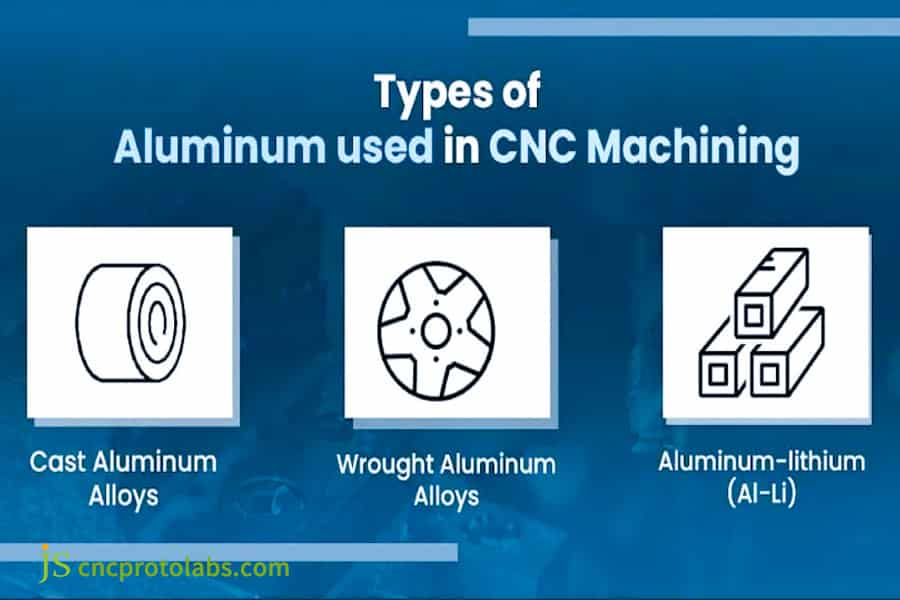
Figure 2: An infographic illustrating three key types of aluminum alloys (Cast, Wrought, Al-Li) used in CNC machining for automotive and industrial applications.
How Does CNC Machining For OEMs Differ From General Job Shops?
Generally, CNC machining for OEMs is quite different from the typical work of general machining shops. While the former is geared towards cost, efficiency, and the continuous stability of quality control in mass production, the latter really puts the spotlight on the precision of single-piece prototyping.
Process Restructuring
Local machine shops generally employ 3-axis machine tools with manual clamping for small batches, whereas OEM mass production suppliers realize automated mass production by using specialized jigs, tool optimization, and multi-axis machining. The JS Precision case study demonstrates that blending small batches can lower the processing cost by 41%.
Supply Chain Management
Besides the Just-In-Time delivery capability requirement, OEM suppliers also have to secure prices through long-term aluminum contracts, reduce inventory via batch delivery, and utilize flexible production lines for fast mode changes between different models.
Engineering Collaboration
Top-tier OEM partners typically make the first step at the design phase, by means of Design-Factoring (DFM) collaboration, to cut down costs, optimize the part design and process layout, which eventually could reduce mass production costs by 15-40%.
Looking for a CNC machining for OEMs supplier with DFM collaboration capabilities? Contact JS Precision's DFM engineering team and mention "Automotive Parts Mass Production DFM" to receive free part design optimization suggestions.
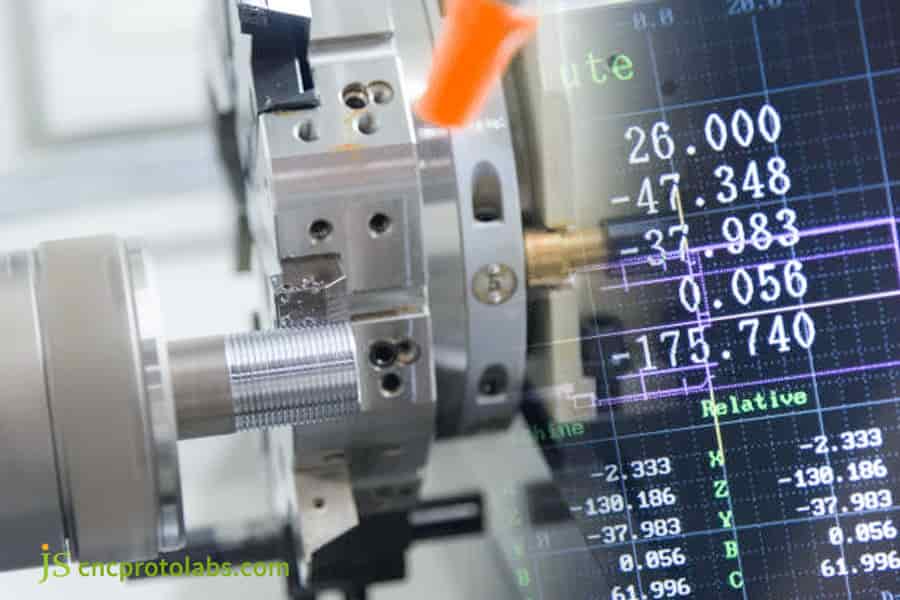
Figure 3: Close-up of CNC machining an aluminum part, overlaid with a digital display showing real-time coordinate data (e.g., X, Y, Z, B, C axes) for precision monitoring.
How To Maintain CNC Machining Certification Compliance In High-Volume Runs?
CNC machining certification is an essential requirement for the mass production of automotive parts. IATF 16949 ranks as the primary certification. Merely holding the certificate is not enough, full process compliance is required during mass production. This is exactly what quality control stability hinges on and is a major criterion for supplier selection.
IATF 16949 is Not the Endpoint but the Starting Point
To keep up with compliance in mass production, one needs to build a comprehensive "man, machine, material, method, environment, and test" process control system. One may think of it as standardizing the operation at every stage and achieving constant quality control through full-process inspection records. This is the main compliance implementation method.
Nissan's practical case is a vivid example of compliance implementation. In the case of Nissan, it is possible to guarantee zero-defect delivery of 550, 000 parts a year by doing in-machine inspection once every 20 parts and automatically updating tool compensation, which is a very effective compliance implementation method.
SPC and Process Capability Index (Cpk)
The fundamental prerequisite for the quality control of automotive parts in mass production is that Cpk should be equal to or higher than 1.33.
To achieve this, the critical dimensions should be monitored continuously, and any deviation should be immediately signaled automatically through an SPC system. The recording of data plays an important role in the traceability and hence, the guarantee of stable quality control.
Dynamic Maintenance of PPAP Documentation Packages
The PPAP documentation package is core to compliance and requires dynamic maintenance. It must be submitted and approved before mass production. Any changes during mass production require updated approval, and a complete batch record must be maintained for traceability.
Want to confirm whether your supplier truly meets CNC machining certification compliance requirements? JS Precision can provide you with a free supplier assessment checklist, including core inspection items for IATF 16949 system implementation.
What Are The Secrets To Optimizing Automotive Machine Shop Efficiency?
Efficiency optimization in an automotive machine shop plays a vital role in cutting down the expenses. Doing optimization in three dimensions, equipment, digitalization, and outsourcing strategies, can help to reduce the changes/ up the efficiency and provide the stable quality control at the same time.
1.Equipment Optimization: With the help of multi-axis and automation, milling and turning composite machines, five-axis machine tools, and automated units can do a lot to improve the efficiency and reduce the labor costs.
2.Digital Management: Using AI technologies like adaptive cutting and constant spindle temperature cooling can help to extend the tool life improve the accuracy, and through rational production scheduling, save the energy costs.
3.Outsourcing Strategy: It is advisable to base the decision on the break-even point. Outsourcing is cheaper for annual demand <5000 units, for 5000-20000 units a combination of in-house development and outsourcing is necessary, >20000 units can consider an automated production line.
Want to optimize your automotive machine shop efficiency and achieve a 30% cost reduction? JS Precision's industrial engineering team can provide you with a free shop floor efficiency diagnosis and personalized advice on equipment upgrades and outsourcing strategies.
JS Precision Case Study: Us Auto Parts Manufacturer Cuts Per-Unit Cost By 37% While Achieving Zero Defects
Project Challenges
An American auto parts manufacturer intends to mass, produce 6061-T6 aluminum alloy valve bodies, which are core hydraulic components, with an annual consumption of 80, 000 units.
The original US supplier revealed three major pain points:
- The unit price at $28.5 was too high.
- The lead time was 10-12 weeks, which failed to meet the automaker's JIT delivery requirements.
- Due to tool wear, the batch scrap rate fluctuated between 1.2% and 2.8%, and the Cpk was only 1.12, which did not satisfy the IATF 16949 requirement of Cpk 1.33.
Solution
JS Precision, a proficient auto CNC machining service provider, has created a total solution to the project troubles:
1. DFM Optimization: by changing the internal sharp corner radius of parts from R0.5mm to R2.0mm it is possible to use standard diameter tools, which increases roughing efficiency by 25% and decreases tooling costs by 30%.
2. Process Upgrade: Implementing a "precision five-axis one-time clamping + in-machine inspection" solution, which re-calibrates the cutting tool after 20 pieces automatically, and a full-process SPC system is used to keep track of the key dimensions and to guarantee Cpk 1.33.
3. Supply Chain Integration: Southwest Aluminum and us have signed a long-term procurement agreement which has brought 6061-T6 aluminum alloy sheets at 22% cheaper price than that of the US market, besides higher batch stability.
4. Post-processing Collaboration: The anodizing process is performed at an external supplier who is a long-term partner and has a dedicated quality agreement with us. Yield rate is stable at over 98.5% and delivery time is managed in a unified manner.
Project Outcomes
The three key outcomes of the project through end-to-end optimization were:
- The cost per aluminum alloy valve body was lowered to $17.9, which was 37.2% cheaper than the previous cost.
- Process capability Cpk went up from 1.12 to 1.42, which is good for the quality control of mass production of automotive parts.
- Over a period of 12 months 96, 000 units were delivered defect-free, the delivery time was shortened to 5-6 weeks (including sea freight) and thus, the JIT delivery requirements of automakers were fulfilled.
Want to replicate this success in your automotive parts mass production project, achieving cost reduction, efficiency improvement, and zero-defect delivery? Call JS Precision's mass production project hotline now, tell them your part requirements, and you can get a free project feasibility analysis report.
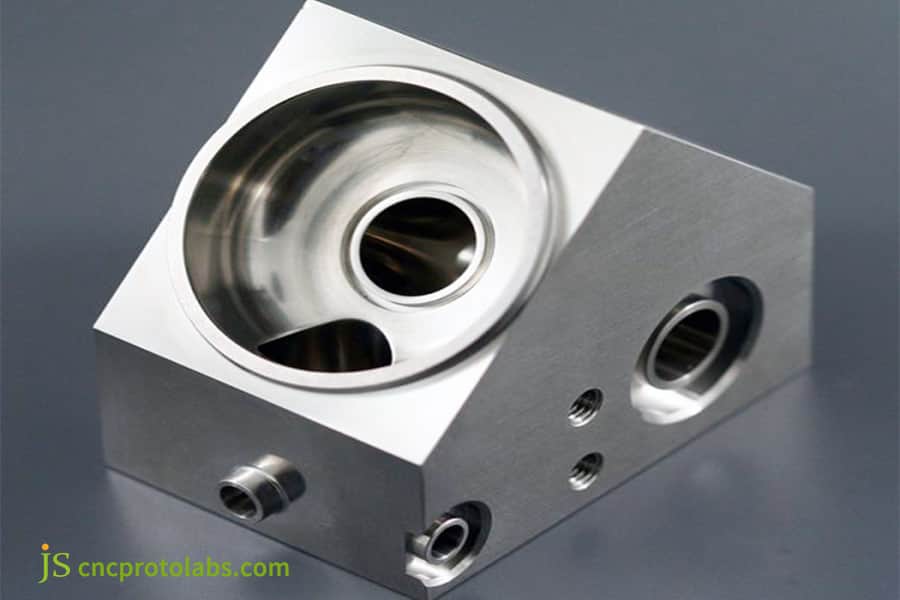
Figure 4: A close-up of a complex, high-quality aluminum automotive part with a smooth finish, showcasing the result of precision CNC turning.
FAQs
Q1: What's the typical range of hourly rates for CNC machining of automotive parts?
The hourly rates of automotive CNC machining suppliers in China are mostly between $40-80, in Europe and America $80-150, and for premium five-axis machines, the rates can even go up to $200-400, the main factors being the equipment precision and the complexity of the process.
Q2: How big of a c ost difference is machining aluminum alloys compared to steel?
In total, the cost of machining aluminum through CNC is about 15-20% less than steel. The price per unit of aluminum alloy is a little bit higher, however, the tool life is 2-3 times that of steel, thus the overall cost advantage is quite substantial.
Q3: What is the quantity for a large batch? How much of a discount can we expect?
CNC automotive parts generally initiate automated machining when the batch size hits 2000 or more pieces. The unit price of 100 pieces in a small batch can be 60-70% higher than that of a large batch. The more you produce, the bigger the discount you get.
Q4: Can suppliers with IATF 16949 certification be trusted all the time?
IATF 16949 certification is one of the requirements for automotive CNC machining suppliers. Besides that, their SPC implementation records, gauge calibration system, and PPAP document capabilities also need to be checked for the reliability of them.
Q5: Does the programming fee have to be paid at the sample stage?
A programming fee of $200-$500 per iteration is typically charged for CNC machining of automotive parts during the prototype stage. If mass production is later decided, professional suppliers generally refund or deduct this fee from the mass production payment.
Q6: Why should we choose Chinese CNC machining suppliers?
Most Chinese CNC machining suppliers rely on imported machine tools, such as DMG MORI, and their equipment levels are given standard with international standards. Labor and fixed costs are lower, therefore resulting in the overall costs 30-50% lower than in Europe and America, plus more flexible delivery time.
Q7: Is it necessary to have special tools to work on aluminum alloys?
CNC machining of aluminum usually uses polished groove-shaped, sharp-edged carbide tools. For mass production, it is better to use PCD tools since their lifetime is 20 times longer than that of carbide tools.
Q8: What is the process if the design needs modification?
If the design of CNC automotive parts needs modification, after providing updated drawings, the supplier's engineering team will conduct a Design for Manufacturing (DFM) assessment, providing feedback on the impact on cost and delivery time. This can be completed within 24-48 hours.
Summary
Deciding on CNC machining for automotive parts mass production is a business decision that weighs precision against cost. The key to competitive advantage is in the intricate details of price breakdown, material selection, process optimization, and system management.
Learning about hourly rate structure, opting for the right aluminum alloy solution, and selecting the most suitable OEM supplier can lead to cost-cutting, efficiency enhancement, and defect-free delivery.
If you need a trustworthy auto CNC machining partner, just bring us your drawings and estimated annual usage to check our services, JS Precision's engineering team will give you a tailored cost breakdown solution for automotive and industrial applications within 24 hours, thus assisting you in becoming more competitive in the global supply chain.
Are you prepared for your next mass production project? [Contact us/Get a free quote] to get a tailor-made cost breakdown solution and DFM optimization recommendations.

Disclaimer
The contents of this page are for informational purposes only.JS Precision Services,there are no representations or warranties, express or implied, as to the accuracy, completeness or validity of the information. It should not be inferred that a third-party supplier or manufacturer will provide performance parameters, geometric tolerances, specific design characteristics, material quality and type or workmanship through the JS Precision Network. It's the buyer's responsibility Require parts quotation Identify specific requirements for these sections.Please contact us for more information.
JS Precision Team
JS Precision is an industry-leading company, focus on custom manufacturing solutions. We have over 20 years of experience with over 5,000 customers, and we focus on high precisionCNC machining,Sheet metal manufacturing,3D printing,Injection molding,Metal stamping,and other one-stop manufacturing services.
Our factory is equipped with over 100 state-of-the-art 5-axis machining centers, ISO 9001:2015 certified. We provide fast, efficient and high-quality manufacturing solutions to customers in more than 150 countries around the world. Whether it is small volume production or large-scale customization, we can meet your needs with the fastest delivery within 24 hours. Choose JS Precision this means selection efficiency, quality and professionalism.
To learn more, visit our website:www.cncprotolabs.com
Resource