English




Aluminum CNC machining is a fundamental process in the production of high-precision parts. At the same time, it has also brought great difficulties to many engineers in the production process.
Have you ever come across situations in which aluminum alloy parts have been properly sampled in the production process but have frequently deformed or been out of tolerance in the process of mass production?
Have you ever been in a dilemma in deciding whether to use 6061 or 7075 materials in the production process because of the high cost of scrap that may result from a wrong choice?
There is no fundamental difference between CNC machining and ordinary cutting. From the release of internal stress to the formation of built-up edge, all the details in the process will have a direct impact on product quality and production costs.
In this article, there will be an in-depth analysis of the technical logic and cost control in aluminum CNC machining.
Quick Overview of Core Answers
| Core Questions | Key Solutions | Value Brought to You |
| Balancing Precision, Cost, and Material Selection | The key is understanding material properties of aluminum CNC machining. There is an 80% difference in material strength between 6061 and 7075 aluminum grades. DFM is also applied here. | The entire process of mastering decision-making will save you from incurring more than 30% of extra costs because of wrong material selection and design. |
| Technical Pitfalls in Aluminum Machining | The key challenges are built-up edge, burrs, and stress deformation, which must be resolved during tool selection and parameter optimization as well as stress relief treatment. | Identifying technical risk will ensure consistency and stability of parts in mass production. |
| Choosing Chinese Suppliers | The supply chain cluster is already mature in China, which will allow comprehensive cost advantages and iteration capabilities beyond aluminum CNC machining Vietnam and other places. | Obtain a global supply chain partner that combines price competitiveness and technological depth. |
Key Takeaways
- Material defines the upper limit: The material strength of 7075 exceeds that of 6061 by 80%, but it has poor weldability and costs 2-3 times as much. The selection of material entails precise trade-offs depending on working conditions.
- Tolerance = cost: Marking non-critical dimensions with a tolerance of ±0.1mm instead of ±0.01mm can decrease the scrap rate and inspection time by 15-25%.
- Controllable deformation: Stress relieving (heat treatment) after rough machining of high strength aluminum is critical to ensuring that the flatness of large thin walled parts is ≤0.1mm.
- Collaboration with the supply chain: Selecting a Chinese partner with DFM capabilities can decrease the prototype to mass production cycle by more than 30%.
Why Trust This Guide? JS Precision's Experience In Aluminum CNC Machining
Technical expertise is very much supported by deep industry experience in CNC machining. JS Precision is an experienced aluminum CNC machining company for over 15 years. We have been supporting more than 300 high end manufacturing companies globally, especially in aerospace, robotics, precision electronics, and other industries.
We have produced more than 1 million high precision aluminum parts and have helped in solving over 50 common problems of the industry, like the machining deformation of 7075 thin-walled parts and the machining precision hole systems of 6061.
Core engineers of JS Precision have all been involved in CNC machining aluminum with their hands for more than 10 years, so they have a very full understanding of the nature of different grades of aluminum and their process parameter optimization.
The technical points mentioned in this guide have been checked during manufacturers' actual production, and therefore they are aligned with the ISO 9001:2015 quality management system and aluminum processing standards. The process parameters and solutions that have been shared are totally based on JS Precision's large, scale manufacturing experience.
To illustrate, in the case of 7075 aluminum's residual stress deformation, our "roughing + cryogenic stress relief + finishing" method has been implemented in more than 20 aerospace parts projects, with the deformation being precisely controlled within 0.05mm every time.
In the case of 6061 aluminum's built up edge issue, the cutting speed optimized at 14000 rpm + adjusted feed parameters of 90 mm/min have led to a very stable surface roughness of Ra below 0.8 μm.
We deeply understand the stringent requirements of high end manufacturing in terms of precision, delivery time, and cost. We reject theoretical technical discussions, all content is focused on mass production implementation.
Want to verify our aluminum CNC machining technical capabilities? Submit your 3D part drawings now, and JS Precision's engineering team will provide you with a free process feasibility analysis and preliminary cost calculation within 24 hours, letting professional data answer your questions.
Why Choose Aluminum CNC Machining Over Other Processes?
Knowing other manufacturing processes, you can figure out ways to reduce the cost, thus the aluminum fabrication can be selected more appropriately, and the benefits of CNC machining become clearer.
Laser Cutting vs. CNC: Which One Should You Choose?
Laser cutting fits very well with thin sheet parts (e.g. fast speed, heat affected zone <0.1mm), great for quick blanking and outer contour forming.
On the other hand, for complicated features like threads and countersunk holes, aluminum CNC machining is the core process without a substitute, guaranteeing higher precision and functionality.
3D Printing vs. CNC: Geometrical Complexity and Functionality
3D printing is the excellent choice for complex lattice structures, however, the surface roughness is only Ra 6.3-12.5μm.If you look for really good surface quality (Aluminum CNC machining can bring surface finish Ra below 0.8μm) and top mechanical properties, CNC machining is the winner in precision, cost as well as efficiency.
Waterjet Cutting: A Cold Alternative
Waterjet cutting is a good choice for heat, sensitive materials of more than 100mm thickness, however, it possesses high operating costs and is slow. High precision mating parts still need to be CNC finished after aluminum fabrication initially.
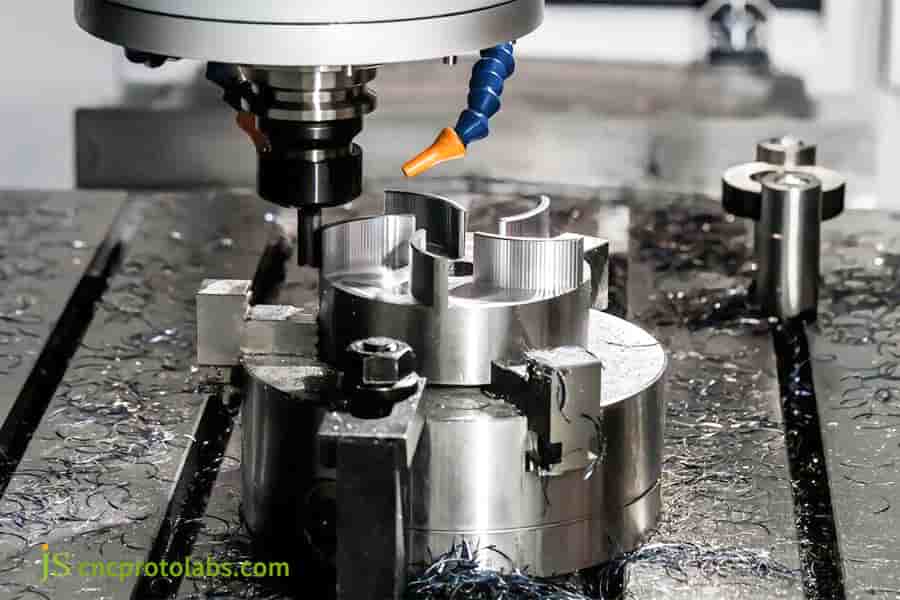
Figure 1: Close-up of a CNC milling machine cutting a cylindrical aluminum workpiece with coolant spray.
What Challenges Arise During CNC Machining Aluminum (And How To Solve Them)?
Though aluminum is quite an easy material to machine, there are a few pitfalls. Familiarity with these fundamental challenges of CNC machining aluminum will enable you to avoid quality issues right from the source.
Challenge 1: Built Up Edge (BUE) and Poor Surface Finish
- Problem: Aluminum has a high viscosity, and a high speed cutting will easily result in the formation of a built up edge that will cause surface roughness to deteriorate to Ra 3.2μm and above.
- Solutions: Employ a large rake angle tool and high pressure coolant, along with cutting parameters of 14000 rpm and 90 mm/min to guarantee rapid chip removal.
Challenge 2: Burr Formation at Edges and Cross Holes
- Problem: Generation of burrs is inevitable when thin walls and cross holes are machined, the feed rate impacts burr size to a greater extent.
- Solution: A climb milling strategy should be undertaken where an "entry feed" technique is used for burr prone areas, and this should be combined with post processing to perfectly cleanse the parts of burrs.
Challenge 3: Stress Deformation in High Strength Alloys
- Problem: Upon finish machining 7075 aluminum, residual stress redistributes, and the deformation of flat parts can go beyond 0.5 mm.
- Solution: The "roughing + stress relief + finishing" method can be used to make sure that the deformation remains under control and does not exceed 0.05 mm.
Worried about encountering the above technical pitfalls in your CNC machining aluminum project? Contact JS Precision immediately to obtain a free "Aluminum CNC Machining Risk Avoidance Checklist" to proactively manage production and ensure product quality.
How Can You Reduce Costs Through Smart Aluminum Fabrication Design?
During the design phase, around 70% of the part costs are determined. By optimizing the aluminium fabrication design through DFM can drastically decrease the price of aluminium CNC machining service.
Simplify Complex Geometries
- Do not use internal fillets <0.5mm. It is suggested to use the standard radii like R3 and R4 to reduce the wear of the dedicated tools and thus, the machining time will be short accordingly.
- Do not use narrow grooves with a depth to width ratio >6:1. These shapes, by nature, cause the difficulty of machining to be increased exponentially, thus the cost will also be high.
Tolerances and Profit Margins
Basically, you need to know which are the critical surfaces and which are not. One of the ways of reducing the scrap rate by 20% is by allowing non critical surface tolerance to be raised from ±0.01mm to ±0.1mm, thus aluminum fabrication cost structure can be optimized as well.
Standardize Hole Sizes and Threads
Standardize the specifications of threaded holes and through holes to lessen the number of changes in tools, increase the efficiency of mass production, and lower the time cost of aluminum CNC machining service.
Which Aluminum Alloy Is Right For Your Aluminum CNC Machining Parts?
Choosing the appropriate aluminum alloy is the key to the success of aluminum CNC machining parts. The following is a review of the main features of the most popular grades, in accordance with the ISO 286-1 international standard.
Table of Mainstream Aluminum Alloy Properties and Machining Characteristics
| Alloy Grade | Yield Strength (MPa) | Corrosion Resistance | Machinability | Cost (relative to 6061) | Applicable Scenarios |
| 6061-T6 | 270 | Excellent | Excellent | 1.0 | Brackets, housings, body panels |
| 6061-T651 | 265 | Excellent | Excellent | 1.1 | High-flatness thick plate parts |
| 7075-T6 | 490 | Medium | Medium | 2.5 | Aerospace structural parts, high-stress robotic arms |
| 7075-T651 | 480 | Medium | Medium | 2.7 | High-precision, high-strength thin-walled parts |
| 5052-H32 | 140 | Excellent | Good | 0.9 | Electronic housings, fuel tanks, formed parts |
- 6061-T6: The Versatile Workhorse
6061-T6 is the aluminum grade that is most frequently used for CNC machining. With its combination of strength, resistance to corrosion, and ease of machining, it is the go to material for most aluminum CNC machining applications.
- 7075-T6: The High Strength Choice
7075-T6 once has a yield strength 80% higher than 6061 but its price is 2-3 times higher and welding is difficult. It is the right material for top notch aluminum CNC machining parts.
- 5052-H32: The Ideal for Formed Parts
5052-H32 plasticity is excellent, as well as the resistance to corrosion, also, it does not crack after forming. It is a good fit for aluminum CNC machining parts that are bent and stretched.
- The Importance of Temper (T6 vs. T651)
T651 is stress relieved.If you want a very flat surface and the aluminum plate is thick, go for T651 otherwise, after CNC machining aluminum you gamble a lot if the deformation returns.
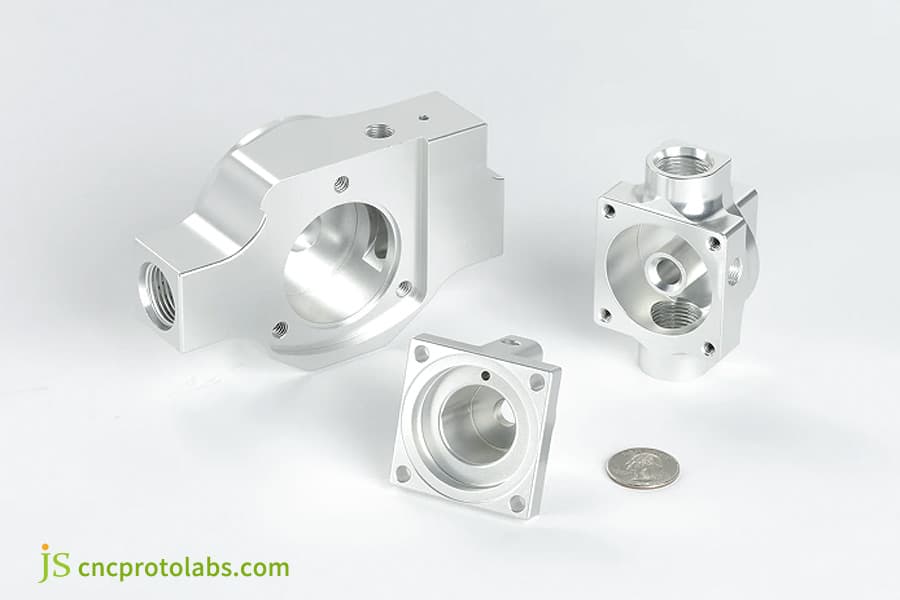
Figure 2: Three silver machined aluminum parts with different designs and holes, photographed with a coin for scale.
How Does CNC Machining Aluminum Compare To Stainless Steel CNC Machining?
Comparing the core characteristics of aluminum CNC machining and stainless steel CNC machining can help you make accurate material selection decisions.
Comparison Table of Core Parameters for CNC Machining of Aluminum and Stainless Steel
| Comparison Dimensions | 6061-T6 Aluminum | 304 Stainless Steel |
| Cutting Speed | 1500-2000 m/min | 300-500 m/min |
| Tool Wear Rate | Low | High |
| Part Machining Cost ($/piece) | 30-80 | 60-200 |
| Density (g/cm³) | 2.7 | 7.9 |
| Thermal Conductivity (W/m·K) | 167 | 16.2 |
| Corrosion Resistance | Good (Oxide Layer Protection) | Excellent (Chromium Passivation Layer) |
Machinability and Cost: A Direct Showdown
Aluminum CNC machining has a cutting speed 3-5 times faster than stainless steel CNC machining, with less tool wear. The cost of small parts is $30-80 per piece, far lower than the cost of stainless steel machining.
Physical Properties: Weight vs. Strength
- Aluminum CNC machining substrates are lightweight and have good thermal conductivity, thus, they are heat dissipation components.
- Stainless steel CNC machining substrates are corrosion resistant and wear resistant, thus they can be used as protective covers in the harsh environment.
Decision Tree: Making the Right Choice
- Stainless steel CNC machining is the material of choice when the environment is extremely hot and highly corrosive.
- Aluminum CNC machining, on the other hand, is the best choice when the application requires low weight, low cost, and high efficiency.
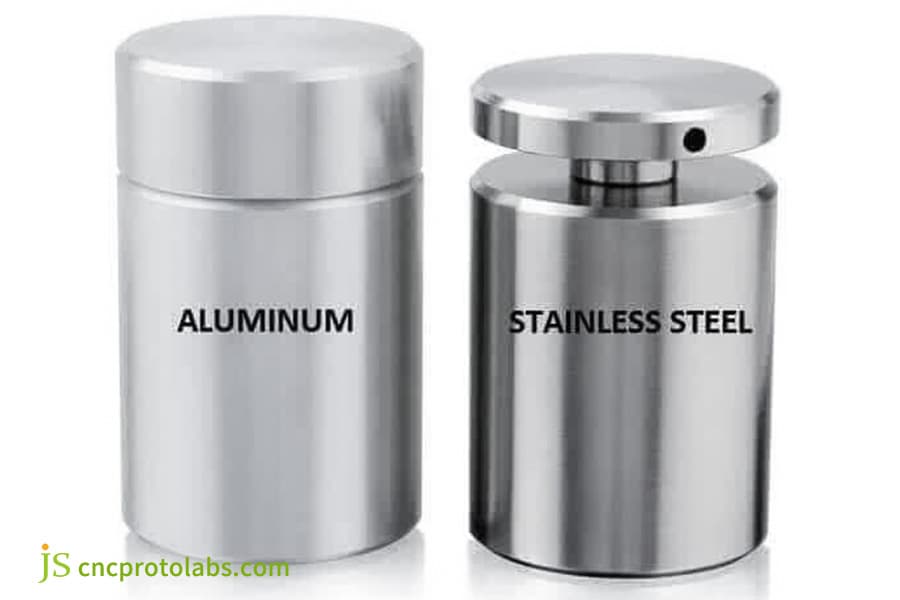
Figure 3: Two labeled metal cans, one “ALUMINUM” and one “STAINLESS STEEL,” for a direct visual material comparison.
Case Study: JS Precision Solves The Difficulty Of Multi-Variety, Small-Batch Processing For a German Robotics Company
Challenge
A German industrial robot company was working on a lightweight arm (600mm x 150mm x 100mm) made of 7075-T6 for a new collaborative robot. The original European component supplier had a lead time of 8-10 weeks.
From a demand perspective of 20 pieces/batch, three variations, and multiple varieties in small batches, the aluminum CNC machining service was not only very costly but also could not overcome the issue of deformation during thin walled machining. The flatness deviation of the first batch of prototypes went over the tolerance by 0.3mm.
Solution
After the involvement of JS Precision, the processing solution was restructured from three aspects: materials, processes, and fixtures.
1.Material Optimization:
Keeping the material requirements of 7075-T6 (yield strength 490MPa), the blank was changed to T651 stress relief thick plate.
The test result indicated that this cutting down the internal stress of the substrate by more than 65%, thus, the risk of deformation after machining was decreased from the very source, and a basis was set for further precision machining.
2.Process Restructuring:
A four step process of "rough machining + cryogenic stress relief + semi finishing + finishing" is adopted, where the cryogenic treatment is 2 hours at -196°C to completely release cutting stress, thereby keeping residual stress below 50MPa and ensuring machining stability.
3.Fixture Design:
Tailor made pneumatic flexible fixtures that can be positioned in the range of ±0.008mm, thus allowing a changeover to be done very quickly in fact, within 15 minutes.
Single part clamping time has been brought down from 45 minutes to 8 minutes, thus the single batch processing efficiency goes up by 78%, which is compatible with the multi variety, small batch mode of production.
Results
The final part flatness is always kept within 0.05mm, which is in line with the customer assembly requirements, the total procurement costs (including logistics) are lower by 42% vis European suppliers, the delivery times of bulk orders are always within 4 weeks with the fastest sample delivery being only 7 days, thus the customer's supply chain agility is greatly enhanced.
Want to optimize both quality and cost in your aluminum CNC machining project? View more industry case studies from JS Precision to learn how we solve various CNC machining aluminum production challenges and provide reference for your project.
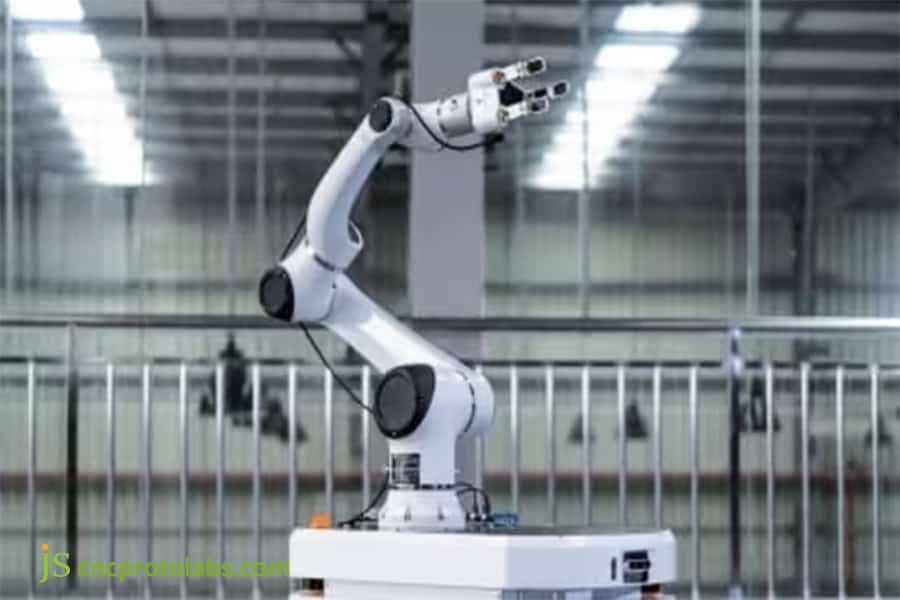
Figure 4: A white, multi-joint robotic arm with a thin-walled structure mounted on a base in an industrial setting.
How To Evaluate a Reliable Aluminum CNC Machining Service Provider?
Choosing a provider of aluminum CNC machining services basically boils down to checking how well they can work out difficult problems. Here are some main points for consideration:
Beyond ISO: Assessing Technical Infrastructure
- Machine & Tools: Check if there is a 4+1/5 axis machining center and tool management system that can handle complex aluminum CNC machining services.
- Quality Control: To what extent are they equipped with a coordinate measuring machine (CMM), can they provide a key parameter testing report, and do they have the capability to continuously monitor CPK 1.33?
The Test Piece: Let the Part Speak
A test piece with 0.8mm thin walls, a 5:1 deep cavity, and ±0.01mm pin holes is a great way of directly verifying whether the aluminum deformation problem was effectively solved by the CNC machining provider.
Why JS Precision (China) Over Aluminum CNC Machining in Vietnam or Others?
China has a complete CNC industry chain, and JS Precision not only has a price advantage, but also provides seamless communication, 24-hour sample iteration, and one-stop aluminum CNC machining service delivery, far exceeding the service response and delivery capabilities of aluminum CNC machining vietnam.
Looking for a reliable aluminum CNC machining parts provider? Schedule a factory visit with JS Precision to learn about our processing equipment, quality control system, and production capacity firsthand, experiencing professional CNC machining aluminum services.
FAQs
Q1: What levels of tolerance can aluminum CNC machining hit?
Generally, standard machining tolerances for aluminum CNC machining can be as fine as ±0.05mm. If state of the art equipment is used along with process optimization, machining tolerances can be controlled to an accuracy of ±0.005mm, thus satisfying the requirements of high end manufacturing.
Q2: Which aluminum alloy is more suitable for CNC machining, 6061 or 7075?
Due to its softer nature, lower viscosity, reduced tool wear, and easier process changes, 6061 aluminum is much more favorable for CNC machining. In contrast, 7075 aluminum, which features a higher strength, calls for more cutting edge tools and machining methods.
Q3: What step should be taken to eliminate deformation of aluminum alloy parts after machining?
Stress relief is considered an essential part when it comes to preventing the deformation of aluminum alloy parts after machining. High strength aluminum materials such as 7075 demand a treatment involving rough machining + stress relief heat treatment + finish machining.
Q4: What are the choices of surface treatment for machined aluminum parts?
The chief surface treatment method for CNC machined aluminum parts is anodizing (divided into decorative and hard types). You can also choose from sandblasting, wire drawing, and chemical passivation.
Q5: What is the maximum size of workpiece you can handle?
JS Precision has a wide variety of CNC machining centers at its disposal. Therefore, we can manufacture aluminum CNC machining parts from tiny components up to large structural parts with dimensions of 2000mm×1000mm.
Q6: How soon can you provide samples?
JS Precision usually sends out samples of standard aluminum CNC machining parts within 7-15 working days after getting 3D files and process confirmation. Fast delivery can be as quick as 7 days.
Q7: Why do colors differ after anodizing?
Color variations in anodized aluminum components depend on the base material type and batch. 6061 shows color uniformity to a greater extent. JS Precision is capable of providing color matching swatches to ensure batch to batch color continuity.
Q8: Would it be possible for you to help me with design optimization to lower costs?
JS Precision engineering team is at your disposal for a complimentary DFM review of aluminum CNC machining parts designs. We focus on feature optimization and tolerance adjustment to lower the cost of manufacturing without compromising on the functionality of the parts.
Summary
The success of aluminum CNC machining largely depends on the interplay of materials, processes, and the supply chain. Selecting the suitable materials, redesigning for better efficiency, and partnering with the right players are essential to reach both super precision and budget friendly outcomes.
JS Precision, with its aluminum CNC machining exposure of more than 15 years, is capable of solving any aluminum CNC machining problems.
Just send your 2D/3D drawings over to us, and one of our engineering teams will, within 24 hours, do a technical evaluation and give you a very competitively priced offer with DFM optimization recommendations. Through our expertise, we can help the realization of your inventive design into dependable and accurate aluminum parts.

Disclaimer
The contents of this page are for informational purposes only.JS Precision Services,there are no representations or warranties, express or implied, as to the accuracy, completeness or validity of the information. It should not be inferred that a third-party supplier or manufacturer will provide performance parameters, geometric tolerances, specific design characteristics, material quality and type or workmanship through the JS Precision Network. It's the buyer's responsibility Require parts quotation Identify specific requirements for these sections.Please contact us for more information.
JS Precision Team
JS Precision is an industry-leading company, focus on custom manufacturing solutions. We have over 20 years of experience with over 5,000 customers, and we focus on high precisionCNC machining,Sheet metal manufacturing,3D printing,Injection molding,Metal stamping,and other one-stop manufacturing services.
Our factory is equipped with over 100 state-of-the-art 5-axis machining centers, ISO 9001:2015 certified. We provide fast, efficient and high-quality manufacturing solutions to customers in more than 150 countries around the world. Whether it is small volume production or large-scale customization, we can meet your needs with the fastest delivery within 24 hours. Choose JS Precision this means selection efficiency, quality and professionalism.
To learn more, visit our website:www.cncprotolabs.com
Resource