English



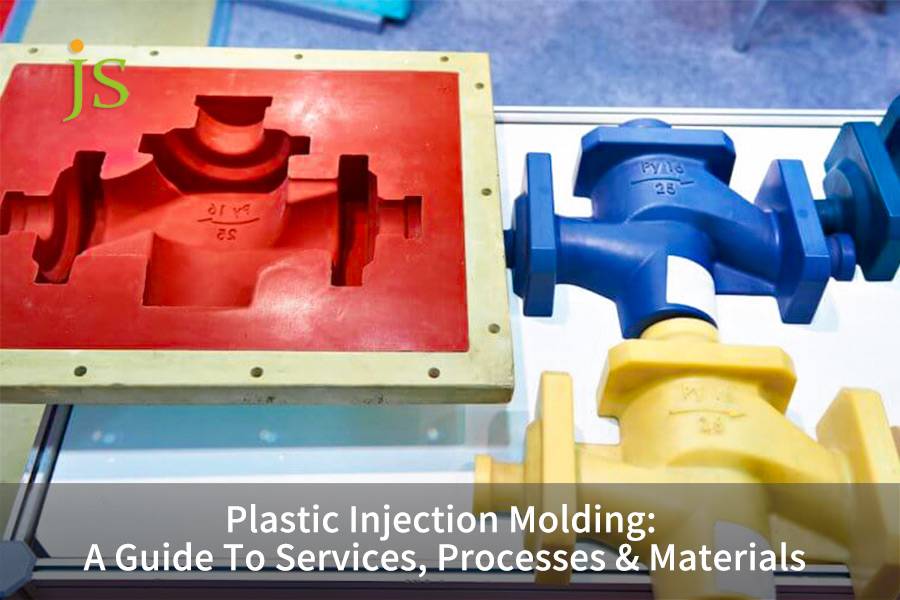

Plastic injection molding is really at the heart of today's plastics manufacturing, in fact, most everyday plastic products you see or use come from this very technique. It combines accuracy in control, the knowledge of materials, and the art of designing industrially.
This article is a roadmap to help you grasp the whole plastic injection molding process, giving you enough technical information to aid a project decision. JS Precision has an injection molding solution under one roof.
Core Answer Summary
| Core Questions | Key Answers | Value for You |
| How does injection molding work? | Molten plastic is injected into a mold under high pressure, held under pressure, cooled, and then ejected. It involves five core steps. | Understanding the process logic ensures seamless design and production, preventing cost overruns. |
| How to choose the right material? | Match materials to product function, different materials are suitable for different usage scenarios. | Matching materials to requirements ensures product performance and controls costs. |
| Why is injection molding suitable for mass production? | Lower unit price after mold cost amortization, consistent product tolerances, and high production efficiency. | Achieve economies of scale, maximize profits, and quickly recover investment. |
| How to choose an injection mold? | Select mold type according to production scale, material determines mold lifespan. | Balance investment and efficiency to reduce overall production costs. |
Key Takeaways
- Molds are the backbone of plastic injection molding:
A top quality steel mold that has been precision hardened can produce more than a million units before it needs replacement, so ROI (return on investment) goes up drastically with bigger production volume.
- Materials determine the performance ceiling of plastic injection molding products:
Each of PP ABS PC, and other materials has its own pros, selecting the wrong material can be one of the main reasons for product failure.
- Speed of cooling is the decisive factor for profit making in plastic injection molding:
An effective cooling layout can reduce the molding cycle by a healthy 30% or even more, which is a direct example that production profits are increased.
- Choosing a supplier is even more critical than a single piece of equipment:
Partners with both mold engineering capabilities and system certifications such as ISO 13485/IATF 16949 are the key to the long term success of plastic injection molding projects.
Why Trust This Guide? JS Precision's Experience In Plastic Injection Molding
Plastic injection molding demands professional knowledge and practice. JS Precision has been deeply involved in this field for more than 10 years, working for hundreds of clients in different high end industries like automotive, medical, and consumer electronics.
We have a profound technical understanding of key plastic injection molding skills like mold design, material compatibility, and process improvement.
We also have responded to several industry problems of our clients, for example, lowering the scrap rate of complicated medical parts from 18% to less than 2% and cutting down the production time of car parts by 40%. Our proposals are not only theoretically grounded but also extensively supported by actual production data.
From start to finish, we follow the SPI mold manufacturing standard (SPI 101-105). This is an international standard for plastic injection molding mold manufacturing. We apply this standard to every step of our mold design, material selection, processing, and testing so that every mold can achieve the high precision and durability that our customers expect.
We operate a fully equipped mold shop along with a skilled engineering team, which allows us to quickly make changes to mold designs and even carry out maintenance during production time.
Since medical devices and the critical automotive parts are very high precision plastic injection molding projects, our technical team is always there to guide you right from DFM analysis all the way to mass production delivery.
We are proudly certified with IATF 16949 for the automotive sector and ISO 13485 for the medical device sector which are among the highest standards in ensuring product quality for our clients in the upper tier markets.
Over the past decade, JS Precision has completed the development of more than 500 sets of plastic injection molding precision molds, with a cumulative production of over 1 billion parts and a customer repeat cooperation rate of over 85%.
Every project we undertake is a combination of technology and experience, always centered on solving customer problems and creating value for them.
If you are looking for a reliable partner for your plastic injection molding project, contact our professional engineers now for a free one-on-one project consultation. We will provide targeted technical advice based on your product needs.
What Exactly Is The Plastic Injection Molding Process And How Does It Work?
Plastic injection molding is a repetitive manufacturing method where each cycle yields one or several plastic components. Knowing the ins and outs of this method is essential for quality and productivity. The whole operation can be split into three main phases that have the most influence on the quality of the product.
Mold Closure and Injection: Accurate Filling With High Pressure
It takes hundreds of tons of clamping force for the mold to close. Plastic pellets are transferred from the hopper into a heated barrel to melt and then pumped into the cavity at a high pressure and speed by a screw. The injection speed and clamping force should be carefully adjusted to the product and material in order to prevent defects.
Holding Pressure and Cooling: Deciding Dimensional Precision
The molding cycle goes into the holding pressure phase right after injection to make up for the shrinkage of plastic during cooling. The amount of shrinkage depends on the type of material.
The cooling process can take up 50 to 80% of the whole molding cycle and is primarily influenced by the product's thickness. It is necessary to ensure proper cooling because, without it, distortion and changes in dimensions will be the results.
Mold Opening and Ejection: The Final Link in the Cycle Time
After the plastic is completely cooled, the mold is opened and the ejector pin is pushed out of the finished product at a constant speed to avoid damage. The typical cycle is 18-25 seconds, and for every 1mm increase in product wall thickness, the cooling time may exponentially increase, affecting production efficiency.
If you want to optimize your product's plastic injection molding process and shorten the production cycle while maintaining quality, you can download our Plastic Injection Molding Process Optimization White Paper, which contains numerous practical parameter adjustment and process improvement methods.
Which Plastics For Injection Molding Are Right For Your Project?
Choosing the appropriate plastics for injection molding should follow ASTM D1238 standard. This plays a key role in defining the product's performance, pricing, and durability. Various plastic materials possess diverse traits and can be used in different applications. To make it easier for you, we have divided them into two categories.
Material Cost Reference Table
| Material Name | Unit Price (USD/lb) | Shrinkage Rate | Core Characteristics |
| Polypropylene (PP) | 0.90 | 1.5-2.5% | Excellent chemical resistance, fatigue resistance, low cost. |
| Polystyrene (PS) | 1.00 | 0.4-0.7% | Lightweight, easy to mold, smooth surface. |
| Low-Density Polyethylene (LDPE) | 1.20 | 1.5-3.0% | High flexibility, impact resistance, waterproof. |
| Acrylonitrile-Butadiene-Styrene Copolymer (ABS) | 1.30 | 0.4-0.8% | High impact strength, good surface gloss. |
| Nylon (PA) | 2.20 | 0.8-1.5% | High abrasion resistance, high strength, requires drying treatment. |
| Polycarbonate (PC) | 2.30 | 0.5-0.7% | High transparency, impact resistance, high temperature resistance. |
| Polyphenylene Sulfide (PPS) | 4.50 | 0.2-0.5% | High temperature resistance, chemical corrosion resistance, and dimensional stability. |
General purpose engineering plastics: balancing cost and performance
General purpose engineering plastics offer a balance of cost and performance, making them a good fit for most typical product demands:
- ABS boasts excellent impact strength and a shiny surface, making it a perfect fit for product shells and car interiors.
- PP is both chemically and fatigue resistant, making it a great choice for food containers and medical devices.
- PS is not heavy and can be easily molded, it is the material of choice for low cost daily necessities.
- LDPE offers great flexibility, it is often used for hoses and soft containers.
High performance specialty materials: extreme conditions
- PC has the features of high transparency, impact resistance, and high temperature resistance which makes it a good selection for glasses and medical shells.
- PPS resists temperature and chemical corrosion, fits here of engines and other industrial parts.
- PA is very resistant to wear, due to its mechanical features it must be dried before use.
What Are The Key Advantages Of Plastic Injection Molding For High-Volume Production?
Plastic injection molding remains the most popular method for mass production of plastic items. Its benefits only become clearer as one produces more units. The main advantages of plastic injection molding rest in its capability to guarantee product uniformity, lower unit price, and find the best mix of quality and cost.
Comparison of Mass Production Costs for Different Processes
| Production Process | Initial Investment in Mold/Equipment (USD) | Cost per Unit of 10,000 Pieces (USD) | Cost per Unit of 1 Million Pieces (USD) | Tolerance | Production Efficiency (Pieces/Hour) |
| Plastic Injection Molding | 3000-300000 | 2.00 | 0.20 | ±0.005 inches | 1000-5000 |
| 3D Printing | 5000-20000 | 5.00 | 4.80 | ±0.01 inches | 10-50 |
| CNC Machining | 10000-50000 | 3.50 | 3.20 | ±0.002 inches | 50-200 |
| Thermoforming | 2000-50000 | 1.80 | 0.50 | ±0.01 inches | 800-3000 |
Unit Cost Advantage
Plastic injection The initial investment in molding dies for plastic injection is high. But fixed costs are spread out with production volume. After 10,000 units are made, the cost per piece goes down greatly, and at 1 million units, it is much cheaper than other processes. Besides, waste materials can be recycled, which helps in cost cutting even more.
Accurate Intricate Forms
Well over a million products can be made with a tolerance consistency of ±0.005 inches with injection molding, making it highly suitable for industries that require high interchangeability, such as automotive and medical.
Besides, complex and delicate products can be produced in one run without any intermediate assembly.
Excellent Material Variety and Gradual Product Integration
Plastic injection molding can work with a broad range of materials including thermoplastics, thermosets, and elastomers.
Two-color molding is a technique that enables the production of rigid flexible integrated parts, thereby doing away with secondary assembly. This is one of major advantages of plastic injection molding which performs well in enhancing both product performance and production efficiency.
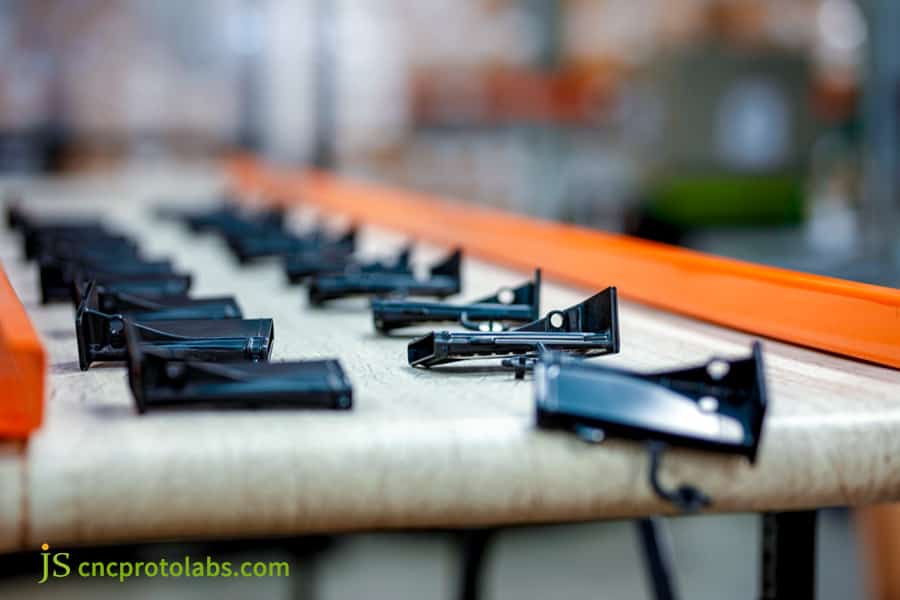
Figure 1: Numerous black plastic parts are transported on a conveyor belt, illustrating the efficiency of mass production in injection molding.
The Main Types Of Plastic Injection Molds: Which One Saves You Money?
Molds are central to plastic injection molding. Types of plastic injection molds determine production efficiency, quality, and cost. It is very important to select the right mold according to production volume and product design for cost saving.
Cold Runner Molds: A Less Expensive Way for Small Batch Prototypes
Cold runner molds are mechanically quite simple and have a low price, so they can be handy for small batch prototyping less than say 10, 000 pieces that however require frequent color changes. Besides, they produce runner waste, though it is recyclable bringing the influence of runner waste on small batch production costs to a minimum.
Hot Runner Molds: A Productivity Booster for Mass Production
Hot runner molds are heated to release the runner and therefore do not generate any waste of runner. The utilization rate of the material reaches a level of over 99%. They also reduce manufacturing time quite significantly.
The investment cost is also quite large initially but in mass production, the advantages in terms of material and efficiency outweigh the investment costs.
Special Mold Types: Meeting Complicated Production Needs
Special molds allow the making of complex products:
- Two-color/overmolding molds can integrate rigid and flexible so that a secondary assembly is no longer necessary.
- Stack molds can double production and are very suitable for thin walled parts.
- Spin on molds are generally used for internally threaded products while increasing efficiency.
If you'd like to know which types of plastic injection molds are best suited for your project, submit your product's 3D drawings to JS Precision. Our mold engineers will provide you with a free mold design solution and cost quote.
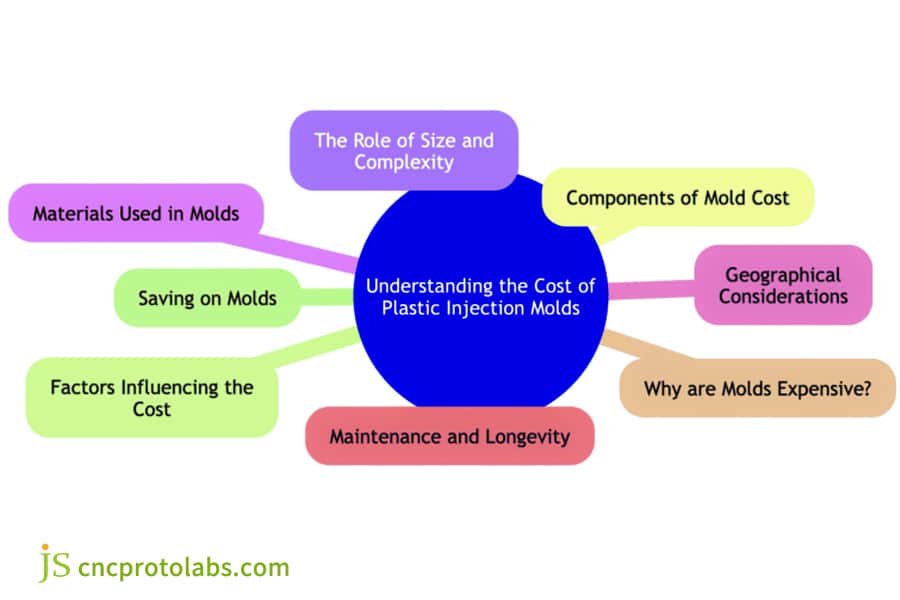
Figure 2: A mind map diagram centered on “Understanding the Cost of Plastic Injection Molds,” with branches detailing factors like materials, size, complexity, and maintenance.
What Plastic Injection Molding Equipment Do You Need To Get Started?
Complete plastic injection molding equipment is not just essential, it is the fundamental way to effective and efficient process execution. Besides the core injection molding machine, you cannot forget the need for different auxiliary equipment, mainly those that will be selected based on either the product or the production volume.
Injection Molding Machine:The Core Production Equipment
Classified by Clamping Force Injection molding machines are indeed the main production equipment, having clamping forces between 30 and 4000 tons, thus being suitable for products of various sizes.
The screw diameter and injection volume must correspond to the product weight. Mainstream types include hydraulic, electric, and hybrid types, with hybrid systems being more suitable for mass production.
Mold and Temperature Control System: Guarantee of Precision and Stability
Molds can be made either of hardened steel or aluminum alloy. Aluminum molds are cheaper and quicker to make, and are therefore more suitable for small batch production.
On the other hand, hardened steel molds have a long service life and very high precision, fitting large batch production very well. Mold temperature controllers finely adjust the cooling time, so that product dimensions remain stable.
24/7 Stable Production Guarantee
Automation and the use of auxiliary equipment enable a production line to run non stop. Robo arms take out parts, crushers gather waste, conveyors carry finished products, and dryers take care of plastic granules. Fully automated units require less human work thereby stabilizing and improving the efficiency.
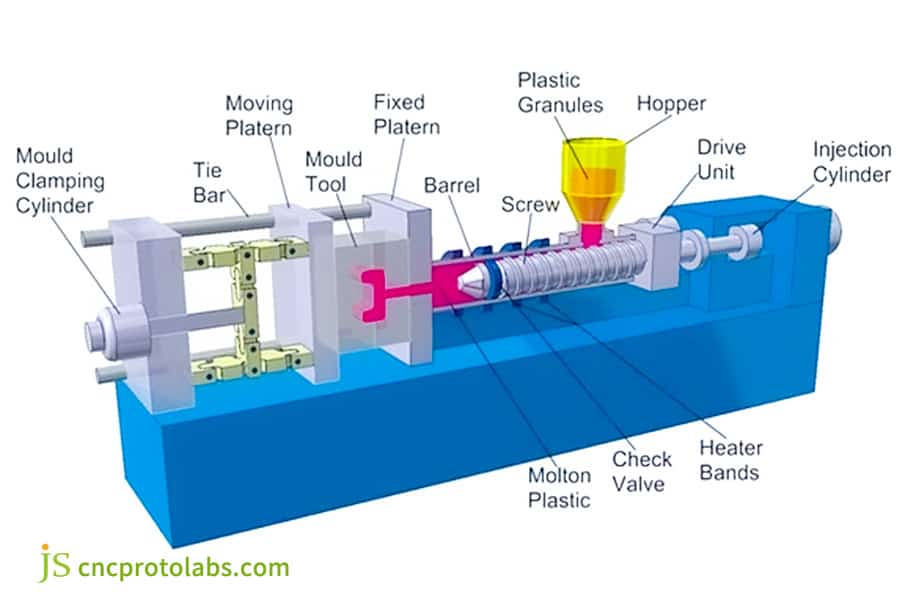
Figure 3: A detailed cutaway diagram labeling key components of an injection molding machine, including the hopper, screw, barrel, heater bands, and mold.
How To Choose a Partner For Plastic Injection Molding Services?
Selecting a dependable partner is vital for the accomplishment of plastic injection molding projects. A partner of top quality enables the full utilization of the advantages of plastic injection molding. Give more weight to their mold engineering skills, know how of materials, and certifications of the system.
JS Precision condenses the main aspects of assessment into three sections so that you can swiftly find the ideal partner.
Mold Engineering Capabilities: In house Workshop Determines Response Speed
MVP partners should have an in house mold workshop so that they can quickly iterate and maintain the mold without being affected by longer lead times of external mold shops. Moreover, they can boast precise mold design and manufacturing equipment and staffs with skilled technical knowledge.
Materials Science and Certification System: A Guarantee of Quality
Partners for projects with special requirements should be able to recommend the right materials accurately, know how to handle tough plastics, and have IATF 16949 and ISO 13485 certifications, among others, to attest to their quality control systems
Process Control and Data Transparency: The Core Foundation of Cooperation
Top notch partners boast production monitoring systems capable of tracking live data, offering comprehensive test reports in detail, willingly performing DFM analyses, working on product design improvements, and thus preventing production errors and the rise of costs.
Case Study: JS Precision Cuts Cooling Cycle By 44% With Conformal Cooling Innovation
As plastic injection molding technology evolve, JS Precision has made a big leap in the field of conformal cooling design which is one of the best solutions to problems in cooling un-evenness that in turn has double the performance and half the costs for customers.
Customer Request: Hot Spot Deformation Problem in Complex Medical Components
With the medical devices customer's plastic injection molding project, the customer's parts were warping because mold cooling was not uniform, and as a result, yield rate was only 82%. Furthermore, the cooling cycle had to be extended to 45 seconds which meant low efficiency and high costs.
JS Precision Roadmap: Conformal Cooling Design and Additive Manufacturing Inserts
JS Precision engineering team first did a thorough analysis of the client's plastic injection molding process and mold design. Based on this, they came up with a solution that will be highly effective:
- Thanks to Moldflow mold flow analysis and ANSYS thermal simulation technology, the team accurately identified the three main product hot spots. They found out that the temperature difference between the hot spots and the cold zone was 28℃. Also, they defined the temperature gradient distribution range of 5-33℃ having the cooling design data at hand.
- The cooling water channels within the mold insert were modified with a conformal cooling layout. The diameter of the water channel was fixed at 8mm, and the distance between the water channel and the product contour was 0.5mm, which can increase heat exchange efficiency by over 35% and also address the issue of uneven cooling.
- Through metal additive manufacturing (SLM) technology, the H13 mold steel was chosen to fabricate the insert with a forming accuracy of ±0.01mm. The high precision assembly with the mold body was carried out, the assembly gap was controlled within 0. 003-0. 005mm, thus ensuring mold sealing and stability.
Quantifiable Results: Double Success in Efficiency Improvement and Cost Reduction
The molding cycle was shortened to only 25 seconds, the yield rate reached over 98%, customers' annual savings exceeded 30%, and the payback period of the mold investment is only 6 months, which clearly demonstrate the advantages of the process.
If you also encounter pain points such as low production efficiency and high scrap rates in your plastic injection molding projects, you can contact JS Precision to see more successful process optimization cases. Our engineers will provide you with targeted technical transformation solutions.
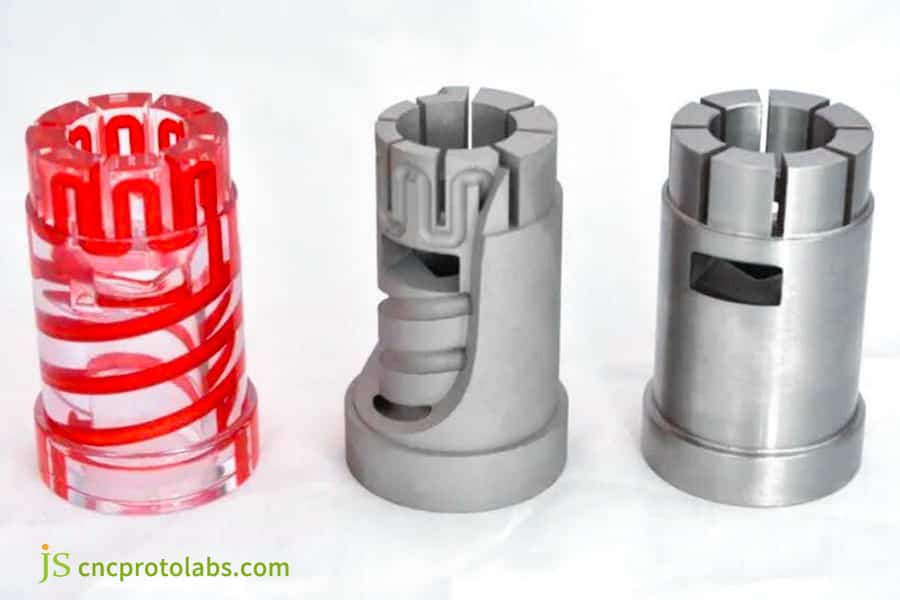
Figure 4: Three metal mold components are displayed, including a red insert with internal channels (likely for conformal cooling), a gray insert, and a solid mold body piece.
FAQs
Q1: What is the minimum order quantity (MOQ) for injection molding?
Factors such as the complexity of the mold and the material used determine the MOQ. Trial runs of small batch manufacturing may begin with 1000-5000 pieces, large batch manufacturing can be negotiated. JS Precision is willing to arrange flexible MOQs in order to cater to various project stages.
Q2: How long can a mold last? What is its lifespan?
The life of a mold is very much dependent on the mold material used. Aluminum molds being able to last 5000 to 25000 cycles, are a good choice for small batches, hardened steel molds can result in very long runs lasting over 1 million cycles and with good maintenance, their life can be further extended.
Q3: What tolerances can be achieved for injection molded parts?
Tolerances in plastic injection molding mainly depend on two factors: material shrinkage and the precision of the mold. Injection molding to high precision can achieve tolerances of ±0. 005 inches. JS Precision will establish suitable tolerance levels for you.
Q4: How to avoid shrinkage marks or warping in injection molded parts?
Make a uniform product wall thickness, tweak the holding pressure parameter, and use conformal cooling design. Doing Design for Manufacturing (DFM) review of the product in its earliest stage is the most effective way to avoid shrinkage marks and warping.
Q5: How long does mold manufacturing take?
The manufacturing time depends on the complexity and material of the mold. For simple aluminum molds, it takes 4-6 weeks, while for complex hardened steel molds, it takes 8-12 weeks. JS Precision provides urgent service support for rapid verification.
Q6: Is injection molding suitable for metal inserts?
Plastic injection molding is quite suitable for processes involving metal inserts. The metal insert is first situated in the mold cavity and then plastic is injected so as to produce a single piece part. This technique is very common in making products like electronic connectors.
Q7: How to get an injection molding quote? What is required?
You are responsible for furnishing 3D drawings of the product, specification of materials, rough annual production quantity, and surface finish requirements. JS Precision will send back review and the price estimate within one day.
Q8: Which is more suitable for small batches, injection molding or 3D printing?
3D printing is a better option cost wise for orders of fewer than 1000 pieces, as it does not involve the making of a mold, for orders of more than 1000 pieces, the cost benefits of plastic injection molding become very clear, and JS Precision is able to offer you both methods.
Summary
Plastic injection molding is a complex process that combines science, experience, and technology.
Choosing the right materials, designing the mold, optimizing the production process, and selecting the right partners are the main factors that will either make or break your project. They also serve as the main gateways for companies to engage in large scale production of plastic products.
Act now and make your ideas a reality.
Feel free to share your product sketches and technical specifications with JS Precision. Our team of injection molding engineers will offer you complete assistance, starting from DFM analysis to clear pricing. Together, let's turn your product concept into a proven market winning tool.

Disclaimer
The contents of this page are for informational purposes only.JS Precision Services,there are no representations or warranties, express or implied, as to the accuracy, completeness or validity of the information. It should not be inferred that a third-party supplier or manufacturer will provide performance parameters, geometric tolerances, specific design characteristics, material quality and type or workmanship through the JS Precision Network. It's the buyer's responsibility Require parts quotation Identify specific requirements for these sections.Please contact us for more information.
JS Precision Team
JS Precision is an industry-leading company, focus on custom manufacturing solutions. We have over 20 years of experience with over 5,000 customers, and we focus on high precisionCNC machining,Sheet metal manufacturing,3D printing,Injection molding,Metal stamping,and other one-stop manufacturing services.
Our factory is equipped with over 100 state-of-the-art 5-axis machining centers, ISO 9001:2015 certified. We provide fast, efficient and high-quality manufacturing solutions to customers in more than 150 countries around the world. Whether it is small volume production or large-scale customization, we can meet your needs with the fastest delivery within 24 hours. Choose JS Precision this means selection efficiency, quality and professionalism.
To learn more, visit our website:www.cncprotolabs.com
Resource