English



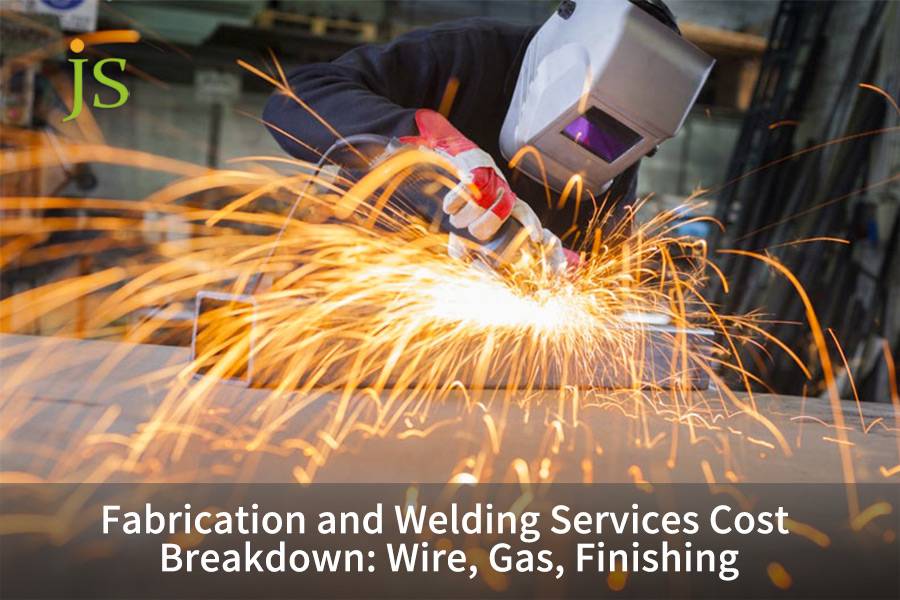

Fabrication and welding services costs are mainly influenced by three major factors: the wire deposition rate, shielding gas usage level, and post-treatment processing stage. Wire fillers account for 15%-25%, shielding gas loss for 10%-18%, and post-weld finishing for 20%-35%. These three are the key cost elements that directly impact the weld pass rate and overall cost of the fabrication & welding process.
Summary Table of Core Answers: Welding Cost Breakdown&Metrics
|
Cost Component |
Typical Share |
Key Technical Metric |
Cost Reduction Strategy |
|---|---|---|---|
|
Wire |
15%-25% |
Deposition efficiency (Solid 95% vs. Flux-cored 85%) |
Optimize groove angle to 45°, reduce fill metal by 20%. |
|
Gas |
10%-18% |
Flow rate (12-18 L/min), ternary mix precision |
Anti-turbulence flow control, argon purging cuts waste by 30%. |
|
Finishing |
20%-35% |
Surface roughness (Ra), pickling & passivation |
Control spatter to reduce secondary grinding labor. |
|
Labor |
30%-45% |
Fit-up tolerance (±0.5mm), fixture positioning |
Apply DFW design, use laser-cut parts to minimize setup time. |
Sources: American Welding Society (AWS) — Welding Handbook, 9th Edition, Vol. 1 & 2, 2001/2004; International Organization for Standardization (ISO) — ISO 5817:2023, Quality levels for imperfections in fusion-welded joints.
How to Calculate Consumables and Welding Wire Cost in Fabrication Projects?
Calculating the true welding wire cost requires precise measurement of joint cross-section, material density, and actual deposition efficiency.
Comparison of deposition efficiency of various processes
With JS Precision's experience on a number of automotive frame projects, utilization of welding wire largely depends on the type of welding process, which is the very first step of cost control.
- GMAW (Solid Wire): gives the highest deposition rate of 92%-97% and produces less than 5% spattering, so it turns out to be the most economic choice.
- FCAW-G (Flux-Cored): 80%-86% of deposited metal, while the slag and the flying particles result to additional losses.
- SMAW (Stick): with the lowest amount of deposited material of only between 60% and 65%, and a big fraction of remaining material loss, it's unsuitable for batch work.
- GTAW (TIG): although the deposition rate is 96%-100%, it has only 1.5 lb/hr of wire per unit time of operation. In general, GTAW is applied only when there is need for a small area high precision weld.
Metal deposition efficiency is defined by AWS D1.1:2020 as the quotient from dividing the mass of deposited metal by the mass of melted filler metal.
We confirmed in internal tests that adhering to the AWS D1.1:2020 procedures for selecting process wires allows them to keep the level of spatter to below 3% consistently.
Cost difference between solid welding wire and flux-cored welding wire
Choosing the right welding wire directly affects the welding consumables cost.
- ER70S-6 Carbon Steel Welding Wire: solid welding wire allows very high deposition rate and little spatter. It's perfect for automated production lines.
- ER308L stainless steel welding wire: Flux-cored welding wire, has excellent resistance to cracking but low deposition rate which leads to a higher cost, 15%-20% higher per kg of effective deposition.
Formula for estimating the amount of consumables
The core formula for calculating welding wire consumption is:
Consumable Weight = (Joint Cross-Sectional Area × Weld Length × Material Density) / Deposition Efficiency
In simple words, the bigger the bevel, the more the filler you have to add, which of course will lead to higher costs. It is well established that just changing the V-groove from a 60° to a 45° weld groove reduces the welding wire purchase cost by more than 20%.
|
Welding Process |
Deposition Efficiency (%) |
Spatter Loss (%) |
Stub End Loss (%) |
|---|---|---|---|
|
SMAW |
62 |
5 |
15 |
|
GMAW (Solid) |
95 |
3 |
1 |
|
FCAW-G |
84 |
8 |
2 |
|
GTAW |
96 |
1 |
0 |
Sources: American Welding Society (AWS) — Welding Handbook, 9th Edition, Vol. 2, 2004; International Institute of Welding (IIW) — Doc. XII-2070-12, Review of Arc Efficiency Values for Gas Tungsten Arc Welding, 2012.
Contact our engineers for a detailed cost comparison analysis between different welding wires for your project.
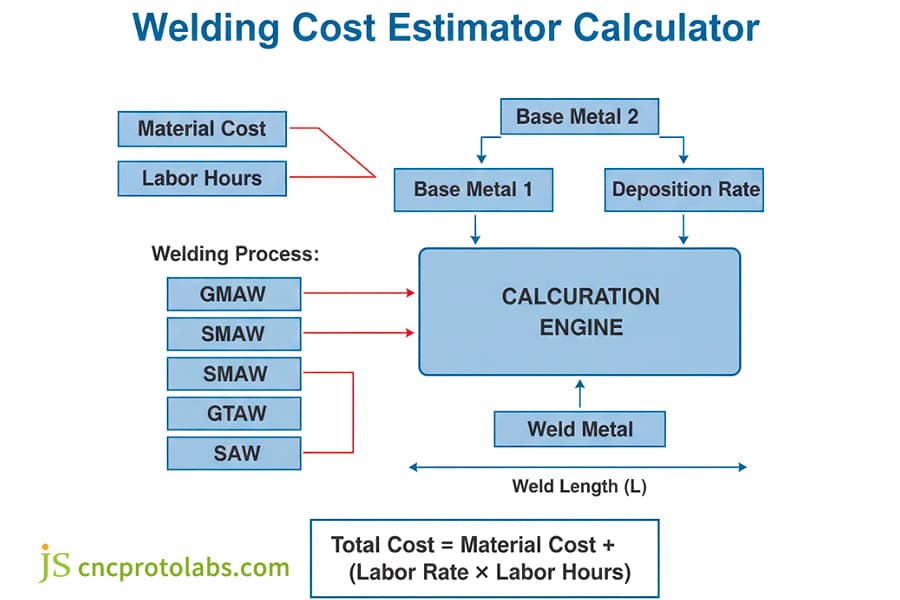
Figure 1: Welding cost estimator calculator flowchart and formula.
How Do Gas Mixture and Flow Rate Impact Shielding Gas Cost?
The shielding gas cost is directly driven by base gas price, mixing accuracy, and flow rate, with improper settings causing both cost overruns and porosity defects.
Protective gas selection and consumption rate
Different shielding gas combinations impact the welding cost and quality.
- 100% Argon: used mainly for welding aluminum and titanium alloys. But, its unit price is high although its usage is lower relatively.
- 80% Ar + 20% CO2: The most commonly used carbon steel mixture, with moderate cost, good melting depth, and gas accounting for about 6%.
- Trinary gases (ex. Ar+CO2+O2) that have more beneficial properties for welding such as stable arc and less spatter may but cost more. But, reducing rework will help in balancing of gas cost.
Flow control and turbulence prevention
Flow control is an important means to reduce costs of metal welding service.
- Proper flow rate range: Flow rate control at 12-18 L/min would provide enough gas protection for the weld pool to achieve a good result while being economical.
- Danger of excessive flow: if you get above 25 L/min you can run into turbulent flow problems, air entrainment and porous defects, all resulting in a need for repairs and higher costs.
- Equipment solution: Throttling valves and gas mixers will help to precisely control the flow and can cut the gas consumption by more than 30%.
Figure 2: Welder working on metal with bright sparks and smoke.
What Parameters Drive the Non-Linear Increase in Welding Finishing Cost?
The welding finishing cost often accounts for one-third of total manufacturing labor, driven by grinding, spatter removal, pickling, and blasting requirements.
Surface finishing level and labor cost
The higher the acceptability standards, the welding finishing costs increase nonlinearly.
- Standard grade (Ra ≤ 6.3 µm): Spattering removal through grinding is enough, with the extra cost amounting to approximately 10% of the welding cost.
- Structural grade (Ra ≤ 3.2 µm): apart from the spatter removal by grinding, grinding shall be done to level the weld and smoothing wire draw operation, which will raise the total additional cost to around 25%.
- Sanitary grade (Ra ≤ 0.8 µm) : several polishing steps are needed. As a result, the manpower time required increases drastically and the price increases more than 50%.
ISO 5817:2023 Class B : Presence of cracks and lack of fusion is not allowed; pore diameter ≤0.2s/0.2a, maximum up to 3mm.
To its sanitation grade stainless steel structural component project, JS Precision raised the first weld inspection acceptance rate to 99.2% by following strictly the standard's Level B requirements
Balancing drawing requirements with cost
Imposing requirements for very smooth surface texture to the highest level in drawings often results in uncontrolled expenses.
- No superfluous requirement specification: when it comes to a non-aesthetic part, Ra 6.3µm is normally the minimum that can be done and that means there's no justification to ask for Ra 0.8µm.
- Emphasize process management: Maintaining the parameters during welding can not only decrease the spatter, but also largely reduce the need for grinding.
- Design with post-processing in mind: while the fish scale welding that doesn't need grinding is very attractive visually, this method demands highly talented operator and makes time/cost balance difficult.
Want to control costs more precisely with your project drawings? Send your design requirements to us, and they can carry out a free DFM (Design For Manufacture) check to you and help balance quality and budget.
Figure 3: Worker welding metal beam with bright flying sparks.
How Does Design for Welding Optimize the Overall Welding Cost Breakdown?
Optimizing weld position, joint geometry, and combining bends can reduce welding and assembly labor by over 30% from the design stage, fundamentally improving the welding cost breakdown .
Replace fillet welds with bent parts
Using bent parts instead of flat parts connected by fillet welds is a proven way to save money on fabrication welding services.
- Basic idea: by doing one bend only, you eliminate two or more fillette welds, which in turn means no welding time, no welder, and no filler metal used.
- Real life results: when applied to simple container type frames, this technique is able to cut down the deposited metal weight beyond 40%.
- Application example: Substituting a piece made of fours plates welded together with a piece that is bent into a single shape results in reducing the cost of the latter unit nearly by half.
Geometric optimization of thick plate bevel
Filler and welding deformation levels are largely determined by the bevel design.
- Double V bevel vs. single V bevel: if a sheet is more than 12mms thick, by creating a double V-bevel that is symmetrical it will lead to a reduction in filler volume by roughly 40% and a welding deformation.
- Gap-reduction Bevel: by further reducing the bevel angle we reduce the need for a lot of filler metal. Yet, high precision laser cutting and automated welding equipment are prerequisites for that.
- JS Precision's practical method: we save filler wire use by 22% through optimizing bevel from 60 to 45 composite bevel when executing the heavy machinery chassis projects.
|
Design Optimization Method |
Material Thickness |
Weld Volume Reduction |
Labor Saving per Part |
Cost Impact |
|---|---|---|---|---|
|
Bend Alternative 2x Fillet Welds |
3-6 mm |
40%-50% |
12-18 min |
-28% to -35% |
|
Double-V vs. Single-V Groove |
12-25 mm |
38%-42% |
22-30 min |
-22% to -30% |
|
Narrow Gap Groove (8°-10°) |
20-50 mm |
50%-60% |
35-50 min |
-30% to -40% |
|
Laser-cut Precision Fit-up (±0.3mm) |
All ranges |
8%-12% (less gap fill) |
5-10 min |
-8% to -15% |
Sources: American Welding Society (AWS) — AWS D1.1:2020, Structural Welding Code — Steel, Annex M; International Organization for Standardization (ISO) — ISO 5817:2023, Quality levels for imperfections in fusion-welded joints.
Today you can get a free DFW design evaluation report for your product simply by contacting our engineering department.
What Distinguishes the Cost Structure of Prototypes from Batch Fabrication?
Prototype production bears fixed amortizations like tooling setup and first-article inspection, while batch manufacturing is dominated by material utilization and cycle-time savings. Understanding this distinction is critical when evaluating any metal welding service provider.
Cost Characteristics of One-off Prototypes
The cost structure of the prototype stage (1-5 pieces) is completely different from mass production, mainly reflected in the centralized amortization of fixed costs.
- Tools and setting up: the lack of dedicated welding positioners and profile fixtures means that the positioning and adjustment time can make up more than half of the total man-hours.
- Cost of the initial product examination: NDT/RT/UT tests on the first piece have an impact that is not proportionally small for unit cost.
- Gas and electrical power use: since the quantities are small, the advantages of getting gas at a cheaper rate from the central gas supply are lost. As a result, the gas cost per piece is 25% to 35% higher.
Cost Advantages of Batch Production
Medium to large batch sizes (100–5,000+ pieces) drastically cut down unit costs through the benefits of economies of scale.
- Automation of jigs and welding positioners lead to a substantial amortization. The initial investment for such jigs and positioners is rapidly repaid over the volume, and the time saved on positioning reduces the total man-hours to merely not more than 15%.
- Centralized gas system: Bulk gas procurement and manifold distributions result in per-piece cut down of gas consumption by 18–28%.
- Cycle time improvement: when skills and production stability improve together, the cost of direct manpower reduces progressively by 20%–30%.
Man-hour Decay Curve from Prototype to Mass Production
Based on JS Precision's tracking data from a number of projects, the man-hour reduction from prototype to volume manufacturing shows an easily distinguishable stair-step pattern.
- Phase 1 (prototype): 1–5 pcs - the average man-hour per piece is around 3–4 times that of a mature volume phase, the main time being program debugging and positioning calibration.
- Phase 2 (Pilot Run): 20–50 pcs - Tooling becomes more stable gradually; the man-hours drop to around 50%–60% that the prototype phase.
- Phase 3 (Mass Production): 500+ pcs - when the process becomes 100% locked in, the automated cycle is stabilized; man-hour consumption drops to 25%–30% of the prototype baseline.
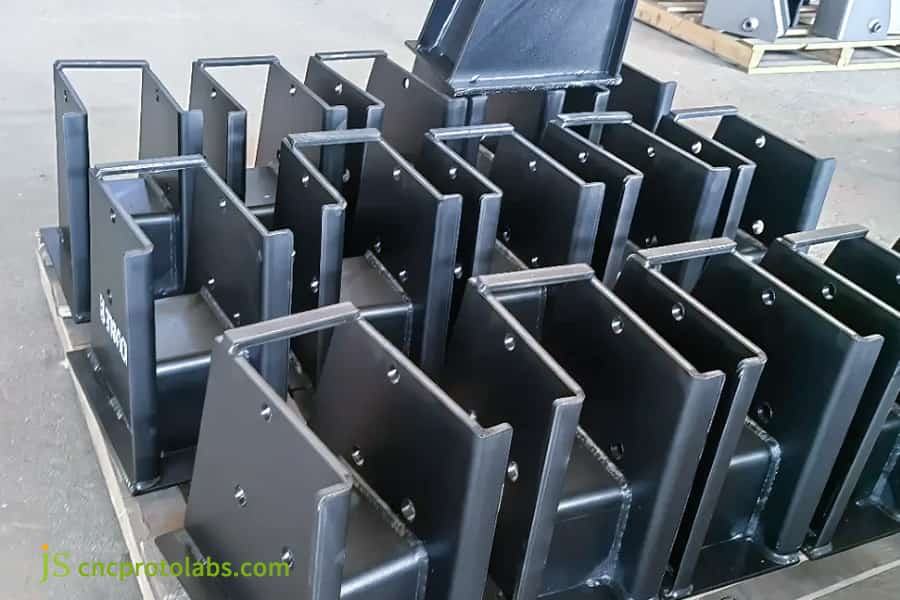
Figure 4: Batch of welded metal brackets on pallet for fabrication.
How JS Precision Reduced Metal Welding Quote Costs by 26% for Structural Frames?
For heavy chassis structural components operating under high-frequency vibration conditions, JS Precision has achieved significant cost reduction and efficiency improvement through process optimization, ultimately reducing customers' metal welding quote.
Customer Challenges and Initial Situation
Under harsh vibrations conditions the North American producer saw chassis joining failure rate to be around 12%. This way their quality control team had to sort out and rework almost 1 in 10 weldments or even more in worst cases.
- Low yield rate: The first yield rate was very low that led to a large number of rework and scrap.
- High outsourcing cost: Post-weld spatter polishing and post-weld correction take up a great share of the outsourcing budget.
- Budget Overrun: The initial quote of the original supplier was way over-budget, so the customer has an urgent need to look for other options.
JS Precision's Solutions and Quantification Results
We effectively resolved its clients' issue by adopting three main strategies:
- Bevel angle optimization: changed the bevel angle of the 12mm thick Q355B connector from 60° to 45° and this lead to a reduction of 22% in the amount of filler wire.
- Adjustment of protective gas formula: moved from the standard 80/20 protective gas to one predominantly consisting of argon with just a small amount of oxygen, a ternary micro-oxidation mixture which efficiently controlled arc spatter.
- Custom tooling design: to reduce thermal deformation,we designed a special pneumatic clamping with forced cooling system which can keep thermal deformation to a range of ±1.0mm. This eliminates the need for flame straightening.
Lessons learned from failure
We had problems during their first production trial as well.
- Problem: the copper pad transferred the heat too soon to the metal resulting in poor weld metal fusion.
- Solution: by utilizing the thermal FE analysis, we set the preheating at 120℃ so the heat was evenly spread resulting in flawless welds.
Final results and measured data
With process iteration, our team has succeeded in reducing the total manufacturing cost of chassis structural components. The first-pass yield rate of welds has also increased to 99.2%, while post-processing grinding time per part has decreased by 45%. In addition, the overall quote for the metal welding service has been reduced by 26.4%.
| Evaluation Dimensions | Before Optimization | After Optimization | Improvement Amount |
| Wire Filler Weight (kg/piece) | 3.6 kg | 2.8 kg | -22% |
| Grinding Time (min/piece) | 85 min | 47 min | -45% |
| Heat Deformation (mm) | ±3.0 mm | ±1.0 mm | 67% Improvement |
| Overall Unit Cost (USD) | $100.00 | $73.60 | -26.40% |
Sources: International Organization for Standardization (ISO) — ISO 5817:2023, Quality levels for imperfections in fusion-welded joints; ASTM International — ASTM A967/A967M-17, Standard Specification for Chemical Passivation Treatments for Stainless Steel Parts.
If you would like to see the cost-effectiveness through this kind of optimization for your production, don't hesitate to get in touch with us. You will get a free initial estimate from us as well.
What Technical Specifications Are Required for an Accurate Metal Welding Quote?
Submitting engineering drawings with clear weld symbols, NDT levels, and surface finish standards is key to receiving an accurate metal welding quote without risk premiums.
Essential checklist for engineers seeking quotes
When a clear quote package gives all necessary details, the risk premium of the price can be reduced by 15% to 30% roughly.
- Base material and tolerances: it is necessary to indicate the metal grade (e.g. Q355B) and the material thickness tolerance (e.g. ±0.5mm).
- Welding symbols: weld leg sizes and penetration depths need to be marked as AWS D1.1 or ISO 2553 standards.
- Inspection standards: it should be clearly stated what the non-destructive testing level is and at what rate the components shall be sampled.
- Surface treatment: the powder coating pretreatment grade should either be stated if powder coating is used, or the Ra index for electro-polishing. For the case of stainless steel parts, specify the passivation requirements of ASTM A967/A967M-17.
As ASTM A967/A967M-17, all batches of stainless steel parts should be immersed in water, passed through highly humid and salt spray conditions, and then checked for signs of rust, corrosion or free iron. The surface must be clean of any such signs.
JS precision ensures that when receiving Request for Quotation (RFQ) drawings, the main thing is to check passivation requirements.
How to Prepare Technical Details for a Faster Quotation
A clear understanding of the technical parameters increases the accuracy of the quotation received from fabrication and welding services vendors.
- Reducing uncertainty: if the drawings are very unclear, suppliers may take a higher risk which is usually a premium of 15%-30%.
- Fast tracking the process: our engineering department can quickly begin process designing with cost accounting if the technical data received are clear.
- Limiting the number of communications: an RFQ filled completely may minimize at least two to three communications about clarifications, that means making starting up the project a lot quicker.
FAQs
Q1: What is the most significant cost driver in custom fabrication and welding services?
Direct labor and post-weld finishing account for 50%-70% of total cost. The time spent on assembly, spatter grinding, and weld smoothing exceeds the combined cost of welding wire and shielding gas, making labor and finishing the most significant opportunity for cost reduction.
Q2: How does welding wire selection directly affect the Welding Wire Cost?
The deposition of solid welding wire is 93%-97%, and residue is very small; flux-cored welding wire deposition is only 80%-86%. Using welding wire of high deposition rate can save filler, shorten slag removing time, greatly reduce welding cost.
Q3: Can shielding gas optimization effectively lower total welding expenses?
Yes. Gas flow over 25 L/min creates turbulence and porosity problems. Gas flow control at 12-18 L/min and throttle valve arrangements can result in 20% saving in the gas consumed while completely eliminating the expense on repairs.
Q4: Why does post-weld surface treatment contribute heavily to Welding Finishing Cost?
Residual polishing, spatter removal, and acid pickling passivation are largely performed by hand. Parts requiring a surface roughness of Ra ≤ 0.8 μm need multiple polishing passes, which drives labor time and cost up exponentially.
Q5: How does JS Precision control costs on complex welded metal assemblies?
JS Precision applies a design to weld first method (DFW), using precision laser cutting and special tooling to achieve control over gap and thermal deformation up to ±1.0mm, which greatly minimizes grinding and reduces overall costs of production.
Q6: What technical details are necessary to receive an accurate Metal Welding Quote?
2D or 3D drawings with material indication, AWS/ISO (welding symbols), inspection level and surface roughness requirements are mandatory. The less the uncertainties in the description the smaller the added costs. You can directly upload drawings to obtain accurate quotations.
Q7: Is TIG welding more expensive than MIG welding for custom manufacturing?
Definitely yes. TIG welding speed is slower it could weld up to 2-3 times faster if the job were done with MIG welding. Still, TIG welding can produce a more pleasing weld surface and lower grind cost after welding.
Q8: How does weld joint design impact overall consumable and energy usage?
By changing the bevel angle from 60° to 45° and matching it with a root face, we will be able to decrease the amount of filler wire needed by more than 20%, cut down both arc and power use, making a big saving in energy costs.
Summary
The cost control of welding is a well-structured program that includes consumables gases the design, and post-processing. Only considering the labor part leads to forgetting of the hidden costs which are in fact a very big part such as the rework from spatter and the losses by back protection. Companies can greatly reduce the costs by integrating an optimized DFW at the design and strictly using optimized process parameters at the manufacturing stage as well as maintaining the quality requirements.
Want a review of welding manufacturing costs for your new project? JS Precision will help you by giving a detailed manufacturing feasibility analysis and an open metal welding quote within 24 hours after sending the drawings of your product either 2D or 3D to JS Precision engineering team.

Disclaimer
The contents of this page are for informational purposes only. For JS Precision Services, there are no representations or warranties, express or implied, as to the accuracy, completeness, or validity of the information. It is the buyer's responsibility to identify specific technical requirements and request a formal parts quotation. Please contact us for more information.
Resource