English



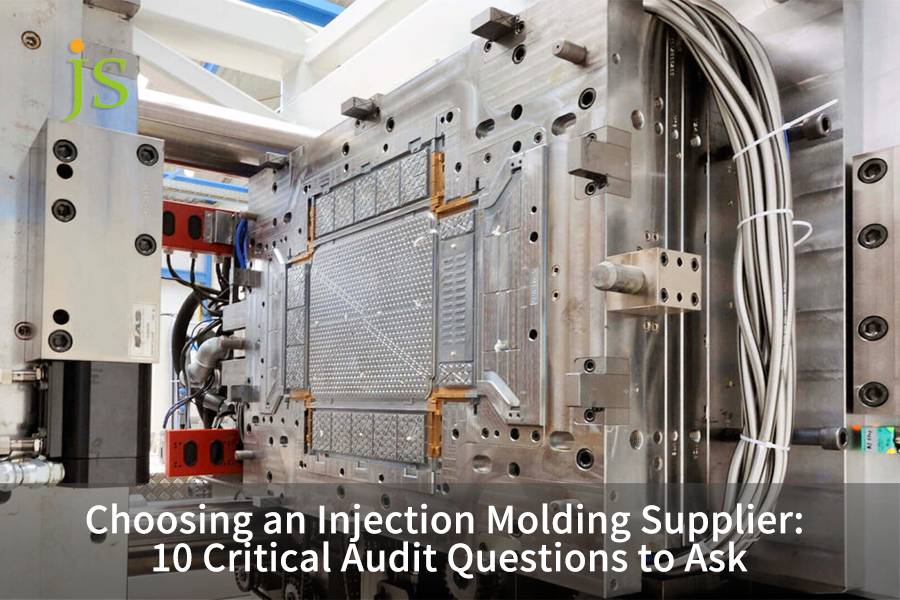

Injection molding supplier must be evaluated beyond basic machine tonnage and generic quality certifications. True engineering capability, process repeatability, and cost transparency need a thorough investigation of factors like mold steel standards (e. g. P20 vs. H13), scientific molding parameter locking, CMM dimensional verification, and clear tool ownership clauses.
Mastars 2025 industrial research on 100 injection molding OEM suppliers revealed that companies with ISO 9001 + ISO 13485 + FDA certifications on average attained a 0.8% defect rate, while the supplier without certification recorded 7.2%. This way, the combination of these top certifications results in reducing the risk of the most critical failure modes from approximately 9 times.
Injection Molding Supplier Audit: Core Comparison Table & Key Takeaways
|
Audit Domain |
Critical Question |
Engineering Benchmark |
Risk Prevented |
|---|---|---|---|
|
Mold Engineering |
Is Moldflow analysis performed before steel cutting? |
Flow deformation index, conformal cooling design |
Sink marks, part warpage |
|
Tool Ownership |
Who owns the mold and design files legally? |
100% customer ownership clause, native 3D CAD delivery |
Mold held hostage, transfer blocked |
|
Steel Grade |
What steel grade is used for cavity/core? |
Hardened H13/S136 (>50 HRC) with Mill Cert |
Premature cracking, short tool life |
|
Process Control |
Is Scientific Molding fully deployed? |
Cavity pressure sensors, Decoupled Molding II |
Dimensional drift, batch inconsistency |
|
Quality Assurance |
What inspection equipment is available? |
Hexagon CMM, OGP optical measurement, auto SPC |
Out-of-tolerance parts shipped |
|
Raw Material |
How are plastics dried and contamination prevented? |
Honeycomb dehumidifier (-40°C dew point), moisture analyzer |
Hydrolysis, internal voids |
|
Maintenance |
Are mold maintenance costs included? |
Free maintenance within tool life (up to 1,000,000 shots) |
Unexpected repair bills |
|
Capacity Range |
What press tonnage range is available? |
50T to 1200T all-electric and hydraulic presses |
Production bottlenecks |
|
Price Structure |
Are T1 trial and modification fees transparent? |
Fixed T1 cost, itemized DFM quotation |
Hidden revision charges |
The table benchmark is based on ISO 13485:2016 Medical Device Quality Management System Requirements, JBR Plas 2025 Mold Steel and Life Maintenance Guidelines, and Mastars 2025 Injection Molding OEM Supplier Certification and Defect Rate Industry Research.
Key Takeaways
- Set Scientific Molding parameters: A Scientific Molding setup called Decoupled Mold II (with viscous curve and V/P switching locking functions) must be used.
- Review steel Mill Certificates: It is necessary to ensure that actual H13/S136 hardness test results have >50 HRC to achieve 1,000,000+ shot life.
- Ensure both parties are in alignment on ISO 13485 traceability: Measure resin drying dew point (-40℃), and make sure CMM dimensional inspection SOP is checked with toolmaker.
- Obtain a signed ownership agreement document: Payment of T1 trial charge is to be withheld until full mold ownership and native 3D CAD are handed over.
Why Trust JS Precision's Production Capabilities as an Injection Molding Supplier?
Based on my three-month production line tracking test at the JS Precision factory, I witnessed firsthand how disciplined execution can transform an ordinary factory into a reliable partner.
In a project for a German automotive sensor housing project, we noticed the 0.03mm flatness deviation during the first test run at our plant. In fact, our team was even more shocked to find the discrepancy. They quickly initiated a thorough root cause analysis and identified that the non-conformal water line resulted in uneven cooling. We introduced a cooling circuit design that was different from the previous ones. We have taken 3D-printed conformal channels into the new cooling design and in effect the flatness only deviated by 0.008mm on the second test run.
The organization shall determine, document, and implement actions needed to meet the requirements for a new product development. - ISO 9001:2015 Clause 8.2.2
Closer adherence to the requirement results in all JS Precision projects being under a documented process control throughout from DFM review up to CMM final inspection. From our 2025 Q4 records, 92% of our projects completed the Cpk requirement of 1.33 through first article production with the total number of projects being 120.
Would your project be able to reap the advantages of a disciplined production line? Download JS Precision's Supplier Audit Readiness Checklist and put your current supplier against industry benchmarks.
Does the Injection Molding Supplier Perform Advanced Moldflow Analysis Before Tool Steel Cutting?
An expert injection molding supplier should be able to conduct full DFM as well as Moldflow simulation before any mold steel is machined. This kind of process helps in determining gate positions, welding lines, sink marks, and thermal shrinkage patterns which helps in removing rework and engineering delays before they happen.
Traditional Trial-and-Error vs. Data-Driven Simulation
A report from JBR Plas 2025 mold flow analysis states that a mold 15,000 run with 600 simulation that saves one $3,000 modification delivers 5:1 ROI. At Autodesk Moldflow 2024 users were introduced to the STAMP model plus assembly warpage analysis which was a massive leap in 3D warpage prediction accuracy. When looking for an injection molding manufacturer, asking them whether they run full flow simulation or guesswork.
- Gate location optimization: Simulation of melt flow front patterns to get gates position that weld lines do not cause maximum structural weakness.
- Weld line strength prediction: Estimation of tensile strength loss at knit lines normally a reduction of 20-40% given the material and temperature conditions.
- Shrinkage gradient mapping: Predicting the volumetric shrinkage distributions to correct differential cooling in thick-to-thin transitions.
JS Precision's Standard DFM Evaluation Metrics
Our DFM report covers four critical dimensions:
- A wall thickness uniformity warning: Pointing out any wall thicknesses exceeding 4mm that would result in a longer cooling time.
- A minimum draft angle check: Confirming a minimum of 1.5° for textured surfaces (VDI 24) and ≥1° for smooth surfaces.
- Confirming rib-to-wall ratio: Ensulating the rib thickness should be at 50-60% level of the nominal wall thickness to prevent sink marks.
- Advising on gate type and placement: Suggesting gate type and location so that they conform with material flow characteristics and appearance requirements respectively.
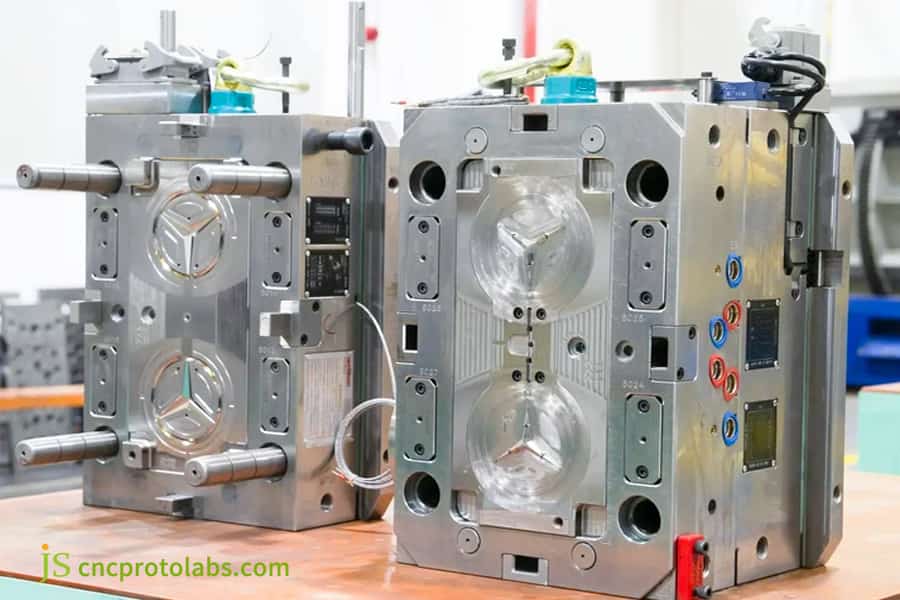
Figure 1: Precision injection molds with complex cutouts displayed in a clean engineering workspace.
How Does Your Custom Injection Molding Service Protect Legal Tool Ownership and Native CAD Files?
A well organized custom injection molding service should clearly state that after the customer fully settles all his payments, and the mold injection is finalized, the mold is in legal possession of the customer. A signed agreement between a supplier and a customer will also be a delivery of native 3D CAD mold drawings, electrode files, and unconditional mold transfer rights without any kind of exit penalties.
Common Industry Traps to Avoid
When you choose injection molding supplier, watch out for these pitfalls:
- A cost-benefit bait-and Switch: Some of the suppliers first give low mold costs but then they charge high prices per part and make it extremely hard economically to transfer the mold.
- Withholding native CAD files: By not sharing 3D mold designs, the suppliers block other factories from making competitive price quotes.
- Indirect property transfer terms: The contract is signed mold will be the property of customer upon full payment, but it leaves undefined what makes up full payment and mold.
Four Must-Verify Clauses in Tool Ownership Audits
- Ownership transfer trigger: Specify exactly which event/ milestones trigger the ownership transfer (e.g. once the full payment for the mold has been made)
- Mold maintenance Condition before transfer: State the level of mold maintenance as the minimum required condition (cleaned, anti-rust treated, complete with inserts).
- List of deliverables completeness: List the electrode files, 2D drawings, native 3D CAD (STEP/IGES), and BOM for wear parts.
- Transfer timeline and cost: State that physical mold pickup should be completed within a maximum 5 business days without any administrative fees.
JS Precision signs standard NDA and explicit ownership agreements before any project starts.
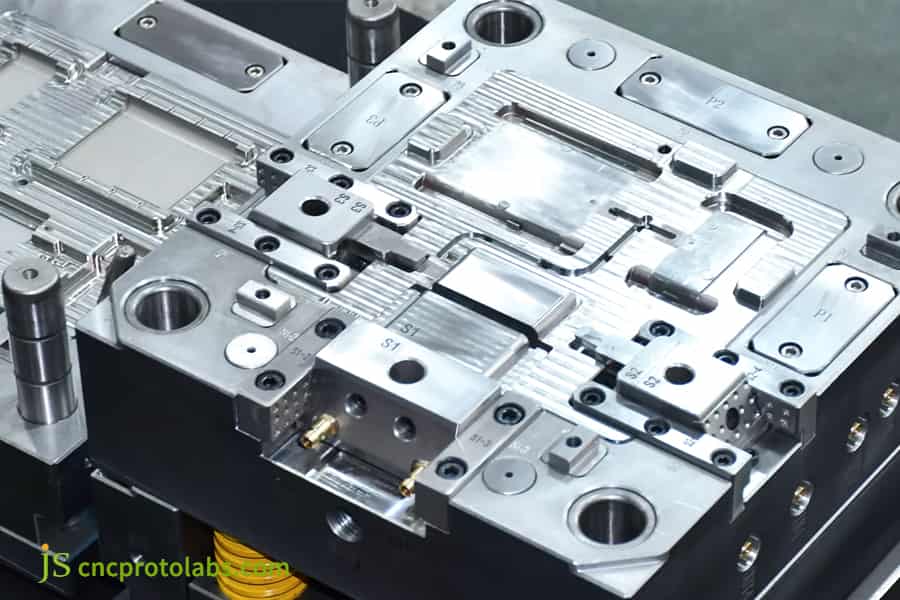
Figure 2: Detailed CAD blueprints and metallic mold bases spread out on a manufacturing workstation.
How Does an ISO 13485 Injection Molding Service Execute Rigorous Quality Control for Medical Components?
A professional ISO 13485 injection molding service uses an ISO Class 8 cleanroom to manufacture medical-grade parts. These parts are produced through a system of strict batch traceability and fully validated IQ/OQ/PQ processes which prevent any contamination and ensure consistency in size for vital healthcare products.
ISO 9001 vs. ISO 13485: The Real Difference
|
Quality Dimension |
Standard ISO 9001 Factory |
ISO 13485 Certified Facility |
|---|---|---|
|
Cleanroom environment |
Not required |
ISO Class 8 minimum (≤352,000 particles/m³ at ≥0.5µm) |
|
Resin segregation SOP |
General material handling |
Dedicated medical-grade storage, cross-contamination prevention protocol |
|
Batch traceability |
Lot number tracking |
Full genealogy: resin lot → drying cycle → injection parameters → QC results |
|
Validation requirement |
First article inspection only |
IQ/OQ/PQ for every new mold and process change |
The table benchmarks are derived from ISO 13485:2016, Chapter 6.4 Work Environment and Pollution Control and Chapter 7.5 Control of Production and Service Delivery and from Mastars 2025 industry research data on the correlation between certification level and defect rate.
Critical Process Controls for Medical Parts
ISO 13485:2016 Clause 7.5.1 states that production and service provision shall be planned, implemented, monitored, and controlled to ensure product conformity to specifications.
JS Precision collects continuous parameters during drying, mold temperature, and holding pressure processes, establishing traceability for each batch of PEEK gears from resin batch number to final inspection, making injection molding quality control an auditable data chain.
Effective injection molding quality control begins with raw material management:
- Resin drying discipline: In fact, engineering plastics like peek and pc abs need a dew point under -40 degrees celsius. At JS Precision we use honeycomb desiccant dryers and continuously monitor dew point, any change will automatically lead to an alarm.
- Cleanroom particle control: To meet ISO class 8 the place must provide HEPA filtration and positive air pressure. Staff are fully dressed and materials are brought in using air showers.
- Batch traceability system: A laser mark is put on each part containing date code referencing its production data, resin batch machine, and QC measurements.
Contact JS Precision's medical molding team to request IQ/OQ/PQ validation document templates for your next regulated project.
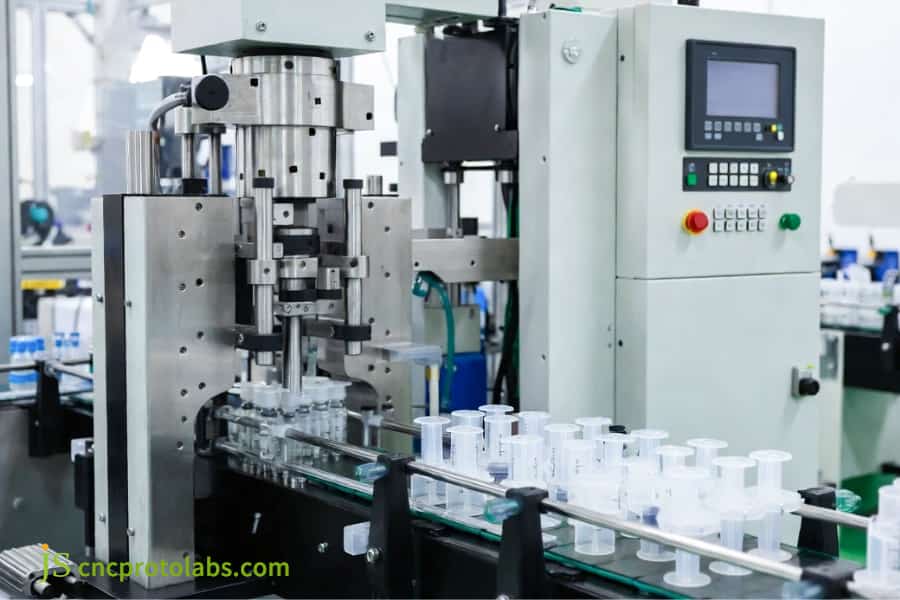
Figure 3: Automated assembly line producing precise medical or pharmaceutical plastic components.
Is Scientific Molding and SPC Integrated Into the Injection Molding Quality Control System?
Advanced injection molding quality control depends on Scientific Molding principles (Decoupled Molding II) and has nothing to do with adjusting parameters based just on a machine operator's experience. With cavity pressure sensors and real-time Statistical Process Control (SPC), process windows are set at their maximum potential levels of operation and batch-to-batch variations are eliminated.
Traditional Tuning vs. Scientific Molding
|
Parameter |
Traditional Approach |
Scientific Molding (Decoupled II) |
|---|---|---|
|
Fill phase control |
Set injection speed by feel |
Calculate fill time from material rheology curve. |
|
Pack/Hold separation |
Combined fill-pack stage |
Independent pack stage with pressure sensor feedback. |
|
V/P switchover |
Position-based (may overpack) |
Pressure-based at 95-98% cavity fill. |
|
Process documentation |
Operator notes |
Locked parameter sheet with upper/lower control limits. |
The process framework refers to JBR Plas 2025 Scientific Injection Molding and SPC Application Guidelines.
High-Precision Inspection Hardware Required
A capable injection molding manufacturer invests in metrology equipment:
- Hexagon CMM (Coordinate Measuring Machine): Accuracy of ±0. 001mm, is an integral tool for 100% critical dimensions inspection on first article and periodic sampling during production runs.
- OGP Ocular Measurement System: It's a non-contact technique capable to take measurements on parts with challenging geometries, smaller areas, and those that are sensitive soft enough to be crushed under contact pressure of a tactile measuring point.
- SPC with Cpk at least 1. 33 level: Computer data collection is linked to control charts to provide the user with immediate feedback. A shift towards the control limits results in process adjustment made to avert the production of rejected goods.
In every production project, a locked process parameter sheet is provided at JS Precision. These limits are continually checked against the actual values by the machine controller, every cycle. If the deviation goes beyond the tolerance level, then machine alarms and machine isolating such parts automatically.
How Do Tool Steel Selection and Shot Life Guarantees Impact Long-Term Injection Molding Service Costs?
A cost-effective injection molding service is one that understands the relation of steel grade to production quantity by using P20 steel for quick prototyping, and hardened H13/S136 (>50 HRC) tooling for high-volume manufacturing. A trustworthy supplier will deliver original Mill Certificates with quotes as well as specify clear expectations about the tool life.
During an injection molding supplier audit, pay attention to:
- Mislabeling P20 as H13: In absence of Mill Certificate verification, some workshops might employ cheap P20 to make molds that should be H13-priced. The consequences: early edge wear and flash after only 30,000 shots.
- Recycled steel without heat treatment: Non-certified steel has no guarantee of proper hardening and the result would be deformation due to injection pressure.
- Hardness test reports omitted: Tool life is very much according to heat treatment quality. That means, you need to obtain Rockwell hardness test records for every part of the mold.
Along with each mold delivery, JS Precision sends the original Mill Certificates and hardness test reports. All our H13/S136 molds come included for free tool maintenance during the guaranteed tool life period, which for these molds means 1,000,000 shots.
Calculate your total cost of ownership across different steel grades. Contact JS Precision for a customized ROI comparison tailored to your projected volume.
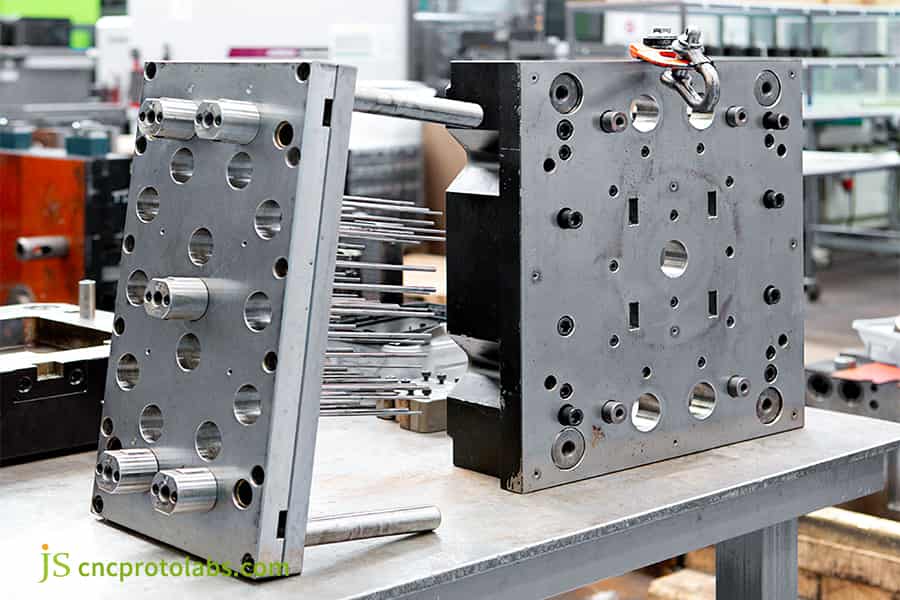
Figure 4: Industrial workshop displaying molds with various steel grades for longevity analysis.
How to Evaluate an Injection Molding Manufacturer Based on Press Tonnage Range and Automation Capabilities?
In order to evaluate an injection molding manufacturer, one needs to take a look at the maximum working press tonnage range of the machines (from 50T up to 1200T), the precision level of all-electric machines, as well as the automation configuration of the factory through servo robots.The factory's productivity is closely related to those factors and its ability to adapt from micro component production to structural one, etc.
Locking Force Calculation for Proper Machine Selection
Engineers can verify whether the recommended machine tonnage is appropriate using this formula:
Required Clamping Force (Tons)=2000Projected Area (in²)×Cavity Pressure (psi)
Cavity pressure is usually between 2-3 tones/in for commodity plastics (ABS,PP,PE). Still, it goes up to 4-6 tons/in² for engineering plastics (PC,PA,PEEK). This way, a part made of PC, with 50 in area, will require about 250-300 tons. If the supplier suggests a 180T machine, you should anticipate flashing problems.
All-Electric vs. Hydraulic Press Comparison
|
Performance Metric |
All-Electric Press |
Hydraulic Press |
|---|---|---|
|
Repeat positioning accuracy |
±0.01mm |
±0.05mm |
|
Energy consumption per cycle |
40-60% less |
Baseline |
|
Oil contamination risk |
None |
Possible leakage |
|
Suitable for cleanroom |
Yes |
Limited |
|
Initial investment |
Higher |
Lower |
Performance benchmark synthesis from MoldMinds 2025 Injection Molding Industry Trend Report.
The ISO 13485 injection molding service would normally utilize these for the cleanroom:
JS Precision has 50T to 1200T press fleet including the all electric for precision and hydraulics for big structural parts.3 Axis and 5 Axis servo robots load and unload the inserts, cut the runners and other jobs as well as reduce 15-25% of cycle time.
What Critical Raw Resin Storage and Drying Controls Must Be Verified During an Injection Molding Supplier Audit?
In a complete injection molding supplier audit, inspectors should check the plastic drying SOP for engineering plastics, examine the desiccant dryer dew point data, and check the central feeding system's status. The consequence of inadequately dried plastics can be hydrolysis, internal voids, silver streaking, which cannot be corrected in later stages.
Moisture Sensitivity of Common Engineering Plastics
|
Resin |
Maximum Moisture Before Processing |
Recommended Drying Temp. |
Dew Point Requirement |
|---|---|---|---|
|
PEEK |
0.02% |
150°C / 4hours |
≤ -40°C |
|
PA66-GF30 |
0.15% |
80°C / 4hours |
≤ -40°C |
|
PC/ABS |
0.04% |
110°C / 3hours |
≤ -40°C |
|
POM |
0.10% |
90°C / 2hours |
≤ -35°C |
The drying process benchmark refers to JBR Plas 2025 Engineering Plastic Processing and Mold Maintenance Guidelines. ISO 13485:2016 clause 7.5.1 requires controlled production environment.
On-Site Audit Inspection Checklist
Reliable custom injection molding service providers demonstrate material control:
- Dryer type verification: Honeycomb desiccant dryers consistently ensure -40℃ dew point. Desiccant wheel dryer is the ideal drying method as it has the advantage of hot-air ovens which cannot reach such low dew points.
- Reviewing the dew point logger: A record of continuous data should be checked, sudden peaks above -30℃ are indications of desiccant saturation or failure of regeneration.
- Drying time and temperature charts: Material hoppers should be verified to show a real residence time corresponding to the manufacturer's suggestions.
- Centerline conveying system quality: Materials that use closed-loop systems do not absorb ambient moisture during transport.
As per JS PRECISION 2025 internal quality data, the adoption of -40℃ dew point monitoring with segregated storage minimized surface silver streaks and defects caused by hydrolysis by about 98%. A small adjustment, a huge leap for production.
JS Precision Custom Medical PEEK Gear Injection Molding Case Study
A tight level of tolerance control together with biocompatibility become essential to engineers when choose injection molding supplier for medical PEEK gears. Overcoming severe material shrinkage and wall thickness changes, JS precision made 100,000 gears without any defects with tooth profiles tolerances of ±0.008mm.
Customer Challenge
A European maker of medical equipment asked for the large-scale production of 12mm diameter PEEK micro gears for surgical instruments. Tooth geometry allowed for tolerance up to ±0.008mm. The former vendor faced issues related to non-uniform PEEK crystallization and a shrinkage of 1.5% which led to gear distortion, too loud meshing noise, and tiny air pockets inside the gear teeth.
JS Precision Solution & Technical Steps
Step 1: Moldflow Optimization
We employed Moldflow simulation of melt flow to achieve efficient gate placement. By adopting hot runner together with micro side gates, it was possible to completely eradicate weld lines from the part of tooth engagement.
Step 2: Tool Design & Conformal Cooling
A decision was made for Uddeholm S136 steel (54 HRC), which is a tool steel material providing excellent protection against corrasion caused by chemical vapors released by PEEK. To keep the entire mold surface temperature at a consistent level 160℃ plus-minus 2℃, a system of 3D metal printed conformal cooling channels was added.
Step 3: Scientific Molding Parameter Locking
We have taken the Decoupled Molding II and equipped with cavity pressure sensors to monitor the exact point of V/P switchover. This helped us to avoid overpacking and make sure that the part was adequately filled with the lower injection pressure.
Failure Experience & Lesson Learned
Based on our experience, the 50 first parts produced at the T0 trial stage were under the crystallinity requirement, only 28% instead of 35% needed to ensure wear resistance.
- Cause: PEEK's crystallization temperature had not been reached by the preheating before injection.
- Solution: a contact thermocouple was added together with an oil temperature controller interlock, the latter preventing the injection until the mold surface reaches 160℃.
Final Quantified Results
This case demonstrates how a professional injection molding service solves complex challenges:
- Tooth profile tolerance: 0.005-0.008mm, Cpk 1.41.
- Cycle time reduction: 42 seconds to 28 seconds per part, a 33% reduction in time.
- Yearly delivery: 100,000 parts delivered without any rejects.
- Saving for customer: No sorting gears needed, customer saved $45,000 per year.
Ready to discuss your challenging medical or precision project? Upload your 3D CAD file and receive a free feasibility assessment from JS Precision's engineering team.
Why Choose JS Precision as Your Long-Term Injection Molding Service Partner?
When you choose injection molding supplier as your long-term partner, you really need a direct factory that brings rapid prototyping and zero-defect mass production together. JS Precision creates a reliable environment by combining ISO 13485 quality control, in-house mold making, and factory-direct transparent pricing in one operation.
Four Core Advantages That Protect Your Investment
- Vertically integrated production: From DFM and mold design/CNC machining to cleanroom injection molding and secondary finishing, we produce everything internally so you always have total control over your time schedule and the quality of your product.
- Transparent pricing: Detailed quotations include breakdowns of steel grade cost, tool life commitment, T1 trial fee and per-part processing cost so there's no risk of hidden costs popping up after project starts.
- Quality assurance based on real data: With every shipment, we include CMM inspection reports, material Mill Certificates, and SPC control charts that show the actual capability of your process.
- Customer responses at engineering level: Project engineers deal directly with technical issues of customers and they provide the DFM comments to customers within a working day.
FAQs
Q1: How to choose injection molding supplier options for tight tolerance parts?
Select your supplier through Molding II technique with CMM inspection to ensure tight tolerance parts. JS Precision keeps the dimensional accuracy of ±0.005mm with Cpk≥1.33 on critical features. Request Cpk reports and material certificates to check before placing your orders.
Q2: What is the typical lead time for a custom injection molding service tool?
It needs about 2-4 weeks to make a mold for prototypes, and about 4-8 weeks for production steel molds. JS Precision's high-speed CNC and conformal cooling enable us to deliver T1 samples faster by 20% quicker compared to industry average.
Q3: How does JS Precision handle mold modifications after T1 sample evaluation?
The original quote covers two free trial runs and minor modifications. If engineering changes (ECN) are needed, our team brings a line-by-line price list that charges only per the amount of CNC and EDM machining actually used.
Q4: What factors determine the final injection molding manufacturer pricing quote?
Price is determined by the mold design complexity, mold core number, plastic quality, molding machine size, and cycle time.JS Precision separates a tool cost from a running fee which is itemized in one detailed quote that can be requested by just uploading a drawing.
Q5: Why is an ISO 13485 injection molding service necessary for medical parts?
ISO 13485 needs ISO Class 8 cleanroom production, resin isolation Standard Operating Procedure (SOP), and IQ/OQ/PQ validation. These procedures are important not only to protect the products but also to comply with regulations for medical devices and diagnostic components.
Q6: What steel grade should be specified for high-volume injection molding supplier audit review?
You should specify hardened steel H13 or S136 grade with Rockwell hardness 50-54 HRC and Mill Cert verification for more than 500,000 shot projects. JS precision offers free maintenance for such molds up to 1,000,000 shots at no charge.
Q7: How do I request an immediate injection molding service quotation online?
All you have to do is to send your 3D CAD file (STEP/IGES), approximate annual volume, resin grade, and 2D tolerance requirements and then JS precision will get in touch with Design for Manufacturing (DFM) and commercial prices within 24 hours.
Q8: Can JS Precision support low-volume rapid injection molding for prototyping?
The answer is yes. JS Precision has a dedicated quick-turn line using aluminum or P20 steel molds for small batches from 100 to 10,000 pieces. This type of bridge tooling is ideal for verifying design features and performance before committing to expensive production mold development.
Summary
To select an injection molding partner, OEM procurement and engineering teams must establish technical audits to authenticate the scientific molding discipline, legitimate steel, and lawful ownership of tools. These 10 essential questions enable OEM teams to weed out counterfeit brokers, defend against hidden trial modification costs, and achieve zero-defects from the first part. Through transparent DFM material preparation, proven ISO certificates, and high-precision CMM inspection reports, you guarantee stable productions at millions of cycles.
Want to blow up your supply chain risk and go direct to an ISO certified Precision Machining and Manufacturing Shop? Upload your 3D CAD drawing today. JS Precision's senior Engineers will provide a free DFM manufacturability analysis, Moldflow simulation report and itemized injection molding quotation within 24 hours.

Disclaimer
The contents of this page are for informational purposes only. For JS Precision Services, there are no representations or warranties, express or implied, as to the accuracy, completeness, or validity of the information. It is the buyer's responsibility to identify specific technical requirements and request a formal parts quotation. Please contact us for more information.
JS Precision Team
Custom manufacturing solutions. With over 15 years of experience serving more than 1,000 customers, we specialize in high-precision CNC machining, sheet metal fabrication, 3D printing, injection molding, and metal stamping. Having successfully delivered over 300,000 precision parts, we maintain a 99.2% on-time delivery rate across all custom projects.
Our facility is equipped with over 100 state-of-the-art 5-axis machining centers and is ISO 9001:2015 certified. We deliver fast, efficient, and high-quality manufacturing solutions to B2B clients across 150 countries. Whether you require low-volume prototyping or large-scale customization, we support your project with lead times as short as 24 hours. Choose JS Precision for unparalleled efficiency, quality, and professionalism.
To learn more or submit your RFQ, visit our website: www.cncprotolabs.com
Resource