English




Sheet metal laser cutting service comparison reveals a clear answer for 2026: one should select SendCutSend or OSH Cut for 1–10 piece lightweight prototypes, pick Protolabs for R&D parts with a high budget, and change to a producer with in-house 20 kW fiber laser lines like JS Precision in case of 50–5000+ piece mid-to-high volume manufacturing for minimizing procurement cost by 25–40% in total. This assessment factors in fiber power, gas assist purity, common-side nesting algorithms, and post-processing capability across the service providers.
Top 7 Sheet Metal Laser Cutting Services: 2026 Capability Overview
Disclosure: JS Precision is one of the providers reviewed in this guide. Ratings are based on 2025–2026 order data and public specifications; we have aimed for objectivity, but bias may exist.
|
Service Provider |
Delivery Model / Core Strength |
Typical Tolerance |
Material & Thickness Range |
Best Application & Cost Advantage |
|---|---|---|---|---|
|
JS Precision |
Manufacturer / 20kW fiber laser + full bending integration |
±0.02mm – ±0.05mm |
High-purity N₂ (99.999%) / 0.5–30mm |
50–5000+ pcs batch production, per-project cost data available on request (2025–2026 quotes database) |
|
SendCutSend |
Lightweight prototyping / Instant online quoting |
±0.12mm (±0.005") |
Standard air/oxygen / 0.8–12mm |
1–5 pcs hobbyist prototyping, fast standard metal cutting |
|
OSH Cut |
Sheet metal quick-turn / Automated riveting & bending verification |
±0.12mm (±0.005") |
Nitrogen/oxygen / 0.5–16mm |
Small-medium batches with standard fastener assemblies |
|
Xometry |
Matching network / Global distributed capacity scheduling |
±0.10mm (varies by shop) |
All major metals / 0.5–25mm |
Multi-national decentralized sourcing, oversized parts |
|
Protolabs |
Digital rapid mold shop / Industrial-grade closed-loop production |
±0.08mm |
Automated nitrogen cutting / 0.5–10mm |
High-budget medical/aerospace functional validation |
|
RapidDirect |
Hybrid manufacturing / Agile prototyping to small batch delivery |
±0.08mm |
Carbon steel, stainless steel, aluminum / 0.5–20mm |
Hardware startup trial runs, rapid tooling coordination |
|
LaserBoost |
European local quick-turn / 72-hour EU rapid response |
±0.20mm |
Common industrial metals / 0.5–15mm |
European local short-lead-time samples and urgent orders |
Data sources: based on JS Precision's internal order database of 1,200+ European projects (2025–2026), available as anonymized summary on request; public pricing information from each provider's website (2026 Q1).
Key Takeaways
- 1–5 piece prototyping: Algorithm platforms provide the fastest solution for prototyping. When it comes to bulk production of 50+ pieces, manufacturers with in-house manufacturing capabilities reduce the unit cost by 25%–40%.
- Smart common-edge nesting: Saves raw materials by up to 15%–19% as the material utilization improves from 68%–72% to 87%–89%. Plus 99.999% high-purity nitrogen, it gets rid of any need for pickling and grinding.
- In-house CNC bending and riveting: 20% less logistics packaging and no accumulation of clamping errors across vendors.
Which Metrics Define Top Laser Cutting Service Providers 2026?
Evaluating top laser cutting service providers 2026 requires examining machine power and beam quality, edge perpendicularity (ISO 9013 standard), heat-affected zone control, and secondary forming integration.
Fiber Laser vs. CO₂: Performance Gap on Thin and Medium Plates
20kW fiber lasers generate produce up to 60% less dross on 10mm+ stainless steel than 12kW units:
- Using 12kW fiber laser to cut 10mm SS304, average dross height was at 0.18mm, where about one third (35%) of the workpieces required manual grinding.
- With 20kW fiber laser on 10mm SS304, the dross level is below 0.08mm and 92% of the workpieces did not require secondary processing.
- As far as the same material is concerned, the heat-affected zone (HAZ) in case of CO₂ laser is about 0.4mm and edge hardening adds difficulty to bending operations.
Repeat Positioning Accuracy and Kerf Compensation
According to ISO 9013:2017, the core formula for thermal cutting quality classification is: Class 1 perpendicularity tolerance u = 0.05 + 0.003a mm, the average roughness Rz5 = 10 + 0.6a μm. We follow this specification in our activities.
In a 2025 benchmark on 6mm stainless steel samples, we measured actual positioning error of 0.10–0.18mm across three third-party providers who quote ±0.1mm — algorithm quality matters, which is the quality of the thermal compensation algorithm that makes a real difference.
Total Cost of Ownership Formula
Total part cost = (Material cost per sheet ÷ Parts per sheet) + (Cutting time × Machine rate) + (Piercing count × Piercing cost) + (Assist gas volume × Gas cost)
Understanding laser cutting service pricing requires looking beyond machine hour rate to nesting density and scrap rate.
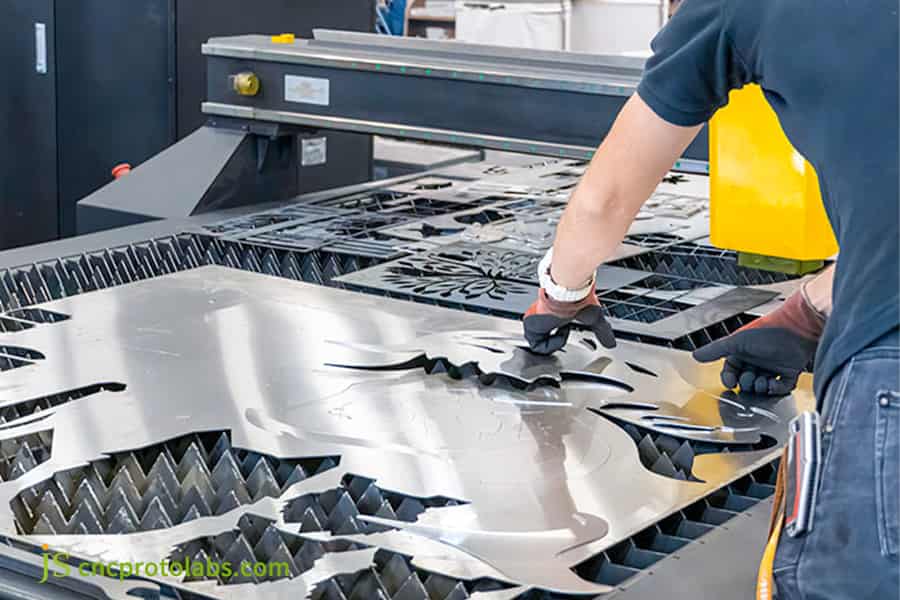
Figure 1: Worker removing laser cut metal sheet parts from cutting machine bed.
How Do Tolerance and Kerf Quality Vary Across Precision Laser Cutting Service Options?
Precision laser cutting service tolerance is directly affected by material thickness and the supplier's thermal control capability. SendCutSend offers ±0.12mm (±0.005"), LaserBoost relaxes to ±0.20mm, while Protolabs achieves stable ±0.08mm.
Kerf Width and HAZ Depth by Material and Thickness
|
Material |
1mm Thickness |
3mm Thickness |
6mm Thickness |
12mm Thickness |
|---|---|---|---|---|
|
Cold-rolled steel (SPCC) |
Kerf 0.12mm, HAZ 0.05mm |
Kerf 0.18mm, HAZ 0.10mm |
Kerf 0.25mm, HAZ 0.20mm |
Kerf 0.35mm, HAZ 0.35mm |
|
Stainless steel 304 |
Kerf 0.14mm, HAZ 0.06mm |
Kerf 0.20mm, HAZ 0.12mm |
Kerf 0.28mm, HAZ 0.22mm |
Kerf 0.40mm, HAZ 0.40mm |
|
Aluminum 6061 |
Kerf 0.16mm, HAZ 0.04mm |
Kerf 0.22mm, HAZ 0.08mm |
Kerf 0.30mm, HAZ 0.15mm |
Kerf 0.42mm, HAZ 0.30mm |
Data source: JS Precision 2025 production measurement database (8,400+ parts); ISO 9013:2017 Class 1 quality range.
Micro-Hole Drilling Challenges and Solutions
When hole diameter is smaller than material thickness (D/t < 1), piercing instability leads to hole ovalization:
- SendCutSend: Software compensation of fixed 0.15 mm oversize suitable for holes of non critical dimensions.
- LaserBoost: Minimum hole diameter equal to material thickness of aluminum and copper to prevent excessive taper.
- Protolabs: Dynamic adjustment of laser power curve reduces the laser burn-through corners by 40% on a hole array.
- JS Precision: Adaptive segmented piercing keeps roundness within ±0.02 mm even at D/t = 0.8.
Thick Plate Hole Roundness Management
For plates of 6mm, heat build-up will lead to hole diameter fluctuations: entry side gets an extra 0.05mm, whereas exit side contracts by 0.10–0.15mm. You should ideally keep a 0.15mm gap for assembly holes or alternatively select a manufacturer who offers the adaptive piercing technology in segments.
Upload your part drawings to JS Precision to get a free DFM review. Their engineers will be able to tell you which features have to be 0.02mm in tolerance and which ones can have a looser tolerance at 0.15mm saving you up to 25% or 15% on your quoted price.
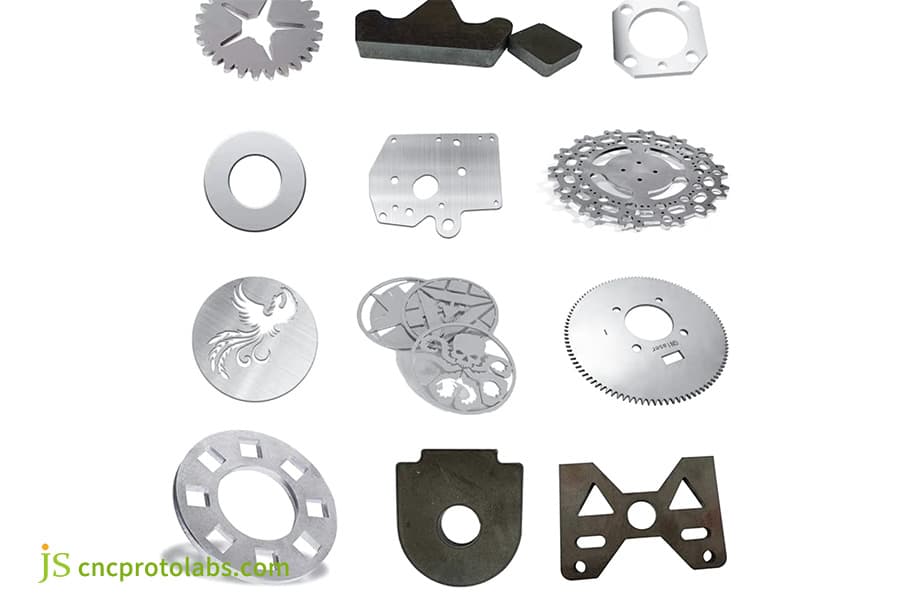
Figure 2: Collection of precision laser cut metal parts showing various shapes and quality.
How Does Custom Laser Cutting Service Optimize Fabrication Costs via Nesting and Gas Selection?
Custom laser cutting service cost reduction relies on high-density common-edge nesting algorithms and proper assist gas configuration. Using compressed air instead of high-purity nitrogen for carbon steel reduces gas cost by 18%, while common-edge micro-tab nesting lifts material utilization from 68%–72% to 87%–89%.
Laser Cutting Cost Breakdown Model
|
Cost Component |
Percentage |
Key Drivers |
|---|---|---|
|
Raw material |
50% |
Sheet price, nesting utilization |
|
Machine depreciation & labor |
25% |
Hourly rate, cutting speed |
|
Assist gas & electricity |
15% |
Gas type, pressure, flow rate |
|
Post-processing |
10% |
Deburring, grinding, pickling |
Data source: JS Precision 2025 cost accounting data; SME 2025 Fabrication Cost Survey.
Oxygen vs. Nitrogen vs. Compressed Air: Surface Quality Impact
- Oxygen cut: Ideal for carbon steel thick plates, Ra 6.3–12.5μm, need to grind to remove oxidation before paint
- Ultra-pure nitrogen (99.999%): Ra 1.6–3.2μm without any oxidation, no treatment required before welding and spraying.
- Compressed air: Cheapest gas option (0.05/m³ vs. Nitrogen 0.30/m³), mild oxidation can be seen on stainless steel after processing.
Nesting Efficiency: Platform vs. Manufacturer
- SendCutSend and OSH Cut: online automated nesting with fixed 3–5mm spacing, typically material utilizations are 70%–75%.
- JS Precision: Manual hybrid nesting that allows for 2mm spacing, cutting laser heads idle time by 30% and decreasing number of pierces by 40%. This sheet metal fabrication cost reduction method is particularly evident in mass production.
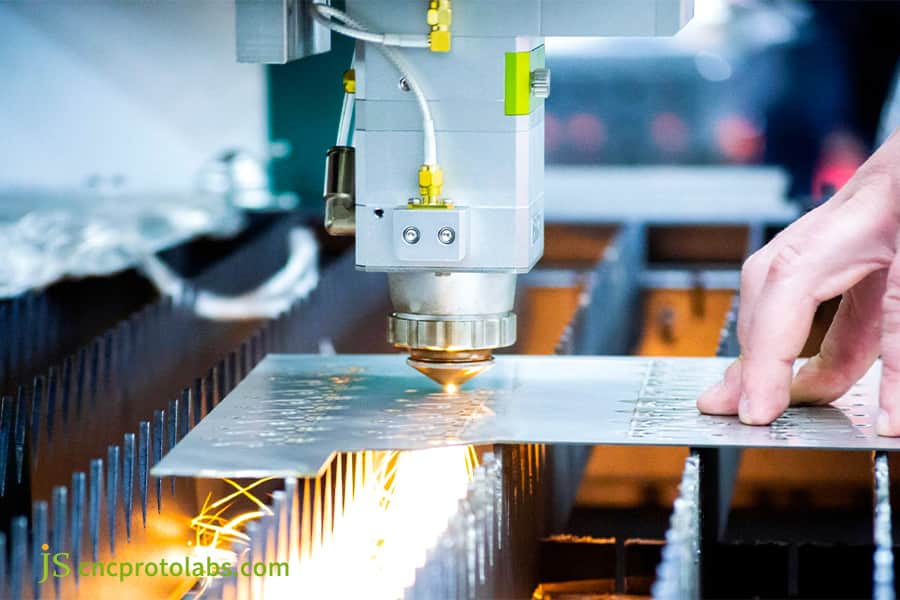
Figure 3: Laser cutting machine nesting and cutting metal sheet with hand guidance.
What Are the Pros and Cons in This Laser Cutting Comparison Guide?
A laser cutting comparison guide presents in detail, differentiating production modes, pricing formulas, and after-production integration features of seven main suppliers. Algorithmic systems stand out in delivering quick quotes for the one-off prototype, while then again the manufacturers with in-house manufacturing capability are proving their cost-cutting capacities for the medium-larger batches.
Provider Deep Dive
In sheet metal laser cutting services comparison, take the three elements of minimum order quantity, file format, and post-processing support as your points of comparison.
- SendCutSend: 60-sec fully automatic quoting system. There is no minimum order. But, manual nesting discounts for large batches are not available. Extra charges will be applied for thickplate dross removals. Ideal for 1–5 piece prototyping.
- OSH Cut: this company is a leader in 3D sheet metal unfolding verification. In addition, they are one of few sheet metal companies in the world that can provide real-time bending simulation. M3-M36 thread tapping is also supported. Price per unit batch machine-hour is at a high relative level. Ideal for 5–20 piece chassis prototypes with standard fasteners.
- Xometry: through a global network of manufacturing locations, the company is good choice for very heavy/large parts and/or multiple operations. The resolution of disputes of product quality usually takes 72 hours. It is a good option for multi-national decentralized purchasing.
- Protolabs: Fully automated digital manufacturing facility providing closed-loop production with repeat accuracy of 0.08mm, higher prices; the product first and foremost suited for development stages of high-budget medical, aerospace parts.
- RapidDirect: from rapid prototyping to small lots; instant DFM review; small capacity to cut plates heavier than ordinary; fitting for hardware startups 10–50 piece trial runs.
- LaserBoost: the delivery of Europe's standard metals of 0.5–15mm is done very quickly by a Europe logistics cycle of 72 hours; the material deviation is 0.20mm; it does not have a cross-continent edge; is suitable for European local orders needing urgent delivery.
- JS Precision: A self-activated production line of 20kW capable of sheet-metal bending with material-saving rate over 88% available for jobs of medium to large size, lot of at least 50 pcs up to 5000+ pcs. Tolerances: 0.02mm–0.05mm. It includes the surface finishing of the entire process and only 4-hour technical support response time. Single piece prototype ordering in the online checkout is not available. Ideal for mid-to-large batch precision sheet metal customization.
Provider Comparison Matrix
|
Provider |
Min. Order |
File Format |
Post-Processing Support |
|---|---|---|---|
|
SendCutSend |
1 piece |
DXF, SVG, AI |
Deburring, brushing (extra) |
|
OSH Cut |
1 piece |
DXF, STEP |
Bending, riveting, tapping |
|
Xometry |
1 piece |
STEP, STL, X_T |
Full suite (varies by shop) |
|
Protolabs |
1 piece |
STEP, DXF |
Deburring, tapping, anodizing |
|
RapidDirect |
1 piece |
STEP, DXF, PDF |
Bending, welding, surface treatment |
|
LaserBoost |
1 piece |
DXF, DWG, STEP |
Basic deburring, bending |
|
JS Precision |
10 pieces |
DXF, DWG, STEP |
Full: bending, riveting, welding, powder coating, anodizing |
Data source: Public information on the official websites of various service providers (Q1 2026).
Understanding laser cutting service pricing requires identifying hidden costs—SendCutSend's extra charges for thick-plate dross removal and Xometry's multi-tier subcontracting premiums.
Request a side-by-side quote comparison from JS Precision—submit your 3D STEP model and target quantity to receive a detailed breakdown.
How to Choose a Sheet Metal Laser Cutting Service for Prototyping vs Mass Production?
Choosing a sheet metal laser cutting service depends on your procurement volume and lifecycle stage. For 1–10 piece prototype validation, prioritize SendCutSend or OSH Cut; for 50+ piece production, switch to a manufacturer with in-house production lines.
Three-Stage Procurement Decision Tree
Stage 1: Prototype Validation (1–10 pieces)
- SendCutSend and OSH Cut base quoting on code, thereby removing engineering review time.
- Best turn around: 24–48 hours from file upload to shipment.
Stage 2: Pilot Run (10–100 pieces)
- Suppliers with engineering review capability (RapidDirect, JS Precision) verify bend allowance and reduce scrap rate by 15%–25%.
- Typical lead time: 3–5 business days including DFM feedback.
Stage 3: Mass Production (100–5000+ pieces)
- Platform software fees and fixed markups become cost disadvantages.
- Compared with algorithm platforms, JS Precision can lower the per-unit cost by 25-40% through bulk sheet purchasing (8%-12% saving), an automatic material tower (40% less handling time) and a combination of common-edge nesting with some manual nesting which produces above 88% yield.
Cost Conversion Curve Example
From our work on the JS Precision 2025 production scaling project:
- 10 pieces @ SendCutSend: $18.50/piece, 2-day lead time
- 100 pieces @ JS Precision: $8.20/piece, 5-day lead time (includes DFM and bending)
- 1000 pieces @ JS Precision: $4.95/piece, 7-day lead time (full nesting optimization)
Request a batch pricing estimate from JS Precision—upload your drawings with target quantities of 50, 200, and 1000 pieces to receive a tiered price curve.
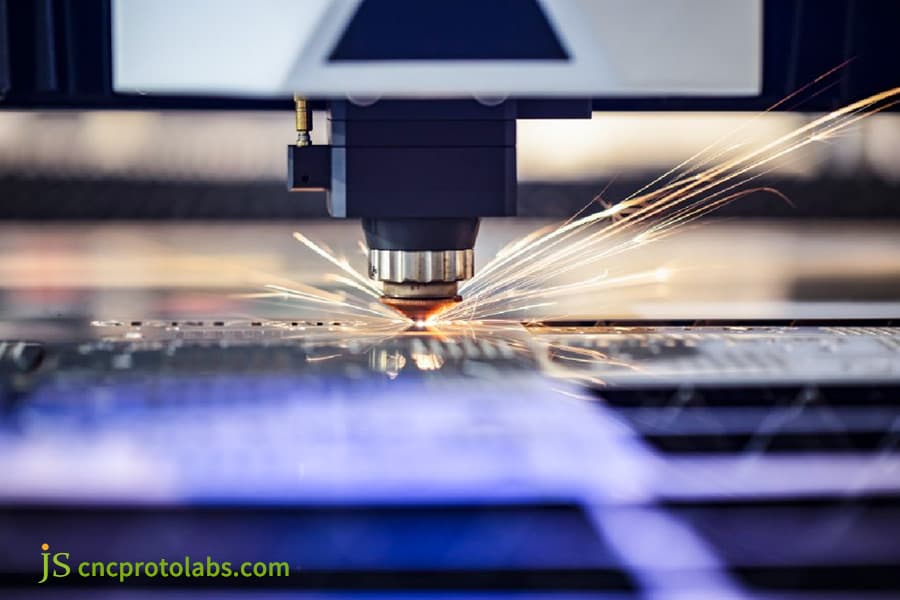
Figure 4: Close up of laser cutting machine processing metal sheet with bright sparks.
Why Is Secondary Fabrication Crucial for a Precision Laser Cutting Service?
Variations in secondary fabrication capabilities in precision laser cutting services directly affect assembly yield as well as hidden costs. Platforms that are only limited to flat cutting require clients to outsource bending and surface treatment with the result that logistics costs increase by 20%+ and accumulated tolerance exceedance risk.
Crystal Orientation and Bending Crack Prevention
- Bending in the running direction: K factor=0.33, bending deduction=1.5x material thickness.
- Bending against the running direction: K factor=0.42, bending deduction=1.8x material thickness.
- Failure mode: an incorrect K-factor will lead to cracking on the outer surface most of all so for 6061-T6 aluminum and high-strength steel.
In-House vs. Outsourced Secondary Capability Comparison
|
Capability |
OSH Cut |
JS Precision |
|---|---|---|
|
Standard bending |
Up to 3/4" plate, M3-M36 tapping |
Complex multi-bending, 8-axis CNC |
|
Deburring & edge rounding |
Manual (extra) |
Timesavers dual-direction rotating brush (automated) |
|
Surface treatment |
Not offered |
Powder coating, anodizing, chromate conversion |
|
Weld preparation |
None |
Bevel cutting |
The combination of forming and finishing processes directly influences the correctness of assembly. JS Precision has a single facility that does bending deburring surface treatment, which removes a need for having multiple suppliers and accumulating tolerances.
Salt Spray Test results
ASTM B117 salt spray test results indicated that galvanized steel deburred and rounded parts showed no white rust (the beginning stage of corrosion) after 720hr while laser-cut sharp edged parts peeling at burrs failed at 480hr.
In other words, deburring is more than appearance, it enhances a coating with corrosion resistance of a powder-coated surface by almost twice.
Case Study: JS Precision Custom Precision Laser Cutting for Industrial Energy Storage Enclosures
Custom laser cutting service delivered by JS Precision achieved 34.2% cost reduction on 2.5mm SGCC battery enclosures for a European energy storage integrator, while maintaining ±0.05mm assembly tolerance.
Client Challenge
The customer earlier used a simple one-part nesting prototyping platform and sent their bending to an outsource partner. It came down mainly to:
- Material use: 68% only
- Edge Rusting: there was severe HAZ discoloration that was the reason for a weld porosity problem with automated welding.
- Rework rate (Batch level): 14.5%.
JS Precision's Solution
- Nesting change: Smart nesting using intelligent sharing of edges through CAD/CAM increased the sheet yield to 87.2%.
- Equipment adjustment: A combination of 20kW fiber laser with 16 bar high-purity nitrogen, nozzle standoff 0.6mm, eliminated the problem of oxidation.
- Tabs/Heat Management: Tabs of pre-set size 0.2mm, the FlyCut algorithm decreased the heat-related changes from 1.2mm to 0.08mm.
- Integration of the closed-loop process: Laser-cut parts were automatically fed into 8-axis CNC bending machine.
Failure Experience and Process Correction
In the first trial batch, the usual pulse piercing led to 0.5mm substrate warping in the dense vent hole area. Engineers then tested a frequency-variable progressive piercing technique with power cooling delay at corners, which entirely prevented the problem of thermal deformation.
Final Results
- Unit manufacturing cost: Reduced by 34.2%.
- Raw material consumption: Reduced by 19%.
- Welding porosity defect rate: Dropped to below 0.02%.
- Delivery lead time: Compressed from 18 days to 7 days.
If your energy storage, automotive, or industrial enclosure project is such that tight tolerances and economical batches in mass production are necessary, then you may upload your STEP/DXF drawings to the digital engineering evaluation system of JS Precision. Then process engineers will return not only DFM optimization remarks, and nesting yield projections, but also tiered production quotes within 2 hours.
FAQs
Q1: What are the advantages of fiber laser cutting over waterjet and plasma cutting in terms of tolerance and cost?
Fiber laser gets the highest cutting speed on sheet material from 0.5–20mm and no contamination comes from consumables. The width of the kerf is only between 0.1–0.3mm and tolerance is set from ±0.02mm to ±0.05mm.
Q2: Which assist gas should be selected among oxygen, nitrogen, and high-pressure air for sheet metal cutting?
Oxygen is first and foremost used in oxy-fuel cutting of thick carbon steel plates, while stainless steel, aluminum, and even galvanized sheets demand 99.999% pure nitrogen to avoid surface oxidation. However, high-pressure air is mostly used for low-price non-aesthetic applications.
Q3: What core engineering parameters determine the final quote for a sheet metal laser cutting service?
Among them are the material grade and thickness, the overall length of contour cutting, the total number of piercings, the type of assist gas, hourly machine cost, number of items per order, etc. Get an instant free quote by uploading drawings - the closer you can present your drawings the better price you will get.
Q4: How can CAD drawings be optimized according to DFM principles to reduce laser cutting costs?
Get rid of overlapping lines and redundant nodes. Design the hole diameters at least 1.2× material thickness. Leave enough space for common-edge nesting. Reduce the unnecessary narrow slots which in turn lowers the piercing frequency. Good DFM can save 15% machine time.
Q5: What tolerances and delivery lead times can JS Precision achieve for custom precision laser cutting?
JS Precision's 20kW fiber laser cutter ensures standard precision of contours to within ±0.02mm. Prototypes can be delivered in a day or two, and the bulk orders of 500–5000 pieces will be completed and ready for shipment in 5 to 7 days if working days are counted.
Q6: Can highly reflective materials like copper and aluminum alloys be reliably processed by fiber laser?
Absolutely. High-power fiber lasers that use anti-back reflex isolators, high-frequency modulated pulses, and powerful nitrogen cleaning efficiently work brass sheets copper various alloys of aluminum, and the cutting surfaces come vertically and free from residues.
Q7: What is the typical percentage of unit cost reduction when scaling from prototyping to mass production?
The switch from 1–5 piece prototyping to 500+ piece manufacturing generally leads to a 25%–40% decrease in per-unit cost. The use of combined nesting and the production of continuous goods automatically results in a 34%+ total saving.
Q8: What specific design files and specifications are required to receive an accurate laser cutting quote?
Provide 2D drawings (DXF/DWG formats) with critical tolerances marked as well as a 3D model (STEP format) with bend information. State material grade thickness quantity and post-processing requirements clearly.
Summary
Selecting top 7 sheet metal laser cutting services basically comes to the nesting utilization, flawless edge quality that saves secondary processing, and efficient full-process integration. Using purest possible assist gas, optimizing geometry of lead-in, and matching correct suppliers prototype with production can all help to prevent the need for rework assembling and realize costs cutting in the life cycle.
Looking for a manufacturer which offers precise features for you as if it is made on a single part scale? Upload your STEP / DXF drawings to JS Precision' digital engineering evaluation system at once. Our technicians for processes can send you DFM improvement proposals, nesting yield forecasts, and production quotations with different tiers all within 2 hours, shortening product development time and minimizing overall purchase expenses.

Disclaimer
The contents of this page are for informational purposes only. For JS Precision Services, there are no representations or warranties, express or implied, as to the accuracy, completeness, or validity of the information. It is the buyer's responsibility to identify specific technical requirements and request a formal parts quotation. Please contact us for more information.
Resource