English



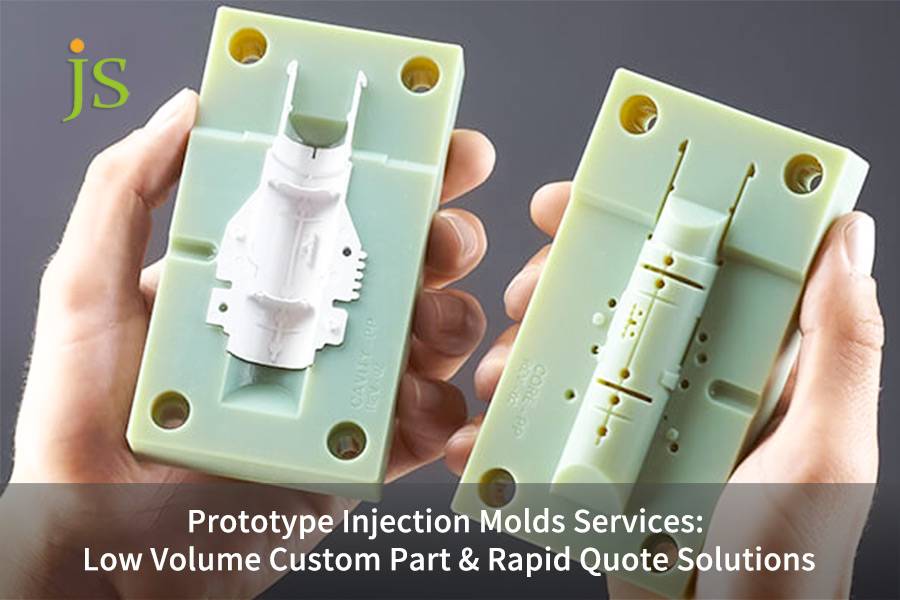

Using prototype injection molds is a major remedy for the issues of low volume plastic prototype verification. A lot of companies run into a whole set of problems when they require 50 plastic functional prototypes during the R&D phase:
Conventional steel molds cost $20,000 and have a 6 week waiting period, 3D printed parts cannot pass temperature resistance tests, and CNC machining is completely ruled out because of the concave structures.
In a way, low volume injection molding prototype verification is caught in the triple dilemma of "cost, cycle time, and performance, " and the use of injection mold tooling is the key factor which will decide if these problems can be addressed in a very efficient manner or not.
Core Answer Summary
|
Problem
|
Solution
|
Key Data
|
|---|---|---|
|
High Mold Costs For Small Batches
|
Aluminum molds/3D printed inserts
|
Startup costs reduced by 60%-70%
|
|
Long Mold Delivery Cycle
|
Rapid CNC machining
|
5-7 days delivery
|
|
Slow Quote Feedback
|
Standardized mold base + automated DFM
|
Quote within 2 working hours
|
|
Prototype Performance Deviates From Mass Production
|
Mass production uses the same resin grade + process matching
|
Shrinkage deviation ≤0.2%
|
Key Takeaways
- Rapid injection molding is just one fifth the price of 3D printing for 50-500 functional prototypes, which cuts prototype costs drastically for the customers.
- To get high quality prototypes, customers have to select suppliers who have dedicated prototyping workshops, tolerance control closed loop (0.05mm), and quick material changing capabilities.
- JS Precision offers material certification reports and dimensional inspection reports which can help customers to directly move from prototypes to mass production and can save costs in future iterations.
Why Choose JS Precision's Prototype Injection Mold Services?
Selecting the right prototype injection molds service is critically important for business success when trying to address the problem of low volume prototype verification.
JS Precision has been extensively experienced in prototype injection molding and injection mold tooling for decades and has served over 500 companies in sectors such as medical, automotive, and electronics. We give our clients workable solutions that are suitable to their individual requirements.
We strictly follow the ISO 16916:2016 international standard in the design and manufacture of injection snap molds, so our output matches the international level of quality, and at the same time, our clients can effectively address quality risks and finish prototype verification efficiently.
A startup in the medical device sector needed 50 endoscope handle prototypes. Traditional steel molds were too expensive ($21,000) and they had a long delivery time (up to 8 weeks), while 3D printed samples did not pass a 70℃ sterilization test.
Working with JS Precision, the customer got the right prototypes in just one week. Costs were kept low with the use of 7075 aluminum molds and slider core pulling technology, coming to $6,300 only, the client was directly saved $14,700 and at the same time, R&D investment and time costs were drastically reduced.
When it comes to low volume prototype validation, companies mainly focus on the speed of response and the accuracy of prototype, with having separate prototyping workshops and the use of efficient equipment as the main factors capable of guaranteeing these goals.
JS Precision with three FANUC Roboshot dedicated prototyping injection molding machines (30-100 tons) purchased, has opened a prototyping workshop dedicated to prototyping and does not take mass production orders, which is a great way to meet customer needs quickly.
Our closed loop tolerance control is 0.05mm, besides that we provide material certification and dimensional inspection reports which assist our customers to move directly from prototype to mass production, reducing costs of subsequent iterations and becoming a trustworthy partner for a low volume prototype validation.
If you are struggling with cost and lead time issues in low volume prototyping, contact our engineers for a customized prototype injection molds solution and a free project feasibility assessment.
What Are Prototype Injection Molds And How Do They Address High Costs And Long Lead Times In Low Volume Production?
Aluminum molds or 3D printed inserts that are used in prototype injection molds are a substitute for the usual steel molds. This way, the start up costs could be cut by 60%-70%.
Rapid CNC machining can be employed, and the time for mold delivery can be brought down to 5-7 days, which is perfect for small batch prototype production of 50-500 pieces, thereby solving the problem of low volume prototype verification.
Cost Amortization Failure of Traditional Steel Molds in Small Batch Production
The price for processing one single P20 steel mold is around $15,000-$20,000. If the cost is shared among 200 pieces, then the cost per piece would be $75-$100, which greatly raises R&D expenses.
Besides, steel mold heat treatment and EDM processing usually take 4-6 weeks, which is not the case if R&D needs extremely short cycles for iterations.
Low Cost Alternatives for Aluminum Molds and 3D Printed Inserts
The SPI Class 105 standard dictates that the lifespan of a prototype mold should not be more than 500 cycles.
We have aluminum molds made from 7075 that meet this standard in every way as they have been brought to softness of HB 150 and can resist 500-1000 injection cycles. The price of the mold is only $3,000-$5 000 just a quarter of that of steel molds.
To put it simply, this is just like hiring a temporary car to meet your "temporary need" during the R&D phase, instead of spending a lot of money on buying a vehicle that will be used forever, at the same time fulfilling the needs while saving money.
Rapid CNC Machining Enables 5-7 Day Delivery
We employ a fast CNC machine equipped with a spindle speed of up to 24,000 rpm for aluminum mold processing. In fact, roughing and finishing are performed together in one setup, and the whole operation lasts 12-18 hours.
Besides, when using standard mold bases from DME or Hasco, this will enable you to save 70% of the mold base machining time. As a result, the mold can be delivered within 5-7 days.
Download the prototype injection molds selection white paper to clearly understand the applicable scenarios for aluminum molds and steel molds, helping you quickly identify the appropriate injection mold tooling solution.
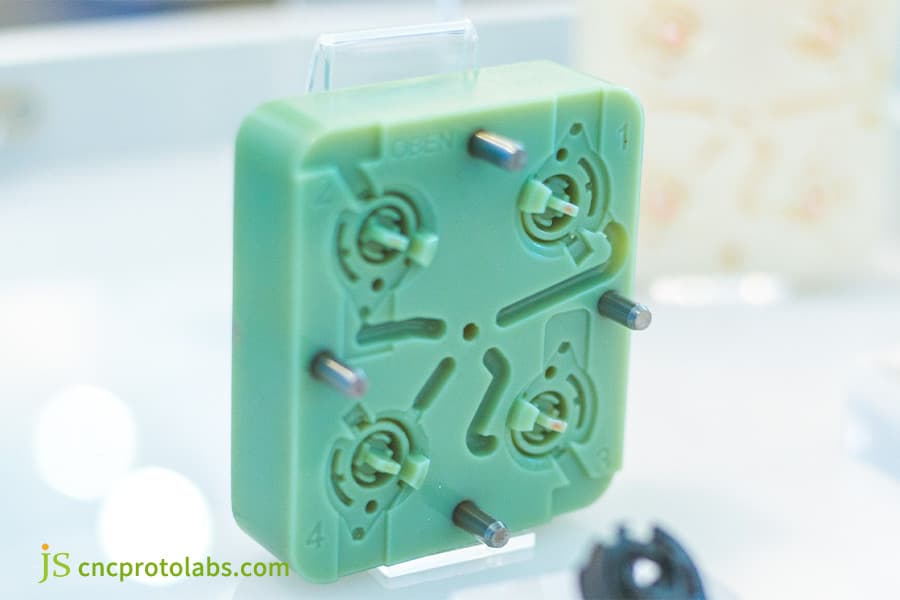
Figure 1: A translucent green prototype injection mold with four distinct cavities, metal guide pins, and ejector systems, mounted on a display stand.
How Does Prototype Injection Mold Services Achieve 24-Hour Fast Quoting From Design To Parts?
Once customers have uploaded the 3D drawings in STP or X_T formats, the system is capable of spotting the molding defects and giving a rough estimate of the mold processing time within 30 minutes.
JS Precision commits to sending a preliminary quote within 2 working hours, effectively addressing the challenge of slow quotation turnaround and assisting clients in making quick decisions.
A Standardized Mold System Cuts Custom Design Time
We have prepared six standard mold sizes in advance, which will cover about 90% of the prototype parts. Only core/cavity inserts require machining. The mold bases are reusable, so the design duration drops from 3 days to 4 hours, thereby greatly enhancing the efficiency of quotation.
Automatic DFM Analysis Tool Rapidly Locates Molding Defects
This program scans elements such as thickness of walls, areas of undercuts and angles of drafts.
The recommended thickness of walls is 1.5 to 3.0mm (a warning will be generated for deviations beyond 20%), and the draught angle of between 1.5 and 2 is the one proposed. Besides, information about the location of the gate and the existence of the risk line is included in the final DFM report.
To put it simply, it is like "examining" your prototype design beforehand, detecting any troubles that might arise and steering clear of the need for redoing during the actual production.
2-Work-Hour Quotation Commitment and Urgent Order Processing
We confirm complexity of the mold within 1-hour time frame, besides, we calculate material and machine costs within 1 hour so the preliminary quotation is given no later than 2 working hours. In the case of urgent orders, we offer a formal quotation including a mold life prediction within 4 hours.
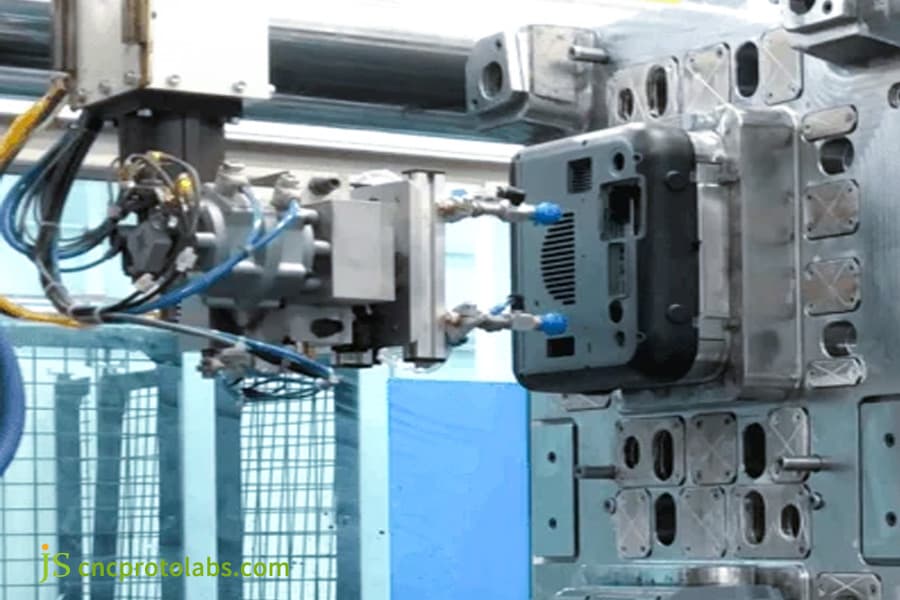
Figure 2: A close-up of industrial machinery performing precision machining on components, within a factory setting.
How Do Parts Of a Plastic Injection Mold Directly Affect The Cost And Flexibility Of Modifying The Prototype Mold?
The configuration of parts of a plastic injection mold directly affects cost and modification flexibility. The mold base makes up 40% of the mold price, which can be lowered to 25% by opting for a standard mold base.
Accuracy is largely dependent on the core/cavity, and the ejection and cooling features will be the most loosened in the prototype phase.
Making Mold Base Standard and Material Choice for Core/Cavity
LKM standard mold bases cost only $800-$1500, while custom mold bases cost over $5000. Core/cavity materials are selected based on batch size: aluminum for <500 pieces, and steel for 2000 pieces.
Methods for Ejection and Cooling System Simplification
In the prototype stage, molds can also simplify the ejection and cooling structures. For instance, the number of ejector pins can be cut by half from 8 to 4, and still, the ejection balance can be maintained.
Two straight through water channels are used in the cooling system to keep the difference in mold temperatures at 5 thus the problem of part warping and deformation is completely eliminated, and the cost and precision are balanced.
The Core Functions of Parting Surface and Core Pulling Cannot be Simplified
Concave shapes in molds generally need sliding blocks or ejectors at some angle to the surface to get the parts out after molding. At the prototype stage, manual core pulling simply by hand can be done (can lead to 40% cost reduction).
- If you have 3 iterations or less, it is better to go for the manual core pull method.
- For 5 iterations and above, a pneumatic sliding block costing $800 would be the best choice from the standpoint of both cost and efficiency.
What Failure Modes Should Injection Molding Tool Design Avoid for Custom Parts?
The logic of injection molding tool design will directly decide the quality of the prototype output. If the gate, cooling, and ejection features are badly designed, they can cause weld lines bending etc. problems. By means of mold flow analysis and interchangeable inserts, the first time molding yield rate can be boosted up to over 90%.
Weld Lines and Strength Reduction Caused by Incorrect Gate Location
A controller housing spawned a weld line directly opposite the base of the snap fit due to an unauthorized gate location, thus the tensile strength was only 52% of the design value. After re-gating the product to the tail end, the strength went back to > 90% of the base material.
Insufficient Cooling Channels Leading to Warping and Extended Cycles
It takes 1 cycle of an aluminum mold without cooling channels for 90 seconds, and the part flatness is over 0.15mm. Having a 6mm diameter straight through cooling channel, cycle time reduced to 35 seconds, with warping 0.05mm, thus combining efficiency and precision.
Quickly Replaceable Insert Design Supports Iterative Modifications
These replaceable parts have been made as separate and independent inserts. When you want to do a modification, you just have to change the insert related to the modification. You do not have to remake the whole mold. In fact, it will only cost you $200-$500.
In other words, it's just like changing a phone battery, you don't change your whole phone only because the battery becomes old, you only change the main parts so that you can still use it, thereby saving money and also making it more efficient.
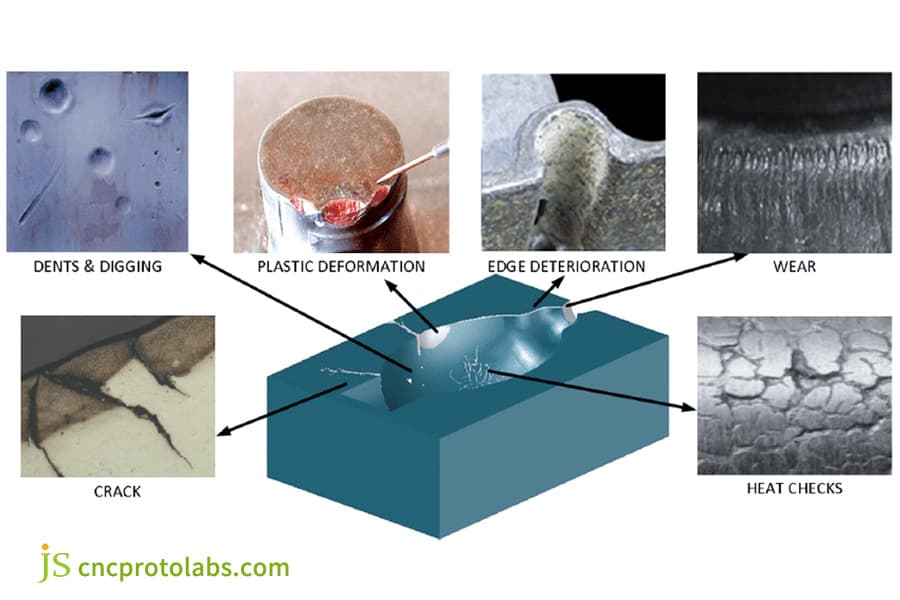
Figure 3: A technical diagram illustrating various types of edge deterioration in injection molds, such as dents, cracks, plastic deformation, and heat checks.
How To Determine If Plastic Injection Molding Products Meet The Final Assembly Requirements During The Prototype Stage?
The main factor in deciding if a plastic injection molding products prototype is qualified is that it performs well and is consistent in terms of dimensions with the mass produced part, so that no rework is required later.
Handling Variations in Performance Between Prototype and Original Raw Material
For example, switching the prototype material from unreinforced ABS to the mass production material of glass fiber reinforced ABS can result in the shrinkage rate being reduced from 0.5% to 0.2%, which may cause assembly problems.
Ensuring that prototype and production are made of the same raw material grade, and that the MFI difference is 5%, is very important.
Accurate Duplication of Shrinkage Rate by Molding Parameters
Molding parameters such as holding pressure and mold temperature have a direct impact on the shrinkage rate. For instance, raising the holding pressure from 50MPa to 80MPa would lower the shrinkage rate, and increasing the mold temperature results in higher shrinkage rate. A shrinkage rate variation of 0.2% can be preserved.
Material Certification Reports and Dimensional Inspection Reports Release Standards
The material certification report must contain details like density, tensile strength, etc. Dimensional inspections rely on CMM, where the critical size CPk 1.33, thus ensuring that the prototype and production part are consistent and avoiding any assembly problems.
Get a free Plastic Injection Molding Products Assembly Validation Guide to quickly determine if your prototype meets final assembly requirements and avoid rework.
What Unique Pain Points Does Rapid Injection Molding Solve In Prototype Plastic Molding Compared To CNC Machining And 3D Printing?
Rapid injection molding is capable of producing quite complex hollow shapes in one go, which means there is no necessity for CNC machining and bonding.Also, assembly tolerance stacking is circumvented.
Besides, it employs injection grade raw materials with isotropic deviations 5% and the tensile strength of the produced parts is 2-3 times higher that of FDM 3D printing. As a result, it is an ideal process for small batch prototyping needs.
Comparison of Performance and Cost of Different Processing Methods
|
Processing Method
|
Tolerance Range
|
Material Isotropic
|
Total Cost of 200 ABS Shells (USD)
|
Complex Concave Structure Molding Capability
|
Applicable Batch
|
|---|---|---|---|---|---|
|
Rapid Injection Molding
|
±0.05mm
|
Excellent (deviation ≤5%)
|
1300
|
Strong, one time molding
|
50-500 pieces
|
|
CNC Machining
|
±0.01mm
|
Excellent
|
1800
|
Weak, requires disassembly and bonding
|
1-50 pieces
|
|
3D Printing (FDM)
|
±0.1mm
|
Poor (Z-axis strength only 30% of X-Y plane)
|
1600
|
Medium, insufficient detail precision
|
1-20 pieces
|
|
Traditional Steel Mold Injection Molding
|
±0.02mm
|
Excellent
|
21500
|
Strong
|
Over 1000 pieces
|
vs CNC: Molding Capability of Complex Concave Structures
CNC cannot work on closed concave or deep narrow grooves. This means that in order to finish the process, disassembly and bonding are necessary. The combined assembly tolerances go up to 0.2mm.
Rapid injection molding, on the other hand, uses sliders/angled ejectors for one time molding without any assembly errors.
vs 3D Printing: Isotropic Materials Mimic Real Strength
Parts printed with FDM have Z axis strength only 30% compared to X-Y plane strength. Besides, they do not pass the flame retardancy and sterilization tests.
Rapid injection molding however using injection grade raw materials with isotropic deviations 5%, allows to conduct a mechanical verification that reflects the real world.
Contact our engineers for a free cost estimate for your prototype plastic molding project, comparing the cost effectiveness of different processing methods to choose the optimal solution.
What Three Technical Indicators Matter When Selecting the Best Injection Molding Companies?
Choosing best injection molding companies requires special attention to three main parameters, which will directly affect the quality of prototypes, lead time, and cost without compromising other factors.
Mold Material Performance Comparison Table|
Mold Material
|
Hardness
|
Mold Cost (USD)
|
Service Life (times)
|
Processing Cycle (days)
|
Applicable Batch
|
|---|---|---|---|---|---|
|
7075 Aluminum Mold
|
HB 150
|
3000-5000
|
500-1000
|
5-7
|
50-500 pieces
|
|
6061-T6 Aluminum Mold
|
HB 95
|
2000-3500
|
300-500
|
4-6
|
50-300 pieces
|
|
P20 Steel Mold
|
HRC 28-32
|
15000-20000
|
Over 10000
|
30-42
|
Over 1000 pieces
|
|
H13 Steel Mold
|
HRC 45
|
25000-30000
|
Over 50000
|
40-50
|
Over 5000 pieces
|
|
3D Printed Inserts
|
HB 80
|
500-1500
|
100-300
|
1-2
|
-
|
When it is only 20-100 pcs, mixed line production will add 10 working days to the prototype mold queue, which results in delaying the R&D phase.
JS Precision is equipped with not only a prototyping workshop but also 3 dedicated injection molding machines that are never used for mass production. Advance orders get a reply within 48 hours, thus ensuring a quick delivery time.
Closed loop tolerance control is indispensable for precision. To correct mold deviations, we rely on Renishaw probes, and the first piece is checked with a CMM. We change the process so that CPk 1.33, and the critical dimension deviations are kept 0.05mm, which is the standard for mass production.
JS Precision Case Study: 50 Endoscope Handle Prototypes For Medical Device Startup Companies
Medical device prototype verification demands highest standards on the materials, accuracy and production time. This project is a good example of how JS Precision via prototype injection molding can solve core problems of the clients in a fast and efficient way.
Challenges Encountered
A medical device startup wanted to buy 50 prototype endoscope handles. One handle is composed of four hidden clips and a 1.5mm cooling channel.
PC/ABS alloy (HDT 110) was the main material used and the clips had to survive a 50N tensile force. Steel molds took 8 weeks, cost 21K, and 3D printed samples were deformed after 70℃ sterilization and did not fulfill the requirements.
Solution
After analyzing very thoroughly the client's needs, JS Precision came up with a targeted prototype injection mold solution.
We employed 7075 aluminum molds with mold costs of only $5 800 which drastically cut down clients cost. To get over the recessed clip challenge, we came up with a slider core pulling structure to produce one piece molding of the recessed clips. In this way, we bypassed the precision deviation issues resulted from disassembly processing.
Using mold flow simulation, we set the gate to single point injection at the handle tail, and by the weld line below the decorative rib, the strength of the clips stress area was ensured.
The same grade PC/ABS (SABIC C6200) was the material matched to the mass production model.
With the change of pressure holding parameters (70MPa×3s) and injection speed (60mm/s), the mass production shrinkage rate of 0.5%-0.7% was very closely achieved in the prototype, and thus the performance consistency between the prototype and the mass produced parts was secured.
The molds were handed over within 7 days, and after that, in a very short 2 hours, injection molded 50 parts, which effectively addressed the client's R&D cycle requirements.
Final Results
The average snap fit tensile strength of this batch of prototypes was 53N and the strength of the weld line area was 93% of the base material.
No deformation was observed after 70℃/48-hour heat aging and it passed ISO 10993-5 cytotoxicity screening, which makes it suitable for direct FDA pre-approval.
The total cost was $6 300 which saved $14,700 compared to steel molds and the cycle was also shortened by 7 weeks. The client later replaced the aluminum molds with hard molds for mass production.
For more medical industry prototype injection molding case studies, contact us for a free project cost estimate and to quickly obtain customized prototype injection molds services solutions.
FAQs
Q1: What is the minimum order for prototype injection molds?
The least number of pieces you can order from prototype injection molds is 20. Actually, the mold lifespan of 100-500 cycles is sufficient to meet the requirements of small batch production verification of prototypes during the R&D phase.
Q2: How many parts can be produced from one aluminum mold before breaking?
Molds made of 7075 aluminum are able to carry out from 500 to 1000 injections. After wear, the accuracy becomes 0.1mm. Further use is possible by changing the inserts or making the steel mold.
Q3: How much would a prototype mold modification cost?
Changing only the inserts costs $200-$500. Structural modifications to the entire mold cost $2000 and more.The exact price will be determined by the complexity of the change.
Q4: What types of 3D drawing formats are you able to work with?
We work with STP IGS X_T, and STL. It is advised to use STP as it is able to keep the solid features of the parts better and hence help in mold designing and identifying defects.
Q5: How soon can I get my first part?
Delivery of the mold takes 5-7 days while the process of injection molding requires only 1 day. So in total customers can get their first prototype part in as little as 6-8 days, thereby greatly facilitating R&D verification.
Q6: Can we use raw materials specified by the customer?
Certainly, we can work with the raw materials specified by the customer. We keep 20 grades of the commonly used materials in stock at all times. However, we can also source a wide range of different special grades of raw materials as per specific customer requirements.
Q7: What tolerances can I expect on prototype parts?
The tolerance on aluminum mold prototype parts is about 0.05mm while that on steel molds can be as precise as 0.02mm. These two figures are capable of addressing different precision needs in prototype verification scenarios.
Q8: Can molds used for prototypes be used for mass production?
Prototype aluminum molds can be converted to steel mold inserts. They keep the original standard mold base, so there is no need for redesign which can ultimately save customers 40% of the total cost of mass production molds.
Summary
Prototype injection molds for 50-500 plastic functional prototypes are definitely the best choice when it comes to balancing cost, cycle time, and performance.
It completely eliminates the constraints of traditional steel molds, CNC machining, and 3D printing, providing customers with prototypes at the performance level of mass production parts at a low cost and within a short cycle time during the R&D stage.
Going with JS Precision means you don't have to choose between these three methods. Our expert prototype injection molds services will make it simple for you to have rapid prototype verification and mass production integration, thereby bringing your product to market faster.
Submit your 3D designs and get a formal quote including mold life prediction within 2 hours. Book a technical consultation now and get an initial mold flow analysis report for free.

Disclaimer
The contents of this page are for informational purposes only.JS Precision Services,there are no representations or warranties, express or implied, as to the accuracy, completeness or validity of the information. It should not be inferred that a third-party supplier or manufacturer will provide performance parameters, geometric tolerances, specific design characteristics, material quality and type or workmanship through the JS Precision Network. It's the buyer's responsibility Require parts quotation Identify specific requirements for these sections.Please contact us for more information.
JS Precision Team
JS Precision is an industry-leading company, focus on custom manufacturing solutions. We have over 20 years of experience with over 5,000 customers, and we focus on high precisionCNC machining,Sheet metal manufacturing,3D printing,Injection molding,Metal stamping,and other one-stop manufacturing services.
Our factory is equipped with over 100 state-of-the-art 5-axis machining centers, ISO 9001:2015 certified. We provide fast, efficient and high-quality manufacturing solutions to customers in more than 150 countries around the world. Whether it is small volume production or large-scale customization, we can meet your needs with the fastest delivery within 24 hours. Choose JS Precision this means selection efficiency, quality and professionalism.
To learn more, visit our website:www.cncprotolabs.com
Resource