English




CNC turning lathe serves as essential equipment for the machining of rotating parts, whereas milling machines are mostly employed in the processing of prisms and complex curved surfaces. An incorrect combination of the two may very well result in precision failure and an increase in costs.
In deciding on manufacturing methods, the nub of the issue in choosing either a CNC turning lathe or a machining center revolves around the matching of the part's geometric features with the machine's kinematics.
This post aims to analyze the fundamental rationale of these two technologies and thus demonstrate how a professional CNC turning and milling hybrid strategy can effectively reconcile precision and cost.
Quick Overview of Core Answers
| Core Questions | Key Answers | Value for You |
| Choosing Turning or Milling? | Part geometry determines: CNC turning lathe for the circular parts, milling for the prisms, the complex parts require CNC turning and milling composite machining. | Avoiding precision loss and cost overruns due to choosing the wrong process paths. |
| When is a Vertical Lathe Necessary? | Vertical turning lathe is the only choice for large disc parts with a diameter over 1000mm and weight over 5 tons. | Among other benefits, processing large parts becomes more ruggid and fixture complexity can be lowered. |
| Know the Real Machining Cost | Besides labor costs it is necessary to take into account various hidden costs such as changed clamps errors, process flow, quality risks. | Switching to professional CNC turning services may result in 30-40% overall costs savings. |
| Choose a Reliable Supplier | Assess the situation from four perspectives: the range of the technical capability coverage, quality system, on time delivery rate, and DFM response speed. | Locate a CNC turning company partner who will give full commitment to the value you deserve. |
Key Takeaways:
- Geometry defines the manufacturing process: Parts to be rotated are usually done by CNC turning lathe, prism parts will be processed with a milling machine, and complex parts will require the combination of CNC turning and milling.
- The degree of accuracy depends on the machines: Lathes are capable of producing roundness up to 0.003-0.010mm whereas milling machines can provide flatness tolerance of 0.005-0.020mm/100mm.
- Cost is not limited to unit price: Hidden costs include multiple clamping errors, process flow, and quality risks. Outsourcing CNC turning services can reduce costs by 40%.
- Supplier evaluation in 3 dimensions: Besides the indispensable technical capabilities, operational reliability and quality system are also necessary.
Why Trust This Guide? JS Precision's Sophisticated CNC Turning Services Experience
CNC turning is the core technology of JS Precision, which we have been developing for more than 15 years. Our team has turned, milled, and done composite machining on more than 100,000 precision parts for over 200 high end clients worldwide in the aerospace, medical equipment, and high end automotive parts industries.
We have fixed the problems of more than a thousand pain points of the industry, including selection errors of the process, insufficient precision, and too high costs.
Our machine tools include CNC turning lathe machining with diameters from 0.5-480mm, as well as complex surface machining using five axis milling, thus allowing us to combine different processes for the parts that need them.
With regard to process cost control, JS Precision uses the supply chain advantages of the Dongguan precision manufacturing industrial cluster to lower the average cost per piece for CNC turning and milling composite machining by 35%.
A case in point: after our process optimization, the defect rate of a medical client's 17-4PH stainless steel parts has decreased from 12% to below 0.5% (in accordance with ISO 13485:2016 medical standards).
We have a complete quality inspection system with a high precision CMM coordinate measuring machine and an on line SPC control system for assuring stable machining tolerances of ±0.005mm. Every piece is accompanied by complete first article inspection reports and material certificates.
It has been a long time that we at JS Precision have mainly worked on DFM optimization, helping our customers by identifying and reducing the risks of accuracy and cost in their process design even before they become problems.
Our dedicated team operates 24/7, so we can fulfill our clients' needs for process consultation and drawing analysis within a day. Our efficient sample delivery cycles are always within 7-10 days and bulk orders are 15-25 days. We have developed strong relationships as a core CNC turning company with leading clients across the globe.
Want to gain a preliminary understanding of our selection logic and mitigate cooperation risks? Consider downloading JS Precision‘s free white paper, "CNC Machining Selection and Pitfall Avoidance Guide," to quickly grasp the core evaluation criteria for CNC turning company. No complicated operations are required, making it easy to clarify cooperation directions.
What Are The Core Mechanical Differences Between a CNC Turning Lathe And a CNC Mill?
The major difference between CNC lathe vs CNC mill lies in the kinematic configuration of the machines, which directly dictates the process boundaries and accuracy performance. It is also the fundamental technical reason for CNC turning.
Core Principles
- CNC Turning Lathe: The workpiece rotates, the tool is stationary. It is used for making parts such as shafts and sleeves, thus the roundness can be as stable as 0.003-0.010mm.
- Milling Machine: The tool rotates and the workpiece is stationary. Prismatic parts like brackets and boxes, as well as complex curved surfaces, can be machined by milling which obtains a flatness of 0.005-0.020mm/100mm.
How do the differences in cutting forces influence the process boundaries?
- CNC turning is a continuous cutting process with stable cutting forces, which can allow for a surface finish of Ra 0.8-3.2μm to be easily attained. On the contrary, milling is an intermittent cutting process, therefore the depth of cut should be controlled to prevent chatter.
- The spindle of a CNC turning lathe is designed for radial load mainly, while a milling machine has to handle load from several directions, thus the whole machine and the fixture are required to have higher rigidity.
Still have questions about process matching between CNC lathe vs CNC mill? Contact a dedicated engineer now for free one-on-one answers to your questions, providing precise adaptation suggestions based on the actual situation of the part, without cumbersome procedures.
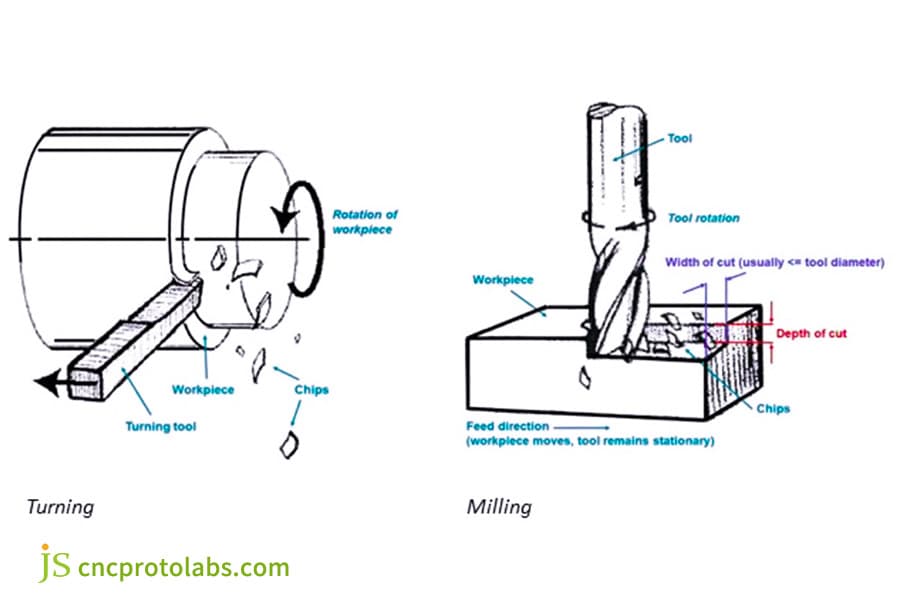
Figure 1: A black-and-white line diagram compares the principles of turning (workpiece rotates, tool is stationary) and milling (tool rotates, workpiece is stationary), showing chip formation and movement.
When Should You Choose a Vertical Turning Lathe Over a Horizontal Alternative?
Choosing between a vertical turning lathe and a horizontal CNC turning lathe is mainly determined by the size, weight, and shape of the part. Both offer unique features that cannot be replaced, and the former being the best choice for large disk shaped parts.
- The inevitable choice for large diameter parts
The vertical turning lathe has a horizontal load bearing worktable and it is particularly designed for disc/flange parts with diameters >1000mm and weights >5 tons, which guarantees machining solidity and accuracy.
- Clamping advantages and gravity assistance
The piece of work to be machined is weighted by its own mass thus the setting costs and fixing mistakes are reduced while at the same time it makes the loading and unloading easier, thus making it very suitable for single piece and small batch production of heavy parts.
- The irreplaceable scenario of horizontal CNC turning lathe
Parts of a shaft with a length to diameter ratio >4 need a horizontal lathe with a tailstock to prevent deformation. Automatic bar stock feeding systems are only compatible with horizontal structures, thus the horizontal lathe is suitable for the mass production of small to medium diameter rotating bodies.
- Comparison of Core Parameters between Vertical Turning Lathe and Horizontal CNC Turning Lathe
| Parameters | Vertical Turning Lathe | Horizontal CNC Turning Lathe |
| Applicable Part Diameter | ≥1000mm | ≤800mm |
| Applicable Part Weight | ≥5 tons | ≤2 tons |
| Length-to-Diameter Ratio | ≤3 | ≥4 |
| Clamping Cost | Low (Gravity Assisted) | Medium (Customized Fixture Required) |
| Loading/Unloading Efficiency | High (Heavy Parts) | High (Automatic Bar Feeding) |
| Typical Machining Parts | Wind Turbine Bearing Housing, Large Flange | Drive Shaft, Precision Pins |
| Surface Roughness | R1.6-3.2μm | 0.8-1.6μm |
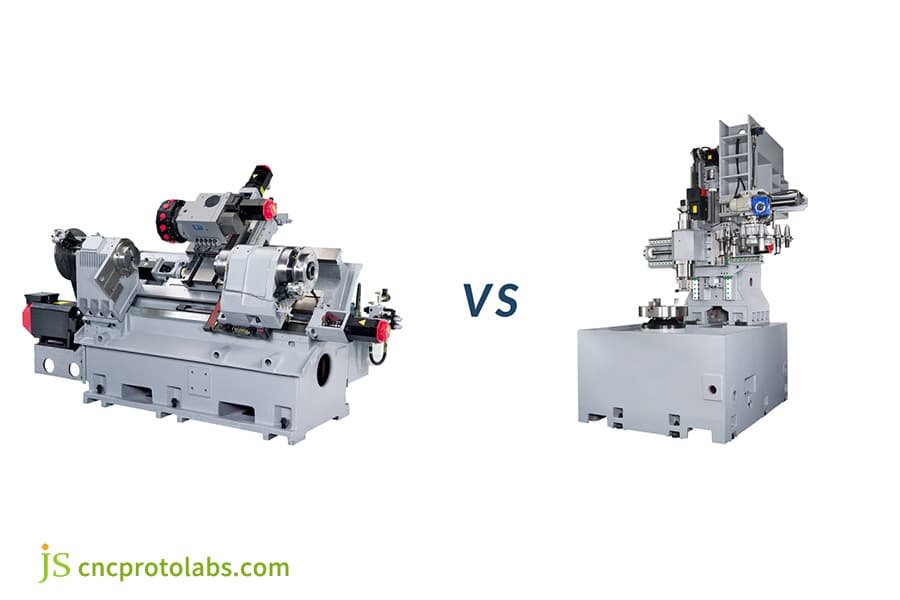
Figure 2: A visual comparison of a horizontal CNC turning lathe (left) with a multi-axis vertical machining center (right), highlighting their structural differences.
CNC Lathe Vs CNC Mill: How Does Part Geometry Dictate The Choice?
The decision between CNC lathe vs CNC mill basically depends on harmonizing the shape of the part with the features of the equipment.
1. Selection of Rotating Parts
Rotating parts such as shafts and pins should be machined in a single setup on a CNC turning lathe to tightly control and achieve standards for diameter tolerances, roundness, and coaxiality.
2. Process Path for Prismatic Parts
For prismatic parts such as brackets and boxes, milling is a good choice as it will perfectly handle the requirements of complex hole making and surface machining, as well as ensuring the accuracy of the hole positions.
3. The Ultimate Solution for Composite Geometry
If a part has both rotating surfaces and complex planes/hole systems, CNC turning and milling combined machining can help to eliminate errors in a single setup, therefore, shortening the process route.
What Are The Real Capabilities Of CNC Turning And Milling?
CNC turning and milling each have very clearly defined machining boundaries. By knowing the size and level of accuracy that can be achieved, it is possible to perfectly design the process and thus get the most output from a CNC turning lathe.
- Dimensional Machining Capability Boundaries:
The CNC turning lathe can manufacture parts that rotate with diameters from 0.5 to 480 mm and lengths from 1 to 450 mm. The milling range is determined by the machine's travel, five axis machining is capable of working on complex curved surfaces.
- Levels of Achievable Accuracy:
Precision turning diameter tolerances of 0.003mm are possible, which are compatible with ISO-286 2:2010 standard. Ra0.4m can be achieved by using special tools, precision milling flatness is 0.005-0.020mm/100mm, with five axis machining further improving the accuracy.
- Composite Machining Breakthrough:
Composite machining centers equipped with Y axis and power tools are capable of performing turning, milling, and drilling all in one operation, five axis milling makes it possible to produce complex curved surfaces by one time forming without the need for multiple clamping operations.
- Comparison of CNC Turning and Milling Accuracy Capabilities
| Machining Process | Dimensional Tolerance | Geometric Tolerance | Surface Roughness Ra | Applicable Part Characteristics |
| Precision Turning | ±0.003mm | Roundness 0.003mm | ≤0.4μm | Rotating surfaces, threads, external diameters |
| Ordinary Turning | ±0.010mm | Roundness 0.010mm | 0.8-3.2μm | Ordinary shafts, sleeves |
| Precision Milling | ±0.005mm | Flatness 0.005mm/100mm | 1.6μm | Complex planes, precision hole systems |
| Ordinary Milling | ±0.020mm | Flatness 0.020mm/100mm | 3.2-6.3μm | Brackets, simple housings |
| CNC Turning and Milling Combined Machining | ±0.005mm | Position 0.010mm | 1.6μm | Rotating surfaces + planes/hole systems |
Want to gain a deeper understanding of part accuracy achievable and unlock the processing limits of your equipment? View CNC turning lathe accuracy test cases to intuitively understand the implementation solutions for different accuracy requirements, and quickly grasp the core information without consultation.
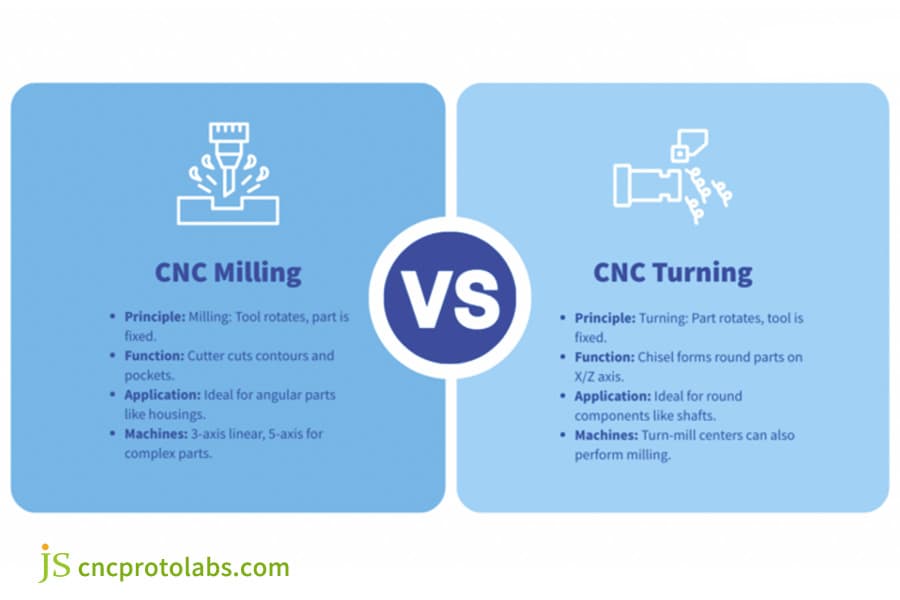
Figure 3: An infographic titled “CNC Milling VS CNC Turning” by FACTUREE, listing the principles, functions, applications, and suitable machines for each process.
What Are The Hidden Costs Of CNC Turning Services And Milling?
Overemphasizing only documented costs at the time of picking out CNC turning services might very easily bring about uncontrolled costs. Hidden costs stand for 30-50%, and CNC turning and milling services are the best way to come down these costs.
Explicit Costs vs. Hidden Costs
- Explicit Costs: Labor costs (US$25-90/hour), material costs, tooling costs, which can be directly calculated.
- Hidden Costs: Clamping errors, process flow, rework of defective products, etc., easily neglected but highly influential.
How Does Process Chain Length Affect Total Cost?
- Pure turning parts: 2-3 processes, hidden costs make up about 10%, controllable total cost.
- Pure milling parts: 3-5 processes, hidden costs make up about 20%.
- Complex parts: Hidden costs that come from separate equipment processing go over 50%, composite machining helps lower unit costs by 20-30%.
Transportation and Logistics Cost Traps
International shipping accounts for 5-10% of order value, urgent shipments double costs; precision parts require professional packaging. Selecting a CNC turning company nearby will help you to skip these costs.
Worried about uncontrolled processing costs and want to control expenses in advance? Get a free full-process cost estimate for CNC turning services, clearly listing explicit and implicit cost details to help you accurately control costs and avoid cost traps.
Which Technology Delivers Better ROI For Your Specific Batch Size?
The ROI of CNC turning lathe and milling is largely influenced by the production volume. Professional CNC turning services can provide the best solution, whereas composite machining is ideal for small to medium batches of intricate parts.
1. Single Prototype: Flexibility is Key
For a single piece prototype, CNC turning lathe is a more efficient option for simple rotating parts, while suppliers of composite machining are the best choice for complex parts to shorten the delivery time.
2. Small to Medium Batch Production: Process Integration is the Key to Cost Reduction
In small to medium batch production, applying composite machining to batches of 50-500 pieces can result in cost savings of 20-30%. Selecting CNC turning services can help in avoiding the idling of equipment.
3. Large Scale Production: Automation is the Core
Large scale production depends heavily on automation. Turning can be capable of 24 hour unattended operation, while milling is dependent on pallet systems and robots. Outsourcing is a great way to avoid the need for a huge investment in equipment.
How To Evaluate a CNC Turning Company For Complex Projects?
To select a reliable CNC turning company, one needs to evaluate the company from three perspectives: technology, quality, and operations. A core indicator of turning lathe capacity is CNC turning lathe capabilities.
1.Technical Capability Inventory
Confirm whether the supplier is equipped with CNC turning machines and 5 axis machines that are suitable for the parts and the working range is compatible with the parts. Also, check if they can continuously reach a tolerance of ±0.005mm.
2.True Level of Quality System
The supplier must have advanced precision testing equipment and be capable of issuing full test reports and material certificates. A good product supplier should have a PPM of less than 50.
3.Three Major Indicators of Operational Reliability
- On time delivery rate of a quality supplier should be more than 90%.
- DFM feedback should be finished within 24-48 hours.
- High repurchase rate is the literal proof of the excellent service.
4.JS Precision: Your Reliable Partner in CNC Turning
JS Precision, which is located in the center of the Dongguan city precision manufacturing district, offers a complete line of services from DFM optimization to CNC turning and milling services.
We company is equipped with a CNC turning lathe and five axis equipment, and can deliver samples within 7-10 days and bulk production within 15-25 days.
Case Study: JS Precision Precision Conquers Complex 17-4Ph Stainless Steel Parts In a Single Setup
Challenge
A US medical company was struggling with their core components for 17-4PH stainless steel minimally invasive instruments. The components were an outer diameter of ±0.005mm, three intersecting holes, and a 0.010mm/100mm flat surface which demanded super high precision and surface quality.
The original supplier's method of "turning before milling" had resulted in a deviation of 0.02mm in the intersecting hole position, a defect rate of 12%, and an 8 week delay in delivery which affected the client's R&D progress.
Solutions
1.Process Restructuring:
The JS engineering team proposed to use a CNC turning and milling composite machining center with a Y axis and a power tool.
As such, it is possible to do all processes in one single setup thus completely eliminating the ±0.02mm positional error caused by secondary setups, cutting process flow time by 40% and thoroughly enhancing the continuity in the machining process.
2.DFM Optimization:
Changing the toolpath for milling planes, controlling the radial depth of cut to 0.15-0.2mm limits the tool deformation, thus allowing the flatness to be within 0.010mm/100mm continually. Improving the drilling sequence, using a "shallow to deep" pattern to prevent deformation more than 0.005mm in thin walled areas (wall thickness ≤2mm).
3.Tooling Strategy:
The use of CBN tools for finish turning the external diameter with a tool speed of 800r/min and a feed rate of 0.1mm/r achieves temperature cutting reduction and guarantees a stable Ra surface roughness of 0.4μm that greatly exceeds the customer's requirement of Ra≤1.6μm thus parts wear resistance is greatly improved.
4.Online Inspection:
In line measurement is conducted after every 5 parts have been made during the process. Qualitative and quantitative measurement data are automatically collected through a probe system in the machine. Accurate changes for tool wear (≤0.001mm per hour) are made to ensure that batch processing dimensional tolerances remain stable within 0.005mm.
Results
After the optimization of the process, the rate of defective parts was reduced to less than 0.5%, the time of one piece processing was shortened by 35%, the total procurement cost was reduced by 40%, the delivery time was locked within 3 weeks, thus allowing the customers to achieve zero inventory supply.
Have pain points in machining complex parts and want to replicate the cost reduction and efficiency improvement results in this case study? Get a free customized DFM optimization solution. JS Precision engineers will combine CNC turning and milling composite machining technology to specifically solve your machining problems.
FAQs
Q1: What is the major difference between CNC turning lathe and milling?
A CNC turning lathe spins the workpiece and keeps the tool stationary, it is mainly used for machining bodies of revolution. On the other hand, a milling machine spins the tool and keeps the workpiece stationary, it is mainly used for machining prisms and complicated curved surfaces. The decision depends on the shape of the part.
Q2: In which cases is it necessary to choose a vertical turning lathe?
For machining large disc or flange parts with a diameter >1000mm and a weight >5 tons, a vertical turning lathe is a must be selected. Gravity assisted positioning achieves the machining rigidity.
Q3: What is the impact of single clamping CNC turning and milling?
Single clamping CNC turning and milling avoids secondary clamping errors, elevates the part's coaxiality and positional accuracy, cuts the process route by more than 40%, and thus, significantly lowers the machining costs.
Q4: What is the way to calculate a fair price for CNC turning services?
The price of CNC turning services should be estimated first based on an hourly reference cost of $25-90, plus the costs of materials and tooling, and afterward, the price should be modified depending on the complexity and precision requirements of the part's processes.
Q5: How to avoid multiple clamping errors for complex parts?
The best way to prevent multiple clamping errors for complex parts is to select a supplier who has CNC turning and milling capabilities. The supplier may then perform all turning and milling operations in a single clamping, thus avoiding multiple clamping errors.
Q6: How long does sample delivery typically take?
The delivery of simple CNC turning lathe samples is made within 7-10 days after order, complex CNC turning and milling composite parts require 15-25 days delivery time, which mainly depends on the materials and programming.
Q7: How to verify the supplier's machining quality?
There are several ways to check the supplier's machining quality, you may ask for a first piece inspection report, CMM data, and material certification. Also, you can check their production and testing equipment by a personal visit or video.
Q8: Why choose a Chinese CNC turning company?
Choosing a Chinese CNC turning company is due to the complete supply chain, fast iteration, and excellent cost of the Dongguan and Shenzhen clusters, with a stable delivery cycle of 15-25 days and high cost-effectiveness.
Summary
It is not the case that CNC turning is absolutely better or worse than milling. At the heart of the matter is the accurate alignment of the component's shape, production volume, and machinery. The right method and the right CNC turning company are essential for gaining both accuracy and cost benefits.
JS Precision, a specialist CNC turning company, offers a comprehensive range of services covering CNC turning and milling from start to finish, with its complete set of machinery, experienced team, and strict quality system, providing the best solutions for both simple and complex parts.
Submit your drawings immediately, and our engineering team will provide you with professional process analysis and competitive pricing within 24 hours, starting your journey of cost reduction and efficiency improvement.

Disclaimer
The contents of this page are for informational purposes only.JS Precision Services,there are no representations or warranties, express or implied, as to the accuracy, completeness or validity of the information. It should not be inferred that a third-party supplier or manufacturer will provide performance parameters, geometric tolerances, specific design characteristics, material quality and type or workmanship through the JS Precision Network. It's the buyer's responsibility Require parts quotation Identify specific requirements for these sections.Please contact us for more information.
JS Precision Team
JS Precision is an industry-leading company, focus on custom manufacturing solutions. We have over 20 years of experience with over 5,000 customers, and we focus on high precisionCNC machining,Sheet metal manufacturing,3D printing,Injection molding,Metal stamping,and other one-stop manufacturing services.
Our factory is equipped with over 100 state-of-the-art 5-axis machining centers, ISO 9001:2015 certified. We provide fast, efficient and high-quality manufacturing solutions to customers in more than 150 countries around the world. Whether it is small volume production or large-scale customization, we can meet your needs with the fastest delivery within 24 hours. Choose JS Precision this means selection efficiency, quality and professionalism.
To learn more, visit our website:www.cncprotolabs.com
Resource