English



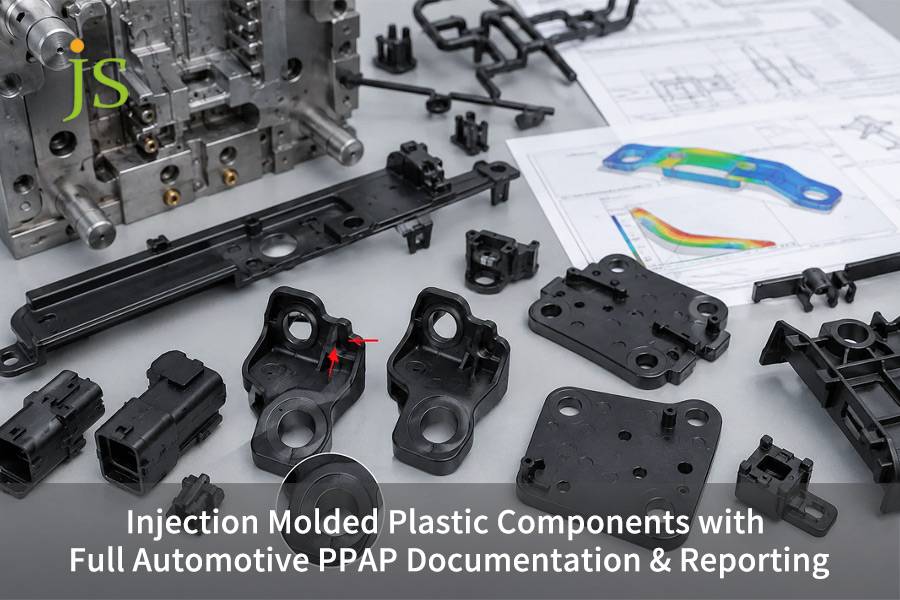

PPAP injection molding is a quality assurance process that guarantees the automotive plastic component parts comply with dimensional, mechanical, and regulatory requirements. Choosing a supplier of automotive plastic components injection molded by a qualified company is a matter that demands a solid quality system for procurement teams belonging to automotive Tier 1 and Tier 2.
The automotive injection molding service provided by JS Precision includes full PPAP documents packages from Level 1 to Level 5 with 18 core elements, MSA system measurement analysis, capability studies, and AAR appearance reports. This comprehensive approach guarantees zero-defect delivery in large-scale production.
PPAP Injection Molding Compliance Overview
|
PPAP Submission Level |
Applicable Production Scenario |
Mandatory Core Documents/Reports |
Mass Production Capability Requirement |
|---|---|---|---|
|
Level 1 |
Cosmetic parts or simple general standard parts |
PSW, Appearance Approval Report (AAR) |
Dimensional checklist |
|
Level 2 |
Limited production or minor structural change parts |
PSW, FAI dimensional report, IMDS restricted substance proof |
Cpk≥1.33 |
|
Level 3 (Standard) |
Automotive core functional & complex injection parts |
Full 18-element package (PFMEA, Control Plan, Gage R&R) |
Ppk≥1.67, Cpk≥1.33 |
|
Level 4 |
Change parts with customer-specific customization |
PSW and customer-designated selective files |
Per customer protocol |
|
Level 5 |
High-risk parts requiring on-site supplier audit |
Full original data and tooling records audited on-site |
Ppk≥1.67 + on-site audit |
Key Takeaways
- Compliant Delivery: The company submits a full series of PPAP Level 3 injection molding reports that are a strict compliance with the IATF 16949 automotive quality system.
- Precise Tolerance Control: For the general sizes the deviations are within ±0.10 mm to ±0.15 mm and for the critical fit sizes (CTQ) the deviations are continuously within ±0.025 mm to ±0.05 mm. Automotive plastic components quality is confirmed through the use of Zeiss CMM and Gage R&R (< 10%) verification.
- Process Control: A combination of Moldflow analysis, PFMEA, and control plans, allows process capability from the first run of trial molding to full-scale production to be at initial process capability Ppk≥1.67.
Why Trust JS Precision's Automotive PPAP Injection Molding Service To Provide Complete Dimensional Reports?
According to industry standards, the main difficulty in PPAP injection molding is the capability of constantly meeting the customer engineering design and dimensional requirements after a steady-state production run and not just the document accumulation.
From our work on the new energy battery bracket project, it showed that the client's previous supplier had some uneven fill of the cavity of the mold resulting in buckle size changes of ±0.08 mm and a Cpk of 0.92, so the product could not be safely swapped.
JS Precision decided to change the gate location with Moldflow, performed slow wire EDM and very precise CNC, set up the SOP for very rigorous dehumidification and drying monitoring, and ultimately within 12 days produced a PPAP Level 3 compliant set of documents and the Ppk of 300 trial samples came to 1.75.
IATF 16949:2016 states in plain language: The organizations shall develop implement document, and keep enhancing the quality management system, so that products and services remain consistent and customers' regulations are fulfilled.
To fully comply with that standard, JS Precision's automotive injection molding service closes the loop on quality control: DFM pre-audit, mold cavity machining (accuracy ±0.005 mm), trial molding CMM complete inspection, and finally batch PPAP Level 3 documentation delivery, this guarantees that each batch's dimensional and surface defects are both under control and traceable.
Want to obtain your automotive injection molding PPAP compliance diagnostics and cost assessment? Download JS Precision's Automotive PPAP 18-Element Checklist White Paper, which includes a complete document structure checklist and tolerance control guidelines.
What Is PPAP in Injection Molding and What Elements Are Included?
PPAP injection molding is a standardized process in the automotive industry for verifying the stability of injection molded parts and mold manufacturing processes. It includes 18 core elements such as a PSW (Power Supply Worksheet) signature page, dimensional reports, PFMEA (Power Supply Measuring Instrument), and material testing to ensure mass production requirements are met.
PPAP Engineering Definition:
In the development of automotive injection mold tooling, PPAP is a set of documents and data evidence provided by suppliers to demonstrate that injection molds and processing techniques can continuously meet customer engineering design and dimensional requirements under steady-state production.
- PSW: PPAP's main deliverable, it is an overview of all testing results and needs the supplier's statement, signature, and/or stamp.
- Design Records and Ballooned 2D Drawings: 2D drawings need to be tied back to 3D design records with a balloon indicating all dimensions.
- PFMEA and Control Plan: This includes a process risk assessment and a specification of what and how mass production controls are carried out.
18 Core Document Structures:
|
Document Category |
Included Items |
Key Deliverables / Tools |
Audit Focus |
|---|---|---|---|
|
Design Documents |
Design Records, Engineering Change Documents, Customer Engineering Approval, DFMEA |
3D model, ballooned 2D drawing, ECR/ECO records |
100% coverage of customer-specified dimensions & GD&T |
|
Process Planning |
Process Flow Diagram, PFMEA, Control Plan, MSA (Gage R&R) |
Flow chart, Risk Priority Number (RPN), gage repeatability & reproducibility report |
Are high-risk processes closed-loop? Is RPN below customer threshold? |
|
Verification Reports |
Full Dimensional Measurement Results, Material / Performance Tests, Initial Process Capability Study (Cpk/Ppk) |
FAI report, tensile/flame test certificates, Minitab capability analysis chart |
Continuous 300-piece Ppk≥1.67, Cpk≥1.33 |
|
Deliverables |
Qualified Laboratory Documentation, Appearance Approval Report (AAR), Samples, Master Sample, Checking Aids, Customer-Specific Requirements, PSW |
Lab ISO/IEC 17025 accreditation, signed AAR page, PSW summary sheet |
Is PSW signed by authorized person? Are samples retained and traceable? |
Engineering Material Compliance Documents:
For materials such as PA66-GF30 and PBT, the material compliance documents for automotive plastic injection molded components include:
- Material Declaration Statement: a document showing that the raw materials used comply with relevant regulations.
- Recyclability and Disposal Statement: a document stating that the materials can be efficiently recycled and disposed of based on the requirements of the manufacturer.
- Environmental Product Declaration: a third-party verified document showing the environmental performance of the products through their lifecycle, including their production process, use and disposal.
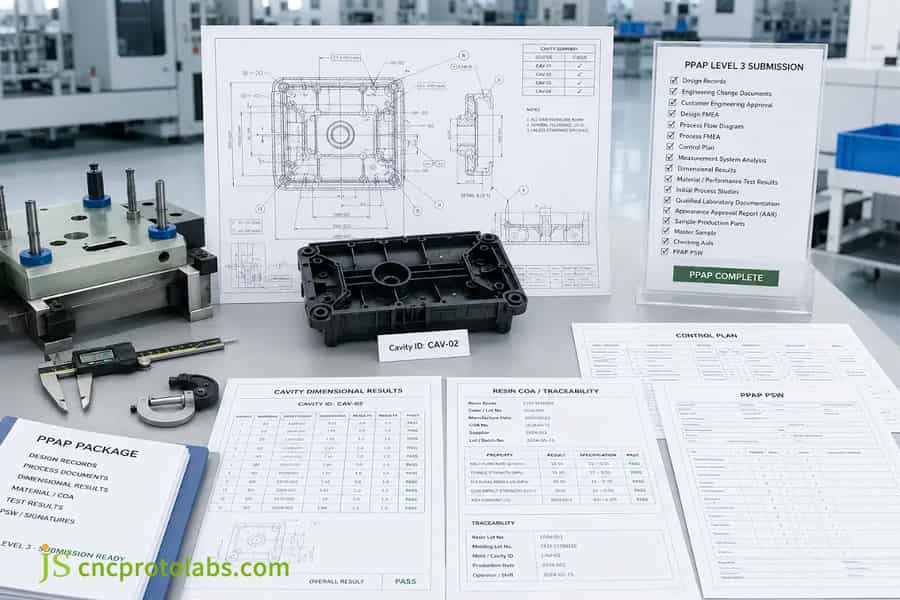
Figure 1: Comprehensive PPAP documentation checklist and injection mold tooling on display.
How Does JS Precision Ensure Mold Tooling Meets PPAP Level 3 Standards?
PPAP level 3 injection molding is designed to conform to Level 3 audit specifications and to produce large scale zero-defect items via Moldflow simulation, T1 trial mold dimension correction, Gage R&R measurement system confirmation, as well as a Ppk capability study that includes 300 consecutive trial productions.
Multi-cavity mold dimensional consistency control:
In automotive injection molding service, Zeiss CMM's logic for detecting the dimensional consistency of each cavity in multi-cavity tooling is as follows:
- Full scan by cavity: A 100% CMM measurement of samples produced by each cavity is carried out.
- Critical feature tolerance control: CTQ critical mating dimensions are constantly kept within ±0.025 mm.
- Between-cavity variation study: dimensional distribution is compared between cavities by Minitab and any systematic deviations are pinpointed.
Measurement System Analysis (MSA) Hard Specifications
For mold tooling with PPAP, the reliability of the measurement system is critical:
- Gage R&R < 10%: The measurement system is satisfactory, action is not necessary.
- 10% ≤ Gage R&R ≤ 30%: Acceptability is dependent upon measurement system improvement.
- Gage R&R > 30%: Measurement system is not acceptable. Tooling must be either changed or recalibrated.
Comparison of Common Mold Steel Properties
|
Steel Grade |
Hardness (HRC) |
Corrosion Resistance |
Application Scenario |
Typical Cavity Life (shots) |
|---|---|---|---|---|
|
S136 |
52–54 |
Excellent |
Medical, optical, high-gloss parts |
1,000,000+ |
|
718H |
48–52 |
Good |
Automotive structural parts |
800,000+ |
|
NAK80 |
38–42 |
Moderate |
Prototype, low-volume production |
200,000+ |
|
H13 |
46–50 |
Fair |
Hot runner manifolds, high-temp molds |
500,000+ |
Looking for an automotive mold manufacturer that meets Level 3 PPAP standards? Get a free mold development cost estimate. JS Precision will provide you with a complete verification solution and transparent quotation for mold tooling with PPAP.
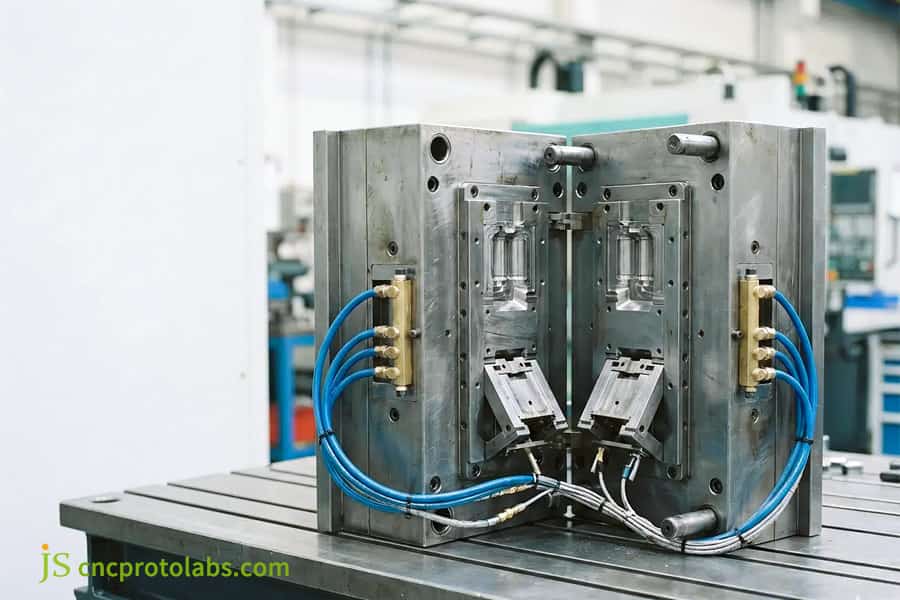
Figure 2: Precision injection mold tooling with PPAP Level 3 submission checklist.
How Does IATF 16949 Standardize Automotive Injection Molding Service?
The major international standard IATF 16949 establishes a holistic risk prevention mechanism (PFMEA) starting with the quality control of incoming materials (IQC), quality control of the injection molding process (IPQC), to the quality control of outgoing products (OQA) which will guarantee consistency and traceability of the production of automotive plastic parts.
The main differences of IATF 16949 and ISO 9001:
- Advanced Product Quality Planning (APQP): Identifying injection molding defects such as shrinkage, cracking, and flash in advance before injection molding process.
- Continuous PFMEA updates: Process failure mode analysis is updated immediately from any anomalies observed during trial molding.
- Statistical Process Control (SPC): It uses an X-bar and R control chart to keep an eye on the variation of the injection pressure, melt temperature, and holding time.
Full-Process Traceability Mechanism:
In PPAP injection molding, traceability is ensured through rigorous batch tracking:
- Traceability ID: A unique traceability number is given to every production batch.
- Raw Material Batch Number Binding: With this system, every piece that has been injection-molded can be accurately traced back to not only the raw material batch number but also to the exact production team that made it.
- Equipment History Linkage: A detailed record is kept of all process stages, like injection molding machine number, mold number, and the version of the process parameters.
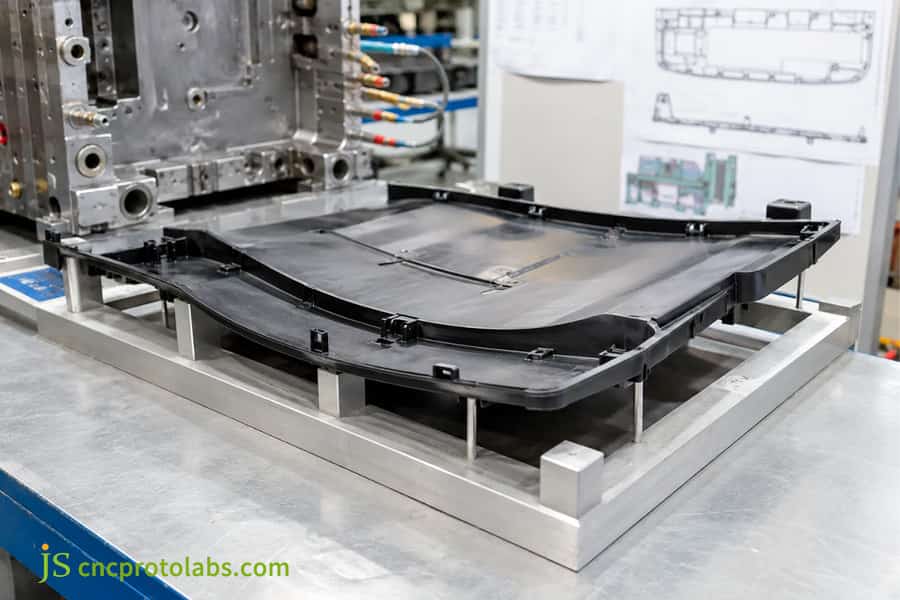
Figure 3: Precision automotive mold tooling meeting IATF 16949 quality standards.
How to Calculate and Verify Cpk and Ppk for Automotive Plastics?
Verification of process capability for PPAP injection molding calls for a starting capability index (Ppk) 1.67 and a long-term process capability index (Cpk) 1.33. The data collection is carried out by implementing a 100% CMM scan on at least 300 consecutive samples taken from a steady-state injection molding machine.
Formulas for calculating Ppk and Cpk:
Ppk = min((USL - μ) / (3σ), (μ - LSL) / (3σ))
Cpk = (1 - k) × Cp, where k is the offset coefficient, Cp = (USL - LSL) / (6σ)
- Ppk (Process Performance Index): The index is used to judge the capability of a process during the pilot production stage (300 consecutive units), where a value of 1.67 must be obtained.
- Cpk (Process Capability Index): This index is for judging the capability of a long-time stable production, where 1.33 is required.
- Judgment Logic: In a nutshell, Ppk > 1.67 means the process currently conforms to the customer's requirements. 1.33≤Ppk≤1.67 means the process is acceptable, although it needs improvement. Ppk < 1.33 means that the process has not met the acceptance criteria.
Dimensional Fluctuation Analysis
For automotive plastic injection molded components:
- General Tolerances (±0.10mm): Dimensional variations occur normally from the interaction of crystallinity, shrinkage rate and changes in environmental temperature and humidity.
- Fine-Grade Critical Tolerances (±0.03 mm): The CTQ features (clamp fitting dimensions, sealing groove tolerances) necessitate dynamic acquisition of data from multiple cavities.
- Capability Analysis Report: Employ Minitab in the creation of a process capability analysis report that is fully compliant.
Need high precision process capability assessment for complex injection molded parts? Get free Cpk/Ppk data assessment support to ensure your PPAP injection molding report passes on the first try.
How to Troubleshoot Dimensional Non-Conformities in PPAP Reporting?
In automotive injection mold tooling, resolving dimensional deviations and warpage in PPAP reports requires optimizing water cooling balance through Moldflow analysis, adjusting the holding pressure curve, and using 8D reports and DOE (Design of Experiments) to correct mold steel welding or CNC precision repair.
Engineering-level Correction Logic
The pain points related to the deviations in T1 trial mold FAI reporting for automotive parts (e.g. Headlight bases, dashboard brackets, and junction box covers):
- Cause-and-effect analysis (Ishikawa Diagram): This will help in understanding the main reasons causing the issue by looking at six categories: people machine material method environment, and measurement.
- Fiberglass orientation analysis: The uneven shrinkage of the part and its deformation due to the fibreglass alignment can be identified by this analysis.
- DOE (Design of Experiments): Different combinations of holding pressure and mold temperature are going to be tried to discover the most suitable process parameters.
Three-Step Mold Correction Method
In automotive injection molding service:
- Optimize the temperature and water circulation of injection molds: balance the temperature field of the mold cavity and eliminate uneven thermal stress.
- Modify the hold pressure and hold time: First the pressure is pressurized up to 100MPa and then lowered 60MPa.
- Micro-steel reinforcement of mold cavity: Implement CNC welding or EDM correction on the automotive injection mold tooling cavity, with the correction amount controlled within ± 0.005 mm.
Dimensional Control Objectives
Through CAPA corrective measures, provide customers with compliant automotive plastic components:
- General dimensions: Controlled within ±0.10mm.
- Critical fit tolerances: Stable within ±0.03mm to ±0.05mm.
- Warpage: < 0.1 mm.
Case Study: How JS Precision Achieved PPAP Level 3 Approval for EV Plastic Components
JS Precision met a Tier 1 customer's problem of low Cpk 0.92 and snap-fit dimensions beyond ±0.05 mm. JS Precision got a certified PPAP level 3 injection molding package in less than 12 days after conducting mold flow optimization and high precision CNC correction.
Customer Challenges:
Tier 1 automotive supplier needed to manufacture PBT+20%GF battery brackets and fastening parts for its new EVs.The parts incorporate 12 crucial snap-fit structures. Fine tolerance is controlled within ±0.05 mm to ±0.03 mm for these features and general tolerance within ±0.12 mm to ±0.15 mm. Delivery of PPAP level 3 injection molding was required within 15 working days. Due to uneven filling of the mold cavity of the former supplier, snap-fit dimensions fluctuated and exceeded the tolerance of ±0.08 mm at the level of Cpk 0.92.
JS Precision Solution
For mold tooling with PPAP, JS Precision implements the following:
- DFM and Mold Flow Optimization: We made use of Moldflow to pinpoint the best gate position and layout for cooling water channels in order that residual stress during formation of crystals and shrinkage warpage could be minimized.
- Precision Mold Machining: Through the combination of slow wire EDM and high precision CNC machining, the deviation between the required and actual dimensions of the mold cavity steel was kept within 0.005mm. This gave injection molding enough shrinkage allowance.
- Scientific Injection Molding and DOE Testing: To develop an injection molding process with consistent parameters, we applied the method of multi-stage holding pressure together with fine temperature regulation (up to ±1℃ only).
- Fully Automated Metering and MSA: The full-size measuring including snap fit of an injection mold was carried out by a Keyence image measuring instrument together with Zeiss CMM. The measurement system is so accurate that it resulted in a Gage R&R of 7.2%.
Lessons Learned from Failures
In the second T1 molding trial, PBT material was dried only for a short time which decreased the tensile strength by 10% leading the PPAP report material performance to fail JS Precision. JS Precision then came up with a strictly controlled dehumidification and drying SOP which would be monitored through temperature and dew point recordings in real time to avoid performance defects caused by the material being improperly dried.
Per AIAG PPAP: An index > 1.67 means the process currently satisfies the customer requirements. Starting production and implementing the control plan can be done upon approval.
JS Precision for example in the development of PBT+20%GF battery bracket project applied the Ppk data of the 300 consecutive production samples as the main criterion for the PPAP approval process to verify Truth is the process capability indices for all CTQ characteristics exceed 1.67. The mold and process steady production capabilities are statistically proved.
Final Results
- Initial process capability: Initial Ppk improved from 0.92 (Cpk) to 1.75 (Ppk), far exceeding the customer acceptance criterion of >1.67.
- Critical fit tolerances: converged from exceeding ±0.08mm to stable control within ±0.03mm.
- General dimensional tolerances: tightened from ±0.12-0.15mm to ±0.10 mm.
- PPAP Level 3 delivery: from unapproved by the previous supplier to approved delivery within 12 days by JS Precision.
Facing similar PPAP approval challenges in automotive injection molding? View the full case study to learn how JS Precision achieved a 0.3% scrap rate and 12-day fast delivery through mold tooling with PPAP optimization.
What Is the Cost Breakdown for Automotive Plastic Injection Molding with PPAP?
The pricing of automotive injection molding service is made up of mold production which takes 40%-60% of the cost, material and injection molding process which is around 20%-30%, and PPAP metrology and quality inspection certificate which takes 10%-15%.
Unit Total Cost Formula:
Unit Total Cost = Part Unit Price + (Total Tooling Cost / Estimated Total Production Quantity) + (PPAP Inspection & Certification Fee / First Batch Delivery Quantity)
In PPAP injection molding, costs are broken down as follows:
- Part Unit Price: The quantity of engineering plastics (PA66, PBT, or PC/ABS) that goes into the mold is the major factor in part unit price estimation, plus molding cycle length and injection molding machine hourly rates.
- Molded Costs: These will vary with the number of cavities used, type of steel for mold (e.g. NAK80 instead of S136), tolerance precision of the mold (for instance, standard vs. Fine grade), and hot runner system configuration.
- PPAP Certification Fee: This will cover the charge of CMM full-size scanning, third-party testing cost on tensile/flame resistant, and fees involved IMDS registration.
Cost Impact of Different Tolerance Grades
For automotive plastic components:
- General Tolerance ±0.10-±0.15 mm: This is the benchmark tolerance for mold processing costs, no extra cost.
- Fine Tolerance ±0.025-±0.05 mm: The mold steel cavity part needs CNC high precision finishing and EDM correction, which will raise the price by 15-25%
- PPAP Level 3 Certification: The part needs to be completely measured with CMM full-size scanning and also a MSA analysis shall be made. There will be a one-time fee for certification ranging from 1,500-5,000.
Tiered Pricing Optimization
JS Precision helps customers optimize total procurement costs through tiered pricing and mold life commitments:
- Mold Life Commitment: S136 steel molds come with a minimum life expectancy of 1 million cycles which can cut the per mold cost Really.
- Bulk Discount: In cases where annual production is over 500,000 units, the single-piece processing fee will be cut by 10-20%.
- PPAP Bundled Pricing: The cost for producing the molds and getting PPAP is included in the product pricing so there are neither hidden costs nor extra costs.
Want a transparent, no-hidden-fee quote for automotive injection molding parts? Get a free total cost estimate for your project. JS Precision will provide a detailed quote including a breakdown of costs throughout the entire automotive injection molding service process.
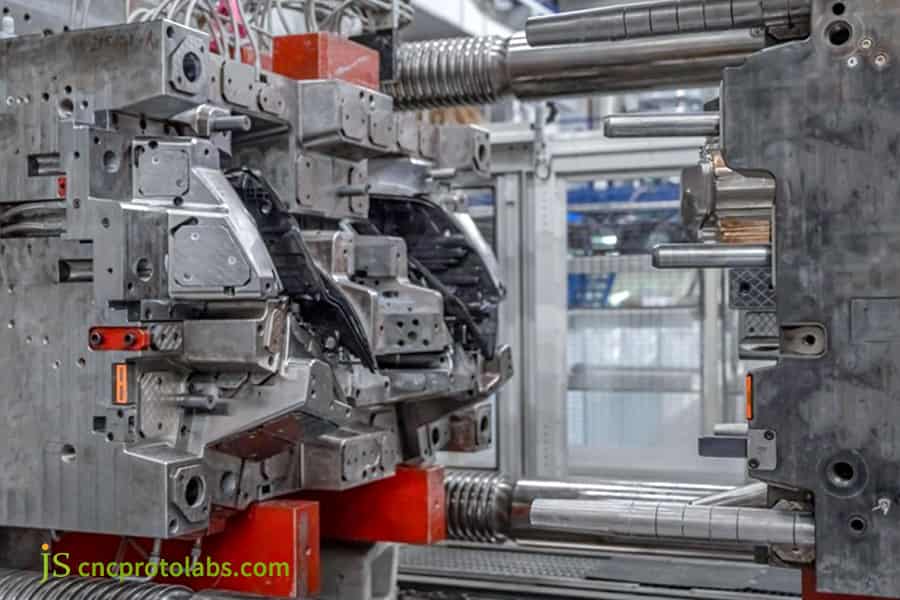
Figure 4: Close-up of an automotive plastic injection molded component in production.
Why Partner with JS Precision for Automotive Plastic Injection Molding Services?
Choosing JS Precision for your automotive injection molding service means choosing an expert with IATF 16949 certification, Zeiss CMM metrology capabilities, and over 15 years of experience, providing comprehensive assurance from DFM to PPAP issuance.
JS Precision's Four Core Advantages
In manufacturing automotive plastic components:
- Physical facility and advanced production equipment: Our facility is equipped with over 30 80T-1200T precision injection molding machines as well as a state-of-art mold processing workshop.
- Holistic quality control: Compliance with the IATF 16949 injection molding service. Besides, having an independent CMM calibration and measurement lab makes it much easier for us to trace raw material from warehouse, every step to finish delivery of the product is kept in record.
- PPAP first time pass rate over 98%: A quality team made up of experienced engineers closely follows the APQP process which minimizes customers' repeated audit cost.
- International Speedy Services: With a professional engineering team fluent in both languages, not only can they offer DFM evaluations with a turnaround of 24 hours but are also capable of doing trial molds and delivering level 3 documents between 10-15 days.
Client Benefits:
Working with JS Precision we can get your project what comes next services: PPAP Level 3 Pass on the first try, Process Capability Assurance with Ppk≥1.67 and fully signed First Article Inspection reports as well as dimensional measurement tables by the CMM for each batch.
Instead of risks like communication problems, delays in response, and after-sale compensation being a result of the platform middleman we work only directly through operating our own factory to offer you exclusive engineering service and transparent responsibility assignment in our factory.
FAQs
Q1: What is PPAP Level 3 and why is it standard for automotive injection molding?
PPAP Level 3 necessitates that you send all the 18 documents listed here including Pre-Survey Worksheet, design record, Full Dimensional Inspection Report/Fully Dimensional Report Inspection, PFMEA, control plan, and a Ppk report. It is probably the most widely used standard in the automotive supply chain and can completely confirm that molds and the injection molding process do not have any instabilities.
Q2: Which PPAP submission levels can JS Precision provide for molded components?
JS Precision can provide a set of PPAP Level 3 complete documents for injection molding from the submission levels, Level 1 to Level 5. The quality department makes reports that also include a complete CMM scan, an IMDS registration, and a Gage R&R analysis, which they smoothly integrate with the automotive supply chain.
Q3: How long does it take to compile a full Level 3 PPAP report for plastic parts?
JS Precision will complete a Level 3 PPAP in about 3-5 business days once mold has been produced and a T1 trial is conducted. The whole procedure entails taking dimensional measurements of trial production samples of 200-1,000 consecutive ones, Ppk analysis using Minitab, and a check on the material used. JS Precision will be able to provide you with the initial data within 72 hours.
Q4: What is the difference between Cpk and Ppk in automotive PPAP reports?
The process capability of the pilot production is evaluated by Ppk which takes 300 continuous items as test sample, and the requirement is to have minimum of 1.67. Process capability of the long-term stable production is represented by Cpk which needs to be minimum 1.33. JS Precision closes the loop injection molded parameter control to meet the requirement of reaching 1.6Ppk for critical dimension.
Q5: How does JS Precision handle out-of-tolerance dimensions during PPAP testing?
We immediately launch the 8D problem solving when the results indicate that dimensional deviations are present. Using Moldflow, shrinkage is then verified and both the holding pressure and cooling parameters are re-tuned. In case that the production line parameter changes cannot reach the standards, our mold workshop performs CNC/EDM precision work or micromanufacturing welding work and then re-sampling is done till all of the sizes meet the specification.
Q6: What automotive-grade resins does JS Precision process for PPAP components?
We have been processing automotive engineering plastics of the highest-grade like PA66+GF30, PBT+GF20, PC/ABS POM PPS and PEEK. All of the materials that we use are accompanied with the original CoA, UL94 flame retardancy test and RoHS/REACH reports. We also provide aid for the IMDS registration.
Q7: How much does a full PPAP Level 3 documentation package cost?
PPAP certification is a costly part of a project as it usually represents about 10 to 15% of the total cost, and its amount varies as how many CMM measurement points and testing items are outsourced. The quote prepared by JS Precision covers the price of molds, part units, and PPAP certification, all itemized without ambiguities. If you want a quotation, just upload your drawings.
Q8: How can I request a quote and PPAP assessment from JS Precision?
To get started provide JS Precision with your 3D models (STEP/IGES) and 2D drawings (PDF) with marked tolerances. Engineering and technical support will do a complimentary analysis assessing product manufacturability (DFM) and also prepare a detailed and very accurate quotation. It'll be ready overnight as a rule.
Summary
Acquiring PPAP certification is essential for compliant and thorough automotive production quality guarantee. Achieving automotive OEM-approved PSW (PSQ / PSC) approval of very intricate injection moulded products is a guarantee if we have successfully prevented any defects through trial moulding, right from runner layout and CMM dimension measurement to Ppk skill evaluation after integration of IATF 16949 QMS in JS Precision.
Ready to accelerate your automotive parts mass production approval process? JS Precision provides a one-stop automotive injection molding service, offering professional DFM assessments and compliant PPAP Level 3 solutions in as little as 24 hours. Click here to upload your CAD drawings and get a free DFM assessment and detailed quote now!

Disclaimer
The contents of this page are for informational purposes only. For JS Precision Services, there are no representations or warranties, express or implied, as to the accuracy, completeness, or validity of the information. It is the buyer's responsibility to identify specific technical requirements and request a formal parts quotation. Please contact us for more information.
JS Precision Team
Custom manufacturing solutions. With over 15 years of experience serving more than 1,000 customers, we specialize in high-precision CNC machining, sheet metal fabrication, 3D printing, injection molding, and metal stamping. Having successfully delivered over 300,000 precision parts, we maintain a 99.2% on-time delivery rate across all custom projects.
Our facility is equipped with over 100 state-of-the-art 5-axis machining centers and is ISO 9001:2015 certified. We deliver fast, efficient, and high-quality manufacturing solutions to B2B clients across 150 countries. Whether you require low-volume prototyping or large-scale customization, we support your project with lead times as short as 24 hours. Choose JS Precision for unparalleled efficiency, quality, and professionalism.
To learn more or submit your RFQ, visit our website: www.cncprotolabs.com
Resource