English



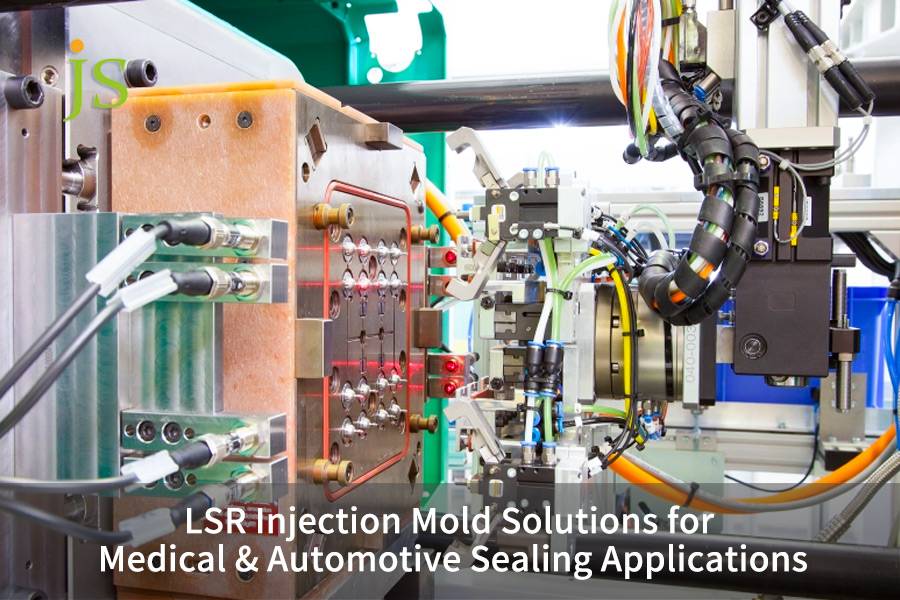

LSR injection mold is one of the key solutions in a plant to solve flash, porosity and seal failure problems for the mass production of medical and automotive seals. By developing a parting line accuracy of ±0.003mm and applying a mold cavity vacuum technology of -0.095MPa, these combined efforts not only the risks of leaks are completely eliminated but also the curing time can be reduced by one-third. Mass production of medical and automotive seals is often accompanied by flash getting out of control mainly because mold venting and runner design defects occur. This results in product recalls and increased costs.
Senior mold engineers, in cooperation with industry experts, prepared this writing addressing the main points of LSR mold design, as well as the zero-defect mass production process.
Here we will direct our efforts to explaining what comes next.
- Parameters for design of mold venting and parting line (2μm - 5μm) to prevent flash in medical and automotive seals.
- Pressure balance control system of needle valve type cold runner system.
- Manufacturing cases in the industry of JS Precision in the field of EV sealing rings and medical one-way valves.
- Four basic cost structure formulas that influence LSR mold quotation.
Keep reading to get to know precision injection molding engineering solutions that are practical and doable.
Overview of JS Precision's Core LSR Injection Mold Custom Processing Technical Specifications
| Core Sealing Application Scenarios | Key Technical Pain Points | JS Precision Core Tooling Solutions | Quantifiable Metrics |
| Medical Sealing Components (e.g., breathing mask valves, infusion connectors) | Cytotoxic residues, microbial growth, micron-level flash (no manual trimming). | ISO 8 cleanroom production, lever-less fully electric injection molding machine, cold runner hard seal needle valve control. | Flash thickness ≤0.005mm, curing cycle 15-25s, zero biological contamination. |
| Automotive Sealing Elements (e.g., new energy vehicle battery pack seals, sensor harness waterproof plugs) | Long-term compression set, high temperature resistance, two-shot injection molding thermal insulation challenges. | Using a fixed mold cold runner + moving mold hot mold (170°C) thermal insulation design, mold surface ultra-mirror polishing (SPI A1). | Dimensional tolerances ±0.02mm, Mold Life ≥1,000,000 Molding Cycles |
Core Engineering Conclusions
- Flash and Venting Control: Parting surface and venting groove precision got controlled strictly to 0.003mm±0.001mm, and also a mold cavity vacuum of -0.095MPa were combined to fully eliminate the molding defects.
- Cold Runner Selection: Mass production multi-cavity molds are the independent needle valve type cold runners, shear rate fluctuations are controlled within ±3%, and material utilization exceeds 98%.
- Two-Color Injection Molding Process: Molds are installed with PEEK heat insulation plates to guarantee a temperature difference ΔT≥80℃ between hot and cold molds so that plastic part deformation is avoided.
- Cost-Benefit Formula: Initial cost of cold runner molds is 35%-50% higher, but after 80,000 molding cycles, ROI becomes positive, while long-term mass production cost-effectiveness is even more.
Why Rely On The Precision Of JS Precision’s Injection Mold Tooling Service For Quotations?
According to industry practice and years of experience in executing projects, we believe that pricing a precision mold is not merely a question of size measurement alone. It is a thorough evaluation of the methods materials accuracy, and yield that have an immediate impact on a customer's cost and quality levels for mass production.
Sealing molds for medical use should not only be subjected to rigorous biosafety compliance standards but also should be free of any material leaching and product contamination.
ISO 10993-1 states: Medical rubber and plastic molds and finished products must be non-cytotoxic, non-allergenic and harmless in direct contact with human tissues or fluids.
All medical-grade molds are so produced with medical-grade stainless steel and the entire processing is conducted in sanitary conditions ensuring that biological contamination is avoided at the source. Based on our fieldwork with infusion connector medical molds, a compliant design increases mold costs slightly but product scrap rate can be brought down to zero.
Through 15 years of mold R&D and mass production experience, the team has designed a four-dimensional cost accounting model (exclusive formula): mold steel cost + precision machining time + process configuration cost + mass production quality assurance cost, which prevents secret industry markups. We provide detailed quotations without hidden costs and meet overseas client audit standards.
This well-regulated pricing scheme supports the balance between compliance and affordability, enabling the accurate budget preparation for projects of various scales, and drastically reducing the client's trial-and-error expenditures.
To gain a basic understanding of precision mold pricing logic and avoid pricing pitfalls, you can download the Mold Cost Accounting White Paper for free to quickly grasp the industry's core pricing rules.
Why Are Flash Tolerances for Medical and Automotive LSR Injection Mold So Demanding?
The making of medical and automotive seals in molds is an extremely challenging industry with very high entry barriers. The liquid silicone rubber (LSR) injection molds used for such products have very tough standards on flash tolerances. The thickness of flash is controlled below 0.005mm. Even a tiny flash often means very harmful issues like bacteria growth in medical products or a leak of water in automotive products. This is one of the main problems professional high precision mold tooling service have to deal with.
Root Causes of LSR Material Molding Defects
- Material Characteristics: LSR liquefied silicone has a low viscosity and very high fluidity, this property can make it run into small openings in the mold during high-pressure injection molding, so resulting in flash defects.
- Process Differences: While traditional plastic injection molding has a poor flowability and can accommodate large molding gaps. LSR injection molding demands over 10 times the precision of the mold parting surfaces and venting channels.
High-Precision Flash Control Solution
- Precision Machining Equipment: The use of Swiss Mikron coordinate grinders and GF AgieCharmilles wire EDM machines results in machining tolerances of ±0.002mm, with a material penetration limit of less than 0.005mm.
- Stepped Venting Design: The first venting channel is 0.003mm deep, 3.0mm wide, and 1.5mm long, the second channel increases to 0.05mm, because of this ensuring accurate venting while removing flash.
| Venting Structure Type | Venting Efficiency | Applicable LSR Viscosity | Controllable Maximum Flash Value | Mass Production Yield Performance | Suitable Scenarios |
| Single-stage Straight Venting | 65% | Medium to High Viscosity LSR | 0.02mm | Approximately 82% | General Civilian Seals |
| Segmented Stepped Venting | 98% | Full Viscosity Range LSR | ≤0.005mm | ≥99.5% | Medical/Automotive Precision Seals |
| Negative Pressure Assisted Venting | 100% | Low Viscosity, High Flow LSR | ≤0.003mm | ≥99.7% | EV High-Pressure Seals, Medical Valve Plates |
| Local Multi-hole Venting | 90% | Medium Viscosity LSR | 0.01mm | Approximately 95% | Complex and Irregularly Shaped Seals |
In brief, this tiered setup secures thorough gas removal from the mold cavity and simultaneously traps the liquid silicone raw materials inside, which is essential for achieving micron-level zero flash molding. Typical molds are equipped with a single-stage venting channel only, and their venting efficiency is quite limited, making overflow a frequent occurrence. Due to their inability to handle the high-flow molding features of LSR, ordinary market molds are why manual trimming is not possible in such cases.
If your sealing component project is plagued by flash defects, you can get a free parting surface-specific design assessment and a precise quote for high precision mold tooling service to quickly resolve mass production defects.
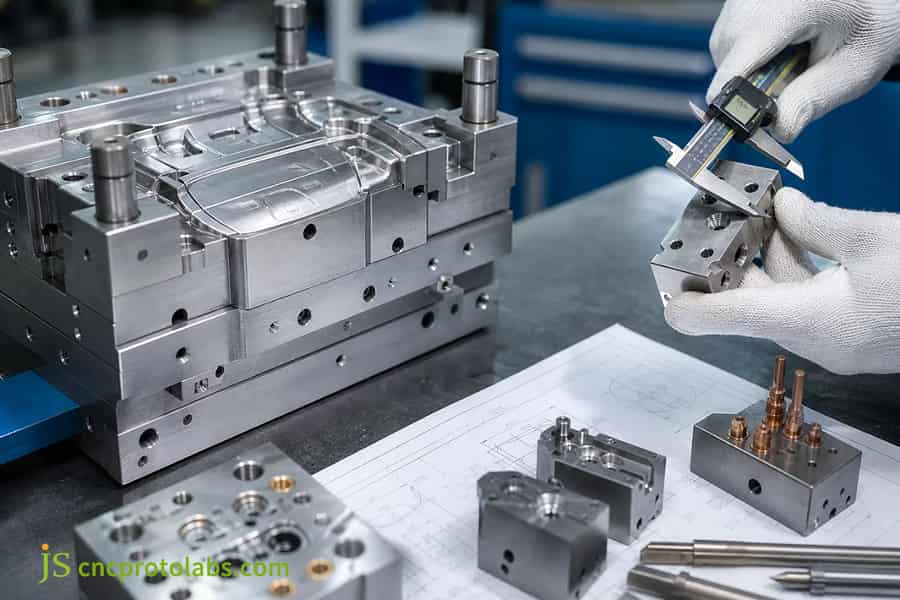
Figure 1: Precision metal mold with calipers measuring components in manufacturing facility.
How to Eliminate Bio-Contamination Through High Precision Medical Sealing Component Molding?
The key to removal of biocontamination in the medical sealing components is positioning the entire medical sealing component molding process in an ISO 8 cleanroom environment, plus a dedicated liquid silicone rubber tooling system that is oil-free and release agent-free, so that secondary contamination is eliminated from the production source.
Mold Material Anti-Contamination Design
- Steel Selection: S136 martensitic stainless steel is picked, with a heat treatment hardness of HRC 52-54, which is corrosion-resistant and does not have trace element precipitation.
- Surface Treatment: SPI A1 ultra-mirror polishing is performed, which gives a non-porous mold surface that stops bacteria and impurities adhesion and growth.
Dust-Free Automated Molding Process
- No Human Intervention: Incorporates a fully automated robotic arm for gripping and a Teflon-coated pneumatic ejection structure, which completely removes secondary contamination from human contact.
- Zero-Additive Molding: Throughout the whole process external release agents are not used at all. Automatic demolding takes place when the mold is precisely structured, which secures the purity of medical products.
This method entirely aligns with the ISO 13485 medical quality system standard, which leads to zero biological contamination in the mass production of medical seals. Medical-grade LSR products directly contact with the body fluids, medicines, or respiratory tract. Even trace impurities, metal leaching, or bacterial residue could cause product failure and might even cause medical safety incidents.
For custom medical-grade silicone mold needs, submit 3D drawings to receive a 24-hour customized DFM optimization solution, proactively avoiding mass production contamination and dimensional defects.
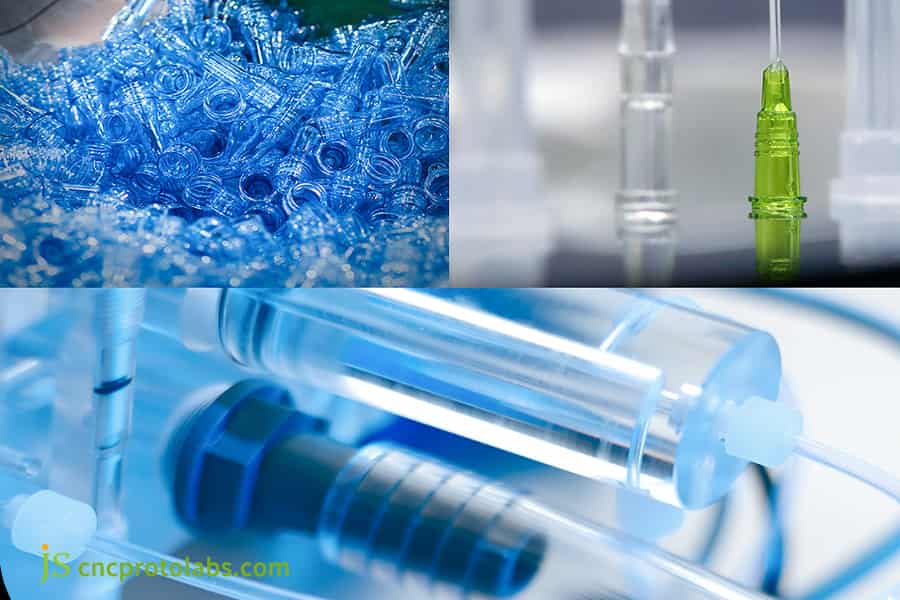
Figure 2: Medical syringes and transparent liquid silicone rubber components.
What Are the Design Secrets of Automotive Molding Service When Implementing Cold Runner Systems?
The main reason why our expert automotive molding service is so effective is that we use independent adjustable needle valve cold runner systems. With such systems, we manage to keep the synchronization error of multi-gate opening below 0.01 seconds in order for the cavity filling to be consistent, even when making large-part LSR injection molding seals.
Core Challenges in Mass Production of Automotive Seals
- Functional Requirements: An electric vehicle (EV) motor, its electronic control, and electrical seals must be able to withstand high temperatures, meet the UL94 V-0 flame retardancy standard, and resist aging, all the while maintaining very accurate molding.
- Difficulties During Production: Large plastic components are often subject to unbalanced filling of the runners, localized overfilling resulting in warpage, and significant losses of material.
Optimizing cold runners for better results
- Runner Style Choice: Needle valve cold runners cut down on material waste by more than 30% against open runners and also reduce the curing time by 25%.
- Simulation of flow fields: The flow imbalance rate in the mold cavity has been modeled using Moldflow software and it is able to be kept to the outstanding value of 2.5%, which in turn totally eradicates stress and warping deformations inside the parts.
The sealing elements of the three-electric system (battery, motor, and electronic control system) of the new energy vehicles are under conditions of high temperature, high pressure, and alternating vibration often which is why their molding consistency and structural stability thoroughness levels are much more than that of normal civilian products.
How Does an Advanced LSR Mold Design Service Accurately Calculate Non-Linear Shrinkage Rates?
LSR mold design service that you can count on decide not to follow fixed shrinkage ratio algorithms that are traditional. Instead, they develop a nonlinear model of calculation by combining mold cavity pressure, curing temperature, and shear direction. By employing expert liquid silicone rubber tooling methods, they accurately measure final product dimensional error and keep it within ±0.05%.
LSR Shrinkage Molding Fundamental Concepts
- Shrinkage Features: LSR curing as well as cross-linking are responsible for the 2.5%-3.5% linear shrinkage. When this is combined with the effect of thermal expansion and contraction, fixed-ratio calculations tend to result in dimensional deviations.
- Material Differences: Different brands of silicone like Dow, Wacker, and Shin-Etsu may have differences in shrinkage coefficients up to 0.3%. These differences must be taken into account for shrinkage compensation.
Accurate Dimensional Compensation Procedure
- Parameter Modeling: With the combination of 60-100MPa mold cavity pressure and 160-180℃ curing temperature, a special shrinkage rate function model is created.
- Precision Machining: CNC five-axis linkage milling with cavity pre-compensation, and ±0.5℃ accurate temperature control runners, guarantee batch dimensional consistency.
| Compensation Method | Applicable Material Type | Dimensional Error Accuracy | Applicable Product Structure | Batch Stability |
| Fixed Proportion Compensation | General-purpose LSR | ±0.20% | Regular, simple small parts | General, prone to batch deviation |
| Piecewise Linear Compensation | Medium viscosity industrial LSR | ±0.10% | Conventional structure seals | Good |
| Nonlinear Dynamic Compensation | Medical/Automotive high-end LSR | ±0.05% | Curved surfaces, thin walls, irregular shapes | Excellent, zero batch deviation |
To sum up, this flexible calculation technique is capable of working with any LSR raw materials and conditions of operation, so it totally resolves the issue of batch dimensional deviation. The shrinkage deformation of LSR is not simply a physical shrinkage, but a combination of cross-linking chemical reactions and thermal stresses. Different curing rates and mold cavity pressures will affect the local shrinkage amount.
Fixed-ratio compensation methods have long been misunderstood by manufacturers as a one-size-fits-all solution for all types of production. But, it is only when dealing with simple regular small parts that these methods can be applicable. They have no provision for curved, thin-walled, multi-structural, irregular-shaped seals, which are most likely to be manufacturing problems of mass production like batch size deviations and assembly interference.
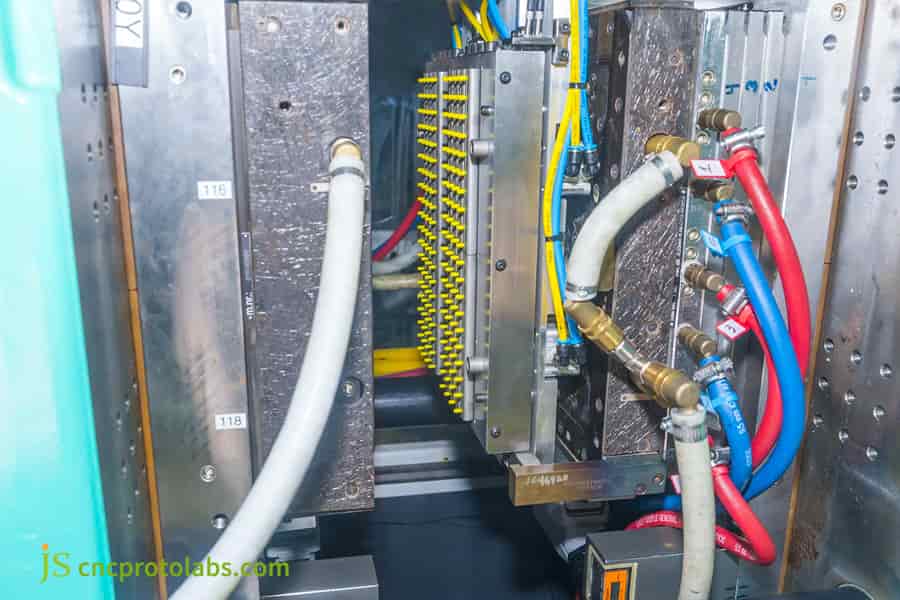
Figure 3: Industrial LSR mold with hydraulic hoses and cooling channels.
How to Achieve Zero-Defect Delivery via Closed-Loop Process in Mass Automotive LSR Part Production?
In order to consistently deliver zero-defect products during large-scale automotive LSR part production, it is essential that a sensor-linked closed-loop control system be integrated. This system not only tracks the pressure changes in the LSR injection molding filling phase but also discards defective items on its own if the pressure level goes beyond ±1.5MPa.
Major quality Ensuring Measures for Large-scale Manufacturing
- Raw Material Ratio: The mixing ratio of A/B adhesives is strictly maintained at 1:1. The high-accuracy gear pump has a metering error of 0.2%, which effectively rules out defects due to raw material imbalance.
- Constant Temperature Material Control: A barrel temperature control ensures a constant 15-20℃ cooling water circulation that prevents the premature cross-linking of LSR and contributes to molding stability.
Complete Inspection and Regulatory Compliance
CCD vision inspection machines enable faultless parts inspection like flash, pores, and black spots detection which completely comply with the IATF 16949 automotive zero defects production standards.
The IATF 16949:2016 standard specifies: Automotive rubber and plastic parts mass production should have full-process traceability and systems to automatically reject defective products.
Assisted by this closed-loop system, stable high-quality mass production at the scale of tens of millions of units per year becomes possible. Automotive LSR seals mass production comes with long production cycles and huge batch volumes. Defects in molding can be caused by differences in raw material batches, temperature and humidity changes in the workshop, and slight changes in production equipment parameters.
Case Study: How Did JS Precision Resolve Local Porosity and Flash Defects for an EV Client's BMS Seals?
By the team mastery of high precision mold tooling service, porosity and flash were identified and fixed as defects in the mass production process of BMS seal LSR injection molds for new energy vehicle companies. As a result, production capacity has been successfully improved from 62% to 99.7%.
Customer's Major Pain Points
The product is a 3-dimensional composite injection molded BMS seal. The original mold was not rigid and had misaligned venting. After a high temperature injection molding at 170℃, slight deformation occurred, which led to material shortages, porosity, and 0.08mm excessive flash, thereby rendering mass production impossible.
Customized Rectification Solution
- Mold Base Upgrade: Conducted ANSYS stress analysis to optimize design. Changed P20 mold base to 4140 tempered steel, a mold clamping balance block was added to prevent mold remaining deformation during high-temperature operation.
- Vacuum Optimization: Vacuum was started 0.8s before the melt injection stage. -0.096MPa was reached in the mold cavity vacuum, a level that was sufficient to completely eliminate porosity defects.
- Precision Upgrade: Slow wire EDM was done with secondary cutting, the clearance along the parting line was kept 0.003mm, which effectively eliminated flash issues.
Project Experience and Results
When initial pressurization debugging was done simply, it was a failure decision, as the root LSR defects cause was identified as mold structure and precision, not injection parameters. Cycle time post rectification was 28s unlike 42s before, raw material loss was minimized by 35%, and products with acceptable flash were delivered without inspection.
Customer Feedback
The purchasing director and the chief engineer of car company's BMS R&D department together declared that JS Precision's capability for manufacturing silicone rubber precision molds was up to the standard. Besides uncovering hidden engineering design flaws, they also met the expected closed-loop delivery speed, that is why we prefer them for our long-term strategic cooperation.
Leveraging their engineering experience accumulated from real-world case studies, they can precisely tackle various complex sealing component molding challenges. We immediately connect you with the lead engineer for your project to obtain a customized technical assessment solution.
What Qualifications Must a High Precision Mold Tooling Service Manufacturer Possess to Secure Western Orders?
To cater for high-end medical and automotive orders from European and American clients through the export route, manufacturers of high precision mold tooling service must have their custom LSR injection mold products certified to both IATF 16949 and ISO 13485 standards. Besides that, they must have ISO 8 cleanroom facilities and a complete set of compliant delivery documentation capabilities.
Essential Requirements for Overseas Audits
- Testing Facilities: Having a Zeiss fully automated coordinate measuring machine, measurement uncertainty ≤0.5μm, able to produce authoritative CMM testing reports.
- Technical Documentation: The DFM reports standardized shall also include cavitation prediction, weld line assessment, and heating pipe layout so conforming to PPAP Level 3 documentation requirements.
Capability to Support Compliance
Complete intellectual property protection systems and an English-speaking communication team are two major ingredients for seamless integration with overseas clients' supply chain audit requirements. Audits by buyers overseas of high-end mold manufacturers are not only about product precision, they also ensure end-to-end compliance, traceability, and technology output standardization.
Complete testing reports, compliance documents, intellectual property protection, etc. are the essential factors for entry into the medical and automotive supply chains of Europe and America and something important that differentiates the leading mold manufacturers from the ordinary smaller ones.
Figure 4: Precision injection molds and calipers on technical drawings.
Why Partner with JS Precision for Your Precision LSR Tooling and Manufacturing in China?
By selecting JS Precision as a local partner, you gain the opportunity to create tailor-made precision LSR injection molds with a tolerance of only ±0.002mm. Drawing on 15 years of industry knowledge and experience, they offer great capability to deeply improve the cost efficiency for the total mass production of LSR injection molding, incorporating a thorough cost reduction of 25%-40%.
Complete-Chain Engineering and Hardware
- Engineering Team: 25 senior process engineers can quickly produce customized DFM solutions within 12 hours, proactively anticipating potential mass production risks like dimensional deviations, runner imbalances, flash, and porosity.
- Hardware Configuration: Equipped with Makino CNC machining, Sodick EDM, and fully automated silicone mixing equipment. High-precision equipment supports a processing tolerance of ±0.002mm, ensuring molding stability and batch consistency.
Points of flexible manufacturing and price system
- Flexible Manufacturing: There is no minimum order requirement, which means you can have small-batch prototype iterations to support your R&D and also carry out large-scale mass production of millions of molds, this way being able to cover the whole lifecycle of the customer's projects.
- Pricing And Transparency: Thorough breakdown of factory price, absolutely no hidden costs. Utilizing the local closed-loop production advantages, thereby helping customers to reduce the overall mass production costs by 25%-40%.
No need to incur costs for inferior molds and inefficient mass production. Submit project drawings for free cost calculation and receive a high-performance customized quote within 24 hours. From initial DFM optimization and precision mold machining to trial molding iteration and mass production delivery, a one-stop closed-loop service is provided, saving communication and trial-and-error costs associated with multiple parties.
FAQs
Q1: What is the average life of a tooling for an LSR injection mold, and how does JS Precision ensure it?
Well, the life of an LSR injection mold depends heavily on the choice of mold steel. Typically, for mass-production molds, imported S136 or 420ESR stainless steel of hardness HRC 52-54 is used. With conventional maintenance, mold life can easily and reliably extend beyond 1 million cycles. We offer mass-production customers free maintenance and even a lifetime replacement warranty for their core parts.
Q2: How does JS Precision reduce tooling costs for LSR injection molding by more than 35% over Western competitors?
First of all, we take advantage of Dongguan's well-established industrial cluster and one-stop closed-loop production to totally cut outsourcing expenses. Then, mix efficient local engineering and time bonuses, at the same time keeping a precise tolerance level of ±0.005mm, and our LSR injection molding molds overall cost can be lowered by 35%-45%. This is a great offer compared to foreign manufacturers by a wide margin.
Q3: What major changes in mold design are required when switching from high consistency rubber (HCR) to liquid silicone rubber (LSR)?
Most HCR rubber is compression molded, which produces large molding gaps and has the tendency to create thick flash. LSR is a liquid at low temperature, so it relies on high-pressure precision injection molding. It also needs a water-cooled runner, a parting gap of 0.005mm precision, and a mold cavity vacuum system to eliminate shortage and overflow defects of the material.
Q4: How do you handle the extreme temperature gradient that occurs in two-shot overmolding while producing automotive LSR parts?
This temperature difference issue in two-shot overmolding is tackled by using a independently temperature-controlled mold structure. Between the hard plastic cavity and the LSR molding cavity, a PEEK heat-insulating gasket is placed to keep a temperature difference of 80℃ quite stable. In this way, the plastic part at a high temperature won't deform, and the LSR will have enough time for cross-linking and can be cured properly. So, the solution is suitable for automotive LSR parts.
Q5: How does JS Precision determine and fix filling imbalance for the molding of multi-cavity medical sealing components?
The biggest reason of flow imbalance in multi-cavity molding of medical sealing components is the shear-thinning property of LSR. Our team manages to keep the shear rate variation of each cavity within ±3% by adjusting the needle valve stroke and flow channel cross-section, and also performing CAE fluid simulation. This way, the filling pressure is equalized and flash and short-fill defects are completely removed.
Q6: Will JS Precision take low MOQ or rapid prototyping orders for custom silicone seals?
We basically have no minimum order quantity (MOQ) conditions. This way, we completely adjust to the small-batch iteration needs of the R&D phase. We can very quickly make simple aluminum or P20 prototype molds, and you will get test samples in 7-10 business days. To customize rapid prototyping solutions efficiently and verify product structure and sealing performance, you can directly upload drawings.
Q7: What kinds of cleanroom and quality assurance methods does JS Precision use for medical LSR toolings?
We use an ISO 8 cleanroom for the entire medical-grade LSR mold production, ensuring a closed-loop and sterilized environment from raw material proportioning, injection molding, robotic part handling, to aseptic packaging. With 100% CCD inspection and FDA-certified raw materials, a full set of statutory test reports can be issued to meet medical access standards.
Q8: What kind of information is needed to get a detailed quote for your LSR injection mold tooling service?
You should send 3D/2D engineering drawings, type of raw material or hardness parameters, and approximate mass production capacity so that you get the quote that represents your LSR injection mold job as closely as possible. Afterwards, we are able to do cost estimation within 4-8 hours, and we even give you a formal standardized all-English quotation and project proposal.
Summary
Zero-defect mass production of medical and automotive LSR seals depend upon ±0.003mm mold precision, precision vacuum degassing, a needle valve cold runner balancing system and a compliant production system. It takes rigidity of mold steel, micron level structural design, non-linear shrinkage compensation to achieve no flash, no porosity and no failure of the seals. It is also the nature to accelerate product time-to-market and projects ROI.
If you have encountered something like seal molding failure, or dimension out of tolerance, and low mass production yield, (etc.), there is no need to repeat trial squeezing, and then loss costs. Please submit project parameters and drawings, and learn our professional engineer make customization DFM report and cost down quotation for you, that enable your company zero-defect mass production and grasp the market chance.

Disclaimer
The contents of this page are for informational purposes only. For JS Precision Services, there are no representations or warranties, express or implied, as to the accuracy, completeness, or validity of the information. It is the buyer's responsibility to identify specific technical requirements and request a formal parts quotation. Please contact us for more information.
JS Precision Team
ustom manufacturing solutions. With over 15 years of experience serving more than 1,000 customers, we specialize in high-precision CNC machining, sheet metal fabrication, 3D printing, injection molding, and metal stamping. Having successfully delivered over 300,000 precision parts, we maintain a 99.2% on-time delivery rate across all custom projects.
Our facility is equipped with over 100 state-of-the-art 5-axis machining centers and is ISO 9001:2015 certified. We deliver fast, efficient, and high-quality manufacturing solutions to B2B clients across 150 countries. Whether you require low-volume prototyping or large-scale customization, we support your project with lead times as short as 24 hours. Choose JS Precision for unparalleled efficiency, quality, and professionalism.
To learn more or submit your RFQ, visit our website: www.cncprotolabs.com
Resource