English



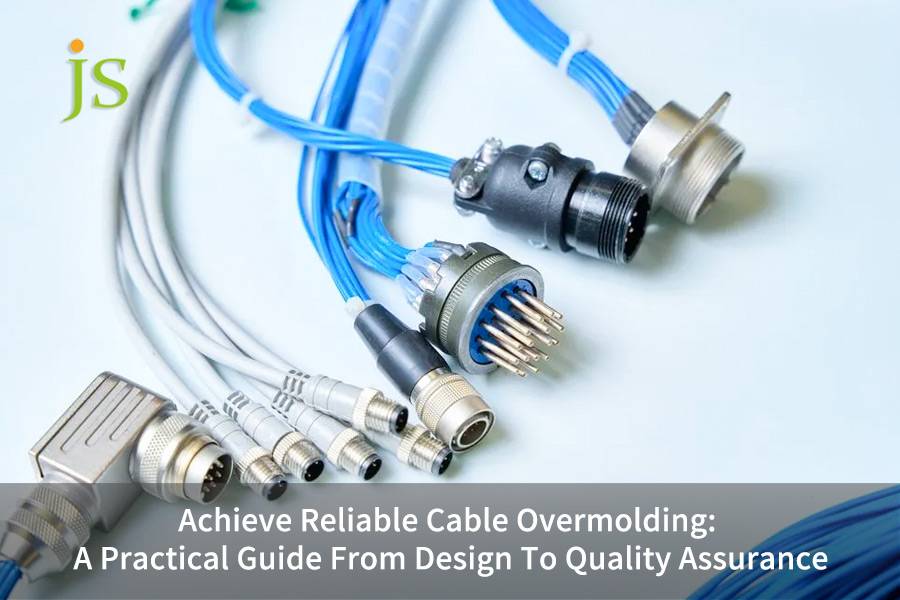

Cable overmolding is one of the fundamental mechanisms in making extremely dependable cable assemblies. Cable assemblies with overmolded portion are a necessity if one seeks to maintain the quality of signal and the durability of connection even in unfavorable conditions.
Nonetheless, under the circumstances when the design is unsatisfactory or process control is lacking, overmolded cables are not only incapable of giving the required protection but might in fact turn out to be the very first point of weakness in the system which will fail, resulting in equipment downtime and high maintenance costs.
Here is an article that will, with first hand engineering experience, depict the way of making absolutely reliable custom overmolded cable assemblies, starting from design right up to the final quality inspection.
Core Answer Table
| Main Modules | Key Points |
| Design | The main factors that determine cable overmolding reliability and the bending life reaching over 1 million cycles are a scientifically designed stress cone structure (with a 15°-30° gradient) and chemical bonding (TPU-TPU). |
| Process Control | In order to prevent internal voids, interface delamination, and core wire displacement, the cable overmolding process should be controlled strictly in terms of mold temperature (±2°C), injection pressure, and material humidity (<0.02%). |
| Quality Verification | To make sure custom overmolded cable assemblies can operate in harsh environments for a long time without breaking down, products are made in line with IPC/WHMA-A-620F Class 3 standards and physically subjected to IPX7 waterproof, X-ray non destructive, and push pull force testing. |
| Mass Production Assurance | Great quality of lead materials (e.g. S136), thorough 100% AOI inspection, and a batch traceability program are integral to the consistency of overmolded cable assemblies manufactured on a mass scale. |
Key Conclusions:
- Design Driven Reliability: The most reliable overmolded cable assemblies are those that come through scientifically designed stress structures and careful selection of material pairings.
- Process Determined Lifespan: During injection molding, the control of temperature, pressure, and ambient humidity directly influences the interfacial bond strength and the life of the product.
- Standards Measure Quality: Following IPC/WHMA-A-620F standards for inspection plays a vital role in making sure the operation of custom overmolded cable assemblies is sustainable even in the most extreme environments.
Why Trust This Guide? JS Precision’s Experience In Cable Overmolding
A good guide leads you to a trustworthy manufacturer who will ensure the success of overmolded cable assemblies projects. And JS Precision's alone practical experience is the main foundation for this guide.
For more than 15 years, we at JS Precision have been dedicated to cable overmolding, delivering personalized products and services to over 5000 clients worldwide, including those in the most challenging environments such as industrial robots, outdoor medical equipment, and automotive electronics.
We have done more than 100,000 projects related to overmolding, and 89% of our customers keep coming back.
A professional engineering team with 20+ highly experienced engineers is our group. All of them being Class 3 certificated IPC/WHMA-A-620F, they are the highest tier PCB professionals who can support you through consultation, production, and testing.
We strictly comply with the IPC/WHMA-A-620F standard. Our products are certified with the UL 1581 standard. This globally recognized standard is the main assurance for the quality of overmolded cables.
For example, an outdoor equipment manufacturer suffered five times of interface delamination failures within three months in a high temperature, high humidity environment because of the use of ordinary overmolded cables, each malfunction causing the company more than $5,000 of losses.
JS Precision came with a new cable overmolding met The cable overmolding process was optimized, and the resulting balance of the TPU-TPU chemical bonding led to a product life expectancy of more than three years. Thus, the downtime problem was completely eliminated in the end.
We are always oriented towards data and practice, and theoretical debates are automatically out of the question for us. Every piece of advice comes entirely from the experience of working on real projects, and every set of parameters is subject to double or triple checking.
Be it the small batch prototypes or the large scale mass production, we will be able to offer stable and efficient solutions that will help customers to lower costs and to minimize risks.
To learn more about JS Precision' successful cable overmolding case studies, contact our engineers for detailed information and a free copy of the "Overmolded Cable Assemblies Reliability Design White Paper."
Why Does Your Project Need Custom Overmolded Cable Assemblies Instead Of Standard Ones?
Many customers are still hesitating when they pick out cables and wonder why they cannot get custom overmolded cables instead of just standard, readily available ones.
The reason is quite simple: the shortcomings of standard components can never be suitable for quite severe operating conditions whereas the benefits of customization by overmolding are very accurately pointing to the very issues that are bothering users.
Limitations of Off the Shelf Cable Assemblies
The shortcomings of standard cables are quite obvious. A set of data clearly compares the difference between them and customized components:
| Performance Indicators | Standard Cable Assemblies | Custom Overmolded Cable Assemblies | Comparison | Applicable Scenarios |
| Bending Life | <50,000 cycles | ≥1,000,000 cycles | More than 20 times improvement | Standard components are only suitable for static environments |
| IP Protection Rating | Typically IP40 | Up to IP67/IPX9K | Significantly improved dust and water resistance | Standard components cannot be used in humid/dusty environments |
| Size Adaptability | Fixed size | Customizable compact shape | Saves 30%-50% of installation space | Standard components cannot fit compact equipment |
| Bond Strength | Mechanical connection, easy to detach | Chemical bonding, strong and stable | Bond strength increased by more than 5 times | Standard components are not suitable for vibration environments |
Engineering Value of Customization
The chief advantage of custom overmolded cable assemblies is "exact matching". The secret is to create a 15°-30° gradual stress dispersion cone to alleviate the bending stress, along with the chemical union of materials, the result is an impeccable seal that keeps moisture and dust at bay.
Be it in cases of bending at high frequencies in robots or the needs of outdoor medical equipment that must be waterproof and dustproof, custom made parts are able to address the failure issues of ordinary parts.
Also, they have the capability to combine the main conductors, enhance the layout of wires, and make the integration of the equipment more efficient.
Unsure if your project requires a customized solution? Submit your equipment operating condition requirements and receive a free one-on-one consultation from a JS Precision engineer to assess the suitability of custom overmolded cable assemblies.
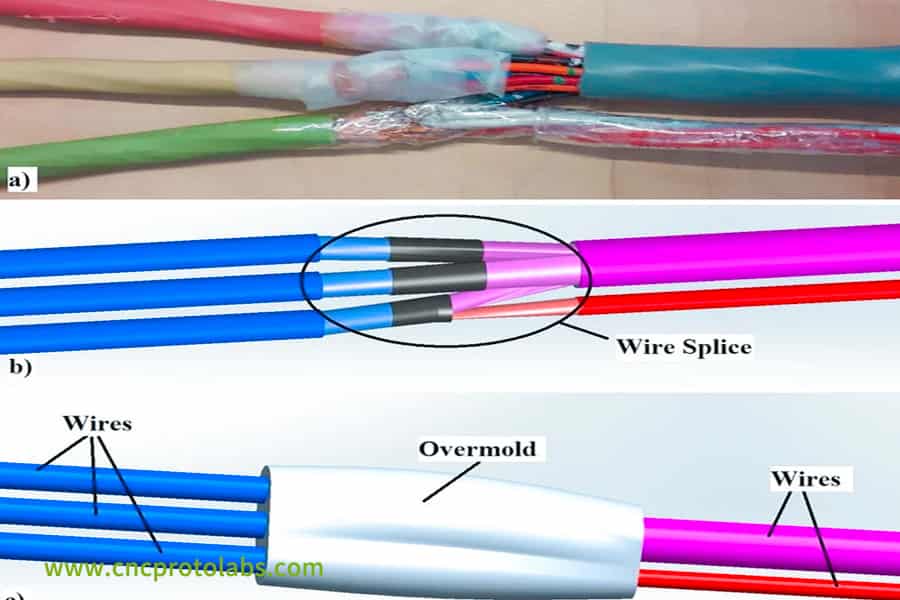
Figure 1: A composite image illustrating three key stages of the cable overmolding process, from the initial wire splice and preparation (a, b) to the final encapsulated and labeled overmolded section (c).
What Are The Root Causes Of Failure In Overmolded Cable Design?
There are many instances of customers reporting frequent overmolded cable failure while at the same time not finding the root cause. Actually, cable failures around cable connector junctions remain as the highest failure areas for most customers in the overmolded cable industry.
There are four main reasons for failure in that area with case examples shown below:
Stress Concentration:
The sudden change in stiffness associated with a rigid connector and flexible cable junction causes stress levels to be highly localized and increased resulting in fatigue failure as the major reason. Without proper stress relief, the cable will fail very quickly.
Material Incompatibility:
When the overmolding material and cable sheathing material are chemically incompatible (for example high density polyurethane overlaid with PVC) so that chemical bonding does not happens debonding loss of seal and short circuits will occur.
Core Wire Displacement:
When the core wire is forcibly moved (needle sweep) due to high speed stream of molten metal hitting the core wire during injection molding. Improper process control is the ultimate cause of this defect. It will cause short circuits or signal instabilities.
Lack of DFM Analysis:
A design made purely based on experience and without checking manufacturability leads to design to process mismatches. Such a situation makes failure inevitable.
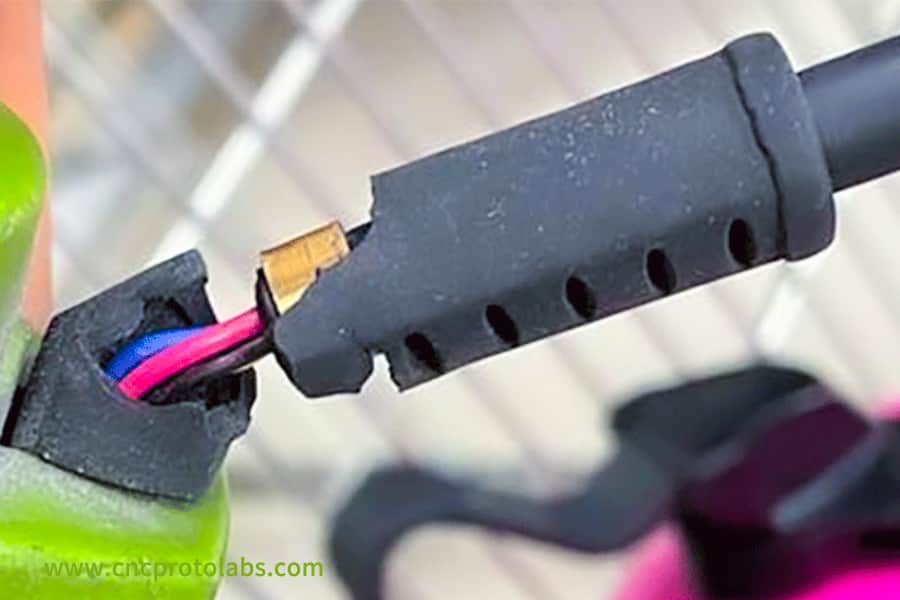
Figure 2: A close-up view of a black multi-wire cable being worked on in a workshop during the overmolding process, highlighting precision manufacturing details.
How To Select The Right Material System For Your Overmolding Cables Project?
Selecting the right material is a crucial part of ensuring the reliability of overmolding cables, that means that getting the right material only is like winning half of the battle.
Different materials have widely different performance characteristics, so documenting key parameters is useful for selection, besides, the "chemical bonding first" principle should be adhered to.
| Material Type | Hardness Range | Core Performance | Applicable Environment | Cost Range (USD/kg) | Service Life |
| PVC | 70A-85A | Low cost, easy to process, plasticizer migration is easy. | Consumer grade products, dry and normal temperature environment. | 2.5-4.0 | 1-2 years. |
| Polyether TPU | 80A-95A | Hydrolysis resistant, good toughness, strong adhesion. | Humid environment, outdoor equipment. | 8.5-12.0 | 3-5 years. |
| Polyester TPU | 80A-95A | Oil resistant, abrasion resistant, high mechanical strength. | Industrial environment, automotive electronics. | 9.0-12.5 | 3-5 years. |
| Santoprene (TPV) | 75A-90A | Strong weather resistance, good high and low temperature impact performance. | Outdoor equipment, -40°C to +135°C environment. | 10.0-14.0 | 5-8 years. |
Strain Relief Geometry: What Makes An Overmolded Cable Last Longer?
After material selection, stress relief structure design is a vital factor in determining the lifespan of overmolded cables. The core to improve bending life of the cable to more than 1 million cycles is a proper design of a stress cone and scientifically setting the sheath length.
Gradual Taper Principle vs. Stepped Geometry
Stepped geometry may cause stress concentration and the cable may break at the corners, whereas a 15°-30° smooth stress cone can distribute bending stress evenly, eliminating sharp changes and significantly improving bending life.
Area of "Allowable Bending Zone" Length Calculation
The sheath length must be determined in a scientific way. Normally, it should be 5-8 times the diameter of the wire. So, in the case of a 5mm cable, the length of the sheath should be 25-40mm in order to properly distribute the stress without wasting the material and increasing the volume unnecessarily.
Anti twist Features: Internal Grooves and Locking Mechanisms
To make a cable resistant to torsion such as in robot joints, the mold should have non circular grooves or bosses to prohibit the sheath layer from rotating with the cable which leads to core wire twisting and breakage.
How Does The Cable Overmolding Process Impact Mechanical Reliability?
Well designed products made with quality materials must strictly follow the processes. Injection molding parameters such as melt temperature, holding pressure, mold temperature, and even the humidity of the environment can affect the quality of the product. Any parameter that is not under control can cause the product to fail.
Critical Control of Melt and Mold Temperature
It is very important to control the temperature of the mold.
- If the temperature is too low, the materials will not stick well, and the bonding may fail.
- If the temperature is too high, the materials will degrade and become brittle. The control range is usually within ±2°C.
Pressure and Hold Pressure for Shrinkage Compensation
The pressure holding parameters affect the density of the product. Insufficient pressure can cause internal voids, while excessive pressure can easily cause core wire displacement. Multiple adjustments are needed to determine the appropriate parameters and compensate for cooling shrinkage.
Humidity: The Hidden Killer in the Environment
At high temperatures, when injecting moisture absorbing materials like TPU, moisture can produce bubbles that harm the seal. So, material humidity during drying should be controlled strictly to be < 0.02%.
Worried about your cable overmolding process parameters being unreasonable? You can submit existing process parameters, and JS Precision engineers will optimize and adjust them for you free of charge to improve product reliability.
What Are The Critical Checkpoints During The Overmolding Cables Production?
Quality control in mass production is vital for ensuring the consistency of overmolding cables. You cannot rely only on pre-production validation, you should also keep real time monitoring during production to eliminate batch failures.
Pre-Production Validation: Connector Survivability and Cable Pre-Treatment
It is necessary to test the connectors for survival at injection molding temperature and pressure before mass production.
On the other hand, cable standard pre-treatments should be defined to guarantee that the outer sheath is clean and to enhance the bonding performance.
In Process Monitoring: Mold Flow Analysis and Pressure Stability
At the time of production, filling pattern and mold flow analysis results have to be compared. Besides, real time tracking of the clamping force and injection pressure swings is a must. When deviations occur, the system should give immediate alerts, and the process should be recorded as per ISO 9001:2015 standards.
Need to establish a mass production quality control system for overmolding cables? Contact JS Precision to obtain standardized production checkpoint procedures to ensure mass production consistency.
How To Verify Quality In Custom Overmolded Cable Assemblies?
Quality verification is the final barrier. We assess the mechanical integrity and environmental sealing of the components in thorough ways through multi dimensional testing per IPC/WHMA-A-620F.
Following IPC/WHMA-A-620F Class 3 Criteria
We strictly follow IPC/WHMA-A-620F Class 3 standard specifying acceptance criteria forsappearance, adhesion and mechanical strength so that a product isapplied in a high end application.
Destructive & Non Destructive Testing (Pull Test, X-Ray/CT)
Adhesion is measured by pushing and pulling to determine theforce, whereas with X-Ray/CT the inside of high reliability products can beseen, solving their potential internal problems before hand.
Environmental Seal Validation (IP6X IPX7 IPX9K)
Seal tests are performed relative to the use case. IP6X isused for dust protection, IPX7 for waterproofing and IPX9K forhigh pressure steam cleaning and each one can be used for different stringent environmental requirements.
Case Study Of JS Precision: Reliability Of Robot Joint Cable Overmolding
It is a well established fact that the mixture of theory and practice not only makes the core points more understandable but also creates real life examples that are the best form of learning.
In this context, a very practical example from JS Precision has been presented here, which analytically breaks down how design and process optimisation can be instrumental in overcoming the reliability issues presented by overmolded cable assemblies.
Challenges Encountered
A medical robot company's equipment joints standard cables were the first elements that failed regularly, as they broke after just 50,000 high frequency bending cycles, which resulted in the equipment being non operational most of the time. Additionally, the connectors took up too much space and restricted movement.
It was only after several unsuccessful attempts with different standard cables that the company asked for our help.
Solution
At first, JS Precision engineers thoroughly examined the malfunctioned cables and pinpointed the main problems: the stress concentration caused fatigue fracture, the material incompatibility led to slight delamination, and the oversized cable prevented a proper fit.
In order to fix the problems, we came up with a tailor made solution as follows:
- Changed the cable overmolding mold by using 85A hardness polyether based TPU material to achieve TPU-TPU chemical bonding with the cable sheath, guaranteeing the sealing performance and bond strength.
- A smooth 30° stress cone was designed in order to effectively bending stress is dispersed, stress concentration is avoided, and core wire breakage is solved.
- Changed the mold shape to a very small structure that perfectly fits the very limited space of robot joints, solving volume interference issues.
- Changed cable overmolding machines parameters, rigorously controlling the mold temperature at 50±2°C and drying the material humidity <0. 02% resulted in no internal voids and product density improvement.
Final Results
After the optimization, the last deliverables of the custom overmolded cable assemblies were pretty extensive, here they are:
- Bending life compliance: It has been evidenced by a series of experiments that it can endure 2 million bending cycles, which is way beyond the customer's mere requirement of 1 million cycles, thus thoroughly addressing the problem of core wire breakage.
- Higher Protection Level: IP67 protection level, supporting medical cleaning and disinfection, and still ensuring the sealing is dependable in moist environments.
- Better Adaptability: The customized form is able to fit the limited spaces of robot joints, thus tackling the problem of interference caused by standard cables.
- More Customer Advantages: Downtime of the equipment dropped to 0%, which means over $400,000 are saved annually from downtime losses, on top of that, long term partnerships have been forged with customers.
Is your equipment also facing issues such as overmolded cable assemblies failing or poor adaptability? Submit your detailed equipment requirements to receive customized solutions and a free cost estimate.
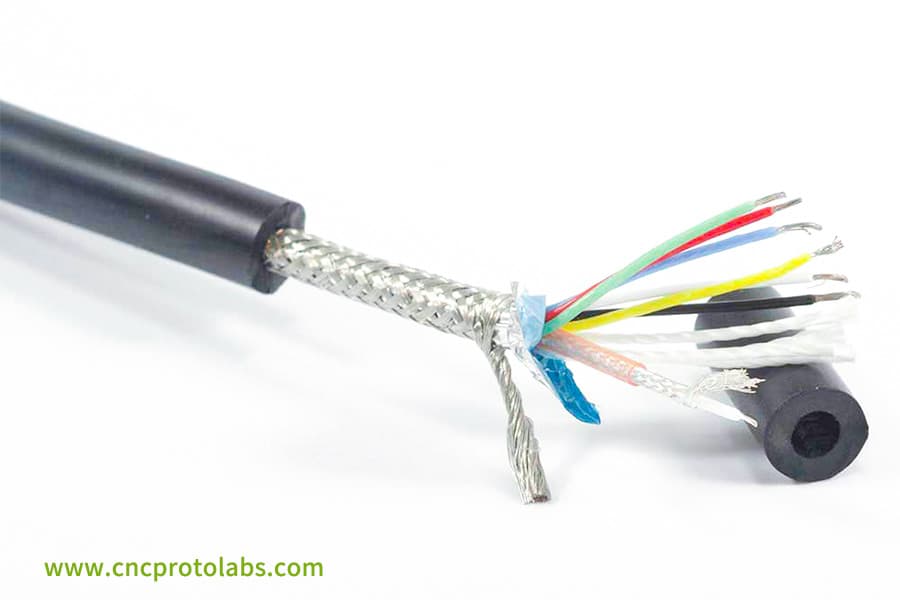
Figure 3: A close-up detail of a cable during overmolding, showing the transition where the outer jacket has been stripped back to reveal the braided shielding and multiple color-coded inner wires, with their ends prepared.
Is Your Supply Chain Ready For High Volume Overmolded Cable Production?
When it comes to high volume production, the stability and consistency of the supply chain are indispensable. We consider high quality molds, automated testing, and a stable supply chain as our main pillars.
Mold Steel Selection and Lifecycle Management
Our preference is for high polish, corrosion resistant mold steels such as S136. The mold life of this steel allows for over 500,000 cycles, which can effectively guarantee product consistency in high volume production and also prevent deviations resulting from mold wear.
Automated Optical Inspection (AOI) for 100% Quality Assurance
To meet the requirement of 100% inspection of product appearance, dimensions, and parting lines, we have implemented an automated visual inspection system. Besides subbing out manual work, it dramatically changes the pace of work, radically changes the way faults are made, and makes sure shipments are defect free.
Global Delivery with Local Technical Support (JS Precision Advantage)
JS Precision has robust manufacturing capabilities and a global supply chain in China that make it possible to have rapid worldwide delivery at the same time provide localized technical support, hence shortening communication and logistics cycles.
FAQs
Q1: What is cable overmolding?
Cable overmolding is the act of injection molding thermoplastic material over cables and connectors to make a protective layer that provides stress relief and environmental sealing while also enhancing the reliability of the cable.
Q2: What are the main advantages of overmolded cable assemblies?
The primary benefits are that the bending life exceeds one million cycles, providing protection IP67 and above, customizable compact shapes, strong adhesion, the ability to operate under harsh conditions, and the ability to address the shortcomings of standard parts.
Q3: How to prevent overmolded cable breakage during use?
The main thing is to come up with a smooth stress 15°-30° cone design so that the material can be chemically bonded, bending stress would be spread out, and the injection molding process be kept to the standard so that stress leading to breakage is avoided.
Q4: What is the most important principle when selecting overmolding materials?
The main guiding principle ought to ensure that the overmolding material is very suitable with the cable sheath material so that the priority remains providing a chemical bond instead of only depending on mechanical locking to get a strong bond.
Q5: What is the typical delivery time for custom overmolded cable assemblies?
Delivery times for custom overmolded cable assemblies are typically 2-3 weeks for JS Precision samples and 3-4 weeks for mass production orders depending on the quantity. If you want, delivery can be expedited with efficiency and quality as the priority.
Q6: What impact do mold temperature and humidity have on overmolding quality?
Mold temperature is a key factor in the bonding of materials, if the temperature is too low, the bond will be weak, while high humidity leads to the formation of bubbles. Both effects will substantially decrease the sealing and durability of the product.
Q7: Is cable overmolding suitable for small batch customization?
Overmolding cable is certainly a viable option. We provide the verification step with the help of 3D printed soft molds, which can lower the costs of small batch production. Then, by changing to mass production hard molds, we can cater to small batch requirements after design confirmation.
Q8: How does your company ensure consistency in mass production?
Among the ways we maintain consistency in mass production are the use of premium mold steel, e.g. S136 conducting 100% AOI inspections, implementing a batch traceability system, and enforcing strict control over process parameters.
Summary
Robust overmolded cable assemblies are far from being mere "injection molded". They are methodically developed step by step by a combination of scientific design, careful choice of materials, hard work, and testing under the standards.
Truly they are the "lifeline" of the equipment, the control of each link corresponds directly to the stable operation and longevity of the equipment.
If you want a custom overmolded cable assemblies solution for tough applications, or if you have concerns about risks your current design may have, get in touch with the JS Precision engineers for a professional manufacturability evaluation. Our professional team is here to protect your project.

Disclaimer
The contents of this page are for informational purposes only.JS Precision Services,there are no representations or warranties, express or implied, as to the accuracy, completeness or validity of the information. It should not be inferred that a third-party supplier or manufacturer will provide performance parameters, geometric tolerances, specific design characteristics, material quality and type or workmanship through the JS Precision Network. It's the buyer's responsibility Require parts quotation Identify specific requirements for these sections.Please contact us for more information.
JS Precision Team
JS Precision is an industry-leading company, focus on custom manufacturing solutions. We have over 20 years of experience with over 5,000 customers, and we focus on high precisionCNC machining,Sheet metal manufacturing,3D printing,Injection molding,Metal stamping,and other one-stop manufacturing services.
Our factory is equipped with over 100 state-of-the-art 5-axis machining centers, ISO 9001:2015 certified. We provide fast, efficient and high-quality manufacturing solutions to customers in more than 150 countries around the world. Whether it is small volume production or large-scale customization, we can meet your needs with the fastest delivery within 24 hours. Choose JS Precision this means selection efficiency, quality and professionalism.
To learn more, visit our website:www.cncprotolabs.com
Resource