English



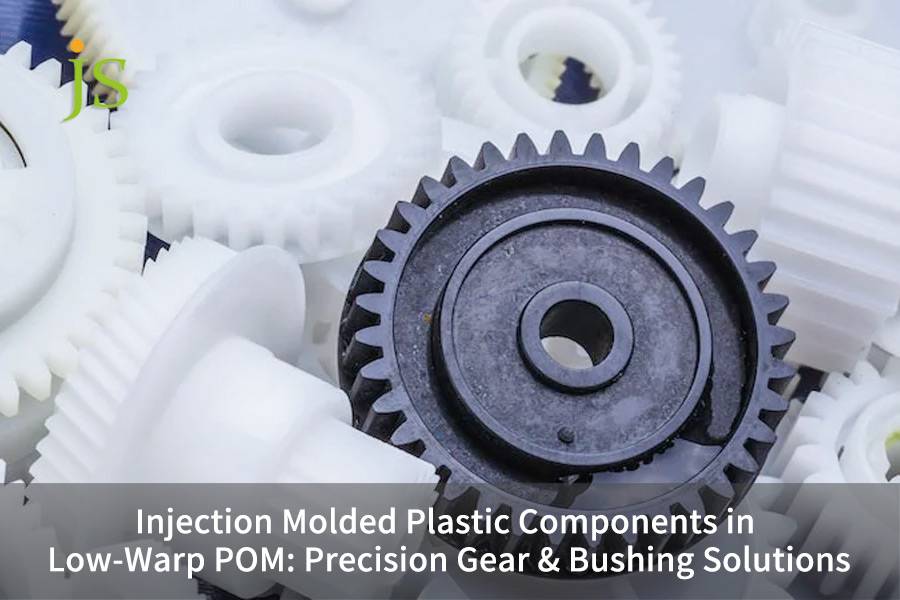

POM injection molding service produce precision gears and bushings through customized low warpage mold design, achieving a tolerance of ± 0.005 mm and a pitch runout of<0.015 mm. Standard POM injection processing results in deformation like warping and ovality, due to the 1.8%-2.5% crystallinity shrinkage.
Optimizing the hot runner and precise holding pressure curve can solve these structural deformation problems. Continue reading to master the low warpage POM processing strategy.
Overview of Low Warpage POM Injection Molding Service
|
Engineering Dimension |
Low-Warp POM Standard |
JS Precision Capability |
Procurement Value |
|---|---|---|---|
|
Shrinkage & Warpage Control |
Warpage < 0.03 mm |
RHCM variable mold temp (95°C – 110°C) |
Eliminates gear face runout & bushing ovality |
|
Gear Precision Grade |
AGMA 10 / DIN 7 |
WEDM-LS compensated tooth cavity mold |
Ensures low backlash & smooth transmission |
|
Packing & Crystallinity |
Multi-step gradual pack profile |
90–120 MPa step pack / switch point control |
Removes root sink marks, boosts fatigue life 40% |
|
Mold Lead Time & Quotation |
DFM feedback within 24 hrs |
In-house T1 mold shop, 15 days for precision mold T1 trial |
Shortens NPI cycle, reduces trial cost 20% |
Key Takeaways
- Elimination Anisotropy of Shrinkage: By maintaining the temperature of the POM injection mold between 95 and 110℃ a much more uniform crystallization of the material is achieved, thereby the gear face warpage is kept below 0.02 mm.
- Compensatory Cavity Design: Reverse shrinkage compensation technique used in cavity machining eliminates the dimensional deviation of involute gear profile produced by post-cooling shrinkage.
- End-to-end Quality Control: With the help of a decoupled molding technology and in-depth coordinate measuring machine inspection it is assured that the precision gear molding service conforms to AGMA Class 10 tolerance.
Why Trust JS Precision's POM Injection Molding Service?
Based on industry experience, low-warpage high-precision POM injection molding is not just a single-process problem, but a systems engineering effort that takes the coordination of material crystallization kinetics, mold thermal balance.
Our team dealt with a gear case where the first prototype had a flat surface deformation of 0.035 mm and a roundness radial deviation of 0.022 mm, making a trial production pass rate of only 42%. After about three months of refining the process (including Moldflow simulation, altering the runner temperature to 105℃ for a hot runner system, and employing WEDM-LS (slow-feeding wire-cut EDM) gear cavity reverse compensation, we were able to bring warpage down to just 0.012 mm, maintain runout at a stable 0.007 mm, and raise yield to 99.1%.
The ISO 9001:2015 regulations stipulate that the setting and monitoring of process parameters (e.g. Temperature pressure and cycle time) are of primary importance in assuring product quality.
JS Precision's way of ensuring full compliance with this requirement is by having three main control measures for every custom injection mold tooling service project: use of Statistical Process Control (SPC) to monitor the process parameters, keep of records of preventive mold maintenance, and a three-stage inspection process with Zeiss CMM (first article, in-process, and final). Every consignment of injection molded POM components has a Cpk capability report accompanying it.
Download the JS Precision Low-Warp POM Injection Molding Process White Paper to access variable mold temperature profile templates and gear cavity compensation calculation sheets, thereby accelerating your NPI (New Product Introduction) validation cycle.
Why Does POM Injection Molding Service Face Warpage Challenges in Precision Gear Manufacturing?
The core contradiction of POM injection molding service in processing highly crystalline polyoxymethylene comes from the anisotropy of crystal shrinkage.
Crystallization mechanism and shrinkage distribution
- Crystallinity and shrinkage: POM generally contains 70-85% crystallinity and at the same time, a cooling & crystallization process goes with 1.8-2.5% volumetric shrinkage. The shrinkage for homopolymers (POM-H) is 2.5-3.5% whereas, for copolymers (POM-C), it is 1.5-2.5%.
- Anisotropy of internal stress: The molecular chains line along the flow direction. In flow direction, the shrinkage is approximately 2.0-2.3%. While, in the transverse direction, it is 1.5-2.0%.
- Effect of thermal gradient: The difference in wall thickness between gear root and the tip produces a microscopic thermal gradient in the part. This leads to the warping of the part getting even.
The engineering deficiencies of traditional cooling
- Uneven crystallization (Surface vs. Core):
When the cooling is done by standard mold temperature of less than 80℃, the surface layer is the first one getting crystallized and solidized. Then, in the later stage of crystallization, because it is shrinked, the core is constrained by the surface layer, resulting in the deformation upon the release of internal stress.
- Dimensional change of part by post-crystal growth:
Post-crystallization of POM continues for the first 48 hours after demolding and parts that have not been fully crystallized will continuously undergo changes in dimension during their usage
- Physical approach of low-warpage Injection molding:
By using Moldflow flow analysis to predict the warpage distribution in advance, combined with RHCM variable mold temperature technology at 95℃-110℃ mold temperature, injection molded POM components can achieve uniform crystallization.
In short, apart from the choice of mold temperature being a question of only hot or cold, mold temperature is an imperative factor of whether or not POM molecular chains align adequately. It is quite common that parts, when the mold temperature is not sufficient, can continue to grow (i.e. Expand) on the customer's assembly line.
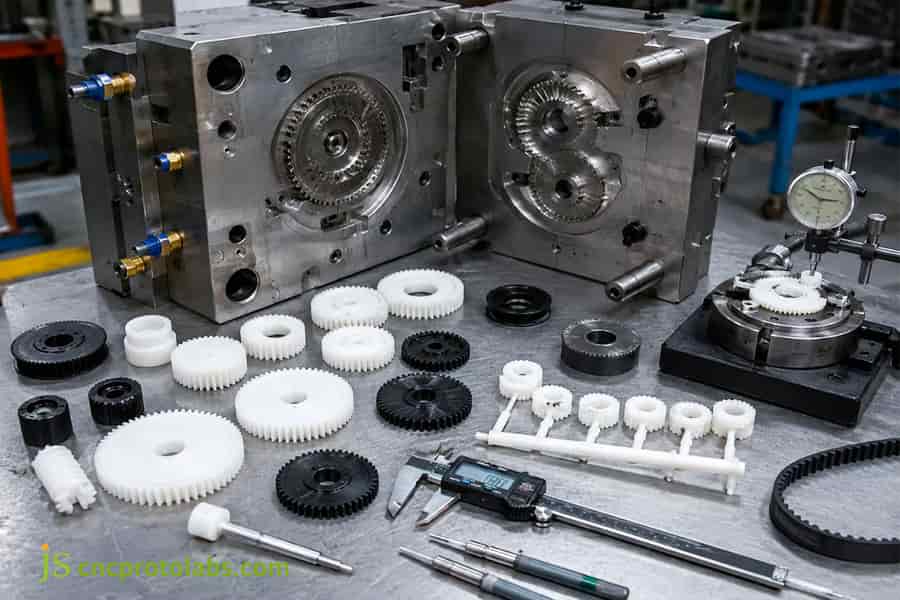
Figure 1: POM injection mold with precision gears and measuring tools.
How to Select and Modify Low-Warp POM Materials for Tight-Tolerance Gears and Bushings?
The dimensional stability of injection molded POM components depends 70% on material selection. In precision bushing molding, the material's isotropic shrinkage characteristics are more important than the absolute shrinkage rate.
Comparison of physical properties: POM-H vs. POM-C
|
Material Grade |
Tensile Strength |
Mold Shrinkage |
Friction Coefficient |
Typical Application |
|---|---|---|---|---|
|
POM-H (Delrin 500) |
70 MPa |
2.5%–3.5% |
0.18 |
High-strength gears, load-bearing structures |
|
POM-C (Duracon M90) |
60 MPa |
1.5%–2.5% |
0.20 |
Bushings, valves, complex thin walls |
|
10%–20% PTFE filled POM |
62 MPa |
1.2% (isotropic) |
0.12 |
High-roundness precision bushings |
|
Mineral-filled POM |
58 MPa |
1.2% (isotropic) |
0.19 |
Low-warp gears, dimensionally stable parts |
Filler orientation and modification mechanisms
- Short glass fiber reinforcement drawbacks:
Injection of short glass fibers causes the fibers' alignment along the flow direction, which enhances the difference in transverse and longitudinal shrinkage (e.g. By a range of 0.5%-0.8%). This can cause distortion of rings, the silent cause of out-of-roundness of precision bushing molding.
- Benefits by mineral filler introduction:
Adding 10%-20% PTFE or ultra-fine mineral fillers will enable isotropy and shrinkage reduction to about 1.2%, which is why these materials are ideal for the production of circular parts.
- Material matching for custom injection mold tooling service:
JS Precision provides low warpage POM raw material matching and testing certification based on usage scenarios, combined with custom injection mold tooling service to ensure the dimensional stability of the final injection molded POM components.
Contact JS Precision's materials engineers to obtain a customized POM modification solution and physical property test report for your parts.
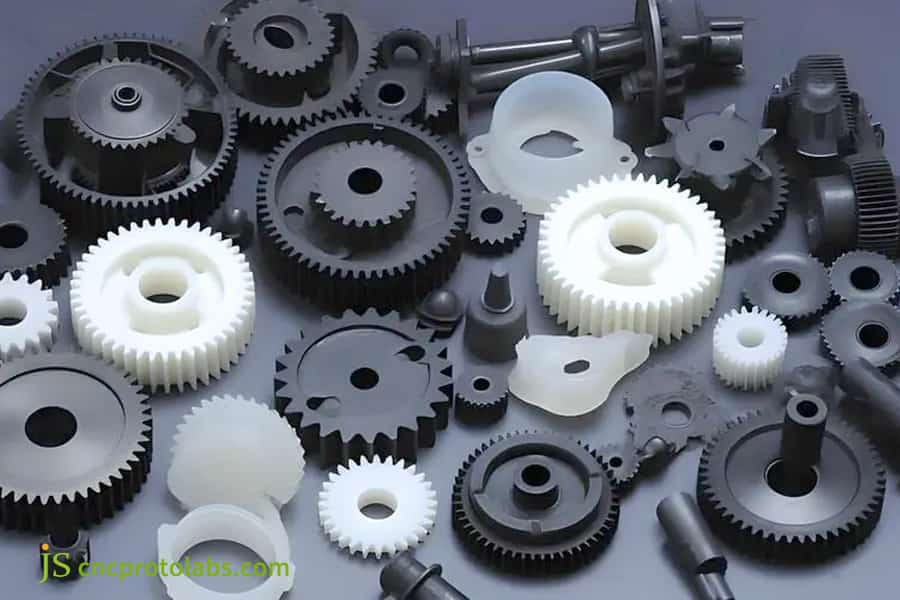
Figure 2: Various black and white POM gears on dark surface.
What Core Anti-Warping Rules Must Be Followed in POM Gear Mold Design?
In POM gear mold design, something important is to pre-sculpt the post-cooling intended shape of the part into the mold steel, since POM tends to shrink when cooled. By a specific compensation, the mold cavity of POM is to be oversized that of the final part.
Compensation design of gear cavities in non-uniform manner
- Reverse deformation compensation: Through shrinkage test data, a reverse deformation compensation value (typically 0.006 mm) is preset on the involute tooth profile (WEDM-LS (Low-Speed Wire-Cut EDM)) to correct post-cooling profile deviations.
- S136 cavity with hardened steel: Since S136 steel (HRC 52-54) is extremely hard and resistant to thermal effects, it is chosen for gear cavities to ensure tooth profile tolerances remain stable at AGMA Class 10 over a lifetime of 1 million cycles.
- Precision transfer of POM injection mold tooling: Mold precision is a major determinant of part precision, as an example, the mold tooth profile error is only 0.001 mm, the gear's pitch diameter runout is only 0.0015 mm for the finished product.
Temperature control channels and gating systems
|
Design Element |
Conventional Design |
Low-Warp Optimized Design |
Physical Effect |
|---|---|---|---|
|
Water circuit layout |
Single straight channel |
High-density cross/conformal cooling |
Cavity temperature difference ≤ ±1.5°C |
|
Gate type |
Single side gate |
Diaphragm gate / 3-point balanced submarine gate |
Symmetric melt filling, eliminates asymmetry |
|
Ejection method |
2–4 point ejection |
Multi-point synchronized ejection |
Prevents pull-out or deformation during demolding |
Solution evaluation and delivery
JS Precision performs detailed analysis of POM injection mold tooling and brings custom injection mold tooling service. Through our hands-on involvement of a 12 cavities gear mold in very small tolerances (precision) project, changing the type of gate from simple-side gate to 3-point balanced submarine gate lowered the discrepancy in filling time, from 18% down under 3%.
Upload your 3D CAD drawings to receive a dedicated mold DFM assessment report and a detailed quote from JS Precision within 24 hours.
How to Precisely Control Injection Molding Process Parameters to Eliminate POM Bushing Warpage?
The essence of low-warp injection molding comes down to the transformation of a normal traditional single-stage packing into a scientific three-stage Decoupled Molding control strategy.
Decoupled molding parameter setups:
- Filling stage (velocity control): the cavity should be filled with resin to 95%-98% at high speed to avoid over-packing near the gate area caused by pressure spikes at the flow front.
- Packing stage (Pack): when the cavity is 95%-99% full the machine will switch from velocity control to pressure control. A stepped pressure reduction will be applied starting from 110 MPa down to 60 MPa.
- Holding stage: the holding pressure is set usually 20-60% of the packing pressure. It is used to create even pressure distribution throughout the cavity and keep the gate frozen while the gate freezes to reduce shrinkage differences.
Holding pressure gradient formula:
Phold(t) = Pinitial − k × t, where Pinitial = 110 MPa, k ≈ 20 MPa/s
Decisive impact of mold temperature on crystallinity and ovality
|
Mold Temp Range |
Crystallinity |
Bushing Ovality |
Post-Crystallization Drift |
|---|---|---|---|
|
60°C–80°C |
60%–65% |
0.03–0.05 mm |
Significant (0.015 mm in 48h) |
|
80°C–95°C |
70%–75% |
0.015–0.025 mm |
Moderate |
|
95°C–110°C |
78%–85% |
< 0.01 mm |
Minimal (< 0.003 mm) |
ISO 1328-1:2013 defines gear accuracy so well that if gear meets its class 10 gear specification, a radial runout must be kept to an extremely narrow variation.
To get the maximum dimensional stability from POM full crystallization, the mold temperature must be heated up to the 95-110℃ range which is a requirement for ovality of precision-molded bushings to be held within 0.01 mm.
Production supervision and guarantee
The POM injection molding process offered by JS Precision relies on injection molding machines equipped with closed-loop injection system and temperature monitoring on the tool to make low-variation parts the whole time of production.
Contact our engineering team for parameter evaluation and a manufacturing quote to ensure your POM bushings meet specifications on the first attempt.
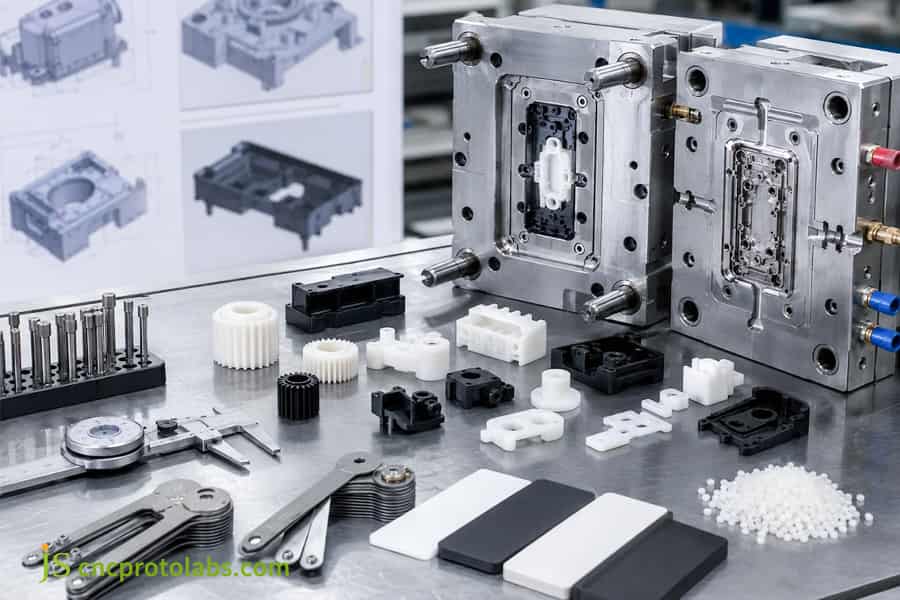
Figure 3: POM bushings and mold tools on metal table.
How to Achieve High Concentricity and Sink-Mark-Free Wall Control in Precision POM Bushings?
In precision bushing molding, the coaxiality of the inner diameter of the shaft sleeve directly determines the wear life of the transmission shaft. To achieve a coaxiality of ± 0.008 mm, full chain control is required from wall thickness design, core needle material to detection methods.
Wall Thickness Uniformity Control
- Wall thicknes ratio constraints: Keeping the wall thickness ratio between a bushing body and a rib/boss around 1:1 to 1.2:1 is the key to preventing internal voids and surface sink marks through such a thick-ratio variation of wall.
- Hollowing structure: Whenever ribs or bosses wall thickness is more than 60%, the hollowing design will be introduced which keeps wall thickness uniform sink marks disappear.
- The same origin logic of precision gear molding service: The thickness of the gear plate and the rim thickness should also follow a ratio of 1:1-1.2:1, otherwise the root shrinkage will directly reduce the fatigue life.
High-Thermal-Conductivity Core Pins and Coaxiality Control
- Beryllium copper core pins: Inner diameter core pins are made of beryllium copper whose thermal conductivity is thrice that of mold steel providing heat dissipation from the inner cavity at an enhanced rate.
- Prevention of uneven inner diameter shrinkage: Unequal shrinkage of inner diameter and deviation from coaxiality can be brought about from heat build-up in the core pin. The beryllium copper core pins will only allow the surface temperature variation be of ±1℃.
- Inspection of injection molded POM components: By using the Zeiss CMM (Coordinate Measuring Machine), the company JS Precision carries out an inspection of POM injection molded parts, thereby assuring that the coaxiality is being kept within a band of ±0.008 mm.
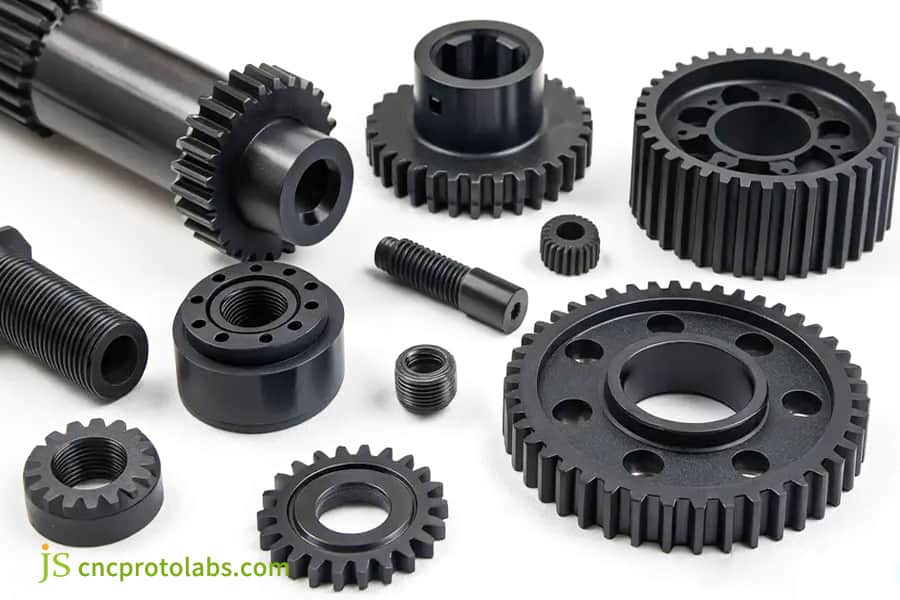
Figure 4: Precision POM bushings with high concentricity and smooth sink-mark-free walls.
How JS Precision Solved POM Gear Warpage and 0.01mm Pitch Runout for a Medical Pump Manufacturer?
JS Precision solved a customers 0.03 mm warpage and running pitch error problem by redesigning the 12-cavity POM precision gear molds cooling channels, adjusting shrinkage compensation for the involute tooth cavities, and increasing the injection mold temperature to 105℃.
Challenges Faced by the Client
A European medical device client asked to produce POM reduction gears ( Module 0.5) for infusion pumps. The first parts showed 0.035 mm warpage along the axis and pitch diameter runout of 0.022 mm ( requirement was less than 0.010 mm). This led to operational issues like vibration and flow pulsation and only 42 percent of trial production parts were good.
JS Precision Solution
- POM Gear Mold Design Improvement: Based on the Moldflow simulation, single-side gating was replaced with a three-point balanced submarine gate system to get rid of filling asymmetry.
- Cavity Compensation Machining: S136 hardened steel (HRC 52-54) teeth were machined byLow-speed wire-cut EDM (WEDM-LS) with a reverse deformation compensation of 0.006 mm built into them.
- Process Parameter Optimization: At 105℃ mold temperature and a holding pressure which steps from 90 MPa down ton 50 MPa a combination was put in place to remove shrinkage voids at the tooth roots.
Lessons Learned from Initial Failure
In the T1 mold test, the mold temperature was initially set at 85℃. After 48 hours, the deformation of the product increased by 0.015 mm due to the gradual internal stress release. Then the engineering team increased the mold temperature to 105℃ and lengthened the cooling time by 2.5 seconds. The problem of delayed stress release was resolved. This failure highlighted that at least 95℃ is one of the critical factors for the proper crystallization of POM.
Final Results (CMM Inspection Report)
End-face warpage was reduced to 0.012 mm, and pitch diameter runout stabilized at 0.007 mm, meeting AGMA Class 10 standards with a 99.1% yield rate.
Get the same precision gear molding solution—upload your gear drawings, and the JS Precision engineering team will provide a free DFM and Moldflow warpage analysis report.
How Do Low-Warp POM Molded Parts Compare to CNC Machined POM Parts in Cost and Precision?
In general, the point at which POM injection molding service become the most cost-effective compared to CNC machining is around the production of 1,000 units. When the production volume is lower than this number, CNC machining is more flexible. As the volume increases, unit cost of injection molding drastically decreases.
Cost Calculation Model
Total Cost = C_mold + (P_unit × N)
Where C_mold is the mold cost, P_unit is the unit price for injection molding, and N is the production quantity.
Mass Production Cost-Efficiency Comparison
|
Evaluation Dimension |
CNC Machined POM |
Injection Molded POM (custom injection mold tooling service) |
|---|---|---|
|
Per-part tolerance |
±0.005 mm |
±0.01 mm (optimized) |
|
Residual stress |
Cutting-induced residual stress |
No secondary cutting stress |
|
Unit cost @ N=500 |
$8.50 |
$6.20 (including mold amortization) |
|
Unit cost @ N=1,000 |
$8.50 |
$3.10 (36% of CNC) |
|
Unit cost @ N=10,000 |
$8.50 |
$1.30 (15% of CNC) |
|
Cycle time per part |
25–40 min |
45–70 sec (incl. cooling) |
When quantities exceed 1,000 units, the unit cost for injection molding drops to 15%-20% of the CNC machining cost.
Selection Decision Matrix
- Prototype Validation (< 500 units): If you choose CNC machining, you may save costs by not purchasing a mold and speed up design iteration through quick and easy production.
- Small-batch production (500-1,000 units): Comprehensive analysis. If the part is simple and the tolerance is < 0.01 mm, directly switch to injection molding. If the gear profile is complex or the parts are extremely precise (≤±0.005 mm), then the idea is for CNC machining to make prototypes before switching to injection molding after.
- Bulk production stage (> 1,000 units): POM injection molding service is compulsory, the cost saving per unit is many times more than with CNC machining.
Why Partner with JS Precision for Low-Warp POM Precision Injection Molding Services?
The reliability of a POM injection molding service depends on the supplier's ability to create a closed-loop system across four dimensions: materials, molds, processes, and inspection. JS Precision utilizes an ISO 9001:2015 certified quality management system to ensure that every parameter within these four dimensions is traceable, reproducible, and auditable.
Engineering and Technical Capabilities
- Material and Crystallization Control: Proficient in selecting POM-H/POM-C material, mineral-filled modification, as well as in controlling variable mold temperature at 95-110℃ (RHCM).
- Core Mold Technology: Involute gear profile reverse compensation, WEDM-LS (low-speed wire-cut EDM) machining, and conformal cooling channel design.
- Precision Gear Molding Process Closed-Loop: Decoupled injection molding + CMM full inspection + Cpk process capability analysis.
Production and Inspection Equipment List
|
Equipment Type |
Model/Specification |
Core Purpose |
|---|---|---|
|
WEDM-LS Slow Wire |
Accuracy ±0.002 mm |
S136 cavity tooth profile reverse compensation machining |
|
Injection Molding Machine |
Nissei series |
Decoupled Molding execution |
|
CMM |
Zeiss CMM |
Gear pitch runout, bushing concentricity full inspection |
|
Mold Temperature Controller |
RHCM variable temp unit |
Precise 95°C–110°C mold temperature control |
Lead Time and Quality System
- Responsiveness: In case of a custom injection mold tooling service, design for manufacturability feedback and detail quotations will be given within 24 hours. The lead time for precision molds manufacturing is 15-25 days.
- QualityCertification: The factory is ISO 9001:2015 certified, each batch of injection molded POM components comes with a Cpk process capability analysis report and CMM inspection data.
- Precision at microns-level for POM injection mold tooling: Control of precision is ensured along the entire process, from mold steel to the finished part.
FAQs
Q1: What makes POM injection molding service different from processing standard thermoplastics?
An extremely crystalline polymer with high degree of crystallinity, POM's volumetric shrinkage is at 1.8%-2.5%. It is different from amorphous plastics as molding temperatures are 95-110, and a multi-stage holding pressure is required to avoid sinking marks and warping.
Q2: How does JS Precision eliminate warpage in precision gear molding service?
Moldflow analysis, multi-point balanced mold feeding, and reverse cavity compensation for gear molds. In combination with decoupling, temperature setting up of a molder at 105℃ results in stable AGMA Class 10 gear pitch variation of 0.010 mm.
Q3: What is the typical lead time and cost structure for custom injection mold tooling service?
The mold fabrication time ranges from 15-25 days with cavity count and complexity as influencing factors. Expenses are mainly a reflection of steel grade (e.g. S136) and precision level requirements. DFM results are issued 24 hours upon submission.
Q4: Why is mineral-filled POM preferred over glass-filled POM for low-warp injection molding?
Oriented along the path of flow, glass fibers result in shrinkage which is directional and this causes warping in circular parts. Mineral-filled POM exhibits the uniformity of shrinkage and is recommended for parts like bushings and gears that are of roundness of the highest quality.
Q5: What tolerances can be achieved for precision bushing molding using low-warp POM?
After optimizing the hot runner and high thermal conductivity core needle, the inner and outer diameters are within ±0.008 mm, and the coaxiality is within 0.010 mm. Uniform wall thickness and precise pressure switching are key.
Q6: How does mold temperature directly affect the fatigue life of injection-molded POM components?
Crystallinity of the POM is affected directly by the mold temperature. The crystallization will stay incomplete and internal stress as residual will be trapped if the POM is cooled down below 80 . Whereas the cold runners or temperatures between 95 to 110℃ will lead the crystallization to its full extent, which results in over 40% increase in fatigue life.
Q7: Can JS Precision modify POM gear mold design to fix existing gear noise issues?
Definitely, by performing a tooth profile deformation and warpage analysis on the CAD files and gear samples we can develop a mold compensation and cooling channels design that can completely get rid of gear meshing noises.
Q8: How can I request an instant RFQ for POM injection mold tooling and production?
Kindly upload your 3D CAD files in a format of (STEP/IGES) and a detailed information like your required tolerance levels and annual production volume. Upon completion of DFM analysis by the JS Precision engineering team a quote can be issued promptly within 24 hours.
Summary
Manufacturing low-warpage POM gears and bushings requires a deep integration of material selection, mold design, and decoupled injection molding processes. By utilizing mold temperature control (95℃-110℃), reverse compensation for gear cavities, and isotropic materials, we ensure that the pitch circle runout of the injection-molded POM components remains within 0.010 mm while eliminating axial warpage.
Do you want to eliminate warpage defects in POM parts and enhance the performance of your mechanical transmission components? Submit your 3D CAD drawings and technical specifications to JS Precision today. Our engineering team will provide a free DFM (Design for Manufacturability) analysis, a Moldflow shrinkage assessment, and a detailed production quotation within 24 hours. Choose JS Precision's custom injection mold tooling service to efficiently meet your precision injection molding production needs!

Disclaimer
The contents of this page are for informational purposes only. For JS Precision Services, there are no representations or warranties, express or implied, as to the accuracy, completeness, or validity of the information. It is the buyer's responsibility to identify specific technical requirements and request a formal parts quotation. Please contact us for more information.
JS Precision Team
Custom manufacturing solutions. With over 15 years of experience serving more than 1,000 customers, we specialize in high-precision CNC machining, sheet metal fabrication, 3D printing, injection molding, and metal stamping. Having successfully delivered over 300,000 precision parts, we maintain a 99.2% on-time delivery rate across all custom projects.
Our facility is equipped with over 100 state-of-the-art 5-axis machining centers and is ISO 9001:2015 certified. We deliver fast, efficient, and high-quality manufacturing solutions to B2B clients across 150 countries. Whether you require low-volume prototyping or large-scale customization, we support your project with lead times as short as 24 hours. Choose JS Precision for unparalleled efficiency, quality, and professionalism.
To learn more or submit your RFQ, visit our website: www.cncprotolabs.com
Resource